Deborah Philips Art
to
1
Overall Width
to
Overall Height
to
1
1
1
1
9,962
2,753
1,376
1,373
1
Artist: Deborah Philips
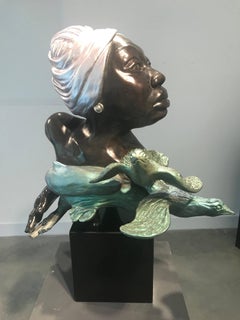
Nina Simone-Feeling Good -Bronze 26"
By Deborah Philips
Located in West Palm Beach, FL
Nina Simone- Feeling Good Bronze
If you are a fan of Nina Simone, you know how beautifully the piece is executed.
"Feeling Good" - Birds flying high, Fish...
Category
2010s Realist Deborah Philips Art
Materials
Bronze
Related Items
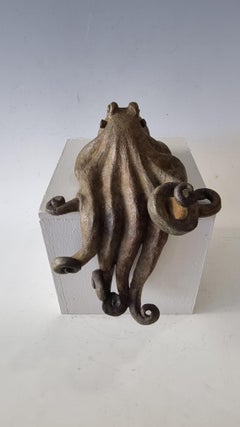
0ctopus Bronze by Sophie Martin 3/8
By Sophie Martin
Located in Pasadena, CA
Animal sculptor Sophie MARTIN creates from inert clay a whole living animal kingdom.
She freely observes the animal and captures and interprets a movement; and places it in nature an...
Category
21st Century and Contemporary Realist Deborah Philips Art
Materials
Bronze

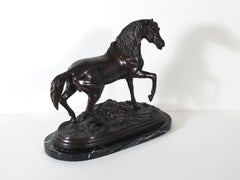
Cheval Libre (Free Horse)
By Pierre Jules Mêne
Located in San Francisco, CA
Artist: After Pierre Jules Mene (French, 1810-1879)
Title: Cheval Libre (Free Horse)
Year: 1868
Medium: Cast bronze sculpture with dark brown patina
Edition: Unknown
Size: Inclu...
Category
Mid-19th Century Realist Deborah Philips Art
Materials
Bronze
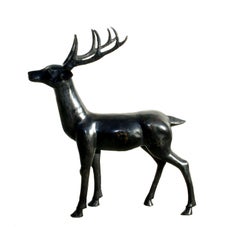
Deer, Large Patinated Bronze Sculpture
Located in Long Island City, NY
This bronze sculpture of a deer is a realistic rendering of the majestic animal. Deer have been the center of literature and art for many cultures across the world. They have also ...
Category
20th Century Realist Deborah Philips Art
Materials
Bronze
Antique Horse Bronze Trotting Stallion Isidore Jules Bonheur (France, 1827-1901)
By Isidore Jules Bonheur
Located in SANTA FE, NM
Antique Horse Bronze
Portrait of a Trotting Stallion
Isidore Jules Bonheur (France, 1827-1901)
Cast bronze mounted on a rectangular plinth with dark brown patina,
Signed: I. BONHEUR
17 x 11 3/4
A brilliant exploration of a stallion in full trot. The patina is a deep, warm walnut brown with honey-colored tones.
Isidore Bonheur was best known and the most distinguished of the 19th century French animalier sculptors. Isidore, the younger brother of Rosa Bonheur and older brother of Auguste, began his studies of painting initially with his father, who was friends with Francisco Goya. By 1848 he debuted at the Paris Salon having discontinued animal and landscape painting to concentrate on creating sculptures and in 1849, Bonheur enrolled at the Ecole des Beaux Arts. He won medals at the Paris Salon in 1859 and did so again in 1865 and in 1869. After entering the Exposition Universelle 1855, he won the Gold Medal in 1889. In the 1870s exhibited in the London at the Royal Academy of Arts where he earned great prestige and won the coveted Medaille d’Or. After winning numerous other medals and prizes, Bonheur was awarded the Legion d' Honneur in 1895 and he was Knighted in Portugal, Spain and France. Bonheur continued exhibiting at the Paris Salon until 1899.
Many of his bronzes were fabricated at the foundry owned by Hippolyte Peyrol, Bonheur's brother-in-law by marriage to Isidore’s youngest sister Juliette Bonheur. The Peyrol casts for both Rosa and Isidore are exceptionally well executed which suggests a strong working relationship between the founder and sculptor. There is little doubt that Isidore Bonheur was an acute observer of nature; his animals were not anthropomorphized but modelled to catch movement or posture characteristics of the particular species he was sculpting. He achieved this most successfully with his sculptures of horses which are usually depicted as relaxed rather than spirited. These figures are among his most renowned works and his equestrian models became very popular, particularly among the British aristocracy.
An acute observer of nature, his sculptures reflect his commitment to the Realist school - with precise detailing of the movements of animals in their natural habitats. Ultimately, His naturalistic studies of animals are now some of the most highly sought after works by any of the animalier. He was possibly inspired by his many visits to the Buffalo Bill Wild West Show...
Category
1870s Realist Deborah Philips Art
Materials
Bronze
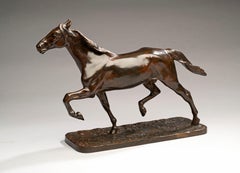
$11,000
H 11.75 in W 17 in D 5 in
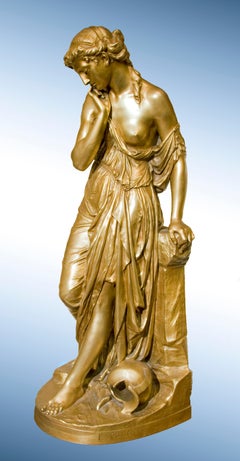
La cruche cassée
Located in Mc Lean, VA
Nice, 19th-century gilt bronze cast by Emile Francois Carlier
Exhibited:
Salon, Société des Artistes Français, Paris, 1865 (another cast)
Salon, Société des Artistes Français, Pari...
Category
Late 19th Century Realist Deborah Philips Art
Materials
Bronze
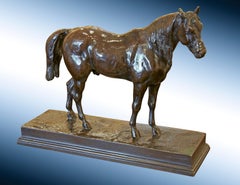
Le cheval demi-sang arabe
By Antoine-Louis Barye
Located in Mc Lean, VA
A nineteenth-century cast of Antoine-Louis Barye's Le cheval demi-sang arabe (no. A125-Poletti; A148-Pivar), with nice patina.
Poletti and Richarme, Barye: ...
Category
Late 19th Century Realist Deborah Philips Art
Materials
Bronze
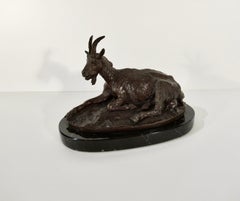
Chevre Allongee (Reclining Goat)
Located in San Francisco, CA
This artwork "Chevre Allongee (Reclining Goat)" c. 1860, is bronze sculpture after renown French artist Antoine Louis Barye, 1796-1875. Signature is impressed in the bronze. The subject size is 4.25 x 7 x 3.35 inches, including marble base is 5.25 x 4 x 7.75 inches. It is in excellent condition.
About the artist:
Antoine-Louis Barye lived his entire life in Paris and may never have left France. He was born in 1795 (a date revised in the 1990s from 1796 as a result of Martin Sonnabend's recalculation of the Revolutionary calendar). He is reported to have had minimal formal schooling even in reading, and to have acquired his extensive liberal-arts education on his own. His initial professional training was in metalwork: first with his father, a goldsmith from Lyons, then with a metal engraver in military equipment, and finally with Martin-Guillaume Biennais (active 1800-1832), then master goldsmith to Napoleon. After serving in the army from 1812 to 1814, Barye trained in the fine arts with sculptor François-Joseph Bosio (1768-1845) and painter Baron Gros (1771-1835). He then studied at the Ecole des Beaux-Arts from 1818 to 1823. His miniature medallion, Milo of Crotona Devoured by a Lion, won an honorable mention in metal engraving in 1819, but he failed to win the Prix de Rome. He worked as a craftsman for the goldsmith Jacques-Henri Fauconnier (1779-1839) from 1823 to 1831 and made his Salon debut in 1827 with a selection of busts.
Barye made his critical and public mark as a sculptor four years later, in the Salon of 1831, with groups representing predatory violence in the wild. His first government commission came soon after, precisely for such a subject. The Minister of the Interior purchased Barye's monumental plaster Lion (since called Lion Crushing a Serpent), shown in 1833, and had it cast in bronze by Honoré Gonon and shown in 1836, before placing it in the public Tuileries Gardens (now Musée du Louvre, Paris). In 1834 Barye was chosen for a project that was never executed, the colossal eagle as the crowning element of the triumphal arch at the Etoile. Around 1836 the government commissioned him to execute the emblematic animal decoration on the July Column at the place de la Bastille, inaugurated in 1840. He produced a monumental effigy of Saint Clotilde for the Church of the Madeleine, Paris, in the early 1840s. In 1846 the government commissioned a pendant Seated Lion for the Tuileries Lion Crushing a Serpent (1847, bronze, Portal, Pavillon de Flore, Palais du Louvre, Paris). During these same years the royal family began buying and commissioning small-scale works from Barye for their private collections. Around 1834, the duc d'Orléans commissioned a highly publicized surtout de table representing hunts of different regions and historical periods, possibly one of several tabletop projects that he ordered from Barye. The duc's sister Marie d'Orléans allegedly commissioned a lost-wax bronze of Barye's Charles VI Surprised in the Forest of Le Mans (location unknown; later serial variants), a model first shown in the Salon of 1833; his brother, the duc de Montpensier, apparently commissioned a pair of figurative...
Category
Mid-19th Century Realist Deborah Philips Art
Materials
Bronze
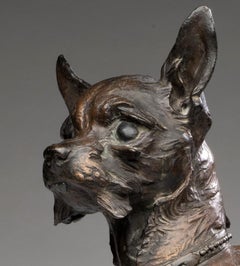
Rare, Antique, Life-Size Dog Bronze of a Chihuahua "Lydie" Charles Valton. 1890s
By Charles Valton
Located in SANTA FE, NM
Antique Bronze Dog Sculpture
Chihuahua "La Petite Belle Lydie"
Charles Valton (French, 1851-1918)
Circa 15 1/2 x 10 1/4 x 7
Lydie is a Chihuahua making her a very rare image from ...
Category
Late 19th Century Realist Deborah Philips Art
Materials
Bronze
$10,800 Sale Price
20% Off
H 15.5 in W 10.25 in D 7 in
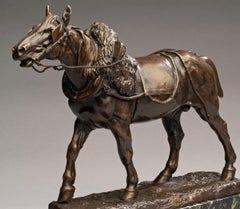
Antique Bronze Portrait Draft Horse by Isidore Jules Bonheur (France, 1827-1901)
By Isidore Jules Bonheur
Located in SANTA FE, NM
Antique Bronze Portrait of a Draft Horse
Isidore Jules Bonheur (France, 1827-1901)
Circa 1840s
Cast bronze mounted on a rectangular plinth atop a marble s...
Category
1870s Realist Deborah Philips Art
Materials
Bronze
$12,500
H 11.75 in W 17 in D 5 in
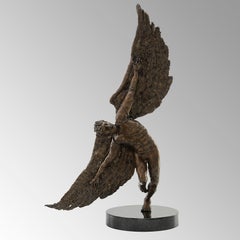
Sculpture, "Icarus Ascending"
Located in San Diego, CA
This is a limited edition figurative realistic sculpture by San Diego artist, Peter Dingli. It is made of bronze. Its dimensions are 21" x 35" x 15". A certificate of authenticity wi...
Category
2010s Realist Deborah Philips Art
Materials
Metal, Bronze
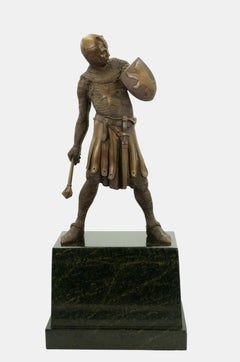
Crusader with shield and mace / - Ready to strike -
Located in Berlin, DE
Josef Moest (1873 Cologne - 1914 Rath), Crusader with shield and mace, around 1910. Bronze on a black marble pedestal (19 cm high). 57.5 cm (total height) x 21 cm (width) x 12 cm (de...
Category
1910s Realist Deborah Philips Art
Materials
Bronze
$5,515 Sale Price
20% Off
H 22.64 in W 8.27 in D 4.73 in
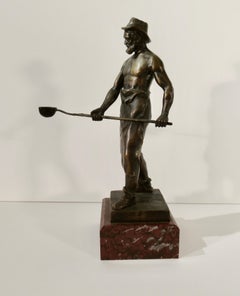
The Foundry Worker
Located in San Francisco, CA
This sculpture "The Foundry Worker" c.1925 is a bronze sculpture by German artist Albert Caasmann, 1886-1968. The signature is impressed in the bronze. The subject size is 11.15 x 8.15 x 3.15 inches, including marble base, the size is 13.15 x 8.15 x 5 inches. It is in excellent condition.
about the artist:
Albert Caasmann (2 June 1886 – 23 March 1968) was a German sculptor and porcelain artist. Caasmann designed toy figures for the Berlin toy company Lineol and from 1919 to 1952 was the lead designer and production manager for the company. He designed figurines for the porcelain companies Rosenthal AG and Volkstedt. Caasmann's work for the company Rosenthal are exhibited in the Porzellanikon's Rosenthal Museum. Lineol toy figures modeled by Caasmann are in the Historical Toy Museum in Freinsheim and the Toy museum in Havelland.
Albert Caasmann was born on 2 June 1886 in Berlin, Germany. From 1909 to 1919, he worked as a freelancer for the Berlin toy company Lineol, founded by Oskar Wiederholz in 1906. After service as a soldier in the First World War, he became the leading designer and production manager of Lineol from 1919 to 1952. He designed over 600 figures for Lineol, including soldiers, animals, Indians, knights, fairy figures, and railroad figures. His toy figures were widely used in the region by children. Lineol ceased operations in 1965, and in 1985 the company Lineol Duscha has the trademark rights to Lineol. Lineol Duscha reproduces Lineol figures modeled before 1945. Lineol toy figures modeled by Caasmann are in the Historical Toy Museum in Freinsheim and the Toy museum in Havelland.
Caasmann spent time in the Berlin Zoo, where he modeled his animal models. He made a model for a porcelain cheetah...
Category
Early 20th Century Realist Deborah Philips Art
Materials
Bronze
Deborah Philips art for sale on 1stDibs.
Find a wide variety of authentic Deborah Philips art available for sale on 1stDibs. You can also browse by medium to find art by Deborah Philips in bronze, metal and more. Not every interior allows for large Deborah Philips art, so small editions measuring 22 inches across are available. Customers who are interested in this artist might also find the work of Peter Brooke, Christopher Slatoff, and Bela Bacsi. Deborah Philips art prices can differ depending upon medium, time period and other attributes. On 1stDibs, the price for these items starts at $11,000 and tops out at $11,000, while the average work can sell for $11,000.