Denial Figurative Sculptures
Canadian, b. 1976
Denial, also known as Daniel Bombardier, is a Canadian street artist known for his bold and satirical works that comment on consumer culture and the human condition. He was born on May 27, 1976, in Windsor, Ontario, Canada.
Denial's artistic practice is characterized by his use of iconic imagery and text, often re-appropriated in unexpected and humorous ways. His works feature recognizable brands and logos, altered to convey messages of social and political commentary.
Denial's works have been exhibited in galleries and museums around the world, including the Museum of Contemporary Art in Detroit and the Celaya Brothers Gallery in Mexico City. He has also created large-scale murals and public installations in cities across North America.
In addition to his work as a street artist, Denial is also an accomplished graphic designer and illustrator, creating album covers, posters, and merchandise for a variety of clients.
Denial's works continue to challenge and provoke audiences with their clever and irreverent approach to contemporary art and culture. He remains an influential figure in the street art movement, inspiring a new generation of artists to use their creativity to make a difference in the world.to
1
1
Overall Width
to
Overall Height
to
1
1
1
1
8
125
111
100
88
1
Artist: Denial
DENIAL 100% Fuck You Can Sculpture Edition 100 Urban Street Contemporary Art COA
By Denial
Located in Draper, UT
DENIAL is a Canadian artist whose work critiques consumerism and the human condition. Though based in Windsor Ontario,
DENIAL spends much of the year travelling and exhibiting thro...
Category
2010s Street Art Denial Figurative Sculptures
Materials
Metal


$1,400 Sale Price
20% Off
Related Items
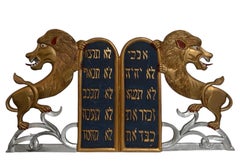
Rare Folk Art Hebrew Judaica Carved Gilded Wood Lions Torah Synagogue Sculpture
Located in Surfside, FL
Paint and gold paint on wood
Circa early to mid 20th century.
This is not signed
A treasure from a proud congregation. It is a hand-carved wooden sculpture showing the Tablets of the Law flanked by two Lions of Judah. Their paws held the tablets. Their roaring mouths faced outward, protecting the commandments from threats. In a foliage design with gold and silver paint.
Circa 1920-1940's. This Neoclassical, Judaic, Art Deco, Egyptian revival, Shul, Aron Kodesh hand carving, wood with gilding, Hebrew lettering ten commandments sign sculpture, was produced probably in New York.
There was a show at the Folk Art Museum titled “Gilded Lions and Jeweled Horses: The Synagogue to the Carousel” That featured these antique magnificent pieces. From gilded lions to high-stepping horses, the sacred to the secular, and the Old World to the New, “Gilded Lions and Jeweled Horses: The Synagogue to the Carousel” traces the journey of Jewish woodcarvers and other artisans from Eastern and Central Europe to America and the unsung role they played in establishing a distinct Jewish culture in communities throughout the United States. The exuberant artworks stand as a testament to a history of survival and transformation and provide a surprising revelation of the link that was forged between the synagogue and the carousel as immigrant Jewish artists transferred symbolic visual elements into this vernacular American idiom. The first major study of this important aspect of the Jewish contribution to American folk art, the exhibition features approximately one hundred artworks and objects, including rare documentary photographs of Eastern European synagogue arks and carved gravestones, sacred carvings, papercuts, and carousel animals. Some of these same Jewish European carvers worked on Coney Island amusement park rides and carousel horses and other carnival and circus carvings.
Category
Early 20th Century Folk Art Denial Figurative Sculptures
Materials
Metal
$3,600
H 20.25 in W 38 in D 1 in
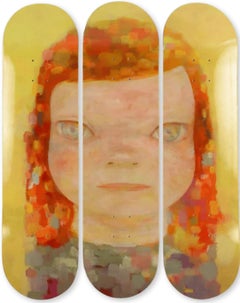
Light Haze Day - Japanese, Contemporary, Gold, Pop Art
By Yoshitomo Nara
Located in London, GB
3 x skateboard decks
Each deck measure approx. 31x8in (80x20cm)
Made of 7-ply Grade A Canadian Maple wood
3 x Sk8ology Invisible Floating Skateboard Deck Snap Display wall mount incl...
Category
2010s Pop Art Denial Figurative Sculptures
Materials
Wood, Screen
$2,028 Sale Price
35% Off
H 31.5 in W 23.63 in
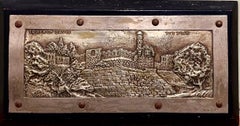
Vintage Jerusalem Sculpture Wall Plaque 1930
s Palestine Israeli Bezalel School
Located in Surfside, FL
Repousse sculptural plaque from the original Bezalel Art School in Jerusalem.
This is marked "Made in Palestine" as it is from the British Mandate period. It is in an Orientalist des...
Category
20th Century Modern Denial Figurative Sculptures
Materials
Metal
$1,250
H 6 in W 11.5 in D 1 in
Limited Edition Historic 1st Companion Ever, uniquely Hand Signed and Dated KAWS
By KAWS
Located in New York, NY
KAWS VERY FIRST COMPANION - HISTORIC
Uniquely Hand signed by the artist.
(the regular edition was unsigned)
KAWS
Limited Edition 1st Companion (Hand Signed by KAWS), 1999
Painted Ca...
Category
1990s Street Art Denial Figurative Sculptures
Materials
Resin, Mixed Media

$38,500
H 7.75 in W 4.25 in D 2.25 in
Mid Century Mod Judaica Chrome Eiffel Tower Star of David Candle Holders France
Located in Surfside, FL
20th Century Charming Metal Eiffel Tower Star of David Judaica Candle Holders
9.5" X 2.5" X 2.5"
These are unmarked. Not sure of the country of origin. ...
Category
20th Century Contemporary Denial Figurative Sculptures
Materials
Metal

$650
H 9.5 in W 2.5 in D 2.5 in
Florentine singer / - The Renaissance of the Renaissance -
By Paul Dubois
Located in Berlin, DE
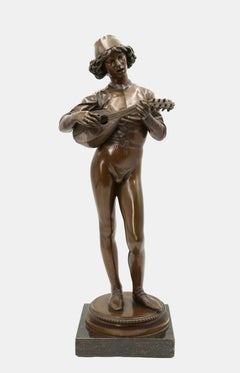
Paul Dubois (1829 Nogent-sur-Seine - 1905 Paris), Florentine singer, 1865. Light brown patinated bronze with cast round plinth mounted on a square marble base (3.5 cm high). Total height 53 cm. Bronze dimensions: 49.5 cm (height) x 20 cm (length) x 10 cm (width), weight 5.6 kg. Inscribed on the plinth "P.[aul] DUBOIS", dated "1865", with the foundry's mark "F. BARBEDIENNE FONDEUR" and the signet "REDUCTION MECANIQUE A. COLLAS".
- Patina very occasionally darkened, lute with loss of one tuning peg, otherwise in excellent condition.
- The renaissance of the Renaissance -
The bronze is a precisely executed and masterfully cast contemporary reduction of Paul Dubois 155 cm tall masterpiece "Florentine Singer", which is exhibited in the Musée d'Orsay and for which the artist was awarded the Medal of Honor at the Paris Salon in 1865. The work acted as a beacon, and was followed by a plethora of depictions of juveniles.
Inspired by Donatello and Luca della Robbia, but also by painters such as Piero della Francesca, Benozzo Gozzoli, and Pinturicchio, the "Florentine Singer" is not an epigonal work that pays homage to a vanished era, but a successful attempt to draw vitality from the art of the past and thus give it new life.
The effect of vitality is the core of Italian Renaissance art theory. In order to fulfill itself as art, art had to appear like nature. This naturalism also characterizes the "Florentine Singer". The young man appears to have been taken from life, which is reinforced by the momentary nature of his action. He has just struck a now fading chord. In addition, the natural appearance is enhanced by the detailed shaping of the figurative details, such as the laces with the slightly curved leather of the shoes, the belt buckle, or the ornamentation on the body of the lute. Even the fingernails are clearly defined. Unlike the Renaissance, however, the effect of liveliness here is not based on the "discovery" of nature and the human body, but primarily on the rediscovery of the art of the Quattrocento. The liveliness of the artwork is therefore at the same time a revitalization of this art, so that we can speak of a Renaissance of the Renaissance, just as the Pre-Raphaelites in England at the same time transferred the Quattrocento to contemporary art.
Dubois takes on the most difficult of all subjects, the depiction of singing through silent sculpture. He was preceded in this by Luca della Robbia and Donatello with their pulpits of singers created in the 1430s in the Museo dell'Opera del Duomo in Florence. Compared to these works, the physiognomy of Dubois singer is far less animated, yet he also depicts singing in a convincing manner. He uses the whole body. He takes the ancient contrapposto, which was essential to Renaissance sculpture, and transforms the standing leg-playing posture into a late medieval S-swing, giving the body an elegant beauty and at the same time setting it in melodic motion. In the equally elegant finger position, the music is expressed in a much more literal way with the beating of the lute. Finally, the musicality of the sculpture culminates in the face with the mouth open to sing.
Through the act of singing, which is a great challenge to the artistic will to depict perfect beauty, the gracefulness of the classical face is not diminished, but enhanced. Starting from the face with the singing mouth and the gaze absorbed by the sounds, the inner vitality spreads, giving the bronze sculpture an intense aura, enhanced by the music. Dubois transfers the beauty of the Renaissance to the musical, sublimating the visible sculpture to the invisible of music.
He took up the challenge of transcending the Renaissance with the Renaissance, thus responding to the Querelle des Anciens et des Modernes, which arose at the end of the 17th century around the French Academy and remained virulent into the 19th century, in which antiquity was regarded either as an unattainable ideal or as a standard to be surpassed. With his work, Dubois proved that the Renaissance, which had championed the art of the ancients, could lead to a new renaissance of art.
About the artist
Paul Dubois' great-uncle was the famous French Baroque sculptor Jean-Baptiste Pigalle, in whose footsteps the talented great-nephew followed. When he debuted at the Paris Salon in 1858, he signed his work "Dubois-Pigalle". At his father's request, however, he first studied law before devoting himself to sculpture under the tutelage of François Christophe Armand Toussaint in 1856 and entering the École des Beaux-Arts in 1858. From 1859 to 1863, he lived in Rome and traveled to Naples and Florence. Inspired by Florentine art of the quattrocento, Dubois initiated a school-forming neo-Florentine style that combined the elegantly simple forms of youthful grace with a precise wealth of detail.Two purchases by the French state (“envois de Rome”) were made during his stay in Rome, which brought him recognition in Paris. After his return there, he quickly became an internationally sought-after artist.
Dubois was also active as a creator of monuments. His most famous work is the equestrian statue of Joan of Arc (1896) on the forecourt of Reims Cathedral. He was also a sought-after portraitist who produced around 50 busts and - Dubois was also a passionate painter - around 100 portraits in oil.
From 1873 to 1878 he was curator of the Museum du Luxembourg, in 1876 he became a member of the Institut de France and from 1878 to 1905 he was director of the École des Beaux-Arts.
In 1865, Dubois was awarded the Paris Salon Medal of Honor for his “Florentine Singer”. In 1867 he became Chevalier, in 1874 Officier, in 1886 Commandeur of the Légion d'honneur, which awarded Dubois the Grande Croix in 1896.
Selected Bibliography
Stole, Elmar: Paul Dubois. In: Saur. Allgemeines Künstlerlexikon, vol. 30, Munich - Leipzig 2001, pp. 677-678.
GERMAN VERSION
Paul Dubois (1829 Nogent-sur-Seine - 1905 Paris), Florentinischer Sänger, 1865. Hellbraun patinierte Bronze mit gegossener runder Plinthe auf quadratischem Marmorsockel montiert (3,5 cm Höhe). Gesamthöhe 53 cm. Maße der Bronze: 49,5 cm (Höhe) x 20 cm (Länge) x 10 cm (Breite), Gewicht 5,6 kg. Auf der Plinthe mit „P.[aul] DUBOIS“ bezeichnet, auf „1865“ datiert, mit dem Gießereistempel „F. BARBEDIENNE FONDEUR“ und dem Signet „REDUCTION MECANIQUE A. COLLAS“ versehen.
- Patina sehr vereinzelt nachgedunkelt, Laute mit Verlust eines Stimmwirbels, ansonsten ausgezeichnet erhalten.
- Die Renaissance...
Category
1860s Realist Denial Figurative Sculptures
Materials
Bronze
$4,269 Sale Price
20% Off
H 20.87 in W 7.88 in D 3.94 in
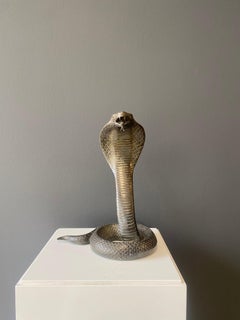
Cobra, Unknown, 20th century, Bronze, Animal, Snake, Design, art deco, Cast
Located in Geneva, CH
Cobra, Unknown, 20th century, Bronze, Animal, Snake, Design, art deco, Cast
Category
20th Century Art Deco Denial Figurative Sculptures
Materials
Bronze
$22,533
H 32 in W 25 in D 18 in
Pecheur / - Full of anticipation -
Located in Berlin, DE
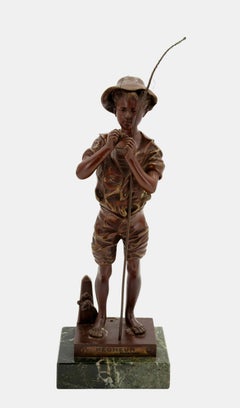
Adolphe Jean Lavergne (1863-1928), Pecheur, c. 1900. Brown patinated bronze with rectangular cast plinth on a green marble base (3 cm high), total height with hinge 37 cm, width 9 cm, depth 8 cm, weight 2.9 kg, signed “Lavergne” on the plinth.
- Base with old drilling and a few oxidized areas, patina occasionally rubbed, somewhat stained in the folds.
- Full of anticipation -
This bronze is the larger, highly detailed version of the fisherman that made Parisian artist Adolphe Jean Lavergne famous. In preparation for fishing, the boy prepares his rod before heading out to sea. The attachment of the iron ring and the rope behind him suggest a quay wall and a boat moored there. However, the depiction is entirely focused on the actual action of the young fisherman: With equal skill and concentration, he bends a hook to connect it to the fishing line. The contrast with his casual clothing, the loose-fitting trousers, the open shirt with its "wild" folds, and, last but not least, the sun hat boldly perched on his neck, reinforces the impression of the attentive care with which he goes about his work. His gaze makes him appear absorbed, as if he has forgotten the world around him and yet he is visibly filled with anticipation of fishing.
GERMAN VERSION
Adolphe Jean Lavergne (1863-1928), Pecheur, um 1890. Braun patinierte Bronze mit rechteckiger gegossener Plinthe auf grünem Marmorsockel (3 cm Höhe), Gesamthöhe mit Angel 37 cm, Breite 9 cm, Tiefe 8 cm, Gewicht 2,9 kg, auf der Plinthe mit „Lavergne“ signiert.
- Sockel mit alter Bohrung und wenigen oxidierten Stellen, Patina mitunter berieben, in den Falten vereinzelt etwas fleckig.
- Voller Vorfreude -
Die Bronzefigur ist die größere äußerst detaillierte Ausführung des Fischers, mit dem der Pariser Künstler Adolphe Jean Lavergne bekannt geworden ist. In Vorbereitung auf das Fischen präpariert der Junge die Angel...
Category
1890s Realist Denial Figurative Sculptures
Materials
Bronze
$683 Sale Price
20% Off
H 14.57 in W 3.55 in D 3.15 in
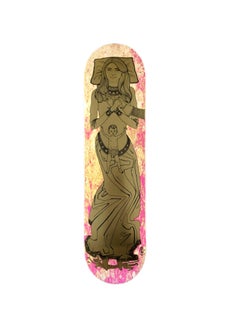
Kate board - skateboard - Grayson Perry
By Grayson Perry
Located in London, GB
Grayson Perry
Kate Board, 2017
Screenprint on skateboard
Made of 7-ply Grade A Canadian Maple wood
31 1/2 × 7 9/10 in 80 × 20 cm
Edition of 999
co-published by the artist and The Sk...
Category
2010s Contemporary Denial Figurative Sculptures
Materials
Wood, Screen
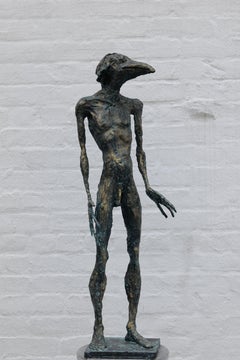
Birdman – Contemporary Hybrid Human-Bird Sculpture by Zura
Located in Brooklyn, NY
More than a creature, Birdman embodies transformation and duality. Is it a guardian, a trickster, or an internal self-reflection? Its bird-like head and humanoid stance invite viewer...
Category
21st Century and Contemporary Contemporary Denial Figurative Sculptures
Materials
Bronze
$4,400 Sale Price
66% Off
H 26 in W 6 in D 5 in
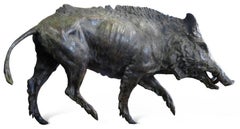
"Wild Boar" contemporary realist bronze cinghiale sculpture, life-size, Fenske
By Ben Fenske
Located in Sag Harbor, NY
‘Wild Boar’, the striking new bronze sculpture by Ben Fenske and Richard Zinon, vibrantly illustrates the ‘new’ Renaissance currently under way.
Ferocio...
Category
21st Century and Contemporary American Realist Denial Figurative Sculptures
Materials
Bronze
$80,000
H 33 in W 51 in D 25 in
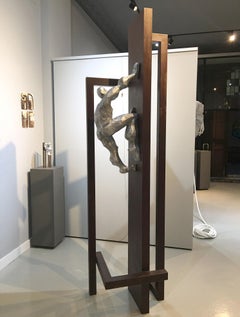
Abstract Men Large Sculpture Brown Rusted Metal Silver Aluminum Indoor / Outdoor
Located in ALCOY/ALCOI, ES
Per Una Paret Llisa
Here some fragments for one of his latest exhibition catalogue
“I think that a work of art should puzzle viewers, make them reflect on the meaning of life” Antoni Tàpies
Moisés Gil’s sculptures can be described as philosophical and conceptual, as they encourage individuals to reflect and act in a never-ending existential struggle, in the face of the multiple situations by which they are affected in contemporary societies. Art is always a form of communication: communication with and between the materials employed by the artist, giving rise to an aesthetic visual balance able to convey feelings, emotions and ideas, all of which are essential to a nonconformist commitment and worldview.
Moisés Gil puts his representations of individuals in sculptural structures to better indicate the place of humans in the world, the place of contemporary individuals in their different environments, sometimes hostile; they are naked men...
Category
2010s Contemporary Denial Figurative Sculptures
Materials
Metal, Steel
$11,859 Sale Price
20% Off
H 80.32 in W 26.78 in D 20.48 in
Previously Available Items
WTF - Big Laser Cut
By Denial
Located in Dallas, TX
Provenance:1XRUN LIVE on NTWRK w/ Denial Auction: October 30th, 2023
DENIAL is a Canadian artist whose work critiques consumerism and the human condition. Though based in Windsor On...
Category
21st Century and Contemporary Pop Art Denial Figurative Sculptures
Materials
Wood, Spray Paint

Denial figurative sculptures for sale on 1stDibs.
Find a wide variety of authentic Denial figurative sculptures available for sale on 1stDibs. If you’re browsing the collection of figurative sculptures to introduce a pop of color in a neutral corner of your living room or bedroom, you can find work that includes elements of yellow and other colors. You can also browse by medium to find art by Denial in metal, screen print and more. Much of the original work by this artist or collective was created during the 21st century and contemporary and is mostly associated with the street art style. Not every interior allows for large Denial figurative sculptures, so small editions measuring 11 inches across are available. Customers who are interested in this artist might also find the work of Banksy, and Mr Brainwash. Denial figurative sculptures prices can differ depending upon medium, time period and other attributes. On 1stDibs, the price for these items starts at $1,400 and tops out at $1,400, while the average work can sell for $1,400.