Edmond Aman-Jean Art
to
1
1
1
1
1
1
1
1
"La femme à la corbeille" original etching
By Edmond Aman-Jean
Located in Henderson, NV
Medium: original etching. A fine impression on japon paper, printed in Paris in 1926 for the Revue de l'Art ancien et moderne. The plate measures 10 3/8 x 7 1/8 inches (263 x 198 mm)...
Category
1920s Edmond Aman-Jean Art
Materials
Etching

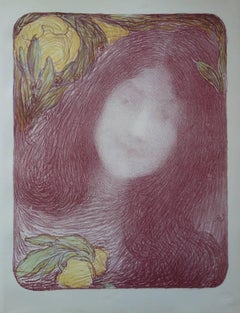
Art Deco : Woman with Flowers - Original lithograph, 1897
By Edmond Aman-Jean
Located in Paris, IDF
Edmond AMAN JEAN
Art Deco : Woman with Flowers (Sous les fleurs), 1897
Original lithograph (Champenois workshop)
Printed signature in the plate
On vellum, 40 x 31 cm (c. 16 x 12 in)...
Category
1890s Realist Edmond Aman-Jean Art
Materials
Lithograph
Related Items
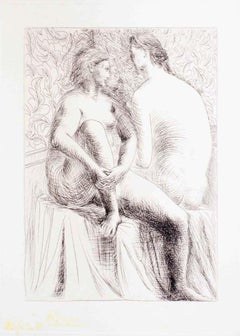
Deux Femmes Nues - Etching by Pablo Picasso - 1930
By Pablo Picasso
Located in Roma, IT
Etching on wove Arches paper.
Hand signed and numbered in ink. Edition of 81/125 prints.
Published by Editions Albert Skira, Paris, in 1930.
Very good condition.
Catalogue Bloch no. ...
Category
1930s Cubist Edmond Aman-Jean Art
Materials
Paper, Etching

$29,056
H 22.84 in W 18.12 in D 0.04 in
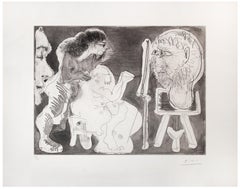
Le Modèle et son Peintre - Etching by Pablo Picasso - 1963
By Pablo Picasso
Located in Roma, IT
Etching, burin and Aquatint. Edition of 24/50 prints, numbered and hand signed.
Rare and in very good conditions.
Bibliography:
G. Bloch, Picasso: Catalog of the Printed Graphic wor...
Category
1960s Modern Edmond Aman-Jean Art
Materials
Etching
$15,299
H 19.69 in W 27.56 in D 0.04 in
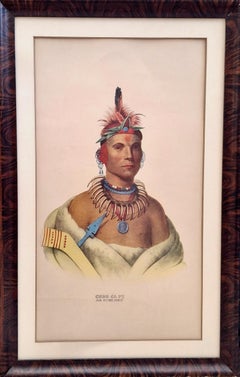
“Chono Ca Pe, An Ottoe Chief”
Located in San Francisco, CA
Chono Ca Pe, is the remarkably handsome man looking back at us across some 200 years, expressing a certain wariness of the white man painting him. Also known as Big Kansas, the sitte...
Category
Mid-19th Century Realist Edmond Aman-Jean Art
Materials
Paper, Lithograph
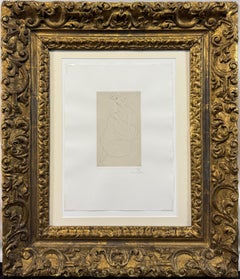
"La Correspondance" Signed Etching, Edition of 25, Young Woman Writing
By Henri Matisse
Located in Yardley, PA
Created at the height of Matisse’s mature period, this work exemplifies the artist’s turn toward clarity, purity of line, and compositional balance. Matisse, in his signature linear ...
Category
1920s Modern Edmond Aman-Jean Art
Materials
Etching
$12,000
H 27.25 in W 23.75 in D 3 in
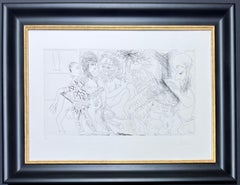
Pablo Picasso ( 1881 – 1973 ) – hand-signed etching on BFK Rives paper - 1968
By Pablo Picasso
Located in Varese, IT
Groupe avec vieillard à la torche sur un âne amoureux, femme et arlequin (Ref: Bloch 1484 )
etching on Rives wove paper, Edited in 1968
Limited edition of 50 copies
Current copy num...
Category
1960s Cubist Edmond Aman-Jean Art
Materials
Paper, Etching
$15,417
H 23.63 in W 30.71 in D 2.37 in
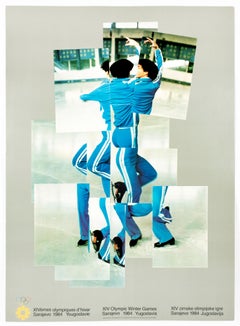
Vintage David Hockney poster, XIV Olympic Winter Games 1984, The Skater
By David Hockney
Located in New York, NY
Vintage David Hockney poster for the XIV 1984 Olympic Games in Sarajevo published as part of the official 1984 Olympic Fine Art Posters Series. The Olympic Committee commissioned 15 ...
Category
1980s Realist Edmond Aman-Jean Art
Materials
Lithograph
YE PIPE AND BOWL Signed Lithograph Colonial Sign Painter, American Illustration
By Norman Rockwell
Located in Union City, NJ
Artist: Norman Rockwell, American (1894 - 1978)
Title: Ye Pipe and Bowl
Year: 1976
Medium: Hand Drawn Lithograph on Arches paper, 100% acid free, hand signed in pencil by Norman Rock...
Category
1970s Realist Edmond Aman-Jean Art
Materials
Lithograph
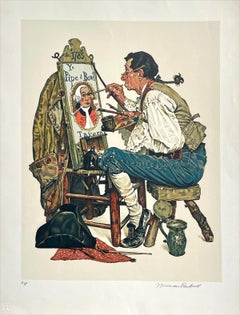
Norman RockwellYE PIPE AND BOWL Signed Lithograph Colonial Sign Painter, American Illustration, 1976
$1,800 Sale Price
30% Off
H 26.5 in W 21 in
Vintage David Hockney Poster Galerie der Spiegel 1970 (Boy in an Egg) with bird
By David Hockney
Located in New York, NY
This vintage exhibition poster reproduces The Boy Hidden in an Egg by David Hockney from his Six Fairy Tales from the Brothers Grimm, 1969. A shirtless young man curls up inside a d...
Category
1970s Realist Edmond Aman-Jean Art
Materials
Lithograph
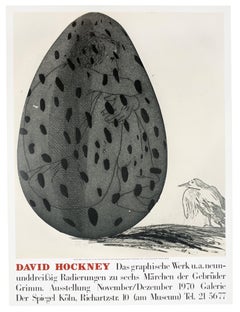
$245
H 33.5 in W 25.5 in
THE FOUR SEASONS 4 Lithographs on Arches paper, American Illustration, Americana
By Norman Rockwell
Located in Union City, NJ
Artist: Norman Rockwell, American (1894 - 1978)
Title: The Four Seasons: SPRING, SUMMER, AUTUMN, WINTER
Medium: Lithograph on Arches paper, 100% acid free
Paper Size: 20.5 x 19.25 in...
Category
1970s Realist Edmond Aman-Jean Art
Materials
Lithograph
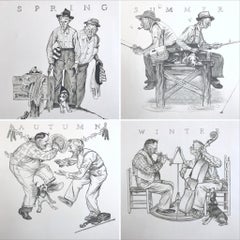
$3,100 Sale Price
20% Off
H 20.5 in W 19.25 in
Greyhounds - Etching by Henry Alken - 1822
By Henry Alken
Located in Roma, IT
Etching and aquatint realized by Henry Alken in 1822. Table from "The Sporting Repository", first edition.
Very good condition.
Henry Alken (1765-1851) was en english painter and e...
Category
Mid-19th Century Modern Edmond Aman-Jean Art
Materials
Etching

The Archangel Raphael Leaving Tobias
Family - Etching by Rembrandt - 1641
By Rembrandt van Rijn
Located in Roma, IT
The Archangel Raphael Leaving Tobias' Family is an etching by Rembrandt executed in 1641. This etching is a proof of the 3rd state (of 4) before of the diagonals on the ground at the...
Category
1640s Old Masters Edmond Aman-Jean Art
Materials
Etching

$13,757 Sale Price
20% Off
H 4.18 in W 6.11 in D 0.04 in
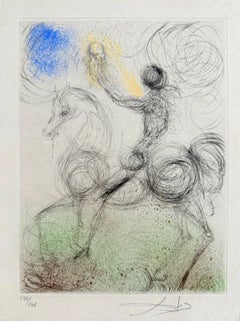
Cavalier et la mort (Knight and Death)
By Salvador Dalí
Located in OPOLE, PL
Salvador Dali (1904-1989) - Cavalier et la mort (Knight and Death)
Drypoint etching with roulette from 1969.
The edition 142/145.
Dimensions of work: 38 x 28 cm.
Hand signed.
Pu...
Category
1970s Surrealist Edmond Aman-Jean Art
Materials
Drypoint, Etching
Previously Available Items
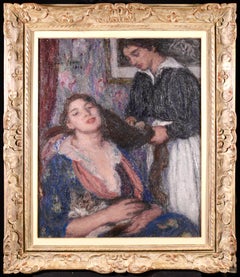
Femme a la toilette - Symbolist Oil, Figures in Interior by Edmond Aman-Jean
By Edmond Aman-Jean
Located in Marlow, Buckinghamshire
Large signed and dated figurative oil on canvas by French symbolist painter Edmond Francois Aman-Jean. The piece depicts a seated a beautiful young woman wearing a blue floral dressing gown having her long brunette hair brushed by her maid wearing her black uniform with white apron.
Signature:
Signed and dated 1916 upper left
Dimensions:
Framed: 38"x33"
Unframed: 29"x24"
Provenance:
Private UK collection
Edmond Aman-Jean spent his early childhood in St-Amand, where his father ran an inland water transport company. Both his parents died before he was ten years old, and he went to live with his uncle in Paris. After a classical education at a Jesuit school, he started working at the studio of the sculptor Justin Lequien, where George Seurat was a fellow pupil. In 1878, with Seurat, he enrolled at the École des Beaux-Arts in Paris, studying under Henri Lehmann, who also taught Pissarro. There, Aman-Jean, Ernest Laurent and Seurat realised they had a shared interest in Impressionism and consequently decided to leave the school. The pencil portrait of Aman-Jean by Seurat is a moving testimony to the intensity of his early years. At the Salon of 1881 he discovered Puvis de Chavannes, and from around 1883 he worked with him, assisting on Sacred Grove, which adorns a wall of the main staircase of the Musée des Beaux-Arts in Lyons. He won his first award at the Salon in 1883, and in 1885 he was given a travel scholarship to Rome, where he went with Ernest Laurent and Henri Martin. After joining Stéphane Mallarmé's Cercle des Mardis, he was asked to participate in the Salon de la Rose-Croix in 1892 and 1893. It was around this time that he struck up a friendship with Verlaine that was to endure until his death. He stopped exhibiting at the Salon des Artistes Français, which he considered too conventional, and began exhibiting regularly at the Salon de la Société Nationale des Beaux-Arts, becoming a member in 1893, and chairman of the painting section in 1914, 1921 and 1922. From 1896 to 1897 he went on a long trip to Italy with his wife, staying in Naples and Amalfi. In 1889 he won a silver medal, and in 1900 was awarded a gold medal at the Exposition Universelle. On that occasion he was also made a Chevalier of the Légion d'Honneur (he was later made an Officier, then in 1933 a Commandeur, as well as an Officier de l'Ordre de Léopold de Belgique). From 1899 onwards he often exhibited with the Société des Pastellistes de France. In 1899 he founded the Société Nouvelle de Peintres et Sculpteurs, which exhibited at the Galerie Georges Petit for 14 years. Around the turn of the century he travelled to Munich, Holland, Belgium and England and to Vienna as a guest of the Secession. He also made many trips to Italy. From 1902 onwards he was frequently invited to the USA to produce commissioned portraits of numerous public figures, as well as murals in a number of towns. He was also invited to exhibit there, notably at the Carnegie International in Pittsburgh until 1914, where he was on the judging panel. He even organised an exhibition of French art between 1911 and 1912 which took place in Buffalo, St Louis and Pittsburgh. In 1912 he took part in the new Salon de la Triennale with, among others, Maurice Denis and Renoir. In 1913 he was appointed curator of the La Fontaine museum in Château-Thierry. Also in 1913 he published his paper on Velazquez, which was an immediate success. His work was interrupted by World War I. For four years he stayed in Château-Thierry, which fell under German occupation, and almost ceased painting altogether. After 1922 he left the Société Nationale and founded the Salon des Tuileries together with Albert Besnard, who became its chairman, with Aman-Jean and Bourdelle as vice-chairmen. He very rarely had solo exhibitions, but exhibited jointly with René Ménard at the Galerie Georges Petit in 1925. In 1936 a major exhibition was held at the Salon des Tuileries in his honour. Since his death he has been represented at collective exhibitions of the works of his era. The Musée des Arts Décoratifs in Paris held a retrospective of his work in 1970; the Musée de la Chartreuse in Douai and the Musée des Beaux-Arts in Carcassonne hosted the exhibition Dreams of Women, Edmond Aman-Jean in 2003 and 2004.
In the 1880s he had produced engravings and lithographs. His lithographs were a big success. He made little effort to distribute his etchings. He was a careful draughtsman, working in charcoal, lithographic pencil, coloured chalk and pastels. He produced decorative compositions, most of them destined for various public buildings in Paris: St Julian the Nurse in 1883, Joan of Arc in 1885, The Park in 1901 for the town hall in Château-Thierry, four panels for the Marsan wing of the Louvre in 1908-1909, and painted The Four Elements for the chemistry lecture theatre at the Sorbonne in 1912, after which the parliament of Chile commissioned four large panels for the parliamentary palace. For a while after his studies at the École des Beaux-Arts, Aman-Jean practised Seurat's technique of divisionism, but he soon reverted to a 'flat' style as he tackled his first few commissions for decorative compositions. During his stay in Naples and Amalfi in 1896 and 1897, the harsher light enabled him to discover more vibrant colours, and he took to using these in moderation during this first period of maturity. Gradually from 1912 onwards his work began to reflect a sensitivity to the intimate charm of Bonnard's work. Today, this intimist part of his output is more appreciated, although it surprised those around him at the time. Works include portraits of women at home: Portrait of Miss S. Poncet, Portrait of Mrs. Juliette Second, and some anonymous young women with dreamy, melancholy demeanours: Confiding Secrets, Waiting and Woman with a Peacock, in which we witness both the supple rigour of his drawing and the colour harmonies, muted again but punctuated with brighter notes, which especially characterise his later work. The critic Roger Marx thought, with respect to these young women, that 'the unfathomable mystery of the eyes and the vague smile suggest the flight of troubled thought', although it is true that art criticism leaned towards psychological explanation at the time. He also depicted numerous nudes, no longer portrayed as allegories, but displaying a healthy sensuality, particularly in his drawings from 1906-1907 onwards, which testify clearly to his interest in femininity.
Museum and Gallery Holdings:
Aix-les-Bains (Mus. Faure): Woman with a Black Hat (1900); Woman with a Pink Shawl (c. 1905, pastel); Reverie, Nude Study (c. 1907, charcoal and watercolour); Woman in a Dressing Gown (c. 1915, pastel); Bather with Rose (c. 1925)
Amsterdam (Van Gogh Mus.): Pensive Young Woman, Portrait of Thadée Aman-Jean (1892)
Brest: St Genevieve outside Paris (1885)
Bucharest: Confiding Secrets (1908)
Buenos Aires: Woman with Blue Vase
Carcassonne: St Julian L'Hospitalier (1882); Doubter (1900)
Château-Thierry: The Violinist (c. 1905, pastel); Woman with a Coral Necklace, Miss Ella Carmichael (c. 1908); Portrait of Dr. Ernest de Massary (1914); Portrait of Mme Ladureau (1933)
Château-Thierry (Town Hall): The Park (1901, in collaboration with Aubert)
Cincinnati (AM): Merry Woman (La Rieuse) (engraving)
Cleveland (MA): Meditation (1891)
Dijon (MBA): Merry Woman (c. 1897, lithograph); Hair (c. 1898, lithograph); Reverie (c. 1898, pastel); Woman with Glove (1902, pastel); Head of a Woman in a White Hat (1902, pastel); Portrait of a Woman, Mme Ernest Chausson (1902); Line Aman-Jean Dressed as Marie-Antoinette (1903); Still-life (c. 1905); Little Girl in the Meadows
Douai: Privacy, Reading (1904); Goodbye to the Swallows (1923); Resting after the Duet (1924); Raining Stars (c. 1925)
Gray: Young Woman with Yellow Scarf (1895); Woman with White Glove (1898, pastel); La Pierreuse (1898, pastel); Study of a Woman (c. 1905, charcoal, pastel and distemper); Young Girl with Flowers (c. 1905); Study of a Reclining Nude (c. 1905, charcoal, chalk and watercolour); Woman in a Straw Hat (c. 1905, pastel); Nude with a Hat (1906, charcoal and pastel); Portrait of Mr Edmond Pigalle (1906, charcoal and pastel); Nude with Pergola (1906-1907, charcoal and pastel); Portrait of a Woman, Mme René-Jean (1907, charcoal and pastel); Young Woman with Blue Eyes (1920)
Kurashiki (Ohara MA): Hair (c. 1910); Family Portrait (1913)
Limoux (Mus. Petiet): Young Girl with Dog...
Category
1910s Symbolist Edmond Aman-Jean Art
Materials
Canvas, Oil
"The Mirror in the Vase", by French symbolist Edmond Aman-Jean
By Edmond Aman-Jean
Located in New York, NY
Signed low right.
Category
Late 19th Century Symbolist Edmond Aman-Jean Art
Materials
Canvas, Oil
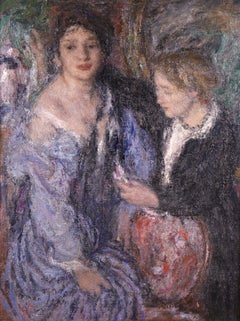
Elegant Women - Impressionist Oil, Figures in Interior Edmond Francois Aman-Jean
By Edmond Aman-Jean
Located in Marlow, Buckinghamshire
A large and stunning oil on canvas by French impressionist painter Edmond Francois Aman-Jean. The piece depicts an elegant woman in a purple dress with her assistant.
Signature:
Signed lower left
Dimensions:
Framed: 40"x33.5"
Unframed: 30.5"x24"
Provenance:
Private French collection
Edmond Aman-Jean spent his early childhood in St-Amand, where his father ran an inland water transport company. Both his parents died before he was ten years old, and he went to live with his uncle in Paris. After a classical education at a Jesuit school, he started working at the studio of the sculptor Justin Lequien, where George Seurat was a fellow pupil. In 1878, with Seurat, he enrolled at the École des Beaux-Arts in Paris, studying under Henri Lehmann, who also taught Pissarro. There, Aman-Jean, Ernest Laurent and Seurat realised they had a shared interest in Impressionism and consequently decided to leave the school. The pencil portrait of Aman-Jean by Seurat is a moving testimony to the intensity of his early years. At the Salon of 1881 he discovered Puvis de Chavannes, and from around 1883 he worked with him, assisting on Sacred Grove, which adorns a wall of the main staircase of the Musée des Beaux-Arts in Lyons. He won his first award at the Salon in 1883, and in 1885 he was given a travel scholarship to Rome, where he went with Ernest Laurent and Henri Martin. After joining Stéphane Mallarmé's Cercle des Mardis, he was asked to participate in the Salon de la Rose-Croix in 1892 and 1893. It was around this time that he struck up a friendship with Verlaine that was to endure until his death. He stopped exhibiting at the Salon des Artistes Français, which he considered too conventional, and began exhibiting regularly at the Salon de la Société Nationale des Beaux-Arts, becoming a member in 1893, and chairman of the painting section in 1914, 1921 and 1922. From 1896 to 1897 he went on a long trip to Italy with his wife, staying in Naples and Amalfi. In 1889 he won a silver medal, and in 1900 was awarded a gold medal at the Exposition Universelle. On that occasion he was also made a Chevalier of the Légion d'Honneur (he was later made an Officier, then in 1933 a Commandeur, as well as an Officier de l'Ordre de Léopold de Belgique). From 1899 onwards he often exhibited with the Société des Pastellistes de France. In 1899 he founded the Société Nouvelle de Peintres et Sculpteurs, which exhibited at the Galerie Georges Petit for 14 years. Around the turn of the century he travelled to Munich, Holland, Belgium and England and to Vienna as a guest of the Secession. He also made many trips to Italy. From 1902 onwards he was frequently invited to the USA to produce commissioned portraits of numerous public figures, as well as murals in a number of towns. He was also invited to exhibit there, notably at the Carnegie International in Pittsburgh until 1914, where he was on the judging panel. He even organised an exhibition of French art between 1911 and 1912 which took place in Buffalo, St Louis and Pittsburgh. In 1912 he took part in the new Salon de la Triennale with, among others, Maurice Denis and Renoir. In 1913 he was appointed curator of the La Fontaine museum in Château-Thierry. Also in 1913 he published his paper on Velazquez, which was an immediate success. His work was interrupted by World War I. For four years he stayed in Château-Thierry, which fell under German occupation, and almost ceased painting altogether. After 1922 he left the Société Nationale and founded the Salon des Tuileries together with Albert Besnard, who became its chairman, with Aman-Jean and Bourdelle as vice-chairmen. He very rarely had solo exhibitions, but exhibited jointly with René Ménard at the Galerie Georges Petit in 1925. In 1936 a major exhibition was held at the Salon des Tuileries in his honour. Since his death he has been represented at collective exhibitions of the works of his era. The Musée des Arts Décoratifs in Paris held a retrospective of his work in 1970; the Musée de la Chartreuse in Douai and the Musée des Beaux-Arts in Carcassonne hosted the exhibition Dreams of Women, Edmond Aman-Jean in 2003 and 2004.
In the 1880s he had produced engravings and lithographs. His lithographs were a big success. He made little effort to distribute his etchings. He was a careful draughtsman, working in charcoal, lithographic pencil, coloured chalk and pastels. He produced decorative compositions, most of them destined for various public buildings in Paris: St Julian the Nurse in 1883, Joan of Arc in 1885, The Park in 1901 for the town hall in Château-Thierry, four panels for the Marsan wing of the Louvre in 1908-1909, and painted The Four Elements for the chemistry lecture theatre at the Sorbonne in 1912, after which the parliament of Chile commissioned four large panels for the parliamentary palace. For a while after his studies at the École des Beaux-Arts, Aman-Jean practised Seurat's technique of divisionism, but he soon reverted to a 'flat' style as he tackled his first few commissions for decorative compositions. During his stay in Naples and Amalfi in 1896 and 1897, the harsher light enabled him to discover more vibrant colours, and he took to using these in moderation during this first period of maturity. Gradually from 1912 onwards his work began to reflect a sensitivity to the intimate charm of Bonnard's work. Today, this intimist part of his output is more appreciated, although it surprised those around him at the time. Works include portraits of women at home: Portrait of Miss S. Poncet, Portrait of Mrs. Juliette Second, and some anonymous young women with dreamy, melancholy demeanours: Confiding Secrets, Waiting and Woman with a Peacock, in which we witness both the supple rigour of his drawing and the colour harmonies, muted again but punctuated with brighter notes, which especially characterise his later work. The critic Roger Marx thought, with respect to these young women, that 'the unfathomable mystery of the eyes and the vague smile suggest the flight of troubled thought', although it is true that art criticism leaned towards psychological explanation at the time. He also depicted numerous nudes, no longer portrayed as allegories, but displaying a healthy sensuality, particularly in his drawings from 1906-1907 onwards, which testify clearly to his interest in femininity.
Museum and Gallery Holdings:
Aix-les-Bains (Mus. Faure): Woman with a Black Hat (1900); Woman with a Pink Shawl (c. 1905, pastel); Reverie, Nude Study (c. 1907, charcoal and watercolour); Woman in a Dressing Gown (c. 1915, pastel); Bather with Rose (c. 1925)
Amsterdam (Van Gogh Mus.): Pensive Young Woman, Portrait of Thadée Aman-Jean (1892)
Brest: St Genevieve outside Paris (1885)
Bucharest: Confiding Secrets (1908)
Buenos Aires: Woman with Blue Vase
Carcassonne: St Julian L'Hospitalier (1882); Doubter (1900)
Château-Thierry: The Violinist (c. 1905, pastel); Woman with a Coral Necklace, Miss Ella Carmichael (c. 1908); Portrait of Dr. Ernest de Massary (1914); Portrait of Mme Ladureau (1933)
Château-Thierry (Town Hall): The Park (1901, in collaboration with Aubert)
Cincinnati (AM): Merry Woman (La Rieuse) (engraving)
Cleveland (MA): Meditation (1891)
Dijon (MBA): Merry Woman (c. 1897, lithograph); Hair (c. 1898, lithograph); Reverie (c. 1898, pastel); Woman with Glove (1902, pastel); Head of a Woman in a White Hat (1902, pastel); Portrait of a Woman, Mme Ernest Chausson (1902); Line Aman-Jean Dressed as Marie-Antoinette (1903); Still-life (c. 1905); Little Girl in the Meadows
Douai: Privacy, Reading (1904); Goodbye to the Swallows (1923); Resting after the Duet (1924); Raining Stars (c. 1925)
Gray: Young Woman with Yellow Scarf (1895); Woman with White Glove (1898, pastel); La Pierreuse (1898, pastel); Study of a Woman (c. 1905, charcoal, pastel and distemper); Young Girl with Flowers (c. 1905); Study of a Reclining Nude (c. 1905, charcoal, chalk and watercolour); Woman in a Straw Hat (c. 1905, pastel); Nude with a Hat (1906, charcoal and pastel); Portrait of Mr Edmond Pigalle (1906, charcoal and pastel); Nude with Pergola (1906-1907, charcoal and pastel); Portrait of a Woman, Mme René-Jean (1907, charcoal and pastel); Young Woman with Blue Eyes (1920)
Kurashiki (Ohara MA): Hair (c. 1910); Family Portrait (1913)
Limoux (Mus. Petiet): Young Girl with Dog...
Category
1910s Impressionist Edmond Aman-Jean Art
Materials
Canvas, Oil
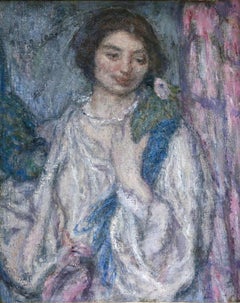
Jeune Fille avec Perroquet
By Edmond Aman-Jean
Located in Marlow, Buckinghamshire
Oil on canvas. Signed upper left. Framed dimensions are 31 inches high by 27 inches wide.
Edmond Aman-Jean spent his early childhood in St-Amand, where his father ran an inland water transport company. Both his parents died before he was ten years old, and he went to live with his uncle in Paris. After a classical education at a Jesuit school, he started working at the studio of the sculptor Justin Lequien, where George Seurat was a fellow pupil. In 1878, with Seurat, he enrolled at the École des Beaux-Arts in Paris, studying under Henri Lehmann, who also taught Pissarro. There, Aman-Jean, Ernest Laurent and Seurat realised they had a shared interest in Impressionism and consequently decided to leave the school. The pencil portrait of Aman-Jean by Seurat is a moving testimony to the intensity of his early years. At the Salon of 1881 he discovered Puvis de Chavannes, and from around 1883 he worked with him, assisting on Sacred Grove, which adorns a wall of the main staircase of the Musée des Beaux-Arts in Lyons. He won his first award at the Salon in 1883, and in 1885 he was given a travel scholarship to Rome, where he went with Ernest Laurent and Henri Martin. After joining Stéphane Mallarmé's Cercle des Mardis, he was asked to participate in the Salon de la Rose-Croix in 1892 and 1893. It was around this time that he struck up a friendship with Verlaine that was to endure until his death. He stopped exhibiting at the Salon des Artistes Français, which he considered too conventional, and began exhibiting regularly at the Salon de la Société Nationale des Beaux-Arts, becoming a member in 1893, and chairman of the painting section in 1914, 1921 and 1922. From 1896 to 1897 he went on a long trip to Italy with his wife, staying in Naples and Amalfi. In 1889 he won a silver medal, and in 1900 was awarded a gold medal at the Exposition Universelle. On that occasion he was also made a Chevalier of the Légion d'Honneur (he was later made an Officier, then in 1933 a Commandeur, as well as an Officier de l'Ordre de Léopold de Belgique). From 1899 onwards he often exhibited with the Société des Pastellistes de France. In 1899 he founded the Société Nouvelle de Peintres et Sculpteurs, which exhibited at the Galerie Georges Petit for 14 years. Around the turn of the century he travelled to Munich, Holland, Belgium and England and to Vienna as a guest of the Secession. He also made many trips to Italy. From 1902 onwards he was frequently invited to the USA to produce commissioned portraits of numerous public figures, as well as murals in a number of towns. He was also invited to exhibit there, notably at the Carnegie International in Pittsburgh until 1914, where he was on the judging panel. He even organised an exhibition of French art between 1911 and 1912 which took place in Buffalo, St Louis and Pittsburgh. In 1912 he took part in the new Salon de la Triennale with, among others, Maurice Denis and Renoir. In 1913 he was appointed curator of the La Fontaine museum in Château-Thierry. Also in 1913 he published his paper on Velazquez, which was an immediate success. His work was interrupted by World War I. For four years he stayed in Château-Thierry, which fell under German occupation, and almost ceased painting altogether. After 1922 he left the Société Nationale and founded the Salon des Tuileries together with Albert Besnard, who became its chairman, with Aman-Jean and Bourdelle as vice-chairmen. He very rarely had solo exhibitions, but exhibited jointly with René Ménard at the Galerie Georges Petit in 1925. In 1936 a major exhibition was held at the Salon des Tuileries in his honour. Since his death he has been represented at collective exhibitions of the works of his era. The Musée des Arts Décoratifs in Paris held a retrospective of his work in 1970; the Musée de la Chartreuse in Douai and the Musée des Beaux-Arts in Carcassonne hosted the exhibition Dreams of Women, Edmond Aman-Jean in 2003 and 2004.
In the 1880s he had produced engravings and lithographs. His lithographs were a big success. He made little effort to distribute his etchings. He was a careful draughtsman, working in charcoal, lithographic pencil, coloured chalk and pastels. He produced decorative compositions, most of them destined for various public buildings in Paris: St Julian the Nurse in 1883, Joan of Arc in 1885, The Park in 1901 for the town hall in Château-Thierry, four panels for the Marsan wing of the Louvre in 1908-1909, and painted The Four Elements for the chemistry lecture theatre at the Sorbonne in 1912, after which the parliament of Chile commissioned four large panels for the parliamentary palace. For a while after his studies at the École des Beaux-Arts, Aman-Jean practised Seurat's technique of divisionism, but he soon reverted to a 'flat' style as he tackled his first few commissions for decorative compositions. During his stay in Naples and Amalfi in 1896 and 1897, the harsher light enabled him to discover more vibrant colours, and he took to using these in moderation during this first period of maturity. Gradually from 1912 onwards his work began to reflect a sensitivity to the intimate charm of Bonnard's work. Today, this intimist part of his output is more appreciated, although it surprised those around him at the time. Works include portraits of women at home: Portrait of Miss S. Poncet, Portrait of Mrs. Juliette Second, and some anonymous young women with dreamy, melancholy demeanours: Confiding Secrets, Waiting and Woman with a Peacock, in which we witness both the supple rigour of his drawing and the colour harmonies, muted again but punctuated with brighter notes, which especially characterise his later work. The critic Roger Marx thought, with respect to these young women, that 'the unfathomable mystery of the eyes and the vague smile suggest the flight of troubled thought', although it is true that art criticism leaned towards psychological explanation at the time. He also depicted numerous nudes, no longer portrayed as allegories, but displaying a healthy sensuality, particularly in his drawings from 1906-1907 onwards, which testify clearly to his interest in femininity.
Museum and Gallery Holdings:
Aix-les-Bains (Mus. Faure): Woman with a Black Hat (1900); Woman with a Pink Shawl (c. 1905, pastel); Reverie, Nude Study (c. 1907, charcoal and watercolour); Woman in a Dressing Gown (c. 1915, pastel); Bather with Rose (c. 1925)
Amsterdam (Van Gogh Mus.): Pensive Young Woman, Portrait of Thadée Aman-Jean (1892)
Brest: St Genevieve outside Paris (1885)
Bucharest: Confiding Secrets (1908)
Buenos Aires: Woman with Blue Vase
Carcassonne: St Julian L'Hospitalier (1882); Doubter (1900)
Château-Thierry: The Violinist (c. 1905, pastel); Woman with a Coral Necklace, Miss Ella Carmichael (c. 1908); Portrait of Dr. Ernest de Massary (1914); Portrait of Mme Ladureau (1933)
Château-Thierry (Town Hall): The Park (1901, in collaboration with Aubert)
Cincinnati (AM): Merry Woman (La Rieuse) (engraving)
Cleveland (MA): Meditation (1891)
Dijon (MBA): Merry Woman (c. 1897, lithograph); Hair (c. 1898, lithograph); Reverie (c. 1898, pastel); Woman with Glove (1902, pastel); Head of a Woman in a White Hat (1902, pastel); Portrait of a Woman, Mme Ernest Chausson (1902); Line Aman-Jean Dressed as Marie-Antoinette (1903); Still-life (c. 1905); Little Girl in the Meadows
Douai: Privacy, Reading (1904); Goodbye to the Swallows (1923); Resting after the Duet (1924); Raining Stars (c. 1925)
Gray: Young Woman with Yellow Scarf (1895); Woman with White Glove (1898, pastel); La Pierreuse (1898, pastel); Study of a Woman (c. 1905, charcoal, pastel and distemper); Young Girl with Flowers (c. 1905); Study of a Reclining Nude (c. 1905, charcoal, chalk and watercolour); Woman in a Straw Hat (c. 1905, pastel); Nude with a Hat (1906, charcoal and pastel); Portrait of Mr Edmond Pigalle (1906, charcoal and pastel); Nude with Pergola (1906-1907, charcoal and pastel); Portrait of a Woman, Mme René-Jean (1907, charcoal and pastel); Young Woman with Blue Eyes (1920)
Kurashiki (Ohara MA): Hair (c. 1910); Family Portrait (1913)
Limoux (Mus. Petiet): Young Girl with Dog...
Category
Early 20th Century Impressionist Edmond Aman-Jean Art
Materials
Canvas, Oil
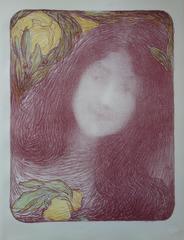
Sous les fleurs - Original lithograph (1897/98)
By Edmond Aman-Jean
Located in Paris, IDF
Aman Jean
Sous les fleurs
Original litograph
Printed signature in the plate
1897/98
Printed on paper Vélin
Size 40 x 31 cm (c. 16 x 12")
INFORMATION : Pu...
Category
1890s Realist Edmond Aman-Jean Art
Materials
Lithograph
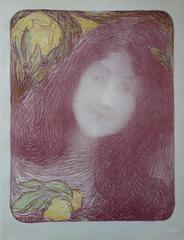
Sous les fleurs - Originale lithograph (1897/98)
By Edmond Aman-Jean
Located in Paris, IDF
Aman Jean
Sous les fleurs
Original litograph
Platesigned
1897/98
Printed on paper Vélin
Size 40 x 31 cm (c. 16 x 12")
INFORMATION : Published by 'Estampe...
Category
1890s Art Nouveau Edmond Aman-Jean Art
Materials
Lithograph
Edmond Aman-jean art for sale on 1stDibs.
Find a wide variety of authentic Edmond Aman-Jean art available for sale on 1stDibs. You can also browse by medium to find art by Edmond Aman-Jean in canvas, etching, fabric and more. Not every interior allows for large Edmond Aman-Jean art, so small editions measuring 8 inches across are available. Customers who are interested in this artist might also find the work of Eugène Carrière, Adolphe Lalyre , and William Harnden. Edmond Aman-Jean art prices can differ depending upon medium, time period and other attributes. On 1stDibs, the price for these items starts at $350 and tops out at $8,209, while the average work can sell for $540.