Edna Hibel Art
to
1
3
3
Overall Width
to
Overall Height
to
7
1
1
3
2
5
2
4
3
1
1
1
3
3
3
1
1
10
10,222
2,785
2,504
1,384
5
7
Artist: Edna Hibel
Edna Hibel Mother and Child Original Oil Painting on Silk
By Edna Hibel
Located in San Francisco, CA
Edna Hibel: 1917-2015. Well listed important American artist. Mostly associated with Florida and Massachusetts. There is a Hibel Museum in Florida. Some called her the latter 20th ce...
Category
1960s Edna Hibel Art
Materials
Oil
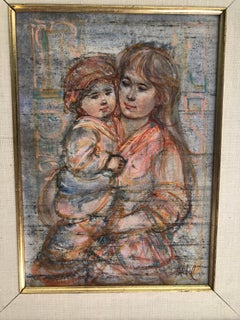
Mother and Children
By Edna Hibel
Located in San Francisco, CA
This artwork "Mother and Children" c.1970, is a colors lithograph on paper by American artist Edna Hibel, 1917-2014. It is signed and numbered II 3/10 Ed. 200 in pencil by the artist. The The artwork (sheet ) size is 34 x 23 inches, framed size is 40 x 29 inches. Custom framed in original wooden decorated grey/silver frame. It is in excellent condition.
About the artist:
Edna Hibel, a painter of sentimental pictures of children, has had a more than 60-year career as painter and lithographer and promoter of peace through exhibitions of her artwork.
She was born in 1917 in Boston, Massachusetts. Her parents were Abraham and Lena Hibel, and she was raised in the Boston area and educated at Brookline High School where she met her future husband, Theodore Plotkin.
She began to paint when she was nine years old and learned watercolor during summers at the shore where her family vacationed in Maine and Hull, Massachusetts.
Hibel studied at the Boston Museum School of Fine Arts, from 1935-39, receiving a Sturtevant Traveling Fellowship to Mexico. In Boston, in 1966, she began lithography, continuing in 1970 in Zurich, where she still works every year. She has created lithographic works with up to 32 stones (or colors) on paper, silk, wood veneer and porcelain. The latter pieces are called lithographs on porcelain and result from a complicated process, that she keeps a secret, whereby she transfers stone lithographic color separations onto Bavarian hard paste porcelain. Hibel has created the "Arte Ovale" series and various plaques with this technique.
She organized the Edna Hibel Museum of Art, in Jupiter, Florida, to display and promote her work and also created a United Nations stamp, "Mother Earth."
In 1995, she was commissioned by the Foundation of the U.S. National Archives to commemorate the 75th anniversary of women receiving the universal right to vote. At the ceremony, Ms. Lucy Baines Johnson referred to Hibel as the "Heart and Conscience of America."
In November, 2001, the World Cultural Council based in Mexico City gave her the Leonardo da Vinci World Award of Arts.
Hibel's work has been exhibited in museums and galleries in more than 20 countries including Russia, Brazil, China, Costa Rica, and the United States, and under the royal patronage of Count and Countess Bernadotte of Germany, Count Thor Bonde of Sweden, Prince and the late Princess Rainier of Monaco and Her Majesty Queen Elizabeth II of England.
Pope John Paul II gave her a medal of honor as did the late Belgian King Baudouin. She also received honorary Doctoral degrees including from Eureka College, and Northwood University of Florida, Michigan and Texas. She also has received many humanitarian honors for her charitable efforts for children's and medical charities.
Her exhibitions "Golden Bridge" and " Peace Through Wisdom" were efforts to promote peace and cultural understanding between China, the United States, Yugoslavia and Russia, and a television documentary titled "Hibel's Russian Palette" was based on her trips and art shows in Leningrad, now St. Petersburg. In 2001, Edna received a Lifetime Achievement Award from "Women in the Visual Arts," an organization of artists in the South Florida area.
Works in Permanent Collections:
Harvard University
Boston University
Museum of Fine Arts, Boston
Springfield Museum of Arts, Massachusetts
University of New Hampshire
Fleischmann Collection, Cincinnati
Detroit Art Institute
Milwaukee Art Museum
Phoenix Art Museum
La Jolla Museum, California
Lowe Gallery, University of Miami, Florida
Columbus Museum of Arts and Crafts, Georgia
WarrenHall Coutts, Ill, Memorial Museum of Art, El Dorado, Kansas
Palais des Nations,Geneva, Switzerland
United Nations Headquarters, New York City
Norton Gallery, West Palm Beach, Florida
de Saisset Museum, Santa Clara, California
Russian Academy of Art, St. Petersburg, Russia
Hibel Museum of Art, Lake Worth, Florida
One Artist Exhibitions:
Shacknow Museum of Fine Arts, Plantation, Florida, 2000
Cornell Museum of Art and History, Delray Beach, Florida, 1999 (and 1993)
Klutznick National Jewish Museum, Washington, D.C., 1999
The Museum of Printing History, Houston, Texas, 1999 (and 1998)
Mitsukoshi Fine Art Gallery, Tokyo, Japan, 1995 (and 1994)
Lyme Academy of Fine Art, Old Lyme, Connecticut, 1994
Grenchen Art Museum, and Galerie BrechbUhl, Grenchen, Switzerland, 1992
Soviet Union Academy of Art, and Exhibition Hall of the Russian Union of Artists, Leningrad (St. Petersburg),
Russia, U.S.S.R., 1990
Northern Indiana Arts Association Gallery, Munste~ Indiana, 1990
Galerie Vindobona, Bad Kissingen,West Germany, 1988
The National Museum of Women in the Arts, Washington, D.C., 1989
St. Peter An...
Category
Late 20th Century American Impressionist Edna Hibel Art
Materials
Lithograph
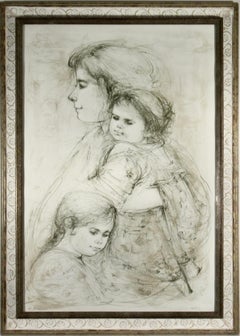
Two Fine Prints from the David Suite by Edna Hibel, 1978
By Edna Hibel
Located in New York, NY
Edna Hibel (American, 1917-2015)
Two Lithographs from the David Suite, 1978
Hand pulled original lithograph on Japanese rice paper
Sheet: 26 x 20 in.
Signed lower right: Hibel
Number...
Category
1970s Modern Edna Hibel Art
Materials
Rice Paper, Lithograph
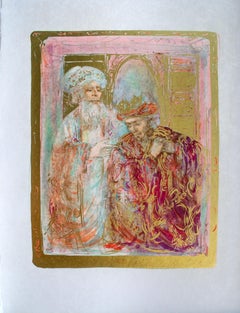
Edna Hibel Enhanced Lithograph of Venice
By Edna Hibel
Located in Palm Beach, FL
Serene moment in time on a Venetian canal as realized by artist Edna Hibel executed with a stone lithograph technique as the artists proof and enhanced with pastel and gold leaf. Pre...
Category
Late 20th Century Modern Edna Hibel Art
Materials
Gold Leaf

Chinese Girl
By Edna Hibel
Located in San Francisco, CA
This artwork "Chinese Girl" c.1970, is a colors lithograph on Japan nacre paper by American artist Edna Hibel, 1917-2014. It is signed and inscribed Artist Proof in pencil by the art...
Category
Late 20th Century American Impressionist Edna Hibel Art
Materials
Lithograph
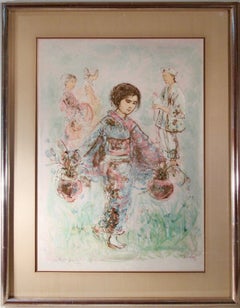
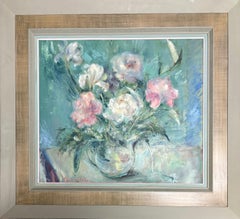
“Flowers”
By Edna Hibel
Located in Warren, NJ
Edna Hibel original painting on board “flowers”. In good condition measures 38x34
Category
20th Century Edna Hibel Art
Materials
Oil

$5,000
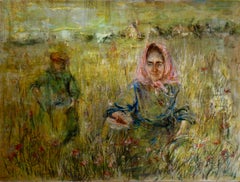
Untitled, Two people in the field
By Edna Hibel
Located in San Francisco, CA
This artwork "Untitled, Two People in the Field" c.1970, is an oil painting on canvas by American artist Edna Hibel, 1917-2014. It is signed at the lower left corner by the artist. The canvas size is 30 x 40 inches. It is in good condition, It has been recently revarnished.
About the artist:Edna Hibel, a painter of sentimental pictures of children, has had a more than 60-year career as painter and lithographer and promoter of peace through exhibitions of her artwork.
She was born in 1917 in Boston, Massachusetts. Her parents were Abraham and Lena Hibel, and she was raised in the Boston area and educated at Brookline High School where she met her future husband, Theodore Plotkin.
She began to paint when she was nine years old and learned watercolor during summers at the shore where her family vacationed in Maine and Hull, Massachusetts.
Hibel studied at the Boston Museum School of Fine Arts, from 1935-39, receiving a Sturtevant Traveling Fellowship to Mexico. In Boston, in 1966, she began lithography, continuing in 1970 in Zurich, where she still works every year. She has created lithographic works with up to 32 stones (or colors) on paper, silk, wood veneer and porcelain. The latter pieces are called lithographs on porcelain and result from a complicated process, that she keeps a secret, whereby she transfers stone lithographic color separations onto Bavarian hard paste porcelain. Hibel has created the "Arte Ovale" series and various plaques with this technique.
She organized the Edna Hibel Museum of Art, in Jupiter, Florida, to display and promote her work and also created a United Nations stamp, "Mother Earth."
In 1995, she was commissioned by the Foundation of the U.S. National Archives to commemorate the 75th anniversary of women receiving the universal right to vote. At the ceremony, Ms. Lucy Baines Johnson referred to Hibel as the "Heart and Conscience of America."
In November, 2001, the World Cultural Council based in Mexico City gave her the Leonardo da Vinci World Award of Arts.
Hibel's work has been exhibited in museums and galleries in more than 20 countries including Russia, Brazil, China, Costa Rica, and the United States, and under the royal patronage of Count and Countess Bernadotte of Germany, Count Thor Bonde of Sweden, Prince and the late Princess Rainier of Monaco and Her Majesty Queen Elizabeth II of England.
Pope John Paul II gave her a medal of honor as did the late Belgian King Baudouin. She also received honorary Doctoral degrees including from Eureka College, and Northwood University of Florida, Michigan and Texas. She also has received many humanitarian honors for her charitable efforts for children's and medical charities.
Her exhibitions "Golden Bridge" and " Peace Through Wisdom" were efforts to promote peace and cultural understanding between China, the United States, Yugoslavia and Russia, and a television documentary titled "Hibel's Russian Palette" was based on her trips and art shows in Leningrad, now St. Peter...
Category
Late 20th Century American Impressionist Edna Hibel Art
Materials
Oil
Related Items
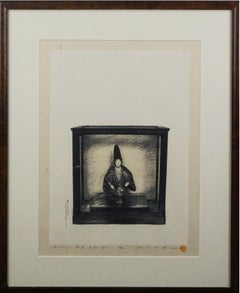
Japanese Diarist Doll in Glass Case - Silkscreen
Located in Soquel, CA
Wonderful silkscreen of Japanese diarist doll in glass case. Illegibly signed left corner, dated (October 8, 1983) and numbered (2/30). Presented in wood frame. Image size: 20"H x 14...
Category
1980s Edna Hibel Art
Materials
Ink, Rice Paper
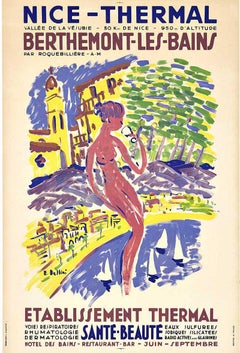
Original Nice-Themal spa Berthemont - Les -Bains antique French vintage poster
By Emmanuel Bellini
Located in Spokane, WA
Original French travel poster: Nice - Thermal health spa original vintage poster created by artist Emmanuel Bellini.
Original linen backed, large French travel size: Nice - Therm...
Category
1950s Impressionist Edna Hibel Art
Materials
Lithograph
$796 Sale Price
20% Off
H 47 in W 32 in D 0.07 in
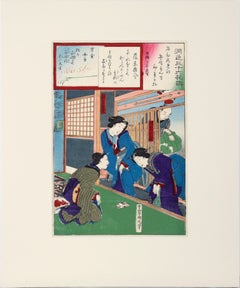
"Enshoku Sanju-roku Kasen" (Thirty-six Enchanting Flowers) Woodblock on paper
By Toyohara Kunichika
Located in Soquel, CA
"Enshoku Sanju-roku Kasen" (Thirty-six Enchanting Flowers) Woodblock on paper
Elegant woodblock print by Toyohara Kunuchika (Japanese, 1835-1900). Three women are in talking with each other inside, while a man waits outside holding a bag of some kind. The colors in this piece are rich and saturated, primarily blues, greens, and purple.
Mat size: 16"H x 20"W
Paper size: 14.75"H x 9.88"W
Born in 1835, Toyohara Kunichika grew up in the Kyobashi district of Edo in the midst of merchants and artisans. In 1848, at age 13, he was accepted as an apprentice into the studio of Utagawa Kunisada I...
Category
1880s Edo Edna Hibel Art
Materials
Ink, Rice Paper, Woodcut
$475
H 20 in W 16 in D 0.25 in
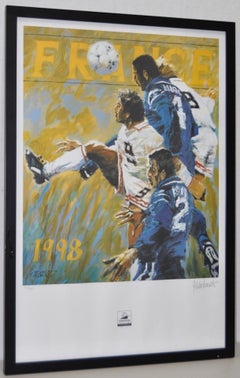
France World Cup Lithograph by Aldo Luongo c.1998
By Aldo Luongo
Located in San Francisco, CA
FRANCE World Cup Lithograph by Aldo Luongo c.1998
Limited edition France 98' World Cup - Official License
From a very limited edition of 300.
Pencil signed lower right. Edition 24/300 lower left.
This is a rare, very small edition lithograph for the 1998 Soccer World Cup...
Category
Late 20th Century Impressionist Edna Hibel Art
Materials
Lithograph
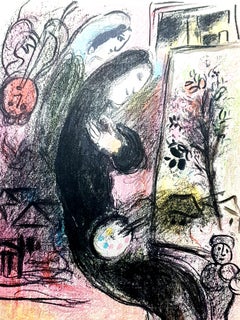
Marc Chagall - Inspiration - Original Lithograph from "Chagall Lithographe" v. 2
By Marc Chagall
Located in Collonge Bellerive, Geneve, CH
Marc Chagall
Original Lithograph from Chagall Lithographe 1957-1962. VOLUME II.
1963
Dimensions: 32 x 24 cm
From the unsigned edition of 10000 copies without margins
Reference: Mourlot 398
Condition : Excellent
Marc Chagall (born in 1887)
Marc Chagall was born in Belarus in 1887 and developed an early interest in art. After studying painting, in 1907 he left Russia for Paris, where he lived in an artist colony on the city’s outskirts. Fusing his own personal, dreamlike imagery with hints of the fauvism and cubism popular in France at the time, Chagall created his most lasting work—including I and the Village (1911)—some of which would be featured in the Salon des Indépendants exhibitions. After returning to Vitebsk for a visit in 1914, the outbreak of WWI trapped Chagall in Russia. He returned to France in 1923 but was forced to flee the country and Nazi persecution during WWII. Finding asylum in the U.S., Chagall became involved in set and costume design before returning to France in 1948. In his later years, he experimented with new art forms and was commissioned to produce numerous large-scale works. Chagall died in St.-Paul-de-Vence in 1985.
The Village
Marc Chagall was born in a small Hassidic community on the outskirts of Vitebsk, Belarus, on July 7, 1887. His father was a fishmonger, and his mother ran a small sundries shop in the village. As a child, Chagall attended the Jewish elementary school, where he studied Hebrew and the Bible, before later attending the Russian public school. He began to learn the fundamentals of drawing during this time, but perhaps more importantly, he absorbed the world around him, storing away the imagery and themes that would feature largely in most of his later work.
At age 19 Chagall enrolled at a private, all-Jewish art school and began his formal education in painting, studying briefly with portrait artist Yehuda Pen. However, he left the school after several months, moving to St. Petersburg in 1907 to study at the Imperial Society for the Protection of Fine Arts. The following year, he enrolled at the Svanseva School, studying with set designer Léon Bakst, whose work had been featured in Sergei Diaghilev's Ballets Russes. This early experience would prove important to Chagall’s later career as well.
Despite this formal instruction, and the widespread popularity of realism in Russia at the time, Chagall was already establishing his own personal style, which featured a more dreamlike unreality and the people, places and imagery that were close to his heart. Some examples from this period are his Window Vitebsk (1908) and My Fianceé with Black Gloves (1909), which pictured Bella Rosenfeld, to whom he had recently become engaged.
The Beehive
Despite his romance with Bella, in 1911 an allowance from Russian parliament member and art patron Maxim Binaver enabled Chagall to move to Paris, France. After settling briefly in the Montparnasse neighborhood, Chagall moved further afield to an artist colony known as La Ruche (“The Beehive”), where he began to work side by side with abstract painters such as Amedeo Modigliani and Fernand Léger as well as the avant-garde poet Guillaume Apollinaire. At their urging, and under the influence of the wildly popular fauvism and cubism, Chagall lightened his palette and pushed his style ever further from reality. I and the Village (1911) and Homage to Apollinaire (1912) are among his early Parisian works, widely considered to be his most successful and representative period.
Though his work stood stylistically apart from his cubist contemporaries, from 1912 to 1914 Chagall exhibited several paintings at the annual Salon des Indépendants exhibition, where works by the likes of Juan Gris, Marcel Duchamp and Robert Delaunay were causing a stir in the Paris art world. Chagall’s popularity began to spread beyond La Ruche, and in May 1914 he traveled to Berlin to help organize his first solo exhibition, at Der Sturm Gallery. Chagall remained in the city until the highly acclaimed show opened that June. He then returned to Vitebsk, unaware of the fateful events to come.
War, Peace and Revolution
In August 1914 the outbreak of World War I precluded Chagall’s plans to return to Paris. The conflict did little to stem the flow of his creative output, however, instead merely giving him direct access to the childhood scenes so essential to his work, as seen in paintings such as Jew in Green (1914) and Over Vitebsk (1914). His paintings from this period also occasionally featured images of the war’s impact on the region, as with Wounded Soldier (1914) and Marching (1915). But despite the hardships of life during wartime, this would also prove to be a joyful period for Chagall. In July 1915 he married Bella, and she gave birth to a daughter, Ida, the following year. Their appearance in works such as Birthday (1915), Bella and Ida by the Window (1917) and several of his “Lovers” paintings give a glimpse of the island of domestic bliss that was Chagall’s amidst the chaos.
To avoid military service and stay with his new family, Chagall took a position as a clerk in the Ministry of War Economy in St. Petersburg. While there he began work on his autobiography and also immersed himself in the local art scene, befriending novelist Boris Pasternak, among others. He also exhibited his work in the city and soon gained considerable recognition. That notoriety would prove important in the aftermath of the 1917 Russian Revolution when he was appointed as the Commissar of Fine Arts in Vitebsk. In his new post, Chagall undertook various projects in the region, including the 1919 founding of the Academy of the Arts. Despite these endeavors, differences among his colleagues eventually disillusioned Chagall. In 1920 he relinquished his position and moved his family to Moscow, the post-revolution capital of Russia.
In Moscow, Chagall was soon commissioned to create sets and costumes for various productions at the Moscow State Yiddish Theater...
Category
1960s Surrealist Edna Hibel Art
Materials
Lithograph
$1,483
H 9.45 in W 12.6 in D 0.04 in
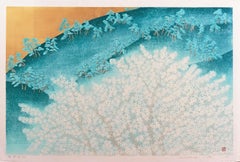
Cherry Blossoms at Dusk
, Japanese color woodblock, Musashino College of Art
Located in Santa Cruz, CA
Signed lower right, 'Morihiro Sato' (Japanese, born 1943), with artist chop mark, and dated 1985; titled, lower left, in English and Kanji 'Cherry Trees (Dusk)' with number and limitation, '3/55'.
Paper dimensions: 24.25 x 35.5 inches
A fresh and unfaded woodblock print showing a view of cherry tree boughs heavy with glowing blossoms before a vista of rolling hills with stylized Japanese pine beneath a luminous, golden sunset.
Morihiro Sato graduated from Musashino College of Fine Art before studying under the printmaker Joichi Hoshi (1913-1979). Sato’s work focuses on the beauty of nature, particularly that of trees. Through the medium of woodblock with inclusion of metallic pigments, his delicately atmospheric prints evoke a sense of gentle sense of wonder.
*With thanks to Ronin Gallery
Category
1980s Modern Edna Hibel Art
Materials
Gold Leaf
$2,700 Sale Price
25% Off
H 22 in W 33.75 in
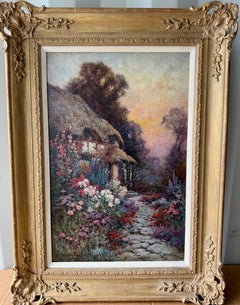
Early 20th century Impressionist English Cottage Garden landscape
By Alfred Fontville de Breanski
Located in Woodbury, CT
Alfred Fontville De Breanski (1877–1957)
“English Cottage Garden”, circa 1920
Oil on canvas Signed lower right
This richly coloured and romantic vision of rural England by Alfred F...
Category
1920s Impressionist Edna Hibel Art
Materials
Canvas, Oil
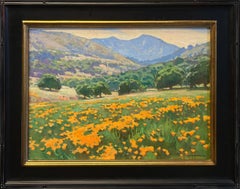
Poppies; Tejon Ranch, California
By Ray Roberts
Located in Pasadena, CA
Acquired by the gallery directly from the artist
Signed "Ray Roberts" on lower right
UNFRAMED: 18" x 24" FRAMED: 24.5" x 30.5" x 1"
Artist Statement
"...
Category
2010s Realist Edna Hibel Art
Materials
Linen, Oil, Panel
Rare 1922 German Jewish Judaica Zion Woodcut Woodblock Print Hermann Fechenbach
By Hermann Israel Fechenbach
Located in Surfside, FL
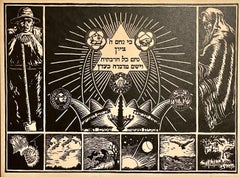
Title: Zion
Subject: Various biblical images depicting Creation and prayer
1922
Medium: woodcut
Frame: 14" x 18"
Image: 12.5" x 16.75"
Provenance: owned and signed verso by Peter Keil.
Central panel shows the Jewish star over a crown, with inscription in Hebrew: "When God comforts Zion, He will comfort all its ruins and make its deserts look like Eden," and "You have sanctified the seventh day, the goal of creation of Heaven and Earth." This is flanked by a Palestinian farmer pioneer on the left and a Jew praying on the right. The lower tier shows six vignettes of the days of creation from Genesis.
Hermann Fechenbach was born in 1897 in Württemberg, Germany. He grew up in Bad Mergentheim where his parents had an inn, which served as a meeting place for the local Jewish community.
He left school early and through family connections with clothing retailers received training in window dressing. His skill with brush writing was quickly recognised by a big firm in Dortmund where he was responsible for the displays in 10 large windows. He received his conscription papers in 1916 and recalls “being as patriotic as any other fool”. In August 1917 he was involved in a grenade attack in which he was the sole survivor. With serious injuries to both legs he struggled to safety and was eventually transported to a front line “slaughterhouse” where the first of a series of amputations was performed which led to the loss of his left leg.
As a result of his injuries his father dropped his opposition to him becoming an artist. His formal art education started in 1918 with training at a Stuttgart handcraft school for invalids. He attended the Academies in Stuttgart and Munich to learn painting and restoration for 3 years. He was influenced at this time by Max Liebermann. He has been compared to Kathe Kollwitz and was a contemporary of Jakob Steinhardt and hermann Struck. In 1923 he went to Florence for a year. While in Florence he started to produce a series of miniature wood engravings to illustrate the stories of Genesis. This was followed by periods in Pisa, Venice, Vienna and Amsterdam. In 1924 he returned to Stuttgart to paint in the contemporary style “Die Neue Sachlichkeit”. (The New Objectivity was a movement in German art that arose during the 1920s Weimar republic as a reaction against expressionism. The term was coined by Gustav Friedrich Hartlaub, the director of the Kunsthalle in Mannheim, who used it as the title of an art exhibition staged in 1925 to showcase artists who were working in a post-expressionist spirit. These artists—who included Max Beckmann, Otto Dix, George Grosz, Christian Schad, Rudolf Schlichter and Jeanne Mammen) Every spring and autumn he exhibited at the “Kunstgebit” which served as the showcase for all serious artists of the period.
His professional status “Kunstmaler und Grafiker” was recognised by Berlin in 1926. Practically all his work from this period was sold following exhibition.
In 1926 he collaborated with an architect friend to build a bungalow in Hohenheim, a non-Jewish area and a suburb of Stuttgart. Hermann alternately lived in his country bungalow and his town studio, producing portraits for sale or barter and wood engravings for his own pleasure.
In 1930 he married a non-Jewish professional photographer – Greta Batze. They had a studio in Stuttgart, which was used to teach art to a group of 12 students.
In 1933 the Nazi influence removed his name from the official state register together with the right to exhibit. By spending most of his time in his bungalow out of the Jewish quarter the Fechenbachs escaped being registered by the Nazis for some years. They were ostracised and abused by their non-Jewish neighbours. Hermann made weekly visits to friends in town to teach them the practical skills they would need assuming they were to escape from Germany. His energies were directed towards protection and survival.
Ultimately the Nazi persecution forced the Fechenbachs to flee their homeland. They moved to Palestine for 3 months in 1938, but found the political and physical environment unsustainable.
Greta arrived in England penniless in January 1939 to work as a domestic servant and to find a guarantor for her husband. Hermann arrived in May 1939. They moved to Blackheath a few months later. Hermann resumed his painting and engraving as a means of earning a living. He raised enough money to get his parents out of Germany to join his brothers in Argentina but was unable to save his twin sister Rosa who died in a Nazi concentration camp. In 1940 Hermann was interned in Bury as a suspect alien. He protested about his treatment by starting a hunger strike. Because of his persistence he was moved to a prison in Liverpool. From Liverpool he was moved to the Hutchinson Camp in the Isle of Man with fellow artist Kurt Schwitters. Arrangements were made for Greta to be accommodated near by. While interned he commenced work on “Refugee Impressions”, a series of linocut prints (no wood was available).
In 1941 when released from internment the Fechenbachs came under the sponsorship of Dr. Bela Horovitz, the Austrian art publisher who in turn made an introduction to Professor Tancred Borenius.
They were offered lodgings with a family in Oxford. Hermann had his first public exhibition for many years in a small gallery in Oxford in 1942. A second exhibition of oils, pencil drawings, coloured linocut and woodblock prints held later in the year was opened by the mayor of Oxford and critically acclaimed.
In 1944 the first London exhibition took place at the Anglo-Palestinian club in Piccadilly. There were two exhibitions at the Ben Uri Art gallery during this period.
In 1948 a second exhibition at the Anglo Palestinian club was inaugurated by a member of the Rothschild family and several members of Parliament. This was a great success.
In 1944 the Fechenbachs moved to a top floor studio flat in Colet Gardens. Open exhibitions were held each Spring at the Embankment from 1946 to 1951. Movietone News produced a short feature on the artist, which was shown in cinemas in England and Germany.
In 1969 he published the Genesis story in a hard back volume containing 137 prints. He started to research the fate of the entire Jewish community of Bad Mergentheim during the period of the second world war, liaising with historian Dr. Paul Sauer and Professor Max Miller, historian and theologian. In 1972 Kohlhammer published his partly autobiographical book “The last Jews of Mergentheim”. He exhibited at the Anglo-Palestinian Club & the Ben Uri Gallery in the 1940s. His works only came to prominence during the last year of his life when he exhibited at Blond Fine Art.
Peter Keil part of the Junge Wilde. In 1978, the Junge Wilde painting style arose in the German-speaking world in opposition to established avant garde, minimal art and conceptual art. It was linked to the similar Transavanguardia movement in Italy, USA (neo-expressionism) and France (Figuration Libre). They were also known as the Neue Wilde. Artists included; Austria: Siegfried Anzinger, Erwin Bohatsch, Herbert Brandl, Gunter Damisch, Hubert Scheibl, Hubert Schmalix...
Category
1980s Impressionist Edna Hibel Art
Materials
Woodcut
Portrait of a Woman Mid 20th Century French Oil on Canvas Painting
Located in Cirencester, Gloucestershire
Portrait of a Woman in Pink Blouse
French, mid 20th century
oil on canvas, unframed
canvas: 24 x 20 inches
Provenance: private collection, Paris
Condition: sound and original conditi...
Category
Mid-20th Century French School Edna Hibel Art
Materials
Oil

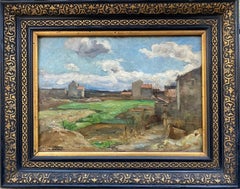
Passing Clouds, Before The Storm: A Dramatic Belle Époque Landscape
By Paul Leon Felix Schmitt
Located in Norwich, GB
This striking oil landscape is dominated by a vast, cinematic sky, rendered with the rapid, "plein air" brushwork that defined the late 19th-century French school. Rather than a stat...
Category
1890s Impressionist Edna Hibel Art
Materials
Oil, Board
$1,980
H 14.57 in W 18.12 in D 0.79 in
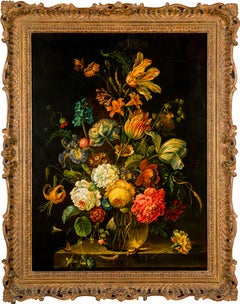
Still Life
By Jan Davidsz. de Heem
Located in Douglas, Isle of Man
In the manner of Jan Davidsz De Heem. This painting is in the Dutch Golden Age manner and is catalogued as such, however we believe the picture dates around the 18th Century and cou...
Category
18th Century Dutch School Edna Hibel Art
Materials
Oil, Panel
Previously Available Items
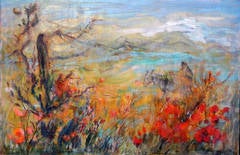
Arizona Desert
By Edna Hibel
Located in West Palm Beach, FL
Original Painting on Canvas by Renown Artist Edna Hibel
Category
1940s Realist Edna Hibel Art
Materials
Oil
Edna Hibel art for sale on 1stDibs.
Find a wide variety of authentic Edna Hibel art available for sale on 1stDibs. You can also browse by medium to find art by Edna Hibel in oil paint, paint, handmade paper and more. Much of the original work by this artist or collective was created during the 20th century and is mostly associated with the modern style. Not every interior allows for large Edna Hibel art, so small editions measuring 9 inches across are available. Customers who are interested in this artist might also find the work of Alfred Wands, William Frates, and Helen Rayburn Caswell. Edna Hibel art prices can differ depending upon medium, time period and other attributes. On 1stDibs, the price for these items starts at $400 and tops out at $6,000, while the average work can sell for $1,950.