Emile Roux Fabre Art
to
2
1
Overall Width
to
Overall Height
to
3
3
3
3
2
1
1
1
1
2
1
1
3
10,225
2,785
2,504
1,382
3
Artist: Emile Roux Fabre
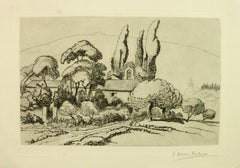
Provence
By Emile Roux-Fabre
Located in Houston, TX
Classic etching of Provence by French artist E. Roux-Fabre, circa 1930.
Original artwork on paper displayed on a white mat with a gold border. Mat fits a standard-sized frame. Archi...
Category
1930s Emile Roux Fabre Art
Materials
Etching
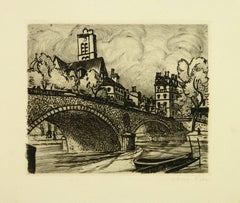
French Etching Bridge
By Emile Roux-Fabre
Located in Houston, TX
French etching of arched bridge by artist E. Roux-Fabre, circa 1930.
Original artwork on paper displayed on a white mat with a gold border. Mat fits a ...
Category
1930s Emile Roux Fabre Art
Materials
Etching
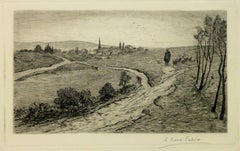
Vintage Landscape Etching - The Flock
By Emile Roux-Fabre
Located in Houston, TX
Vintage black and white etching of a farmer leading his flock of sheep to a pasture bordered by a small village by French artist Emile Roux Fabre, circa 1930. Signed in pencil lower ...
Category
1930s Emile Roux Fabre Art
Materials
Ink, Paper
Related Items
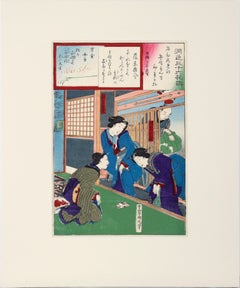
"Enshoku Sanju-roku Kasen" (Thirty-six Enchanting Flowers) Woodblock on paper
By Toyohara Kunichika
Located in Soquel, CA
"Enshoku Sanju-roku Kasen" (Thirty-six Enchanting Flowers) Woodblock on paper
Elegant woodblock print by Toyohara Kunuchika (Japanese, 1835-1900). Three women are in talking with each other inside, while a man waits outside holding a bag of some kind. The colors in this piece are rich and saturated, primarily blues, greens, and purple.
Mat size: 16"H x 20"W
Paper size: 14.75"H x 9.88"W
Born in 1835, Toyohara Kunichika grew up in the Kyobashi district of Edo in the midst of merchants and artisans. In 1848, at age 13, he was accepted as an apprentice into the studio of Utagawa Kunisada I...
Category
1880s Edo Emile Roux Fabre Art
Materials
Ink, Rice Paper, Woodcut

$475
H 20 in W 16 in D 0.25 in
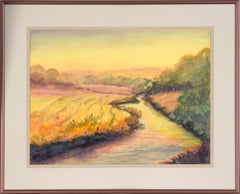
Golden Hour at the River - Watercolor Landscape on Paper
Located in Soquel, CA
Golden Hour at the River - Watercolor Landscape on Paper
Glowing sunset landscape by Rosalind O'Neal (American, b. 1927). A river winds winds towards the viewer, reflecting the glowing sunset. On the left bank, there are rows of crops in yellow and orange. On the right side, trees and shrubs line the bank. In the distance green and golden hills meet the sky.
Signed "Rosalind O'Neal" in the lower right corner.
Presented in a copper colored frame with a double mat.
Frame size: 17"H x 21"W
Image size: 12"H x 16"W
Rosalind O’Neal (American, b. 1927) was a longtime Ukiah, CA resident and a member of the Mendocino County Art Association. O’Neal was primarily a watercolor artist, focusing on portraits and landscapes, but has also worked in acrylic at times.
1997 - Ukiah Main Office Savings Bank of Mendocino County, Ukiah, CA
2003 - Savings Bank of Mendocino, Ukiah, CA
2004 - Mendocino County Art Association’s Golden Anniversary...
Category
21st Century and Contemporary American Impressionist Emile Roux Fabre Art
Materials
Watercolor, Laid Paper
$625
H 17 in W 21 in D 1 in
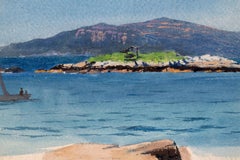
Charles Partridge Adams California Coastal Watercolor, American Impressionist
By Charles Partridge Adams
Located in Denver, CO
This exquisite California coastal watercolor by American Impressionist Charles Partridge Adams (1858–1942) captures the serene beauty of the shoreline in vibrant hues of blue, green,...
Category
1920s American Impressionist Emile Roux Fabre Art
Materials
Watercolor
$1,495
H 12.25 in W 15.25 in D 2.5 in
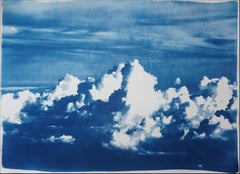
Blustery Clouds, Stormy Sky Landscape, Blue Tones, Extra Large Cyanotype, Paper
By Kind of Cyan
Located in Barcelona, ES
This is an exclusive handprinted limited edition cyanotype.
"Blustery Clouds" is an cyanotype of the semi-abstract patterns of clouds in the sky after a storm.
Details:
+ Title: Blu...
Category
2010s Realist Emile Roux Fabre Art
Materials
Watercolor, Paper, Emulsion, Etching, Lithograph
Mounts Bay Mood. Contemporary limited edition etching
By Ian Laurie
Located in Brecon, Powys
Mounts Bay Mood. Limited Edition etching from the well collected studio of Ian Laurie. Signed and numbered 14 of 50. Each one of the 25 is slightly different in tone and color
Image...
Category
21st Century and Contemporary Impressionist Emile Roux Fabre Art
Materials
Etching
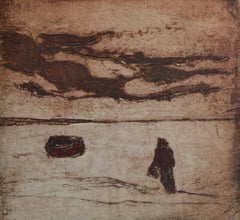
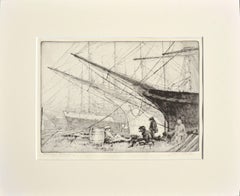
"Drowsy Bums" - Mid Century Figurative San Francisco Dock Landscape
By John Stoll
Located in Soquel, CA
Figurative landscape capturing dock workers' afternoon break by John Theodore Edward Stoll (b. Germany; 1889, d. California; 1974). Signed "John Stoll" lower right. Titled "Drowsy Bu...
Category
1940s American Impressionist Emile Roux Fabre Art
Materials
Paper, Printer s Ink, Etching
$1,250
H 14.38 in W 17.38 in D 0.25 in
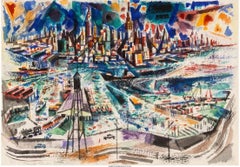
NYC Watercolor Drawing American Modern 20th Century Modernism Mid-Century WPA
By David Fredenthal
Located in New York, NY
NYC Watercolor Drawing American Modern 20th Century Modernism Mid-Century WPA.
David Fredenthal (1914-1958) "View of New York from New Jersey,"7 x 10 inches. Watercolor on Paper, c. 1948. Signed lower right.
David Fredenthal (1914 - 1958) was one ot America's most respected watercolor artists. He was famous for his bold, intensely vigorous and complex paintings and drawings that expressed his deep feeling for excitement with life and living. He was a draftsman with seemingly a special gift for catching anything, physically and emotionally on the spot, and he never went anywhere without three or four loaded pens and a sketchbook in his pocket.
As part of the WPA project he executed a number of murals including the Sports Pavilion on the Heinz Building of the New York World's Fair 1939. Some of his fresco and mural techniques were inspired by his friendship with Diego Rivera who had admired and encouraged him in the early 1930's.
After he won a traveling scholarship to Europe from The Museum of Modern Art at age 19, he was the recipient of two Guggenheim grants in Painting. He had his first solo exhibition at the Downtown Gallery in New York in 1937 at age 23, and many others after that including the Whitney Museum of American Art in 1947.
Because of Fredenthal's prodigious drawing gifts, he was chosen by Erskine Caldwell to illustrate his novel "Tobacco Road...
Category
1940s American Modern Emile Roux Fabre Art
Materials
Paper, Watercolor
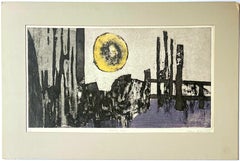
Evening Moon, color etching renowned printmaker Signed/N, ex Denver Art Museum
Located in New York, NY
Kathan Brown
Evening Moon, 1962
Color etching on wove paper
Hand signed, titled, dated and numbered 30/100 by Kathan Brown on the front
18 3/4 × 27 3/4 inches
De-accessioned from the...
Category
Mid-20th Century Modern Emile Roux Fabre Art
Materials
Etching
$1,000
H 18.75 in W 27.75 in
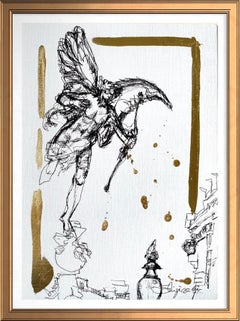
Original Ink+Gold leaf Drawing-British Awarded Artist-From London with Love
Located in London, GB
From London with Love is an intimate drawing series by Shizico Yi, composed of en plein air studies capturing quiet, private moments between the artist and the city of London. Drawn ...
Category
2010s Contemporary Emile Roux Fabre Art
Materials
Gold Leaf
$392
H 11.7 in W 8.27 in D 0.08 in
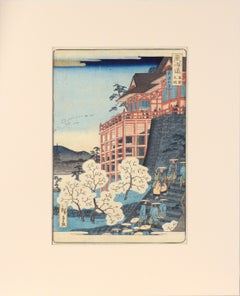
Kiyomizu Temple, Scenes of Famous Places along Tôkaidô Road - Woodblock on Paper
By Utagawa Hiroshige II
Located in Soquel, CA
Kiyomizu Temple, Scenes of Famous Places along Tôkaidô Road - Woodblock on Paper
Full Title:
Kyoto: Kiyomizu Temple (Kyô Kiyomizudera), from the series Scenes of Famous Places along...
Category
1860s Edo Emile Roux Fabre Art
Materials
Ink, Rice Paper, Woodcut
$1,200
H 20 in W 16 in D 0.25 in
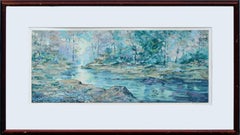
Flower Song Landscape
By Michael Schofield
Located in Soquel, CA
Flower song, a beautiful landscape lithograph in soft tones by Michael Schofield (American, b. 1947). Presented in a wooden frame. Signed "Schofield" lower right and numbered "165/35...
Category
1970s American Impressionist Emile Roux Fabre Art
Materials
Paper, Ink
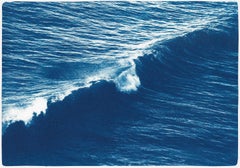
Venice Beach Seascape, Long Wave, Nautical Scene in Blue Tones, Limited Edition
By Kind of Cyan
Located in Barcelona, ES
This is an exclusive handprinted limited edition cyanotype.
This beautiful cyanotype is titled "Long Wave in Venice Beach" and it shows an outstanding wave in one of the most iconic ...
Category
2010s Realist Emile Roux Fabre Art
Materials
Paper, Emulsion, Watercolor, Engraving, Etching, Monotype
Previously Available Items
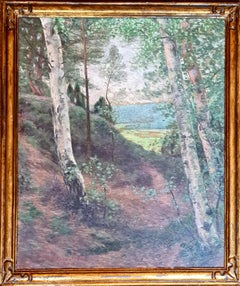
The Forest, Large Barbizon School, Oil on Canvas Wooded Landscape
By Emile Roux-Fabre
Located in Cotignac, FR
A French Barbizon School oil on canvas forest view by Emile Roux-Fabre. The painting is signed and dated bottom left with a dedication.
A charming view of forest glade leading out to a valley landscape beyond. The artist has captured the magic feeling of the cool forest shade against the sunshine of the landscape beyond. The texture of the bark on the silver birch trees, the contrast of the leaves on the trees all framing the perspective to the view beyond. An extremely accomplished and atmospheric painting.
The Barbizon school of painters was part of an art movement towards Realism in art, which arose in the context of the dominant Romantic Movement of the time. The Barbizon school was active roughly from 1830 through 1870. It takes its name from the village of Barbizon, France, on the edge of the Forest of Fontainebleau, where many of the artists gathered. Most of their works were landscape paintings, but several of them also painted landscapes with farmworkers, and genre scenes of village life. Some of the most prominent features of this school are its tonal qualities, colour, loose brushwork, and softness of form.
The leaders of the Barbizon school were: Théodore Rousseau, Charles-François Daubigny, Jules Dupré, Constant Troyon, Charles Jacque, and Narcisse Virgilio Díaz. Jean-François Millet lived in Barbizon from 1849, but his interest in figures with a landscape backdrop sets him rather apart from the others. Jean-Baptiste-Camille Corot was the earliest on the scene, first painting in the forest in 1829, but his work has a poetic and literary quality which sets him somewhat apart. Other artists associated with the school, often pupils of the main group, include: Henri Harpignies, Albert Charpin, François-Louis Français and Émile van Marcke.
In 1824 the Salon de Paris exhibited works of John Constable, an English painter. His rural scenes influenced some of the younger artists of the time, moving them to abandon formalism and to draw inspiration directly from nature. Natural scenes became the subjects of their paintings rather than mere backdrops to dramatic events. During the Revolutions of 1848 artists gathered at Barbizon to follow Constable's ideas, making nature the subject of their paintings. The French landscape became a major theme of the Barbizon painters.
Millet extended the idea from landscape to figures — peasant figures, scenes of peasant life, and work in the fields. In The Gleaners (1857), for example, Millet portrays three peasant women working at the harvest. Gleaners are poor people who are permitted to gather the remains after the owners of the field complete the main harvest. The owners (portrayed as wealthy) and their laborers are seen in the back of the painting. Millet shifted the focus and the subject matter from the rich and prominent to those at the bottom of the social ladders. To emphasize their anonymity and marginalized position, he hid their faces. The women's bowed bodies represent their everyday hard work.
In the spring of 1829, Jean-Baptiste-Camille Corot came to Barbizon to paint in the Forest of Fontainebleau, he had first painted in the forest at Chailly in 1822. He returned to Barbizon in the autumn of 1830 and in the summer of 1831, where he made drawings and oil studies, from which he made a painting intended for the Salon of 1830; "View of the Forest of Fontainebleau'" (now in the National Gallery in Washington) and, for the salon of 1831, another "View of the Forest of Fontainebleau"'. While there he met the members of the Barbizon school: Théodore Rousseau, Paul Huet, Constant Troyon, Jean-François Millet, and the young Charles-François Daubigny.
During the late 1860s, the Barbizon painters attracted the attention of a younger generation of French artists studying in Paris. Several of those artists visited Fontainebleau Forest to paint the landscape, including Claude Monet, Pierre-Auguste Renoir, Alfred Sisley and Frédéric Bazille. In the 1870s those artists, among others, developed the art movement called Impressionism and practiced 'plein air' painting. In contrast, the main members of the school made drawings and sketches on the spot, but painted back in their studios.
The Post-Impressionist painter Vincent Van Gogh studied and copied several of the Barbizon painters as well, including 21 copies of paintings by Millet. He copied Millet more than any other artist. He also did three paintings in Daubigny's Garden.
The Barbizon painters also had a profound impact on landscape painting in the United States. This included the development of the American Barbizon school by William Morris Hunt. Several artists who were also in, or contemporary to, the Hudson River School studied Barbizon paintings for their loose brushwork and emotional impact. A notable example is George Inness, who sought to emulate the works of Rousseau. Paintings from the Barbizon school also influenced landscape painting in California. The artist Percy Gray...
Category
Early 20th Century Emile Roux Fabre Art
Materials
Canvas, Oil
H 24.02 in W 20.08 in D 0.79 in
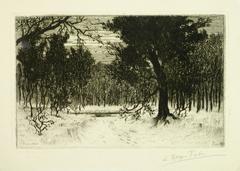
Forest of Fontainebleau
By Emile Roux-Fabre
Located in Houston, TX
Elegant etching of forest path by French artist, E. Roux-Fabre, 1937. Signed lower right.
Original artwork on paper displayed on a white mat with a gold border. Mat fits a standar...
Category
1930s Emile Roux Fabre Art
Materials
Etching
Emile Roux Fabre art for sale on 1stDibs.
Find a wide variety of authentic Emile Roux Fabre art available for sale on 1stDibs. You can also browse by medium to find art by Emile Roux Fabre in etching, canvas, fabric and more. Not every interior allows for large Emile Roux Fabre art, so small editions measuring 16 inches across are available. Customers who are interested in this artist might also find the work of Theophile Narcisse Chauvel, Jean François Millet, and Charles François Daubigny. Emile Roux Fabre art prices can differ depending upon medium, time period and other attributes. On 1stDibs, the price for these items starts at $225 and tops out at $906, while the average work can sell for $250.