Emmanuel Bellini Art
to
1
1
Overall Width
to
Overall Height
to
1
1
1
1
1
1
9,978
2,753
1,376
1,373
1
Artist: Emmanuel Bellini
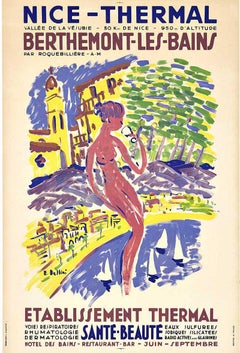
Original Nice-Themal spa Berthemont - Les -Bains antique French vintage poster
By Emmanuel Bellini
Located in Spokane, WA
Original French travel poster: Nice - Thermal health spa original vintage poster created by artist Emmanuel Bellini.
Original linen backed, large French travel size: Nice - Therm...
Category
1950s Impressionist Emmanuel Bellini Art
Materials
Lithograph
Related Items
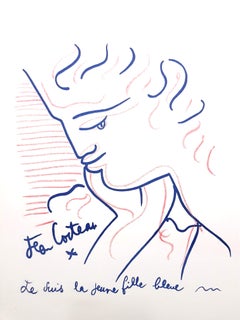
Jean Cocteau - Blue Lady - Original Lithograph
By Jean Cocteau
Located in Collonge Bellerive, Geneve, CH
Original Lithograph by Jean Cocteau
Title: Blue Lady
Signed in the plate
Dimensions: 32 x 25.5 cm
Edition: 200
1959
Publisher: Bibliophiles Du Palais
Unnumb...
Category
1950s Modern Emmanuel Bellini Art
Materials
Lithograph

$1,426
H 12.6 in W 10.04 in D 0.04 in
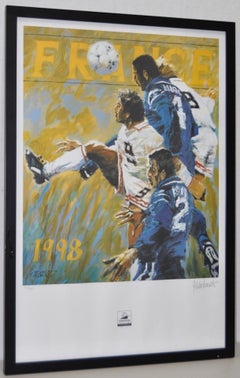
France World Cup Lithograph by Aldo Luongo c.1998
By Aldo Luongo
Located in San Francisco, CA
FRANCE World Cup Lithograph by Aldo Luongo c.1998
Limited edition France 98' World Cup - Official License
From a very limited edition of 300.
Pencil signed lower right. Edition 24/300 lower left.
This is a rare, very small edition lithograph for the 1998 Soccer World Cup...
Category
Late 20th Century Impressionist Emmanuel Bellini Art
Materials
Lithograph
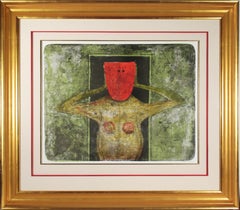
Mascara Roja
By Rufino Tamayo
Located in San Francisco, CA
This artwork titled "Mascara Roja" 1969 is an original colors lithograph on B.F.K. Rives paper by renown Mexican artist Rufino Tamayo, 1899-1991. It is hand signed and inscribed H.C. (Hors Commerce) in pencil by the artist. The image size is 21 x 27.25 inches, framed size is 37.25 x 42 inches. Published by Touchtone Publisher, New York, printed by Ateliers Desjobert, Paris. Referenced and pictured in the artist's catalogue raisonne by Pereda, plate #124. Custom framed in a wooden gold leaf frame, with gold and red spacer and fabric matting. It is in excellent condition.
About the artist:
A native of Oaxaca in Southern Mexico, Rufino Tamayo's father was a shoemaker, and his mother a seamstress. Some accounts state that he was descended from Zapotec Indians, but he was actually 'mestizo' - of mixed indigenous/European ancestry. (Santa Barbara Museum of Art). He began painting at age 11. Orphaned at the age of 12, Tamayo moved to Mexico City, where he was raised by his maternal aunt who owned a wholesale fruit business.
In 1917, he entered the San Carlos Academy of Fine Arts, but left soon after to pursue independent study. Four years later, Tamayo was appointed the head designer of the department of ethnographic drawings at the National Museum of Archaeology in Mexico City. There he was surrounded by pre-Colombian objects, an aesthetic inspiration that would play a pivotal role in his life. In his own work, Tamayo integrated the forms and tones of pre-Columbian ceramics into his early still lives and portraits of Mexican men and women.
In the early 1920s he also taught art classes in Mexico City's public schools. Despite his involvement in Mexican history, he did not subscribe to the idea of art as nationalistic propaganda. Modern Mexican art at that time was dominated by 'The Three Great Ones' : Diego Rivera, Jose Clemente Orozco, and David Alfaro Siqueros, but Tamayo began to be noted as someone 'new' and different' for his blending of the aesthetics of post Revolutionary Mexico with the vanguard artists of Europe and the United States.
After the Mexican Revolution, he focused on creating his own identity in his work, expressing what he thought was the traditional Mexico, and refusing to follow the political trends of his contemporary artists. This caused some to see him as a 'traitor' to the political cause, and he felt it difficult to freely express himself in his art. As a result, he decided to leave Mexico in 1926 and move to New York, along with his friend, the composer Carlos Chavez. The first exhibition of Tamayo's work in the United States was held at the Weyhe Gallery, New York, in that same year. The show was successful, and Tamayo was praised for his 'authentic' status as a Mexican of 'indigenous heritage', and for his internationally appealing Modernist aesthetic. (Santa Barbara Museum of Art).
Throughout the late thirties and early forties New York's Valentine Gallery gave him shows. For nine years, beginning in 1938, he taught at the Dalton School in New York.
In 1929, some health problems led him to return to Mexico for treatment. While there he took a series of teaching jobs. During this period he became romantically involved with the artist Maria Izquierdo...
Category
Mid-20th Century Modern Emmanuel Bellini Art
Materials
Lithograph
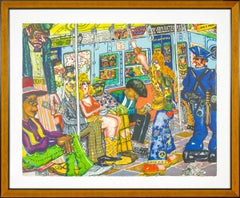
Hand-signed "Local" lithograph by Red Grooms from the 1971 "No Gas" portfolio
By Red Grooms
Located in Boca Raton, FL
"Local" lithograph by Red Grooms from the 1971 "No Gas" portfolio. Hand-signed AP Red Grooms in policeman's left shoe in bottom lower right of image. Depicts people on subway.
Category
1970s Contemporary Emmanuel Bellini Art
Materials
Lithograph
$3,500
H 28.75 in W 34.5 in
Rare 1922 German Jewish Judaica Zion Woodcut Woodblock Print Hermann Fechenbach
By Hermann Israel Fechenbach
Located in Surfside, FL
Title: Zion
Subject: Various biblical images depicting Creation and prayer
1922
Medium: woodcut
Frame: 14" x 18"
Image: 12.5" x 16.75"
Provenance: owned and signed verso by Peter Keil.
Central panel shows the Jewish star over a crown, with inscription in Hebrew: "When God comforts Zion, He will comfort all its ruins and make its deserts look like Eden," and "You have sanctified the seventh day, the goal of creation of Heaven and Earth." This is flanked by a Palestinian farmer pioneer on the left and a Jew praying on the right. The lower tier shows six vignettes of the days of creation from Genesis.
Hermann Fechenbach was born in 1897 in Württemberg, Germany. He grew up in Bad Mergentheim where his parents had an inn, which served as a meeting place for the local Jewish community.
He left school early and through family connections with clothing retailers received training in window dressing. His skill with brush writing was quickly recognised by a big firm in Dortmund where he was responsible for the displays in 10 large windows. He received his conscription papers in 1916 and recalls “being as patriotic as any other fool”. In August 1917 he was involved in a grenade attack in which he was the sole survivor. With serious injuries to both legs he struggled to safety and was eventually transported to a front line “slaughterhouse” where the first of a series of amputations was performed which led to the loss of his left leg.
As a result of his injuries his father dropped his opposition to him becoming an artist. His formal art education started in 1918 with training at a Stuttgart handcraft school for invalids. He attended the Academies in Stuttgart and Munich to learn painting and restoration for 3 years. He was influenced at this time by Max Liebermann. He has been compared to Kathe Kollwitz and was a contemporary of Jakob Steinhardt and hermann Struck. In 1923 he went to Florence for a year. While in Florence he started to produce a series of miniature wood engravings to illustrate the stories of Genesis. This was followed by periods in Pisa, Venice, Vienna and Amsterdam. In 1924 he returned to Stuttgart to paint in the contemporary style “Die Neue Sachlichkeit”. (The New Objectivity was a movement in German art that arose during the 1920s Weimar republic as a reaction against expressionism. The term was coined by Gustav Friedrich Hartlaub, the director of the Kunsthalle in Mannheim, who used it as the title of an art exhibition staged in 1925 to showcase artists who were working in a post-expressionist spirit. These artists—who included Max Beckmann, Otto Dix, George Grosz, Christian Schad, Rudolf Schlichter and Jeanne Mammen) Every spring and autumn he exhibited at the “Kunstgebit” which served as the showcase for all serious artists of the period.
His professional status “Kunstmaler und Grafiker” was recognised by Berlin in 1926. Practically all his work from this period was sold following exhibition.
In 1926 he collaborated with an architect friend to build a bungalow in Hohenheim, a non-Jewish area and a suburb of Stuttgart. Hermann alternately lived in his country bungalow and his town studio, producing portraits for sale or barter and wood engravings for his own pleasure.
In 1930 he married a non-Jewish professional photographer – Greta Batze. They had a studio in Stuttgart, which was used to teach art to a group of 12 students.
In 1933 the Nazi influence removed his name from the official state register together with the right to exhibit. By spending most of his time in his bungalow out of the Jewish quarter the Fechenbachs escaped being registered by the Nazis for some years. They were ostracised and abused by their non-Jewish neighbours. Hermann made weekly visits to friends in town to teach them the practical skills they would need assuming they were to escape from Germany. His energies were directed towards protection and survival.
Ultimately the Nazi persecution forced the Fechenbachs to flee their homeland. They moved to Palestine for 3 months in 1938, but found the political and physical environment unsustainable.
Greta arrived in England penniless in January 1939 to work as a domestic servant and to find a guarantor for her husband. Hermann arrived in May 1939. They moved to Blackheath a few months later. Hermann resumed his painting and engraving as a means of earning a living. He raised enough money to get his parents out of Germany to join his brothers in Argentina but was unable to save his twin sister Rosa who died in a Nazi concentration camp. In 1940 Hermann was interned in Bury as a suspect alien. He protested about his treatment by starting a hunger strike. Because of his persistence he was moved to a prison in Liverpool. From Liverpool he was moved to the Hutchinson Camp in the Isle of Man with fellow artist Kurt Schwitters. Arrangements were made for Greta to be accommodated near by. While interned he commenced work on “Refugee Impressions”, a series of linocut prints (no wood was available).
In 1941 when released from internment the Fechenbachs came under the sponsorship of Dr. Bela Horovitz, the Austrian art publisher who in turn made an introduction to Professor Tancred Borenius.
They were offered lodgings with a family in Oxford. Hermann had his first public exhibition for many years in a small gallery in Oxford in 1942. A second exhibition of oils, pencil drawings, coloured linocut and woodblock prints held later in the year was opened by the mayor of Oxford and critically acclaimed.
In 1944 the first London exhibition took place at the Anglo-Palestinian club in Piccadilly. There were two exhibitions at the Ben Uri Art gallery during this period.
In 1948 a second exhibition at the Anglo Palestinian club was inaugurated by a member of the Rothschild family and several members of Parliament. This was a great success.
In 1944 the Fechenbachs moved to a top floor studio flat in Colet Gardens. Open exhibitions were held each Spring at the Embankment from 1946 to 1951. Movietone News produced a short feature on the artist, which was shown in cinemas in England and Germany.
In 1969 he published the Genesis story in a hard back volume containing 137 prints. He started to research the fate of the entire Jewish community of Bad Mergentheim during the period of the second world war, liaising with historian Dr. Paul Sauer and Professor Max Miller, historian and theologian. In 1972 Kohlhammer published his partly autobiographical book “The last Jews of Mergentheim”. He exhibited at the Anglo-Palestinian Club & the Ben Uri Gallery in the 1940s. His works only came to prominence during the last year of his life when he exhibited at Blond Fine Art.
Peter Keil part of the Junge Wilde. In 1978, the Junge Wilde painting style arose in the German-speaking world in opposition to established avant garde, minimal art and conceptual art. It was linked to the similar Transavanguardia movement in Italy, USA (neo-expressionism) and France (Figuration Libre). They were also known as the Neue Wilde. Artists included; Austria: Siegfried Anzinger, Erwin Bohatsch, Herbert Brandl, Gunter Damisch, Hubert Scheibl, Hubert Schmalix...
Category
1980s Impressionist Emmanuel Bellini Art
Materials
Woodcut

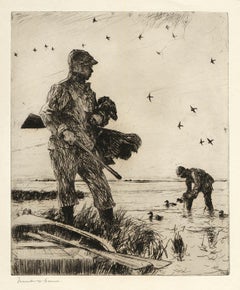
Winter Wildfowling
By Frank Benson
Located in New York, NY
This 1927 etching by Frank W. Benson is entitled Winter Wildfowling. Printed in an edition of 150 this impression is signed in pencil, lower left. The image size 11 7/8 x 9 7/8" (30 x 24.8 cm) and sheet size 15 1/16 x 12 5/8" (38.3 x 32 cm).
FRANK W. BENSON (1862-1951)
Frank Weston Benson, well known for his American impressionist paintings, also produced an incredible body of prints - etchings, drypoints, and a few lithographs. Born and raised on the North Shore of Massachusetts, Benson, a natural outdoorsman, grew up sailing, fishing, and hunting. From a young age, he was fascinated with drawing and birding – this keen interest continued throughout his life.
His first art instruction was with Otto Grundman at the Museum of Fine Arts in Boston, and then in 1883 in Paris at the Academie Julian where he studied the rigorous ‘ecole des beaux arts’ approach to drawing and painting for two years.
During the early 1880’s Seymour Haden visited Boston giving a series of lectures on etching. This introduction to the European etching...
Category
1920s American Impressionist Emmanuel Bellini Art
Materials
Etching
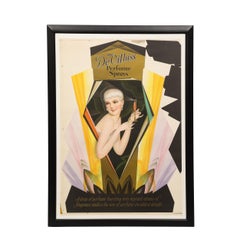
DeVilbiss Purfume Art Deco Poster by George Petty for the A.C. Schultz Company
Located in New York, NY
This beautiful Art Deco poster was realized by the esteemed American Artist George Petty for the A.C. Schultz Company in 1926. The work is an advertisement for DeVilbiss Perfume, which depicts a "Petty Girl" (as they came to be known) in the center of the composition floating in a pentagonal black color block. With short cropped silvery white hair and red lipstick, the female figure in center (suggestive of a stylized flapper) squeezes the atomizer of her perfume bottle misting herself in fragrance. Skyscraper style geometric forms suggesting elaborately faceted gemstones- in hues of rose, lavender, orange sapphire and yellow diamond- explode around her, suggesting the stage design for the set of the iconic film "Metropolis". The top of the composition features a bronze color block reading "DeVilbiss Perfume sprays" and in scrolling Deco lettering text reads “A drop of perfume bursting into myriad atoms of fragrance makes the use of perfume an added delight” near the bottom of the piece. Additionally, there is a solid black color block with crystalline black forms emanating outwards at the base of the composition, as well as a geometric abstract form on the right side of the piece imbuing it with a distinctly modernist inflection. With its quintessentially Art Deco sensibility, this piece is sure to delight discerning collectors of the period as well as those with a distinct appreciation for unusual (and stunning) fine art pieces. its vibrant palate and clean modernist lines make this piece a winning addition to any style of interior from classic Deco to contemporary. The piece comes presented in a custom gallery frame and is in excellent vintage condition.
George Petty was an American illustrator known for his series of pin-ups known as "Petty Girls" which he created for Esquire magazine. The Petty Girl were coquettish women whose legs were elongated to create idealized female forms. They were featured on magazine centerfolds, billboards, and calendars for companies such as Ridgid Tools. Born George Brown Petty IV on April 27, 1894 in Abbeville, LA, Petty received his formal training at the School of the Art Institute of Chicago under Ruth Van Sickle Ford...
Category
1920s Art Deco Emmanuel Bellini Art
Materials
Lithograph
$2,975
H 42 in W 29 in D 1 in
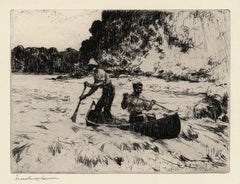
Running the Rapids
By Frank Benson
Located in New York, NY
The etching "Running the Rapids" was created by Frank Benson in 1927. Printed in an edition of 150, this impression is signed in pencil, lower left. The image size is 5 13/16 x 7 7/8" (14.8 x 20 cm) and sheet size 8 1/16 x 10 5/16" (20.3 x 26.2 cm).
Frank Weston Benson (1862-1951), well known for his American impressionist paintings, also produced an incredible body of prints - etchings, drypoints, and a few lithographs. Born and raised on the North Shore of Massachusetts, Benson, a natural outdoorsman, grew up sailing, fishing, and hunting. From a young age, he was fascinated with drawing and birding – this keen interest continued throughout his life.
His first art instruction was with Otto Grundman at the Museum of Fine Arts in Boston, and then in 1883 in Paris at the Academie Julian where he studied the rigorous ‘ecole des beaux arts’ approach to drawing and painting for two years.
During the early 1880’s Seymour Haden visited Boston giving a series of lectures on etching. This introduction to the European etching...
Category
1920s American Impressionist Emmanuel Bellini Art
Materials
Etching
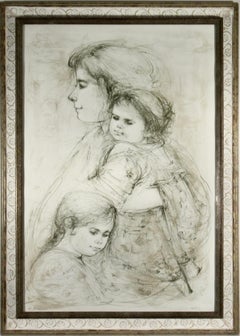
Mother and Children
By Edna Hibel
Located in San Francisco, CA
This artwork "Mother and Children" c.1970, is a colors lithograph on paper by American artist Edna Hibel, 1917-2014. It is signed and numbered II 3/10 Ed. 200 in pencil by the artist. The The artwork (sheet ) size is 34 x 23 inches, framed size is 40 x 29 inches. Custom framed in original wooden decorated grey/silver frame. It is in excellent condition.
About the artist:
Edna Hibel, a painter of sentimental pictures of children, has had a more than 60-year career as painter and lithographer and promoter of peace through exhibitions of her artwork.
She was born in 1917 in Boston, Massachusetts. Her parents were Abraham and Lena Hibel, and she was raised in the Boston area and educated at Brookline High School where she met her future husband, Theodore Plotkin.
She began to paint when she was nine years old and learned watercolor during summers at the shore where her family vacationed in Maine and Hull, Massachusetts.
Hibel studied at the Boston Museum School of Fine Arts, from 1935-39, receiving a Sturtevant Traveling Fellowship to Mexico. In Boston, in 1966, she began lithography, continuing in 1970 in Zurich, where she still works every year. She has created lithographic works with up to 32 stones (or colors) on paper, silk, wood veneer and porcelain. The latter pieces are called lithographs on porcelain and result from a complicated process, that she keeps a secret, whereby she transfers stone lithographic color separations onto Bavarian hard paste porcelain. Hibel has created the "Arte Ovale" series and various plaques with this technique.
She organized the Edna Hibel Museum of Art, in Jupiter, Florida, to display and promote her work and also created a United Nations stamp, "Mother Earth."
In 1995, she was commissioned by the Foundation of the U.S. National Archives to commemorate the 75th anniversary of women receiving the universal right to vote. At the ceremony, Ms. Lucy Baines Johnson referred to Hibel as the "Heart and Conscience of America."
In November, 2001, the World Cultural Council based in Mexico City gave her the Leonardo da Vinci World Award of Arts.
Hibel's work has been exhibited in museums and galleries in more than 20 countries including Russia, Brazil, China, Costa Rica, and the United States, and under the royal patronage of Count and Countess Bernadotte of Germany, Count Thor Bonde of Sweden, Prince and the late Princess Rainier of Monaco and Her Majesty Queen Elizabeth II of England.
Pope John Paul II gave her a medal of honor as did the late Belgian King Baudouin. She also received honorary Doctoral degrees including from Eureka College, and Northwood University of Florida, Michigan and Texas. She also has received many humanitarian honors for her charitable efforts for children's and medical charities.
Her exhibitions "Golden Bridge" and " Peace Through Wisdom" were efforts to promote peace and cultural understanding between China, the United States, Yugoslavia and Russia, and a television documentary titled "Hibel's Russian Palette" was based on her trips and art shows in Leningrad, now St. Petersburg. In 2001, Edna received a Lifetime Achievement Award from "Women in the Visual Arts," an organization of artists in the South Florida area.
Works in Permanent Collections:
Harvard University
Boston University
Museum of Fine Arts, Boston
Springfield Museum of Arts, Massachusetts
University of New Hampshire
Fleischmann Collection, Cincinnati
Detroit Art Institute
Milwaukee Art Museum
Phoenix Art Museum
La Jolla Museum, California
Lowe Gallery, University of Miami, Florida
Columbus Museum of Arts and Crafts, Georgia
WarrenHall Coutts, Ill, Memorial Museum of Art, El Dorado, Kansas
Palais des Nations,Geneva, Switzerland
United Nations Headquarters, New York City
Norton Gallery, West Palm Beach, Florida
de Saisset Museum, Santa Clara, California
Russian Academy of Art, St. Petersburg, Russia
Hibel Museum of Art, Lake Worth, Florida
One Artist Exhibitions:
Shacknow Museum of Fine Arts, Plantation, Florida, 2000
Cornell Museum of Art and History, Delray Beach, Florida, 1999 (and 1993)
Klutznick National Jewish Museum, Washington, D.C., 1999
The Museum of Printing History, Houston, Texas, 1999 (and 1998)
Mitsukoshi Fine Art Gallery, Tokyo, Japan, 1995 (and 1994)
Lyme Academy of Fine Art, Old Lyme, Connecticut, 1994
Grenchen Art Museum, and Galerie BrechbUhl, Grenchen, Switzerland, 1992
Soviet Union Academy of Art, and Exhibition Hall of the Russian Union of Artists, Leningrad (St. Petersburg),
Russia, U.S.S.R., 1990
Northern Indiana Arts Association Gallery, Munste~ Indiana, 1990
Galerie Vindobona, Bad Kissingen,West Germany, 1988
The National Museum of Women in the Arts, Washington, D.C., 1989
St. Peter An...
Category
Late 20th Century American Impressionist Emmanuel Bellini Art
Materials
Lithograph
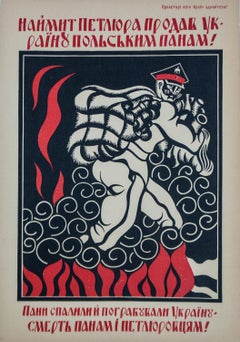
Corrupt Petliura Ukraine Russian Propaganda Poster
Located in Paonia, CO
Vintage Soviet Government propaganda lithographic poster titled with Ukrainian text that reads “Corrupt Petliura has sold Ukraine to the Polish landowners. Landowners burned and plundered Ukraine. Death to landowners and Petlyurovites.” Originally issued April 1920 following the Treaty of Warsaw (also the Polish-Ukrainian Agreement). The agreement was a military-economical alliance between the Second Polish Republic, represented by Jozef Pilsudski, and the Ukrainian People’s Republic, represented by Symon Petliura, against Bolshevik Russia. The artwork features Jozef Pilsudski running away with a sack of goods. Good condition. Artist unknown.
The Bolshevik Era (1917-1921) was a life and death struggle for the Bolsheviks and their ideology. The propaganda poster...
Category
Early 20th Century Expressionist Emmanuel Bellini Art
Materials
Lithograph
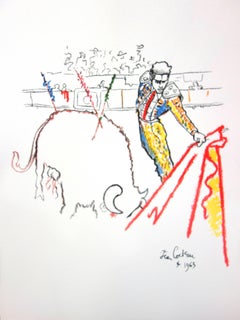
Jean Cocteau - Torrero - Original Lithograph
By Jean Cocteau
Located in Collonge Bellerive, Geneve, CH
Original Lithograph by Jean Cocteau
Title: Taureaux
Signed in the plate
Dimensions: 40 x 30 cm
Edition: 200
Luxury print edition from the portfolio of Trinckvel
1965
From the last po...
Category
1960s Modern Emmanuel Bellini Art
Materials
Lithograph
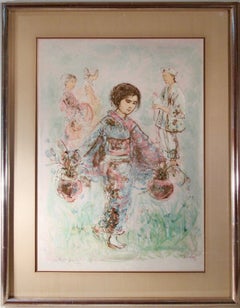
Chinese Girl
By Edna Hibel
Located in San Francisco, CA
This artwork "Chinese Girl" c.1970, is a colors lithograph on Japan nacre paper by American artist Edna Hibel, 1917-2014. It is signed and inscribed Artist Proof in pencil by the art...
Category
Late 20th Century American Impressionist Emmanuel Bellini Art
Materials
Lithograph
Previously Available Items
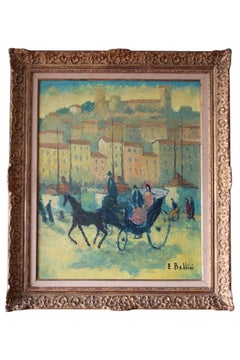
Large Vintage Landscape/Figurative oil painting horse
cart by Emmanuel Bellini
By Emmanuel Bellini
Located in AIGNAN, FR
*RESERVED*Amazing large framed oil on canvas of a horse and carriage on the promanade in Cannes, French Riviera. Here, this renown French Artist, Emmanuel Bellini has given us a larg...
Category
Late 20th Century Post-Impressionist Emmanuel Bellini Art
Materials
Oil
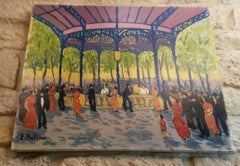
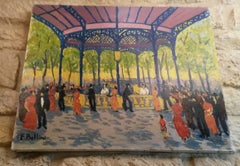
La Belle Epoque of the Vichy Baths by Emmanuel Bellini
By Emmanuel Bellini
Located in Paris, FR
Vivid colours oil on canvas from the 60's by the famous French listed artist Emmanuel BELLINI ( 1904-1989 ), depicting the Belle epoque period and its kiosk of the thermal natural springs at the VICHY Spa in the begining of the 20th century named Belle Epoque.
The painting is post impressionnist style and the resort atmosphère perfectly rendered.
The oil is in excellent condition, signed on the left bottom, again on the back and titled.
Sold unframed.
Dimensions : 73 cm x 60 cm 28.74 in. x 23.62 in.
About thé artist :
Emmanuel Bellini b: 1904 d: 1989
Bellini was born in Monaco during the “Belle Epoque” era to a working class loving family of Italian descent. Surrounded by an idyllic setting where the air was perfumed by the flowers and fruits of the Mediterranean, meeting with the the colors of the sky, sun and earth. This formed an indelible palette in the young mind of this artist. An era of horse drawn carriages, polite society, the nearby theatre and opera house, all appealed and stimulated the senses of the young man who set to work as an apprentice in Nice for the architect Charles Damas, who was instrumental in the designs of the famous Paris Opera House and that of Monaco.
Later becoming an architect himself, in his search of the purity of the line, his internal compass directed him to the sea, the sailboats, the magical backdrop of the Casino and its gardens which persisted to inspire and capture his imagination. This led him to create his iconic posters for the Automobile Club of Monaco, as well as the special Galas and events of Monaco, and the city of Cannes. It was only a matter of time before his paintings were brought to the attention of the outside world. First exhibiting in 1949 at the Galerie Lambert in Paris, and quickly followed by the famed Galerie Petrides leading to many other exhibits in various galleries across the cities of Europe. His style is unique, reminiscent of far away impressionism, but with accents of fauvism.
With his success, Bellini purchased the baroque Italian Chapel in Cannes formerly owned by the Princess Kara-Georgevich of Serbia. Complete with bell tower and garden, it became his studio, and where he entertained the many luminaries who would visit him from the musicians of his day (Mireille Mathieu, Tino Rossi, Manitas de Plata…) to the artists ( Marie Laurencin, Maurice Utrillo, Carzou, Miro, Brayer…)to the celebrities and royalty (Lilly Pons, Prince Rainier III of Monaco, Mitty Goldin among many others). Here in this beautiful setting, he recreated the settings of the 1930’s that so intrigued him throughout his life in oil and water colors. His love of the theatre and music propelled him to create sets for opera and theatre houses...
Category
1960s Post-Impressionist Emmanuel Bellini Art
Materials
Canvas, Oil
H 23.63 in W 28.75 in
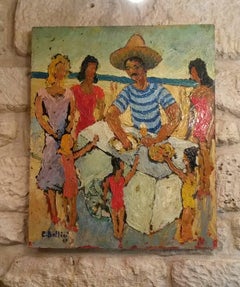
The Sorbet Merchant
By Emmanuel Bellini
Located in Paris, FR
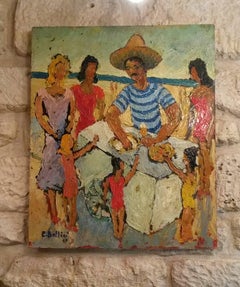
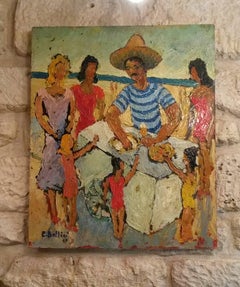
The sorbets merchant.
Beautiful oil on cardboard from the late 40's by the famous French listed artist Emmanuel BELLINI, 1904 -1989 depicting a scene of life in summer in the French ...
Category
1940s Fauvist Emmanuel Bellini Art
Materials
Canvas, Oil
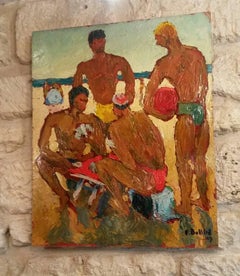
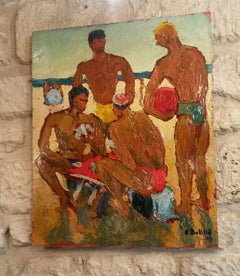
Men playing cards on the beach, French Riviera
By Emmanuel Bellini
Located in Paris, FR
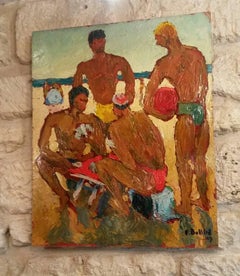
Joueurs de carte à la plage, Men playing cards on the beach on the French Riviera.
Beautiful oil on cardboard from the late 40's by the famous French listed artist Emmanuel BELLINI, 1904 -1989 depicting a scene in summer with men playing cards on a beach on the French Riviera.
The painting whose tones have accents of Fauvism and Impressionism is one of the first works of the artist begining his carreer as a painter in 1948.
The painting is signed at the bottom left and again on the back, dated 49 and titled.
Sold unframed.
Dimensions : 61 cm x 50 cm 24.0 in. x 19.68 in.
About thé artist :
Emmanuel Bellini b: 1904 d: 1989
Bellini was born in Monaco during the “Belle Epoque” era to a working class loving family of Italian descent. Surrounded by an idyllic setting where the air was perfumed by the flowers and fruits of the Mediterranean, meeting with the the colors of the sky, sun and earth. This formed an indelible palette in the young mind of this artist. An era of horse drawn carriages, polite society, the nearby theatre and opera house, all appealed and stimulated the senses of the young man who set to work as an apprentice in Nice for the architect Charles Damas, who was instrumental in the designs of the famous Paris Opera House and that of Monaco.
Later becoming an architect himself, in his search of the purity of the line, his internal compass directed him to the sea, the sailboats, the magical backdrop of the Casino and its gardens which persisted to inspire and capture his imagination. This led him to create his iconic posters for the Automobile Club of Monaco, as well as the special Galas and events of Monaco, and the city of Cannes. It was only a matter of time before his paintings were brought to the attention of the outside world. First exhibiting in 1949 at the Galerie Lambert in Paris, and quickly followed by the famed Galerie Petrides leading to many other exhibits in various galleries across the cities of Europe. His style is unique, reminiscent of far away impressionism, but with accents of fauvism.
With his success, Bellini purchased the baroque Italian Chapel in Cannes formerly owned by the Princess Kara-Georgevich of Serbia. Complete with bell tower and garden, it became his studio, and where he entertained the many luminaries who would visit him from the musicians of his day (Mireille Mathieu, Tino Rossi, Manitas de Plata…) to the artists ( Marie Laurencin, Maurice Utrillo, Carzou, Miro, Brayer…)to the celebrities and royalty (Lilly Pons, Prince Rainier III of Monaco, Mitty Goldin among many others). Here in this beautiful setting, he recreated the settings of the 1930’s that so intrigued him throughout his life in oil and water colors. His love of the theatre and music propelled him to create sets for opera and theatre houses...
Category
1940s Fauvist Emmanuel Bellini Art
Materials
Canvas, Oil
Men playing cards on the beach, French Riviera
By Emmanuel Bellini
Located in Paris, FR
Joueurs de carte à la plage, Men playing cards on the beach on the French Riviera.
Beautiful oil on cardboard from the late 40's by the famous French listed artist Emmanuel BELLINI, 1904 -1989 depicting a scene in summer with men playing cards on a beach on the French Riviera.
The painting whose tones have accents of Fauvism and Impressionism is one of the first works of the artist begining his carreer as a painter in 1948.
The painting is signed at the bottom left and again on the back, dated 49 and titled.
Sold unframed.
Dimensions : 61 cm x 50 cm 24.0 in. x 19.68 in.
About thé artist :
Emmanuel Bellini b: 1904 d: 1989
Bellini was born in Monaco during the “Belle Epoque” era to a working class loving family of Italian descent. Surrounded by an idyllic setting where the air was perfumed by the flowers and fruits of the Mediterranean, meeting with the the colors of the sky, sun and earth. This formed an indelible palette in the young mind of this artist. An era of horse drawn carriages, polite society, the nearby theatre and opera house, all appealed and stimulated the senses of the young man who set to work as an apprentice in Nice for the architect Charles Damas, who was instrumental in the designs of the famous Paris Opera House and that of Monaco.
Later becoming an architect himself, in his search of the purity of the line, his internal compass directed him to the sea, the sailboats, the magical backdrop of the Casino and its gardens which persisted to inspire and capture his imagination. This led him to create his iconic posters for the Automobile Club of Monaco, as well as the special Galas and events of Monaco, and the city of Cannes. It was only a matter of time before his paintings were brought to the attention of the outside world. First exhibiting in 1949 at the Galerie Lambert in Paris, and quickly followed by the famed Galerie Petrides leading to many other exhibits in various galleries across the cities of Europe. His style is unique, reminiscent of far away impressionism, but with accents of fauvism.
With his success, Bellini purchased the baroque Italian Chapel in Cannes formerly owned by the Princess Kara-Georgevich of Serbia. Complete with bell tower and garden, it became his studio, and where he entertained the many luminaries who would visit him from the musicians of his day (Mireille Mathieu, Tino Rossi, Manitas de Plata…) to the artists ( Marie Laurencin, Maurice Utrillo, Carzou, Miro, Brayer…)to the celebrities and royalty (Lilly Pons, Prince Rainier III of Monaco, Mitty Goldin among many others). Here in this beautiful setting, he recreated the settings of the 1930’s that so intrigued him throughout his life in oil and water colors. His love of the theatre and music propelled him to create sets for opera and theatre houses...
Category
1940s Fauvist Emmanuel Bellini Art
Materials
Canvas, Oil
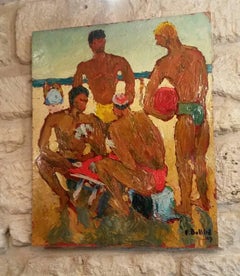
Men playing cards on the beach, French Riviera
By Emmanuel Bellini
Located in Paris, FR
Joueurs de carte à la plage, Men playing cards on the beach on the French Riviera.
Beautiful oil on cardboard from the late 40's by the famous French liste...
Category
1940s Fauvist Emmanuel Bellini Art
Materials
Canvas, Oil
The Sorbet Merchant
By Emmanuel Bellini
Located in Paris, FR
The sorbets merchant.
Beautiful oil on cardboard from the late 40's by the famous French listed artist Emmanuel BELLINI, 1904 -1989 depicting a scene of life in summer in the French Riviera with a sorbet merchant. The painting whose tones have accents of Fauvism and Impressionism is one of the first works of the artist.
The painting is signed at the bottom left and again on the back, dated 49 and titled.
Sold unframed.
Dimensions : 61 cm x 50 cm 24.0 in. x 19.68 in.
About thé artist :
Emmanuel Bellini b: 1904 d: 1989
Bellini was born in Monaco during the “Belle Epoque” era to a working class loving family of Italian descent. Surrounded by an idyllic setting where the air was perfumed by the flowers and fruits of the Mediterranean, meeting with the the colors of the sky, sun and earth. This formed an indelible palette in the young mind of this artist. An era of horse drawn carriages, polite society, the nearby theatre and opera house, all appealed and stimulated the senses of the young man who set to work as an apprentice in Nice for the architect Charles Damas, who was instrumental in the designs of the famous Paris Opera House and that of Monaco.
Later becoming an architect himself, in his search of the purity of the line, his internal compass directed him to the sea, the sailboats, the magical backdrop of the Casino and its gardens which persisted to inspire and capture his imagination. This led him to create his iconic posters for the Automobile Club of Monaco, as well as the special Galas and events of Monaco, and the city of Cannes. It was only a matter of time before his paintings were brought to the attention of the outside world. First exhibiting in 1949 at the Galerie Lambert in Paris, and quickly followed by the famed Galerie Petrides leading to many other exhibits in various galleries across the cities of Europe. His style is unique, reminiscent of far away impressionism, but with accents of fauvism.
With his success, Bellini purchased the baroque Italian Chapel in Cannes formerly owned by the Princess Kara-Georgevich of Serbia. Complete with bell tower and garden, it became his studio, and where he entertained the many luminaries who would visit him from the musicians of his day (Mireille Mathieu, Tino Rossi, Manitas de Plata…) to the artists ( Marie Laurencin, Maurice Utrillo, Carzou, Miro, Brayer…)to the celebrities and royalty (Lilly Pons, Prince Rainier III of Monaco, Mitty Goldin among many others). Here in this beautiful setting, he recreated the settings of the 1930’s that so intrigued him throughout his life in oil and water colors. His love of the theatre and music propelled him to create sets for opera and theatre houses...
Category
1940s Fauvist Emmanuel Bellini Art
Materials
Canvas, Oil
The Sorbet Merchant
By Emmanuel Bellini
Located in Paris, FR
The sorbets merchant.
Beautiful oil on cardboard from the late 40's by the famous French listed artist Emmanuel BELLINI, 1904 -1989 depicting a scene of life in summer in the French ...
Category
1940s Fauvist Emmanuel Bellini Art
Materials
Canvas, Oil
La Belle Epoque of the Vichy Baths by Emmanuel Bellini
By Emmanuel Bellini
Located in Paris, FR
Vivid colours oil on canvas from the 60's by the famous French listed artist Emmanuel BELLINI ( 1904-1989 ), depicting the Belle epoque period and its kiosk of the thermal natural springs at the VICHY Spa in the begining of the 20th century named Belle Epoque.
The painting is post impressionnist style and the resort atmosphère perfectly rendered.
The oil is in excellent condition, signed on the left bottom, again on the back and titled.
Sold unframed.
Dimensions : 73 cm x 60 cm 28.74 in. x 23.62 in.
About thé artist :
Emmanuel Bellini b: 1904 d: 1989
Bellini was born in Monaco during the “Belle Epoque” era to a working class loving family of Italian descent. Surrounded by an idyllic setting where the air was perfumed by the flowers and fruits of the Mediterranean, meeting with the the colors of the sky, sun and earth. This formed an indelible palette in the young mind of this artist. An era of horse drawn carriages, polite society, the nearby theatre and opera house, all appealed and stimulated the senses of the young man who set to work as an apprentice in Nice for the architect Charles Damas, who was instrumental in the designs of the famous Paris Opera House and that of Monaco.
Later becoming an architect himself, in his search of the purity of the line, his internal compass directed him to the sea, the sailboats, the magical backdrop of the Casino and its gardens which persisted to inspire and capture his imagination. This led him to create his iconic posters for the Automobile Club of Monaco, as well as the special Galas and events of Monaco, and the city of Cannes. It was only a matter of time before his paintings were brought to the attention of the outside world. First exhibiting in 1949 at the Galerie Lambert in Paris, and quickly followed by the famed Galerie Petrides leading to many other exhibits in various galleries across the cities of Europe. His style is unique, reminiscent of far away impressionism, but with accents of fauvism.
With his success, Bellini purchased the baroque Italian Chapel in Cannes formerly owned by the Princess Kara-Georgevich of Serbia. Complete with bell tower and garden, it became his studio, and where he entertained the many luminaries who would visit him from the musicians of his day (Mireille Mathieu, Tino Rossi, Manitas de Plata…) to the artists ( Marie Laurencin, Maurice Utrillo, Carzou, Miro, Brayer…)to the celebrities and royalty (Lilly Pons, Prince Rainier III of Monaco, Mitty Goldin among many others). Here in this beautiful setting, he recreated the settings of the 1930’s that so intrigued him throughout his life in oil and water colors. His love of the theatre and music propelled him to create sets for opera and theatre houses...
Category
1960s Post-Impressionist Emmanuel Bellini Art
Materials
Canvas, Oil
H 23.63 in W 28.75 in D 1.19 in
Men playing cards on the beach, French Riviera
By Emmanuel Bellini
Located in Paris, FR
Joueurs de carte à la plage, Men playing cards on the beach on the French Riviera.
Beautiful oil on cardboard from the late 40's by the famous French liste...
Category
1940s Fauvist Emmanuel Bellini Art
Materials
Canvas, Oil
Emmanuel Bellini art for sale on 1stDibs.
Find a wide variety of authentic Emmanuel Bellini art available for sale on 1stDibs. You can also browse by medium to find art by Emmanuel Bellini in lithograph and more. Much of the original work by this artist or collective was created during the 1950s and is mostly associated with the Impressionist style. Not every interior allows for large Emmanuel Bellini art, so small editions measuring 32 inches across are available. Customers who are interested in this artist might also find the work of Robert Daughters, Levon West, and Zamy Steynovitz. Emmanuel Bellini art prices can differ depending upon medium, time period and other attributes. On 1stDibs, the price for these items starts at $995 and tops out at $995, while the average work can sell for $995.