Ernst August Leuteritz Centerpieces
to
2
2
2
2
2
2
2
2
2
2
2
4
101
59
49
41
Creator: Ernst August Leuteritz
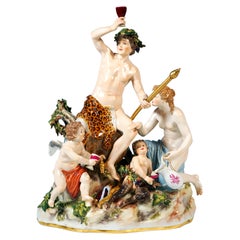
Large Meissen Bacchanal Group, Bacchus And His Entourage, By Leuteritz, Ca. 1860
By Ernst August Leuteritz, Meissen Porcelain
Located in Vienna, AT
Bacchus with a nymph, putto and satyr grouped around a wine barrel:
The cheerful youthful god, his head crowned with a dense wreath of vines, his loins covered with a large leopard s...
Category
1880s German Rococo Antique Ernst August Leuteritz Centerpieces
Materials
Porcelain
Large Meissen Cupid Group
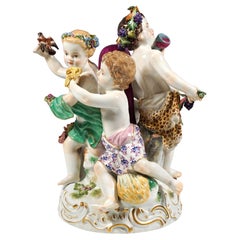
Allegory - The Four Seasons
, By Leuteritz, Ca. 1880
By Ernst August Leuteritz, Meissen Porcelain
Located in Vienna, AT
An excellent and rare Meissen group of the seasons with large figures:
Four amoretti wrapped in cloths grouped on a rock, representing the four seasons: a female amoretto as spring w...
Category
1880s German Rococo Antique Ernst August Leuteritz Centerpieces
Materials
Porcelain
Related Items
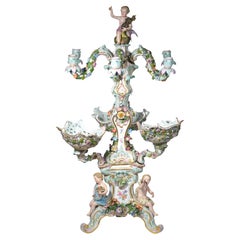
Monumental Meissen Porcelain Four Elements Centerpiece/Candelabra
By Meissen Porcelain
Located in New York, NY
A Monumental Meissen Porcelain Elemental Centerpiece/Candlabra with Bowls and Candelabra Arms. The centerpiece is composed of porcelain in a multipart structure integrating both bow...
Category
1860s German Rococo Antique Ernst August Leuteritz Centerpieces
Materials
Porcelain

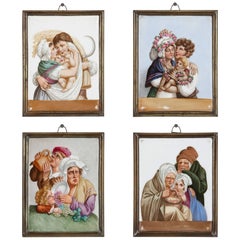
Four Meissen Porcelain Plaques Depicting the Four Seasons
By Meissen Porcelain
Located in London, GB
This delicately detailed set of four allegorical porcelain plaques portrays family scenes within the theme of the four seasons: Spring, Summer, Autumn and Winter.
Spring can be ide...
Category
Early 19th Century German Folk Art Antique Ernst August Leuteritz Centerpieces
Materials
Metal
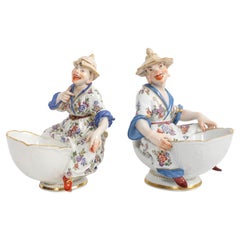
Pair of Meissen Porcelain Chinoiserie Figural Sweetmeat Dishes, J.J. Kandler
By Meissen Porcelain
Located in New York, NY
A fine pair of Meissen porcelain chinoiserie figural sweetmeat dishes, after a model by J.J. Kandler
Each with a Malabar chinoiserie figure seated on...
Category
Mid-20th Century German Rococo Ernst August Leuteritz Centerpieces
Materials
Porcelain
$11,800 / set
H 8 in W 6.75 in D 5.5 in
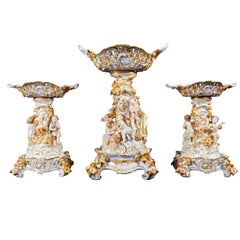
Meissen Porcelain Chinoiserie "Gold Dragon" Flower-Encrusted Garniture
By Meissen Porcelain
Located in New York, NY
A Meissen porcelain ‘Gold Dragon’ pattern three-piece garniture.
A Meissen porcelain reticulated three-piece basket Garniture and stands.
...
Category
Late 19th Century German Rococo Antique Ernst August Leuteritz Centerpieces
Materials
Porcelain
$78,500 / set
H 21 in W 12 in D 8.5 in
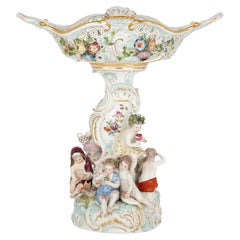
Large Meissen porcelain Rococo style centrepiece
By Meissen Porcelain
Located in London, GB
Large Meissen porcelain Rococo style centrepiece
German, Late 19th Century
Height 42cm, width 40cm, depth 25cm
According to a design by E. A. Leuteritz,...
Category
Late 19th Century German Rococo Antique Ernst August Leuteritz Centerpieces
Materials
Porcelain
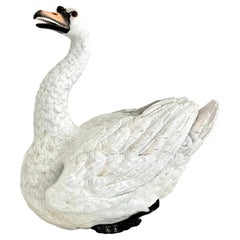
Fine Large Late 18th - Early 19th Century Meissen Porcelain Model of a Swan
By Meissen Porcelain
Located in New York, NY
A fine, exceptionally detailed large Meissen model of a swan, modelled by J. J. Kändler, with incised plumage, the feathers of the wings picked out in soft grey and beige, with russe...
Category
Late 18th Century German Neoclassical Antique Ernst August Leuteritz Centerpieces
Materials
Porcelain
$9,500
H 14.25 in W 9.25 in D 13.5 in
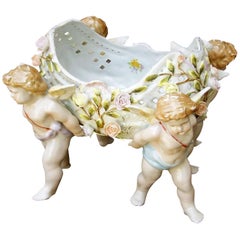
19th Century Viennese Porcelain Figural Cherub Jardinière or Centrepiece Bowl
By Meissen Porcelain
Located in Vigonza, Padua
This item is a big 19th century Viennese porcelain centerpiece bowl or jardinière beautifully enameled in rich colors with floral sprays and gilt highlights. This stunning Rococo pie...
Category
Mid-19th Century Austrian Rococo Antique Ernst August Leuteritz Centerpieces
Materials
Porcelain
$5,695
H 9.85 in W 11.82 in D 10.63 in
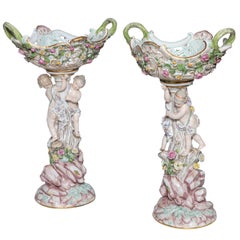
Pair of 19th Century Meissen Porcelain Cupid Centerpieces with Baskets
By Meissen Porcelain
Located in New York, NY
Pair of 19th century Meissen Porcelain compote centerpieces with cupids running after each other around a tree with filigree baskets on top with raised...
Category
19th Century German Antique Ernst August Leuteritz Centerpieces
Materials
Porcelain
$6,500 / item
H 15 in W 5.5 in D 4 in
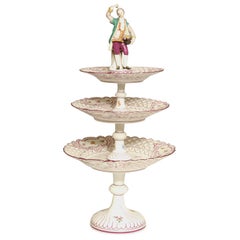
Meissen Three-Tiered Porcelain Dessert Stand with Figural Finial
By Meissen Porcelain
Located in Great Barrington, MA
This wonderful three-tiered Meissen dessert stand is decorated with hand-painted floral reserves and pierced graduated plates with magenta borders. Per...
Category
Early 20th Century German Ernst August Leuteritz Centerpieces
Materials
Porcelain, Paste
German 19th Century Berlin Porcelain Kpm Covered Bacchus Tureen Centerpiece
By Royal Porzellan Bavaria KPM Germany Handarbeit.
Located in Los Angeles, CA
A very fine German 19th century Berlin porcelain covered Tureen, the finial in form of an infant Bacchus on a domed cover with molded band and painted scenes divided by floral sprays...
Category
19th Century German Classical Greek Antique Ernst August Leuteritz Centerpieces
Materials
Porcelain

$4,950 Sale Price
33% Off
H 13 in Dm 10.38 in
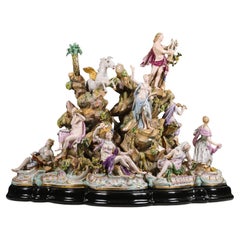
A Monumental Meissen Porcelain Figural Group of Mount Parnassus
By Meissen Porcelain
Located in Brighton, West Sussex
A Monumental Meissen Porcelain Figural Group of Apollo and the Nine Muses on Mount Parnassus.
Comprised of sixteen interlocking parts. Apollo standing holding a lyre and with Pegasus besides a tree, atop a rocky outcrop detailed with foliage and waterfalls above nine goddesses:
Calliope, seated and shown writing, representing eloquence and epic poetry.
Clio, seated with an open book and blowing a trumpet, representing history.
Erato, seated and holding a kithara, representing science and the arts
Euterpe, seated and holding a flute, representing music.
Melpomene, seated holding a knife and with one hand to her head, representing tragedy.
Thalia, seated and holding aloft mask, representing comedy and idyllic poetry.
Urania, seated with telescope and globe, representing astronomy and astrology,
Polyhymnia, standing with one hand raised and holding a book, representing sacred poetry.
Terpsichore, standing, representing dance.
Each piece exceptionally finely detailed and painted. The base portions with rocaille edges. On a later black polished wooden base.
Multiple blue crossed swords marks. Each piece titled to underside.
German, Circa 1880.
Mount Parnassus, is a spur of the Pindus Mountains in central Greece and was sacred to the ancient Greeks and in mythology to Apollo, the god of music and poetry and of the Sun and light. Mount Parnassus the mythical centre of poetry, music, and learning in ancient Greece was a popular theme in Barqoue and Rococo art, often substitutable with Athena’s arrival at Mount Helicon from the fifth book of Ovid’s “Metamorphoses”, where she asks the Muses to show her the new spring which gushed forth from the spot where Pegasus “with his hoof of horn opened the earth” (V, 250-260).
Here, the mountain, formed from rugged rock cliffs, culminates in a plateau on which the youthful Apollo stands and plays the lyre. The Castalian spring flows from beneath Pegasus’ hoof, representing the source of inspiration and attracting the nine muses, who embody the arts and inspire creation through song, music, and dance.
Mount Parnassus was created at the Meissen porcelain manufactory as a table centrepiece and an earlier version, apparently with only five muses, is listed in the inventory of the pastry shop of the Meissen manufactory manager and cabinet minister Heinrich Graf Brühl in 1753. The storage in the pastry shop of approximately 3,000 objects and dishes, including many individual parts for centrepieces, is related to their function as table decorations, replacing decorations previously made by the confectioner from perishable materials such as sugar or wax.
The purpose of this table decoration was as a feast for the eyes to accompany the feast of the banquet. The sculptural figurines often depicted a particular theme, with characters drawn from theatre and opera, from classical mythology or pastoral idylls. Allegories and mythological themes, such as the glorification of fine arts, were also popular. Stylistically, Mount Parnassus fits Kändler’s style of the 1740s, and was sold by Brühl in 1762 to Frederick the Great of Prussia who used mythology as a means of self-expression and had already ordered individual figures of Apollo and the Muses as table decorations in 1744. Today it is in the Museum of Applied Arts, Frankfurt (inv. no. M.L. 41). There is another version of Mount Parnassus, from the collection of Prince Alexander Dolgorukoff, in the Hermitage in Saint Petersburg.
The present version dates to the second half of the nineteenth century when there was a great revival of Kändler rococo figurines which were reissued and a “Second Rococo”. Another nineteenth century example is in the collection of the Museo Francesco Borgogna, Italy (inv. 1906, XIII, 19-20). These nineteenth century versions were made by the Meissen factory using Kändler's period models. It is recorded that a new version of Mount Parnassus, dating to the 1880s, was part of the Royal Porcelain collection in Dresden:
'In the porcelain collection there is a new version from the 1880s based on the old models, the largest group of this genre, the Parnassus, which shows the named muses all around on the lower part of the rock, each practising their own art, while on the top there is Apollo with the lyre and next to it the Castalian spring rises from the hoofbeat of Pegasus. Each figure is executed individually with its rocky background, and all the pieces are then fitted together, as we have already seen in his earlier, larger compositions. The rock pieces are finished off like a pedestal at the bottom with Rococo ornaments.' (Jean Louis Sponsel, Kabinettstücke der Meissner Porzellan-manufaktur von Johann Joachim Kändler, Leipzig, 1900, pp. 203-204).
Kunst und kunsthandwerk; monatsschrift herausgegeben vom Österreichischen museum fuer kunst und industrie, Vienna, 1894, v.7 pt.1, p.133.
Kari Berling, Das Meißner Porzellan und seine Geschichte. Leipzig 1900, S. 99, 187-200.
Helmuth Gröger, Johann Joachim Kaendler. Dresden, 1956.
Peter W Meister, Franz Adrian Dreier, Figürliche Keramik aus zwei Jahrtausenden. Kat Museum für Kunsthandwerk, Frankfurt. Frankfurt 1964, Nr. 90.
Rainer Rückert, Meißener Porzellan, 1710-1810. Kat. Ausst. Bayerisches Nationalmuseum München. München 1966.
Stefan Bursche, Tafelzier des Barock. München 1974, Abb. 300.
"Tafelaufsatz, Der Parnass", Auswahlkatalog, Museum für Kunsthandwerk (Frankfurt am Main, Germany), 1987, pp. 86-87.
Alfred Ziffer, ‘Meissener Porzellanplastik für fürstliches Interieur und Zeremoniell’, Keramos, Issue 241/242, pp. 29–52.
MEISSEN
The production of Meissen porcelain began in 1710 at the manufactory at Meissen...
Category
19th Century German Rococo Antique Ernst August Leuteritz Centerpieces
Materials
Porcelain
$266,714
H 26.78 in W 36.23 in D 24.02 in
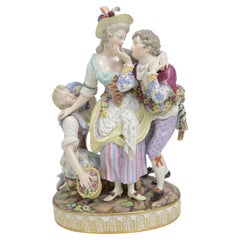
19th Century Meissen Group of Lovers
By Meissen Porcelain
Located in Brighton, Sussex
An enchanting late 19th Century large porcelain group of two ladies competing for the heart of a nobleman. Having wonderful bold colours, garlands of flowers, and an under glaze blue...
Category
Late 19th Century German Romantic Antique Ernst August Leuteritz Centerpieces
Materials
Porcelain
Previously Available Items
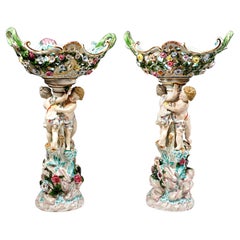
Pair Of Splendid Meissen Porcelain Centerpieces With Cupids, Leuteritz, Ca. 1860
By Meissen Porcelain, Ernst August Leuteritz
Located in Vienna, AT
The pair of centrepieces was designed by Leuteritz using old molds in the Rococo style:
Towering rocks from which a tree trunk rises in the middle, crowned by a column piece with a s...
Category
1860s German Rococo Revival Antique Ernst August Leuteritz Centerpieces
Materials
Porcelain
H 15.75 in W 9.45 in D 7.09 in
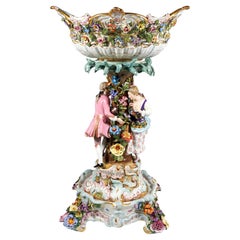
Meissen Splendour Centerpiece With Gallant Couple On Pedestal, Leuteritz, c 1870
By Ernst August Leuteritz, Meissen Porcelain
Located in Vienna, AT
The centrepiece was designed by Leuteritz using old moulds in the Rococo style:
A round, flat, cone-shaped base with abundant rocaille relief decoration, a strong palm tree rising in...
Category
19th Century German Rococo Revival Antique Ernst August Leuteritz Centerpieces
Materials
Porcelain
H 23.63 in W 11.82 in D 11.82 in
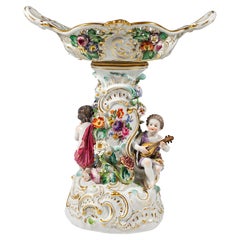
Meissen Splendid Centerpiece With Music Playing Children, by Leuteritz, Mid-20th
By Meissen Porcelain, Ernst August Leuteritz
Located in Vienna, AT
The centerpiece was designed by Leuteritz using old forms in Rococo style:
High, round rocaille base, centered a high column, covered on the front and back with large rocaille panel...
Category
Mid-20th Century German Rococo Ernst August Leuteritz Centerpieces
Materials
Porcelain
H 12.8 in W 11.23 in D 7.68 in
Meissen Tall Splendour Centerpiece With Gallant Couple, by Leuteritz, c 1870
By Meissen Porcelain, Ernst August Leuteritz
Located in Vienna, AT
The centerpiece was designed by Leuteritz using old forms in the Rococo style: a round, conical rock base with a small, round pedestal, with a palm tree in the middle, around which a...
Category
19th Century German Rococo Revival Antique Ernst August Leuteritz Centerpieces
Materials
Porcelain
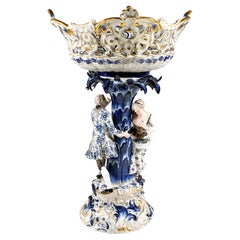
H 19.49 in W 12.8 in D 11.62 in
Ernst August Leuteritz centerpieces for sale on 1stDibs.
Ernst August Leuteritz centerpieces are available for sale on 1stDibs. These distinctive items are frequently made of porcelain and are designed with extraordinary care. There are many options to choose from in our collection of Ernst August Leuteritz centerpieces, although beige editions of this piece are particularly popular. Many of the original centerpieces by Ernst August Leuteritz were created in the Rococo style in germany during the mid-20th century. If you’re looking for additional options, many customers also consider centerpieces by Johann Joachim Kändler, and Meissen Porcelain. Prices for Ernst August Leuteritz centerpieces can differ depending upon size, time period and other attributes — on 1stDibs, these items begin at $5,826 and can go as high as $5,826, while a piece like these, on average, fetch $5,826.