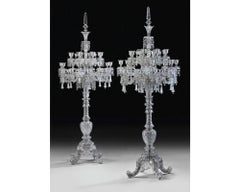
F. C. Osler Floor Lamps

British

British glassmakers F. C. Osler redefined the art of cut-glass design in an era of Victorian luxury, refinement and grandeur.

The firm began in Birmingham in 1807 by Thomas Osler, who established his business making small glass ornaments and pieces for chandeliers. His sons, Follett and Clarkson Osler, joined the company and, in 1831, reorganized it as F. C. Osler. 

During the 1840s, F. C. Osler expanded production to include the manufacture of chandeliers and glass furnishings, opening a second workshop in London in 1845. The company focused on producing large-scale designs, leading to the creation of one of their most famous pieces: the 27-foot-high, four-ton Crystal Fountain for London’s Great Exhibition in 1851. Another notable F. C. Osler piece at the exhibition was a pair of eight-foot-high candelabras purchased by Prince Albert for Queen Victoria. Today, they are on display as part of the Royal Collection at Osborne House on the Isle of Wight.

The success of F. C. Osler’s Crystal Fountain established the company’s reputation as one of the finest glassmakers of the 19th century. Wealthy clients coveted its cut-glass chandeliers, wall sconces, epergnes, candelabras and decorative centerpieces

F. C. Osler also received several important commissions. In 1856, F. C. Osler designed a large chandelier for St. George’s Hall in Liverpool and a 36-light chandelier for London’s Mansion House. In 1858, they were asked to produce tableware for a banquet held by Queen Victoria at Aston Hall, in Birmingham. The Queen is said to have been so impressed with the glassware she asked permission to keep a champagne glass.

F. C. Osler thrived throughout the late 19th century, experimenting with complex cut-glass motifs and expanding its successful export market to India. They became a favorite glassmaker for Indian royalty and aristocratic English ex-pats. 

By the 1920s, demand for cut-glass products waned, and F. C. Osler closed its Birmingham factory in 1922. The company remained in business, albeit on a much smaller scale, until 1976.

Today, F. C. Osler remains a symbol of grand Victorian glassmaking and is sought by antique collectors and interior designers worldwide.

On 1stDibs, discover a range of antique F. C. Osler lighting, decorative objects and serveware.

to
1
1
Height
to
1
1
1
1
1
1
1
1
1
1
1
24
197
188
138
128
Creator: F. C. Osler
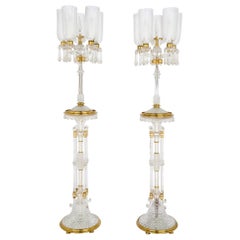
Very Large Pair Antique English Cut Crystal Gilt Metal Candelabra Osler
By F. C. Osler
Located in London, GB
Very Large Pair Antique English Cut Crystal Gilt Metal Candelabra Osler English, c. 1880 Height 183.5cm / 186cm, diameter 40cm This luxurious pair of large antique candelabra showc...
Category

Late 19th Century English Belle Époque Antique F. C. Osler Floor Lamps

Materials

Crystal, Metal

Related Items
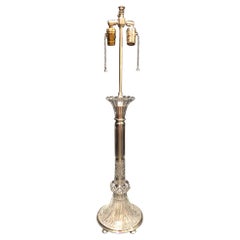
Cut Crystal Lamp By F&C Osler
By F. C. Osler
Located in Norwood, NJ
F&C Osler marked cut crystal lamp. Silver over bronze mounted fine quality cut crystal lamp. Of elegant column form with flared base and tulip form top. 2...
Category

Early 20th Century English Regency Revival F. C. Osler Floor Lamps

Materials

Crystal, Silver Plate, Bronze

Cut Crystal Lamp By F&C Osler
$2,175
H 33 in Dm 8.5 in
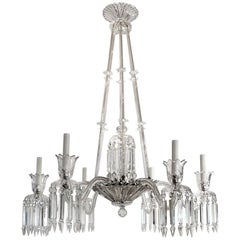
19th Century English Cut Crystal Chandelier, Signed F C Osler
By F. C. Osler
Located in Pittsburgh, PA
This six light chandelier by the renowned firm of F & C Osler, is of rare design and a first rate example the the glass cutters art! Originally gas powere...
Category

Mid-19th Century English Victorian Antique F. C. Osler Floor Lamps

Materials

Crystal

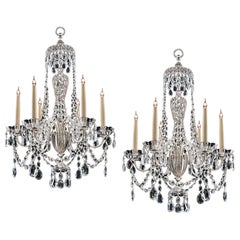
A Pair Of Silvered and Crystal Chandeliers By Osler Faraday
By Faraday Son, F. C. Osler
Located in Steyning, West sussex
The baluster stem centred by a spiral urn and corresponding canopy, with cascading chains. The candle branches are swaged with drapes and fitted with drop hung pans.
Category

Early 20th Century English F. C. Osler Floor Lamps

Materials

Crystal, Metal

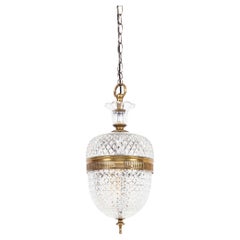
Antique Ornate F&C Osler Pineapple Cut Glass Light Pendant Lamp, C.1910
By F. C. Osler
Located in London, GB
An elegantly formed cut glass pendant light made in Birmingham (England) by F& C Osler. c.1910 Thick hand cut glass shades, with a central pierced gilt brass band and glass covered ...
Category

1910s English Art Nouveau Vintage F. C. Osler Floor Lamps

Materials

Brass

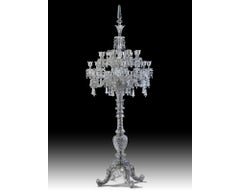
Cristalleries De Baccarat, a Large French Cut-Crystal Tsarine Torchere
By Cristalleries De Baccarat
Located in Queens, NY
Cristalleries De Baccarat, A Large French Cut-Crystal Twenty-Four Light Tsarine Torcheres, Standing Floor Chandelier. "A Magnificent Chandelier" Each central stem issuing twenty-four out-scrolled candle branches suspending prisms and bell-flowers, on four splayed supports, in the Indian Maharaja style, stamped BACCARAT throughout. 86" high x 33" wide Wired for electricity. In overall excellent condition. The torchère is fully complete and there are no damages associated.Ready to place. Comparative Literature: Lerch, Moscou, Splendeurs des Romanov, Exhibition catalogue, 11 July – 13 September 2009, Monaco, pp. 214-217. M. Lerch, Baccarat: la légende du cristal, Exhibition catalogue, 15 October 2014 – 4 January 2015, Paris, pp.68-69. D. Sautot, The Story of Baccarat, Paris, 1993. Cristalleries de Baccarat: The origins of the manufacture, also known as the Compagnie des Cristalleries de Baccarat, can be traced to 1764. On this year, King Louis XV accorded to the Bishop of Metz permission to establish a glass factory on his land, in the small village of Baccarat in Lorraine, in order to compete with the celebrated Bohemian production. Lorraine is traditionally a glass-making region, due to the abundance of silica in the soil and due to its large forests, which supplied the wood to fuel the ovens. Francois-Eugène de Fontenay, who joined the company in 1841, discovered that the addition of nickel oxide in the manufacturing process resulted in a perfectly clear product, 'crystal glass', that was free of discoloration and that imitated precious rock crystal. For this discovery, the Baccarat company was awarded a gold medal at the French Expositions des Produits de l'Industrie in 1844. Continually experimenting with their manufacturing process, the quality of Baccarat's 'crystal glass' improved, reaching the highest level by the end of the century. The Baccarat manufacture rapidly became a leading producer with highly skilled maître-verriers. In 1823, Baccarat participated for the first time at the National Exhibition. Louis XVIII was seduced by the quality of the pieces presented, which received the praise of the jury and the first gold medal. As a result of their success and innovations, the manufacture gradually consolidated its reputation, which allowed it to dominate the French market. The Russian fascination for Baccarat: In 1867, Tsar Alexander II visited the Exposition Universelle in Paris and fell in awe in the sight of Baccarat’s stand...
Category

20th Century French F. C. Osler Floor Lamps

Materials

Crystal

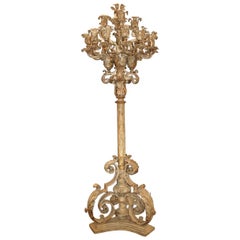
Antique Torcheres Floor Candelabra
Located in Atlanta, GA
Pair of palatial iron torcheres with 17 lights.
Category

19th Century Italian Antique F. C. Osler Floor Lamps

Materials

Iron

Antique Torcheres Floor Candelabra
$11,750 / set
H 89.5 in Dm 30 in
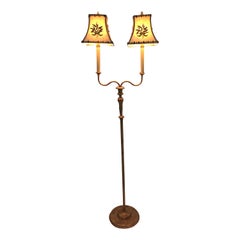
Very Pretty Two-Arm Gilt Metal Floor Lamp with Hand Embroidered Shades
By Tyndale
Located in Hopewell, NJ
An elegant gilt metal designer floor lamp having round base and two candlestick arms, with very pretty custom hand embroidered shades. By Raymond Waites...
Category

1990s American F. C. Osler Floor Lamps

Materials

Metal

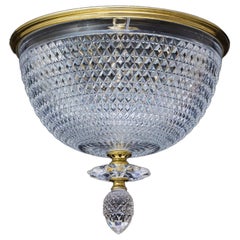
Large Cut Glass Plafonnier by F. C. Osler
By F. C. Osler
Located in Steyning, West sussex
A cut glass gilt mounted plafonier by F. & C. Osler with split diamond cut bowl issuing a cut glass star and pine cone finial, the metal stamped F&C O...
Category

Early 1900s British Victorian Antique F. C. Osler Floor Lamps

Materials

Cut Glass

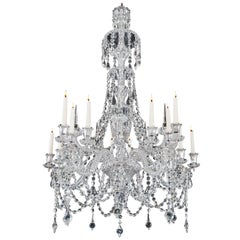
Fine Quality Eight Light Cut-Glass Antique Chandelier by F&C Osler
By F. C. Osler
Located in Steyning, West sussex
A fine quality eight-light cut-glass chandelier by F&C Osler of Birmingham the main baluster shaped stem centered by eight drop hung rope twist reverse crooks these with flute cut co...
Category

1860s English Victorian Antique F. C. Osler Floor Lamps

Materials

Silver Plate

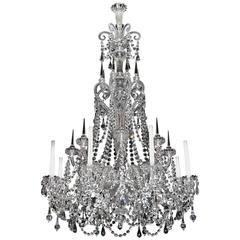
Unusual 15-Light Cut Glass Antique Chandelier by F&C Osler
By F. C. Osler
Located in Steyning, West sussex
A fine quality cut glass fifteen-light chandelier by F&C Osler the main baluster shaped shaft surmounted by a drop hung canopy and a draping pan with cascading drapery terminating at...
Category

1860s English Victorian Antique F. C. Osler Floor Lamps

Materials

Silver Plate

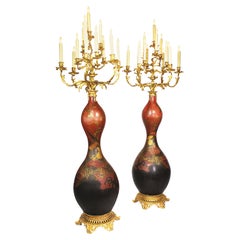
Pair 19th Century Japanese Imari Porcelain Gilt-Bronze Torchere Candelabra
By Imari Porcelain
Located in Los Angeles, CA
A fine Pair of 19th century Japanese Imari Porcelain and French Gilt-Bronze Mounted Thirteen-Light Celadon Torchere Candelabra. The bottle-shaped Japonisme vases with a Royal red background, decorated with parcel-gilt and black soaring eagles in the hunt within a forestall scene. Each Vase fitted and surmounted with a French 19th century Louis XV Style 13-Light scrolled candelabrum and all raised on a circular pierced gilt-bronze plinth. circa: 1880. Imari Porcelain (????) is the name for Japanese porcelain wares made in the town of Arita, in the former Hizen Province, northwestern Kyushu. They were exported to Europe extensively from the port of Imari, Saga, between the second half of the 17th century and the first half of the 18th century. The Japanese as well as Europeans called them Imari. In Japanese, these porcelains are also known as Arita-yaki (???). Imari or Arita porcelain has been continously produced up through the present day. Characteristics Though there are many types of Imari, Westerners' conception of Imari in the popular sense is associated only with a type of Imari produced and exported in large quantity in mid-17th century. This type is called Kinrande. Kinrande Imari is colored porcelain with cobalt blue underglaze and red and gold overglaze. The color combination was not seen in China at that time. Traditional Ming dynasty color porcelain used dominantly red and green, probably due to scarcity of gold in China, whereas gold was abundant in Japan in those days. The subject matter of Imari is diverse, ranging from foliage and flowers to people, scenery and abstractions. Some Imari design structures such as kraak style were adopted from China, but most designs were uniquely Japanese owing to the rich Japanese tradition of paintings and costume design. The porcelain has a gritty texture on the bases, where it is not covered by glaze. There is also blue and white Imari. Kakiemon style Imari is another type of Imari, but it tends to be categorized separately in Europe. History "Imari" was simply the trans-shipment port for Arita wares. It was the kilns at Arita which formed the heart of the Japanese porcelain industry. Arita's kilns were set up in the 17th century, when kaolin was discovered in 1616 by the immigrant Korean potter, Yi Sam-pyeong (1579–1655). (He may also be known by the name, "Kanage Sambei".) Yi Sam-Pyeong, along with his extended family of 180 persons, left Korea on the offer of a privileged position in Japan. This decision was made after the occurrence of certain Japanese invasions of Korea. After Yi Sam-Pyeong's discovery, his kilns began to produce revised Korean-style blue and white porcelains, known as "Shoki-Imari". In the mid-17th century there were also a lot of Chinese refugees in Northern Kyushu due to the turmoil on Chinese continent, and it is said one of them brought coloring technique to Arita. Thus Shoki-Imari developed into Ko-KutaniImari. Ko-Kutani was produced around 1650 for both export and domestic market. Blue and white porcelain continued to be produced and they are called Ai-Kutani. Ko-Kutani Imari for the export market usually adopted Chinese design structure such as kraak style, whereas Ai-Kutani for the domestic market were highly unique in design and are accordingly valued very much among collectors. Ko-Kutani style evolved into Kakiemon style Imari, which was produced for about 50 years around 1700. Imari achieved its technical and aesthetic peak in Kakiemon style, and it dominated European market. Blue and white Kakiemon is called Ai-Kakiemon. Kakiemon style transformed into Kinrande in the 18th century. Kinrande used blue underglaze and red and gold overglaze, and later some other colors. Imari began to be exported to Europe because the Chinese kilns at Ching-te-Chen were damaged in the political chaos and the new Qing dynasty government stopped trade in 1656–1684. Exports to Europe were made through the Dutch East India Company, but the designation "Imari Porcelain" in Europe connotes Arita wares of mostly Kinrande Imari. Export of Imari to Europe stopped in mid-18th century when China began export to Europe again, since Imari was not able to compete against China due to high labor cost. By that time, however, both Imari and Kakiemon style were already so popular among Europeans, Chinese export porcelain copied both Imari and Kakiemon style, which is called Chinese Imari. At the same time, European kilns, such as Meisen also tried to copy Imari and Kakiemon. Export of Imari surged again in late 19th century (Meiji era) when Japonism flourished in Europe. Thus in western world today, two kinds of Imari can...
Category

19th Century Japanese Japonisme Antique F. C. Osler Floor Lamps

Materials

Bronze, Ormolu

Pair 19th Century Japanese Imari Porcelain 
Gilt-Bronze Torchere Candelabra
Pair 19th Century Japanese Imari Porcelain 
Gilt-Bronze Torchere Candelabra
$18,950 Sale Price / set
61% Off
H 72.25 in Dm 24.25 in
Cristalleries De Baccarat, a Large Pair of French Cut-Crystal Tsarine Torcheres
By Cristalleries De Baccarat
Located in Queens, NY
Cristalleries De Baccarat, A Large Pair of French Cut-Crystal Twenty-Four Light Tsarine Torcheres, Standing Floor Chandeliers. "A Magnificent Pair of Chandeliers" Each central stem...
Category

20th Century French F. C. Osler Floor Lamps

Materials

Crystal

F. C. Osler floor lamps for sale on 1stDibs.

F. C. Osler floor lamps are available for sale on 1stDibs. If you’re looking for additional options, many customers also consider floor lamps by A Modern Grand Tour, CTO Lighting, and Tom Dixon.

Still Thinking About These?

All Recently Viewed