Federico Bartolini Art
Italian, 1861-1908
Federico Bartolini studied at the Academy of San Luca in Rome. In the 1880s, he began to paint with very neat oriental watercolors, probably made from photos. Bartolini exhibited at Accessories Workshop in Brussels, 1881 and Rome, 1883, among others.
to
2
Overall Width
to
Overall Height
to
2
2
1
1
1
2
2
1
2
10,225
2,785
2,504
1,382
2
1
1
Artist: Federico Bartolini
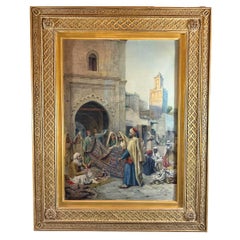
The Carpet Seller 19th Century Orientalist Antique Watercolor Painting on Paper
By Federico Bartolini
Located in Jacksonville, FL
Provenance
John Welles Hollenback, New York
The Painting is Signed FBartolini Lower Right
Federico Bartolini (Italian, 1861 - 1908)
Description:
Federico Bartolini was a renowned ...
Category
19th Century Academic Federico Bartolini Art
Materials
Paper, Watercolor
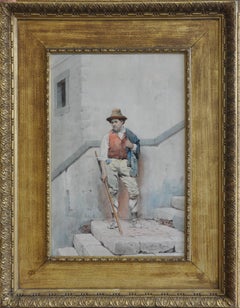
Portrait of an Italian Peasant - Victorian art watercolour painting
By Federico Bartolini
Located in Hagley, England
This beautiful 19th century Italian watercolour portrait painting is by noted artist Frederico Bartolini. It was painted circa 1890 in Rome and is signed and in good condition behind...
Category
19th Century Realist Federico Bartolini Art
Materials
Watercolor
Related Items
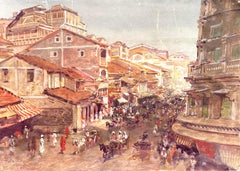
“India, 1912”
Located in Southampton, NY
Original watercolor and gouache on paper of a busy street scene in India done in 1912 by the American artist, William Henry Drake. Copyrighted signed and dated 1912 lower left. Condition is good. Recently professionally matted. Unframed. Overall matte size is 12 by 16 inches. Provenance: A Long Island, New York estate.
William Henry Drake
Born: 1856 New York
Died: 1926 Los Angeles
Nationality: American
Education: Académie Julian, Art Students League of New York
Known for: Painting, illustration
Awards: National Academy
Biography:
Drake studied at the Académie Julian in Paris, with Jean-Joseph Benjamin-Constant and Henri Lucien Doucet.
Back from Europe, he studied at the Cincinnati School of Design, and would often go to the zoo, where he could draw the animals. He was then employed by the Museum of Natural History. He continued to study at the Art Students League of New York. In 1878 he worked as a freelance pen-and-ink artist for such periodicals as Century or Harper’s with animal studies...
Category
1910s Academic Federico Bartolini Art
Materials
Paper, Watercolor, Gouache

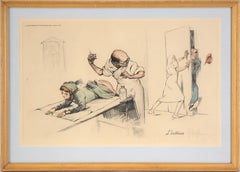
"L
intrus" - Satirical French Illustration - Hand Colored Lithograph
By Gaston Hoffmann
Located in Soquel, CA
Comical illustration by Gaston Hoffmann (French, 1883-1977). A doctor is giving a shot to a female patient, while a nurse tries to prevent a man from barging in.
Pencil signed "G Ho...
Category
1950s Realist Federico Bartolini Art
Materials
Paper, Watercolor, Lithograph
$236 Sale Price
20% Off
H 13 in W 18 in D 0.5 in
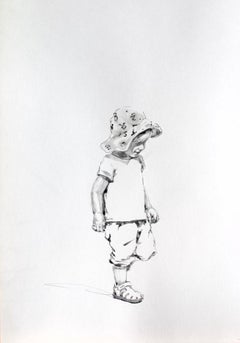
On the walk
Located in Oslo, NO
A minimalist but masterfully executed monochrome watercolor. The work is striking in its lightness - although there is nothing on it except the figure of a child, from the way he is ...
Category
2010s Realist Federico Bartolini Art
Materials
Paper, Watercolor, Pencil
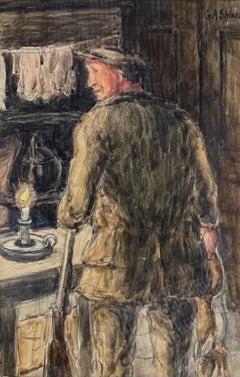
“Bringing Home the Game”
Located in Southampton, NY
Original watercolor with graphite tracings of a hunter bring home the fresh game by the British artist, George Anderson Short. Signed top right. ...
Category
1940s Academic Federico Bartolini Art
Materials
Watercolor, Archival Paper, Graphite
$297 Sale Price
30% Off
H 7.5 in W 4.75 in D 1 in
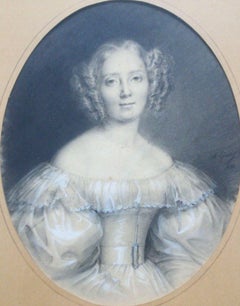
French 19th Century Romantic Period 1830s Paris Society Beauty Portrait
By Adele Grasset
Located in Norwich, GB
A astounding portrait of a society beauty by Adele Grasset (active ca 1830-1850). With an open face and and lightly smiling lips, she is wearing a gown typical of the romantic period. Drawn in graphite and heightened with white, the drawing is dated 1836
As often with woman artists of the 18th and 19th century, there is little biographical information available on Adèle Grasset. We do know however, that she had studied with the highly prominent artist François Gérard (1770-1837) , known also as the Baron Gérard...
Category
1830s Academic Federico Bartolini Art
Materials
Paper, Charcoal, Gouache
$1,701
H 11.82 in Dm 9.06 in
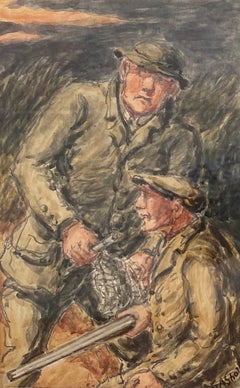
“The Hunters”
Located in Southampton, NY
Original watercolor with graphite tracings of two hunters in the field by the British artist, George Anderson Short. Signed bottom right. Circa ...
Category
1940s Academic Federico Bartolini Art
Materials
Watercolor, Archival Paper, Graphite
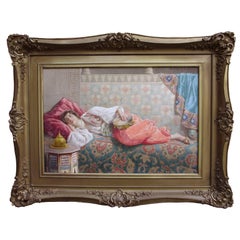
A Fine Orientalist Pencil and Watercolor Reclining Middle Eastern Beauty
By Francesco Ballesio 2
Located in LA, CA
Francesco Ballesio (Italian, 1860-1923). A fine orientalist pencil and watercolor heightened with gum Arabic on paper figure of "A Middle-Eastern Beauty at Rest" depicting a young ma...
Category
Early 1900s Academic Federico Bartolini Art
Materials
Paper, Watercolor, Pencil
$18,950
H 23 in W 30.5 in D 2.25 in
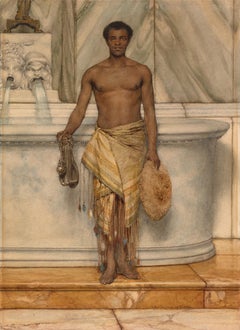
The Balneator by Sir Lawrence Alma-Tadema
By Sir Lawrence Alma-Tadema
Located in New Orleans, LA
Sir Lawrence Alma-Tadema
1836-1912 Dutch
The Balneator
Signed and inscribed "L Alma Tadema. op CLXXVI." (lower right)
Pencil and watercolor with scratching out on paper on board
...
Category
19th Century Academic Federico Bartolini Art
Materials
Paper, Watercolor, Board, Pencil
$175,000
H 21.5 in W 17.13 in D 2 in
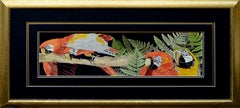
Scarlett Macaw Parrots and Ferns Watercolor, Large-Scale Horizontal Panorama
Located in Soquel, CA
Scarlett Macaw Parrots and Ferns Watercolor, Large-Scale Horizontal Panorama
A substantial horizontal watercolor of four Scarlett Macaw parrot...
Category
Late 20th Century Realist Federico Bartolini Art
Materials
Paper, Watercolor
$920 Sale Price
20% Off
H 24.5 in W 44 in D 1 in
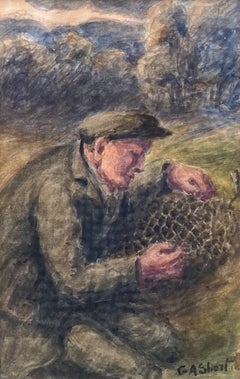
“The Hunter”
Located in Southampton, NY
Original watercolor with graphite tracings of a solitary hunter in the field by the British artist, George Anderson Short. Signed bottom right. ...
Category
1940s Academic Federico Bartolini Art
Materials
Watercolor, Archival Paper, Graphite
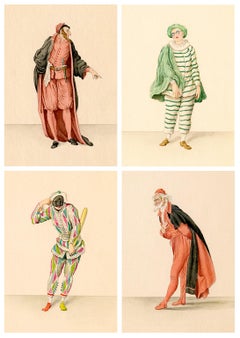
Commedia dell
arte – Four Character Studies in Watercolor, 1920s
Located in Myrtle Beach, SC
Unidentified artist, 'Commedia dell’arte' – four character studies (Arlecchino, Pantalone, Pantalone giovane, Tartaglia), watercolor and pencil, c. 192...
Category
1920s Realist Federico Bartolini Art
Materials
Pencil, Watercolor
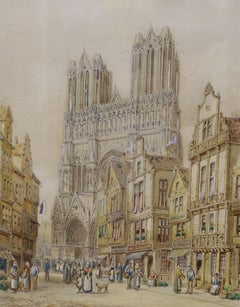
Rheims Cathedral
By Henri Schäfer
Located in Middletown, NY
Watercolor and gouache on cream wove paper. Signed and titled in watercolor in the lower right image area. Small circular pea-sized damp stain in the top center image area (visible in the are of the sky), and some additional small spots of unobtrusive foxing in the upper left sheet area. Otherwise in very good condition with fresh colors and intricate brushwork.
Henri Schäfer...
Category
1870s Realist Federico Bartolini Art
Materials
Watercolor, Gouache, Archival Paper
Previously Available Items
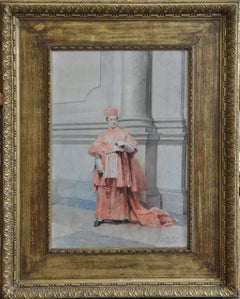
Catholic Cardinal - Italian artist 19thC religious art painting reading Rome
By Federico Bartolini
Located in Hagley, England
A beautiful Italian Realist watercolour portrait of an Italian catholic Cardinal against a backdrop of the buildings by the 19th century Italian arti...
Category
19th Century Realist Federico Bartolini Art
Materials
Watercolor
Federico Bartolini art for sale on 1stDibs.
Find a wide variety of authentic Federico Bartolini available for sale on 1stDibs. You can also browse by medium to find art by Federico Bartolini in paint, watercolor, paper and more. Not every interior allows for large Federico Bartolini, so small editions measuring 21 inches across are available. Customers who are interested in this artist might also find the work of William Edward Frost, Ferdinand Victor Leon Roybet , and Jean Baptiste Édouard Detaille. Federico Bartolini prices can differ depending upon medium, time period and other attributes. On 1stDibs, the price for these items starts at $5,370 and tops out at $79,000, while the average work can sell for $42,185.