Filippo de Grado Still-life Prints
to
1
6
3
Overall Width
to
Overall Height
to
9
27
97
71
65
58
9
9
6
3
2
2
1
1
1
1
1
1
1
1
1
9
9
Artist: Filippo de Grado
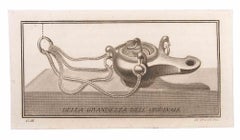
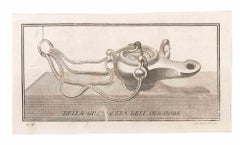
Oil Lamp to Hang - Etching by Filippo de Grado - 18th Century
By Filippo de Grado
Located in Roma, IT
Oil Lamp to Hang is an Etching realized by Filippo de Grado (1705-1780).
The etching belongs to the print suite “Antiquities of Herculaneum Exposed” (original title: “Le Antichità ...
Category
18th Century Old Masters Filippo de Grado Still-life Prints
Materials
Etching
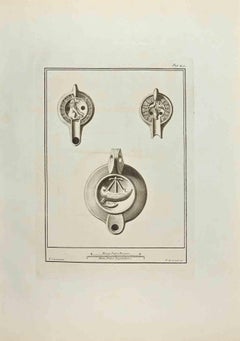
Ancient Still Life 4 - Etching by Filippo de Grado - 18th Century
By Filippo de Grado
Located in Roma, IT
Still Life from "Antiquities of Herculaneum" is an etching on paper realized by Filippo de Grado e Vincenzo Campana in the 18th Century.
Signed on the plate.
Good conditions with s...
Category
18th Century Old Masters Filippo de Grado Still-life Prints
Materials
Etching
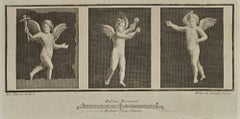
Cupid In Pompeian Fresco - Etching by Filippo de Grado - 18th Century
By Filippo de Grado
Located in Roma, IT
Cupid In Pompeian Fresco from "Antiquities of Herculaneum" is an etching on paper realized by Filippo De Grado in the 18th Century.
Signed on the plate.
Good conditions with some f...
Category
18th Century Old Masters Filippo de Grado Still-life Prints
Materials
Etching
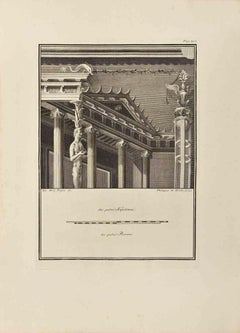
Temple With Sphinx - Etching by Filippo de Grado - 18th Century
By Filippo de Grado
Located in Roma, IT
Temple With Sphinx from "Antiquities of Herculaneum" is an etching on paper realized by Filippo De Grado in the 18th Century.
Signed on the plate.
Good conditions and aged with som...
Category
18th Century Old Masters Filippo de Grado Still-life Prints
Materials
Etching
Oil Lamp With Heads of Animals - Etching by Filippo de Grado - 18th Century
By Filippo de Grado
Located in Roma, IT
Oil Lamp With Heads of Animals from "Antiquities of Herculaneum" is an etching on paper realized by Filippo De Grado in the 18th Century.
Signed on the plate.
Good conditions.
The etching belongs to the print suite “Antiquities of Herculaneum Exposed” (original title: “Le Antichità di Ercolano Esposte”), an eight-volume volume of engravings of the finds from the excavation of the ruins of Herculaneum in the Kingdom of Naples (now Campania, Italy).
It was published between 1757 and 1792 by the Regia Stamperia, and copies were delivered to selected recipients across Europe.
Despite the title, the Antiquity of Herculaneum shows objects from all the excavations undertaken by the Bourbons in the Gulf of Naples. These include Pompeii, Stabia and two sites of Herculaneum: Resina and Portici.
The Bourbon King Carlo appointed fifteen scholars creating a new “Herculaneum Academy” to study the artifacts and publish the results of the archaeological excavations of the sites.
The engravings are of high quality and the accompanying text shows a large scholarship.
They were realized by 25 prominent artists involved by the King to prepare drawings and engravings on the finds, among which we can find Giovanni Elia Morghen, Carlo Nolli, Luigi Vanvitelli, and Giovanni Battista Casanova.
The “Antiquities” was designed more to amaze readers with the quality of the objects in the collection of the King of Naples than to be used in research., following and increasing the interest of 18th-century society for the classical culture and Art in particular.
Through the exaltation of the classical concept of proportions and harmony, the book was of inspiration to the neoclassical movement in Europe, giving artists and decorators access to a huge shop of Hellenistic motifs.Oil Lamp With Animals...
Category
18th Century Old Masters Filippo de Grado Still-life Prints
Materials
Etching
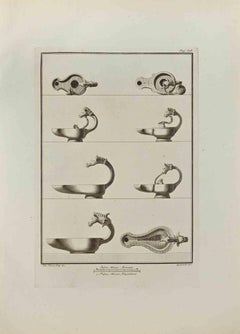
Oil Lamp to Hang - Etching by Filippo de Grado - 18th Century
By Filippo de Grado
Located in Roma, IT
Oil Lamp to Hang is an Etching realized by Filippo de Grado (1705-1780).
The etching belongs to the print suite “Antiquities of Herculaneum Exposed” (original title: “Le Antichità ...
Category
18th Century Old Masters Filippo de Grado Still-life Prints
Materials
Etching
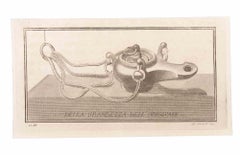
Oil Lamp With Decoration - Etching by Filippo de Grado - 18th Century
By Filippo de Grado
Located in Roma, IT
Oil Lamp With Decoration is an Etching realized by Filippo de Grado (1705-1780).
The etching belongs to the print suite “Antiquities of Herculaneum Exposed” (original title: “Le An...
Category
18th Century Old Masters Filippo de Grado Still-life Prints
Materials
Etching
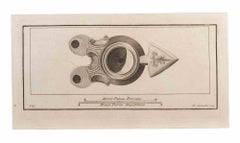
Oil Lamp to Hang - Etching by Filippo de Grado - 18th Century
By Filippo de Grado
Located in Roma, IT
Oil Lamp to Hang is an Etching realized by Filippo de Grado (1705-1780).
The etching belongs to the print suite “Antiquities of Herculaneum Exposed” (original title: “Le Antichità ...
Category
18th Century Old Masters Filippo de Grado Still-life Prints
Materials
Etching
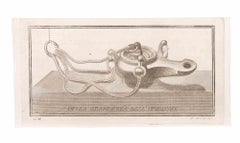
Oil Lamp to Hang - Etching by Filippo de Grado - 18th Century
By Filippo de Grado
Located in Roma, IT
Oil Lamp to Hang is an Etching realized by Filippo de Grado (1705-1780).
The etching belongs to the print suite “Antiquities of Herculaneum Exposed” (original title: “Le Antichità ...
Category
18th Century Old Masters Filippo de Grado Still-life Prints
Materials
Etching
Related Items
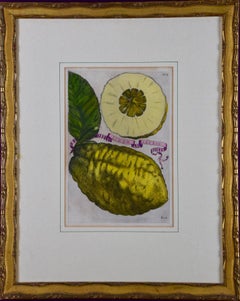
Limon Lavrae: A 17th C. Hand-colored Engraving of Lemon Anatomy by G. Ferrari
By Giovanni Battista Ferrari
Located in Alamo, CA
This 17th century hand-colored engraving of a lemon entitled "Limon Lavrae", plate 219 from Giovanni Baptista Ferrari's publication "Hesperides, sive, De Malorum Aureorum Cultura Etu...
Category
17th Century Old Masters Filippo de Grado Still-life Prints
Materials
Engraving

$1,575
H 23.25 in W 18.5 in D 0.75 in
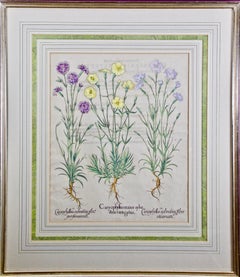
Besler Hand Colored Botanical Engraving of Wood Pink
Cottage Pink Flowers
Located in Alamo, CA
A 17th century hand-colored copper plate engraving entitled "Caryophyllus Maior Sylve Strisvarie Gatus" (Wood Pink & Cottage Pink Flowers) from Basilius Besler's landmark work, Hortus Eystettensis (Garden at Eichstatt), first published in 1613 in Eichstatt, Germany near Nuremberg and later in 1640 and 1713.
This engraving is presented in a silver and gold-colored wood frame with a green edge and three elaborate cream-colored French mats...
Category
17th Century Old Masters Filippo de Grado Still-life Prints
Materials
Engraving
$3,975
H 31 in W 27 in D 1 in
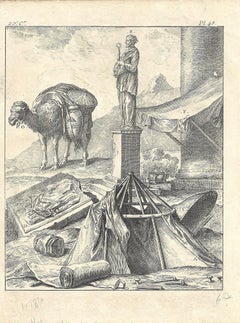
A Hebrew nomadic camp – English School, 18th century
Located in Middletown, NY
Engraving on light weight laid paper with an small indiscernible, alphabetic watermark, 9 x 7 1/2 (230 x 188 mm); sheet 11 1/4 x 8 1/2 inches (284 x 215 mm), wide margins. In very go...
Category
18th Century Old Masters Filippo de Grado Still-life Prints
Materials
Ink, Handmade Paper, Laid Paper, Woodcut
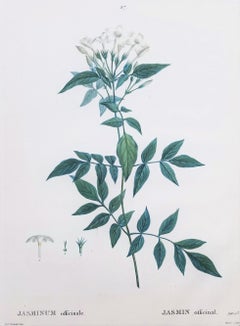
Jasminum officinale (Common jasmine) /// Pierre-Joseph Redouté Botanical Flower
By Pierre-Joseph Redouté
Located in Saint Augustine, FL
Artist: (after) Pierre-Joseph Redouté (French, 1759-1840)
Title: "Jasminum officinale (Common jasmine)" (No. 27 page 93)
Portfolio: Traité des Arbres et Arbustes que l'on Cultive en ...
Category
Early 1800s Old Masters Filippo de Grado Still-life Prints
Materials
Watercolor, Engraving
$600
H 20.75 in W 13.44 in
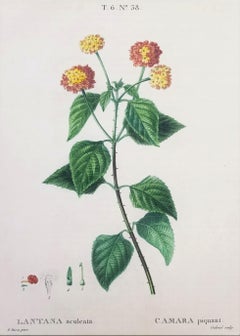
Lantana aculeata (Common Lantana) /// Pancrace Bessa Flower Plant Botanical Art
Located in Saint Augustine, FL
Artist: (after) Pancrace Bessa (French, 1772-1846)
Title: "Lantana aculeata (Common Lantana)" (T.6. No. 38)
Portfolio: Traité des Arbres et Arbustes que l'on Cultive en France en Ple...
Category
Early 1800s Old Masters Filippo de Grado Still-life Prints
Materials
Watercolor, Engraving
$600
H 20.69 in W 13.5 in
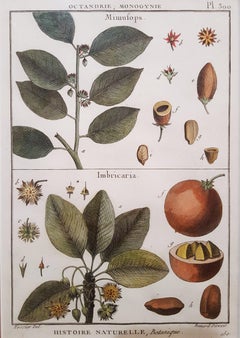
Mimufops (Mimusops); Ibricaria (Shingle Oak) /// Botanical Botany Plants Buffon
By Georges-Louis Leclerc, Comte de Buffon
Located in Saint Augustine, FL
Artist: Georges-Louis Leclerc, Comte de Buffon (French, 1707-1788)
Title: "Mimufops (Mimusops); Ibricaria (Shingle Oak)" (Octandreie, Monogynie, Plate 300)
Portfolio: Histoire Nature...
Category
1740s Old Masters Filippo de Grado Still-life Prints
Materials
Watercolor, Laid Paper, Engraving, Intaglio
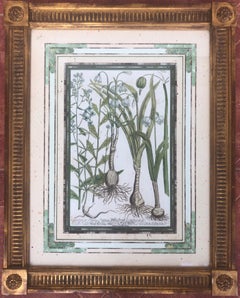
18Th Century Botanical Engraving
By Johann Wilhelm Weinmann
Located in Lake Worth Beach, FL
Rare Botanical Hand Colored Engraving about 1737-1745
Beautifully framed French hand painted mat, in gold leaf frame each print measure 9.5x14.5 with the frame 23.5hx18.5x1
Johann ...
Category
Early 18th Century Old Masters Filippo de Grado Still-life Prints
Materials
Engraving
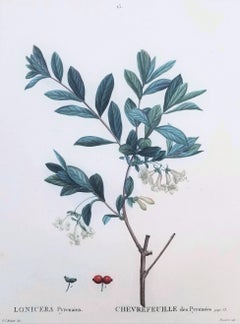
Lonicera Pyrenaica (Pyrenean honeysuckle) /// Pierre-Joseph Redouté Botanical
By Pierre-Joseph Redouté
Located in Saint Augustine, FL
Artist: (after) Pierre-Joseph Redouté (French, 1759-1840)
Title: "Lonicera Pyrenaica (Pyrenean honeysuckle)" (No. 15 page 53)
Portfolio: Traité des Arbres et Arbustes que l'on Cultiv...
Category
Early 1800s Old Masters Filippo de Grado Still-life Prints
Materials
Watercolor, Engraving
$600
H 20.94 in W 13.57 in
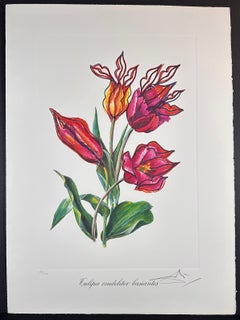
Florals Kissing Tulips
By Salvador Dalí
Located in Hollywood, FL
ARTIST: Salvador Dali
TITLE: Florals Kissing Tulips
MEDIUM: Etching on Heavy Arches paper
SIGNED: Hand Signed by Salvador Dali
PUBLISHER: Editions Graphiques Internationales
ED...
Category
1970s Surrealist Filippo de Grado Still-life Prints
Materials
Etching
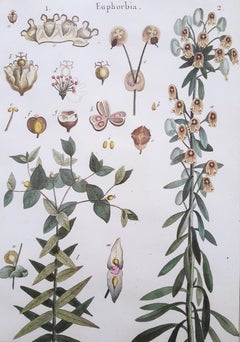
Euphorbia (Spurge) /// Antique Botanical Botany Plants Engraving Buffon Science
By Georges-Louis Leclerc, Comte de Buffon
Located in Saint Augustine, FL
Artist: Georges-Louis Leclerc, Comte de Buffon (French, 1707-1788)
Title: "Euphorbia (Spurge)" (Dodecandrie, Trigynie, Plate 411)
Portfolio: Histoire Naturelle
Year: 1749-1789
Medium...
Category
1740s Old Masters Filippo de Grado Still-life Prints
Materials
Watercolor, Laid Paper, Engraving, Intaglio
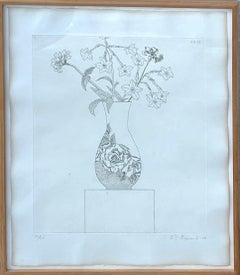
Zen Minimalist Flowers Etching American Modernist Ed Baynard Pop Art Print
By Ed Baynard
Located in Surfside, FL
ED BAYNARD (American, 1940-2016)
Flowers, Flowers in a Vase, Etching.
1979/1980,
Hand signed, dated l.r.,
Hand numbered from small edition 12/24,
Dimensions: 23 by 19 in. Framed 25 by 21 in
Born in Washington, D.C. in 1940. Raised in Washington, D.C. and newly graduated from high school, he flew to Europe living off and on in Paris and London. During this time, he designed costumes for Jimi Hendrix, worked as a graphic designer for the Beatles as well as Elizabeth Taylor and Richard Burton. Returning to New York, he dedicated his life to art after a surprise success with his first show in 1971 at the Willard Gallery in NYC. Ed's images are Zen-like in their simplicity and grace rendered in a flat, graphic style that recalls Japanese Ukiyo-e prints. His watercolors are luminous, like the rest of his representations regardless of the medium. The Japanese inspired ukiyo-e style woodblock prints and lithograph works he created at Tyler Graphics in 1980 contain a 20th century "floating world" sensibility. Ed's wish was to bring harmony, color, and a meditative stillness to this chaotic planet. He did so in a gentle and powerful way, always as an expression of his deep gratitude for the love and beauty, friendship, and concerns he held dearest. His first solo exhibition was in 1971 at New York's legendary Willard Gallery on the recommendation of Agnes Martin. Baynard went on to have exhibitions at galleries including Betty Parsons Gallery, New York (1973); Marian Goodman Gallery, New York (1977); John Berggruen Gallery, San Francisco (1980); and Barbara Gladstone Gallery, New York (1980/81).. Baynard manages to retain a simplicity of form inspired by a love of Japanese Woodblock prints. His new works reflect the same poetry of his earlier paintings, retaining his stylized compositions with their Zen like minimalism and Oriental calm, along with a new sense of rhythm and movement. Baynard uses familiar themes such as flowers, plants, pots, and vases, incorporating them into his delicate watercolor still lifes, thus creating stunning visual feasts. He was included in the 1972 Landscape exhibition at MoMA NY alone with other luminaries James Boynton...
Category
1980s American Modern Filippo de Grado Still-life Prints
Materials
Etching
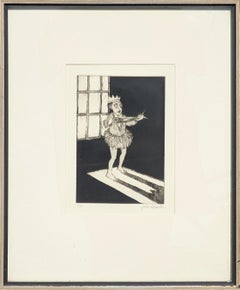
"Momma Always Wanted a Dancer" Black
White Surreal Etching of a Child
Fish
By John Alexander
Located in Houston, TX
Black and white surreal aquatint and etching of a child by Texas artist John Alexander. The work features a child-like figure dressed in a tutu and crown holding a fish in outstretch...
Category
1990s Surrealist Filippo de Grado Still-life Prints
Materials
Paper, Etching, Aquatint
$4,500
H 20.25 in W 16.63 in D 1.63 in
Filippo De Grado still-life prints for sale on 1stDibs.
Find a wide variety of authentic Filippo de Grado still-life prints available for sale on 1stDibs. You can also browse by medium to find art by Filippo de Grado in etching and more. Much of the original work by this artist or collective was created during the 18th century and is mostly associated with the Old Masters style. Not every interior allows for large Filippo de Grado still-life prints, so small editions measuring 10 inches across are available. Filippo de Grado still-life prints prices can differ depending upon medium, time period and other attributes. On 1stDibs, the price for these items starts at $198 and tops out at $512, while the average work can sell for $245.