Francesco Spicuzza Art
Italian, American, 1883-1962
Italian-born Francesco Spicuzza was primarily a Wisconsin painter who did portraits, still-lives and local landscapes. He spent the first part of his life in near-poverty to become a painter. An eternal optimist, in 1917, the artist reported: "I am happy and my only ambition now is to paint better and better until I shall have reached the measure of the best of which I am capable." (Spicuzza, 1917, p. 22). His predilection for beach scenes germinated early: reportedly, the five-year-old boy first drew the outlines of his father's fishing boat in the sand on the seashore near their home in Sicily. After setting himself up as a fruit peddler in Milwaukee, Spicuzza's father sent for his family when Francesco was eight years old.
In 1899 or 1900, Spicuzza began studying drawing and anatomy under Robert Schade (1861-1912), a painter of panoramas who had been trained in Munich under Carl Theodor von Piloty. Spicuzza was also taught by Alexander Mueller (1872-1935), a product of the Weimar and Munich academies.
The earliest influences in his work appear to be from Edward H. Potthast and Maurice Prendergast, though Spicuzza never mentioned either artist. Already in August 1910, Spicuzza was described in a newspaper as "one of the most talented of Milwaukee's rising workers." He undoubtedly received lasting inspiration from his one summer study period in 1911 with John F. Carlson at the Art Students League's Summer School in Woodstock, New York. Although he executed numerous still-lives and an occasional religious work, Spicuzza is best known for his Milwaukee beach scenes populated with frolicking bathers in multi-colored attire, not unlike the images of Potthast, who used a similar technique. These beach genre scenes reflect the attitude of American impressionists who depicted the more pleasant side of life.
Spicuzza manipulated a successful balance of rich pigment applied in varying degrees of impasto texture with subtle nuances of hue. Working all'aperto, he sought "the soft enticing shades of yellow, blue, green, pink and lavender . . . to get the effects of bright glistening summer air." (L.E.S., n.d.). As a painter whose color not only derived from direct observation but also from a personal theory of color symbolism, Spicuzza traded the linear approach of lithography for dynamic patches of brilliant color. Like Prendergast, he would often tilt the angle of the picture plane to bring the viewer's position above the scene.
Spicuzza spent a great deal of time painting en plein air and by 1925 he began summering at Big Cedar Lake, near West Bend, Wisconsin to gather his subject matter. During the difficult era of the Depression, patrons came to Spicuzza's aid and during the 40s, he taught housewives, businessmen and students at the Milwaukee Art Institute, the Milwaukee Art Center, and in his studio. In the following decade, although his kind of art was no longer popular in the "make-it-or-break-it" New York gallery world, Spicuzza enjoyed regular patronage and sales.
Bio by Richard H. Love and Michael Preston Worley, Ph.D.to
13
13
8
5
4
2
1
1
1
1
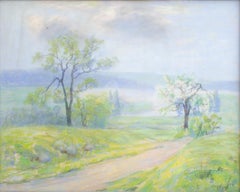
Beautiful large impressionist pastel by Francesco Spicuzza
By Francesco Spicuzza
Located in New York, NY
Francesco Spicuzza (American, 1883-1962)
Untitled Landscape, 20th century
Pastel on paper
Sight size: 24 x 30 in.
Framed: 26 1/4 x 32 3/8 in.
Signed lower right: Spicuzza
Italian-born Francesco Spicuzza was primarily a Wisconsin painter who did portraits, still-lives and local landscapes. He spent the first part of his life in near-poverty to become a painter. An eternal optimist, in 1917, the artist reported: "I am happy and my only ambition now is to paint better and better until I shall have reached the measure of the best of which I am capable." (Spicuzza, 1917, p. 22). His predilection for beach scenes germinated early: reportedly, the five-year-old boy first drew the outlines of his father's fishing boat in the sand on the seashore near their home in Sicily. After setting himself up as a fruit peddler in Milwaukee, Spicuzza's father sent for his family when Francesco was eight years old. For the following six years the boy was unable to attend school because of his job in his father's fruit and vegetable business. The poor lad suffered a caved-in shoulder from carrying a heavy wooden crate.
The young Spicuzza was aided by moral and financial support from a sympathetic Milwaukee businessman named John Cramer, publisher and editor of the Evening Wisconsin, who raised Spicuzza's salary as a newspaper assembler so that he could attend school. In 1899 or 1900, Spicuzza began studying drawing and anatomy under Robert Schade (1861-1912), a painter of panoramas who had been trained in Munich under Carl Theodor von Piloty. Spicuzza was also taught by Alexander Mueller (1872-1935), a product of the Weimar and Munich academies. Mueller realized Spicuzza was a colorist and encouraged that orientation (Madle, 1961). Spicuzza found it beneficial to accept an apprenticeship in a lithographic studio for $8 a week, which demanded most of his time. During the St. Louis Universal Exposition in 1904, still a struggling student, Spicuzza attended the fair, thanks to Cramer. It was not long before Spicuzza received a twenty-five dollar portrait commission, and this inaugural success led to new commissions and allowed him to continue as a painter.
The earliest influences in his work appear to be from Edward H. Potthast and Maurice Prendergast, though Spicuzza never mentioned either artist. Already in August 1910, Spicuzza was described in a newspaper as "one of the most talented of Milwaukee's rising workers." He undoubtedly received lasting inspiration from his one summer study period in 1911 with John F. Carlson at the Art Students League's Summer School in Woodstock, New York. Certainly Spicuzza would have picked up spontaneity in handling the brush from Carlson. Although he executed numerous still-lives and an occasional religious work, Spicuzza is best known for his Milwaukee beach scenes populated with frolicking bathers in multi-colored attire, not unlike the images of Potthast, who used a similar technique. Many of these are small, preparatory works on canvas board executed between 1910 and 1915. Frequently with even greater animation than Potthast, Spicuzza produced moving images of youthful energy and uninhibited child's play. These beach genre scenes reflect the attitude of American impressionists who depicted the more pleasant side of life.
Spicuzza manipulated a successful balance of rich pigment applied in varying degrees of impasto texture with subtle nuances of hue. Working all'aperto, he sought "the soft enticing shades of yellow, blue, green, pink and lavender . . . to get the effects of bright glistening summer air." (L.E.S., n.d.). As a painter whose color not only derived from direct observation but also from a personal theory of color symbolism, Spicuzza traded the linear approach of lithography for dynamic patches of brilliant color. Like Prendergast, he would often tilt the angle of the picture plane to bring the viewer's position above the scene.
Spicuzza was unable to enter the 1913 Armory Show or the Panama-Pacific International Exposition two years later but he did submit work to the annual exhibitions of the Pennsylvania Academy of the Fine Arts and those of the Art Institute of Chicago. His first important award was the bronze medal presented by the St. Paul Institute in 1913, which was followed by the silver medal two years later. Before long, Spicuzza had acquired a greater sense of security in his profession and was described by a writer in International Studio (April 1917) as "an independent artist with an assured future. His pastels and water-colours are poetic and joyous bits of nature with a genuine out-of-door feeling." In 1918, his Spirit of Youth, exhibited at the National Academy of Design, sold for $112.50. Four years later, the artist achieved his greatest local recognition by winning the gold medal from the Milwaukee Art Institute.
Spicuzza spent a great deal of time painting en plein air and by 1925 he began summering at Big Cedar Lake, near West Bend, Wisconsin to gather his subject matter. Easter Morning (1926) owes something to the Symbolist movement, with its figure of Christ appearing over a seascape. During the difficult era of the Depression, patrons came to Spicuzza's aid and during the 40s, he taught housewives, businessmen and students at the Milwaukee Art Institute, the Milwaukee Art Center, and in his private studio. In the following decade, although his kind of art was no longer popular in the "make-it-or-break-it" New York gallery world, Spicuzza enjoyed regular patronage and sales. His beach scenes became more static and he would experiment with modernist techniques. Spicuzza died at the age of seventy-eight.
Sources:
L.E.S., "Do Colors Change a Person's disposition? Experiments of a Milwaukee Artist...
Category
20th Century American Modern Francesco Spicuzza Art
Materials
Paper, Pastel
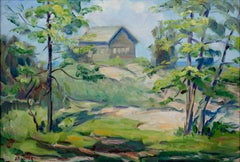
"Cabin on Lake Michigan Shore, " Oil on Board signed by Francesco Spicuzza
By Francesco Spicuzza
Located in Milwaukee, WI
"Cabin on Lake Michigan Shore" is an original oil painting on board by Francesco Spicuzza. The artist signed the piece in the lower left. It depicts a small cabin on the lakeshore surrounded by bright vegetation.
14" x 20" art
22 3/4" x 29" frame
Francesco J. Spicuzza, born in Sicily on July 23, 1883, came to America at the age of 8. He supported himself as a fruit peddler until a newspaperman gave him $4 a week to go to school. He attended classes at the Milwaukee Art Students League, where he studied under Alexander Mueller. There he learned to paint in the then-fashionable "Munich School" technique, with detailed realism in heavy browns and grayed-out hues. Spicuzza completed eight grades in four years, and then in 1911, three businessmen advanced him enough money to allow him to study in New York under artist and teacher John Carlson. It was during this time that Spicuzza changed his style of painting, developing an impressionistic use of color, form and atmospheric renditions. After a period of grinding poverty, one of Spicuzza's pictures won a major New York competition. It was the first of 60 wins, both in the U.S. and Paris. He became a fashionable painter, and many of the leading collections have his work. Spicuzza's typical works were beach scenes, still life, landscapes and portraits done in pastels, oils, ink, charcoal and watercolors. Much of his work traced the history of Milwaukee in the early 1900s. He was probably best known for his scenes of women and children splashing in the waves...
Category
1930s Francesco Spicuzza Art
Materials
Oil, Board
Early 20th century colorful seaside landscape pastel figures bench trees signed
By Francesco Spicuzza
Located in Milwaukee, WI
"Couple on Bench at the Beach" is an original pastel drawing on paperboard by Francesco Spicuzza. The artist signed the piece in the lower left. This drawing depicts two figures sitting on a bench in front of a body of water. The artist used mostly pastel colors for this piece.
6 7/8" x 9 7/8" art
18 1/2" x 21 3/8" frame
Francesco J. Spicuzza, born in Sicily on July 23, 1883, came to America at the age of 8. He supported himself as a fruit peddler until a newspaperman gave him $4 a week to go to school. He attended classes at the Milwaukee Art Students League, where he studied under Alexander Mueller. There he learned to paint in the then-fashionable "Munich School" technique, with detailed realism in heavy browns and grayed-out hues. Spicuzza completed eight grades in four years, and then in 1911, three businessmen advanced him enough money to allow him to study in New York under artist and teacher John Carlson. It was during this time that Spicuzza changed his style of painting, developing an impressionistic use of color, form and atmospheric renditions. After a period of grinding poverty, one of Spicuzza's pictures won a major New York competition. It was the first of 60 wins, both in the U.S. and Paris. He became a fashionable painter, and many of the leading collections have his work. Spicuzza's typical works were beach scenes, still life, landscapes and portraits done in pastels, oils, ink, charcoal and watercolors. Much of his work traced the history of Milwaukee in the early 1900s. He was probably best known for his scenes of women and children splashing in the waves...
Category
1910s Impressionist Francesco Spicuzza Art
Materials
Paper, Pastel, Board

"Lake Michigan Shore, " Oil on Board, Signed
By Francesco Spicuzza
Located in Milwaukee, WI
"Lake Michigan Shore" is an original oil painting on board by Francesco Spicuzza. The artist shows the impact of Impressionism in his landscapes from around 1930. "Lake Michigan Shor...
Category
1930s Francesco Spicuzza Art
Materials
Oil, Board
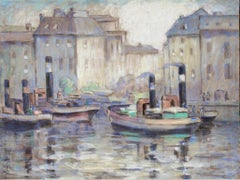
"Boats in Berlin Harbor, " Pastel on Cheesecloth by Francesco Spicuzza
By Francesco Spicuzza
Located in Milwaukee, WI
"Boats in Berlin Harbor" is an original pastel painting on cheesecloth. Small tugboats push across the Berlin harbor as a gauzy cityscape watches from behind.
Image: 25" x 33"
Frame...
Category
1920s American Modern Francesco Spicuzza Art
Materials
Pastel
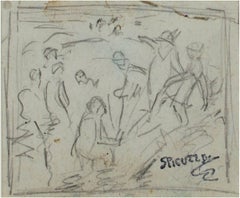
"Lake Michigan Bathers, " Pencil, Reverse,
Photo signed by Francesco Spicuzza
By Francesco Spicuzza
Located in Milwaukee, WI
"Lake Michigan Bathers" is an original pencil sketch by Francesco Spicuzza. The artist signed the piece in the lower right. On the reverse is a silver gelatin photo print...
Category
1910s Francesco Spicuzza Art
Materials
Carbon Pencil, Black and White, Silver Gelatin
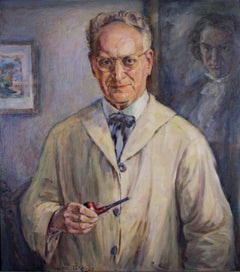
20th century oil painting self portrait male subject glasses pipe signed
By Francesco Spicuzza
Located in Milwaukee, WI
"Self Portrait" is an original oil painting on masonite board by Francesco Spicuzza. The artist signed the piece in the lower left. It depicts the artist holding a pipe in front of a...
Category
1940s Francesco Spicuzza Art
Materials
Masonite, Oil
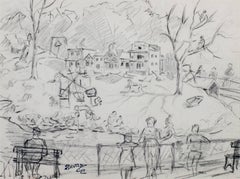
Mid 20th century black and white drawing landscape trees houses figures signed
By Francesco Spicuzza
Located in Milwaukee, WI
"Monkey Island at Washington Park Zoo" is an original graphite and charcoal drawing on paper by Francesco Spicuzza. It depicts a number of figures gazing out at a monkey enclosure at a zoo. The artist signed the piece in the lower left.
8 1/2" x 11 3/4" art
17 1/4" x 21 1/8" frame
Francesco J. Spicuzza, born in Sicily on July 23, 1883, came to America at the age of 8. He supported himself as a fruit peddler until a newspaperman gave him $4 a week to go to school. He attended classes at the Milwaukee Art Students League, where he studied under Alexander Mueller. There he learned to paint in the then-fashionable "Munich School" technique, with detailed realism in heavy browns and grayed-out hues. Spicuzza completed eight grades in four years, and then in 1911, three businessmen advanced him enough money to allow him to study in New York under artist and teacher John Carlson. It was during this time that Spicuzza changed his style of painting, developing an impressionistic use of color, form and atmospheric renditions. After a period of grinding poverty, one of Spicuzza's pictures won a major New York competition. It was the first of 60 wins, both in the U.S. and Paris. He became a fashionable painter, and many of the leading collections have his work. Spicuzza's typical works were beach scenes, still life, landscapes and portraits done in pastels, oils, ink, charcoal and watercolors. Much of his work traced the history of Milwaukee in the early 1900s. He was probably best known for his scenes of women and children splashing in...
Category
1950s Francesco Spicuzza Art
Materials
Paper, Charcoal, Graphite
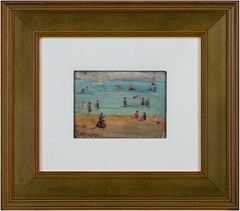
"Lake Michigan Beach Scene, " Oil on Canvas Seascape signed by Francesco Spicuzza
By Francesco Spicuzza
Located in Milwaukee, WI
"Lake Michigan Beach Scene" is an original oil painting by Francesco Spicuzza. The artist painted this scene on canvas and then glued that canvas to a b...
Category
1930s Francesco Spicuzza Art
Materials
Canvas, Oil, Board
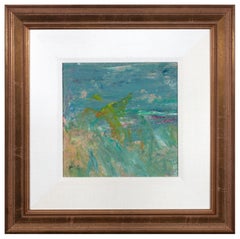
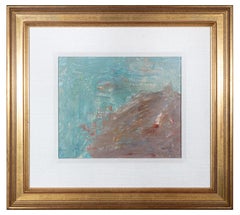
"Rocky Shore, " Oil on Board Abstract Landscape Signed
By Francesco Spicuzza
Located in Milwaukee, WI
"Rocky Shore" is an original oil painting on board by Francesco Spicuzza. The artist signed the piece with his signature stamp in the lower right. Land and water are clearly demarcat...
Category
1930s Francesco Spicuzza Art
Materials
Oil, Board
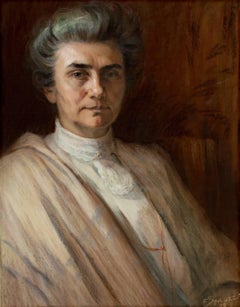
20th century portrait oil painting female subject dark background signed
By Francesco Spicuzza
Located in Milwaukee, WI
"Portrait of the Artist's Mother-in-Law" is an original pastel drawing by Francesco Spicuzza. The artist signed the piece in the lower right. This drawing depicts an elderly woman in beige clothing...
Category
Early 1900s Francesco Spicuzza Art
Materials
Pastel
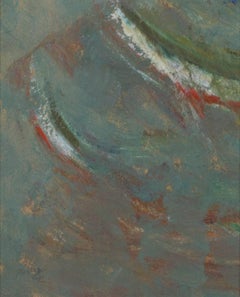
"Snowcapped Mountain, " Oil on Board signed by Francesco Spicuzza
By Francesco Spicuzza
Located in Milwaukee, WI
"Snowcapped Mountain" is an original oil painting on board by Francesco Spicuzza. The artist signed it with his signature stamp in the lower left. This painting depicts a mountain pe...
Category
1930s Francesco Spicuzza Art
Materials
Oil, Board
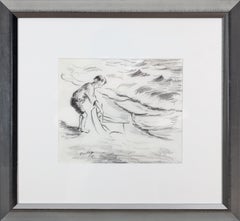
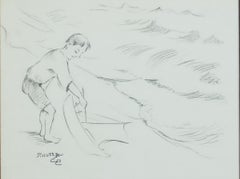
Boy Launching a Sailboat
By Francesco Spicuzza
Located in Milwaukee, WI
Graphite and charcoal on paper signed by the artist.
7.38" x 8.63"
16.75" x 15.5" frame
Framed to conservation standards. Float mounted on 100% cotton matboard and glazed in UF5 Plexiglass that filters 99% of UV Rays to ensure the preservation of the piece. All housed in a bold miter jointed bevel frame in distressed silver finish with reflective accents.
Francesco J. Spicuzza, born in Sicily on July 23, 1883, came to America at the age of 8. He supported himself as a fruit peddler until a newspaperman gave him $4 a week to go to school. He attended classes at the Milwaukee Art Students League, where he studied under Alexander Mueller. There he learned to paint in the then-fashionable "Munich School" technique, with detailed realism in heavy browns and grayed-out hues. Spicuzza completed eight grades in four years, and then in 1911, three businessmen advanced him enough money to allow him to study in New York under artist and teacher John Carlson.
It was during this time that Spicuzza changed his style of painting, developing an impressionistic use of color, form and atmospheric renditions. After a period of grinding poverty, one of Spicuzza's pictures won a major New York competition. It was the first of 60 wins, both in the U.S. and Paris. He became a fashionable painter, and many of the leading collections have his work. Spicuzza's typical works were beach scenes, still life, landscapes and portraits done in pastels, oils, ink, charcoal and watercolors. Much of his work traced the history of Milwaukee in the early 1900s. He was probably best known for his scenes of women and children splashing in the waves...
Category
Mid-20th Century Francesco Spicuzza Art
Materials
Charcoal, Graphite
Related Items
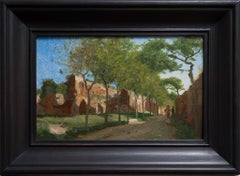
Oil Sketch From Rome Called Ruins of Ancient Rome, c. 1870-72
Located in Stockholm, SE
This beautiful oil sketch, painted en plein air, was created by Swedish artist Olof Arborelius during his stay in Italy from the fall of 1870 until January 1872. The painting features a charming depiction of ancient Roman ruins—either a city wall or an aqueduct—surrounded by lush trees under the clear Italian sky. With loose brushstrokes and a soft, atmospheric touch, the artist captures the natural light and Mediterranean ambiance, demonstrating his profound understanding of plein air painting.
Arborelius was heavily influenced by French artistic trends of the time, particularly in his color sensitivity and study of light and air. His time in Italy was critical for his artistic development, marking the height of his mastery in capturing the delicate interplay of light, color, and atmosphere.
Several of Arborelius’ Italian oil studies, including similar small-format plein air works, were later exhibited at various prestigious exhibitions. These include the Svenska konstnärernas förening memorial exhibition in 1910, the Svensk-Franska Konstgalleriet in Stockholm in 1931, and a memorial exhibition at the Nationalmuseum in 1943.
Viggo Loos praised Arborelius' Italian studies for their "sensitivity to color" and "intense exploration of light and atmosphere," highlighting these works as a high point in the artist's career. Loos emphasized how Arborelius skillfully captured the essence of the Mediterranean landscape, using vibrant tones and delicate brushwork to convey the interplay of light and air.
Moreover, Folke Holmér, the curator of Arborelius’ 1943 memorial exhibition, described his Italian sketches as some of the most painterly pieces of his early production, worthy of comparison with the best works Swedish artists had produced in Italy.
Among his notable works in major collections are three of his Italian oil studies held at the Nationalmuseum: View from Rome Towards the Arch of Septimius Severus...
Category
1870s Impressionist Francesco Spicuzza Art
Materials
Paper, Oil, Cardboard

$3,678
H 9.45 in W 13 in
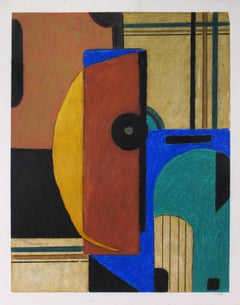
Untitled #5
By Jerry Opper
Located in San Francisco, CA
This artwork "Untitled #5" c.1970 is a colors pastel and crayon on thick paper by American artist Jerry Opper, 1924-2014. It is hand signed in pencil at the lower right corner by the artist. The image size is 22 x 17 inches, sheet size is 24 x 19 inches. It is in excellent condition, there are pastel marks on the margin all around the artwork and also on the back, see picture #1.
About the artist:
Jerry Opper was born in Cleveland, Ohio, on September 5, 1924. He moved to Los Angeles with his family in 1933. After graduating from Hollywood High School, he worked in movie studios and attended art classes at Chouinard Art Institute. In May 1942, Opper was drafted into the army and was then able to study at the Colorado Springs Fine Arts Center while his outfit was stationed in Colorado. Later he was sent to Guam and was discharged in December 1945.
Opper returned to Chouinard and his work in movie studios until 1947, when he moved to San Francisco. He enrolled as a full-time student at the California School of Fine Arts (now SFAI) and received his diploma in June of 1950. In 1948, Opper met his wife Gertrud Ruth Friedmann, daughter of artist Gustav Friedmann, whose works are also in the Lost Art Salon collection. It was love at first sight and a few weeks after their first encounter at the Black Cat in San Francisco's North Beach, they got married and enjoyed a passionate, life-long romance.
Shortly after he finished school, Opper worked briefly as a decorator’s assistant and then started his career as a commercial artist, working for several firms such as Fibreboard, Beatrix Food and Precision. Working full-time and dedicating himself to having a rich family life occupied most of Opper's time, but he continued to be creative. He was above all a family man with the pride of having raised two exceptional daughters, Erika and Jody. Year after year, Opper would painstakingly craft their Halloween costumes...
Category
Late 20th Century American Modern Francesco Spicuzza Art
Materials
Pastel
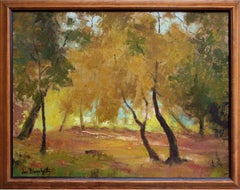
Autumn Trees, Mid Century Fall Landscape with Orange
Earthtones
By Jon Blanchette
Located in Soquel, CA
Autumn Trees, Mid Century Fall Landscape with Orange & Earthtones
Lovely late 1960's vintage landscape oil painting of an autumnal scene by Cal...
Category
1960s American Impressionist Francesco Spicuzza Art
Materials
Canvas, Oil, Cardboard
$1,375
H 20.63 in W 26.63 in D 0.88 in
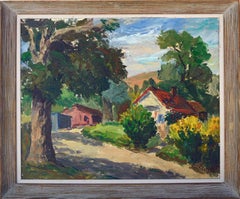
Mid Century Novato Afternoon Country Landscape
By Ted Lewy
Located in Soquel, CA
Wonderful mid century landscape titled "Late Afternoon in Novato" by Ted Lewy (American, 1912-1963). Presented in a rustic wooden frame. Signed "Ted Lewy" and dated "1962" lower righ...
Category
1960s American Impressionist Francesco Spicuzza Art
Materials
Canvas, Oil, Cardboard
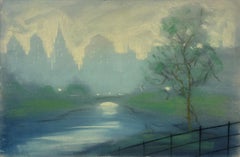
"Central Park" Leon Dolice, New York Central Park Scene, Mid-Century
By Leon Dolice
Located in New York, NY
Leon Dolice
Central Park
Signed lower left
Watercolor on paper
12 x 19 inches
The romantic backdrop of Vienna at the turn of the century had a life-long influence upon the young ma...
Category
1930s American Modern Francesco Spicuzza Art
Materials
Paper, Pastel
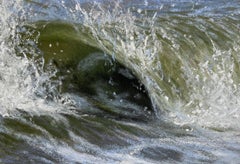
"Ocean IV" (2022) Original Painting by Elena Degenhardt, Pastel Seascape
By Elena Degenhardt
Located in Denver, CO
Elena Degenhardt's "Ocean IV" is a poignant representation of the relentless and eternal spirit of the sea. Crafted in 2022, this exquisite original artwork measures 4 x 6 inches, rendered in soft pastel on paper, and comes elegantly framed in a custom 8 x 10-inch frame that complements the hues of the ocean's waters. Degenhardt's mastery in pastel techniques...
Category
2010s Impressionist Francesco Spicuzza Art
Materials
Paper, Pastel
"Empire State Building" Leon Dolice, New York City Street Scene, Mid-Century
By Leon Dolice
Located in New York, NY
Leon Dolice
Empire State Building
Signed lower right
Watercolor on paper
19 x 12 inches
The romantic backdrop of Vienna at the turn of the century had a life-long influence upon th...
Category
1930s American Modern Francesco Spicuzza Art
Materials
Paper, Pastel

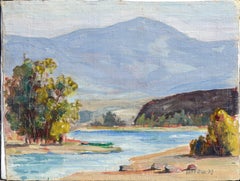
Quiet Stream, Small-Scale Mid Century California Landscape, 1937
By Dalzell Hatfield
Located in Soquel, CA
Quiet Stream, Small-Scale Mid Century California Landscape, 1937
Plein air painting of a California landscape, quiet stream and hills, 1937. Attributed to California artist, art co...
Category
1930s American Impressionist Francesco Spicuzza Art
Materials
Canvas, Oil, Foam Board
$1,350
H 7.13 in W 8.88 in D 0.38 in
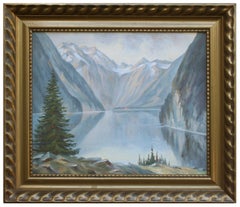
Mid Century Reflecting Mountains Norwegian Landscape
Located in Soquel, CA
Serene mid-century landscape of mountains reflecting over a fjord in Norway by an unknown artist, Circa 1940's. Unsigned. Displayed in a rustic giltwood frame. Image, 20"H x 24"W.
The Norwegian and Antarctic Fjords were carved by a massive sheet of ice...
Category
1940s Impressionist Francesco Spicuzza Art
Materials
Canvas, Oil, Cardboard
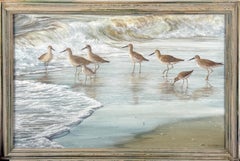
Shorebirds in the Surf an Original Pastel by Gregory Biolchini
Located in Soquel, CA
Shorebirds in the Surf an Original Pastel by Gregory Biolchini
Shorbirds in the Florida Surf by Gregory Biolchini (American, B- 1948).
Lively pastel with eager Shorebirds hunting for...
Category
1980s American Impressionist Francesco Spicuzza Art
Materials
Oil Pastel, Laid Paper
$2,650
H 33 in W 44.75 in D 2.5 in
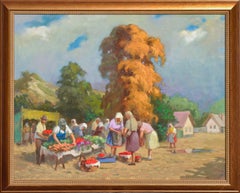
Silesia Farm Stand - Polish Figurative Landscape
Located in Soquel, CA
Colorful scene of shoppers at a rural farm stand under cloudy skies, by Polish artist Gongor (Polish, 20th Century). Signed "Gongor" lower right. Displayed in a dark gold finish wood...
Category
1990s Impressionist Francesco Spicuzza Art
Materials
Canvas, Foam Board, Oil
Mid-Century Winter Sunrise Landscape
By Genevieve Idell Booth Clibborn
Located in Soquel, CA
Beautiful mid-century winter landscape of the sun rising over a forest stream covered in fresh snow by Genevieve Clibborn (American, 1892-1982). Presented in a rustic ornate, faux wood frame. Image, 12"H x 16"W.
Genevieve Idell Booth Clibborn was born in Washington on January 6, 1896. She lived most of her life in Salinas, California (East of the Monterey Peninsula). She painted and exhibited widely in that area. An award-winning artist, she was primarily self-taught and was known for her tree studies. She was a member of the Santa Cruz Art League. She was also a famous evangelist who preached at revivals in the United States, Canada and Australia. Her husband was William Booth-Clibborn, grandson of the founder of the Salvation Army...
Category
1940s American Impressionist Francesco Spicuzza Art
Materials
Canvas, Oil, Cardboard

$899
H 16.75 in W 20.63 in D 2.25 in
Previously Available Items
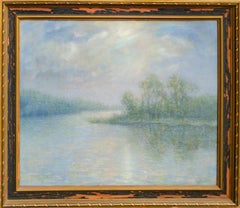
Lovely impressionist landscape in pastel by Francesco Spicuzza
By Francesco Spicuzza
Located in New York, NY
Francesco Spicuzza (American, 1883-1962)
Untitled Landscape, 20th century
Pastel on paper
Sight size: 25 x 29 1/2 in.
Framed: 30 3/4 x 35 1/2 in.
Signed lower right: Spicuzza
Italian-born Francesco Spicuzza was primarily a Wisconsin painter who did portraits, still-lives and local landscapes. He spent the first part of his life in near-poverty to become a painter. An eternal optimist, in 1917, the artist reported: "I am happy and my only ambition now is to paint better and better until I shall have reached the measure of the best of which I am capable." (Spicuzza, 1917, p. 22). His predilection for beach scenes germinated early: reportedly, the five-year-old boy first drew the outlines of his father's fishing boat in the sand on the seashore near their home in Sicily. After setting himself up as a fruit peddler in Milwaukee, Spicuzza's father sent for his family when Francesco was eight years old. For the following six years the boy was unable to attend school because of his job in his father's fruit and vegetable business. The poor lad suffered a caved-in shoulder from carrying a heavy wooden crate.
The young Spicuzza was aided by moral and financial support from a sympathetic Milwaukee businessman named John Cramer, publisher and editor of the Evening Wisconsin, who raised Spicuzza's salary as a newspaper assembler so that he could attend school. In 1899 or 1900, Spicuzza began studying drawing and anatomy under Robert Schade...
Category
20th Century American Modern Francesco Spicuzza Art
Materials
Paper, Pastel
H 30.75 in W 35.5 in D 0.75 in
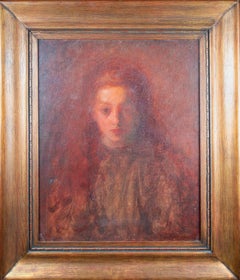
Little Mary Spicuzza
signed oil painting of the artist
s niece
By Francesco Spicuzza
Located in Milwaukee, WI
In this haunting yet adoring portrait, Francesco Spicuzza presents to the viewer his niece Mary. Her young face, probably from when about six years old, emerges from a hazy buildup o...
Category
1910s American Impressionist Francesco Spicuzza Art
Materials
Canvas, Oil
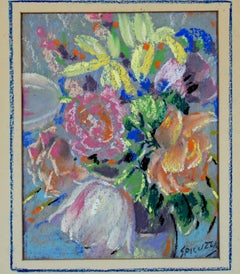
"Floral, " Pastel Vivid Still-life of Flowers signed by Francesco Spicuzza
By Francesco Spicuzza
Located in Milwaukee, WI
"Floral" is an original pastel drawing on paper by Francesco Spicuzza, signed in the lower right. The piece is a still life, a bouquet of flowers in a vase on the table. The perspec...
Category
1920s Modern Francesco Spicuzza Art
Materials
Paper, Pastel
"Boy Launching Toy Sailboat 353, " Original Graphite signed by Francesco Spicuzza
By Francesco Spicuzza
Located in Milwaukee, WI
"Boy Launching Toy Sailboat #353" is an original graphite drawing on paper by Francesco Spicuzza, stamped with his signature in the lower left. Executed i...
Category
1940s Modern Francesco Spicuzza Art
Materials
Paper, Graphite
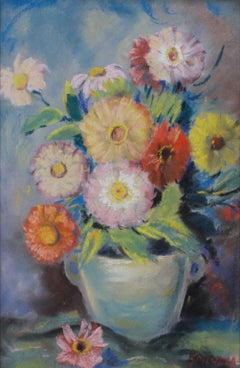
"Flowers in Vase with Handles, " Pastel on Paperboard signed by F. Spicuzza
By Francesco Spicuzza
Located in Milwaukee, WI
"Flowers in Vase with Handles" is an original pastel drawing on paperboard by Francesco Spicuzza. The artist signed the piece in the lower right. This drawing depicts a bouquet of wa...
Category
1930s Francesco Spicuzza Art
Materials
Paper, Pastel, Board
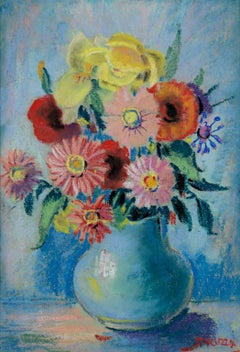
Flowers in Blue Vase
By Francesco Spicuzza
Located in Milwaukee, WI
"Flowers in Blue Vase" is an original pastel drawing on paperboard by Francesco Spicuzza. The artist signed the piece in the lower right. This dra...
Category
1930s Francesco Spicuzza Art
Materials
Paper, Pastel, Board
Francesco Spicuzza art for sale on 1stDibs.
Find a wide variety of authentic Francesco Spicuzza art available for sale on 1stDibs. You can also browse by medium to find art by Francesco Spicuzza in oil paint, paint, board and more. Much of the original work by this artist or collective was created during the 20th century and is mostly associated with the modern style. Not every interior allows for large Francesco Spicuzza art, so small editions measuring 13 inches across are available. Customers who are interested in this artist might also find the work of Leon Kelly, Frank Wilcox, and Abraham Walkowitz. Francesco Spicuzza art prices can differ depending upon medium, time period and other attributes. On 1stDibs, the price for these items starts at $2,025 and tops out at $33,000, while the average work can sell for $5,788.