Gaston Louis Roux Art
to
1
Overall Width
to
Overall Height
to
1
1
1
1
1
1
1
1
1
1
9,971
2,753
1,376
1,373
1
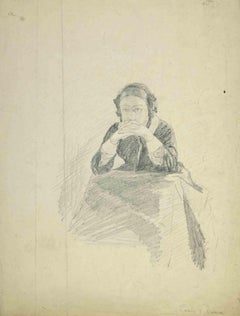
Artist: Gaston Louis Roux
Sketches - Drawing by Louis Roux - Late-19th Century
By Gaston Louis Roux
Located in Roma, IT
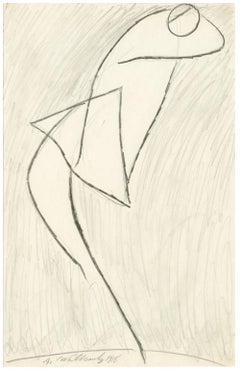
Figure is a Pencil drawing realized by Louis Roux in Late-19th Century.
The Artwork id represented through strong strokes.
Good conditions with slight foxing.
Category
1930s Modern Gaston Louis Roux Art
Materials
Pencil
Related Items
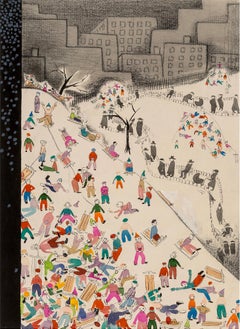
Children Snow Sledding in Central Park - New Yorker Cover Study
Located in Miami, FL
Hungarian/American artist/illustrator depicts a charming scene of sledding in the snow in Central Park. The work is abstract in its design as it's functional in its narrative - Unpublished New Yorker...
Category
1940s Modern Gaston Louis Roux Art
Materials
Charcoal, Ink, Watercolor, Gouache, Pencil

$15,000
H 16.85 in W 12.25 in
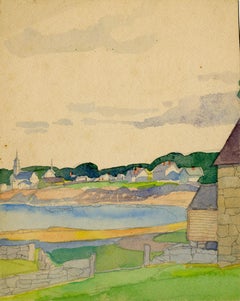
Chapel and houses along a lake, New England Landscape - American School, 19th C
Located in Middletown, NY
Watercolor and pencil on buff wove watercolor paper, 10 x 8 inches (255 x 203 mm). In good condition with overall minor toning. Some watercolor paint splatters on the verso, contem...
Category
Early 1900s American Modern Gaston Louis Roux Art
Materials
Watercolor, Pencil
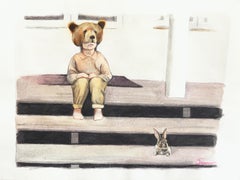
The Art of Saying Nothing - Original Figurative Surrealist Watercolor Artwork
Located in Los Angeles, CA
Amanda Immurs, an artist hailing from Hamilton, Canada, creates enchanting watercolor artworks that bring whimsical scenes of children, animals, and flora to life. Immurs' art is gro...
Category
2010s Modern Gaston Louis Roux Art
Materials
Paper, Watercolor, Graphite
Talking To Whoever Is Listening - Figurative Surrealist Watercolor Artwork
Located in Los Angeles, CA
Amanda Immurs, an artist hailing from Hamilton, Canada, creates enchanting watercolor artworks that bring whimsical scenes of children, animals, and flora to life. Immurs' art is gro...
Category
2010s Modern Gaston Louis Roux Art
Materials
Paper, Watercolor, Graphite
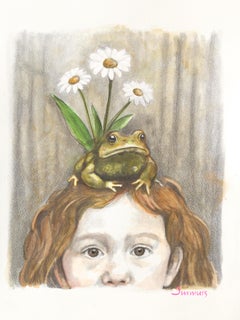
The Whispers Had Changed - Figurative Portrait Watercolor Graphite Artwork
Located in Los Angeles, CA
Amanda Immurs, an artist hailing from Hamilton, Canada, creates enchanting watercolor artworks that bring whimsical scenes of children, animals, and flora to life. Immurs' art is gro...
Category
2010s Modern Gaston Louis Roux Art
Materials
Paper, Watercolor, Graphite
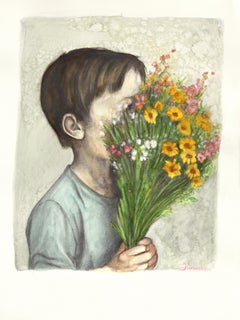
Untitled (Figurative Abstraction of Isadora Duncan #7)
By Abraham Walkowitz
Located in Myrtle Beach, SC
Abraham Walkowitz, Untitled (Figurative Abstraction of Isadora Duncan #7), pencil, 1918. Signed and dated in pencil, bottom center. A fine, spon...
Category
1910s American Modern Gaston Louis Roux Art
Materials
Pencil
$550
H 10.5 in W 6.75 in D 0.01 in
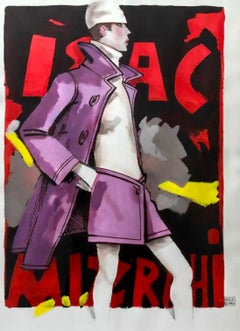
Issac Mizrahi illustration
By Michaele Vollbracht
Located in Miami, FL
Issac Mizrahi fashion illustrationon Arches paper signed in ink lower right Circa 1990's
Image 29.5" H x 21.25"
Frame: 31.5" H x 23.75" W x 1.5" D.
Th...
Category
1990s Modern Gaston Louis Roux Art
Materials
Watercolor, Gouache, Pencil
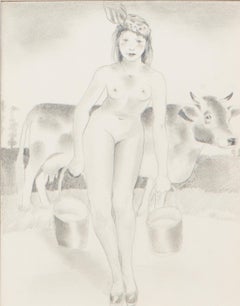
Milchmädchen mit Kuh / Milkmaid with cow
By Mariette Lydis
Located in Wien, 9
Mariette Lydis (Vienna 1887 - Buenos Aires 1970) is an Austrian painter and illustrator who was successful in Paris in the 1930s, in Montparnasse and then in Argentina, where she emigrated in 1940. Mariette Lydis was born on 24 August in Vienna, Austria 1887. From 1919 to 1922 she signed her works with the initials MPK for Marietta Pachoffer Karñy, a name derived from her first marriage in 1910 to Julius Koloman Pachoffer-Karñy, who died on 22 April 1922. Subsequently she lived in different cities around Europe, among others: Athens and Florence. She moved to France from 1926 to 1939, during these years she exhibited and became a member of the Salon d'Automne. She befriended Count Giuseppe Govone, the art publisher, in 1928 and married him on 1 August 1934, for whom she illustrated the books of many authors and cultivated a great friendship with Henry de Montherlant, which came about through the publication of a first in 1938 monograph by the author of Les Jeunes Filles. Fearing the German invasion, she travelled to England and then to Buenos Aires in July 1940, where she stayed and published published her latest paintings...
Category
1930s Modern Gaston Louis Roux Art
Materials
Paper, Pencil
I
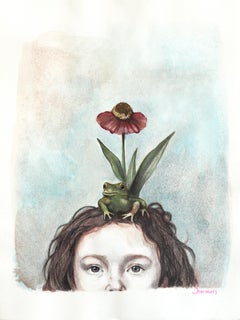
d Like To Dream My Troubles Away - Figurative Surrealist Watercolor Artwork
Located in Los Angeles, CA
Amanda Immurs, an artist hailing from Hamilton, Canada, creates enchanting watercolor artworks that bring whimsical scenes of children, animals, and flora to life. Immurs' art is gro...
Category
2010s Modern Gaston Louis Roux Art
Materials
Paper, Watercolor, Graphite
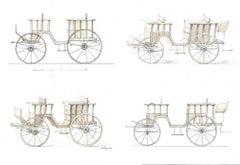
Kutschen (carriages); Group of four designs for hansom cabs.
By Alfred Juergens
Located in Middletown, NY
Four pencil drawings, each with hand coloring in watercolor, each 6 3/4 x 10 inches (sheet) (172 x 254 mm), full margins. Each with inscriptions and notations by the artist in the up...
Category
Mid-20th Century American Modern Gaston Louis Roux Art
Materials
Handmade Paper, Watercolor, Pencil
$800
H 6.78 in W 10.01 in
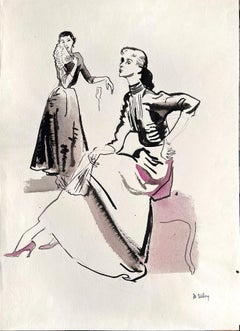
Mid- Century Fashion Illustration - Neiman Marcus ?
By Marjorie Ullberg
Located in Miami, FL
1950's elegant fashion models pose depicted for a designer clothing line for a major San Francisco department store - Perhaps Neiman Marcus. Estate ...
Category
1950s Modern Gaston Louis Roux Art
Materials
Watercolor, Pencil
Black Panther Trials - Civil Rights Movement Police Violence African American
Located in Miami, FL
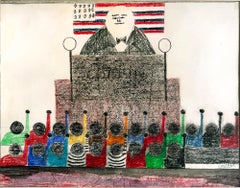
The Black Panther Trials - In this historically significant work, African American Artist Vicent D. Smith functions as an Art Journalist/ Court Reporter as much as a
Artist. Here, he depicts, in complete unity, 21 Black Panther Protestors raising their fist of defiance at the White Judge. Smith's composition is about utter simplicity, where the Black Panther Protestors are symmetrically lined up in a confrontation with a Judge whose size is exaggerated in scale. Set against a stylized American Flag, the supercilious Judge gazes down as the protesters as their fists thrust up. Signed Vincent lower right. Titled Panter 21. Original metal frame. Tape on upper left edge of frame. 255 . Panther 21. Framed under plexi.
_____________________________
From Wikipedia
In 1969-1971 there was a series of criminal prosecutions in New Haven, Connecticut, against various members and associates of the Black Panther Party.[1] The charges ranged from criminal conspiracy to first-degree murder. All charges stemmed from the murder of 19-year-old Alex Rackley in the early hours of May 21, 1969. The trials became a rallying-point for the American Left, and marked a decline in public support, even among the black community, for the Black Panther Party
On May 17, 1969, members of the Black Panther Party kidnapped fellow Panther Alex Rackley, who had fallen under suspicion of informing for the FBI. He was held captive at the New Haven Panther headquarters on Orchard Street, where he was tortured and interrogated until he confessed. His interrogation was tape recorded by the Panthers.[2] During that time, national party chairman Bobby Seale visited New Haven and spoke on the campus of Yale University for the Yale Black Ensemble Theater Company.[3] The prosecution alleged, but Seale denied, that after his speech, Seale briefly stopped by the headquarters where Rackley was being held captive and ordered that Rackley be executed. Early in the morning of May 21, three Panthers – Warren Kimbro, Lonnie McLucas, and George Sams, one of the Panthers who had come East from California to investigate the police infiltration of the New York Panther chapter, drove Rackley to the nearby town of Middlefield, Connecticut. Kimbro shot Rackley once in the head and McLucas shot him once in the chest. They dumped his corpse in a swamp, where it was discovered the next day. New Haven police immediately arrested eight New Haven area Black Panthers. Sams and two other Panthers from California were captured later.
Sams and Kimbro confessed to the murder, and agreed to testify against McLucas in exchange for a reduction in sentence. Sams also implicated Seale in the killing, telling his interrogators that while visiting the Panther headquarters on the night of his speech, Seale had directly ordered him to murder Rackley. In all, nine defendants were indicted on charges related to the case. In the heated political rhetoric of the day, these defendants were referred to as the "New Haven Nine", a deliberate allusion to other cause-celebre defendants like the "Chicago Seven".
The first trial was that of Lonnie McLucas, the only person who physically took part in the killing who refused to plead guilty. In fact, McLucas had confessed to shooting Rackley, but nonetheless chose to go to trial.
Jury selection began in May 1970. The case and trial were already a national cause célèbre among critics of the Nixon administration, and especially among those hostile to the actions of the FBI. Under the Bureau's then-secret "Counter-Intelligence Program" (COINTELPRO), FBI director J. Edgar Hoover had ordered his agents to disrupt, discredit, or otherwise neutralize radical groups like the Panthers. Hostility between groups organizing political dissent and the Bureau was, by the time of the trials, at a fever pitch. Hostility from the left was also directed at the two Panthers cooperating with the prosecutors. Sams in particular was accused of being an informant, and lying to implicate Seale for personal benefit.
In the days leading up to a rally on May Day 1970, thousands of supporters of the Panthers arrived in New Haven individually and in organized groups. They were housed and fed by community organizations and by sympathetic Yale students in their dormitory rooms. The Yale college dining halls provided basic meals for everyone. Protesters met daily en masse on the New Haven Green across the street from the Courthouse (and one hundred yards from Yale's main gate). On May Day there was a rally on the Green, featuring speakers including Jean Genet, Abbie Hoffman, Jerry Rubin, and John Froines (an assistant professor of chemistry at the University of Oregon). Teach-ins and other events were also held in the colleges themselves.
Towards midnight on May 1, two bombs exploded in Yale's Ingalls Rink, where a concert was being held in conjunction with the protests.[4] Although the rink was damaged, no one was injured, and no culprit was identified.[4]
Yale chaplain William Sloane Coffin stated, "All of us conspired to bring on this tragedy by law enforcement agencies by their illegal acts against the Panthers, and the rest of us by our immoral silence in front of these acts," while Yale President Kingman Brewster Jr. issued the statement, "I personally want to say that I'm appalled and ashamed that things should have come to such a pass that I am skeptical of the ability of a Black revolutionary to receive a fair trial anywhere in the U.S." Brewster's generally sympathetic tone enraged many of the university's older, more conservative alumni, heightening tensions within the school community.
As tensions mounted, Yale officials sought to avoid deeper unrest and to deflect the real possibility of riots or violent student demonstrations. Sam Chauncey has been credited with winning tactical management on behalf of the administration to quell anxiety among law enforcement and New Haven's citizens, while Kurt Schmoke, a future Rhodes Scholar, mayor of Baltimore, MD and Dean of Howard University School of Law, has received kudos as undergraduate spokesman to the faculty during some of the protest's tensest moments. Ralph Dawson, a classmate of Schmoke's, figured prominently as moderator of the Black Student Alliance at Yale (BSAY).
In the end, compromises between the administration and the students - and, primarily, urgent calls for nonviolence from Bobby Seale and the Black Panthers themselves - quashed the possibility of violence. While Yale (and many other colleges) went "on strike" from May Day until the end of the term, like most schools it was not actually "shut down". Classes were made "voluntarily optional" for the time and students were graded "Pass/Fail" for the work done up to then.
Trial of McLucas
Black Panther trial sketch...
Category
1970s American Modern Gaston Louis Roux Art
Materials
Watercolor, Pen, Pencil, Paper
Gaston Louis Roux art for sale on 1stDibs.
Find a wide variety of authentic Gaston Louis Roux art available for sale on 1stDibs.