Gaston Suisse Lacquer
to
1
1
1
1
1
1
1
1
1
1
1
1
4
1
1
1
1
Creator: Gaston Suisse
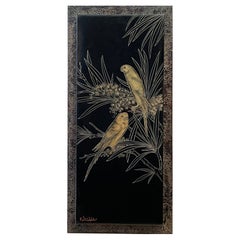
"Couple of parakeets in the mimosas", Gaston Suisse (1896-1988), France
By Gaston Suisse
Located in Paris, FR
Gaston Suisse (1896–1988) was a French decorator and a leading figure of the Art Deco movement. He designed several stage sets for the Ballets Russes at the Paris Opera and costumes ...
Category
1930s French Art Deco Vintage Gaston Suisse Lacquer
Materials
Lacquer
Related Items
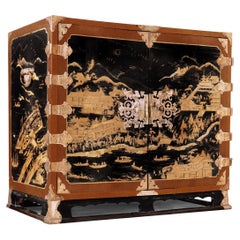
17th Century Japanese Export Lacquer Cabinet with Depiction the Dutch Tradepost
Located in Amsterdam, NL
A highly important Japanese export lacquer cabinet with depiction of the Dutch East India Company tradepost Deshima and the annual Dutch delegation on its way to the Shogun in Edo
Edo period, circa 1660-1680
H. 88 x W. 100.5 x D. 54 cm
This cabinet includes a later European japanned stand, but also a modern powder-coated steel frame.
The latter can be designed and added to your specific needs.
The sides and front of the rectangular two-door cabinet are embellished in gold and silver hiramaki-e and takamaki-e on a black roiro lacquer ground with a continuous design. The two doors depict a long procession of numerous figures travelling on foot and horseback along buildings and a pagoda into a mountainous landscape. This is the annual court journey, Hofreis, of the Dutch from Nagasaki to the Shogun’s court in Edo. Three horseback riders are dressed as Dutch merchants and a fourth figure, probably het Opperhoofd, is seen inside a palanquin, norimon. Just about to cross the bridge, two men are carrying a cabinet like the present one.
Many Japanese figures on either side of the procession are engaged in various activities; some play musical instruments on board of small boats, others are fishing; figures inside buildings are depicted playing go, and farmers are tending to their rice paddocks. The upper part of the right door shows a large mansion, probably the local daimyo’s castle, with men kneeling before a man in the central courtyard.
The court journey fits in with the foreign policy of the shogunate which accorded a role to the VOC alongside China, Korea, and the Ryukyu Islands who also had to pay tribute. However, the VOC employees were traders, having low status in Japan’s social hierarchy, and they were received with less deference than were the state embassies from Korea and the Ryukyu Islands. Nevertheless, the contacts with the Dutch were a welcome source of information to the Shogun about Europe and European science and technology.
The left side of the cabinet depicts, in mirror image, a rare view of the artificial fan-shaped Deshima Island, the trading post for the Dutch in Japan. The island, where the Dutch flag flies, is surrounded by small Japanese boats and an anchored three-masted fluyt (cargo ship), flying Dutch flags, with on the stern the VOC monogram. On the bottom right a busy street of Nagasaki is shown, bordered by shops and leading up to the stone bridge. On the island the trees are beautifully painted, two cows can be seen, and the flagpole, all in very fine detail. Dutchmen and enslaved Malay are visible outside the buildings and two Japanese figures, probably guards, sit in a small hut in the centre.
A maximum of fifteen to twenty Dutchmen lived on the island at any time and soldiers or women were not allowed. Restrictions on Deshima were tight, and the merchants were only allowed to leave the island by special permission. The Opperhoofd had to be replaced every year, and each new Opperhoofd had to make a court journey to pay tribute, present gifts, and to obtain permission to Margaret Barclay eep on trading. In the distance, many birds fly above the hills and a four-story pagoda can be seen. The right side of the cabinet is painted with other horse riders and their retinue journeying through mountains.
The pair of doors to the front open to reveal ten rectangular drawers. The drawers are decorated with scenes of birds in flight and landscapes with trees and plants. The reverse of the left door with two thatched buildings, one with a ladder, underneath a camelia tree with large blooms; the right door with a three-story pagoda nestled among trees and both doors with a flying phoenix, ho-oo bird. The cabinet, with elaborately engraved gilt copper mounts, hinges, lock plates and brass handles, is raised on an 18th-century English japanned wood stand.
A pair of large cabinets...
Category
17th Century Japanese Edo Antique Gaston Suisse Lacquer
Materials
Copper, Gold

$1,494,363
H 34.65 in W 39.57 in D 21.26 in
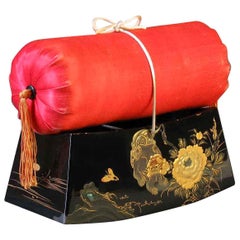
Fine Japanese Lacquer Takamakura Geisha Pillow, First Half of the 20th Century
Located in Ottawa, Ontario
A fine Japanese lacquer Takamakura Geisha pillow, first half of the 20th century. Depicting Shi-Shi Lion between peony and rock in gold, silver, red and ...
Category
Late 19th Century Japanese Japonisme Antique Gaston Suisse Lacquer
Materials
Abalone, Lacquer
$1,250
H 3.5 in W 8.75 in D 4 in
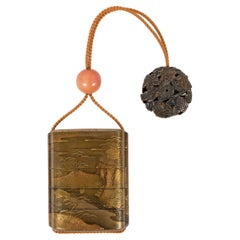
Japanese inro of the edo period adorned with a landscape houses near a lake
Located in PARIS, FR
Inrō with four gold lacquer compartments, decorated with a lake landscape. Accompanied by a bronze ryusa manju.
Small boxes formed of compartments that fit one on top of the other, i...
Category
Late 18th Century Japanese Edo Antique Gaston Suisse Lacquer
Materials
Gold
$6,575
H 2.6 in W 2.17 in D 0.79 in
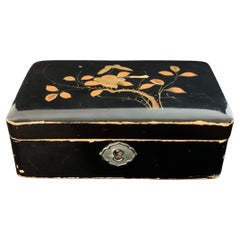
Japonese Lacquered Box with Flower, Late of the 19th Century
Located in Beuzevillette, FR
Nice little black lacquer box from Japan. It is made of black lacquered wood and decorated with flowers and foliage. The inside is covered with red velvet. It is ideal for storing je...
Category
Late 19th Century Japanese Antique Gaston Suisse Lacquer
Materials
Lacquer
$172 Sale Price
20% Off
H 1.78 in W 5.12 in D 3.15 in
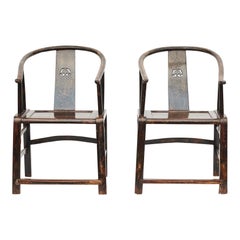
Pair of Early 19th Century Chinese
Lazy Chairs
in Walnut and Black Lacquer
Located in Kastrup, DK
Pair of 'Lazy Chairs' in walnut, black lacquer with a natural cracked wear that gives the chairs an exciting and artistic look.
Ming style, early 19th century China.
The term 'Lazy'...
Category
19th Century Chinese Ming Antique Gaston Suisse Lacquer
Materials
Walnut, Lacquer
$3,078
H 35.83 in W 22.84 in D 26.78 in
A Very Fine Takamaki-e Lacquer Cheroot Case in the Manner of Shibata Zeshin
By Shibata Zeshin
Located in Ottawa, Ontario
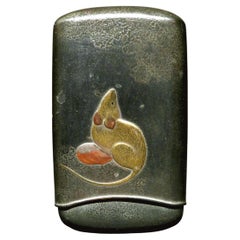
The 'ishime' lacquered case consisting of two conforming molded sections with one sliding overtop the other, both sides decorated with hand painted gilt, silver & burnt dark russet (kasshoku) lacquers, depicting motifs in low relief of a rat with an acorn on one side and two acorns on the opposing.
In Japanese culture rats are considered auspicious symbols of fertility & wealth, acorns symbolize prosperity & growth. Signed with characters and a mon on one edge.
Takamaki-e is a lacquer technique in which metallic powders such as silver, gold, copper, pewter etc., are used in combination with lacquer & clay-dust to build up motifs in low relief.
Please note that the color tones & hues of the lacquered motifs appear somewhat more vibrant in the images due to ambient lighting conditions.
Regarding the opinion stating the superior quality of this fine example being likened to works associated with those by Shibata...
Category
1870s Japanese Meiji Antique Gaston Suisse Lacquer
Materials
Lacquer
$3,800
H 3.75 in W 2.25 in D 0.75 in
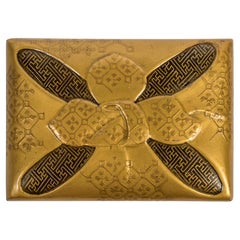
Japanese Kobako box in the form of a furoshiki present in gold and black lacquer
Located in PARIS, FR
Rectangular and flat lacquer Kobako (small box) representing a furoshiki knot seen from above. Fundame background, furoshiki in takamaki-e with floral pattern, inside the folds of th...
Category
Late 18th Century Japanese Edo Antique Gaston Suisse Lacquer
Materials
Gold
$2,749
H 0.6 in W 1.97 in D 2.76 in
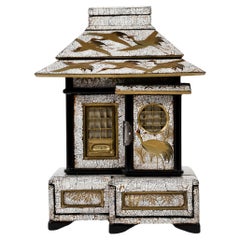
Japanese tea house in rankanku or eggshell lacquer with a decor of gold crane
Located in PARIS, FR
Miniature tea house with a crane and bamboo motif in black and gold takamaki-e lacquer on a rankaku (eggshell inlay) base. It has several compartments and trays on the roof, walls an...
Category
Late 19th Century Japanese Meiji Antique Gaston Suisse Lacquer
Materials
Gold
$9,563
H 7.49 in W 5.52 in D 3.94 in
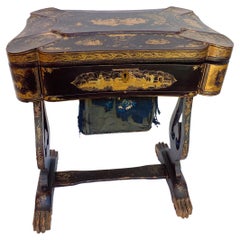
Antique 19th Century Chinese Lacquer Sewing Box with the Stand
Located in Brea, CA
Antique 19th century Chinese lacquer sewing table with hand painted scenes and beautiful legs. Gilt export black lacquer all-over the tabl...
Category
Late 19th Century Chinese Qing Antique Gaston Suisse Lacquer
Materials
Lacquer
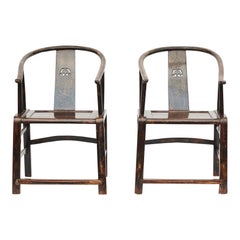
Pair of Early 19th Century Chinese
Lazy Chairs
in Walnut and Black Lacquer
Located in Kastrup, DK
Pair of 'Lazy Chairs' in walnut, black lacquer with a natural cracked wear that gives the chairs an exciting and artistic look.
Ming style, early 19th century China.
The term 'Laz...
Category
19th Century Chinese Ming Antique Gaston Suisse Lacquer
Materials
Walnut, Lacquer
$3,078 / set
H 35.83 in W 22.84 in D 26.78 in
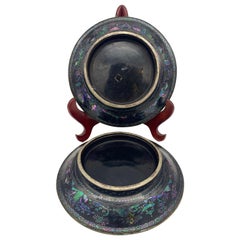
17th Century Pair of Chinese Silver Lacquer Plates with Mother of Pearl
Located in Brea, CA
Pair of Chinese silver, lacquer, and mother of pearl plates from the 17th century. A matching pair of ornamental antique Chinese plates, the faces ...
Category
17th Century Chinese Qing Antique Gaston Suisse Lacquer
Materials
Lacquer
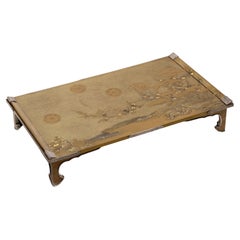
Japanese Bundai or writting table in gold lacquer with a decor of lake landscape
Located in PARIS, FR
Rectangular bundai writing table on four legs in gold lacquer with black highlights on a nashi-ji background. The top is decorated with a lake landscape with plum trees, pine trees a...
Category
Early 18th Century Japanese Edo Antique Gaston Suisse Lacquer
Materials
Gold, Bronze
$17,932
H 4.53 in W 13.39 in D 22.84 in
Gaston Suisse lacquer for sale on 1stDibs.
Gaston Suisse lacquer are available for sale on 1stDibs.