George Aarons Art
to
1
1
Overall Width
to
Overall Height
to
2
2
1
1
2
1
1
1
2
10,222
2,785
2,504
1,384
2
Artist: George Aarons
Large George Aarons Terracotta Sculpture Relief Art Deco Plaque WPA Artist
By George Aarons
Located in Surfside, FL
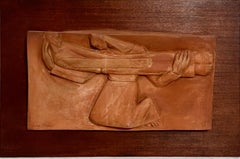
Two Figures (Mother and son)
9" x 17" terracotta sculpture, signed lower left mounted to wood panel, 15 1/2" x 23 1/2"
George Aarons (born Gregory Podubisky, in St. Petersburg, Russ...
Category
20th Century Art Deco George Aarons Art
Materials
Wood, Terracotta
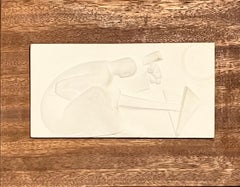
Plaster Sculpture Relief Art Deco Plaque WPA Artist Peace Swords to Ploughshares
By George Aarons
Located in Surfside, FL
Size includes wood mounting.
George Aarons (born Gregory Podubisky, in St. Petersburg, Russia, 1896 - died in Gloucester, Massachusetts 1980) was a distinguished sculptor who lived ...
Category
20th Century Art Deco George Aarons Art
Materials
Plaster, Wood
Related Items
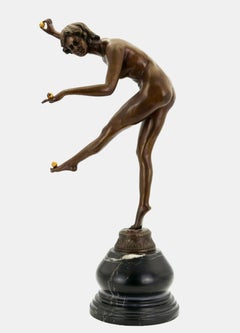
Juggler / - Artistic naturalness -
Located in Berlin, DE
Claire Jeanne Robertine Colinet (1880 Brussels - 1950 Asnières-sur-Seine), Juggler, around 1920. Brownish patinated bronze with gilded balls on a round, multi-profiled stone base (10...
Category
1920s Art Deco George Aarons Art
Materials
Bronze

$3,441
H 18.51 in W 7.88 in D 9.85 in
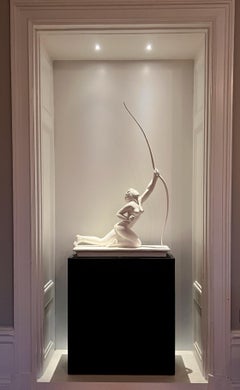
Diana The Huntress Plaster Sculpture, Art Deco, Circa 1920, Signed
Located in Stockholm, SE
Sculpture representing the goddess Diana by Danish sculptor Jens Jacob Bregno (1877–1946), executed in plaster around 1920. This is a highly unusual model by the artist, and possibly...
Category
1920s Art Deco George Aarons Art
Materials
Plaster
$8,068
H 40.56 in W 25.2 in D 7.88 in
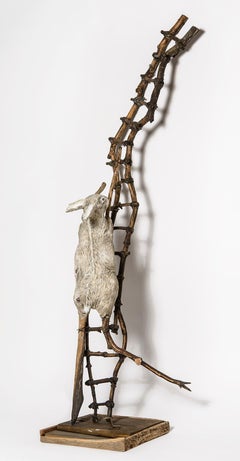
Sculpture of Rabbit crawling up wood ladder:
Talking about Hard Things
By Elizabeth Jordan
Located in New York, NY
Elizabeth Jordan is an artist working primarily in sculpture and whose work uses multiple materials to produce unique, organic forms. In addition to a solo and group shows at Ivy Bro...
Category
2010s Contemporary George Aarons Art
Materials
Wire
$3,360
H 52 in W 13 in D 13 in
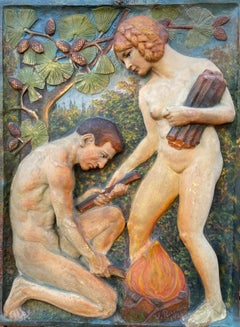
“Adam and Eve”
Located in Southampton, NY
Very rare Art Deco three dimensional terracotta sculpture of Adam and Eve by the Austrian artist, Virgil Rainer. Hand painted by the artist. Signed bott...
Category
1920s Art Deco George Aarons Art
Materials
Terracotta, Plaster
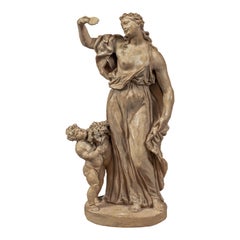
Rococò Italian artist - 18th century terracotta figure sculpture - Allegory
Located in Varmo, IT
Terracotta sculpture - Allegory of Vanity. Italy, 18th century.
17 x 12 x 42 cm high.
Made entirely of terracotta. It depicts a bare-breasted girl holding a mirror and a cherub wit...
Category
Mid-18th Century Rococo George Aarons Art
Materials
Terracotta
$4,746
H 16.54 in W 6.7 in D 4.73 in
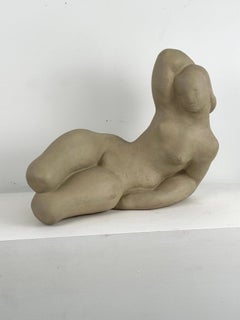
Relining Nude (WG6)
By Waylande Gregory
Located in Wilton Manors, FL
Waylande Gregory (1905-1971).
Nude Reclining, ca. 1950's. Painted composite cast from original sculpted in 1930's. Casting sanctioned and approved by the artist during his lifetime in partnership with MPI, Museum Pieces Incorporated. Very few examples were produced and even fewer survive.
Waylande Gregory was considered a major American sculptor during the 1930's, although he worked in ceramics, rather than in the more traditional bronze or marble. Exhibiting his ceramic works at such significant American venues for sculpture as the Whitney Museum of American Art in New York City and at the venerable Pennsylvania Academy of the Fine Arts in Philadelphia, he also showed his ceramic sculptures at leading New York City galleries. Gregory was the first modern ceramist to create large scale ceramic sculptures, some measuring more than 70 inches in height. Similar to the technique developed by the ancient Etruscans, he fired his monumental ceramic sculptures only once.
Gregory was born in 1905 in Baxter Springs, Kansas and was something of a prodigy. Growing up on a ranch near a Cherokee reservation, Gregory first became interested in ceramics as a child during a native American burial that he had witnessed. He was also musically inclined. In fact, his mother had been a concert pianist and had given her son lessons. At eleven, he was enrolled as a student at the Kansas State Teacher's College, where he studied carpentry and crafts, including ceramics.
Gregory's early development as a sculptor was shaped by the encouragement and instruction of Lorado Taft, who was considered both a major American sculptor as well as a leading American sculpture instructor. In fact, Taft's earlier students included such significant sculptors as Bessie Potter Vonnoh and Janet Scudder. But, Taft and his students had primarily worked in bronze or stone, not in clay; and, Gregory's earliest sculptural works were also not in ceramics. In 1924, Gregory moved to Chicago where he caught the attention of Taft. Gregory was invited by Taft to study with him privately for 18 months and to live and work with him at his famed "Midway Studios." The elegant studio was a complex of 13 rooms that overlooked a courtyard. Taft may have been responsible for getting the young man interested in creating large scale sculpture. However, by the 1920's, Taft's brand of academic sculpture was no longer considered progressive. Instead, Gregory was attracted to the latest trends appearing in the United States and Europe. In 1928 he visited Europe with Taft and other students.
"Kid Gregory," as he was called, was soon hired by Guy Cowan, the founder of the Cowan Pottery in Cleveland, Ohio, to become the company's only full time employee. From 1928 to 1932, Gregory served as the chief designer and sculptor at the Cowan Pottery. Just as Gregory learned about the process of creating sculpture from Taft, he literally learned about ceramics from Cowan. Cowan was one of the first graduates of Alfred, the New York School of Clayworking and Ceramics. Alfred had one of the first programs in production pottery. Cowan may have known about pottery production, but he had limited sculptural skills, as he was lacking training in sculpture. The focus of the Cowan Pottery would be on limited edition, table top or mantle sculptures. Two of the most successful of these were Gregory's Nautch Dancer, and his Burlesque Dancer. He based both sculptures on the dancing of Gilda Gray, a Ziegfield Follies girl.
Gilda Gray was of Polish origin and came to the United States as a child. By 1922, she would become one of the most popular stars in the Follies. After losing her assets in the stock market crash of 1929, she accepted other bookings outside of New York, including Cleveland, which was where Gregory first saw her onstage. She allowed Gregory to make sketches of her performances from the wings of the theatre. She explained to Gregory, "I'm too restless to pose." Gray became noted for her nautch dance, an East Indian folk dance. A nautch is a tight, fitted dress that would curl at the bottom and act like a hoop. This sculpture does not focus on Gray's face at all, but is more of a portrait of her nautch dance. It is very curvilinear, really made of a series of arches that connect in a most feminine way.
Gregory created his Burlesque Dancer at about the same time as Nautch Dancer. As with the Nautch Dancer, he focused on the movements of the body rather than on a facial portrait of Gray. Although Gregory never revealed the identity of his model for Burlesque Dancer, a clue to her identity is revealed in the sculpture's earlier title, Shimmy Dance. The dancer who was credited for creating the shimmy dance was also Gilda Gray. According to dance legend, Gray introduced the shimmy when she sang the Star Spangled Banner and forgot some of the lyrics, so, in her embarrassment, started shaking her shoulders and hips but she did not move her legs. Such movement seems to relate to the Burlesque Dancer sculpture, where repeated triangular forms extend from the upper torso and hips. This rapid movement suggests the influence of Italian Futurism, as well as the planar motion of Alexander Archipenko, a sculptor whom Gregory much admired.
The Cowan Pottery was a victim of the great depression, and in 1932, Gregory changed careers as a sculptor in the ceramics industry to that of an instructor at the Cranbrook Academy in Bloomfield Hills, Michigan. Cranbrook was perhaps the most prestigious place to study modern design in America. Its faculty included the architect Eliel Saarinen and sculptor Carl Milles.
Although Gregory was only at Cranbrook for one and one half years, he created some of his finest works there, including his Kansas Madonna. But, after arriving at Cranbrook, the Gregory's had to face emerging financial pressures. Although Gregory and his wife were provided with complimentary lodgings, all other income had to stem from the sale of artworks and tuition from students that he, himself, had to solicit. Gregory had many people assisting him with production methods at the Cowan Pottery, but now worked largely by himself. And although he still used molds, especially in creating porcelain works, many of his major new sculptures would be unique and sculpted by hand, as is true of Kansas Madonna. The scale of Gregory's works were getting notably larger at Cranbrook than at Cowan.
Gregory left the surface of Kansas Madonna totally unglazed. Although some might object to using a religious title to depict a horse nursing its colt, it was considered one of Gregory's most successful works. In fact, it had a whole color page illustration in an article about ceramic sculpture titled, "The Art with the Inferiority Complex," Fortune Magazine, December, 1937. The article notes the sculpture was romantic and expressive and the sculpture was priced at $1,500.00; the most expensive sculpture...
Category
1950s Art Deco George Aarons Art
Materials
Plaster
Life-Size Art Deco Diana Bronze
By Hans Harry Liebmann
Located in Miami, FL
This is a rare statement piece that commands that eye. It is of museum quality will be the centerpiece of any space. Masterfully crafted details of the human form are finely rendered in a pre-art deco style. Hans Harry Liebmann...
Category
1910s Art Deco George Aarons Art
Materials
Bronze

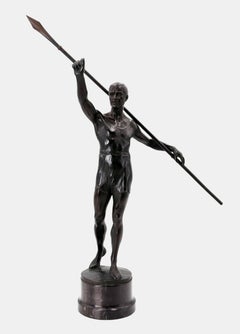
Javelin thrower / - Roman present -
By Franz Iffland
Located in Berlin, DE
Franz Iffland (1862 Tempelhof - 1935 Berlin), Javelin thrower, after 1910. Olive-black patinated bronze with cast plinth mounted on a white-veined black marble base (7 cm high). Tota...
Category
1910s Art Deco George Aarons Art
Materials
Bronze
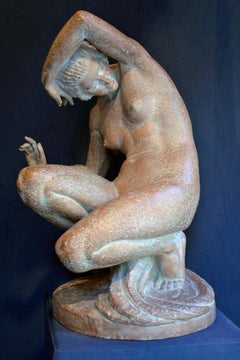
Sculpture Terracotta Female Nude From Marcel Bouraine (1886-1948)
By Marcel-André Bouraine
Located in Saint-Ouen, FR
Sculpture Terracotta From Marcel Bouraine (1886-1948)"
Original terra cotta sculpture of Marcel Bouraine
Naïade of the 1930's Signed Bouraine
On the ...
Category
1930s Academic George Aarons Art
Materials
Terracotta
$5,458
H 23.63 in W 15.75 in D 15.75 in
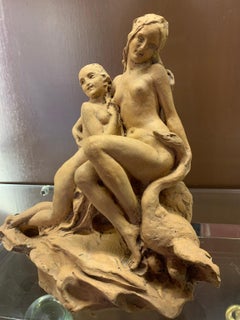
Terracotta figurativa italiana a tema mitologico dei primi del Novecento
Located in Florence, IT
Piccola terracotta a soggetto mitologico firmata sul retro sulla base "Zambini", che per la grafia (in particolare la Z che ricorda una F) permette di identificar...
Category
Early 20th Century Renaissance George Aarons Art
Materials
Terracotta
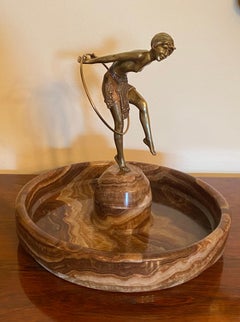
Hoop Dancer
By Demetre Chiparus
Located in Los Angeles, CA
Demetre Haralamb Chiparus (also known as Dumitru Chiparus) (16 September 1886 in Dorohoi, Romania - 22 January 1947 in Paris, France) was a Romanian Art Deco* era sculptor who lived and worked in Paris.
He was born in Romania, the son of Haralamb and Saveta. In 1909 he went to Italy, where he attended the classes of Italian sculptor Raffaello Romanelli. In 1912 he traveled to Paris to attend the Ecole des Beaux Arts* to pursue his art at the classes of Antonin Mercie and Jean Boucher.
Demetre Chiparus died in 1947 and was buried in Bagneux cemetery, just south of Paris.
The first sculptures of Chiparus were created in the realistic style and were exhibited at the Salon of 1914. He employed the combination of bronze and ivory, called chryselephantine*, to great effect. Most of his renowned works were made between 1914 and 1933. The first series of sculptures manufactured by Chiparus were the series of the children.
The mature style of Chiparus took shape beginning in the 1920s. His sculptures are remarkable for their bright and outstanding decorative effect. Dancers of the Russian Ballet, French theatre, and early motion pictures were among his more notable subjects and were typified by a long, slender, stylized appearance. His work was influenced by an interest in Egypt, after Pharaoh Tutankhamen's tomb was excavated.
He worked primarily with the Edmond Etling and Cie Foundry in Paris administrated by Julien Dreyfus. Les Neveux de J. Lehmann was the second foundry which constantly worked with Chiparus and produced the sculptures of his models.
Chiparus rarely exhibited at the Salon. In 1923 he showed his Javelin Thrower, and in 1928 exhibited his Ta-Keo dancer. During the period of Nazi persecution and the World War II, the foundries discontinued production of work by Chiparus. The economic situation of that time was not favorable to the development of decorative arts and circumstances for many sculptors worsened.
Since the early 1940s almost no works of Chiparus were sold, but he continued sculpting for his own pleasure, depicting animals in the Art Deco style. At the 1942 Paris Salon, the plaster sculptures Polar Bear and American Bison were exhibited, and in 1943 he showed a marble Polar Bear and plaster Pelican.
Sculptures of Dimitri Chiparus represent the classical manifestation of Art Deco style in decorative bronze ivory sculpture. Traditionally, four factors of influence over the creative activity of the artist can be distinguished: Serge Diaghilev's Ballets Russes, ancient Egyptian art, and French theatre. Early motion pictures were among his more notable subjects and were typified by figures with a long, slender, stylized appearance. Some of his sculptures were directly inspired by Russian dancers.
Quite often, Chiparus used the photos of Russian and French dancers, stars and models from fashion magazines of his time.
After the tomb of Tutankhamun was discovered in 1922, the art of ancient Egypt...
Category
1920s Art Deco George Aarons Art
Materials
Marble, Bronze
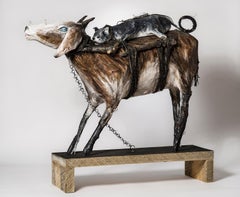
Goat with Cat riding on its back, earth tone sculpture:
Soul to Soul
By Elizabeth Jordan
Located in New York, NY
Elizabeth Jordan is an emerging artist working primarily in sculpture. Her work uses multiple materials to produce unique, organic forms. In early 2016, she participated in an exhibi...
Category
2010s Contemporary George Aarons Art
Materials
Wire
$5,600
H 31 in W 28 in D 12 in
Previously Available Items
Plaster Sculpture Relief Art Deco Plaque WPA Artist Peace Swords to Ploughshares
By George Aarons
Located in Surfside, FL
Size includes wood mounting.
George Aarons (born Gregory Podubisky, in St. Petersburg, Russia, 1896 - died in Gloucester, Massachusetts 1980) was a distinguished sculptor who lived and taught in Gloucester, Massachusetts, for many years until his death in 1980. He had, many students in the area and he designed Gloucester's 350th Anniversary Commemorative Medal.
Aarons moved from Russia to the United States when he was ten. His father was a merchant. He began taking drawing classes during evenings at Dearborn Public School in Boston as a teenager and went on to study at the Boston Museum of Fine Arts in 1916. Aarons later moved to New York City to study with Jo Davidson, and other Paris-trained masters at the Beaux-Arts Institute. He eventually returned to the Boston area and established studios in Brookline and Gloucester, Massachusetts. During his lifetime, he was recognized internationally and won several prestigious awards. Aarons had studios in Brookline, Massachusetts and Gloucester, Massachusetts where he produced large bronze and marble figures and wood carvings. He produced several projects for the Works Progress Administration including a group of three figures for the Public Garden (Boston), a longshoreman, fisherman and foundry worker, as well as a large relief (1938) for the South Boston Housing Project and façade of the Baltimore Hebrew Congregational Building (1956).
His works are at the Museum of Art in Ein Harod, Israel; Fitchburg Art Museum in Massachusetts, Musée de St. Denis in France; Hilles Library at Radcliffe College in Cambridge, Massachusetts; and Hillel House at Boston University in Massachusetts.
He did reliefs for Siefer Hall at Brandeis University in Waltham, Massachusetts (1950); Edward Filene (the founder of Filene's Department Store and a philanthropist) on the Boston Common; Fireman's Memorial in Beverly, Massachusetts; a memorial to Mitchell Frieman in Boston; the U.S. Post Office in Ripley, Mississippi; and at the Cincinnati Telephone Building; the Combined Jewish Philanthropies building in Boston (1965); and a commemorative medal for the 350th Anniversary of the City of Gloucester, Massachusetts (1972).
Characteristic of his era, George Aarons was among the foreign-born American sculptors of the early 20th century who started their careers as academicians and evolved into modernists and increasingly abstract artists.
Over thirty pieces spanning the length of this sculptor's career were featured in this exhibition, including work in various medium bronze, wood and original plasters. Like his contemporaries, Aarons experimented with direct carving in wood, and he was one of the few academically trained sculptors who consistently cut his own works in marble. His early work was classically inspired figurative work, along with sensitive portraits. Some of his most powerful sculpture comes from his middle period, when he worked through his emotional pain following the global realization of the Jewish Holocaust. He depicted humanity deep anxiety over this tragedy with figures that are at once symbolically charged and movingly beautiful. Aarons late work consists of radically simplified forms that continue to reference the human form and often are carved directly in wood and stone.
Aarons summered and taught classes on Cape Ann for many years before moving to Gloucester full-time with his wife about 1950. While Aarons is best known locally for his domestic-scale works, he also executed numerous monumental, public commissions that can be found throughout the United States in cities such as Washington, D.C.; Baltimore, Maryland; and Cincinnati, Ohio; as well as in France and Israel.
As noted in a Gloucester Daily Times Article, Aarons wanted his sculptures to honor the struggles and nobility of people and rail against the evil done against them. And that was why, even as his work grew more and more abstract, stylized and simplified, he never left behind the form of the human figure that had been his focus from his earliest works.
Aarons told the Gloucester Daily Times in September 1954 that he found it hard to remember at just what age he started studying art, but he recalled that the nude model had to partially dress when he was in class because he was so young. He initially studied painting and drawing at the museum school, but he once said he became fascinated by sculpture when he met an established sculptor at the Copley Society in Boston who invited Aarons to his studio and offered him some clay to "play around" with.
After he graduated, he apprenticed under sculptors Richard Brooks, Robert Baker and Solon Borglum. He worked as a carpenter, shipbuilder, dishwasher and chimney sweep. He fashioned architectural decorations, including figures for fountains and now and then a few commissioned portraits. He returned to Boston by the early 1920s and began to exhibit his own works and get commissions for portraits, fountains and reliefs.
His sculptures from this time are dreamy and romantic in the realistic, academic style of the time. A painted portrait of the young Aarons that is included in the North Shore Arts Association exhibit shows a determined fellow with dark brown hair, a suit and bow tie. However, in 1922, this determined young artist was living with his parents on Calder Street in Dorchester.
In the 1930s, Aarons adopted the streamlined, monumental style of the socialist works of the time. Aarons made money, as he would all his life, from commissions, selling his personal work and teaching sculpture, but the Depression of the 1930s was tough for everyone.
So Aarons found work though the federal Works Progress Administration, one of Franklin Roosevelt's New Deal programs. He received his first major commission when he was asked to create a public sculpture for the South Boston Harbor Village public housing project around 1937. He was elevated to the position of supervisor for the project and received a corresponding $5 pay increase to make his weekly salary $32. The raise convinced him he was fit to marry and he proposed to Gertrude Band, an attractive brunette dancer whom he had been dating for more than a year. They were married before the Harbor Village project was dedicated on Labor Day 1938.
Aarons' design featured a brawny, larger-than-lifesize fisherman, longshoreman and a laborer flanked by a boy and girl at either end to portray the children who would live in the apartments. Aarons elected to do the piece in cast stone to employ carpenters and laborers as well as craftsman for a total of 10 men.
In his sculpture, Aarons focused more and more on the theme of oppressed people as he worried about the spread of fascism and Nazism during the 1930s, World War II and after. He had done pieces during the mid-1930s about the oppression of African-Americans, including "Negro Head," which is in the North Shore Art Association retrospective. After the war, he also delved into Jewish themes and became increasingly known as an important Jewish artist, leading to commissions from Jewish organizations across the country and abroad.
"He gets into raw emotion. Some people describe him as an expressionist because of the emotion (in his work)," Reynolds says.
But Aarons, also sculpted sensual sexual nudes...
Category
20th Century Art Deco George Aarons Art
Materials
Plaster, Wood
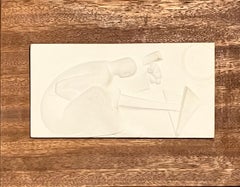
George Aarons Plaster Sculpture Relief Art Deco Plaque WPA Artist Ruth
Naomi
By George Aarons
Located in Surfside, FL
Size includes wood mounting.
George Aarons (born Gregory Podubisky, in St. Petersburg, Russia, 1896 - died in Gloucester, Massachusetts 1980) was a distinguished sculptor who lived and taught in Gloucester, Massachusetts, for many years until his death in 1980. He had, many students in the area and he designed Gloucester's 350th Anniversary Commemorative Medal.
Aarons moved from Russia to the United States when he was ten. His father was a merchant. He began taking drawing classes during evenings at Dearborn Public School in Boston as a teenager and went on to study at the Boston Museum of Fine Arts in 1916. Aarons later moved to New York City to study with Jo Davidson, and other Paris-trained masters at the Beaux-Arts Institute. He eventually returned to the Boston area and established studios in Brookline and Gloucester, Massachusetts. During his lifetime, he was recognized internationally and won several prestigious awards. Aarons had studios in Brookline, Massachusetts and Gloucester, Massachusetts where he produced large bronze and marble figures and wood carvings. He produced several projects for the Works Progress Administration including a group of three figures for the Public Garden (Boston), a longshoreman, fisherman and foundry worker, as well as a large relief (1938) for the South Boston Housing Project and façade of the Baltimore Hebrew Congregational Building (1956).
His works are at the Museum of Art in Ein Harod, Israel; Fitchburg Art Museum in Massachusetts, Musée de St. Denis in France; Hilles Library at Radcliffe College in Cambridge, Massachusetts; and Hillel House at Boston University in Massachusetts.
He did reliefs for Siefer Hall at Brandeis University in Waltham, Massachusetts (1950); Edward Filene (the founder of Filene's Department Store and a philanthropist) on the Boston Common; Fireman's Memorial in Beverly, Massachusetts; a memorial to Mitchell Frieman in Boston; the U.S. Post Office in Ripley, Mississippi; and at the Cincinnati Telephone Building; the Combined Jewish Philanthropies building in Boston (1965); and a commemorative medal for the 350th Anniversary of the City of Gloucester, Massachusetts (1972).
Characteristic of his era, George Aarons was among the foreign-born American sculptors of the early 20th century who started their careers as academicians and evolved into modernists and increasingly abstract artists.
Over thirty pieces spanning the length of this sculptor's career were featured in this exhibition, including work in various medium bronze, wood and original plasters. Like his contemporaries, Aarons experimented with direct carving in wood, and he was one of the few academically trained sculptors who consistently cut his own works in marble. His early work was classically inspired figurative work, along with sensitive portraits. Some of his most powerful sculpture comes from his middle period, when he worked through his emotional pain following the global realization of the Jewish Holocaust. He depicted humanity deep anxiety over this tragedy with figures that are at once symbolically charged and movingly beautiful. Aarons late work consists of radically simplified forms that continue to reference the human form and often are carved directly in wood and stone.
Aarons summered and taught classes on Cape Ann for many years before moving to Gloucester full-time with his wife about 1950. While Aarons is best known locally for his domestic-scale works, he also executed numerous monumental, public commissions that can be found throughout the United States in cities such as Washington, D.C.; Baltimore, Maryland; and Cincinnati, Ohio; as well as in France and Israel.
As noted in a Gloucester Daily Times Article, Aarons wanted his sculptures to honor the struggles and nobility of people and rail against the evil done against them. And that was why, even as his work grew more and more abstract, stylized and simplified, he never left behind the form of the human figure that had been his focus from his earliest works.
Aarons told the Gloucester Daily Times in September 1954 that he found it hard to remember at just what age he started studying art, but he recalled that the nude model had to partially dress when he was in class because he was so young. He initially studied painting and drawing at the museum school, but he once said he became fascinated by sculpture when he met an established sculptor at the Copley Society in Boston who invited Aarons to his studio and offered him some clay to "play around" with.
After he graduated, he apprenticed under sculptors Richard Brooks, Robert Baker and Solon Borglum. He worked as a carpenter, shipbuilder, dishwasher and chimney sweep. He fashioned architectural decorations, including figures for fountains and now and then a few commissioned portraits. He returned to Boston by the early 1920s and began to exhibit his own works and get commissions for portraits, fountains and reliefs.
His sculptures from this time are dreamy and romantic in the realistic, academic style of the time. A painted portrait of the young Aarons that is included in the North Shore Arts Association exhibit shows a determined fellow with dark brown hair, a suit and bow tie. However, in 1922, this determined young artist was living with his parents on Calder Street in Dorchester.
In the 1930s, Aarons adopted the streamlined, monumental style of the socialist works of the time. Aarons made money, as he would all his life, from commissions, selling his personal work and teaching sculpture, but the Depression of the 1930s was tough for everyone.
So Aarons found work though the federal Works Progress Administration, one of Franklin Roosevelt's New Deal programs. He received his first major commission when he was asked to create a public sculpture for the South Boston Harbor Village public housing project around 1937. He was elevated to the position of supervisor for the project and received a corresponding $5 pay increase to make his weekly salary $32. The raise convinced him he was fit to marry and he proposed to Gertrude Band, an attractive brunette dancer whom he had been dating for more than a year. They were married before the Harbor Village project was dedicated on Labor Day 1938.
Aarons' design featured a brawny, larger-than-lifesize fisherman, longshoreman and a laborer flanked by a boy and girl at either end to portray the children who would live in the apartments. Aarons elected to do the piece in cast stone to employ carpenters and laborers as well as craftsman for a total of 10 men.
In his sculpture, Aarons focused more and more on the theme of oppressed people as he worried about the spread of fascism and Nazism during the 1930s, World War II and after. He had done pieces during the mid-1930s about the oppression of African-Americans, including "Negro Head," which is in the North Shore Art Association retrospective. After the war, he also delved into Jewish themes and became increasingly known as an important Jewish artist, leading to commissions from Jewish organizations across the country and abroad.
"He gets into raw emotion. Some people describe him as an expressionist because of the emotion (in his work)," Reynolds says.
But Aarons, also sculpted sensual sexual nudes...
Category
20th Century Art Deco George Aarons Art
Materials
Plaster, Wood
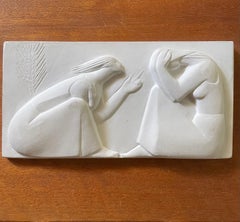
Plaster Sculpture Relief Art Deco Plaque WPA Artist Family w Baby Mother, Father
By George Aarons
Located in Surfside, FL
Size includes wood mounting.
George Aarons (born Gregory Podubisky, in St. Petersburg, Russia, 1896 - died in Gloucester, Massachusetts 1980) was a distinguished sculptor who lived and taught in Gloucester, Massachusetts, for many years until his death in 1980. He had, many students in the area and he designed Gloucester's 350th Anniversary Commemorative Medal.
Aarons moved from Russia to the United States when he was ten. His father was a merchant. He began taking drawing classes during evenings at Dearborn Public School in Boston as a teenager and went on to study at the Boston Museum of Fine Arts in 1916. Aarons later moved to New York City to study with Jo Davidson, and other Paris-trained masters at the Beaux-Arts Institute. He eventually returned to the Boston area and established studios in Brookline and Gloucester, Massachusetts. During his lifetime, he was recognized internationally and won several prestigious awards. Aarons had studios in Brookline, Massachusetts and Gloucester, Massachusetts where he produced large bronze and marble figures and wood carvings. He produced several projects for the Works Progress Administration including a group of three figures for the Public Garden (Boston), a longshoreman, fisherman and foundry worker, as well as a large relief (1938) for the South Boston Housing Project and façade of the Baltimore Hebrew Congregational Building (1956).
His works are at the Museum of Art in Ein Harod, Israel; Fitchburg Art Museum in Massachusetts, Musée de St. Denis in France; Hilles Library at Radcliffe College in Cambridge, Massachusetts; and Hillel House at Boston University in Massachusetts.
He did reliefs for Siefer Hall at Brandeis University in Waltham, Massachusetts (1950); Edward Filene (the founder of Filene's Department Store and a philanthropist) on the Boston Common; Fireman's Memorial in Beverly, Massachusetts; a memorial to Mitchell Frieman in Boston; the U.S. Post Office in Ripley, Mississippi; and at the Cincinnati Telephone Building; the Combined Jewish Philanthropies building in Boston (1965); and a commemorative medal for the 350th Anniversary of the City of Gloucester, Massachusetts (1972).
Characteristic of his era, George Aarons was among the foreign-born American sculptors of the early 20th century who started their careers as academicians and evolved into modernists and increasingly abstract artists.
Over thirty pieces spanning the length of this sculptor's career were featured in this exhibition, including work in various medium bronze, wood and original plasters. Like his contemporaries, Aarons experimented with direct carving in wood, and he was one of the few academically trained sculptors who consistently cut his own works in marble. His early work was classically inspired figurative work, along with sensitive portraits. Some of his most powerful sculpture comes from his middle period, when he worked through his emotional pain following the global realization of the Jewish Holocaust. He depicted humanity deep anxiety over this tragedy with figures that are at once symbolically charged and movingly beautiful. Aarons late work consists of radically simplified forms that continue to reference the human form and often are carved directly in wood and stone.
Aarons summered and taught classes on Cape Ann for many years before moving to Gloucester full-time with his wife about 1950. While Aarons is best known locally for his domestic-scale works, he also executed numerous monumental, public commissions that can be found throughout the United States in cities such as Washington, D.C.; Baltimore, Maryland; and Cincinnati, Ohio; as well as in France and Israel.
As noted in a Gloucester Daily Times Article, Aarons wanted his sculptures to honor the struggles and nobility of people and rail against the evil done against them. And that was why, even as his work grew more and more abstract, stylized and simplified, he never left behind the form of the human figure that had been his focus from his earliest works.
Aarons told the Gloucester Daily Times in September 1954 that he found it hard to remember at just what age he started studying art, but he recalled that the nude model had to partially dress when he was in class because he was so young. He initially studied painting and drawing at the museum school, but he once said he became fascinated by sculpture when he met an established sculptor at the Copley Society in Boston who invited Aarons to his studio and offered him some clay to "play around" with.
After he graduated, he apprenticed under sculptors Richard Brooks, Robert Baker and Solon Borglum. He worked as a carpenter, shipbuilder, dishwasher and chimney sweep. He fashioned architectural decorations, including figures for fountains and now and then a few commissioned portraits. He returned to Boston by the early 1920s and began to exhibit his own works and get commissions for portraits, fountains and reliefs.
His sculptures from this time are dreamy and romantic in the realistic, academic style of the time. A painted portrait of the young Aarons that is included in the North Shore Arts Association exhibit shows a determined fellow with dark brown hair, a suit and bow tie. However, in 1922, this determined young artist was living with his parents on Calder Street in Dorchester.
In the 1930s, Aarons adopted the streamlined, monumental style of the socialist works of the time. Aarons made money, as he would all his life, from commissions, selling his personal work and teaching sculpture, but the Depression of the 1930s was tough for everyone.
So Aarons found work though the federal Works Progress Administration, one of Franklin Roosevelt's New Deal programs. He received his first major commission when he was asked to create a public sculpture for the South Boston Harbor Village public housing project around 1937. He was elevated to the position of supervisor for the project and received a corresponding $5 pay increase to make his weekly salary $32. The raise convinced him he was fit to marry and he proposed to Gertrude Band, an attractive brunette dancer whom he had been dating for more than a year. They were married before the Harbor Village project was dedicated on Labor Day 1938.
Aarons' design featured a brawny, larger-than-lifesize fisherman, longshoreman and a laborer flanked by a boy and girl at either end to portray the children who would live in the apartments. Aarons elected to do the piece in cast stone to employ carpenters and laborers as well as craftsman for a total of 10 men.
In his sculpture, Aarons focused more and more on the theme of oppressed people as he worried about the spread of fascism and Nazism during the 1930s, World War II and after. He had done pieces during the mid-1930s about the oppression of African-Americans, including "Negro Head," which is in the North Shore Art Association retrospective. After the war, he also delved into Jewish themes and became increasingly known as an important Jewish artist, leading to commissions from Jewish organizations across the country and abroad.
"He gets into raw emotion. Some people describe him as an expressionist because of the emotion (in his work)," Reynolds says.
But Aarons, also sculpted sensual sexual nudes...
Category
20th Century Art Deco George Aarons Art
Materials
Plaster, Wood
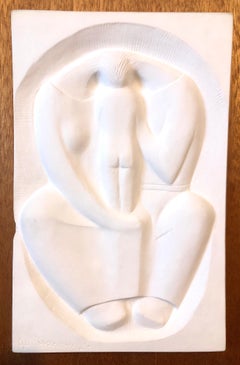
Plaster Sculpture Relief Art Deco Plaque WPA Artist Lovers Embrace, Dancers
By George Aarons
Located in Surfside, FL
Size includes wood mounting.
George Aarons (born Gregory Podubisky, in St. Petersburg, Russia, 1896 - died in Gloucester, Massachusetts 1980) was a distinguished sculptor who lived and taught in Gloucester, Massachusetts, for many years until his death in 1980. He had, many students in the area and he designed Gloucester's 350th Anniversary Commemorative Medal.
Aarons moved from Russia to the United States when he was ten. His father was a merchant. He began taking drawing classes during evenings at Dearborn Public School in Boston as a teenager and went on to study at the Boston Museum of Fine Arts in 1916. Aarons later moved to New York City to study with Jo Davidson, and other Paris-trained masters at the Beaux-Arts Institute. He eventually returned to the Boston area and established studios in Brookline and Gloucester, Massachusetts. During his lifetime, he was recognized internationally and won several prestigious awards. Aarons had studios in Brookline, Massachusetts and Gloucester, Massachusetts where he produced large bronze and marble figures and wood carvings. He produced several projects for the Works Progress Administration including a group of three figures for the Public Garden (Boston), a longshoreman, fisherman and foundry worker, as well as a large relief (1938) for the South Boston Housing Project and façade of the Baltimore Hebrew Congregational Building (1956).
His works are at the Museum of Art in Ein Harod, Israel; Fitchburg Art Museum in Massachusetts, Musée de St. Denis in France; Hilles Library at Radcliffe College in Cambridge, Massachusetts; and Hillel House at Boston University in Massachusetts.
He did reliefs for Siefer Hall at Brandeis University in Waltham, Massachusetts (1950); Edward Filene (the founder of Filene's Department Store and a philanthropist) on the Boston Common; Fireman's Memorial in Beverly, Massachusetts; a memorial to Mitchell Frieman in Boston; the U.S. Post Office in Ripley, Mississippi; and at the Cincinnati Telephone Building; the Combined Jewish Philanthropies building in Boston (1965); and a commemorative medal for the 350th Anniversary of the City of Gloucester, Massachusetts (1972).
Characteristic of his era, George Aarons was among the foreign-born American sculptors of the early 20th century who started their careers as academicians and evolved into modernists and increasingly abstract artists.
Over thirty pieces spanning the length of this sculptor's career were featured in this exhibition, including work in various medium bronze, wood and original plasters. Like his contemporaries, Aarons experimented with direct carving in wood, and he was one of the few academically trained sculptors who consistently cut his own works in marble. His early work was classically inspired figurative work, along with sensitive portraits. Some of his most powerful sculpture comes from his middle period, when he worked through his emotional pain following the global realization of the Jewish Holocaust. He depicted humanity deep anxiety over this tragedy with figures that are at once symbolically charged and movingly beautiful. Aarons late work consists of radically simplified forms that continue to reference the human form and often are carved directly in wood and stone.
Aarons summered and taught classes on Cape Ann for many years before moving to Gloucester full-time with his wife about 1950. While Aarons is best known locally for his domestic-scale works, he also executed numerous monumental, public commissions that can be found throughout the United States in cities such as Washington, D.C.; Baltimore, Maryland; and Cincinnati, Ohio; as well as in France and Israel.
As noted in a Gloucester Daily Times Article, Aarons wanted his sculptures to honor the struggles and nobility of people and rail against the evil done against them. And that was why, even as his work grew more and more abstract, stylized and simplified, he never left behind the form of the human figure that had been his focus from his earliest works.
Aarons told the Gloucester Daily Times in September 1954 that he found it hard to remember at just what age he started studying art, but he recalled that the nude model had to partially dress when he was in class because he was so young. He initially studied painting and drawing at the museum school, but he once said he became fascinated by sculpture when he met an established sculptor at the Copley Society in Boston who invited Aarons to his studio and offered him some clay to "play around" with.
After he graduated, he apprenticed under sculptors Richard Brooks, Robert Baker and Solon Borglum. He worked as a carpenter, shipbuilder, dishwasher and chimney sweep. He fashioned architectural decorations, including figures for fountains and now and then a few commissioned portraits. He returned to Boston by the early 1920s and began to exhibit his own works and get commissions for portraits, fountains and reliefs.
His sculptures from this time are dreamy and romantic in the realistic, academic style of the time. A painted portrait of the young Aarons that is included in the North Shore Arts Association exhibit shows a determined fellow with dark brown hair, a suit and bow tie. However, in 1922, this determined young artist was living with his parents on Calder Street in Dorchester.
In the 1930s, Aarons adopted the streamlined, monumental style of the socialist works of the time. Aarons made money, as he would all his life, from commissions, selling his personal work and teaching sculpture, but the Depression of the 1930s was tough for everyone.
So Aarons found work though the federal Works Progress Administration, one of Franklin Roosevelt's New Deal programs. He received his first major commission when he was asked to create a public sculpture for the South Boston Harbor Village public housing project around 1937. He was elevated to the position of supervisor for the project and received a corresponding $5 pay increase to make his weekly salary $32. The raise convinced him he was fit to marry and he proposed to Gertrude Band, an attractive brunette dancer whom he had been dating for more than a year. They were married before the Harbor Village project was dedicated on Labor Day 1938.
Aarons' design featured a brawny, larger-than-lifesize fisherman, longshoreman and a laborer flanked by a boy and girl at either end to portray the children who would live in the apartments. Aarons elected to do the piece in cast stone to employ carpenters and laborers as well as craftsman for a total of 10 men.
In his sculpture, Aarons focused more and more on the theme of oppressed people as he worried about the spread of fascism and Nazism during the 1930s, World War II and after. He had done pieces during the mid-1930s about the oppression of African-Americans, including "Negro Head," which is in the North Shore Art Association retrospective. After the war, he also delved into Jewish themes and became increasingly known as an important Jewish artist, leading to commissions from Jewish organizations across the country and abroad.
"He gets into raw emotion. Some people describe him as an expressionist because of the emotion (in his work)," Reynolds says.
But Aarons, also sculpted sensual sexual nudes...
Category
20th Century Art Deco George Aarons Art
Materials
Plaster, Wood
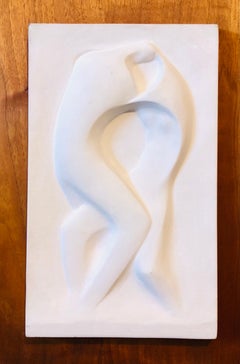
Plaster Sculpture Relief Art Deco Plaque WPA Artist Lovers Embrace, Rose
By George Aarons
Located in Surfside, FL
George Aarons (born Gregory Podubisky, in St. Petersburg, Russia, 1896 - died in Gloucester, Massachusetts 1980) was a distinguished sculptor who lived and taught in Gloucester, Massachusetts, for many years until his death in 1980. He had, many students in the area and he designed Gloucester's 350th Anniversary Commemorative Medal.
Aarons moved from Russia to the United States when he was ten. His father was a merchant. He began taking drawing classes during evenings at Dearborn Public School in Boston as a teenager and went on to study at the Boston Museum of Fine Arts in 1916. Aarons later moved to New York City to study with Jo Davidson, and other Paris-trained masters at the Beaux-Arts Institute. He eventually returned to the Boston area and established studios in Brookline and Gloucester, Massachusetts. During his lifetime, he was recognized internationally and won several prestigious awards. Aarons had studios in Brookline, Massachusetts and Gloucester, Massachusetts where he produced large bronze and marble figures and wood carvings. He produced several projects for the Works Progress Administration including a group of three figures for the Public Garden (Boston), a longshoreman, fisherman and foundry worker, as well as a large relief (1938) for the South Boston Housing Project and façade of the Baltimore Hebrew Congregational Building (1956).
His works are at the Museum of Art in Ein Harod, Israel; Fitchburg Art Museum in Massachusetts, Musée de St. Denis in France; Hilles Library at Radcliffe College in Cambridge, Massachusetts; and Hillel House at Boston University in Massachusetts.
He did reliefs for Siefer Hall at Brandeis University in Waltham, Massachusetts (1950); Edward Filene (the founder of Filene's Department Store and a philanthropist) on the Boston Common; Fireman's Memorial in Beverly, Massachusetts; a memorial to Mitchell Frieman in Boston; the U.S. Post Office in Ripley, Mississippi; and at the Cincinnati Telephone Building; the Combined Jewish Philanthropies building in Boston (1965); and a commemorative medal for the 350th Anniversary of the City of Gloucester, Massachusetts (1972).
Characteristic of his era, George Aarons was among the foreign-born American sculptors of the early 20th century who started their careers as academicians and evolved into modernists and increasingly abstract artists.
Over thirty pieces spanning the length of this sculptor's career were featured in this exhibition, including work in various medium bronze, wood and original plasters. Like his contemporaries, Aarons experimented with direct carving in wood, and he was one of the few academically trained sculptors who consistently cut his own works in marble. His early work was classically inspired figurative work, along with sensitive portraits. Some of his most powerful sculpture comes from his middle period, when he worked through his emotional pain following the global realization of the Jewish Holocaust. He depicted humanity deep anxiety over this tragedy with figures that are at once symbolically charged and movingly beautiful. Aarons late work consists of radically simplified forms that continue to reference the human form and often are carved directly in wood and stone.
Aarons summered and taught classes on Cape Ann for many years before moving to Gloucester full-time with his wife about 1950. While Aarons is best known locally for his domestic-scale works, he also executed numerous monumental, public commissions that can be found throughout the United States in cities such as Washington, D.C.; Baltimore, Maryland; and Cincinnati, Ohio; as well as in France and Israel.
As noted in a Gloucester Daily Times Article, Aarons wanted his sculptures to honor the struggles and nobility of people and rail against the evil done against them. And that was why, even as his work grew more and more abstract, stylized and simplified, he never left behind the form of the human figure that had been his focus from his earliest works.
Aarons told the Gloucester Daily Times in September 1954 that he found it hard to remember at just what age he started studying art, but he recalled that the nude model had to partially dress when he was in class because he was so young. He initially studied painting and drawing at the museum school, but he once said he became fascinated by sculpture when he met an established sculptor at the Copley Society in Boston who invited Aarons to his studio and offered him some clay to "play around" with.
After he graduated, he apprenticed under sculptors Richard Brooks, Robert Baker and Solon Borglum. He worked as a carpenter, shipbuilder, dishwasher and chimney sweep. He fashioned architectural decorations, including figures for fountains and now and then a few commissioned portraits. He returned to Boston by the early 1920s and began to exhibit his own works and get commissions for portraits, fountains and reliefs.
His sculptures from this time are dreamy and romantic in the realistic, academic style of the time. A painted portrait of the young Aarons that is included in the North Shore Arts Association exhibit shows a determined fellow with dark brown hair, a suit and bow tie. However, in 1922, this determined young artist was living with his parents on Calder Street in Dorchester.
In the 1930s, Aarons adopted the streamlined, monumental style of the socialist works of the time. Aarons made money, as he would all his life, from commissions, selling his personal work and teaching sculpture, but the Depression of the 1930s was tough for everyone.
So Aarons found work though the federal Works Progress Administration, one of Franklin Roosevelt's New Deal programs. He received his first major commission when he was asked to create a public sculpture for the South Boston Harbor Village public housing project around 1937. He was elevated to the position of supervisor for the project and received a corresponding $5 pay increase to make his weekly salary $32. The raise convinced him he was fit to marry and he proposed to Gertrude Band, an attractive brunette dancer whom he had been dating for more than a year. They were married before the Harbor Village project was dedicated on Labor Day 1938.
Aarons' design featured a brawny, larger-than-lifesize fisherman, longshoreman and a laborer flanked by a boy and girl at either end to portray the children who would live in the apartments. Aarons elected to do the piece in cast stone to employ carpenters and laborers as well as craftsman for a total of 10 men.
In his sculpture, Aarons focused more and more on the theme of oppressed people as he worried about the spread of fascism and Nazism during the 1930s, World War II and after. He had done pieces during the mid-1930s about the oppression of African-Americans, including "Negro Head," which is in the North Shore Art Association retrospective. After the war, he also delved into Jewish themes and became increasingly known as an important Jewish artist, leading to commissions from Jewish organizations across the country and abroad.
"He gets into raw emotion. Some people describe him as an expressionist because of the emotion (in his work)," Reynolds says.
But Aarons, also sculpted sensual sexual nudes...
Category
20th Century Art Deco George Aarons Art
Materials
Plaster
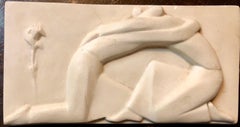
George Aarons art for sale on 1stDibs.
Find a wide variety of authentic George Aarons art available for sale on 1stDibs. You can also browse by medium to find art by George Aarons in wood, ceramic, plaster and more. Much of the original work by this artist or collective was created during the 20th century and is mostly associated with the Art Deco style. Not every interior allows for large George Aarons art, so small editions measuring 10 inches across are available. George Aarons art prices can differ depending upon medium, time period and other attributes. On 1stDibs, the price for these items starts at $1,100 and tops out at $2,200, while the average work can sell for $1,650.