George Morland Drawings and Watercolor Paintings
English, 1763-1804
George Morland (26 June 1763 in London – 29 October 1804 in Brighton) was an English painter. His early work was influenced by Francis Wheatley but after the 1790s he came into his own style. His best compositions focus on rustic scenes: farms and hunting; smugglers and gypsies; and rich, textured landscapes informed by Dutch Golden Age painting.to
1
Overall Width
to
Overall Height
to
1
1
1
1
8
971
401
358
279
1
1
Artist: George Morland
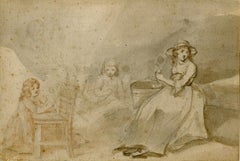
Family Group
By George Morland
Located in Fairlawn, OH
Family Group
Drawing in Chinese white, sepia and bistre ink, c. 1790
Signed lower left: G. Morland (see photo)
The present work appears to be a preliminary study for two Morland paintings where the artist uses portions of this preliminary study in finished exhibition paintings. The strongest association is with the painting entitled The Cottage Door (1790), now in the collection of Royal Holloway College, University of London. Morland uses the same small girl (on left side of this sheet) holding a doll on a chair in the exact same pose. The second painting entitled The Tea Garden (Tate Gallery, London, c. 1790) incorporates similar poses and gestures of the three other figure studies on this sheet.
Provenance: Colnaghi, London (Stock # D25924, see photo)
Maynard Walker Gallery, New York ( see photo of label)
Davis Galleries, New York, their Eagle stamp and stock number (see photo)
Ms. Gloria Kaplan (1930-2011) New York City
Regarding Maynard Walker:
Maynard Walker New York Times obit:
"Maynard Walker, an art dealer in New York City for nearly 40 years who was among the first to show the works of leading American regionalist painters, died of pneumonia Tuesday at St. Joseph's Hospital in Carbondale, Pa. He was 89 years old and lived in Lake Ariel, Pa.
In 1933, while working at the Ferargil Gallery in New York, Mr. Walker organized an exhibition for the Kansas City Art Institute that for the first time brought together the work of the regionalist painters Grant Wood, Thomas Hart Benton and John Steuart Curry.
After Mr. Walker opened his own gallery, at 108 East 57th Street, in 1935, these artists joined him and showed regularly there. The gallery was also among the first to show the work of George Grosz, the German painter and caricaturist, who moved to the United States in 1932. The gallery moved to 117 East 57th Street after the war."
Condition: Aging to paper
Slight fading to ink
Tiny spotting in image
All consistent with the age of the drawing
Image size: 6 3/8 x 9 1/2 inches
Frame size: 14 1/4 x 17 1/4 inches
George Morland was born in London on 26 June 1763. He was the son of Henry Robert Morland, and grandson of George Henry Morland, said by Cunningham to have been lineally descended from Sir Samuel Morland, while other biographers go so far as to say that he had only to claim the baronetcy in order to get it. Morland began to draw at the age of three years, and at the age of ten (1773) his name appears as an honorary exhibitor of sketches at the Royal Academy. He continued to exhibit at the Free Society in 1775 and 1776, and at the Society of Artists in 1777, and then again at the Royal Academy in 1778, 1779 and 1780.
His talents were carefully cultivated by his father, who was accused of stimulating them unduly with a view to his own profit, shutting the child up in a garret to make drawings from pictures and casts for which he found a ready sale. The boy, on the other hand, is said to have soon found a way to make money for himself by hiding some of his drawings, and lowering them at nightfall out of his window to young accomplices, with whom he used to spend the proceeds in frolic and self-indulgence. It has been also asserted that his father, discovering this trick, tried to conciliate him by indulgence, humouring his whims and encouraging his low tastes.
He was set by his father to copy pictures of all kinds, but especially of the Dutch and Flemish masters. Among others he copied Fuseli's Nightmare and Reynolds's Garrick between Tragedy and Comedy. He was also introduced to Sir Joshua Reynolds, and obtained permission to copy his pictures, and all accounts agree that before he was seventeen he had obtained considerable reputation not only with his friends and the dealers, but among artists of repute. A convincing proof of the skill in original composition which he had then attained is the fine engraving.
It is said that before his apprenticeship to his father came to an end, in 1784, Romney offered to take him into his own house, with a salary of £300, on condition of his signing articles for three years. But Morland, we are told, had had enough of restraint, and after a rupture with his father he set up on his own account in 1784 or 1785 at the house of a picture dealer, and commenced that life which, in its combination of hard work and hard drinking, is almost without a parallel.
Morland soon became the mere slave of the dealer with whom he lived. His boon companions were "ostlers, potboys, horse jockeys, moneylenders, pawnbrokers, punks, and pugilists." In this company the handsome young artist swaggered, dressed in a green coat, with large yellow buttons, leather breeches, and top boots. "He was in the very extreme of foppish puppeyism", says Hassell; "his head, when ornamented according to his own taste, resembled a snowball, after the model of Tippey Bob, of dramatic memory, to which was attached a short, thick tail, not unlike a painter's brush." His youth and strong constitution enabled him to recover rapidly from his excesses, and he not only employed the intervals in painting, but at this time, or shortly afterwards, taught himself to play the violin. He made also an effort, and a successful one, to free himself from his task-master, and escaped to Margate, where he painted miniatures for a while. In 1785 he paid a short visit to France, whither his fame had preceded him, and where he had no lack of commissions.
Returning to London, he lodged in a house at Kensal Green, on the road to Harrow, near William Ward, intercourse with whose family seems for a time to have had a steadying influence. It resulted in his marriage with Miss Anne Ward...
Category
1790s English School George Morland Drawings and Watercolor Paintings
Materials
Ink
Related Items
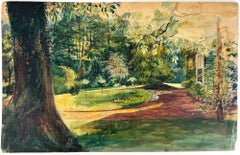
The Mount Willow
Located in Middletown, NY
Watercolor and gouache on heavy gauge watercolor paper, 9 1/2 x 15 1/8 inches (242 x 385 mm), the full sheet. Titled in pencil on the verso. Scattered edge wear, and small losses at ...
Category
Mid-19th Century English School George Morland Drawings and Watercolor Paintings
Materials
Watercolor

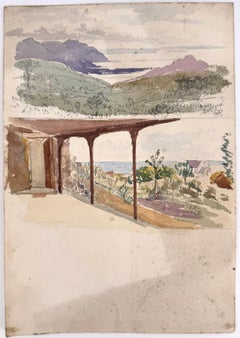
Two views of the sea, Dorset
Located in Middletown, NY
Two watercolor compositions on one sheet of watercolor paper, 10 x 6 7/8 inches (255 x 175 mm), the full sheet. Signed illegibly and dated in pencil on the lower right corner of the ...
Category
Late 19th Century English School George Morland Drawings and Watercolor Paintings
Materials
Watercolor, Pencil, Ink
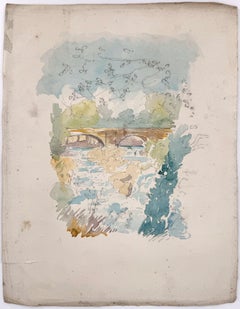
Padbury Brook, Oxfordshire
Located in Middletown, NY
Watercolor and pencil on J Whatman 1884 watermarked cream wove paper, 12 x 9 1/4 inches (305 x 235 mm), the full sheet. Scattered toning and one 2-inch horizontal edge tear in the lo...
Category
Late 19th Century English School George Morland Drawings and Watercolor Paintings
Materials
Watercolor
From St. Martin
s, Parkstone
Located in Middletown, NY
A lovely coastal view of Dorset from the bluffs of what is now Parkstone Golf Club.
1895. Ink and wash on wove paper, 7 1/2 x 11 inches (190 x 280 mm), the full sheet. Signed in ink...
Category
Late 19th Century English School George Morland Drawings and Watercolor Paintings
Materials
Ink
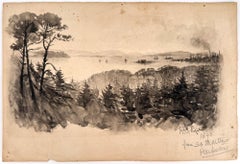
A pair of portraits in profile (2 works) – English School, 18th century
Located in Middletown, NY
Red crayon on cream laid paper, 3 3/4 x 4 inches (95 x 102 mm) ; 3 3/4 x 3 1/8 inches (95 x 80 mm). Each with scattered early repairs done with non-archival tape on the verso; the sm...
Category
Late 18th Century English School George Morland Drawings and Watercolor Paintings
Materials
Crayon, Laid Paper

$350
H 3.75 in W 4.02 in
Seaside cottages
Located in Middletown, NY
Watercolor on watercolor paper, 4 7/8 x 6 3/4 inches (124 x 173 mm), the full sheet. Light toning and minor scattered foxing, colors remain fresh.
Sophia Beale was born in London i...
Category
Early 20th Century English School George Morland Drawings and Watercolor Paintings
Materials
Watercolor
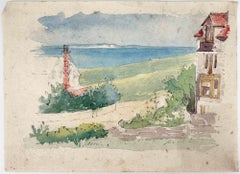
A country cottage
Located in Middletown, NY
Graphite and watercolor on grayish-tan wove paper, 7 5/8 x 6 7/8 inches (194 x 175 mm), the full sheet. An unfinished study in good condition.
On the mat-back is a notation that the...
Category
Mid-19th Century English School George Morland Drawings and Watercolor Paintings
Materials
Watercolor, Handmade Paper, Graphite
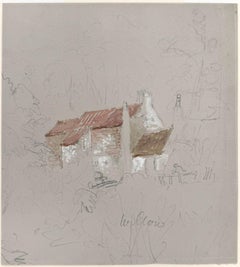
Glastonbury Abbey
By Frederick Nash
Located in Middletown, NY
Ink wash with watercolor in sepia and black, and blue, on buff wove watercolor paper, 14 1/4 x 10 1/4 inches (360 x 260 mm). 1/4" of the lower right corner is lost, minor crack (doe...
Category
Mid-19th Century English School George Morland Drawings and Watercolor Paintings
Materials
Ink, Watercolor, Handmade Paper
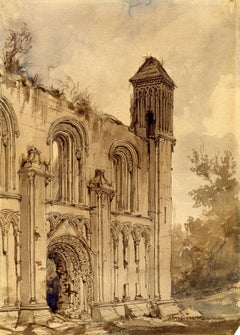
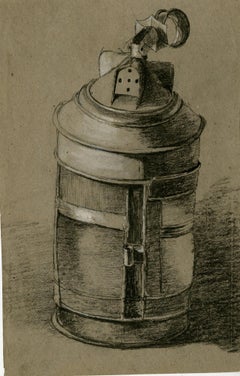
Still life with lantern - English School, 19th Century
Located in Middletown, NY
A luminous 1850 still life study of a tin lantern.
Black chalk with white heightening on brownish-gray, fibrous, handmade buff wove paper, 10 1/2 x 6 3/4 inches (262 x 172 mm), the ...
Category
Mid-19th Century English School George Morland Drawings and Watercolor Paintings
Materials
Chalk, Handmade Paper, Pencil
Study of a girl sitting and reading a book
By William Hoare
Located in Bath, Somerset
A study in red chalk of a girl sitting and reading a book. Red chalk on paper under glass in a giltwood and gesso frame. This small drawing has a sense of intimacy in the capturing of a moment where the sitter is seemingly unaware of being observed, unlike the feeling of formailty and self-awareness in a staged portrait sitting
Provenance:
Private collection, Somerset
With J. Davey & Sons Ltd, Liverpool
William Hoare...
Category
Late 18th Century English School George Morland Drawings and Watercolor Paintings
Materials
Paper, Chalk, Glass

$2,204 Sale Price
20% Off
H 11.42 in W 9.65 in
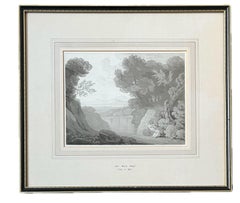
John White Abbott, Early English watercolor, Abraham and Isaac
By John White Abbott
Located in Harkstead, GB
A most attractive watercolor by one of the forefathers of British watercolour painting.
John White Abbott (1763-1851)
Abraham and Isaac in an extensive landscape
Pen, ink and wash
7...
Category
Early 19th Century English School George Morland Drawings and Watercolor Paintings
Materials
Paper, Ink, Watercolor, Pen
$1,060 Sale Price
30% Off
H 7 in W 9 in D 1 in
The Capitol, Timgad, Algeria
Located in Middletown, NY
A luminous landscape of the Roman ruins at Timgad, with the Aurès mountains aglow in the background.
Watercolor on artist board, 9 7/8 x 7 inches (252 x 178 mm), the full sheet. Tit...
Category
Mid-19th Century English School George Morland Drawings and Watercolor Paintings
Materials
Watercolor, Handmade Paper

George Morland drawings and watercolor paintings for sale on 1stDibs.
Find a wide variety of authentic George Morland drawings and watercolor paintings available for sale on 1stDibs. You can also browse by medium to find art by George Morland in ink and more. Not every interior allows for large George Morland drawings and watercolor paintings, so small editions measuring 10 inches across are available. Customers who are interested in this artist might also find the work of and John Sergeant. George Morland drawings and watercolor paintings prices can differ depending upon medium, time period and other attributes. On 1stDibs, the price for these items starts at $5,500 and tops out at $5,500, while the average work can sell for $5,500.