George Wesley Bellows Landscape Prints
American, 1882-1925
George Bellows, an American artist, was born in Columbus, Ohio in 1882, the only child of a successful building contractor from Sag Harbor, New York. He entered Ohio State University in 1901, where he played baseball and basketball and made drawings for college publications. He dropped out of college in 1904, went to New York, and studied under Robert Henri (American, 1865 – 1929) at the New York School of Art, where Edward Hopper (American, 1882 – 1967), Rockwell Kent (American, 1882 – 1971), and Guy Pène du Bois (American, 1884 – 1958) were his classmates. A superb technician who worked in a confident, painterly style, Bellows soon established himself as the most important realist of his generation. He created memorable images of club fights, street urchins swimming in the East River, and the Pennsylvania Station excavation site and garnered praise from both progressive and conservative critics.
In 1910 Bellows began teaching at the Art Students League and married Emma Story, by whom he had two daughters. After 1910 Bellows gradually abandoned the stark urban realism and dark palette characteristic of his early work and gravitated toward painting landscapes, seascapes, and portraits.
Bellows helped organize the Armory Show in 1913, in which five of his paintings and a number of drawings were included. That year he was elected a full member of the National Academy of Design. He had leftist political views and contributed illustrations to the Socialist publication The Masses from 1912 to 1917. Bellows began to make lithographs in 1916 and his exceptional talent engendered a revival of interest in the medium. He worked in Maine, in Carmel, California, and in Middletown, Rhode Island, and was a founding member of the Society of Independent Artists and a charter member of the Association of American Painters and Sculptors. In 1919 he taught at the Art Institute of Chicago.
Bellows, who never went to Europe, is regarded as a quintessential American artist whose vigorous style enabled him to explore a wide range of subjects from scenes of modern urban life to portraits of his daughters, to turbulent Maine seascapes. As an early biographer noted, Bellows “caught the brute force of the prizefighter, the ruggedness of the country pasture, the essence of childhood and recorded them appropriately not only for his own generation but for all time.”[1]
[1] [Frederick A. Sweet], George Bellows: Paintings, Drawings and Prints (Art Institute of Chicago, IL, 1946).
Robert Torchia September 29, 2016to
3
Overall Width
to
Overall Height
to
10
188
169
156
147
3
3
3
2
2
1
3
2
3
Artist: George Wesley Bellows
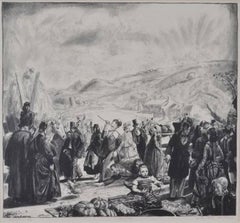
The Irish Fair
By George Wesley Bellows
Located in Fairlawn, OH
Irish Fair
Lithograph, 1923
Signed and numbered in pencil by the artist (see photo)
Titled "Irish Fair" by the artist in pencil
Edition: 84
Housed in an archival frame with acid free matting (see photo)
Provenance:
Estate of the artist, Bellows Family Trust
H.V. Allison & Company (label)
Private Collection, Columbus
References And Exhibitions:
Reference: Mason 153
Note: An illustration commissioned by The Century Company for Don Byrne's novel The Wind Bloweth
Image: 18 7/8 x 21 3/8"
Frame: 29 1/2 x 30 1/2"
“Eleven on a hot July morning, and the little town...
Category
1920s Ashcan School George Wesley Bellows Landscape Prints
Materials
Lithograph
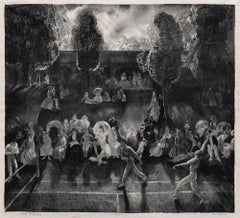
Tennis (Tennis Tournament)
By George Wesley Bellows
Located in Palm Desert, CA
A lithograph by George Bellows. “Tennis (Tennis Tournament)” is a realistic lithograph on paper in black and white by American Realist, George Bellows. Bellows’ depictions of sportin...
Category
1920s American Realist George Wesley Bellows Landscape Prints
Materials
Lithograph
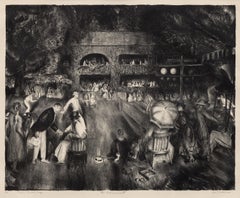
The Tournament (Tennis at Newport)
By George Wesley Bellows
Located in Palm Desert, CA
A lithograph by George Bellows. “The Tournament (Tennis at Newport)” is a realistic lithograph on paper in black and white by American Realist artist, George Bellows. Bellows' depictions of sporting / leisure scenes are unique and valuable. This artwork is edition 56/63 with framed dimensions of 26 x 29 x 1 1/4 inches and has been in the same private collection for almost four decades. The artwork is signed in pencil, lower right, "G. Bellows.”
Provenance:
Catherine E Burns...
Category
1920s American Realist George Wesley Bellows Landscape Prints
Materials
Lithograph
Related Items
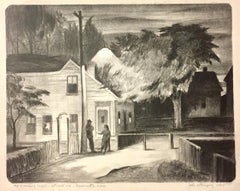
John W. Gregory, Approaching Night, Atwood Avenue, Provincetown, MA
By John W. Gregory
Located in New York, NY
Gregory worked mostly in lithography, probably learned at the Art Students League in New York City. However he often drew New England subjects, so this evening Provincetown scene is ...
Category
1930s Ashcan School George Wesley Bellows Landscape Prints
Materials
Lithograph
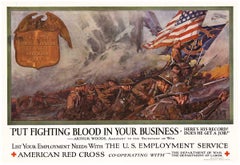
Put Fighting Blood in Your Business
Located in Spokane, WA
Original WW1 poster. Put Fighting Blood in Your Business. Here’s his record! Does he get a Job? Arthur Woods, Assistant to the Secretary of...
Category
1910s American Realist George Wesley Bellows Landscape Prints
Materials
Lithograph

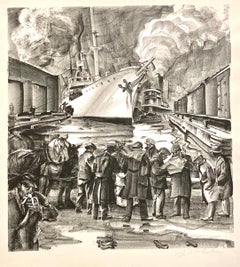
Joseph Webster Golinkin, On the Dock, Banana Boat, New Orleans
By Joseph Webster Golinkin
Located in New York, NY
Chicago-born Golinkin studied at the Artist Students League with George Luks. After working as an illustrator for New York papers he joined the Navy in 1939 and retired as a Rear Adm...
Category
1930s Ashcan School George Wesley Bellows Landscape Prints
Materials
Lithograph
$1,200
H 14.5 in W 13.25 in
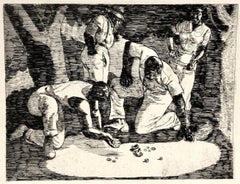
Irving Guyer, Roll Them Bones, Depression-era African-American men at craps
By Irving Guyer
Located in New York, NY
An American Depression-Era subject of African-American men playing craps by Irving Guyer.. (Craps is a game of chance that required neither skill nor strategy. The object is to predi...
Category
1930s Ashcan School George Wesley Bellows Landscape Prints
Materials
Etching
Yelding the Right of Way
Located in San Francisco, CA
This artwork titled "Yelding the Right of Way" c.1975 is a color offset lithograph by renown western artist Arnold Friberg, 1913-2010. It is hand signed...
Category
Late 20th Century American Realist George Wesley Bellows Landscape Prints
Materials
Lithograph
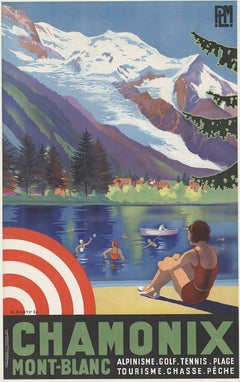
Original Chamonix Mont-Blanc vintage travel poster
Located in Spokane, WA
Original vintage travel poster Chamonix Mont-Blanc PLM French travel poster. Very good condition, archival linen backed. Ready to frame. ...
Category
1930s American Realist George Wesley Bellows Landscape Prints
Materials
Lithograph
$8,500
H 39.38 in W 24.5 in D 0.07 in
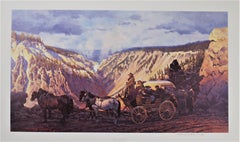
A Kodak Moment
Located in San Francisco, CA
This artwork titled "A Kodak Moment" 1992 is an offset lithograph by renown Western artist Gary Carter, born 1938. It is hand signed and numbered 816/850 i...
Category
Late 20th Century American Realist George Wesley Bellows Landscape Prints
Materials
Lithograph
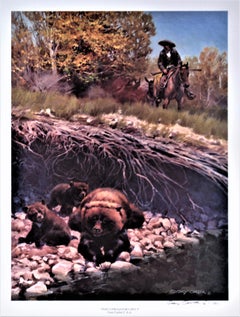
When Predators Meet
Located in San Francisco, CA
This artwork titled "When Predators Meet" 1988 is an offset lithograph by renown Western artist Gary Carter, born 1938. It is hand signed and numbered 817/...
Category
Late 20th Century American Realist George Wesley Bellows Landscape Prints
Materials
Lithograph
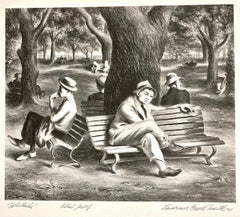
Lawrence Beall Smith, Solitude
By Lawrence Beall Smith
Located in New York, NY
Lawrence Beall Smith draws four men in a park, each with his back to a giant, strong tree. The year is 1938 and the country is coming out of the Depression but World War II is alread...
Category
Mid-20th Century Ashcan School George Wesley Bellows Landscape Prints
Materials
Lithograph
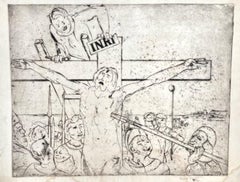
Fred Nagler, (Crucifixion)
By Fred Nagler
Located in New York, NY
The etching (Crucifixion) is signed and titled in pencil. Signed 'Fred' and possibly dated '27' in the image at lower left.
It's in an usually spare drawing style but one that Nagl...
Category
1920s Ashcan School George Wesley Bellows Landscape Prints
Materials
Etching
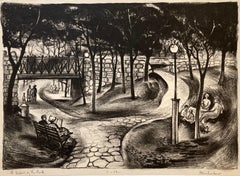
Ann Michalov, A View of the Park
Located in New York, NY
Originally from Illinois, Ann Michalov worked in Spokane, Seattle and Portland, where she finally settled. This lithograph however really looks very like ...
Category
1930s Ashcan School George Wesley Bellows Landscape Prints
Materials
Lithograph
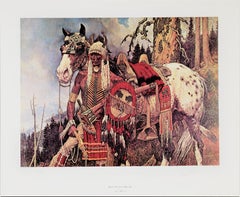
When the Land was His
Located in San Francisco, CA
This artwork titled "When the Land was His" 1985, is a color offset lithograph by renown western artist Arnold Friberg, 1913-2010. It is hand signed and...
Category
Late 20th Century American Realist George Wesley Bellows Landscape Prints
Materials
Lithograph
Previously Available Items
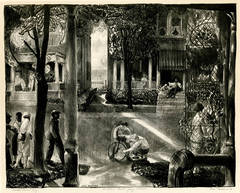
Sixteen East Gay Street
By George Wesley Bellows
Located in Fairlawn, OH
Signed by the artist and his printer Bolton Brown
Edition: 72
Provenance:
H.V. Allison & Co., Inc., New York (label)
References And Exhibitions:
This nostalgic scene o...
Category
1920s George Wesley Bellows Landscape Prints
Materials
Lithograph
George Wesley Bellows landscape prints for sale on 1stDibs.
Find a wide variety of authentic George Wesley Bellows landscape prints available for sale on 1stDibs. You can also browse by medium to find art by George Wesley Bellows in lithograph and more. Not every interior allows for large George Wesley Bellows landscape prints, so small editions measuring 20 inches across are available. Customers who are interested in this artist might also find the work of John Sloan, Fred Nagler, and Anton Schutz. George Wesley Bellows landscape prints prices can differ depending upon medium, time period and other attributes. On 1stDibs, the price for these items starts at $5,000 and tops out at $23,600, while the average work can sell for $14,300.
Questions About George Wesley Bellows Landscape Prints
- 1stDibs ExpertApril 5, 2022Cliff Dwellers by George Bellows is a painting created in 1913 that’s meant to depict the explosive population growth that New York City was experiencing at the time. Specifically, the painting is of a hot summer’s day in New York City’s Lower East Side. On 1stDibs, find a variety of original artwork from top artists.
- 1stDibs ExpertApril 5, 2022George Bellows created paintings that focussed on realism. His oil paintings mixed urban studies with social and political themes, mainly centered around New York City. On 1stDibs, you can shop a selection of George Bellow’s pieces from some of the world’s top art dealers from the comfort of your home.