Gifford Beal Prints and Multiples

American, 1879-1956

Gifford Beal, painter, etcher, muralist and teacher, was born in New York City in 1879. The son of landscape painter William Reynolds Beal, Beal began studying at William Merritt Chase's Shinnecock School of Art (the first established school of plein air painting in America) at the age of 13, when he accompanied his older brother, Reynolds, to summer classes. Beal remained a pupil of Chase's for 10 years also studying with him in New York City at the artist's private studio in the Tenth Street Studio Building. Later at his father's behest, Beal attended Princeton University from 1896–1900 while continuing his lessons with Chase. Upon graduation from Princeton, Beal took classes at the Art Students' League, studying with impressionist landscape painter Henry Ward Ranger and Boston academic painter Frank Vincent DuMond. Beal ended up as President of the Art Students League for 14 years, "a distinction unsurpassed by any other artist." Beal’s student days were spent entirely in this country. Given the opportunity to visit Paris en route to England in 1908, Beal chose to avoid it, he stated, "I didn't trust myself with the delightful life in ParisIt all sounded so fascinating and easy and loose." His subjects were predominately American and it has been said stylistically "his art is completely American." Beal achieved early recognition in the New York Art World. Beal became an associate member of the National Academy of Design in 1908 and was elected to full status as an academician in 1914. Beal was known for garden parties, circuses, landscapes, streets, coasts, flowers and marines. This diversity in subject matter created "no typical or characteristic style to his work." Beal's style was highly influenced by Chase and Childe Hassam, a long time friend of the Beal family who used to travel about the countryside with Beal in a car sketching local sights. Both Hassam and Chase were famous for their impressionist views of New York City and Connecticut and Long Island coastlines. Beal's early work reflects his acquaintance with these painters and focused on the city's commercial and industrial growth. Beal's major influence, however, remained Chase, whose "greatness" Beal attributed to the "sheer fullness of his nature, his store of energy" and his dedication to the profession of painting. "When the story of American art is finally told," Beal predicted, "Chase's name will be high on the list of the great." Regarding his use of color, one art critic wrote: "On the whole, he is inclined toward color that is rich and strong. The garden scenes have masses of deep and gleaming foliage over the gay scenes below. The circus pictures are resplendent in hue. He takes the rich green that crowns the cliffs at Montauk and with it gives depth and richness to their tawny sides. The ocean in Sword Fisherman is an intense blue, neither light nor dark and full of almost imperceptible shadings." Beal found early success with his views of the Hudson Valley where his family had an estate called Willellen in Newburgh, overlooking the Hudson River. A gifted technician and draftsman, Beal did considerable mural painting including seven panels portraying the life of scientist John Henry; North Country and Tropical Country, Department of the Interior building, Washington, D.C and others. Renewing an early interest for the sea, a subject he had favored during his student years, Beal started to achieve recognition for his marine landscapes. In 1921, Beal began spending most of his summers on the Massachusetts coast, first at Provincetown and then at Rockport. Both Beal and his brother Reynolds had a strong attraction to the sea. In the 1940s, Beal, never one to rest on his laurels made a dramatic stylistic change, his painting technique became freer as he replaced naturalistic perspective with an intricately patterned and flattened picture plane. These more decorative works echoed ancient Persian paintings as well as the work of Maurice and Charles Prendergast whose art Beal greatly admired. In the end, Beal adopted a "less objective" style that was high key and "utilizing softer edges." This new work was said to be influenced by Raoul Dufy. However many influences one may choose to cite in Beal's work this is secondary to the fact that Beal throughout his artistic career derived a strong personal statement in his art that was "fundamentally sound and aesthetically pleasing." Beal was a member of the American Academy of Arts and Letters, the American Institute of Arts and Letters, the Architectural League of America and the National Society of Mural Painters. His work can be found in numerous museums and public collections across the country. Beal passed away on Feb. 5th, 1956 at the age of 75 in New York City.

to
1
2
Overall Width
to
Overall Height
to
1
6
1,220
972
913
839
3
1
3
3
3
2
1
1
1
1
1
2
1
2
2
1
Artist: Gifford Beal
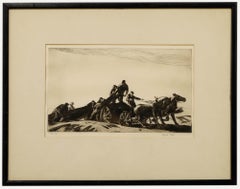
Gifford Beal (1879-1956) - Framed c.1930 Etching, The Net Wagon
By Gifford Beal
Located in Corsham, GB
Gifford Beal (1879-1956) Original Pencil Signed Etching with Drypoint. Presented in a smart black frame. Signed below plate lines. On paper.
Category

Early 20th Century Gifford Beal Prints and Multiples

Materials

Etching

Bareback Act, Old Hippodrome
By Gifford Beal
Located in Missouri, MO
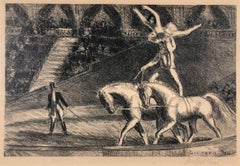
Gifford Beal (1879-1956) "Bareback Act, Old Hippodome" 1950 Lithograph Signed Lower Right With original Associated American Artists label verso image: 6 3/8 x 9 5/8 in. (16.2 x 24.6 cm) sheet: 12 x 16 in. (30.4 x 40.6 cm) framed: 17 x 20 in. Gifford Beal, painter, etcher, muralist, and teacher, was born in New York City in 1879. The son of landscape painter William Reynolds Beal, Gifford Beal began studying at William Merritt Chase's Shinnecock School of Art (the first established school of plein air painting in America) at the age of thirteen, when he accompanied his older brother, Reynolds, to summer classes. He remained a pupil of Chase's for ten years also studying with him in New York City at the artist's private studio in the Tenth Street Studio Building. Later at his father's behest, he attended Princeton University from 1896 to 1900 while still continuing his lessons with Chase. Upon graduation from Princeton he took classes at the Art Students' League, studying with impressionist landscape painter Henry Ward Ranger and Boston academic painter Frank Vincent DuMond. He ended up as President of the Art Students League for fourteen years, "a distinction unsurpassed by any other artist." His student days were spent entirely in this country. "Given the opportunity to visit Paris en route to England in 1908, he chose to avoid it" he stated, "I didn't trust myself with the delightful life in ParisIt all sounded so fascinating and easy and loose." His subjects were predominately American, and it has been said stylistically "his art is completely American." Gifford achieved early recognition in the New York Art World. He became an associate member of the National Academy of Design in 1908 and was elected to full status of academician in 1914. He was known for garden parties, circuses, landscapes, streets, coasts, flowers and marines. This diversity in subject matter created "no typical or characteristic style to his work." Beal's style was highly influenced by Chase and Childe Hassam, a long time friend of the Beal family who used to travel "about the countryside with Beal in a car sketching...
Category

1950s American Realist Gifford Beal Prints and Multiples

Materials

Lithograph

Bareback Act, Old Hippodrome
By Gifford Beal
Located in Missouri, MO
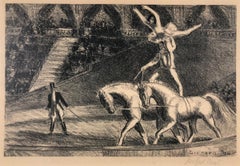
Bareback Act, Old Hippodrome By Gifford Beal (1879-1956) Signed Lower Right Unframed: 6.5" x 9.5" Framed: 17.5" x 20" Gifford Beal, painter, etcher, muralist, and teacher, was born in New York City in 1879. The son of landscape painter William Reynolds Beal, Gifford Beal began studying at William Merritt Chase's Shinnecock School of Art (the first established school of plein air painting in America) at the age of thirteen, when he accompanied his older brother, Reynolds, to summer classes. He remained a pupil of Chase's for ten years also studying with him in New York City at the artist's private studio in the Tenth Street Studio Building. Later at his father's behest, he attended Princeton University from 1896 to 1900 while still continuing his lessons with Chase. Upon graduation from Princeton he took classes at the Art Students' League, studying with impressionist landscape painter Henry Ward Ranger and Boston academic painter Frank Vincent DuMond. He ended up as President of the Art Students League for fourteen years, "a distinction unsurpassed by any other artist." His student days were spent entirely in this country. "Given the opportunity to visit Paris en route to England in 1908, he chose to avoid it" he stated, "I didn't trust myself with the delightful life in ParisIt all sounded so fascinating and easy and loose." His subjects were predominately American, and it has been said stylistically "his art is completely American." Gifford achieved early recognition in the New York Art World. He became an associate member of the National Academy of Design in 1908 and was elected to full status of academician in 1914. He was known for garden parties, circuses, landscapes, streets, coasts, flowers and marines. This diversity in subject matter created "no typical or characteristic style to his work." Beal's style was highly influenced by Chase and Childe Hassam, a long time friend of the Beal family who used to travel "about the countryside with Beal in a car sketching...
Category

20th Century American Modern Gifford Beal Prints and Multiples

Materials

Lithograph

Related Items
Church
Located in New Orleans, LA
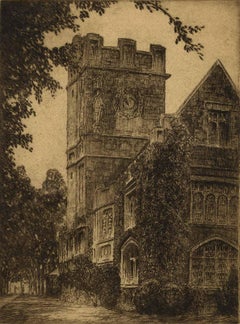
An original print of a church signed in pencil by artist Mr. H. Dewitt Welsh, Artist of Philadelphia, acting secretary of the Division of Pictorial Publicity Committee on Public Inf...
Category

Early 20th Century Gifford Beal Prints and Multiples

Materials

Etching, Aquatint

Church
Church
$150
H 12 in W 8.75 in
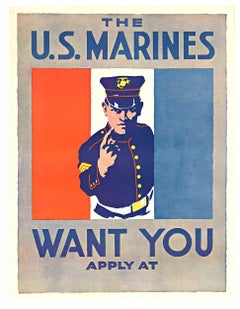
Original The U. S. Marines Want You vintage military recruiting poster
Located in Spokane, WA
Original vintage poster: The U.S. Marines Want You. This military vintage poster is archival linen-backed and in fine condition, ready to frame. There is no date, artist, or printer'...
Category

1910s American Realist Gifford Beal Prints and Multiples

Materials

Lithograph

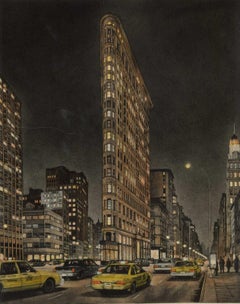
Destinations (Flatiron Bidg, 5th Avenue and Broadway at 23rd Street)
By Frederick Mershimer
Located in New Orleans, LA
In "Destinations", Frederick Mershimer creates an image of taxis rushing by the Fuller Building, better known as Flatiron Building. The building is only six feet wide at its rounded...
Category

1990s Contemporary Gifford Beal Prints and Multiples

Materials

Mezzotint, Aquatint

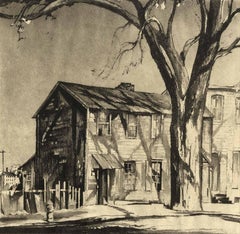
Dark House
By Earl Horter
Located in New Orleans, LA
Dark House is a soft-ground etching with aquatint signed in pencil by the artist. This image is in the collection of the Detroit Institute of the Arts Printmaker Earl Horter, born in 1881 in Germantown, Pennsylvania, was known for his realistic etchings and aquatints of urban scenes, though he was also an illustrator and painter. As a teenager, he engraved stock certificates. He was essentially self-taught, though he did take an etching class when he moved to New York City in 1903 to work for an advertising agency. Horter had a one-man show in 1916 in New York City at the Frederick Keppel and Company gallery. He was given the exhibition by Carl Zigrosser, later the first Curator of Prints and Drawings at the Museum of Modern Art. Horter was back in Philadelphia in 1917, where he would remain until his death in 1940. He worked there as art director for the N. W. Ayer advertising firm from 1917-1923. Horter was a member of the Society of Illustrators. He exhibited at the Pan American Exposition in 1915 in San Francisco, California; the Art Institute of Chicago, Illinois; and the Philadelphia Print Club's National Exhibition of Prints; as well as Corcoran Gallery biennials from 1935 to 1939, in Washington, D.C. Horter is listed in "Mantle Fielding's Dictionary of American Artists"; "Who Was Who in American Art"; and Mallett's "Index of Artists". Though not a man of extraordinary means, Horter was a lover of modernist art, which he gradually purchased, creating an important collection, well ahead of its time in America, of Cubist and Precisionist works, as well as African sculpture and Native American artifacts. Artists Horter collected include Europeans Picasso, Braque, Duchamp and Brancusi, and Americans Charles Sheeler and Arthur B. Carles. He was a friend of Carles, as well as other artists and collectors such as Leopold Stokowski, conductor of the Philadelphia Orchestra; Franklin Watkins; S. S. White; and Carroll Tyson...
Category

1930s American Modern Gifford Beal Prints and Multiples

Materials

Etching

Dark House
Dark House
$395
H 10.44 in W 10.75 in
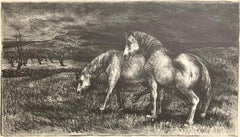
Reginald Wilson, Horses
By Reginald Wilson
Located in New York, NY
Although this work is titled Horses. It nice to think it could be (Horses in a Field in Woodstock, NY), but it was printed by Will Barnet at the Art Students League, about 1938, and Wilson, who visited Woodstock with Arnold Blanche...
Category

1930s American Modern Gifford Beal Prints and Multiples

Materials

Lithograph

Alexander Calder Circus Reproduction Lithograph After a Drawing
By (after) Alexander Calder
Located in Surfside, FL
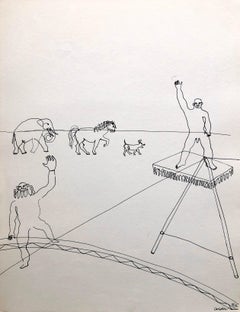
(after) Alexander Calder "Calder's Circus" offset lithograph on wove paper after drawings by the artist Published by Art in America and Perls gallery in 1964 (from drawings done in the 1930's) these range slightly in size but they are all about 13 X 17 inches (with minor variations in size as issued.) These have never been framed. The outer folio is not included just the one lithograph. James Sweeny from the introduction “The fame of Calder’s circus spread quickly between the years 1927 and 1930. All the Paris art world came to know it. It brought him his first great personal success. But what was more important, the circus also provided the first steps in Calder’s development as an original sculptor” Clive Gray wrote ”A visit to the studio of Alexander Calder led to the chance discovery of some hundred masterful circus drawings completed over thirty years ago. We publish, for the first time, a choice of sixteen from that group.” With signed introduction by Miro. These whimsical drawings, done in the style of wire sculpture, include acrobats, clowns, jugglers, trapeeze artists, an elephant, dog and lion. they are great. Alexander Calder is widely considered to be one of the most important American sculptors of the 20th century. He is best known for his colorful, whimsical abstract public sculptures and his innovative mobiles, kinetic sculptures powered by motors or air currents, which embraced chance in their aesthetic. Born into a family of accomplished artists, Calder's work first gained attention in Paris in the 1930s and was soon championed by the Museum of Modern Art in New York, resulting in a retrospective exhibition in 1943. Major retrospectives were also held at the Solomon R. Guggenheim Museum (1964) and the Museum of Contemporary Art, Chicago (1974). Calder’s work is in many permanent collections, most notably in the Whitney Museum of American Art, but also the Guggenheim Museum; the Museum of Modern Art; the National Gallery of Art, Washington, D.C.; and the Centre Georges Pompidou. He produced many large public works, including .125 (at JFK Airport, 1957), Pittsburgh (Carnegie International prize winner 1958, Pittsburgh International Airport) Spirale (UNESCO in Paris, 1958), Flamingo and Universe (both in Chicago, 1974), and Mountains and Clouds (Hart Senate Office Building, Washington, D.C., 1976). Although primarily known for his sculpture, Calder was a prodigious artist with a restless creative spirit, whose diverse practice included painting and printmaking, miniatures (such as his famous Cirque Calder), children’s book illustrations, theater set design, jewelry design, tapestry and rug works, and political posters. Calder was honored by the US Postal Service with a set of five 32-cent stamps in 1998, and received the Presidential Medal of Freedom, posthumously in 1977, after refusing to receive it from Gerald Ford one year earlier in protest of the Vietnam War. Calder moved to New York and enrolled at the Art Students League, studying briefly with Thomas Hart Benton, George Luks, Kenneth Hayes Miller, and John Sloan. While a student, he worked for the National Police Gazette where, in 1925, one of his assignments was sketching the Ringling Bros. and Barnum & Bailey Circus. Calder became fascinated with the action of the circus, a theme that would reappear in his later work. In 1926, Calder moved to Paris, enrolled in the Académie de la Grande Chaumière, and established a studio at 22 rue Daguerre in the Montparnasse Quarter. In June 1929, while traveling by boat from Paris to New York, Calder met his future wife, Louisa James (1905-1996), grandniece of author Henry James and philosopher William James. They married in 1931. While in Paris, Calder met and became friends with a number of avant-garde artists, including Fernand Léger, Jean Arp, and Marcel Duchamp. Cirque Calder (on view at the Whitney Museum of American Art at present) became popular with the Parisian avant-garde. He also invented wire sculpture, or "drawing in space," and in 1929 he had his first solo show of these sculptures in Paris at Galerie Billiet. Hi! (Two Acrobats) in the collection of the Honolulu Museum of Art is an early example of the artist's wire sculpture. The painter Jules Pascin, a friend of Calder's from the cafes of Montparnasse, wrote the preface to the catalog. A visit to Piet Mondrian's studio in 1930, where he was impressed by the environment-as-installation, "shocked" him into fully embracing abstract art, toward which he had already been tending. Dating from 1931, Calder’s sculptures of discrete movable parts powered by motors were christened “mobiles” by Marcel Duchamp, a French pun meaning both "motion" and "motive." At the same time, Calder was also experimenting with self-supporting, static, abstract sculptures, dubbed "stabiles" by Jean Arp in 1932 to differentiate them from mobiles. Public commissions increasingly came his way in the 1960s. Notable examples are .125 for JFK Airport in 1957, Spirale for UNESCO in Paris 1958 and Trois disques, commissioned for Expo 67 in Montreal, Quebec, Canada. Calder's largest sculpture at 25.7 meters high was El Sol Rojo, constructed outside the Aztec Stadium for the 1968 Summer Olympics "Cultural Olympiad" events in Mexico City. Many of his public works were commissioned by renowned architects; I.M. Pei commissioned his La Grande Voile (1966), a 25-ton, 40-foot high stabile for the Massachusetts Institute of Technology. Part of Calder's repertoire includes pivotal stage sets for more than a dozen theatrical productions, including Nucléa, Horizon, and most notably, Martha Graham’s Panorama (1935), a production of the Erik Satie symphonic drama Socrate (1936), and later, Works in Progress (1968). In addition to sculptures, Calder painted throughout his career, beginning in the early 1920s. He picked up his study of printmaking in 1925, and continued to produce illustrations for books and journals.As Calder’s professional reputation expanded in the late 1940s and 1950s, so did his production of prints. Masses of lithographs based on his gouache paintings hit the market, and deluxe editions of plays, poems, and short stories illustrated with fine art prints by Calder became available for sale. One of Calder's most celebrated and unconventional undertakings was a commission from Dallas-based Braniff International Airways to paint a full-size Douglas DC-8-62 four-engined jet as a "flying canvas." Calder created over 2,000 pieces of jewelry over the course of his career, many of them as gifts for friends and relatives. For his lifelong friend Joan Miró, he set a shard of a broken porcelain vessel in a brass ring. Peggy Guggenheim received enormous silver mobile earrings and later commissioned a hammered silver headboard...
Category

1930s American Modern Gifford Beal Prints and Multiples

Materials

Lithograph

The Jewish Welfare Board original 1918 vintage World War 1 antique poster
By Sidney Riesenberg
Located in Spokane, WA
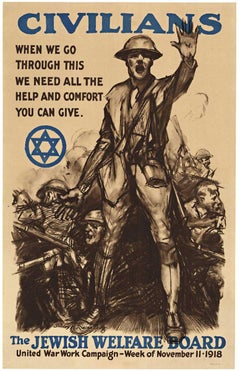
The Jewish Welfare Board. Original World 1 vintage poster, very good condition; archival linen-backed and ready to frame. Printer: Alco-Gravure, Inc., N. Y. There is a tiny ch...
Category

1940s American Realist Gifford Beal Prints and Multiples

Materials

Lithograph

A Gable in the Grande Rue, Lisieux
By John Taylor Arms
Located in New Orleans, LA
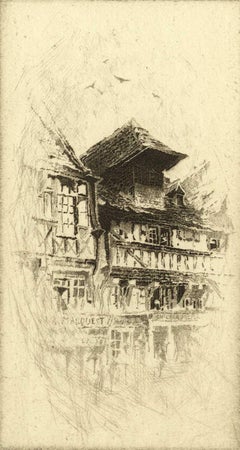
This image is the 3rd etching created by Arms. It was printed byGrederick Reynolds in an edition of 116. Referenced as Fletcher #3 the image is the second in his Gable series. Lis...
Category

1910s American Modern Gifford Beal Prints and Multiples

Materials

Etching

Negro — California WPA Social Realism – Slavery
Located in Myrtle Beach, SC
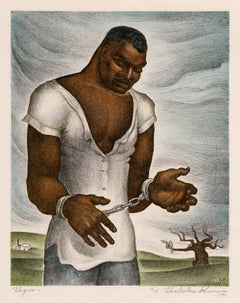
Nicholas Panesis, 'Negro', 1934, color lithograph, edition 18. Signed, dated, titled, and numbered 8/28 in pencil. Initialed in the stone, lower right. A fine impression, with fresh colors, on buff wove paper, with margins (1 1/8 to 2 3/8 inches). Minor glue staining at the extreme sheet edges verso, where previously taped (not visible recto), otherwise in excellent condition. Very scarce. Matted to museum standards, unframed. Image size 10 5/8 x 8 1/2 inches; (270 x 216 mm); sheet size 14 13/16 x 10 15/16 inches (376 x 278 mm). Created for the California Works Progress Administration, Federal Art Project (WPA). Impressions of this work are held in the public collections of La Salle University Art Museum (Philadelphia), U.S. General Services Administration, and Weisman Art Museum (University of Minnesota). ABOUT THE ARTIST Born in Massachusetts, Nicholas Panesis (1913-1967) studied art at Syracuse University, NY, and went on to teach ceramics at Alfred University, NY. Panesis moved to San Francisco in the early 1930s shortly before settling in Los Angeles, where he worked for different animation studios...
Category

1930s American Realist Gifford Beal Prints and Multiples

Materials

Lithograph

Restaurant in Mott Street
By Charles Frederick William Mielatz
Located in New Orleans, LA
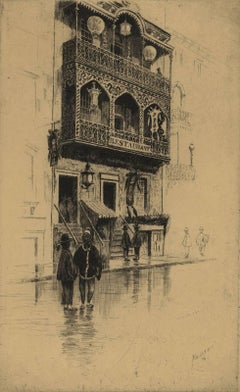
The image depicts a restaurant on New York's Mott Street with ornamental iron work on the balconies. There are six figures in the scene in various stages of contrast. Mott Street is considered the unofficial Main Street of New York's Chinatown. Ella Fitzgerald sang it best: “And tell me what street compares with Mott Street in July? Sweet pushcarts gently gliding by.” CFW Mielatz was an early influence on the drypoints and etchings of Martin Lewis. This piece was created in 1906 and it is signed in pencil. It is part of the collection of New York's Metropolitan Museum of Art C.F.W. Mielatz American, 1860-1919 Born in Bredding, Germany in 1864, Mielatz emigrated to the United States as a young boy and studied at the Chicago School of Design. Mostly self-taught, his first prints were large New England landscapes reminiscent of the painter-etcher school of American Art. Around 1890 he started to produce prints of New York City and by the time of his death, the number totaled over ninety images. He was a master technician in the field of etching, reworking many of his plates to get the exact feeling he was seeking. Mielatz was a member of the New York Etching...
Category

Early 20th Century American Modern Gifford Beal Prints and Multiples

Materials

Drypoint, Etching

When Predators Meet
Located in San Francisco, CA
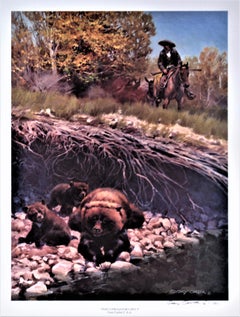
This artwork titled "When Predators Meet" 1988 is an offset lithograph by renown Western artist Gary Carter, born 1938. It is hand signed and numbered 817/...
Category

Late 20th Century American Realist Gifford Beal Prints and Multiples

Materials

Lithograph

When Predators Meet
When Predators Meet
$450
H 25 in W 19.5 in D 0.01 in
Jon Corbino, Montana Earthquake, 1936, lithograph
By Jon Corbino
Located in New York, NY
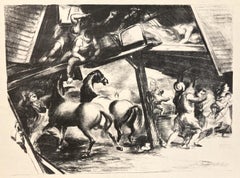
Works by Jon Corbino (1905-1964) feature drama. Here he's showing us the chaos produced by a major earthquake in rural Montana in 1936 -- an actual historical event. The horses (ear...
Category

1930s American Modern Gifford Beal Prints and Multiples

Materials

Lithograph

Gifford Beal prints and multiples for sale on 1stDibs.

Find a wide variety of authentic Gifford Beal prints and multiples available for sale on 1stDibs. You can also browse by medium to find art by Gifford Beal in lithograph and more. Not every interior allows for large Gifford Beal prints and multiples, so small editions measuring 20 inches across are available. Customers who are interested in this artist might also find the work of Walt Kuhn, Gordon Grant, and Alfred Bendiner. Gifford Beal prints and multiples prices can differ depending upon medium, time period and other attributes. On 1stDibs, the price for these items starts at $1,200 and tops out at $1,200, while the average work can sell for $1,200.