Gio Ponti Ceramics

Italian, 1891-1979

An architect, furniture and industrial designer and editor, Gio Ponti was arguably the most influential figure in 20th-century Italian modernism.

Ponti designed thousands of furnishings and products — from cabinets, mirrors and chairs to ceramics and coffeemakers — and his buildings, including the brawny Pirelli Tower (1956) in his native Milan, and the castle-like Denver Art Museum (1971), were erected in 14 countries. Through Domus, the magazine he founded in 1928, Ponti brought attention to virtually every significant movement and creator in the spheres of modern art and design.

The questing intelligence Ponti brought to Domus is reflected in his work: as protean as he was prolific, Ponti’s style can’t be pegged to a specific genre.

In the 1920s, as artistic director for the Tuscan porcelain maker Richard Ginori, he fused old and new; his ceramic forms were modern, but decorated with motifs from Roman antiquity. In pre-war Italy, modernist design was encouraged, and after the conflict, Ponti — along with designers such as Carlo Mollino, Franco Albini, Marco Zanuso — found a receptive audience for their novel, idiosyncratic work. Ponti’s typical furniture forms from the period, such as the wedge-shaped Distex chair, are simple, gently angular, and colorful; equally elegant and functional. In the 1960s and ’70s, Ponti’s style evolved again as he explored biomorphic shapes, and embraced the expressive, experimental designs of Ettore Sottsass Jr., Joe Colombo and others.

Ponti's signature furniture piece — the one by which he is represented in the collections of the Museum of Modern Art in New York, Germany’s Vitra Design Museum and elsewhere — is the sleek Superleggera chair, produced by Cassina starting in 1957. (The name translates as “superlightweight” — advertisements featured a model lifting it with one finger.)

Ponti had a playful side, best shown in a collaboration he began in the late 1940s with the graphic artist Piero Fornasetti. Ponti furnishings were decorated with bright finishes and Fornasetti's whimsical lithographic transfer prints of things such as butterflies, birds or flowers; the Montreal Museum of Fine Arts possesses a 1950 secretary from their Architetturra series, which feature case pieces covered in images of building interiors and facades. The grandest project Ponti and Fornasetti undertook, however, lies on the floor of the Atlantic Ocean: the interiors of the luxury liner Andrea Doria, which sank in 1956.

Widely praised retrospectives at the Queens Museum of Art in 2001 and at the Design Museum London in 2002 sparked a renewed interest in Ponti among modern design aficionados. (Marco Romanelli’s monograph, which was written for the London show, offers a fine overview of Ponti’s work.) Today, a wide array of Ponti’s designs are snapped up by savvy collectors who want to give their homes a touch of Italian panache and effortless chic.

Find a range of vintage Gio Ponti desks, dining chairs, coffee tables and other furniture on 1stDibs.

to
1
1
1
1
1
1
1
1
1
1
1
389
37
29
26
21
Creator: Gio Ponti
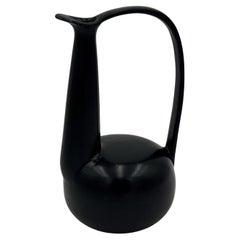
Gio Ponti Carlo Alberto Rossi Vaso Bucchero N.3 Anni ‘40 Rarissimo Design
By Gio Ponti
Located in Taranto, IT
Vaso in bucchero, Gio Ponti e Carlo Alberto Rossi, anni ’40 Raro vaso in ceramica nera bucchero, disegnato da Gio Ponti in collaborazione con Carlo Alberto Rossi negli anni Quarant...
Category

1940s Italian Classical Greek Vintage Gio Ponti Ceramics

Materials

Ceramic

Related Items
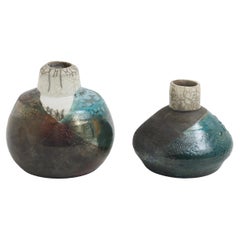
Japanese Modern LAAB Akuma No Me Vase Raku Ceramic Black White Blue Crakle Metal
By LAAB Milano
Located in monza, Monza and Brianza
Akuma No Me vases A combination of crackle', burnt effect and copper, derived from the raku techinque , underline the fleeting nature of the subject that has a particular effect d...
Category

21st Century and Contemporary Italian Modern Gio Ponti Ceramics

Materials

Ceramic

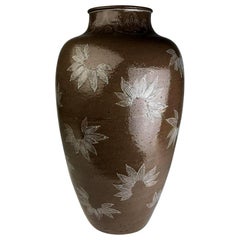
Rare Large Vase with White Slip Inlay Makuzu Kozan Meiji Period
By Makuzu Kozan
Located in Atlanta, GA
A impressively large and unusual stoneware vase in an urn shape from the studio of Japanese Potter Makuzu Kozan, also known as Miyagawa Kozan (1842–1916), one of the most established and collected ceramist from Meiji Period. Born as Miyagawa Toranosuke, Kozan established his pottery studio in Yokohama circa 1870s and later became one of the appointed artist to the Japanese Imperial household. His work was exhibited in many international fairs that the Meiji government participated at the turn of the century and won many grand prizes. This vase is dated to the end of Makuzu's life circa 1910-1916 based on similar work created around that time. After achieving domestic and international fame, Makuzu retired and handed the business to his son Hanzan in 1912. He dedicated his time to other selected projects that were more in tune with Japanese sensibility than export aesthetic. He made a group of stoneware pottery pieces inspired by Edo master like Ninsei and Kenzan as well as his own poetic creation. This piece is attributed to that period. Standing of an impressive size, this vase is more like an urn, made with stoneware instead of porcelain. It was coated with a brown iron glaze with a slight translucent quality. Underglaze whit slips were used to draw low relief decoration of bamboo leaves that sparsely scatter on the surface. Slightly more elaborate scrolling vines and autumn flowers circles under the mouth rim. Same white slip inlay was used to sign the vase under the base. The whole effect of the piece is unusual. With its dark glaze in contrast with the sparse white decoration that is more abstract and geometric than realistic, it appears almost modern with an Art Deco flavor. For stoneware urn and vase in the similar genre by Makuzu Kozan: see figure 113 on page 182 of "Sekai ni Aisa Reta ya Kimono" MIYAGAWA KOZAN MAKUZU...
Category

1910s Japanese Japonisme Vintage Gio Ponti Ceramics

Materials

Ceramic

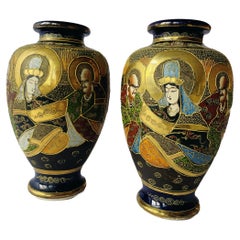
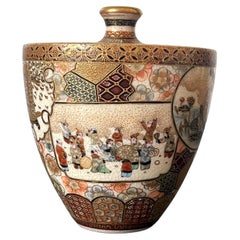
Pair of Japanese Moriage Satsuma Vases with Gold Gilding Circa 1930-1940
Located in Ixelles, BE
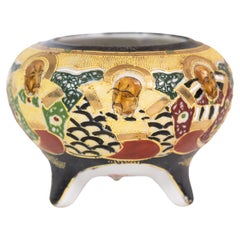
Japanese Satsuma vases from the circa 1930-1940 period are a particular style of ceramic art that originated from the Satsuma province of Japan. Satsuma ware is renowned for its intricate hand-painted designs, rich colors, and distinctive crackled glaze. Satsuma ware dates back to the early 17th century, but it gained widespread popularity in the late 19th and early 20th centuries, including the 1930s and 1940s. Satsuma vases produced during this time often reflected a mix of traditional and modern influences, as Japan went through a period of cultural exchange and artistic experimentation. Satsuma vases are made from a type of Japanese earthenware clay known for its fine texture and malleability. The vases are hand-formed or wheel-thrown and then meticulously hand-painted with intricate designs using enamel paints. The distinctive crackled glaze was achieved by firing the vases at a relatively low temperature, allowing the glaze to crack during the cooling process. The moriage technique involves applying three-dimensional, raised ornamentation to the surface of the ceramic piece, creating a visually textured and layered effect. Artisans create three-dimensional patterns, designs, or intricate motifs using a special mixture of clay, slip, or porcelain paste. The raised elements are added by hand to the ceramic body, and each detail is carefully shaped to achieve the desired effect. The moriage is then gold gilded as some of the intricate ornamental patterns and the halos around the three immortal...
Category

Early 20th Century Japanese Showa Gio Ponti Ceramics

Materials

Pottery

Pair of Rare Porcelain Commemorative Vases by Makuzu Kozan Meiji Period
By Makuzu Kozan
Located in Atlanta, GA
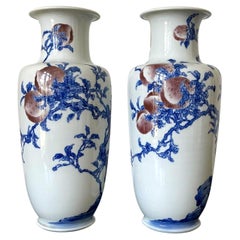
A pair of porcelain vases in classic form, decorated with underglaze blue and copper red painting by Imperial potter Makuzu Kozan. Also known as Miyagawa Kozan (1842–1916), Makuzu was one of the most established and collected ceramist known to the west from Meiji Period. The vases are in a classic Chinese form called "Bang Chu Ping" (grain-mallet vase...
Category

1910s Japanese Japonisme Vintage Gio Ponti Ceramics

Materials

Ceramic

Chinese Export Porcelain Plate Famille Rose Hand Painted Figures, Circa 1940s
Located in Lincoln, Lincolnshire
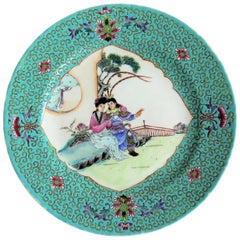
This is a good Chinese Export porcelain Plate which has been beautifully hand enamelled, over-glaze, in the Famille Rose palette with excellent detail, dating to Circa 1940. The mai...
Category

Mid-20th Century Chinese Chinese Export Gio Ponti Ceramics

Materials

Porcelain

Rare Meissen Marcolini Porcelain Chinoiserie Incense Burner Vase and Cover
By Meissen Porcelain
Located in Queens, NY
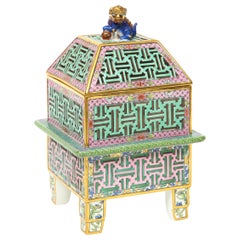
A rare Meissen Marcolini Porcelain Chinoiserie incense burner vase and cover, made for the Chinese market, circa 1800, blue cross swords and star mark, Pressnummer 58 A Museum Quality Piece. Painted in the sought after famille rose palette with sprigs of indianische Blumen and enriched in gilding, the simulated pierced body supported by four feet painted with stylized dragons, the pierced cover with a Buddhist lion finial. 10" high x 6" wide x 6" deep The shape of this piece, which appears to be unrecorded in the literature, is inspired by similar Chinese porcelain censers from the Qing Dynasty, Kangxi Period (1654-1722). An example in the Palace Museum, Beijing, is illustrated by Li Yi-hua in Qing Porcelain of Kangxi, Yongzheng and Qianlong Periods from the Palace Museum Collection, Hong Kong, 1989, pl. 65. Another in the British Museum, London (museum no. PDF, A.812) is catalogued as a perfume-holder. These porcelain examples are in turn inspired by ancient Chinese bronzes from both the Shang (1600-1046 BC) and the Zhou (1046-246 BCE) dynasties, an example of which was sold anonymously by Christie's New York, 22 March 2019, lot 1601. This chain of inspiration tracking backwards from the 19th century to antiquity provides a clear example of how ceramics, and indeed other mediums, are able to influence and motivate the works of later generations. For a Meissen porcelain snuff...
Category

Late 18th Century German Chinoiserie Antique Gio Ponti Ceramics

Materials

Porcelain

Chinese Enameled Floral Offering Dish, c. 1940s
Located in Chicago, IL
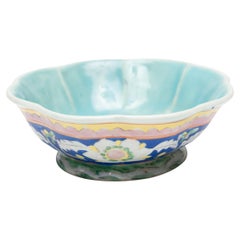
This colorful porcelain bowl dates to the early 20th century and was once used for serving food or presenting food offerings on a home altar. Shaped like an eight-petal flower, the d...
Category

Early 20th Century Chinese Chinese Export Gio Ponti Ceramics

Materials

Porcelain

Vintage Chinese Cloisonné Floral Design Vase
Located in Chicago, IL
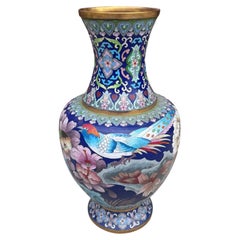
Vintage Chinese Cloisonné Floral Design Vase Chinese floral patterned, lobed shaped cloisonné enameled and gilded vase. Stunning floral details with gold finish top and base. Circa...
Category

Mid-20th Century Chinese Beaux Arts Gio Ponti Ceramics

Materials

Enamel

Chinese Blue White Crab Plate, c. 1940s
Located in Chicago, IL
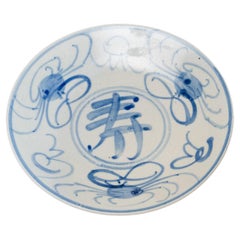
An everyday example of Chinese blue-and-white porcelain, this vintage porcelain plate charms with expressive cobalt-blue decoration, loosely brushed against a blue-grey field. The pl...
Category

Early 20th Century Chinese Chinese Export Gio Ponti Ceramics

Materials

Porcelain

Bowl Made From Porcelain Hand Painted, Of Japanese Origin From 1940s
Located in Lejre, DK
This porcelain bowl of Japanese origin, dating from around the 1940s, is a fine example of traditional Japanese craftsmanship and artistry. The bowl features intricate hand-painted ...
Category

1940s Danish Other Vintage Gio Ponti Ceramics

Materials

Porcelain

Large Korean Blue and White Vase with Phoenix Design
Located in Atlanta, GA
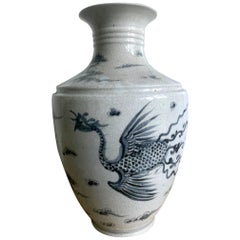
A large and heavy Korean ceramic vase in a Classic Chinese form with open mouth with a wide flared rim, a neck with three concentric grooves and a sloped broad shoulder. The blue and white design features two underglazed phoenix...
Category

Early 20th Century Korean Archaistic Gio Ponti Ceramics

Materials

Ceramic

Fine and Rare Miniature Satsuma Vase by Taizan Yohei
Located in Atlanta, GA
A very fine miniature ceramic vase in satsuma ware by Taizan Yohei IX (1864-1922) circa 1880-1890s of late Meiji period. The vase with a broad flat should...
Category

1880s Japanese Japonisme Antique Gio Ponti Ceramics

Materials

Ceramic

Previously Available Items
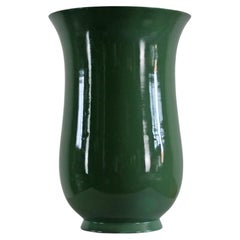
Gio Ponti Large Green Vase in Ceramic by Richard Ginori 1930s Italy
By Gio Ponti, Richard Ginori
Located in Cascina, Pisa
Large vase in green ceramic designed by the Italian designer Gio Ponti and manufactured by Richard Ginori between the 1930s and the 1940s. In this piece, the ceramic was modeled with an elegant and raffinate, flared shape that makes it a perfect decorative vase. The manufacturer's brand is stamped under the base. The history of the Ginori Manufactory began in Doccia, just a stone's throw away from Florence, when in 1735 Marquis Carlo Andrea Ginori started a porcelain factory which was destined to become a worldwide icon of style. The eighteenth-century is a key century for the development of porcelain in Europe, in this period the first manufactures are born, fed by new styles and international trends. In stately homes, palaces and courtyards, the precious porcelain of the Doccia Manufactory is synonymous with elegance and refinement. The passage from the nineteenth, the century of reason to that of feeling marks a new chapter in the development of artistic taste and the manufacture of porcelain. Florence becomes the scene of a controversy between the academic supporters of the Beautiful ideal and the naturalists promulgators of the beautiful natural Since 1806 the direction of the Manifattura passed to Leopoldo Carlo Ginori Lisci who initiates a process of profound renewal. In 1986 The Manifattura expanded and the Richard Ginori Ceramic Company is born. The tradition of master craftsmen meets new technologies and the creations are perfected thanks to the use of new patents From 1923 to 1933 the artistic direction of the Manifattura was entrusted to Gio Ponti. The master is responsible for introducing highly innovative elements with sensitivity and respect for the taste for the ancient, and for the oriental culture. In 1925 at the Universal Exposition in Paris, the Manifattura and its artistic director were awarded the assignment to both of a Grand Prix. The Manufactory was renewed by relying on the experience of the greatest Italian designers of the time: Franco Albini, Franca Helg, Antonio Piva, Sergio Asti, Achille Castiglioni, Gabriele Devecchi, Candido Fior...
Category

1930s Italian Mid-Century Modern Vintage Gio Ponti Ceramics

Materials

Ceramic

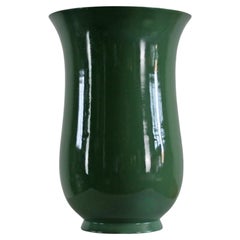
Gio Ponti Large Green Vase in Ceramic by Richard Ginori 1930s
By Gio Ponti, Richard Ginori
Located in Cascina, Pisa
Rare large vase in green ceramic designed by the Italian designer Gio Ponti and manufactured by Richard Ginori between the 1930s and the 1940s. In th...
Category

1930s Italian Mid-Century Modern Vintage Gio Ponti Ceramics

Materials

Ceramic

Gio Ponti ceramics for sale on 1stDibs.

Gio Ponti ceramics are available for sale on 1stDibs. These distinctive items are frequently made of ceramic and are designed with extraordinary care. There are many options to choose from in our collection of Gio Ponti ceramics, although blue editions of this piece are particularly popular. Many of the original ceramics by Gio Ponti were created in the mid-century modern style in italy during the 20th century. Prices for Gio Ponti ceramics can differ depending upon size, time period and other attributes — on 1stDibs, these items begin at $2,744 and can go as high as $3,894, while a piece like these, on average, fetch $3,319.

Still Thinking About These?

All Recently Viewed