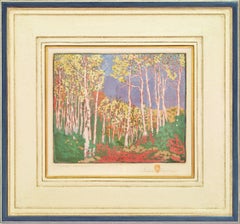
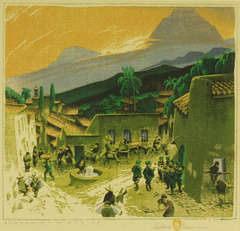
Gustave Baumann Landscape Prints

American, German, 1881-1971

Gustave Baumann was born in Magdeburg, Germany, on June 27, 1881. Baumann immigrated to the USA as a child. He grew up in Chicago but became curious about New Mexico. He visited friends there in 1917 and settled in Santa Fe in 1918. He spent over 50 years there, where he participated in the art community. He created woodblocks from which he made prints and also became a carver of saints and marionettes, working with the Marionette Theatre. Baumann also created numerous paintings in bright colors. His woodcut subjects are church figures, scenes of sacred Indian pictographs and landscapes, including the Grand Canyon. During the 1930s, Baumann was a Works Progress Administration co-ordinator for Santa Fe. He died in Santa Fe on October 8, 1971.

to
3
Overall Width
to
Overall Height
to
1
6
180
169
142
130
3
1
2
1
1
1
1
1
3
1
2
3
Artist: Gustave Baumann
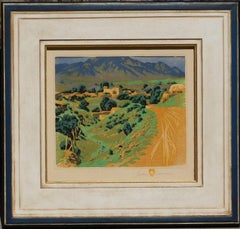
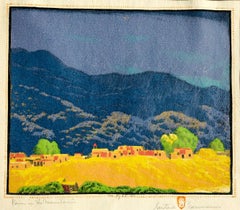
Taos Placita — American Southwest Regionalist Masterwork
By Gustave Baumann
Located in Myrtle Beach, SC
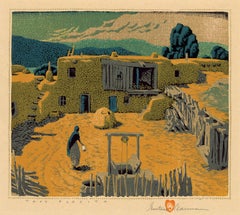
Gustave Baumann, 'Taos Placita', color woodcut, 1947, edition 125. Baumann 132. Signed, titled, and numbered '20-125' in pencil; with the artist’s Hand-in-Heart chop. A superb, richly-inked impression, with fresh colors, on fibrous oatmeal wove paper; the full sheet with margins (2 to 3 1/8 inches); slight rippling at the left sheet edge, in excellent condition. Matted to museum standards, unframed. Image size 9 5/8 x 11 1/4 inches (244 x 286 mm); sheet size 13 1/4 x 17 inches (337 x 432 mm). Collections: Harwood Museum of Art, New Mexico Museum of Art, Phoenix Art Museum, Scottsdale Art Museum, Wichita Art Museum. ABOUT THE ARTIST Gustave Baumann (1881-1971) was a renowned printmaker and a leading figure of the American color woodcut revival whose exquisite craftsmanship and vibrant imagery captured the essence of the Southwest. "A brilliant printmaker, Baumann brought to the medium a full mastery of the craft of woodworking that he acquired from his father, a German cabinetmaker. This craftsmanship was coupled with a strong artistic training that resulted in the handsome objects we see in the exhibition today. After discovering New Mexico in 1918, Baumann began to explore in his woodblock prints of this period the light. color, and architectural forms of that landscape. His prints of this period are among the most beautiful and poetic images of the American West." —Lewis I. Sharp, Director, Denver Art Museum Baumann, the son of a craftsman, immigrated to the United States from Germany with his family when he was ten, settling in Chicago. From 1897 to 1904, he studied in the evenings at the Art Institute of Chicago, working in a commercial printmaking shop during the day. In 1905, he returned to Germany to attend the Kunstwerbe Schule in Munich, where he decided on a career in printmaking. He returned to Chicago in 1906 and worked for a few years as a graphic designer of labels. Baumann made his first prints in 1909 and exhibited them at the Art Institute of Chicago the following year. In 1910, he moved to the artists’ colony in Nashville, Indiana, where he explored the creative and commercial possibilities of a career as a printmaker. In 1915, he exhibited his color woodcuts at the Panama-Pacific International Exposition in San Francisco, winning the gold medal. Among Baumann’s ongoing commercial activities was his work for the Packard Motor Car Company from 1914 to 1920 where he produced designs, illustrations, and color woodcuts until 1923. In 1919, Baumann’s printmaking work dominated the important exhibition of American color woodcuts at the Detroit Institute of Arts. Twenty-six of his prints were included, far more than the works of any other artist. A set of his blocks, a preparatory drawing, and seven progressive proofs complemented the exhibition. That same year, Baumann worked in New York and, over the summer, in Provincetown, Massachusetts. His airy images of Cape Cod employed soft, pastel colors and occasionally showed the influence of the white-line woodcut technique. Many of his Chicago artist friends had traveled to the southwest, and Baumann became intrigued by their paintings, souvenirs, and stories of an exotic place named Taos, New Mexico. In the summer of 1918, he spent the summer in Taos sketching and painting before visiting Santa Fe. Paul Walter, the director of the Museum of New Mexico, offered him a studio in the museum's basement. Inspired by the rugged beauty of the Southwest—the vibrant colors and dramatic landscapes of the region became a central theme in his work, influencing his artistic style and subject matter for the remainder of his career. Later in the decade, he traveled to the West Coast and made prints of California landscape. Baumann's prints became synonymous with the Southwest, capturing the spirit of its place in America's identity with a unique sense of authenticity and reverence. His iconic images of desert vistas, pueblo villages, and indigenous cultures served as visual tributes to the region's rich cultural heritage, earning him a dedicated following among collectors and curators alike. A true craftsman and artist, Baumann completed every step of the printmaking process himself, cutting each block, mixing the inks, and printing every impression on the handmade paper he selected. His dedication to true craftsmanship and his commitment to preserving the integrity of his artistic vision earned him widespread acclaim and recognition within the art world. About the vibrant colors he produced, Baumann stated, “A knowledge of color needs to be acquired since they don’t all behave the same way when ground or mixed...careful chemistry goes into the making of colors, with meticulous testing for permanence. While complicated formulae evolve new colors, those derived from Earth and metal bases are still the most reliable.” In the 1930s, Baumann became interested in puppet theater. He designed and carved his own marionettes and established a little traveling company. From 1943 to 1945, the artist carved an altarpiece for the Episcopal Church of the Holy Faith in Santa Fe. In 1952, a retrospective exhibition of his prints was mounted at the New Mexico Museum of Fine Arts. Throughout his prolific career, Baumann executed nearly four hundred color woodcuts. Baumann’s woodcuts...
Category

1940s American Modern Gustave Baumann Landscape Prints

Materials

Woodcut

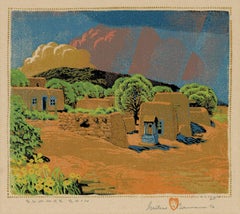
Gustave Baumann Color Woodblock - Rancho de Taos
By Gustave Baumann
Located in Phoenix, AZ
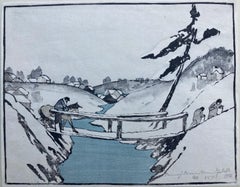
“Rancho de Taos” by well-known woodblock artist Gustave Baumann (1881-1971). The medium is color woodblock. It's a beautiful print in excellent condition. Baumann's personal Hand and...
Category

Mid-20th Century Gustave Baumann Landscape Prints

Materials

Woodcut

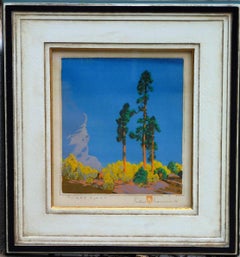
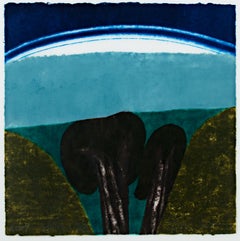
Gustave Baumann Color Woodblock - Three Pines
By Gustave Baumann
Located in Phoenix, AZ
“Three Pines” by well-known woodblock artist Gustave Baumann (1881-1971). The medium is color woodblock. It's a beautiful print in excellent condition. Baumann's personal Hand and He...
Category

Mid-20th Century Gustave Baumann Landscape Prints

Materials

Paper, Color, Woodcut

Related Items
"Enshoku Sanju-roku Kasen" (Thirty-six Enchanting Flowers) Woodblock on paper
By Toyohara Kunichika
Located in Soquel, CA
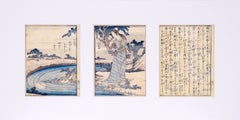
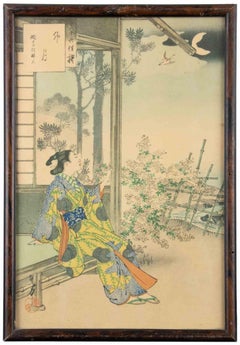
"Enshoku Sanju-roku Kasen" (Thirty-six Enchanting Flowers) Woodblock on paper Elegant woodblock print by Toyohara Kunuchika (Japanese, 1835-1900). Three women are in talking with each other inside, while a man waits outside holding a bag of some kind. The colors in this piece are rich and saturated, primarily blues, greens, and purple. Mat size: 16"H x 20"W Paper size: 14.75"H x 9.88"W Born in 1835, Toyohara Kunichika grew up in the Kyobashi district of Edo in the midst of merchants and artisans. In 1848, at age 13, he was accepted as an apprentice into the studio of Utagawa Kunisada I...
Category

1880s Edo Gustave Baumann Landscape Prints

Materials

Ink, Rice Paper, Woodcut

Takanawa no Kihan - Woodblock print by Utagawa Hiroshige - 1843-1847
By Utagawa Hiroshige
Located in Roma, IT
Takanawa no kihan is a modern artwork realized between 1843 and 1847 after Utagawa Hiroshige. Ukiyo-e color woodblock print from the Touto hakkei (The Eight Famous Views of the Capital of the East) series. Mounted under passepartout. The artwork depicts the port of Takanawa, a suburb of Minato in southern Tokyo, and is one of the very rare sheets by Utagawa Ando Hiroshige...
Category

Mid-19th Century Modern Gustave Baumann Landscape Prints

Materials

Woodcut

Parade - Woodblock Print by Utagawa Kunisada - Mid-19th Century
By Utagawa Kunisada (Toyokuni III)
Located in Roma, IT
Celebratory Parade is an original Woodcut print realized in mid 19th century after Utagawa Kunisada. Good condition and Beautiful colored woodblock print. This wonderful modern a...
Category

Mid-19th Century Modern Gustave Baumann Landscape Prints

Materials

Woodcut

Hiroshige (1797-1858) - View of Kasumigaseki (Kasumigaseki no zu) 東都名所
By Utagawa Hiroshige (Ando Hiroshige)
Located in BRUCE, ACT
Artist: 広重 Hiroshige (1797-1858) Series: Famous Places in the Eastern Capital (Tôto meisho) (東都名所) Title: View of Kasumigaseki (Kasumigaseki no zu) 霞がせきの図 Size: O-ban 大判 24.2 x 36...
Category

1840s Gustave Baumann Landscape Prints

Materials

Woodcut

Matsubaya - Woodblock Print by Utagawa Kuniyoshi - Mid-19th Cent.
By Utagawa Kuniyoshi
Located in Roma, IT
Yosooi of the Matsubaya is an Original Woodcut Print, Oban Format, realized by Kitagawa Tsukimaro. Good condition but many folds in the paper. No signature. Kitagawa Tsukimaro ( 1...
Category

Mid-19th Century Modern Gustave Baumann Landscape Prints

Materials

Woodcut

Werner Drewes, Winter, 1933, modernist woodcut
By Werner Drewes
Located in New York, NY
A modernist fantasy winter scene created by Werner Drewes, this print brings key aspects of the period together. His cubist-inspired woodcut technique is utilized here to bring the s...
Category

1930s American Modern Gustave Baumann Landscape Prints

Materials

Woodcut

Study of Utagawa Hiroshige s "View of Hara-Juku" 53 Stations of the Tokaido Road
By Utagawa Hiroshige
Located in Soquel, CA
Study of Utagawa Hiroshige's "View of Hara-Juku" 53 Stations of the Tokaido Road Hand painted study of Utagawa Hiroshige's "View of Hara-Juku", (by unknown artist), from "53 Station...
Category

1920s Edo Gustave Baumann Landscape Prints

Materials

Paper, Ink, Woodcut

Cherry Blossoms at Dusk , Japanese color woodblock, Musashino College of Art
Located in Santa Cruz, CA
Signed lower right, 'Morihiro Sato' (Japanese, born 1943), with artist chop mark, and dated 1985; titled, lower left, in English and Kanji 'Cherry Trees (Dusk)' with number and limitation, '3/55'. Paper dimensions: 24.25 x 35.5 inches A fresh and unfaded woodblock print showing a view of cherry tree boughs heavy with glowing blossoms before a vista of rolling hills with stylized Japanese pine beneath a luminous, golden sunset. Morihiro Sato graduated from Musashino College of Fine Art before studying under the printmaker Joichi Hoshi (1913-1979). Sato’s work focuses on the beauty of nature, particularly that of trees. Through the medium of woodblock with inclusion of metallic pigments, his delicately atmospheric prints evoke a sense of gentle sense of wonder. *With thanks to Ronin Gallery
Category

1980s Modern Gustave Baumann Landscape Prints

Materials

Gold Leaf

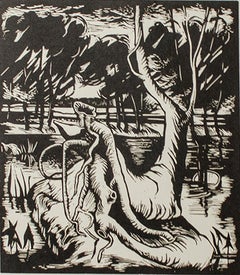
"Flood Waters, " Landscape Wood Engraving by Harold Wescott
By Harold Wescott
Located in Milwaukee, WI
"Flood Waters" is an original wood engraving by Harold Wescott, It features a tree in the center, with its roots wrapping languidly over a form. High waters rise up from the back. Un...
Category

1930s American Modern Gustave Baumann Landscape Prints

Materials

Woodcut

Kiyomizu Temple, Scenes of Famous Places along Tôkaidô Road - Woodblock on Paper
By Utagawa Hiroshige II
Located in Soquel, CA
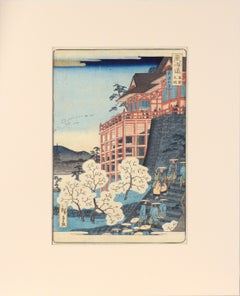
Kiyomizu Temple, Scenes of Famous Places along Tôkaidô Road - Woodblock on Paper Full Title: Kyoto: Kiyomizu Temple (Kyô Kiyomizudera), from the series Scenes of Famous Places along...
Category

1860s Edo Gustave Baumann Landscape Prints

Materials

Ink, Rice Paper, Woodcut

Mu-Tamagawa
Located in Middletown, NY
Woodcut in ink with embossing and hand-coloring in watercolor on laid Japon paper, 16 x 10 inches (406 x 253 mm), ōban tate-e, full margins. Scattered handling wear and toning, other...
Category

Late 19th Century Edo Gustave Baumann Landscape Prints

Materials

Watercolor, Handmade Paper, Woodcut

Stevan Dohanos, Backyard
By Stevan Dohanos
Located in New York, NY
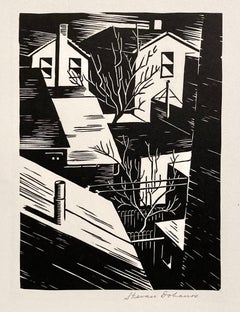
Stevan Dohanos was an accomplished draftsman who work was widely known through the Saturday Evening Post. This print 'Backyard,' however, leaves aside the illustrative magazine work ...
Category

1930s American Modern Gustave Baumann Landscape Prints

Materials

Woodcut

Previously Available Items
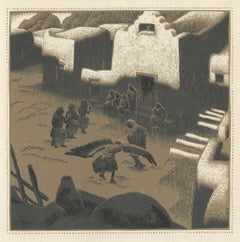
An Eagle Ceremony at Tesuque Pueblo
By Gustave Baumann
Located in Fairlawn, OH
An Eagle Ceremony at Tesuque Pueblo Woodcut printed in two colors, 1932 Unsigned as usual; initialed in the plate lower left (see photo) As published by Elmer Adler in "The Colophon:...
Category

1930s American Modern Gustave Baumann Landscape Prints

Materials

Woodcut

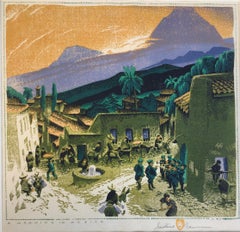
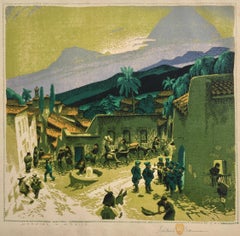
MORNING IN MEXICO (RARE UNDESCRIBED STATE)
By Gustave Baumann
Located in Santa Monica, CA
GUSTAVE BAUMANN (1881 -1971) MORNING IN MEXICO 1934-36 (Chamberlain 143) Color woodcut, 2nd version after Baumann discarded the first blocks. This version 1936. POSSIBLY AN UNIQUE VARIANT IMPRESSION. DIFFERS FORM THE IMAGE IN THE CATALOG RAISONNE. Aside from differing colors not uncommon with Baumann, there are also differences in the blocks. The area along the left edge is different e. g. the left edge - elimination of cross hatching below the roof and the elimination of the lower left corner shrub like cross hatching. . There are also differences in the sky with more clouds. Although the intended edition was 125, this print is very scarce and rarely comes on the market. Very good and fresh impression. No. II - 41 /125. Image, 13 x 13 ¼”, full sheet, 16 7/8 x 14 3/8”, deckle edge. Excellent condition. Provenance: Zaplin Lampert...
Category

1930s American Modern Gustave Baumann Landscape Prints

Materials

Woodcut

MORNING IN MEXICO
By Gustave Baumann
Located in Santa Monica, CA
GUSTAVE BAUMANN (1881 -1971) MORNING IN MEXICO 1934-36 (Chamberlain 143: Baumann 107) Color woodcut, 2nd version after Baumann discarded the first blocks. ...
Category

1930s American Modern Gustave Baumann Landscape Prints

Materials

Woodcut

RAIN IN THE MOUNTAINS
By Gustave Baumann
Located in Portland, ME
Baumann, Gustave. RAIN IN THE MOUNTAINS. Chamberlain 108, Edition 1; Baumann Inventory #76. Color woodcut, 1926. Printed in seven colors by Baum...
Category

1920s Gustave Baumann Landscape Prints

Materials

Woodcut

Summer Rain
By Gustave Baumann
Located in Myrtle Beach, SC
Signed, titled, numbered RC 20-50 and dated 56 in pencil, with the artist’s hand-in-heart chop. A superb impresson, with brilliant, fresh colors, on oatmeal wove paper; with wide m...
Category

1920s American Modern Gustave Baumann Landscape Prints

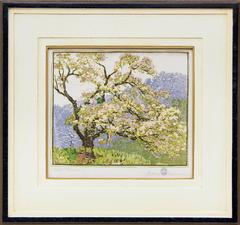
Apple Blossoms
By Gustave Baumann
Located in Denver, CO
Original color woodcut. Housed in a custom frame with all archival materials and Museum Glass (UV Protection/Anti-reflective). Framed dimensions measure 18 ½ x 19 ½ x 1 inches; image dimensions measure 9.5 x 11.25 inches. About the artist: Gustave Baumann’s family emigrated from Germany to Chicago in 1891, when he was only ten years old. When Baumann was 17, he worked for a commercial engraving house while attending night classes at the School of the Art Institute of Chicago. In 1905, he returned to his native Munich where he enrolled in the Kunstgewerbe Schule (Arts and Crafts School). There he studied wood carving while mastering the European technique of color wood block prints. After a year in Germany, Baumann resettled in the United States. He moved to Brown County, Indiana in 1910. The landscapes of Indiana became his main focus. He produced a portfolio of colored woodcuts entitled, “In the Hills of Brown.” In 1915, these woodcuts of Indiana won the gold medal for printmaking at the Panama Pacific International Exposition in San Francisco. In 1916, he organized the first national exhibition of color woodcuts by American artists at the Art Institute of Chicago. Baumann headed to Santa Fe in 1918 to visit his friends Walter Ufer and Victor Higgins. Once in New Mexico, Baumann was overwhelmed by the natural beauty of the state and decided to live there permanently. It was there he met and worked with John Sloane...
Category

Early 20th Century Gustave Baumann Landscape Prints

Materials

Woodcut

Apple Blossoms
Apple Blossoms
H 18.5 in W 19.5 in D 1 in
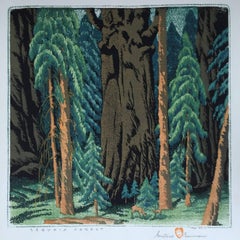
Sequoia Forest
By Gustave Baumann
Located in Santa Monica, CA
GUSTAVE BAUMANN (1881 -1971) SEQUOIA FOREST 1935 (60) (Chamberlain 146.2) Color woodcut. Signed in pencil and with the hand and Heart stamp. No. 1960 3...
Category

1930s American Modern Gustave Baumann Landscape Prints

Materials

Woodcut

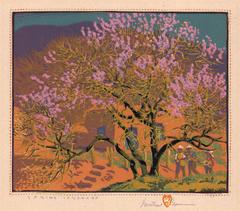
Spring Serenade
By Gustave Baumann
Located in New York, NY
When this color woodcut was created in 1927, Gustave Baumann was living and working in New Mexico. “Spring Serenade” is a beautiful example of his work inspired from the Southwestern landscape and color palate. This impression is signed and titled in pencil. Inscribed "No. 45-120" with Bauman’s hand heart...
Category

Early 20th Century American Modern Gustave Baumann Landscape Prints

Materials

Woodcut

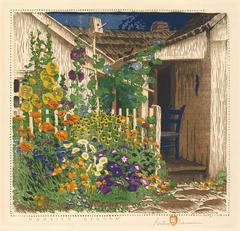
Hoosier Garden
By Gustave Baumann
Located in New York, NY
This color woodcut by Gustave Baumann was printed in 1961. The original woodcut blocks were made in 1927 with an edition of prints created and entitled ...
Category

Mid-20th Century American Modern Gustave Baumann Landscape Prints

Materials

Woodcut

Hoosier Garden
Hoosier Garden
H 22 in W 22.5 in D 2 in
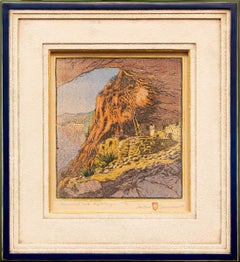
Ceremonial Cave at Frijoles Canyon (New Mexico)
By Gustave Baumann
Located in Denver, CO
A rare original signed woodcut (woodblock) of Frijoles Canyon, New Mexico by New Mexico artist, Gustave Baumann (1881-1971). Pencil signed by the artist, dated 1919 and numbered 8 of 100 prints. Presented in a custom frame, outer dimensions measure 19 ½ x 17 ¾ x 1 ½ inches. Image size is 10 ½ x 9 ½ inches. Gustave Baumann's family emigrated from Germany to Chicago in 1891, when he was only ten years old. When Baumann was 17, he worked for a commercial engraving house while attending night classes at the School of the Art Institute of Chicago. In 1905, he returned to his native Munich where he enrolled in the Kunstgewerbe Schule (Arts and Crafts School). There he studied wood carving while mastering the European technique of color wood block prints. After a year in Germany, Baumann resettled in the United States. He moved to Brown County, Indiana in 1910. The landscapes of Indiana became his main focus. He produced a portfolio of colored woodcuts entitled, "In the Hills of Brown." In 1915, these woodcuts of Indiana won the gold medal for printmaking at the Panama Pacific International Exposition in San Francisco. In 1916, he organized the first national exhibition of color woodcuts by American artists at the Art Institute of Chicago. Baumann headed to Santa Fe in 1918 to visit his friends Walter Ufer and Victor Higgins. Once in New Mexico, Baumann was overwhelmed by the natural beauty of the state and decided to live there permanently. It was there he met and worked with John Sloane...
Category

1910s American Modern Gustave Baumann Landscape Prints

Materials

Woodcut

Aspen Red River
By Gustave Baumann
Located in Denver, CO
An iconic image by the renowned New Mexico artist and printmaker. This piece is number 54 from an edition of only 100 printed. Pencil signed and editioned by the artist. Image size is 10 x 12.5 inches. Housed in a custom frame with all archival materials; outer dimensions are 18 x 20 inches. Expedited and International Shipping are available; please contact us for an estimate. About the Artist: Gustave Baumann's family emigrated from Germany to Chicago in 1891, when he was only ten years old. When Baumann was 17, he worked for a commercial engraving house while attending night classes at the School of the Art Institute of Chicago. In 1905, he returned to his native Munich where he enrolled in the Kunstgewerbe Schule (Arts and Crafts School). There he studied wood carving while mastering the European technique of color wood block prints. After a year in Germany, Baumann resettled in the United States. He moved to Brown County, Indiana in 1910. The landscapes of Indiana became his main focus. He produced a portfolio of colored woodcuts entitled, "In the Hills of Brown." In 1915, these woodcuts of Indiana won the gold medal for printmaking at the Panama Pacific International Exposition in San Francisco. In 1916, he organized the first national exhibition of color woodcuts by American artists at the Art Institute of Chicago. Baumann headed to Santa Fe in 1918 to visit his friends Walter Ufer and Victor Higgins. Once in New Mexico, Baumann was overwhelmed by the natural beauty of the state and decided to live there permanently. It was there he met and worked with John Sloane...
Category

1920s Gustave Baumann Landscape Prints

Materials

Woodcut

A Morning in Mexico
By Gustave Baumann
Located in Fairlawn, OH
Signed, titled, and numbered "II 41 125" in pencil along bottom, Stamped with "Hand in heart" chop Edition: 41/125 Provenance: Zaplin Lampert G...
Category

1910s Gustave Baumann Landscape Prints

Gustave Baumann landscape prints for sale on 1stDibs.

Find a wide variety of authentic Gustave Baumann landscape prints available for sale on 1stDibs. You can also browse by medium to find art by Gustave Baumann in woodcut print and more. Much of the original work by this artist or collective was created during the 1930s and is mostly associated with the modern style. Not every interior allows for large Gustave Baumann landscape prints, so small editions measuring 7 inches across are available. Customers who are interested in this artist might also find the work of Charles Frederick William Mielatz, Arnold Ronnebeck, and Armin Landeck. Gustave Baumann landscape prints prices can differ depending upon medium, time period and other attributes. On 1stDibs, the price for these items starts at $2,000 and tops out at $2,000, while the average work can sell for $2,000.

Recently Viewed

View All