Gustavo Montoya More Art
Mexican, 1905-2003
Gustavo Montoya was born in Mexico City on July 9, 1905. At the age of 13 he studied painting at the Academia de San Carlos. Some of his teachers were: German Gedovius, Roberto Montenegro, Leandro Izaguirre, Francisco de la Torre, Mateo Herrera and Juan de Mata Pacheco, among others. He stated that the school had only taught him the technique of art, but not the spirit of it and therefore he considered himself a self-taught artist.
He married his first wife, Luz Saavedra. In 1929 he traveled to Los Angeles, California, where he worked illustrating posters at the West Coast Theaters Co. The couple had a daughter, Rosa Elena Montoya Saavedra. The marriage did not last long, and Gustavo Montoya returned to Mexico in 1933. In 1936 he entered the Escuela Nacional de Artes Plásticas (National School of Visual Arts) as teacher of the color class.
He married a second time to the painter Cordelia Urueta, with whom he moved to Paris in 1938 to study European avant-garde art. He visited museums, galleries, and painters' studios. He toured Switzerland, Italy and England. In 1939, due to the Second World War, Montoya and his wife were forced to leave for New York where they remained for several years. Exhibited at the Alma Reed Gallery.
When they returned to Mexico in 1942, Gustavo Montoya joined the Mexican neo-realist school movement. In 1953 he entered again as a teacher at the Escuela Nacional de Artes Plásticas.
In 1965 Gustavo Montoya and Cordelia Urueta divorced after 26 years of marriage. He was lonely and did not engage in artistic circles. He was a founding member of the League of Revolutionary Writers and Artists along with Cordelia Urueta and others. Also, he was a founding member of the Salón de la Plástica Mexicana.
He spent most of his professional career depicting the streets of Mexico and its inhabitants. He painted still lifes, street scenes, churches, children, women, and markets in Mexico. Montoya preferred to paint the poor and working class, considering them the most authentic class in Mexico City. He liked to do his work in series around one main idea. Some of his series were: The streets of Mexico, Mexican still lifes, Mexican children, Dreams, Walls, Chess, Allegory of transformation, among others.
Gustavo Montoya died on July 12, 2003 in Mexico City, at the age of 98 years.to
1
Overall Width
to
Overall Height
to
1
1
1
1
4
328
230
120
117
1
Artist: Gustavo Montoya
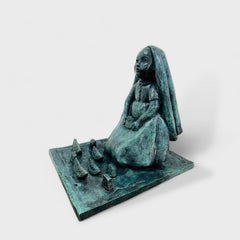
GIRL WITH WATERMELON
By Gustavo Montoya
Located in Dallas, TX
. Watermelon, from the Collection of Mexican Children - (Sandias, de la Colección de Niños Mexicanos). Serie 2/9. CDMX, Mexico.
Category
21st Century and Contemporary Gustavo Montoya More Art
Materials
Bronze
Related Items
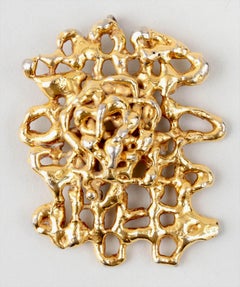
Vintage Abstract Expressionist Ibram Lassaw Modernist Bronze Sculpture Pendant
By Ibram Lassaw
Located in Surfside, FL
IBRAM LASSAW
(Russian-American, 1913-2003),
Sculptural pendant
Gold plated bronze
Signed verso
Measurements: 2-7/8''h, 2-1/4''w.
Ibram Lassaw was born in Alexandria, Egypt, of Russian Jewish émigré parents. After briefly living in Marseille, France, Naples, Italy Tunis, Malta, and Constantinople, Turkey his family settled in Brooklyn, New York, in 1921.His family settled in Brooklyn, New York. He became a US citizen in 1928. Ibram Lassaw, one of America's first abstract sculptors, was best known for his open-space welded sculptures of bronze, silver, copper and steel. Drawing from Surrealism, Constructivism, and Cubism, Lassaw pioneered an innovative welding technique that allowed him to create dynamic, intricate, and expressive works in three dimensions. As a result, he was a key force in shaping New York School sculpture.He first studied sculpture in 1926 at the Clay Club and later at the Beaux-Arts Institute of Design in New York. He made abstract paintings and drawings influenced by Kandinsky, Sophie Taeuber Arp, and other artists. He also attended the City College of New York. Lassaw’s encounter with avant-garde art in the International Exhibition of Modern Art (1926), organized by the Société Anonyme at the Brooklyn Museum, made a powerful impression on him. In the early 1930s he explored new materials and notions of open-space sculpture. The ideas of László Moholy-Nagy and Buckminster Fuller were important to him, and he knew the work of Julio González, Pablo Picasso, and the Russian Constructivists. After experimenting with plaster, rubber and wire, Lassaw began working with steel, which became a frequent medium for the artist, along with other metals. His work reflects the influence of Surrealist artists such as Alberto Giacometti and Joan Miro as well as American Modernist Alexander Calder.A pioneer of abstract sculpture in the United States, in 1936 Lassaw was a founding member of the organization American Abstract Artists. Between 1933 and 1942 he worked for various federal arts projects: the Public Works of Art Project, Civil Works Authority, and WPA, the Works Progress Administration Federal Art Project. In 1938 he produced his first welded work. He served with the U.S. Army, where he learned direct welding techniques. During the 1940s he experimented with cage constructions and with acrylic plastics, adding color to his sculptures by applying dye directly to their surfaces. In 1949 Lassaw was a founder of the Club, an informal discussion group of avant-garde artists that had developed from gatherings at his studio, on Eighth Street.
During the mid-1930s, Lassaw worked briefly for the Public Works of Art Project cleaning sculptural monuments around New York City. He subsequently joined the WPA as a teacher and sculptor until he was drafted into the army in 1942. Lassaw's contribution to the advancement of sculptural abstraction went beyond mere formal innovation; his promotion of modernist styles during the 1930s did much to insure the growth of abstract art in the United States. He was one of the founding members of the American Abstract Artists group, and served as president of the American Abstract Artists organization from 1946 to 1949. In 1951, Samuel Kootz invited Lassaw to join his gallery in New York. He also had a summer gallery in Provincetown, MA. Lassaw had been summering in Provincetown since 1944, and in 1951 rented an apartment next door to the Kootz Gallery. Among the artists in the Kootz Gallery were Jean Arp, William Baziotes, Georges Braque, Jean Dubuffet, Herbert Ferber, Arshile Gorky, Adolph Gottlieb, David Hare, Hans Hofmann, Fernand Leger, Georges Mathieu, Joan Miró, Robert Motherwell, Pablo Picasso, Pierre Soulages, and Maurice de Vlaminck. Lassaw is a sculptor who was a part of the New York School of Abstract expressionism during the 1940s and 1950s. Jackson Pollock, Lee Krasner, James Brooks, Willem de Kooning, and several other artists like Lassaw spent summers on the Southern Shore of Long Island. Lassaw spent summers on Long Island from 1955 until he moved there permanently in 1963.
SELECT EXHIBITIONS
1961 International Exhibition of Modern Jewelry 1890–1961, organized by the Worshipful Company of Goldsmiths in association with the Victoria and Albert Museum, London
1967 Exhibition of Jewelry by Painters and Sculptors, organized for circulation by MoMA
1973 Jewelry...
Category
Mid-20th Century Abstract Expressionist Gustavo Montoya More Art
Materials
Gold, Bronze

$6,500
H 2.88 in W 2.25 in
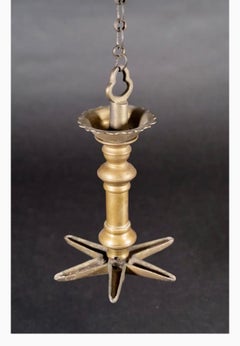
Rare Antique Judaica Hanging Bronze Jewish Synagogue or Temple Oil Lamp w Chain
Located in Surfside, FL
Judaica Shabbat Continental Hanging Solid Brass Oil Lamp with Central Six Pointed Jewish Star Shaped Body Dimensions Approx: with Chain 23"H x 8
11 x 8 x 8 chain is 22" long
Antique...
Category
19th Century Other Art Style Gustavo Montoya More Art
Materials
Brass, Bronze
$950
H 11 in W 8 in D 8 in
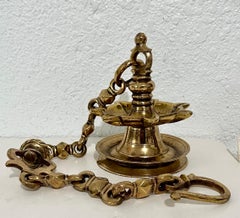
Rare Antique Judaica Hanging Bronze Jewish Synagogue or Temple Oil Lamp w Chain
Located in Surfside, FL
6.5 X 4.5 X 4.5 18" chain
Antique Judaica brass hanging Sabbath or Synagogue Oil Lamp with seven wick oil reservoir. Heavy brass or bronze chain and hook for hanging. Estimated to the 19th century or earlier. there are no markings but similar pieces have been in the Bezalel Museum collection and the Israel Museum collection and the Jewish Museum collection in New York city.. Judaic Shabbat...
Category
19th Century Other Art Style Gustavo Montoya More Art
Materials
Brass, Bronze
$950
H 6.5 in W 4.5 in D 4.5 in
Florentine singer / - The Renaissance of the Renaissance -
By Paul Dubois
Located in Berlin, DE
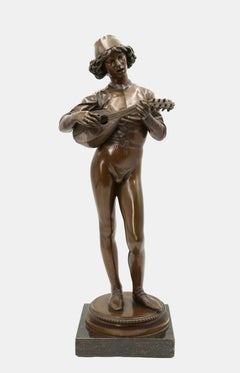
Paul Dubois (1829 Nogent-sur-Seine - 1905 Paris), Florentine singer, 1865. Light brown patinated bronze with cast round plinth mounted on a square marble base (3.5 cm high). Total height 53 cm. Bronze dimensions: 49.5 cm (height) x 20 cm (length) x 10 cm (width), weight 5.6 kg. Inscribed on the plinth "P.[aul] DUBOIS", dated "1865", with the foundry's mark "F. BARBEDIENNE FONDEUR" and the signet "REDUCTION MECANIQUE A. COLLAS".
- Patina very occasionally darkened, lute with loss of one tuning peg, otherwise in excellent condition.
- The renaissance of the Renaissance -
The bronze is a precisely executed and masterfully cast contemporary reduction of Paul Dubois 155 cm tall masterpiece "Florentine Singer", which is exhibited in the Musée d'Orsay and for which the artist was awarded the Medal of Honor at the Paris Salon in 1865. The work acted as a beacon, and was followed by a plethora of depictions of juveniles.
Inspired by Donatello and Luca della Robbia, but also by painters such as Piero della Francesca, Benozzo Gozzoli, and Pinturicchio, the "Florentine Singer" is not an epigonal work that pays homage to a vanished era, but a successful attempt to draw vitality from the art of the past and thus give it new life.
The effect of vitality is the core of Italian Renaissance art theory. In order to fulfill itself as art, art had to appear like nature. This naturalism also characterizes the "Florentine Singer". The young man appears to have been taken from life, which is reinforced by the momentary nature of his action. He has just struck a now fading chord. In addition, the natural appearance is enhanced by the detailed shaping of the figurative details, such as the laces with the slightly curved leather of the shoes, the belt buckle, or the ornamentation on the body of the lute. Even the fingernails are clearly defined. Unlike the Renaissance, however, the effect of liveliness here is not based on the "discovery" of nature and the human body, but primarily on the rediscovery of the art of the Quattrocento. The liveliness of the artwork is therefore at the same time a revitalization of this art, so that we can speak of a Renaissance of the Renaissance, just as the Pre-Raphaelites in England at the same time transferred the Quattrocento to contemporary art.
Dubois takes on the most difficult of all subjects, the depiction of singing through silent sculpture. He was preceded in this by Luca della Robbia and Donatello with their pulpits of singers created in the 1430s in the Museo dell'Opera del Duomo in Florence. Compared to these works, the physiognomy of Dubois singer is far less animated, yet he also depicts singing in a convincing manner. He uses the whole body. He takes the ancient contrapposto, which was essential to Renaissance sculpture, and transforms the standing leg-playing posture into a late medieval S-swing, giving the body an elegant beauty and at the same time setting it in melodic motion. In the equally elegant finger position, the music is expressed in a much more literal way with the beating of the lute. Finally, the musicality of the sculpture culminates in the face with the mouth open to sing.
Through the act of singing, which is a great challenge to the artistic will to depict perfect beauty, the gracefulness of the classical face is not diminished, but enhanced. Starting from the face with the singing mouth and the gaze absorbed by the sounds, the inner vitality spreads, giving the bronze sculpture an intense aura, enhanced by the music. Dubois transfers the beauty of the Renaissance to the musical, sublimating the visible sculpture to the invisible of music.
He took up the challenge of transcending the Renaissance with the Renaissance, thus responding to the Querelle des Anciens et des Modernes, which arose at the end of the 17th century around the French Academy and remained virulent into the 19th century, in which antiquity was regarded either as an unattainable ideal or as a standard to be surpassed. With his work, Dubois proved that the Renaissance, which had championed the art of the ancients, could lead to a new renaissance of art.
About the artist
Paul Dubois' great-uncle was the famous French Baroque sculptor Jean-Baptiste Pigalle, in whose footsteps the talented great-nephew followed. When he debuted at the Paris Salon in 1858, he signed his work "Dubois-Pigalle". At his father's request, however, he first studied law before devoting himself to sculpture under the tutelage of François Christophe Armand Toussaint in 1856 and entering the École des Beaux-Arts in 1858. From 1859 to 1863, he lived in Rome and traveled to Naples and Florence. Inspired by Florentine art of the quattrocento, Dubois initiated a school-forming neo-Florentine style that combined the elegantly simple forms of youthful grace with a precise wealth of detail.Two purchases by the French state (“envois de Rome”) were made during his stay in Rome, which brought him recognition in Paris. After his return there, he quickly became an internationally sought-after artist.
Dubois was also active as a creator of monuments. His most famous work is the equestrian statue of Joan of Arc (1896) on the forecourt of Reims Cathedral. He was also a sought-after portraitist who produced around 50 busts and - Dubois was also a passionate painter - around 100 portraits in oil.
From 1873 to 1878 he was curator of the Museum du Luxembourg, in 1876 he became a member of the Institut de France and from 1878 to 1905 he was director of the École des Beaux-Arts.
In 1865, Dubois was awarded the Paris Salon Medal of Honor for his “Florentine Singer”. In 1867 he became Chevalier, in 1874 Officier, in 1886 Commandeur of the Légion d'honneur, which awarded Dubois the Grande Croix in 1896.
Selected Bibliography
Stole, Elmar: Paul Dubois. In: Saur. Allgemeines Künstlerlexikon, vol. 30, Munich - Leipzig 2001, pp. 677-678.
GERMAN VERSION
Paul Dubois (1829 Nogent-sur-Seine - 1905 Paris), Florentinischer Sänger, 1865. Hellbraun patinierte Bronze mit gegossener runder Plinthe auf quadratischem Marmorsockel montiert (3,5 cm Höhe). Gesamthöhe 53 cm. Maße der Bronze: 49,5 cm (Höhe) x 20 cm (Länge) x 10 cm (Breite), Gewicht 5,6 kg. Auf der Plinthe mit „P.[aul] DUBOIS“ bezeichnet, auf „1865“ datiert, mit dem Gießereistempel „F. BARBEDIENNE FONDEUR“ und dem Signet „REDUCTION MECANIQUE A. COLLAS“ versehen.
- Patina sehr vereinzelt nachgedunkelt, Laute mit Verlust eines Stimmwirbels, ansonsten ausgezeichnet erhalten.
- Die Renaissance...
Category
1860s Realist Gustavo Montoya More Art
Materials
Bronze
$4,276 Sale Price
20% Off
H 20.87 in W 7.88 in D 3.94 in
Pecheur / - Full of anticipation -
Located in Berlin, DE
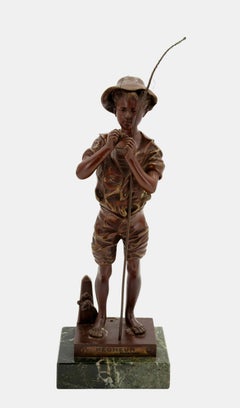
Adolphe Jean Lavergne (1863-1928), Pecheur, c. 1900. Brown patinated bronze with rectangular cast plinth on a green marble base (3 cm high), total height with hinge 37 cm, width 9 cm, depth 8 cm, weight 2.9 kg, signed “Lavergne” on the plinth.
- Base with old drilling and a few oxidized areas, patina occasionally rubbed, somewhat stained in the folds.
- Full of anticipation -
This bronze is the larger, highly detailed version of the fisherman that made Parisian artist Adolphe Jean Lavergne famous. In preparation for fishing, the boy prepares his rod before heading out to sea. The attachment of the iron ring and the rope behind him suggest a quay wall and a boat moored there. However, the depiction is entirely focused on the actual action of the young fisherman: With equal skill and concentration, he bends a hook to connect it to the fishing line. The contrast with his casual clothing, the loose-fitting trousers, the open shirt with its "wild" folds, and, last but not least, the sun hat boldly perched on his neck, reinforces the impression of the attentive care with which he goes about his work. His gaze makes him appear absorbed, as if he has forgotten the world around him and yet he is visibly filled with anticipation of fishing.
GERMAN VERSION
Adolphe Jean Lavergne (1863-1928), Pecheur, um 1890. Braun patinierte Bronze mit rechteckiger gegossener Plinthe auf grünem Marmorsockel (3 cm Höhe), Gesamthöhe mit Angel 37 cm, Breite 9 cm, Tiefe 8 cm, Gewicht 2,9 kg, auf der Plinthe mit „Lavergne“ signiert.
- Sockel mit alter Bohrung und wenigen oxidierten Stellen, Patina mitunter berieben, in den Falten vereinzelt etwas fleckig.
- Voller Vorfreude -
Die Bronzefigur ist die größere äußerst detaillierte Ausführung des Fischers, mit dem der Pariser Künstler Adolphe Jean Lavergne bekannt geworden ist. In Vorbereitung auf das Fischen präpariert der Junge die Angel...
Category
1890s Realist Gustavo Montoya More Art
Materials
Bronze
$684 Sale Price
20% Off
H 14.57 in W 3.55 in D 3.15 in
Cobra, Unknown, 20th century, Bronze, Animal, Snake, Design, art deco, Cast
Located in Geneva, CH
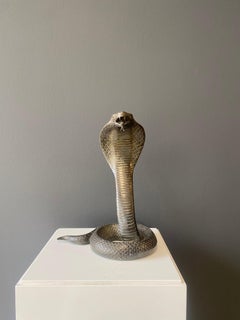
Cobra, Unknown, 20th century, Bronze, Animal, Snake, Design, art deco, Cast
Category
20th Century Art Deco Gustavo Montoya More Art
Materials
Bronze
$22,571
H 32 in W 25 in D 18 in
Rare Brutalist Mexican Sculpture Pendant Necklace Signed Bronze Pal Kepenyes
By Pal Kepenyes
Located in Surfside, FL
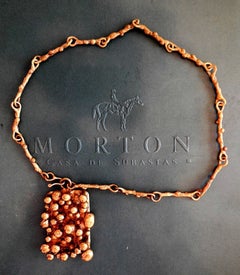
Chain measures 19.5 inches in length
Pendant measures 2.4 X 1.5 X .5 inches
Pal Kepenyes is a sculptor and researcher of Hungarian art, whose artistic production includes sculptures of small and medium format, jewelry and miniature decorative pieces, all made by hand, without any machinery.
Wearable art. Sculptural pendant on matching chain cast in polished bronze or brass. Reminiscent of Harry Bertoia. Organic Modernism. Mod, space age, handmade artisan, studio jewelry.
Pal Kepenyes, wearable art pioneer. sculptor, goldsmith, jeweler, artist, was born in 1926 in Hungary. His creative talent, specifically in creating sculpted works, was evident early on. He moved to Budapest, where he first studied at the University of Arts and Crafts and later at the Academy of Fine Arts. His professor, Beni Ferenczy was one of Hungary's most influential sculptors. Pal Kepenyes (20/21st century) is active/lives in Hungary, Mexico. Pal Kepenyes is known for sculpture, jewelry making, miniature decorative pieces especially influenced by Mexican folk art and folklore. His work also includes animals, lions, tigers, fish, nude figures and milagros.
He began his studies at the School of Decorative Arts in Budapest, and then was a prisoner of war during the Stalinist regime. In 1956, at the end of the Hungarian Revolution, he finally was released and left the country for Paris, where he studied at the School of Fine Arts.
In 1956, he also traveled to Mexico, a country to which he has been devoted for the rest of his life because of his attraction pre-hispanic cultures. Along with Pedro Friedeberg, Arnold Coen, Vladimir Cora, Byron Galvez, Mathias Goeritz, Leonardo Nierman, Gabriel Orozco...
Category
1960s Modern Gustavo Montoya More Art
Materials
Bronze
$2,200
H 2.4 in W 1.5 in D 0.5 in
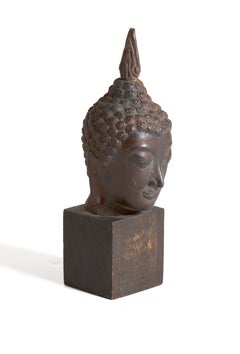
Burma, Thai Bronze Head of Buddha (original)
Located in Milwaukee, WI
Thai Bronze Head of Buddha (Original) 17th c.
Category
17th Century Gustavo Montoya More Art
Materials
Bronze
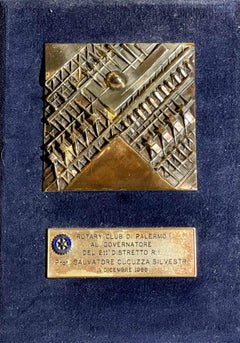
Limited Edition Bronze Plaque (Placca), registered with the Pomodoro Foundation
By Arnaldo Pomodoro
Located in New York, NY
Arnaldo Pomodoro
Plaque (Placca), 1980
Bronze
3 4/5 × 3 4/5 inches
Edition of 500
Incised signature on the front top left, and foundry mark on the bottom; Rotary Club of Palermo plaq...
Category
1980s Abstract Geometric Gustavo Montoya More Art
Materials
Bronze
$2,000
H 3.8 in W 3.8 in D 0.3 in
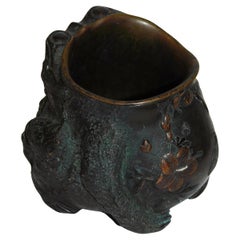
Pair of Mixed Metal Bronze Japanese Meiji Period Toad Brush Pots
Located in Phoenix, AZ
These whimsical mixed metal bronze pots feature plump bug-eyed toads, warts and
all with gaping mouths. These make excellent vases and have metal removable liners.
The toads’ bellie...
Category
1890s Gustavo Montoya More Art
Materials
Bronze
$2,200
H 3.63 in W 4 in D 4.25 in
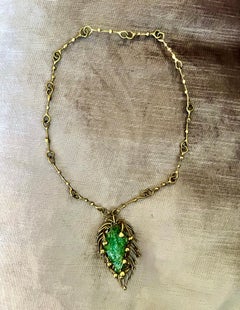
Rare Brutalist Mexican Sculpture Pendant Surrealist Stone Necklace Pal Kepenyes
By Pal Kepenyes
Located in Surfside, FL
Chain is 23.5 inches long.
Pendant is 3.75 X 2 X 1 inches
This piece is not signed. but the chain matches completely with the signed one that I have.
Pal Kepenyes is a sculptor and researcher of Hungarian art, whose artistic production includes sculptures of small and medium format, jewelry and miniature decorative pieces, all made by hand, without any machinery.
Wearable art. Sculptural pendant on matching chain cast in polished bronze or brass. Reminiscent of Harry Bertoia. Organic Modernism. Mod, space age, handmade artisan, studio jewelry.
Pal Kepenyes, wearable art pioneer. sculptor, goldsmith, jeweler, artist, was born in 1926 in Hungary. His creative talent, specifically in creating sculpted works, was evident early on. He moved to Budapest, where he first studied at the University of Arts and Crafts and later at the Academy of Fine Arts. His professor, Beni Ferenczy was one of Hungary's most influential sculptors. Pal Kepenyes (20/21st century) is active/lives in Hungary, Mexico. Pal Kepenyes is known for sculpture, jewelry making, miniature decorative pieces especially influenced by Mexican folk art and folklore. His work also includes animals, lions, tigers, fish, nude figures and milagros.
He began his studies at the School of Decorative Arts in Budapest, and then was a prisoner of war during the Stalinist regime. In 1956, at the end of the Hungarian Revolution, he finally was released and left the country for Paris, where he studied at the School of Fine Arts.
In 1956, he also traveled to Mexico, a country to which he has been devoted for the rest of his life because of his attraction pre-hispanic cultures. Along with Pedro Friedeberg, Arnold Coen, Vladimir Cora, Byron Galvez, Mathias Goeritz, Leonardo Nierman, Gabriel Orozco...
Category
1960s Gustavo Montoya More Art
Materials
Stone, Bronze
$2,200
H 3.75 in W 2 in D 1 in
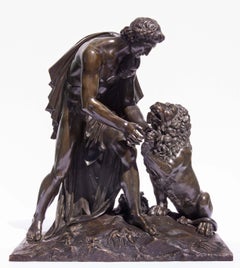
French Neoclassical Bronze Of Androcles and the Lion
Located in Rochester, NY
Large French Neoclassical sculpture of Androcles and the Lion. Exceptional quality casting and patina. Mid 19th century.
The runaway slave Androcles became friends with a wounded lion...
Category
19th Century Gustavo Montoya More Art
Materials
Metal, Bronze
$9,850
H 22 in W 20 in D 8.5 in
Gustavo Montoya more art for sale on 1stDibs.
Find a wide variety of authentic Gustavo Montoya more art available for sale on 1stDibs. You can also browse by medium to find art by Gustavo Montoya in bronze, metal and more. Not every interior allows for large Gustavo Montoya more art, so small editions measuring 17 inches across are available. Customers who are interested in this artist might also find the work of Alberto Montaño Mason, Arozarena De La Fuente, and María José de la Macorra. Gustavo Montoya more art prices can differ depending upon medium, time period and other attributes. On 1stDibs, the price for these items starts at $12,000 and tops out at $12,000, while the average work can sell for $12,000.