Henry George Keller Animal Drawings and Watercolors
American, 1870-1949
Keller, a leading painter in Cleveland, was born at sea, off Nova Scotia on April 3, 1869. His earliest training was in Karlsruhe, Germany under Hermann Baisch (1846-1894), then at the Cleveland School of Art, the Cincinnati Fine Arts Academy and the Art Students League in New York. The young artist was an apprentice at the W. J. Morgan Lithograph Company, also in Cleveland. Keller polished off his art instruction at the Munich Academy (1899-1902) with Heinrich Johann Zügel (1850-1941), chiefly an animal painter. There he would have rubbed shoulders with Walt Kuhn. At the end of his stay in Munich, he won a silver medal. His watercolor, Santa Maria della Salute, in a private collection, is in the tradition of John Singer Sargent. According to Arthur Covey, Keller was back in Munich in 1904-05, and he mentioned a painting called Storm-frightened Animals (Weimer, 1940, pp. 570-572). In Munich, Keller also met William Sommer, a future Cleveland post-impressionist.
Back in America, Keller immediately found a job at the Art Institute of Pittsburgh then he taught at his alma mater, the Cleveland School of Art until 1945. In Cleveland, remarked Keller (in Milliken, 1950), there was "a kind of pale, timid, watered Impressionism" and he reacted against it. Charles Burchfield, one of his more famous students, studied at the Cleveland School of Art between 1912 and 1916, when Keller was studying Asian art and showing modernist tendencies, having surpassed impressionism. Keller was also an enthusiast of Diaghelev's Ballets Russes, which he saw on their American tour. He studied the psychology of color with Dr. J. J. R. Macleod and underwent Cézanne's influence. Also at that time, Keller exhibited two works at the Armory Show — Wisdom and Destiny (Cleveland Museum of Art) and The Valley (unlocated). The former shows Keller's more traditional, intellectual side, with its classical allegorical figures in a stormy landscape. The theme was inspired by one of Maurice Maeterlinck's essays. Keller's modernism is revealed in the contemporary watercolor entitled Sunflower, in the same museum, which recalls some of the bravura of the free brushwork of John Marin. Keller was part of a group called the Cleveland Independents.
The list of Keller's exhibition activities is truly amazing — from local venues in Cleveland to Chicago (including a special show of his wash drawings in May of 1920), Pittsburgh, Philadelphia, and New York, his works were on view year by year. The Cleveland Museum of Art presented him with awards on numerous occasions and in 1939, he was elected to the National Academy of Design. That year, his painting Circus Day was on display at the Golden Gate International Exposition in San Francisco, while at the New York World's Fair in 1939, his Horse Barn appeared in the exhibition of contemporary artists. Here the horses are closer to those of German Expressionist Franz Marc than to those of Degas. The Whitney Museum has Keller's charcoal and watercolor, Bird Rock, California (1925). The painter died in San Diego, on August 3, 1949.to
1
Overall Width
to
Overall Height
to
1
1
1
1
1
5
67
49
42
42
1
Artist: Henry George Keller
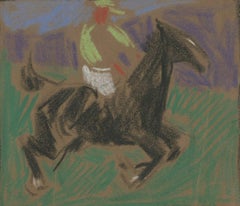
untitled (polo player on horseback)
By Henry George Keller
Located in Fairlawn, OH
untitled (polo player on horseback)
Chalk on tan paper, c. 1920
Unsigned
Provenance: Gift of the artist
William McGill (Keller's student)
Image size: 4 3/8 x 5 ...
Category
1920s American Impressionist Henry George Keller Animal Drawings and Watercolors
Materials
Chalk
Related Items
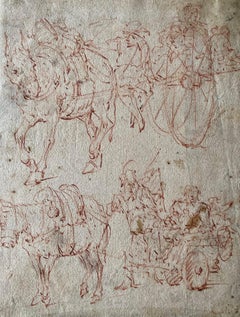
Flemish Old Master, Study of Donkey Carriage, 17th Century, Sanguine Drawing
Located in Greven, DE
This drawing shows several studies of a donkey with a carriage. Its style is close to Flemish 17th century artists. On the passepartout one reads "Mathias Scheyer/ Jacob Weyer", both...
Category
17th Century Baroque Henry George Keller Animal Drawings and Watercolors
Materials
Chalk, Handmade Paper

$861 Sale Price
20% Off
H 7.13 in W 5.52 in
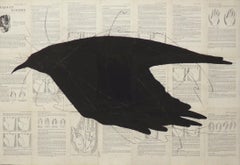
Raven Reads the Lines: Chalk Drawing of Black Bird on Vintage Book Pages
Located in Hudson, NY
Raven Reads the Lines (Chalk Drawing of Black Bird on Vintage Book Pages) by Louise Laplante
chalk on vintage collaged book pages.
Artwork measures ...
Category
2010s Contemporary Henry George Keller Animal Drawings and Watercolors
Materials
Paper, Chalk
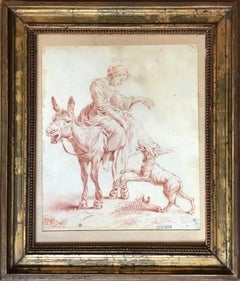
Sanguine drawing "Shepherdess on a Donkey" by Nicolaes Berchem
By Nicolaes Berchem
Located in New York, NY
Provenance: Mercedes von Dietrichtein, Buenos Aires. Alexander von Dietrichstein. By descendants Morritz von Diestrichstein.
Nicolaes Pieterszoon Berchem (1 October 1620 – 18 February 1683) was a highly esteemed and prolific Dutch Golden Age painter of pastoral landscapes, populated with mythological or biblical figures, but also of a number of allegories and genre pieces.
He was a member of the second generation of "Dutch Italianate landscape" painters. These were artists who travelled to Italy, or aspired to, in order to soak up the romanticism of the country, bringing home sketchbooks full of drawings of classical ruins and pastoral imagery. His paintings, of which he produced an immense number, (Hofstede de Groot claimed around 850, although many are misattributed), were in great demand, as were his 80 etchings and 500 drawings. His landscapes, painted in the Italian style of idealized rural scenes, with hills, mountains, cliffs and trees in a golden dawn...
Category
17th Century Dutch School Henry George Keller Animal Drawings and Watercolors
Materials
Paper, Chalk
$5,000
H 9.06 in W 7.49 in D 0.4 in
Former Vincent Price Collection, Dove Drawing by Vincent Capraro
Located in New York, NY
Vincent Capraro (American, 1919-2016)
Doves Courting, c. mid-20th century
Ink and watercolor on paper
Sight: 15 1/4 x 11 in.
Framed: 24 1/2 x 19 3/4 x 5/8 in.
Signed lower right
For...
Category
Mid-20th Century American Impressionist Henry George Keller Animal Drawings and Watercolors
Materials
Paper, Ink, Watercolor
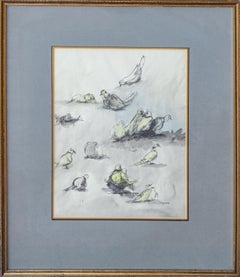
Vincent CapraroFormer Vincent Price Collection, Dove Drawing by Vincent Capraro, c. Mid-20th century
$910
H 24.5 in W 19.75 in D 0.625 in
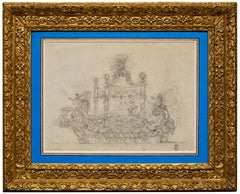
A dazzling Venetian Regatta Boat Study attributed to Alessandra Mauro
Located in PARIS, FR
This stunning Baroque study depicts a regatta boat, a type of vessel developed in eighteenth-century Venice for the regattas organized by the Serenissima during visits by royalty and princes. We propose to link this drawing to the work of Alessandro Mauro, an artist who specialized in this type of composition, as illustrated by a drawing from him at the Metropolitan Museum.
1. Description of the boat
The greatest decorative fantasy reigns in this preparatory study, which blends mythological and exotic elements with references to ancient Egypt. Our drawing is probably an initial thought, destined to be refined and clarified later in pen and ink (as evidenced by the ink stain in the lower right). A quadriga of seahorses guided by Neptune stands at the stern of the boat, shown well above the waterline (perhaps to outline its empty volume). One of the seahorses is ridden by a newt, while Amphitrite lies at the feet of the sea god.
The center of the boat is occupied by a vast baldachin resting on four atlantes and surmounted by a figure riding an animal (a dragon?). Three figures sit beneath the canopy, one of them on a griffin-shaped seat. This allusion to Egyptian antiquity echoes the winged sun (sometimes a symbol of the god Horus, as in the temple of Edfu in Egypt) that adorns the sides of the promontory on which this baldachin rests.
Another flag-bearer figure crouches at the stern of the boat on a raised seat, on the reverse of which is a crowned mermaid whose arm, extended backwards, rests on a mascaron decorated with a radiant face (Helios?) and whose torso surmounts an elephant's head. The heads of the rowers and their oars are sketched all along the boat, whose sides are embellished with elongated naiads.
2. The Venetian regatta boats
An exhibition held in 2013 at the Ca' Rezzonico (the Venetian eighteenth-century museum) paid tribute to these regatta boats through studies and prints depicting them. The regattas organized by the Serenissima in honor of visiting princes and sovereigns were among the most spectacular ceremonies in Venice. Some important artists of the 18th century contributed to the creation of these extravagant boats which were given exotic names such as bissona, malgarota or peota.
The specialists in this field were Andrea Urbani and the brothers Alessandro and Romualdo Mauro. They were born into a family of theater decorators in Piedmont, but little is known about their detailed biography. Alessandro was the architect of the Dresden opera house and of the St. Samuel Theater in Venice (in collaboration with his brother Romualdo), but also worked as stagehand and set designer in Vienna, Rome and Turin. A drawing produced around 1737 from the Metropolitan Museum (7th photo in the gallery) bears witness to his activity as a regatta boat designer.
This drawing is a much more elaborate version than the one presented here, having been entirely reworked in brown ink. However, a figure at the bow of the boat, executed solely in black chalk, still bears witness to a technique similar to that of our drawing.
It is difficult to know whether the boat depicted in our drawing was a project for an actual boat or whether it remained in the planning stage, but the front of our boat (Neptune and the quadriga of seahorses ridden by a newt) bears several similarities to that of a parade boat depicted in the print published by Michele Marieschi entitled Regatta on the Grand Canal, between the Foscari and Balbi Palaces (last photo in the gallery). This print is dated 1741, which could confirm that our work dates from around 1740.
The area between Neptune and the quadriga that precedes him on this strange paddle-boat appears to be partially submerged, confirming that the waterline of our boat was probably intended to be much lower than the one shown in our drawing.
The Correr Museum’s collection holds one of the most important collection of engravings and drawings devoted to these specifically Venetian Baroque productions. These boats were intended to last the duration of a festival. Today, they are only documented by preparatory drawings or prints that testify to the sumptuousness of their decoration. This taste for regatta boats lasted throughout the Venetian eighteenth century, and the conception of regatta boats also attracted great masters such as Giambattista Tiepolo, Francesco Guardi or Giambattista Piranesi...
Category
Mid-18th Century Old Masters Henry George Keller Animal Drawings and Watercolors
Materials
Chalk
$4,609
H 15.75 in W 19.25 in
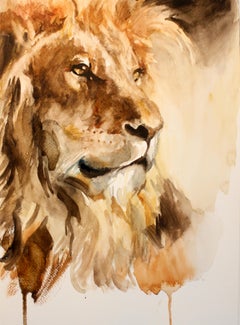
"Lion" Watercolor Painting
By Michele Bajona
Located in Denver, CO
Michele Bajona's (Mexico based) "Lion" is an Watercolor painting that depicts a closeup of a male Lion with a white background.
The painting is ...
Category
2010s American Impressionist Henry George Keller Animal Drawings and Watercolors
Materials
Watercolor
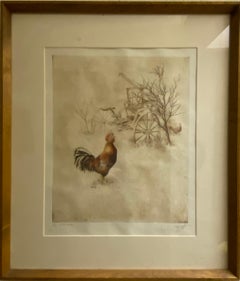
Red Rooster
By Sandy Scott
Located in Loveland, CO
Red Rooster by Sandy Scott
Wildlife Hand-colored Etching
14x11" image 24x20" framed, archival matte, under glass
circa 1970's, numbered 76/100, titled, si...
Category
2010s American Impressionist Henry George Keller Animal Drawings and Watercolors
Materials
Etching, Wood, Archival Paper, Watercolor, Glass
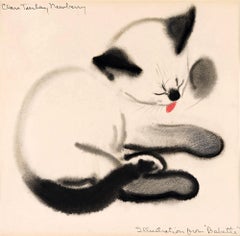
Babette the Cat, Female Illustrator
Located in Miami, FL
A stylized cat named Babette is depicted licking her paw. It is rendered in black and white, which bears the influence of Asian art in its simplicity of line, use of wash, and bleedi...
Category
1930s American Impressionist Henry George Keller Animal Drawings and Watercolors
Materials
Paper, Crayon, Watercolor, Pencil
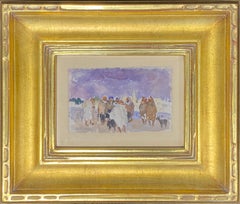
Goat Herders: North Africa
By Martha Walter
Located in New York, NY
A woman artist, in the 1930's traveling to North Africa and around the globe!
Martha Walter's training with William Merritt Chase is evident in the saturated colors and plein-air sub...
Category
1930s American Impressionist Henry George Keller Animal Drawings and Watercolors
Materials
Paper, Watercolor
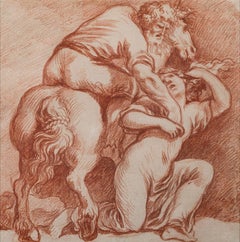
Man on Horseback Abducting a Woman
Located in Paris, Île-de-France
Jean-Robert ANGO (Active 1759 – 1773)
Man on Horseback Abducting a Woman
Red chalk and white chalk
26.1 x 25.9 cm
Provenance
Libert-Castor sale, November 19, 1993 (lot no. 23, ill...
Category
1760s Old Masters Henry George Keller Animal Drawings and Watercolors
Materials
Chalk
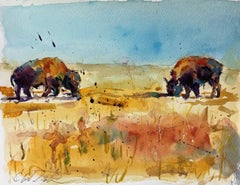
"Untitled 3, " Watercolor Painting
Located in Denver, CO
Clyde Steadman's "Untitled 3" is an original, handmade watercolor painting that depicts bison in a golden prairie.
Category
2010s American Impressionist Henry George Keller Animal Drawings and Watercolors
Materials
Paper, Watercolor
The Searchers (Figurative Chalk Drawing of a Dog on Vintage Book Pages)
Located in Hudson, NY
Figurative chalk drawing of black Greyhound dog and red birds on vintage collaged book pages
'The Searchers' by Louise Laplante in 2022
chalk on vintage collaged book pages
28 x 46 1/2 inches unframed, 32 x 52 inches in natural wood frame with non-glare plexi
This graphic, figurative drawing in black chalk with collaged antique...
Category
2010s Contemporary Henry George Keller Animal Drawings and Watercolors
Materials
Paper, Chalk

$4,800
H 32 in W 52 in D 1.5 in
Henry George Keller animal drawings and watercolors for sale on 1stDibs.
Find a wide variety of authentic Henry George Keller animal drawings and watercolors available for sale on 1stDibs. You can also browse by medium to find art by Henry George Keller in chalk and more. Much of the original work by this artist or collective was created during the 1920s and is mostly associated with the Impressionist style. Not every interior allows for large Henry George Keller animal drawings and watercolors, so small editions measuring 5 inches across are available. Henry George Keller animal drawings and watercolors prices can differ depending upon medium, time period and other attributes. On 1stDibs, the price for these items starts at $300 and tops out at $300, while the average work can sell for $300.