Henry Maurice Art

French, 1907-1984

Maurice Henry was a French poet and painter. He was also active as a filmmaker, art and film critic, photographer and humorous draftsman. He was in touch with a group of young poets and philosophers, with whom he founded the Grand Jeu movement. Henry collaborated with the magazines — Le Rouge et le Noir and Paris Montparnasse. He was in contact with Robert Desnos, André Robert Breton, Benjamin Péret, Louis Aragon and then Roger Vitrac and Jacques Prévert. From 1928, he collaborated with texts, poems and drawings to the magazine of the Grand Jeu movement and participated in the group's exhibition at the Galerie Bonaparte in Paris. He collaborated as an editor and reporter with various Parisian magazines, including Le Petit Journal, Cinemonde, Agence Haves, Revue du Cinéma, Pour Vous and Humanité. In 1932, he moved to the Surrealist movement, met Salvador Dalí and published poems and drawings on Le Surréalisme au Service de la Révolution. In 1939, he also began working as a filmmaker, destined to last over 16 years, during which he screened the screenplay of 20 films. In 1941, he held his first personal exhibition in Paris, at the Galerie La Peau de Chagrin. The presentation was by Jean Cocteau, the first buyer was Pablo Picasso. From 1944, he collaborated with Albert Camus on the magazine, Combat. In 1951, due to questions concerning the internal discipline of the group, he abandoned the Surrealist movement with others. From 1968, he devoted himself almost exclusively to painting and settled in Milan. In 1972, he edited the volume Graphic Antology of Surrealism for the Mazzotta Editions of Milan.

to
1
7
Overall Width
to
Overall Height
to
7
7
4
3
5
2
7
7
9,962
2,753
1,376
1,373
7
Artist: Henry Maurice
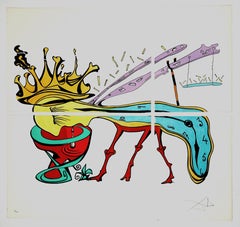
Abstract Composition - Lithograph by Henry Maurice - 1970s
By Henry Maurice
Located in Roma, IT
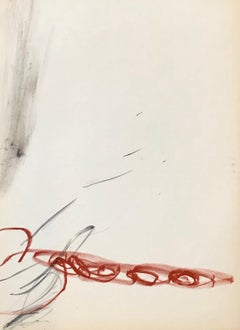
Abstract  Composition is a colored lithograph on paper, realized in the 1970s by Henry Maurice. Hand-signed on the lower. Numbered, edition of 60/100 editions. A beautiful artwork...
Category

1970s Contemporary Henry Maurice Art

Materials

Lithograph

Untitled - Lithograph by Henry Maurice - 1974
By Henry Maurice
Located in Roma, IT
Untitled is a colored lithograph print on paper, realized in the 1970s by Henry Maurice. Hand-signed on the lower. Numbered, edition of 46/100 editions. Very good conditions. A b...
Category

1970s Contemporary Henry Maurice Art

Materials

Lithograph

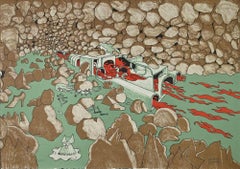
Untitled - Original Lithograph by Henry Maurice - 1973
By Henry Maurice
Located in Roma, IT
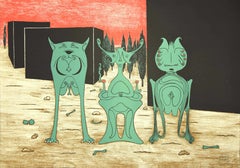
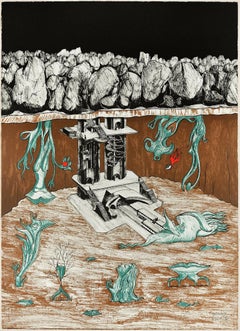
Untitled is a wonderful colored lithograph on paper, realized in 1973 by the French artist, Henry Maurice, published by La Nuova Foglio, the publishing house of Macerata, as it is impressed on the sheet on the lower right corner. Hand-signed and numbered in pencil on lower right margin. Edition of 100 prints. This contemporary artwork representing a surreal futuristic landscape animated by monsters and fantastic characters emerging from a muddy bottom surrounded by post-industrial architectures is in excellent conditions. A contemporary original print for your fashionable private collection at an affordable price, to collect jealously! Maurice Henry...
Category

1970s Surrealist Henry Maurice Art

Materials

Lithograph

Extraterrestrial Fantasy - Lithograph by Henry Maurice - 1974
By Henry Maurice
Located in Roma, IT
Extraterrestrial Fantasy is a colored lithograph on paper, realized in 1974 by Henry Maurice. Hand-signed on the lower. Numbered, edition of 4/100 editions. A beautiful artwork re...
Category

1970s Contemporary Henry Maurice Art

Materials

Lithograph

Untitled - Original Lithograph by Henry Maurice - 1973
By Henry Maurice
Located in Roma, IT
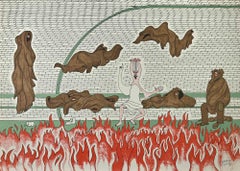
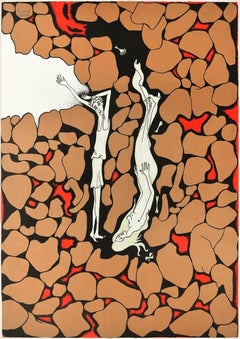
Untitled is a colored lithograph on paper, realized in 1973 by the French artist, Henry Maurice, and published by La Nuova Foglio, a publishing house of Macerata. Hand-signed and numbered in pencil on lower margin. Edition of 100 prints. This contemporary artwork representing a surreal composition with flying monsters surrounded by a wall and fire like in a hell, a scene to decipher as a rebus game, is in excellent conditions. Maurice Henry...
Category

1970s Surrealist Henry Maurice Art

Materials

Lithograph

Untitled - Original Lithograph by Henry Maurice - 1973
By Henry Maurice
Located in Roma, IT
Untitled is a beautiful colored lithograph on paper, realized in 1973 by the French artist, Henry Maurice, and published by La Nuova Foglio, a publishing house of Macerata. Hand-signed and numbered in pencil on lower margin. Edition of 100 prints. This contemporary artwork representing a surreal composition in a futuristic world to decipher as a rebus game, is in excellent conditions. Maurice Henry...
Category

1970s Surrealist Henry Maurice Art

Materials

Lithograph

Extraterrestrial Fantasy - Original Lithograph by Henry Maurice - 1973
By Henry Maurice
Located in Roma, IT
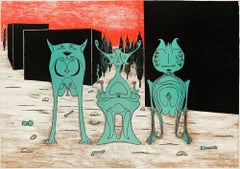
Extraterrestrial Fantasy is a wonderful colored lithograph on paper, realized in 1973 by the French artist, Henry Maurice, published by La Nuova Foglio, the publishing house of Macerata. Hand-signed and numbered in pencil on lower right margin. Edition of 100 prints. This contemporary artwork representing three extraterrestrial guardians at the entrance of a futuristic world is in excellent conditions. Maurice Henry...
Category

1970s Surrealist Henry Maurice Art

Materials

Lithograph

Related Items
1960 s Alexander Calder lithographic cover Derrière le miroir
By Alexander Calder
Located in NEW YORK, NY
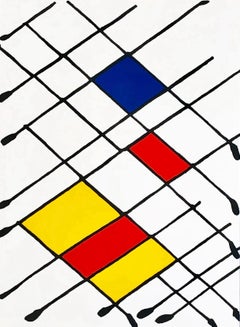
Alexander Calder Lithographic cover c. 1968 from Derrière le miroir: Lithograph in colors; 11 x 15 inches. Very good overall vintage condition. Unsigned from an edition of unknown with crisp bright colors. Published by: Galerie Maeght, Paris, c. 1968. Unsigned from an edition of unknown. Looks fantastic framed. Derrière le miroir: In October 1945 the French art dealer Aimé Maeght opens his art gallery at 13 Rue de Téhéran in Paris. His beginning coincides with the end of Second World War and the return of a number of exiled artists back to France. The publication was created in October 1946 (n°1) and published without interruption until 1982 (n°253). Its original articles and illustrations (mainly original color lithographs by the gallery artists) who were famous at the time. The lithographic publication covered only the artists exhibited by Maeght gallery either through personal or group exhibitions. Among them were, Pierre Alechinsky, Francis Bacon, Alexander Calder, Marc Chagall, Eduardo Chillida, Alberto Giacometti, Vassily Kandinsky, Ellsworth Kelly, Fernand Léger, Henri Matisse, Joan Miró, Saul Steinberg and Antoni Tapies. Related Categories: Mid century modern. Alexander Calder prints. Calder orange. Calder red...
Category

1960s Contemporary Henry Maurice Art

Materials

Lithograph

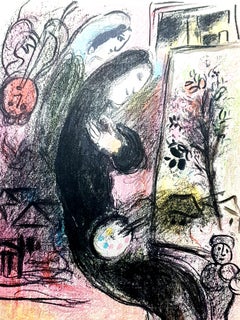
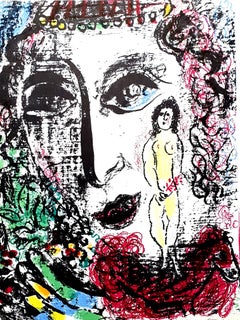
Marc Chagall - Inspiration - Original Lithograph from "Chagall Lithographe" v. 2
By Marc Chagall
Located in Collonge Bellerive, Geneve, CH
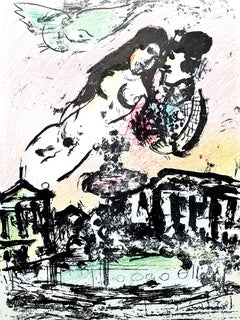
Marc Chagall Original Lithograph from Chagall Lithographe 1957-1962. VOLUME II. 1963 Dimensions: 32 x 24 cm From the unsigned edition of 10000 copies without margins Reference: Mourlot 398 Condition : Excellent Marc Chagall (born in 1887) Marc Chagall was born in Belarus in 1887 and developed an early interest in art. After studying painting, in 1907 he left Russia for Paris, where he lived in an artist colony on the city’s outskirts. Fusing his own personal, dreamlike imagery with hints of the fauvism and cubism popular in France at the time, Chagall created his most lasting work—including I and the Village (1911)—some of which would be featured in the Salon des Indépendants exhibitions. After returning to Vitebsk for a visit in 1914, the outbreak of WWI trapped Chagall in Russia. He returned to France in 1923 but was forced to flee the country and Nazi persecution during WWII. Finding asylum in the U.S., Chagall became involved in set and costume design before returning to France in 1948. In his later years, he experimented with new art forms and was commissioned to produce numerous large-scale works. Chagall died in St.-Paul-de-Vence in 1985. The Village Marc Chagall was born in a small Hassidic community on the outskirts of Vitebsk, Belarus, on July 7, 1887. His father was a fishmonger, and his mother ran a small sundries shop in the village. As a child, Chagall attended the Jewish elementary school, where he studied Hebrew and the Bible, before later attending the Russian public school. He began to learn the fundamentals of drawing during this time, but perhaps more importantly, he absorbed the world around him, storing away the imagery and themes that would feature largely in most of his later work. At age 19 Chagall enrolled at a private, all-Jewish art school and began his formal education in painting, studying briefly with portrait artist Yehuda Pen. However, he left the school after several months, moving to St. Petersburg in 1907 to study at the Imperial Society for the Protection of Fine Arts. The following year, he enrolled at the Svanseva School, studying with set designer Léon Bakst, whose work had been featured in Sergei Diaghilev's Ballets Russes. This early experience would prove important to Chagall’s later career as well. Despite this formal instruction, and the widespread popularity of realism in Russia at the time, Chagall was already establishing his own personal style, which featured a more dreamlike unreality and the people, places and imagery that were close to his heart. Some examples from this period are his Window Vitebsk (1908) and My Fianceé with Black Gloves (1909), which pictured Bella Rosenfeld, to whom he had recently become engaged. The Beehive Despite his romance with Bella, in 1911 an allowance from Russian parliament member and art patron Maxim Binaver enabled Chagall to move to Paris, France. After settling briefly in the Montparnasse neighborhood, Chagall moved further afield to an artist colony known as La Ruche (“The Beehive”), where he began to work side by side with abstract painters such as Amedeo Modigliani and Fernand Léger as well as the avant-garde poet Guillaume Apollinaire. At their urging, and under the influence of the wildly popular fauvism and cubism, Chagall lightened his palette and pushed his style ever further from reality. I and the Village (1911) and Homage to Apollinaire (1912) are among his early Parisian works, widely considered to be his most successful and representative period. Though his work stood stylistically apart from his cubist contemporaries, from 1912 to 1914 Chagall exhibited several paintings at the annual Salon des Indépendants exhibition, where works by the likes of Juan Gris, Marcel Duchamp and Robert Delaunay were causing a stir in the Paris art world. Chagall’s popularity began to spread beyond La Ruche, and in May 1914 he traveled to Berlin to help organize his first solo exhibition, at Der Sturm Gallery. Chagall remained in the city until the highly acclaimed show opened that June. He then returned to Vitebsk, unaware of the fateful events to come. War, Peace and Revolution In August 1914 the outbreak of World War I precluded Chagall’s plans to return to Paris. The conflict did little to stem the flow of his creative output, however, instead merely giving him direct access to the childhood scenes so essential to his work, as seen in paintings such as Jew in Green (1914) and Over Vitebsk (1914). His paintings from this period also occasionally featured images of the war’s impact on the region, as with Wounded Soldier (1914) and Marching (1915). But despite the hardships of life during wartime, this would also prove to be a joyful period for Chagall. In July 1915 he married Bella, and she gave birth to a daughter, Ida, the following year. Their appearance in works such as Birthday (1915), Bella and Ida by the Window (1917) and several of his “Lovers” paintings give a glimpse of the island of domestic bliss that was Chagall’s amidst the chaos. To avoid military service and stay with his new family, Chagall took a position as a clerk in the Ministry of War Economy in St. Petersburg. While there he began work on his autobiography and also immersed himself in the local art scene, befriending novelist Boris Pasternak, among others. He also exhibited his work in the city and soon gained considerable recognition. That notoriety would prove important in the aftermath of the 1917 Russian Revolution when he was appointed as the Commissar of Fine Arts in Vitebsk. In his new post, Chagall undertook various projects in the region, including the 1919 founding of the Academy of the Arts. Despite these endeavors, differences among his colleagues eventually disillusioned Chagall. In 1920 he relinquished his position and moved his family to Moscow, the post-revolution capital of Russia. In Moscow, Chagall was soon commissioned to create sets and costumes for various productions at the Moscow State Yiddish Theater...
Category

1960s Surrealist Henry Maurice Art

Materials

Lithograph

"Untitled" lithograph on cardboard by Imi Knoebel from "Kinderstern" portfolio
By Imi Knoebel
Located in Boca Raton, FL
"Untitled" lithograph on cardboard of red "Star for Children" by artist Imi Knoebel from the "Kinderstern" portfolio, published in 1989 by Edition Domberger to raise money to house f...
Category

1980s Contemporary Henry Maurice Art

Materials

Lithograph

Sam Francis - Michel Waldberg - Metaphysique Du Vid
By Sam Francis
Located in New York, NY
Sam Francis Exhibition Poster. Color lithograph 1986 Painter and printmaker who was prominent among the group of painters known as the seco...
Category

1980s Contemporary Henry Maurice Art

Materials

Lithograph

De l Origine des Espèces par Voie de Sélection Irrationelle: Visage
By Man Ray
Located in New York, NY
A very good impression of this color lithograph. Artist's proof, aside from the edition of 180. Signed and inscribed "EA" in pencil. Printed by Mourlot, Paris. Published by Leon Amie...
Category

1970s Surrealist Henry Maurice Art

Materials

Color, Lithograph

Pahlik Mana (Butterfly Maiden) Dan Namingha Hopi kachina katsina black and white
By Dan Namingha
Located in Santa Fe, NM
Pahlik Mana (Butterfly Maiden) Dan Namingha Hopi kachina katsina black and white unframed limited edition hand pulled lithograph at Tamarind Institue Glenn Green Galleries also pre...
Category

1970s Contemporary Henry Maurice Art

Materials

Lithograph

Dalinean Horses The Centaur of Crete
By Salvador Dalí­
Located in Hollywood, FL
ARTIST: Salvador Dali TITLE: Dalinean Horses The Centaur of Crete MEDIUM: Lithograph SIGNED: Hand Signed PUBLISHER: Simeon Wajntraub & Jacques Carpentier EDITION NUMBER: 170/25...
Category

1970s Surrealist Henry Maurice Art

Materials

Lithograph

Marc Chagall - Original Lithograph
By Marc Chagall
Located in Collonge Bellerive, Geneve, CH
Marc Chagall Original Lithograph 1963 Dimensions: 32 x 24 cm Reference: Chagall Lithographe 1957-1962. VOLUME II. Condition : Excellent Marc Chagall (born in 1887) Marc Chagall was born in Belarus in 1887 and developed an early interest in art. After studying painting, in 1907 he left Russia for Paris, where he lived in an artist colony on the city’s outskirts. Fusing his own personal, dreamlike imagery with hints of the fauvism and cubism popular in France at the time, Chagall created his most lasting work—including I and the Village (1911)—some of which would be featured in the Salon des Indépendants exhibitions. After returning to Vitebsk for a visit in 1914, the outbreak of WWI trapped Chagall in Russia. He returned to France in 1923 but was forced to flee the country and Nazi persecution during WWII. Finding asylum in the U.S., Chagall became involved in set and costume design before returning to France in 1948. In his later years, he experimented with new art forms and was commissioned to produce numerous large-scale works. Chagall died in St.-Paul-de-Vence in 1985. The Village Marc Chagall was born in a small Hassidic community on the outskirts of Vitebsk, Belarus, on July 7, 1887. His father was a fishmonger, and his mother ran a small sundries shop in the village. As a child, Chagall attended the Jewish elementary school, where he studied Hebrew and the Bible, before later attending the Russian public school. He began to learn the fundamentals of drawing during this time, but perhaps more importantly, he absorbed the world around him, storing away the imagery and themes that would feature largely in most of his later work. At age 19 Chagall enrolled at a private, all-Jewish art school and began his formal education in painting, studying briefly with portrait artist Yehuda Pen. However, he left the school after several months, moving to St. Petersburg in 1907 to study at the Imperial Society for the Protection of Fine Arts. The following year, he enrolled at the Svanseva School, studying with set designer Léon Bakst, whose work had been featured in Sergei Diaghilev's Ballets Russes. This early experience would prove important to Chagall’s later career as well. Despite this formal instruction, and the widespread popularity of realism in Russia at the time, Chagall was already establishing his own personal style, which featured a more dreamlike unreality and the people, places and imagery that were close to his heart. Some examples from this period are his Window Vitebsk (1908) and My Fianceé with Black Gloves (1909), which pictured Bella Rosenfeld, to whom he had recently become engaged. The Beehive Despite his romance with Bella, in 1911 an allowance from Russian parliament member and art patron Maxim Binaver enabled Chagall to move to Paris, France. After settling briefly in the Montparnasse neighborhood, Chagall moved further afield to an artist colony known as La Ruche (“The Beehive”), where he began to work side by side with abstract painters such as Amedeo Modigliani and Fernand Léger as well as the avant-garde poet Guillaume Apollinaire. At their urging, and under the influence of the wildly popular fauvism and cubism, Chagall lightened his palette and pushed his style ever further from reality. I and the Village (1911) and Homage to Apollinaire (1912) are among his early Parisian works, widely considered to be his most successful and representative period. Though his work stood stylistically apart from his cubist contemporaries, from 1912 to 1914 Chagall exhibited several paintings at the annual Salon des Indépendants exhibition, where works by the likes of Juan Gris, Marcel Duchamp and Robert Delaunay were causing a stir in the Paris art world. Chagall’s popularity began to spread beyond La Ruche, and in May 1914 he traveled to Berlin to help organize his first solo exhibition, at Der Sturm Gallery. Chagall remained in the city until the highly acclaimed show opened that June. He then returned to Vitebsk, unaware of the fateful events to come. War, Peace and Revolution In August 1914 the outbreak of World War I precluded Chagall’s plans to return to Paris. The conflict did little to stem the flow of his creative output, however, instead merely giving him direct access to the childhood scenes so essential to his work, as seen in paintings such as Jew in Green (1914) and Over Vitebsk (1914). His paintings from this period also occasionally featured images of the war’s impact on the region, as with Wounded Soldier (1914) and Marching (1915). But despite the hardships of life during wartime, this would also prove to be a joyful period for Chagall. In July 1915 he married Bella, and she gave birth to a daughter, Ida, the following year. Their appearance in works such as Birthday (1915), Bella and Ida by the Window (1917) and several of his “Lovers” paintings give a glimpse of the island of domestic bliss that was Chagall’s amidst the chaos. To avoid military service and stay with his new family, Chagall took a position as a clerk in the Ministry of War Economy in St. Petersburg. While there he began work on his autobiography and also immersed himself in the local art scene, befriending novelist Boris Pasternak, among others. He also exhibited his work in the city and soon gained considerable recognition. That notoriety would prove important in the aftermath of the 1917 Russian Revolution when he was appointed as the Commissar of Fine Arts in Vitebsk. In his new post, Chagall undertook various projects in the region, including the 1919 founding of the Academy of the Arts. Despite these endeavors, differences among his colleagues eventually disillusioned Chagall. In 1920 he relinquished his position and moved his family to Moscow, the post-revolution capital of Russia. In Moscow, Chagall was soon commissioned to create sets and costumes for various productions at the Moscow State Yiddish Theater...
Category

1960s Surrealist Henry Maurice Art

Materials

Lithograph

Marc Chagall - Original Lithograph
$1,485
H 9.45 in W 12.6 in D 0.04 in
Manhattan Skyline
By Salvador Dalí­
Located in Hollywood, FL
ARTIST: Salvador Dali TITLE: Manhattan Skyline MEDIUM: Lithograph SIGNED: Hand Signed PUBLISHER: Levine & Levine EDITION NUMBER: 49/150 MEASUREMENTS: 29.75" x21.25" YEAR: 19...
Category

1970s Surrealist Henry Maurice Art

Materials

Lithograph

Manhattan Skyline
Manhattan Skyline
$29,500
H 29.75 in W 21.25 in
THE VISITOR Signed Lithograph, Mini Surreal Landscape Seashell, Mountains, Water
By Fanny Brennan
Located in Union City, NJ
THE VISITOR is a hand drawn, limited edition lithograph by the American surrealist artist Fanny Brennan, created using traditional hand lithography techniques printed on archival Ar...
Category

1990s Surrealist Henry Maurice Art

Materials

Lithograph

Untitled (Pulse) Abstract print limited edition Julie Mehretu Lithograph
By Julie Mehretu
Located in Bristol, GB
Lithograph in colours on wove paper Edition 24 of 100 56 x 65 cm (22 x 25.6 in) Signed, numbered and dated on the front Mint
Category

21st Century and Contemporary Contemporary Henry Maurice Art

Materials

Lithograph

Marc Chagall - Original Lithograph
By Marc Chagall
Located in Collonge Bellerive, Geneve, CH
Marc Chagall Original Lithograph 1963 Dimensions: 32 x 24 cm Reference: Chagall Lithographe 1957-1962. VOLUME II. Condition : Excellent Marc Chagall (born in 1887) Marc Chagall was born in Belarus in 1887 and developed an early interest in art. After studying painting, in 1907 he left Russia for Paris, where he lived in an artist colony on the city’s outskirts. Fusing his own personal, dreamlike imagery with hints of the fauvism and cubism popular in France at the time, Chagall created his most lasting work—including I and the Village (1911)—some of which would be featured in the Salon des Indépendants exhibitions. After returning to Vitebsk for a visit in 1914, the outbreak of WWI trapped Chagall in Russia. He returned to France in 1923 but was forced to flee the country and Nazi persecution during WWII. Finding asylum in the U.S., Chagall became involved in set and costume design before returning to France in 1948. In his later years, he experimented with new art forms and was commissioned to produce numerous large-scale works. Chagall died in St.-Paul-de-Vence in 1985. The Village Marc Chagall was born in a small Hassidic community on the outskirts of Vitebsk, Belarus, on July 7, 1887. His father was a fishmonger, and his mother ran a small sundries shop in the village. As a child, Chagall attended the Jewish elementary school, where he studied Hebrew and the Bible, before later attending the Russian public school. He began to learn the fundamentals of drawing during this time, but perhaps more importantly, he absorbed the world around him, storing away the imagery and themes that would feature largely in most of his later work. At age 19 Chagall enrolled at a private, all-Jewish art school and began his formal education in painting, studying briefly with portrait artist Yehuda Pen. However, he left the school after several months, moving to St. Petersburg in 1907 to study at the Imperial Society for the Protection of Fine Arts. The following year, he enrolled at the Svanseva School, studying with set designer Léon Bakst, whose work had been featured in Sergei Diaghilev's Ballets Russes. This early experience would prove important to Chagall’s later career as well. Despite this formal instruction, and the widespread popularity of realism in Russia at the time, Chagall was already establishing his own personal style, which featured a more dreamlike unreality and the people, places and imagery that were close to his heart. Some examples from this period are his Window Vitebsk (1908) and My Fianceé with Black Gloves (1909), which pictured Bella Rosenfeld, to whom he had recently become engaged. The Beehive Despite his romance with Bella, in 1911 an allowance from Russian parliament member and art patron Maxim Binaver enabled Chagall to move to Paris, France. After settling briefly in the Montparnasse neighborhood, Chagall moved further afield to an artist colony known as La Ruche (“The Beehive”), where he began to work side by side with abstract painters such as Amedeo Modigliani and Fernand Léger as well as the avant-garde poet Guillaume Apollinaire. At their urging, and under the influence of the wildly popular fauvism and cubism, Chagall lightened his palette and pushed his style ever further from reality. I and the Village (1911) and Homage to Apollinaire (1912) are among his early Parisian works, widely considered to be his most successful and representative period. Though his work stood stylistically apart from his cubist contemporaries, from 1912 to 1914 Chagall exhibited several paintings at the annual Salon des Indépendants exhibition, where works by the likes of Juan Gris, Marcel Duchamp and Robert Delaunay were causing a stir in the Paris art world. Chagall’s popularity began to spread beyond La Ruche, and in May 1914 he traveled to Berlin to help organize his first solo exhibition, at Der Sturm Gallery. Chagall remained in the city until the highly acclaimed show opened that June. He then returned to Vitebsk, unaware of the fateful events to come. War, Peace and Revolution In August 1914 the outbreak of World War I precluded Chagall’s plans to return to Paris. The conflict did little to stem the flow of his creative output, however, instead merely giving him direct access to the childhood scenes so essential to his work, as seen in paintings such as Jew in Green (1914) and Over Vitebsk (1914). His paintings from this period also occasionally featured images of the war’s impact on the region, as with Wounded Soldier (1914) and Marching (1915). But despite the hardships of life during wartime, this would also prove to be a joyful period for Chagall. In July 1915 he married Bella, and she gave birth to a daughter, Ida, the following year. Their appearance in works such as Birthday (1915), Bella and Ida by the Window (1917) and several of his “Lovers” paintings give a glimpse of the island of domestic bliss that was Chagall’s amidst the chaos. To avoid military service and stay with his new family, Chagall took a position as a clerk in the Ministry of War Economy in St. Petersburg. While there he began work on his autobiography and also immersed himself in the local art scene, befriending novelist Boris Pasternak, among others. He also exhibited his work in the city and soon gained considerable recognition. That notoriety would prove important in the aftermath of the 1917 Russian Revolution when he was appointed as the Commissar of Fine Arts in Vitebsk. In his new post, Chagall undertook various projects in the region, including the 1919 founding of the Academy of the Arts. Despite these endeavors, differences among his colleagues eventually disillusioned Chagall. In 1920 he relinquished his position and moved his family to Moscow, the post-revolution capital of Russia. In Moscow, Chagall was soon commissioned to create sets and costumes for various productions at the Moscow State Yiddish Theater...
Category

1960s Surrealist Henry Maurice Art

Materials

Lithograph

Marc Chagall - Original Lithograph
$1,485
H 9.45 in W 12.6 in D 0.04 in
Previously Available Items
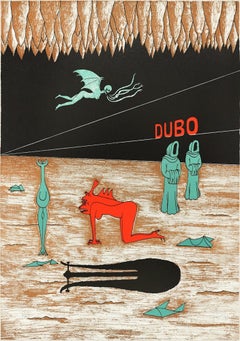
Dubo - Original Lithograph by Henry Maurice - 1970s
By Henry Maurice
Located in Roma, IT
Dubo is a wonderful colored lithograph on paper, realized in Seventies of XX century by the French artist, Henry Maurice, published by La Nuova Foglio, the publishing house of Macerata. Hand-signed and numbered in pencil on lower margin. Edition of 100 prints. This contemporary artwork representing monsters in a surreal scene and in a futuristic world is in excellent conditions. Maurice Henry...
Category

1970s Surrealist Henry Maurice Art

Materials

Lithograph

Extraterrestrial Fantasy - Original Lithograph by Henry Maurice - 1973
By Henry Maurice
Located in Roma, IT
Extraterrestrial Fantasy is a wonderful colored lithograph on paper, realized in 1973 by the French artist, Henry Maurice, published by La Nuova Foglio, the publishing house of Macerata. Hand-signed and numbered in pencil on lower right margin. Edition of 100 prints. This contemporary artwork representing three extraterrestrial guardians at the entrance of a futuristic world is in excellent conditions. Maurice Henry...
Category

1970s Surrealist Henry Maurice Art

Materials

Lithograph

Henry Maurice art for sale on 1stDibs.

Find a wide variety of authentic Henry Maurice art available for sale on 1stDibs. You can also browse by medium to find art by Henry Maurice in lithograph and more. Much of the original work by this artist or collective was created during the 1970s and is mostly associated with the Surrealist style. Not every interior allows for large Henry Maurice art, so small editions measuring 20 inches across are available. Customers who are interested in this artist might also find the work of Mayo (Antoine Malliarakis), Francis de Saint-Genies, and Hanna Kay. Henry Maurice art prices can differ depending upon medium, time period and other attributes. On 1stDibs, the price for these items starts at $226 and tops out at $323, while the average work can sell for $279.

Recently Viewed

View All