Henry Maurice Prints and Multiples

French, 1907-1984

Maurice Henry was a French poet and painter. He was also active as a filmmaker, art and film critic, photographer and humorous draftsman. He was in touch with a group of young poets and philosophers, with whom he founded the Grand Jeu movement. Henry collaborated with the magazines — Le Rouge et le Noir and Paris Montparnasse. He was in contact with Robert Desnos, André Robert Breton, Benjamin Péret, Louis Aragon and then Roger Vitrac and Jacques Prévert. From 1928, he collaborated with texts, poems and drawings to the magazine of the Grand Jeu movement and participated in the group's exhibition at the Galerie Bonaparte in Paris. He collaborated as an editor and reporter with various Parisian magazines, including Le Petit Journal, Cinemonde, Agence Haves, Revue du Cinéma, Pour Vous and Humanité. In 1932, he moved to the Surrealist movement, met Salvador Dalí and published poems and drawings on Le Surréalisme au Service de la Révolution. In 1939, he also began working as a filmmaker, destined to last over 16 years, during which he screened the screenplay of 20 films. In 1941, he held his first personal exhibition in Paris, at the Galerie La Peau de Chagrin. The presentation was by Jean Cocteau, the first buyer was Pablo Picasso. From 1944, he collaborated with Albert Camus on the magazine, Combat. In 1951, due to questions concerning the internal discipline of the group, he abandoned the Surrealist movement with others. From 1968, he devoted himself almost exclusively to painting and settled in Milan. In 1972, he edited the volume Graphic Antology of Surrealism for the Mazzotta Editions of Milan.

to
6
Overall Width
to
Overall Height
to
4
2
6
1,221
968
914
840
6
6
4
2
6
6
Artist: Henry Maurice
Extraterrestrial Fantasy - Original Lithograph by Henry Maurice - 1973
By Henry Maurice
Located in Roma, IT
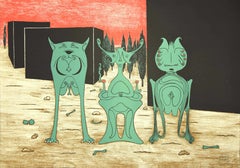
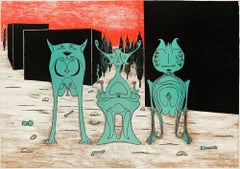
Extraterrestrial Fantasy is a wonderful colored lithograph on paper, realized in 1973 by the French artist, Henry Maurice, published by La Nuova Foglio, the publishing house of Macerata. Hand-signed and numbered in pencil on lower right margin. Edition of 100 prints. This contemporary artwork representing three extraterrestrial guardians at the entrance of a futuristic world is in excellent conditions. Maurice Henry...
Category

1970s Surrealist Henry Maurice Prints and Multiples

Materials

Lithograph

Untitled - Lithograph by Henry Maurice - 1974
By Henry Maurice
Located in Roma, IT
Untitled is a colored lithograph print on paper, realized in the 1970s by Henry Maurice. Hand-signed on the lower. Numbered, edition of 46/100 editions. Very good conditions. A b...
Category

1970s Contemporary Henry Maurice Prints and Multiples

Materials

Lithograph

Extraterrestrial Fantasy - Lithograph by Henry Maurice - 1974
By Henry Maurice
Located in Roma, IT
Extraterrestrial Fantasy is a colored lithograph on paper, realized in 1974 by Henry Maurice. Hand-signed on the lower. Numbered, edition of 4/100 editions. A beautiful artwork re...
Category

1970s Contemporary Henry Maurice Prints and Multiples

Materials

Lithograph

Untitled - Original Lithograph by Henry Maurice - 1973
By Henry Maurice
Located in Roma, IT
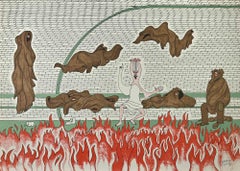
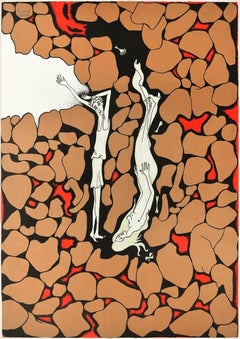
Untitled is a colored lithograph on paper, realized in 1973 by the French artist, Henry Maurice, and published by La Nuova Foglio, a publishing house of Macerata. Hand-signed and numbered in pencil on lower margin. Edition of 100 prints. This contemporary artwork representing a surreal composition with flying monsters surrounded by a wall and fire like in a hell, a scene to decipher as a rebus game, is in excellent conditions. Maurice Henry...
Category

1970s Surrealist Henry Maurice Prints and Multiples

Materials

Lithograph

Untitled - Original Lithograph by Henry Maurice - 1973
By Henry Maurice
Located in Roma, IT
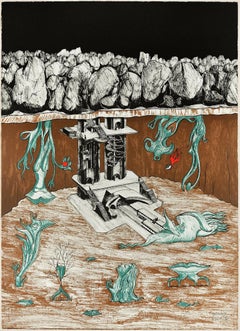
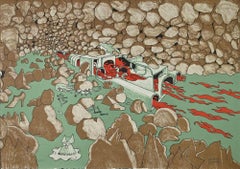
Untitled is a wonderful colored lithograph on paper, realized in 1973 by the French artist, Henry Maurice, published by La Nuova Foglio, the publishing house of Macerata, as it is impressed on the sheet on the lower right corner. Hand-signed and numbered in pencil on lower right margin. Edition of 100 prints. This contemporary artwork representing a surreal futuristic landscape animated by monsters and fantastic characters emerging from a muddy bottom surrounded by post-industrial architectures is in excellent conditions. A contemporary original print for your fashionable private collection at an affordable price, to collect jealously! Maurice Henry...
Category

1970s Surrealist Henry Maurice Prints and Multiples

Materials

Lithograph

Untitled - Original Lithograph by Henry Maurice - 1973
By Henry Maurice
Located in Roma, IT
Untitled is a beautiful colored lithograph on paper, realized in 1973 by the French artist, Henry Maurice, and published by La Nuova Foglio, a publishing house of Macerata. Hand-signed and numbered in pencil on lower margin. Edition of 100 prints. This contemporary artwork representing a surreal composition in a futuristic world to decipher as a rebus game, is in excellent conditions. Maurice Henry...
Category

1970s Surrealist Henry Maurice Prints and Multiples

Materials

Lithograph

Related Items
Antoni Tàpies lithograph Derriere Le Miroir (Antoni Tàpies prints)
By Antoni Tàpies
Located in NEW YORK, NY
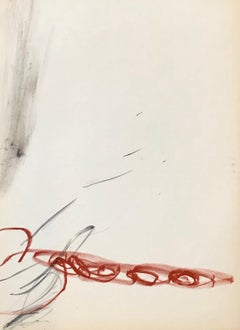
Antoni Tàpies Lithograph c. 1968 from Derrière le miroir: Lithograph in colors; 15 x 11 inches. Very good overall vintage condition. Unsigned from an edition of unknown. Fr...
Category

1960s Contemporary Henry Maurice Prints and Multiples

Materials

Lithograph

Vase (2)
By Yayoi Kusama
Located in Bristol, GB
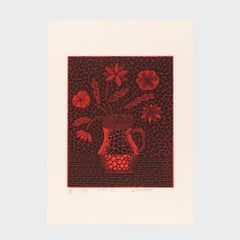
Lithograph Edition 14 of 50 44.6 x 31.7 cm (17.5 x 12.4 in) Signed, numbered, dated and titled on the front Artwork in excellent condition. Minor imperfections may appear due to the ...
Category

1990s Contemporary Henry Maurice Prints and Multiples

Materials

Lithograph

Vase (2)
Vase (2)
$26,733
H 17.56 in W 12.49 in
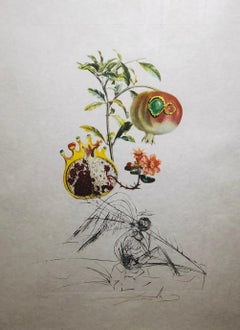
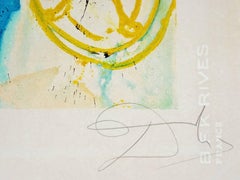
Salvador Dali, "Grenade et l ange from FlorDali - Les Fruits"
By Salvador Dalí­
Located in Chatsworth, CA
This piece was created in 1969 by Salvador Dali, it is a photolithograph of an original gouache painted on printed illustrations with original engraving was created in 1969 by Salvad...
Category

1960s Surrealist Henry Maurice Prints and Multiples

Materials

Lithograph

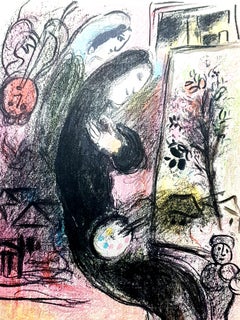
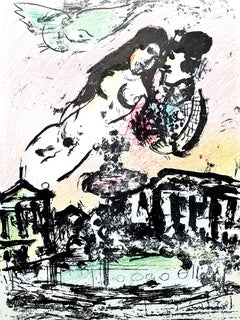
Marc Chagall - Inspiration - Original Lithograph from "Chagall Lithographe" v. 2
By Marc Chagall
Located in Collonge Bellerive, Geneve, CH
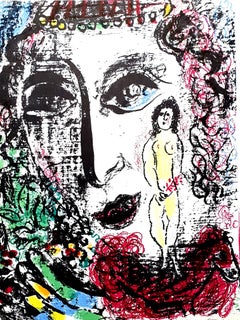
Marc Chagall Original Lithograph from Chagall Lithographe 1957-1962. VOLUME II. 1963 Dimensions: 32 x 24 cm From the unsigned edition of 10000 copies without margins Reference: Mourlot 398 Condition : Excellent Marc Chagall (born in 1887) Marc Chagall was born in Belarus in 1887 and developed an early interest in art. After studying painting, in 1907 he left Russia for Paris, where he lived in an artist colony on the city’s outskirts. Fusing his own personal, dreamlike imagery with hints of the fauvism and cubism popular in France at the time, Chagall created his most lasting work—including I and the Village (1911)—some of which would be featured in the Salon des Indépendants exhibitions. After returning to Vitebsk for a visit in 1914, the outbreak of WWI trapped Chagall in Russia. He returned to France in 1923 but was forced to flee the country and Nazi persecution during WWII. Finding asylum in the U.S., Chagall became involved in set and costume design before returning to France in 1948. In his later years, he experimented with new art forms and was commissioned to produce numerous large-scale works. Chagall died in St.-Paul-de-Vence in 1985. The Village Marc Chagall was born in a small Hassidic community on the outskirts of Vitebsk, Belarus, on July 7, 1887. His father was a fishmonger, and his mother ran a small sundries shop in the village. As a child, Chagall attended the Jewish elementary school, where he studied Hebrew and the Bible, before later attending the Russian public school. He began to learn the fundamentals of drawing during this time, but perhaps more importantly, he absorbed the world around him, storing away the imagery and themes that would feature largely in most of his later work. At age 19 Chagall enrolled at a private, all-Jewish art school and began his formal education in painting, studying briefly with portrait artist Yehuda Pen. However, he left the school after several months, moving to St. Petersburg in 1907 to study at the Imperial Society for the Protection of Fine Arts. The following year, he enrolled at the Svanseva School, studying with set designer Léon Bakst, whose work had been featured in Sergei Diaghilev's Ballets Russes. This early experience would prove important to Chagall’s later career as well. Despite this formal instruction, and the widespread popularity of realism in Russia at the time, Chagall was already establishing his own personal style, which featured a more dreamlike unreality and the people, places and imagery that were close to his heart. Some examples from this period are his Window Vitebsk (1908) and My Fianceé with Black Gloves (1909), which pictured Bella Rosenfeld, to whom he had recently become engaged. The Beehive Despite his romance with Bella, in 1911 an allowance from Russian parliament member and art patron Maxim Binaver enabled Chagall to move to Paris, France. After settling briefly in the Montparnasse neighborhood, Chagall moved further afield to an artist colony known as La Ruche (“The Beehive”), where he began to work side by side with abstract painters such as Amedeo Modigliani and Fernand Léger as well as the avant-garde poet Guillaume Apollinaire. At their urging, and under the influence of the wildly popular fauvism and cubism, Chagall lightened his palette and pushed his style ever further from reality. I and the Village (1911) and Homage to Apollinaire (1912) are among his early Parisian works, widely considered to be his most successful and representative period. Though his work stood stylistically apart from his cubist contemporaries, from 1912 to 1914 Chagall exhibited several paintings at the annual Salon des Indépendants exhibition, where works by the likes of Juan Gris, Marcel Duchamp and Robert Delaunay were causing a stir in the Paris art world. Chagall’s popularity began to spread beyond La Ruche, and in May 1914 he traveled to Berlin to help organize his first solo exhibition, at Der Sturm Gallery. Chagall remained in the city until the highly acclaimed show opened that June. He then returned to Vitebsk, unaware of the fateful events to come. War, Peace and Revolution In August 1914 the outbreak of World War I precluded Chagall’s plans to return to Paris. The conflict did little to stem the flow of his creative output, however, instead merely giving him direct access to the childhood scenes so essential to his work, as seen in paintings such as Jew in Green (1914) and Over Vitebsk (1914). His paintings from this period also occasionally featured images of the war’s impact on the region, as with Wounded Soldier (1914) and Marching (1915). But despite the hardships of life during wartime, this would also prove to be a joyful period for Chagall. In July 1915 he married Bella, and she gave birth to a daughter, Ida, the following year. Their appearance in works such as Birthday (1915), Bella and Ida by the Window (1917) and several of his “Lovers” paintings give a glimpse of the island of domestic bliss that was Chagall’s amidst the chaos. To avoid military service and stay with his new family, Chagall took a position as a clerk in the Ministry of War Economy in St. Petersburg. While there he began work on his autobiography and also immersed himself in the local art scene, befriending novelist Boris Pasternak, among others. He also exhibited his work in the city and soon gained considerable recognition. That notoriety would prove important in the aftermath of the 1917 Russian Revolution when he was appointed as the Commissar of Fine Arts in Vitebsk. In his new post, Chagall undertook various projects in the region, including the 1919 founding of the Academy of the Arts. Despite these endeavors, differences among his colleagues eventually disillusioned Chagall. In 1920 he relinquished his position and moved his family to Moscow, the post-revolution capital of Russia. In Moscow, Chagall was soon commissioned to create sets and costumes for various productions at the Moscow State Yiddish Theater...
Category

1960s Surrealist Henry Maurice Prints and Multiples

Materials

Lithograph

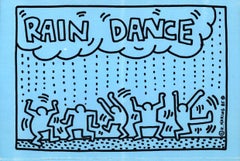
Keith Haring Rain Dance 1985 (Keith Haring posters)
By Keith Haring
Located in NEW YORK, NY
Keith Haring Rain Dance 1985: RARE original 1980s Keith Haring illustrated poster announcement for a legendary Keith Haring UNICEF benefit party at Larry Levan’s Paradise Garage in 1985. An event organized & curated by Keith Haring; with cohosts including Jean-Michel Basquiat, Andy Warhol, Roy Lichtenstein & more. A event organized by Haring on behalf of UNICEF’s African Emergency Relief Fund. Beautifully combines Haring’s trademark kinetic figures set amidst a standout blue and black color-way. Rare. Medium: Offset lithograph in colors on smooth wove paper. 1985. Dimensions: 8.5 x 11 inches (folded open). Fair overall vintage condition. Minor wear to center fold-line; minor separation to the mid far-left edge; surface loss lower left. Otherwise well-preserved. Printed signature, ‘Keith Haring 1985’ on lower right from a scarce edition of unknown. Looks fantastic framed. More on Keith Haring Rain Dance: Curated and organized by Keith Haring, Rain Dance was a 1985 benefit for UNICEF’s African Emergency Relief Fund. Participating artists famously included: Jean-Michel Basquiat, Larry Levan, Fred Brathwaite, Christo, Francesco Clemente, George Condo, Crash, Futura 2000, Jenny Holzer, John Lennon, Roy Lichtenstein, Robert Mapplethorpe, Brice Marden, Robert Morris, Yoko Ono, Lee Quiñones, Robert Rauschenberg, Kenny Scharf, Julian Schnabel, Richard Serra, Cindy Sherman, Tseng Kwong Chi, and Andy Warhol. _ Keith Haring (American, 1958–1990), a Neo-Pop and Graffiti artist, had a short but prolific career centered on a vision to unite “high art,” urban aesthetics, and public spaces using humorous, irreverent, and poignant works. Born in Pennsylvania, Haring attended the Ivy School of Art in Pittsburgh for two years, planning to become a commercial artist. He found this path unsatisfying, and instead chose to study at the School of Visual Arts in New York, where he met fellow artists Jean Michel Basquiat and Kenny Scharf. Haring immersed himself in the culture of the city’s streets and clubs, and, in 1980, began covering the blank billboards on subway station walls with his Subway drawings in chalk. Haring’s bold public art attracted the attention of several galleries, and, by the early 1980s, he was painting Neo-Pop works and large murals full time. In an effort to make his art widely accessible, Haring opened the Pop Shop in 1986 in downtown New York, selling commercial items adorned with his signature, cartoonish imagery. Haring combined graffiti, hip-hop, and urban aesthetics, frequently depicting animals, figures, commercial icons, sexual imagery, and childlike motifs in pieces that were both playful and concerned with social issues. His work became increasingly confrontational following his 1987 diagnosis of AIDS. Haring resolved to work harder than ever in his remaining years, creating pieces with a fervent speed and devoting his art to social action in addition to his personal expression. In 1989, he established the Keith Haring Foundation, whose goal is to promote art programs and public spaces for children, and to raise awareness about AIDS. Haring died on February 16, 1990 in New York at the age of 31. In addition to hundreds of exhibitions held during his lifetime, Haring has been the subject of numerous retrospectives in New York, San Francisco, Paris, Tokyo, Los Angeles and Berlin since his death. Related Categories: Keith Haring posters. Keith Haring activist poster. Keith Haring Dancers. Street art. Graffiti. 1980s. Keith Haring Larry Levan. Keith Haring Paradise Garage...
Category

1980s Contemporary Henry Maurice Prints and Multiples

Materials

Lithograph, Offset

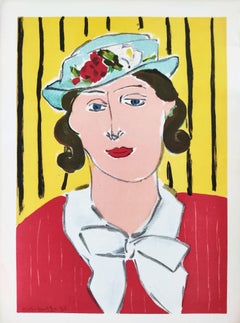
La Femme
By Henri Matisse
Located in OPOLE, PL
Henri Matisse (1869-1954) - La Femme Lithograph from 1939. Dimensions of work: 35.5 x 26.4 cm Publisher: Tériade, Paris. The work is in Excellent condition. Fast and secure ship...
Category

1930s Surrealist Henry Maurice Prints and Multiples

Materials

Lithograph

La Femme
La Femme
$656 Sale Price
20% Off
H 13.98 in W 10.4 in D 0.04 in
Le Cheval de Triomphe
By Salvador Dalí­
Located in OPOLE, PL
Salvador Dali (1904-1989) - Le cheval de triomphe Lithograph from 1970. Edition of 187/254. Dimensions of work: 68 x 50 cm On B.F.K Rives paper as stated in the Field catalogue. ...
Category

1970s Surrealist Henry Maurice Prints and Multiples

Materials

Lithograph

Le Cheval de Triomphe
$5,830
H 26.78 in W 19.69 in D 0.04 in
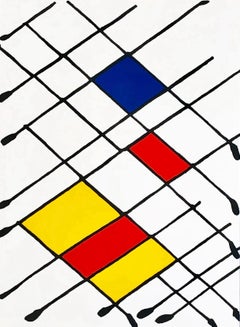
Alexander Calder lithograph 1960s (Calder derriere le miroir)
By Alexander Calder
Located in NEW YORK, NY
Alexander Calder Lithograph c. 1967 from Derrière le miroir: Lithograph in colors; 15 x 11 inches. Very good overall vintage condition; well-preserved. Unsigned from an edition of u...
Category

1960s Contemporary Henry Maurice Prints and Multiples

Materials

Lithograph

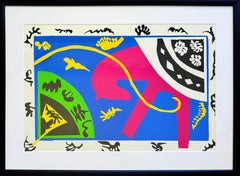
Le cheval, l écuyère et le clown (The Horse, the Equestrienne, and the Clown)
By Henri Matisse
Located in OPOLE, PL
Henri Matisse (1869-1954) - Le cheval, l'écuyère et le clown (The Horse, the Equestrienne, and the Clown) Lithograph from 1983. Dimensions of sheet: 61 x 39 cm Dimensions in frame...
Category

1950s Surrealist Henry Maurice Prints and Multiples

Materials

Lithograph

Marc Chagall - Original Lithograph
By Marc Chagall
Located in Collonge Bellerive, Geneve, CH
Marc Chagall Original Lithograph 1963 Dimensions: 32 x 24 cm Reference: Chagall Lithographe 1957-1962. VOLUME II. Condition : Excellent Marc Chagall (born in 1887) Marc Chagall was born in Belarus in 1887 and developed an early interest in art. After studying painting, in 1907 he left Russia for Paris, where he lived in an artist colony on the city’s outskirts. Fusing his own personal, dreamlike imagery with hints of the fauvism and cubism popular in France at the time, Chagall created his most lasting work—including I and the Village (1911)—some of which would be featured in the Salon des Indépendants exhibitions. After returning to Vitebsk for a visit in 1914, the outbreak of WWI trapped Chagall in Russia. He returned to France in 1923 but was forced to flee the country and Nazi persecution during WWII. Finding asylum in the U.S., Chagall became involved in set and costume design before returning to France in 1948. In his later years, he experimented with new art forms and was commissioned to produce numerous large-scale works. Chagall died in St.-Paul-de-Vence in 1985. The Village Marc Chagall was born in a small Hassidic community on the outskirts of Vitebsk, Belarus, on July 7, 1887. His father was a fishmonger, and his mother ran a small sundries shop in the village. As a child, Chagall attended the Jewish elementary school, where he studied Hebrew and the Bible, before later attending the Russian public school. He began to learn the fundamentals of drawing during this time, but perhaps more importantly, he absorbed the world around him, storing away the imagery and themes that would feature largely in most of his later work. At age 19 Chagall enrolled at a private, all-Jewish art school and began his formal education in painting, studying briefly with portrait artist Yehuda Pen. However, he left the school after several months, moving to St. Petersburg in 1907 to study at the Imperial Society for the Protection of Fine Arts. The following year, he enrolled at the Svanseva School, studying with set designer Léon Bakst, whose work had been featured in Sergei Diaghilev's Ballets Russes. This early experience would prove important to Chagall’s later career as well. Despite this formal instruction, and the widespread popularity of realism in Russia at the time, Chagall was already establishing his own personal style, which featured a more dreamlike unreality and the people, places and imagery that were close to his heart. Some examples from this period are his Window Vitebsk (1908) and My Fianceé with Black Gloves (1909), which pictured Bella Rosenfeld, to whom he had recently become engaged. The Beehive Despite his romance with Bella, in 1911 an allowance from Russian parliament member and art patron Maxim Binaver enabled Chagall to move to Paris, France. After settling briefly in the Montparnasse neighborhood, Chagall moved further afield to an artist colony known as La Ruche (“The Beehive”), where he began to work side by side with abstract painters such as Amedeo Modigliani and Fernand Léger as well as the avant-garde poet Guillaume Apollinaire. At their urging, and under the influence of the wildly popular fauvism and cubism, Chagall lightened his palette and pushed his style ever further from reality. I and the Village (1911) and Homage to Apollinaire (1912) are among his early Parisian works, widely considered to be his most successful and representative period. Though his work stood stylistically apart from his cubist contemporaries, from 1912 to 1914 Chagall exhibited several paintings at the annual Salon des Indépendants exhibition, where works by the likes of Juan Gris, Marcel Duchamp and Robert Delaunay were causing a stir in the Paris art world. Chagall’s popularity began to spread beyond La Ruche, and in May 1914 he traveled to Berlin to help organize his first solo exhibition, at Der Sturm Gallery. Chagall remained in the city until the highly acclaimed show opened that June. He then returned to Vitebsk, unaware of the fateful events to come. War, Peace and Revolution In August 1914 the outbreak of World War I precluded Chagall’s plans to return to Paris. The conflict did little to stem the flow of his creative output, however, instead merely giving him direct access to the childhood scenes so essential to his work, as seen in paintings such as Jew in Green (1914) and Over Vitebsk (1914). His paintings from this period also occasionally featured images of the war’s impact on the region, as with Wounded Soldier (1914) and Marching (1915). But despite the hardships of life during wartime, this would also prove to be a joyful period for Chagall. In July 1915 he married Bella, and she gave birth to a daughter, Ida, the following year. Their appearance in works such as Birthday (1915), Bella and Ida by the Window (1917) and several of his “Lovers” paintings give a glimpse of the island of domestic bliss that was Chagall’s amidst the chaos. To avoid military service and stay with his new family, Chagall took a position as a clerk in the Ministry of War Economy in St. Petersburg. While there he began work on his autobiography and also immersed himself in the local art scene, befriending novelist Boris Pasternak, among others. He also exhibited his work in the city and soon gained considerable recognition. That notoriety would prove important in the aftermath of the 1917 Russian Revolution when he was appointed as the Commissar of Fine Arts in Vitebsk. In his new post, Chagall undertook various projects in the region, including the 1919 founding of the Academy of the Arts. Despite these endeavors, differences among his colleagues eventually disillusioned Chagall. In 1920 he relinquished his position and moved his family to Moscow, the post-revolution capital of Russia. In Moscow, Chagall was soon commissioned to create sets and costumes for various productions at the Moscow State Yiddish Theater...
Category

1960s Surrealist Henry Maurice Prints and Multiples

Materials

Lithograph

Marc Chagall - Original Lithograph
$1,487
H 9.45 in W 12.6 in D 0.04 in
Vitraux in Four Sheets Royal Insect
By Salvador Dalí­
Located in Hollywood, FL
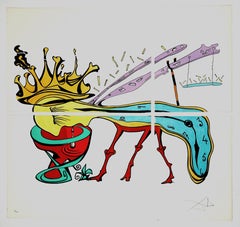
ARTIST: Salvador Dali TITLE: Vitraux in Four Sheets Royal Insect MEDIUM: 4 Lithographs SIGNED: 1 Lithograph is Hand Signed by Salvador Dali EDITION NUMBER: 1 lithograph is numbe...
Category

1970s Surrealist Henry Maurice Prints and Multiples

Materials

Lithograph

Marc Chagall - Original Lithograph
By Marc Chagall
Located in Collonge Bellerive, Geneve, CH
Marc Chagall Original Lithograph 1963 Dimensions: 32 x 24 cm Reference: Chagall Lithographe 1957-1962. VOLUME II. Condition : Excellent Marc Chagall (born in 1887) Marc Chagall was born in Belarus in 1887 and developed an early interest in art. After studying painting, in 1907 he left Russia for Paris, where he lived in an artist colony on the city’s outskirts. Fusing his own personal, dreamlike imagery with hints of the fauvism and cubism popular in France at the time, Chagall created his most lasting work—including I and the Village (1911)—some of which would be featured in the Salon des Indépendants exhibitions. After returning to Vitebsk for a visit in 1914, the outbreak of WWI trapped Chagall in Russia. He returned to France in 1923 but was forced to flee the country and Nazi persecution during WWII. Finding asylum in the U.S., Chagall became involved in set and costume design before returning to France in 1948. In his later years, he experimented with new art forms and was commissioned to produce numerous large-scale works. Chagall died in St.-Paul-de-Vence in 1985. The Village Marc Chagall was born in a small Hassidic community on the outskirts of Vitebsk, Belarus, on July 7, 1887. His father was a fishmonger, and his mother ran a small sundries shop in the village. As a child, Chagall attended the Jewish elementary school, where he studied Hebrew and the Bible, before later attending the Russian public school. He began to learn the fundamentals of drawing during this time, but perhaps more importantly, he absorbed the world around him, storing away the imagery and themes that would feature largely in most of his later work. At age 19 Chagall enrolled at a private, all-Jewish art school and began his formal education in painting, studying briefly with portrait artist Yehuda Pen. However, he left the school after several months, moving to St. Petersburg in 1907 to study at the Imperial Society for the Protection of Fine Arts. The following year, he enrolled at the Svanseva School, studying with set designer Léon Bakst, whose work had been featured in Sergei Diaghilev's Ballets Russes. This early experience would prove important to Chagall’s later career as well. Despite this formal instruction, and the widespread popularity of realism in Russia at the time, Chagall was already establishing his own personal style, which featured a more dreamlike unreality and the people, places and imagery that were close to his heart. Some examples from this period are his Window Vitebsk (1908) and My Fianceé with Black Gloves (1909), which pictured Bella Rosenfeld, to whom he had recently become engaged. The Beehive Despite his romance with Bella, in 1911 an allowance from Russian parliament member and art patron Maxim Binaver enabled Chagall to move to Paris, France. After settling briefly in the Montparnasse neighborhood, Chagall moved further afield to an artist colony known as La Ruche (“The Beehive”), where he began to work side by side with abstract painters such as Amedeo Modigliani and Fernand Léger as well as the avant-garde poet Guillaume Apollinaire. At their urging, and under the influence of the wildly popular fauvism and cubism, Chagall lightened his palette and pushed his style ever further from reality. I and the Village (1911) and Homage to Apollinaire (1912) are among his early Parisian works, widely considered to be his most successful and representative period. Though his work stood stylistically apart from his cubist contemporaries, from 1912 to 1914 Chagall exhibited several paintings at the annual Salon des Indépendants exhibition, where works by the likes of Juan Gris, Marcel Duchamp and Robert Delaunay were causing a stir in the Paris art world. Chagall’s popularity began to spread beyond La Ruche, and in May 1914 he traveled to Berlin to help organize his first solo exhibition, at Der Sturm Gallery. Chagall remained in the city until the highly acclaimed show opened that June. He then returned to Vitebsk, unaware of the fateful events to come. War, Peace and Revolution In August 1914 the outbreak of World War I precluded Chagall’s plans to return to Paris. The conflict did little to stem the flow of his creative output, however, instead merely giving him direct access to the childhood scenes so essential to his work, as seen in paintings such as Jew in Green (1914) and Over Vitebsk (1914). His paintings from this period also occasionally featured images of the war’s impact on the region, as with Wounded Soldier (1914) and Marching (1915). But despite the hardships of life during wartime, this would also prove to be a joyful period for Chagall. In July 1915 he married Bella, and she gave birth to a daughter, Ida, the following year. Their appearance in works such as Birthday (1915), Bella and Ida by the Window (1917) and several of his “Lovers” paintings give a glimpse of the island of domestic bliss that was Chagall’s amidst the chaos. To avoid military service and stay with his new family, Chagall took a position as a clerk in the Ministry of War Economy in St. Petersburg. While there he began work on his autobiography and also immersed himself in the local art scene, befriending novelist Boris Pasternak, among others. He also exhibited his work in the city and soon gained considerable recognition. That notoriety would prove important in the aftermath of the 1917 Russian Revolution when he was appointed as the Commissar of Fine Arts in Vitebsk. In his new post, Chagall undertook various projects in the region, including the 1919 founding of the Academy of the Arts. Despite these endeavors, differences among his colleagues eventually disillusioned Chagall. In 1920 he relinquished his position and moved his family to Moscow, the post-revolution capital of Russia. In Moscow, Chagall was soon commissioned to create sets and costumes for various productions at the Moscow State Yiddish Theater...
Category

1960s Surrealist Henry Maurice Prints and Multiples

Materials

Lithograph

Marc Chagall - Original Lithograph
$1,487
H 9.45 in W 12.6 in D 0.04 in
Previously Available Items
Abstract Composition - Lithograph by Henry Maurice - 1970s
By Henry Maurice
Located in Roma, IT
Abstract  Composition is a colored lithograph on paper, realized in the 1970s by Henry Maurice. Hand-signed on the lower. Numbered, edition of 60/100 editions. A beautiful artwork...
Category

1970s Contemporary Henry Maurice Prints and Multiples

Materials

Lithograph

Dubo - Original Lithograph by Henry Maurice - 1970s
By Henry Maurice
Located in Roma, IT
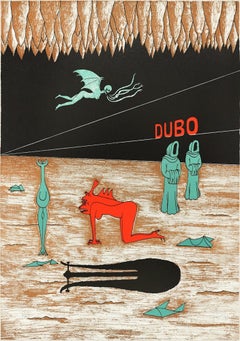
Dubo is a wonderful colored lithograph on paper, realized in Seventies of XX century by the French artist, Henry Maurice, published by La Nuova Foglio, the publishing house of Macerata. Hand-signed and numbered in pencil on lower margin. Edition of 100 prints. This contemporary artwork representing monsters in a surreal scene and in a futuristic world is in excellent conditions. Maurice Henry...
Category

1970s Surrealist Henry Maurice Prints and Multiples

Materials

Lithograph

Extraterrestrial Fantasy - Original Lithograph by Henry Maurice - 1973
By Henry Maurice
Located in Roma, IT
Extraterrestrial Fantasy is a wonderful colored lithograph on paper, realized in 1973 by the French artist, Henry Maurice, published by La Nuova Foglio, the publishing house of Macerata. Hand-signed and numbered in pencil on lower right margin. Edition of 100 prints. This contemporary artwork representing three extraterrestrial guardians at the entrance of a futuristic world is in excellent conditions. Maurice Henry...
Category

1970s Surrealist Henry Maurice Prints and Multiples

Materials

Lithograph

Henry Maurice prints and multiples for sale on 1stDibs.

Find a wide variety of authentic Henry Maurice prints and multiples available for sale on 1stDibs. You can also browse by medium to find art by Henry Maurice in lithograph and more. Much of the original work by this artist or collective was created during the 1970s and is mostly associated with the Surrealist style. Not every interior allows for large Henry Maurice prints and multiples, so small editions measuring 20 inches across are available. Customers who are interested in this artist might also find the work of Mayo (Antoine Malliarakis), Francis de Saint-Genies, and Hanna Kay. Henry Maurice prints and multiples prices can differ depending upon medium, time period and other attributes. On 1stDibs, the price for these items starts at $226 and tops out at $323, while the average work can sell for $279.