Henry Moore Landscape Prints

British, 1898-1986

Henry Spencer Moore OM CH FBA was an English artist. He is best known for his semi-abstract monumental bronze sculptures, which are located around the world as public works of art. As well as sculpture, Moore produced many drawings, including a series depicting Londoners sheltering from the Blitz during the Second World War, along with other prints and graphic works on paper.

His forms are usually abstractions of the human figure, typically depicting mother-and-child or reclining figures. Moore's works are usually suggestive of the female body, apart from a phase in the 1950s when he sculpted family groups. His forms are generally pierced or contain hollow spaces. Many interpreters liken the undulating form of his reclining figures to the landscape and hills of his Yorkshire birthplace.

Moore became well known through his carved marble and larger-scale abstract cast bronze sculptures, and was instrumental in introducing a particular form of modernism to the United Kingdom. His ability in later life to fulfil large-scale commissions made him exceptionally wealthy. Despite this, he lived frugally; most of the money he earned went toward endowing the Henry Moore Foundation, which continues to support education and promotion of the arts.

Find original Henry Moore art on 1stDibs.

to
5
2
12
Overall Width
to
Overall Height
to
11
1
130
180
169
142
131
14
1
1
1
12
2
3
3
2
1
1
1
1
14
14
Artist: Henry Moore
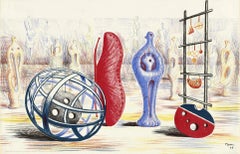
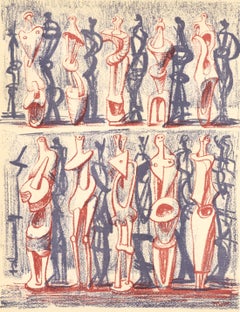
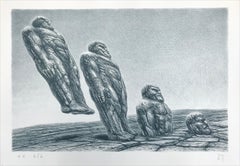
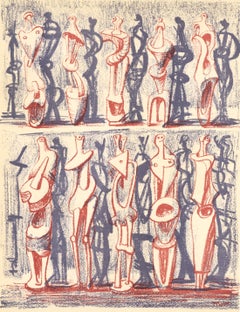
Henry Moore, Red and Blue Standing Figures, from XXe Siecle, 1951
By Henry Moore
Located in Southampton, NY
This exquisite lithograph by Henry Moore (1898–1986), titled Red and Blue Standing Figures, from the album XXe Siecle, Nouvelle serie, No. 1, 1951, originates from the 1951 edition p...
Category

1950s Modern Henry Moore Landscape Prints

Materials

Lithograph

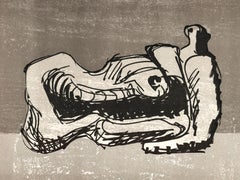
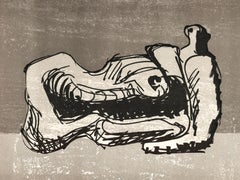
Henry Moore, Reclining Figure, from San Lazzaro et ses Amis, 1975
By Henry Moore
Located in Southampton, NY
This exquisite lithograph by Henry Moore (1898–1986), titled Reclining Figure, from the album San Lazzaro et ses Amis, Hommage au fondateur de la revue XXe siecle (San Lazzaro and His Friends, Tribute to the Founder of the Journal XXe Siecle), originates from the 1975 edition published by XXe siecle, Paris, and printed by Curwen Studio, London, October 1975. Reclining Figure embodies Moore’s lifelong fascination with the human form in repose—a theme that became central to his sculptural and graphic work. Through elegant contours and balanced abstraction, the composition captures the harmony between body, landscape, and spirit that defined Moore’s artistic vision. Executed as a lithograph on velin d'Arches paper, this work measures 10.5 x 14 inches (26.67 x 35.56 cm). Unsigned and unnumbered as issued. The edition exemplifies the exceptional craftsmanship of the Curwen Studio in London, a distinguished atelier celebrated for its collaborations with the leading modern artists of the postwar period. Artwork Details: Artist: Henry Moore (1898–1986) Title: Reclining Figure, from San Lazzaro et ses Amis, Hommage au fondateur de la revue XXe siecle, 1975 Medium: Lithograph on velin d'Arches paper Dimensions: 10.5 x 14 inches (26.67 x 35.56 cm) Inscription: Unsigned and unnumbered as issued Date: 1975 Publisher: XXe siecle, Paris Printer: Curwen Studio, London Catalogue raisonne references: Moore, Henry, et al. Henry Moore, Catalogue of Graphic Work. Gerald Cramer, 1986, illustration 366. Condition: Well preserved, consistent with age and medium Provenance: From the album San Lazzaro et ses Amis, Hommage au fondateur de la revue XXe siecle, published by XXe siecle, Paris, October 1975 Notes: Excerpted from the folio (translated from French), Finished printing in Paris in October 1975. This album has been printed on velin d'Arches in DLXXV numbered examples. The LXXV original examples include a series of VIII original lithographs, signed and numbered by the artists. In addition, LV examples were printed for artists, authors, friends and collaborators of XXe siecle. The typography is from l'Imprimerie Union in Paris; the lithographs of Max Bill, Marc Chagall, Hans Hartung, Braque, Fontana, Magnelli, Picasso, Magritte and Poliakoff were printed by Fernand Mourlot in Paris; those of Alexander Calder and Joan Miro by l'imprimerie Arte in Paris; that of Max Ernst by Pierre Chave in Vence; that of Zao Wou-Ki by ateliers Bellin in Paris; and that of Henry Moore by the Curwen Studio in London. About the Publication: San Lazzaro et ses Amis, Hommage au fondateur de la revue XXe siecle (San Lazzaro and His Friends, Tribute to the Founder of the Journal XXe Siecle), published in 1975 by XXe siecle, Paris, represents one of the most significant collaborative tributes in modern art publishing. Created in honor of Gualtieri di San Lazzaro, the visionary editor and founder of the journal XXe Siecle, the folio unites original lithographs by the greatest modern masters—Picasso, Chagall, Miro, Calder, Hartung, Moore, and others. Printed by premier ateliers such as Mourlot, Arte, Bellin, and Curwen, the portfolio celebrates the spirit of artistic collaboration and innovation that defined mid-20th-century modernism. About the Artist: Henry Moore (1898–1986) was a British sculptor, draftsman, and modernist pioneer whose monumental bronzes and organic abstractions revolutionized 20th-century sculpture and made him one of the most influential artists of his time. Renowned for his reclining figures, mother-and-child compositions, and pierced biomorphic forms inspired by nature, Moore transformed traditional carving into a universal language of rhythm, balance, and humanity. Born in Castleford, Yorkshire, he studied at the Leeds School of Art and the Royal College of Art in London, absorbing the influences of classical sculpture, African and Pre-Columbian art, and the radical innovations of the European avant-garde. Inspired by Pablo Picasso’s Cubist fragmentation of form, Joan Miro’s lyrical biomorphism, Wassily Kandinsky’s spiritual abstraction, and Constantin Brancusi’s purity of shape, Moore developed a style rooted in the harmony between mass and void, structure and space. During the interwar years, he became part of an international circle that included Alexander Calder, Alberto Giacometti, Salvador Dali, Marcel Duchamp, and Man Ray—artists who, like Moore, expanded art’s boundaries through abstraction, surrealism, and conceptual experimentation. Like Calder, Moore explored balance and movement; like Giacometti, he sought the spiritual essence of humanity; and like Dali and Duchamp, he challenged perception and redefined modern form. His sculptures, carved in stone or cast in bronze, evoke both ancient and modern sensibilities—forms that appear to breathe with natural vitality while engaging directly with their surrounding landscapes. Moore’s “Shelter Drawings” (1940–41), created during the London Blitz, revealed his deep empathy for the human condition, marking a pivotal moment in his exploration of resilience and vulnerability. By the mid-20th century, Moore’s monumental bronzes had become landmarks around the world, from the Lincoln Center in New York to the UNESCO headquarters in Paris, embodying timeless symbols of endurance, renewal, and unity. His synthesis of organic abstraction and humanism influenced generations of sculptors including Barbara Hepworth, Isamu Noguchi, Eduardo Paolozzi, Antony Gormley, Anish Kapoor, and Rachel Whiteread. Like Kandinsky and Miro, he believed abstraction could transcend culture and time, while like Duchamp and Man Ray, he embraced experimentation as a pathway to new truths. Moore’s works, housed in major collections including the Museum of Modern Art in New York, the Tate in London, the Guggenheim Museum, and the Art Institute of Chicago, continue to define the landscape of modern sculpture for their elegance, power, and emotional depth. Standing alongside Pablo Picasso, Alexander Calder, Alberto Giacometti, Salvador Dali, Joan Miro, Wassily Kandinsky, Marcel Duchamp, and Man Ray, Henry Moore remains a cornerstone of modern art—a sculptor whose vision united nature, form, and spirit into a universal language of beauty and meaning. His highest auction record was achieved by Reclining Figure: Festival (1951), which sold for $33.1 million USD at Christie’s, London, on June 30, 2016, reaffirming Henry Moore’s enduring legacy as one of the most visionary, influential, and collectible sculptors in the history of modern art. Henry Moore Reclining Figure...
Category

1970s Surrealist Henry Moore Landscape Prints

Materials

Lithograph

Sculptural Objects, School Prints, Henry Moore
By Henry Moore
Located in Southampton, NY
Lithograph on English cartridge paper. Inscription: Unsigned and unnumbered, as issued. Good Condition; never framed or matted. Notes: Published by School Prints Ltd., London; Printe...
Category

1940s Modern Henry Moore Landscape Prints

Materials

Lithograph

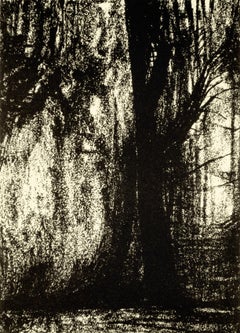
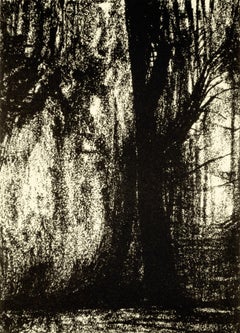
The Forest Henry Moore drawing of Yorkshire landscape for W.H. Auden poetry book
By Henry Moore
Located in New York, NY
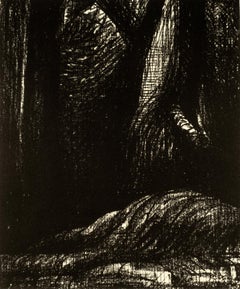
One of a series of 18 lithographs drawn by the artist for the Auden Poems/Moore Lithographs 1974 book and portfolio. This work is from an edition of 25 printed on vellum aside from t...
Category

Late 20th Century Modern Henry Moore Landscape Prints

Materials

Lithograph

Windswept Landscape Henry Moore drawing of Scottish landscape for W.H. Auden
By Henry Moore
Located in New York, NY
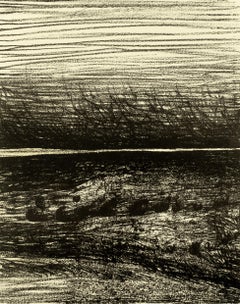
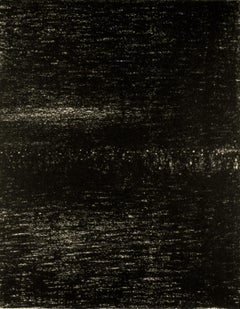
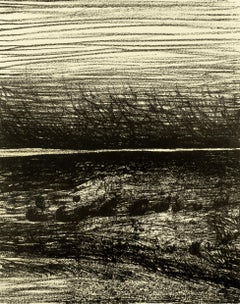
One of a series of 18 lithographs drawn by the artist fo¬r the Auden Poems/Moore Lithographs 1974 book and portfolio. This work is from an edition of 25 printed on vellum aside from the portfolio (edition of 75) and the book. Signed by the artist lower right in pencil; numbered lower left in pencil. Printed in inky black, this print features a shadowy landscape. Brush sweeps to the left, and the sky is drawn with long horizontal lines. In the bottom half of the composition, the ground looks rocky, perhaps dotted with shrubs. Windswept Landscape displays Moore’s fascination with light and dark – what he called a “…bias towards the blackness and mysterious depths.” Moore was inspired by the prints of Rembrandt and the drawings of Seurat, and even drew on his memories of viewing the Altamira cave paintings, recalling how some of the images used the shadow of candlelight on the rough surface of the rock to model light. Shortly before starting work on this series of lithographs, Moore had fallen ill, leaving him aware of his own mortality. His mood pervaded these prints with a sense of danger and foreboding. The Auden/Moore limited edition book and portfolio were exhibited on publication at the British Museum, London, with an accompanying catalogue. Windswept Landscape is one of a group of lithographs...
Category

Late 20th Century Modern Henry Moore Landscape Prints

Materials

Lithograph

Lullaby: Sleeping Head
By Henry Moore
Located in New York, NY
Paper: 25.25 x 20.5 in. / 64.1 X 52 cm. Image: 10.75 x 11.5 in / 27.3 x 29.2 cm. One of a series of 18 lithographs drawn by the artist for the Auden Poems/Moore Lithographs 1974 bo...
Category

Late 20th Century Modern Henry Moore Landscape Prints

Materials

Lithograph

Sketches of Auden: black drawing based on Auden poetry and Yorkshire landscape
By Henry Moore
Located in New York, NY
This black and white portrait drawing is one of a series of 18 lithographs drawn by the artist for the Auden Poems/Moore Lithographs 1974 book and portfolio. This work is from an edition of 25 printed on vellum aside from the portfolio (edition of 75) and the book. Signed by the artist and numbered 8/25 lower right in pencil. This print features a pair of sketches...
Category

Late 20th Century Modern Henry Moore Landscape Prints

Materials

Lithograph

Lullaby Sketches: black white drawing based on Auden poetry and Yorkshire lands
By Henry Moore
Located in New York, NY
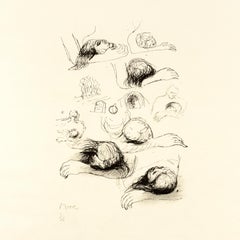
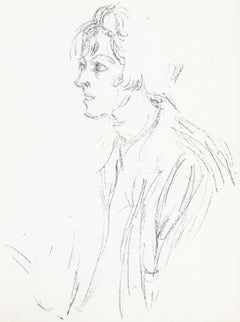
One of a series of 18 lithographs drawn by the artist for the Auden Poems/Moore Lithographs 1974 book and portfolio. This work is from an edition of 25 printed on vellum aside from the portfolio (edition of 75) and the book. Signed by the artist and numbered 1/25 lower left in pencil. This print features small sketches of heads resting on forearms. Moore experimented with different angles, appearing to practice for the composition for Lullaby: Sleeping Head, which depicts a shadowy figure supporting the head of a sleeping woman. Lullaby: Sketches is a rare window into Moore’s process of composing an image. Delicate, single-line arms and hair reveal the sculptor’s equal talent as a draftsman. The imagery for Lullaby Sketches was inspired by Auden’s poem Lullaby. Lullaby was the first poem Moore read for this project, which begins: “Lay your sleeping head, my love / Human on my faithless arm; / Time and fevers burn away Individual beauty from / Thoughtful children, and the grave / Proves the child ephemeral: / But in my arms till break of day / Let the living creature lie, / Mortal, guilty, but to me / The entirely beautiful.” The Auden/Moore limited edition book and portfolio were exhibited on publication at the British Museum, London, with an accompanying catalogue. Lullaby Sketches is one of a group of lithographs...
Category

Late 20th Century Modern Henry Moore Landscape Prints

Materials

Lithograph

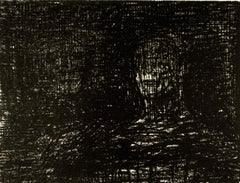
Thin-lipped Armourer I: W. H. Auden poetry with Henry Moore, Yorkshire landscape
By Henry Moore
Located in New York, NY
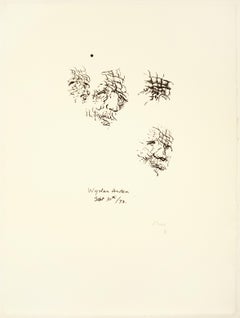
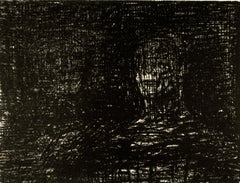
This darkly-shaded portrait of two figures is one of a series of 18 lithographs drawn by the artist for the Auden Poems/Moore Lithographs 1974 book and portfolio. This work is from an edition of 25 printed on vellum aside from the portfolio (edition of 75) and the book. Signed by the artist lower right in pencil; numbered lower left in pencil. Printed in inky black, Thin-lipped Armourer features two figures subsumed in crosshatched shadow. The figure on the left can barely be seen, and the hollows of his eyes recall a skull. Numerous Moore prints from this series include two heads, perhaps relating to the first lines of Auden’s poem Lullaby. Lullaby was the first poem Moore read for this project, which begins: “Lay your sleeping head, my love / Human on my faithless arm; / Time and fevers burn away Individual beauty from / Thoughtful children, and the grave / Proves the child ephemeral: / But in my arms till break of day / Let the living creature lie, / Mortal, guilty, but to me / The entirely beautiful.” This print evinces Moore’s fascination with light and dark – what he called a “…bias towards the blackness and mysterious depths.” Moore was inspired by the prints of Rembrandt and the drawings of Seurat, and even drew on his memories of viewing the Altamira cave paintings, recalling how some of the images used the shadow of candlelight on the rough surface of the rock to model light. Shortly before starting work on this series of lithographs, Moore had fallen ill, leaving him aware of his own mortality. His mood pervaded these prints with a sense of danger and foreboding. The Auden/Moore limited edition book and portfolio were exhibited on publication at the British Museum, London, with an accompanying catalogue. Thin-lipped Armourer I is one of a group of lithographs...
Category

Late 20th Century Modern Henry Moore Landscape Prints

Materials

Lithograph

Fjord by Henry Moore drawing of Scottish landscape for W.H. Auden poetry book
By Henry Moore
Located in New York, NY
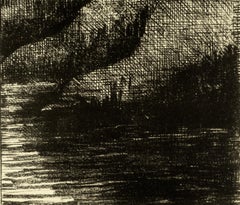
One of a series of 18 lithographs drawn by the artist for the Auden Poems/Moore Lithographs 1974 book and portfolio. This work is from an edition of 25 printed on vellum aside from the portfolio (edition of 75) and the book. Signed by the artist lower right in pencil; numbered 8/25 lower left in pencil. Printed in inky black, Fjord features a close-up view of the water as it meets the shore. Yorkshire is famous for its rocky coastline, where fishing villages cling to cliffs, windswept abbeys peak above the skyline, and sand beaches attract families on vacation. Moore’s scene is dark and even sinister – the shore’s narrow inlets reaching into the water like gnarled fingers. Fjord displays Moore’s fascination with light and dark – what he called a “…bias towards the blackness and mysterious depths.” Moore was inspired by the prints of Rembrandt and the drawings of Seurat, and even drew on his memories of viewing the Altamira cave paintings, recalling how some of the images used the shadow of candlelight on the rough surface of the rock to model light. Shortly before starting work on this series of lithographs, Moore had fallen ill, leaving him aware of his own mortality. His mood pervaded these prints with a sense of danger and foreboding. Fjord is one of a group of lithographs...
Category

Late 20th Century Henry Moore Landscape Prints

Materials

Lithograph

Bridge: abstract black drawing based on Auden poetry and Yorkshire landscape
By Henry Moore
Located in New York, NY
One of a series of 18 lithographs drawn by the artist for the Auden Poems/Moore Lithographs 1974 book and portfolio. This work is from an edition of 25 printed on vellum aside from t...
Category

Late 20th Century Modern Henry Moore Landscape Prints

Materials

Lithograph

The Cavern: abstract black drawing based on Auden poetry and Yorkshire landscape
By Henry Moore
Located in New York, NY
One of a series of 18 lithographs drawn by the artist for the Auden Poems/Moore Lithographs 1974 book and portfolio. This work is from an edition of 25 printed on vellum aside from t...
Category

Late 20th Century Modern Henry Moore Landscape Prints

Materials

Lithograph

Multitude II Henry Moore yorkshire landscape black and white abstract drawing
By Henry Moore
Located in New York, NY
One of a series of 18 lithographs drawn by the artist for the Auden Poems/Moore Lithographs 1974 book and portfolio. This work is from an edition of 25 printed on vellum aside from t...
Category

Late 20th Century Henry Moore Landscape Prints

Materials

Lithograph

Split Stone: abstract drawing based on Auden poetry and Yorkshire landscape
By Henry Moore
Located in New York, NY
This abstract, black and white drawing is one of a series of 18 lithographs drawn by the artist for the Auden Poems/Moore Lithographs 1974 book and portfolio. This work is from an ed...
Category

Late 20th Century Modern Henry Moore Landscape Prints

Materials

Lithograph

Related Items
Ladder
By Fanny Brennan
Located in New York, NY
Created by Surrealist Fanny Brennan from 1992-96, Ladder is a lithograph in colors on wove paper. Hand-monogrammed in pencil and numbered from the edition of 250, the artwork measure...
Category

Late 20th Century Surrealist Henry Moore Landscape Prints

Materials

Lithograph

Les Montgolfieres, Place de la Concorde, Paris
By Fanch (Francois Ledan)
Located in San Francisco, CA
This artwork titled "Les Montgolfieres, Place de la Concorde, Paris" 1987 is a original colors lithograph on Arches paper by French artist (Fanch, Francois Ledan, born 1949) It is hand signed and numbered 67/250 in pencil by the artist. The image size is 25.25 x 19.5 inches, framed is 37.25 x 31.25 inches. Printed by Atelier d'Art Dejobert, Paris, with their blind stamp at the lower left corner. Custom framed in a wooden gold frame, with off white matting. It is in excellent condition. About the artist: Francois "Fanch" Ledan (b. 1949) is noted for colorful scenes of his native Brittany. In 1968 he abandoned his studies in commercial design for full-time studies in painting and fine art. His talent was quickly recognized and soon he was involved in major European shows. He became involved in printmaking in 1973 when he learned lithography in Paris. Since then he has had numerous one-person shows in Europe, North America and South America. His paintings and lithographs from the 1970's and 1980's display characteristics often associated with "naïve" art. His views of Paris, a city which has embraced naïve art, display the attention to detail, In the 80's he turned to more brightly colored paintings and again a connection to Impressionism. He began to work on paintings that he refers to as "interior...
Category

Late 20th Century Modern Henry Moore Landscape Prints

Materials

Lithograph

Walking in Snowy Winter - Lithograph After Utagawa Hiroshige - Mid 20th Century
By Utagawa Hiroshige
Located in Roma, IT
Walking in Snowy Winter is a modern print realized in the Mid-20th Century. Mixed colored lithograph after a woodcut realized by the great Japanese artist Utagawa Hiroshige in the 1...
Category

Mid-20th Century Modern Henry Moore Landscape Prints

Materials

Lithograph

Boatmen-Eight Scenic Spots Along Sumida River After U. Hiroshige-20th Century
By Utagawa Hiroshige
Located in Roma, IT
Boatmen - Eight Scenic Spots Along Sumida River is a modern print realized in the Mid-20th Century. Mixed colored lithograph after a woodcut realized by the great Japanese artist Ut...
Category

Mid-20th Century Modern Henry Moore Landscape Prints

Materials

Lithograph

1975 Andrew Dasburg Color Lithograph, "Trees in Ranchitos II" Taos Modernist
By Andrew Michael Dasburg
Located in Denver, CO
"Trees in Ranchitos II" is a striking 1975 color lithograph by acclaimed modernist artist Andrew Michael Dasburg (1887–1979). This collectible artwork, initialed in the lower right, beautifully captures the serene landscapes of New Mexico, reflecting Dasburg’s signature fusion of Post-Impressionism and Cubist influences. The composition conveys the tranquil rhythm of trees and desert terrain, combining geometric abstraction with lyrical naturalism. The lithograph is presented in a custom frame measuring 30 ½ x 36 ¼ inches, with an image size of 16 ½ x 23 ¼ inches, making it a sophisticated and visually compelling addition to any collection of Taos Modernist art, American modernism, or Southwestern landscape prints. About Andrew Michael Dasburg (1887–1979): Born in Paris, France, Dasburg immigrated to New York City in 1892, where his early talent was recognized. He trained at the Art Students League of New York under notable instructors including Robert Henri, Kenyon Cox, and Birge Harrison. In 1908, he returned to Paris and encountered the works of Henri Matisse and Paul Cézanne, experiences that ignited his lifelong commitment to modernism. After settling in Woodstock, NY, Dasburg immersed himself in the avant-garde scene, collaborating with Morgan Russell...
Category

1970s American Modern Henry Moore Landscape Prints

Materials

Lithograph

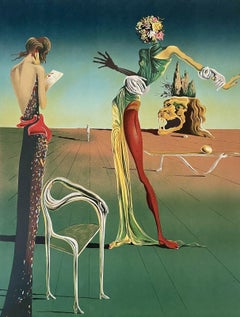
Dali, Femme à tete de Roses (after)
By Salvador Dalí­
Located in Fairfield, CT
Artist: Salvador Dali (1904-1989) Title: Femme à tete de Roses Year: 2004 Medium: Lithograph on wove paper Size: 30.25 x 22 inches Condition: Excellent Inscription: Unsigned and unnu...
Category

Early 2000s Surrealist Henry Moore Landscape Prints

Materials

Lithograph

Dali, Femme à tete de Roses (after)
$2,360 Sale Price
20% Off
H 30.25 in W 22 in
Drue
By Leonora Carrington
Located in Columbia, MO
Leonora Carrington (British-Mexican 1917 - 2011) was a painter, writer, and key figure in Surrealism whose work explored the sacred, the mystical, and the magical in everyday life. B...
Category

20th Century Surrealist Henry Moore Landscape Prints

Materials

Lithograph

Drue
Drue
$15,000
H 44 in W 36.5 in
Incandescent City
By Richard Florsheim
Located in New York, NY
Richard Florsheim created this color lithograph entitled “Incandescent City” in 1960 in an edition of 35 pieces. This impression is signed and inscribed “34/35.” It is in good condit...
Category

1960s American Modern Henry Moore Landscape Prints

Materials

Lithograph

Incandescent City
Incandescent City
$335
H 26 in W 20 in D 0.97 in
Alexander Calder, Black and Red Form, from Derriere le Miroir, 1973
By Alexander Calder
Located in Southampton, NY
This exquisite lithograph by Alexander Calder (1898–1976), titled Formulaire noir et rouge (Black and Red Form), originates from the historic 1973 folio Derriere le Miroir, No. 201. ...
Category

1970s Modern Henry Moore Landscape Prints

Materials

Lithograph

Eduardo Chillida, Untitled, from Derriere le Miroir, 1961
By Eduardo Chillida
Located in Southampton, NY
This exquisite lithograph by Eduardo Chillida (1924–2002), titled Sans titre (Untitled), originates from the historic 1961 folio Derriere le Miroir, No. 124. Published by Maeght Edit...
Category

1960s Modern Henry Moore Landscape Prints

Materials

Lithograph

Three Lovely Kozo Inoue Pastel Prints, 1980s
By Kozo Inoue
Located in New York, NY
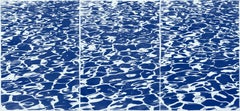
Kozo Inoue (Japanese, 1937-2017) Untitled, 1980 Lithograph Sight: 22 x 31 in. (Each) Framed: 34 x 42 1/2 x 1 in. (Each) Signed and dated 1980 lower right Inscribed lower left Kozo Inoue was a contemporary Japanese printmaker. Born in Osaka, he graduated from the Department of Art History at Keio University in 1960. During life, he worked during the winter months in the Izu Peninsula and Dordogne or Paris in the summer. He is known for his surrealistic silkscreen prints. His prints can be found in the Museum of Modern Art, Paris, Royal Library of Belgium, Modern Museum of Art Osaka and the Spencer Museum of Art, to name just a few. (Bio sourced from Ronin Gallery)
Category

1980s Modern Henry Moore Landscape Prints

Materials

Lithograph

Flights of Fancy original lithograph by Michel Pellus 1977
By Michel Pellus 1
Located in Paonia, CO
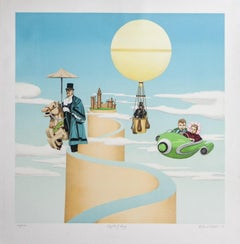
Flights of Fancy is an original signed limited edition (060/250 ) lithograph by Michel Pellus showing a man in a top hat floating in the sky in a hot a...
Category

1970s Surrealist Henry Moore Landscape Prints

Materials

Lithograph

Previously Available Items
Thin-lipped Armourer I: black drawing based on Auden poetry, Yorkshire landscape
By Henry Moore
Located in New York, NY
This darkly-shaded portrait of two figures is one of a series of 18 lithographs drawn by the artist for the Auden Poems/Moore Lithographs 1974 book and portfolio. This work is from a...
Category

Late 20th Century Modern Henry Moore Landscape Prints

Materials

Lithograph

The Forest Henry Moore drawing of Yorkshire landscape for W.H. Auden poetry book
By Henry Moore
Located in New York, NY
One of a series of 18 lithographs drawn by the artist for the Auden Poems/Moore Lithographs 1974 book and portfolio. This work is from an edition of 25 printed on vellum aside from t...
Category

Late 20th Century Modern Henry Moore Landscape Prints

Materials

Lithograph

Windswept Landscape Henry Moore drawing of Scottish landscape for W.H. Auden
By Henry Moore
Located in New York, NY
One of a series of 18 lithographs drawn by the artist fo¬r the Auden Poems/Moore Lithographs 1974 book and portfolio. This work is from an edition of 25 printed on vellum aside from ...
Category

Late 20th Century Modern Henry Moore Landscape Prints

Materials

Lithograph

Multitude I Henry Moore yorkshire landscape black and white abstract drawing
By Henry Moore
Located in New York, NY
One of a series of 18 lithographs drawn by the artist for the Auden Poems/Moore Lithographs 1974 book and portfolio. This work is from an edition of 25 printed on vellum aside from t...
Category

Late 20th Century Henry Moore Landscape Prints

Materials

Lithograph

Fjord by Henry Moore drawing of Scottish landscape for W.H. Auden poetry book
By Henry Moore
Located in New York, NY
One of a series of 18 lithographs drawn by the artist for the Auden Poems/Moore Lithographs 1974 book and portfolio. This work is from an edition of 25 printed on vellum aside from t...
Category

Late 20th Century Henry Moore Landscape Prints

Materials

Lithograph

Henry Moore landscape prints for sale on 1stDibs.

Find a wide variety of authentic Henry Moore landscape prints available for sale on 1stDibs. You can also browse by medium to find art by Henry Moore in lithograph and more. Much of the original work by this artist or collective was created during the 20th century and is mostly associated with the modern style. Not every interior allows for large Henry Moore landscape prints, so small editions measuring 21 inches across are available. Customers who are interested in this artist might also find the work of Julian Trevelyan, Richard Beer, William Walcot, R.E., and Hon.R.I.B.A.. Henry Moore landscape prints prices can differ depending upon medium, time period and other attributes. On 1stDibs, the price for these items starts at $960 and tops out at $3,000, while the average work can sell for $1,500.
Questions About Henry Moore Landscape Prints
  • 1stDibs ExpertApril 5, 2022
    Henry Moore’s sculptures often represented the connection between the human body and landscapes. The underlying meaning is that humanity is shared with the natural world, and many of his large-scale sculptures were created to compliment the outdoor landscape where they were placed. You’ll find a selection of Henry Moore sculptures and sketches on 1stDibs.
  • 1stDibs ExpertMay 30, 2024
    Henry Moore drew hands to symbolize the passage of time. His series of drawings depicting his own hands in old age and other elderly people's hands were meant to represent the effects of work and living on the human body. Much of Moore's work reflected on the human form, including his large bronze sculptures. Explore a diverse assortment of Henry Moore art on 1stDibs.
  • 1stDibs ExpertJune 6, 2024
    Henry Moore's style of art was modern. He is best known for his monumental bronze sculptures, which are installed around the world, often as public art. He used abstract forms of the human body, typically depicting mother-and-child or reclining figures. His more abstract forms are generally pierced or contain hollow spaces. Many critics have likened the undulating shapes of his reclining figures to the landscape and hills of his Yorkshire birthplace. On 1stDibs, find an assortment of Henry Moore art.
  • 1stDibs ExpertMay 3, 2024
    Opinions vary as to what Henry Moore's most famous piece is. Since the British artist's semi-abstract monumental bronze sculptures are often public works of art, many have become well known. Among them are Reclining Figure: Festival (1951), Harlow Family Group (1954-5), Helmet Head No. 4: Interior/Exterior (1963), The Arch (1963-69) and Mother and Child (1983). On 1stDibs, find a variety of Henry Moore art.
  • 1stDibs ExpertApril 5, 2022
    Henry Moore frequently used the wax resist process in his drawings, which involved sketching the forms in wax crayon and coating the drawing with a wash of gray watercolor. He then went in with black ink, gray and black crayons and white watercolor. Find a selection of Henry Moore artwork from top art dealers around the world on 1stDibs.
  • 1stDibs ExpertApril 26, 2024
    Henry Moore created sculptures for a few reasons. Born in Castleford, Yorkshire, in 1898, he had an early interest in being a sculptor, and in 1921, he was awarded a scholarship to study at the Royal Academy of Art in London. As he would explain, this is where he was particularly inspired to pursue his sculpting practice: “Even when I was a student I was totally preoccupied by sculpture in its full spatial richness, and if I spent a lot of time at the British Museum in those days, it was because so much of the primitive sculpture there was distinguished by complete cylindrical realization.” He also had an interest in exploring how the human body connected to landscapes. He often produced works with specific locations in mind, considering how his figures would relate to the space around them. His forms are usually abstractions of the human body, typically depicting mother-and-child or reclining figures, and are often pierced or contain hollow spaces. Many interpreters liken the undulating form of his reclining figures to the landscape and hills of his Yorkshire birthplace. On 1stDibs, shop a variety of Henry Moore art.
  • 1stDibs ExpertMarch 13, 2024
    Henry Moore drew sheep for a few reasons. The British artist thought sheep were peaceful and found watching them graze to be relaxing. He also liked how they stood out against the landscape due to their coloring, likening it to the way a statue draws the eye away from the rest of its surroundings. On 1stDibs, find a diverse assortment of Henry Moore art.
  • 1stDibs ExpertAugust 20, 2024
    How much a Henry Moore statue is worth depends on its history, condition and other factors. In 2022, his Reclining Figure: Festival, created for the 1951 Festival of Britain, set an auction record for the artist when it sold for $31 million. The piece is a good example of the artist's forms, which are usually abstractions of the human figure, typically depicting a mother and child or reclining figure. Moore's works are often suggestive of the female body, apart from a period in the 1950s when he sculpted family groups. If you own a Henry Moore statue, a certified appraiser or experienced art dealer can help you determine its estimated value. Shop an assortment of Henry Moore art on 1stDibs.
  • 1stDibs ExpertApril 5, 2022
    Henry Moore used holes in his sculptures to create the illusion that his work was growing from an empty center. His sculptures Oval with Points and Double Oval are two examples of the technique. You'll find a selection of Henry Moore art on 1stDibs.
  • 1stDibs ExpertApril 5, 2022
    Henry Moore moved to London to study art and often visited the British Museum where he was inspired by ancient sculptures from Egypt, Africa and Mexico. His sculptures have a semi-abstract nature, but he often dabbled in other styles of art. Moore even created his own form of modernism with an eye toward the abstract. On 1stDibs, find a variety of original artwork from top artists.
  • 1stDibs ExpertOctober 30, 2024
    Yes, Barbara Hepworth knew Henry Moore. They met while she was attending the Leeds School of Art in the 1920s. Moore and Hepworth maintained a friendly rivalry throughout their careers. Along with Paul Nash and Ben Nicholson, the two founded the Unit One art movement in 1933. The movement's purpose was to promote avant-garde art in the UK. Explore a wide variety of Barbara Hepworth art.
  • 1stDibs ExpertNovember 20, 2024
    Yes, Henry Moore and Barbara Hepworth were friends. The two met at the Leeds School of Art in the UK and maintained a friendly rivalry throughout their careers. Both Hepworth and Moore were members of Unit One, a group of British artists who sought to educate the public about avant-garde art during the 1930s. Shop a selection of Henry Moore and Barbara Hepworth art on 1stDibs.
  • 1stDibs ExpertApril 5, 2022
    Henry Moore was a prolific artist and it’s difficult to pinpoint exactly how many pieces of art he created. The Henry Moore Foundation lists that their online catalogue of his works currently features more than 11,000 sculptures, drawings, tapestries, textiles and graphics. That’s a significant number indeed and does not represent all of his contributions to the art world. On 1stDibs, find a variety of original artwork from top artists.

Recently Viewed

View All