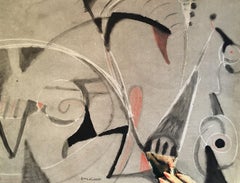
Herve Carrier Art

b. 1932

Hervé Carrier was born October 13, 1932 in Martigues (Bouches-du-Rhône). He interrupted his studies at age 15 and painted his first painting. Apprentice to Merlin-Gerin, and unhappy with his professional occupations, he cultivated a frantic absenteeism that allowed him to discover the museum. His first art book was a Dufy monograph with a view of the old port of Marseille dated to 1925. He then discovered modern painting with the fascicles published by Hazan in the early 1950s. His first exhibition took place in Grenoble in February 1957, his work was then in the form of non-figurative varnished gouaches freely inspired by Fernand Léger.

In 1963, Carrier accepted a job as a caretaker at the Museum of Painting in Grenoble, after 1970 the management of the reserves became his main activity at the museum. In 1961, he constructed sculptures made of poor materials — often fragments of objects, sometimes articulated. He especially sought in these montages a possibility of a playful approach to the sculpture with which he tried to reconcile his interest for the primitive arts. As a result of the ideological effervescence of the moment in 1968, he stopped any individual production for a group activity with Dody and Unal. They participated in the sixth Biennial of Paris, the exhibition Impact 2 at the Ceret Museum in 1972 just before the dissolution of the group. The following year, he began a series of paintings composed of fragments of works of masters of modern art approximately reproduced and arbitrarily collected, which allowed him to reconcile appropriation and misappropriation into a caustic tribute to the influence of the masters.

In 1981, Carrier returned to sculpture long neglected because of a lack of space. This space was in the cellars of the museum where he worked only part-time and then he looked for material from scrap dealers.

"My sculptures are static” he wrote, “fixed of course, but the pieces are twisted, rounded, follow a rhythm, move and turn. It's an expression of freedom, the unpredictable."

From 1983–92, Carrier’s pictorial works were humorous allusions to traditional iconography — Biblical scenes, still lifes, landscapes are the main themes of compositions of a very effective incongruity. "I start from a character, an attitude or a silhouette seen in an old painting. The quote is no longer really one. It's a kind of stimulation to paint."

In 1993, finally retired, Carrier moved to Veynes (Hautes-Alpes). His new studio allowed him to continue to practice sculpture, painting and drawing in the best conditions until his death in 2000.

to
1
1
Overall Width
to
Overall Height
to
1
1
1
1
1
1
9,962
2,753
1,376
1,373
1
Artist: Herve Carrier
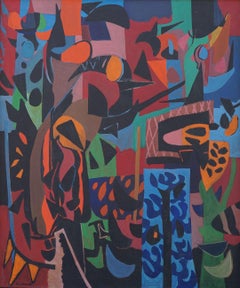
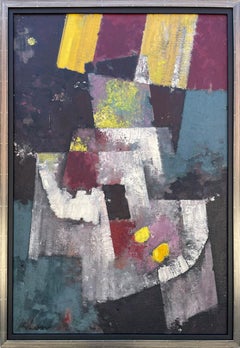
Dark Structure, Abstract Surrealist Original Oil Painting, Signed
By Herve Carrier
Located in Cirencester, Gloucestershire
Dark Structure, Abstract Surrealist Original Oil Painting, Signed By French artist Herve Carrier, Mid 20th Century Signed by the artist on the lower left...
Category

Mid-20th Century Abstract Herve Carrier Art

Materials

Oil

Related Items
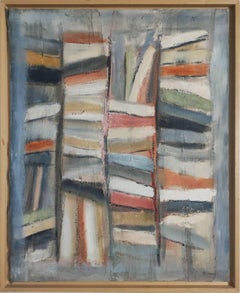
Romans, Abstract library, oil and Collage on canvas, minimalism, textured
By SOPHIE DUMONT
Located in LANGRUNE-SUR-MER, FR
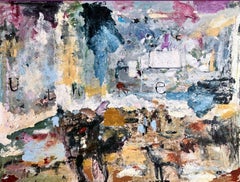
to confront the arts, to merge them, to mix writing and brush, such is the challenge of the artist. Table of a library with collage of fabric allowing the painting to vibrate more. C...
Category

21st Century and Contemporary Abstract Expressionist Herve Carrier Art

Materials

Oil

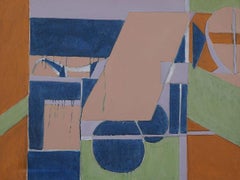
Naval Occurrence, orange, blue green mid-century, abstract geometrical work
By Richard Andres
Located in Beachwood, OH
Richard Andres (American, 1927-2013) Naval Occurrence, c. 1963 oil on canvas signed and titled verso 24 x 32 inches Richard Andres was born in Buffalo, New York in 1927. A graduate of the Cleveland Institute of Art in 1950, he was immediately drafted and served for two years in the army as a mural painter. He received his Master of Arts from Kent State in 1961. A frequent exhibitor at galleries and museums and winner of multiple May Show prizes, Andres taught art in the Cleveland Public Schools for 28 years, as well as teaching the University of Buffalo, the Cleveland Institute of Art and the Western Reserve University. Very little in Richard Andres’ childhood would have predicted his love of classical music, mid-century-modern architecture and certainly not his lifelong passion for art and in particular abstract art. Richard’s father, Raymond, had no more than a third-grade education, and his mother, Clara, was one of thirteen children – only three of whom lived into adulthood and none of whom attended high school. They lived, when Richard was a boy, in a dingy area of Buffalo, NY in a walk-up apartment situated above a tavern. Raymond and Clara supplemented the income from their factory jobs in the bar downstairs with Raymond playing ragtime on the piano and Clara serving drinks. This often left Richard and his two older brothers at home alone to fend for themselves. The two older boys, Raymond and Russell, were - unlike Richard- rather rough and tumble and entertained themselves with stickball, boxing and the like. Richard, on the other hand, from a very young age liked to draw, or better yet even, to paint with the small set of watercolors he received for Christmas one year. Paper, however, at the height of the depression, was hard to come by. Luckily, Clara used paper doilies as decoration for the apartment and Richard would contentedly paint and then cut up doilies, gluing the pieces together to create collages. At eight-years-old, he discovered the Albright-Knox Museum (then known as the Albright Art Gallery) and spent several hours a week there studying the paintings. He was particularly fond of Charles Burchfield‘s landscapes, enamored with their ‘messiness’ and thinking that they somehow captured more ‘feeling’ than works he was previously familiar with. For his tenth Christmas, he asked for and received a ‘how-to’ paint book by Elliot O’Hare. Through this self-teaching, he assembled the portfolio needed for acceptance to Buffalo Technical High School where he studied Advertising Arts. In his Junior year, he was encouraged to enter a watercolor painting, “Two Barns,” in the national 1944-45 Ingersoll Art Award Contest and was one of twelve grand prize winners – each one winning one hundred dollars. More importantly the painting was exhibited at the Carnegie Institute Galleries, which resulted in his winning a national scholarship to the Cleveland School of Art (The Cleveland Art Institute). He flourished at the art school under the tutelage of faculty members such as Carl Gaertner, as well as that of visiting artists such as William Sommer and Henry George Keller. He would say in later years that Gaertner, in particular, influenced his attitude toward life as well as art. “Gaertner,” Andres said, “believed that there was no need to be a ‘tortured artist’, that an artist should rather enjoy beauty, family, and life in general.” Free to spend his days as he chose, he wandered the Cleveland Art Museum for most of the hours he was not attending classes or painting; the remaining time was spent drinking coffee at a local hangout with art school friends – which is where he met fellow Henry Keller scholarship winner, Avis Johnson. Richard was immediately smitten with Avis, but being rather shy, it took him the entire summer of 1948 to build up his courage to ask her out. Over that summer he ‘thought about Avis’ and worked in a diner to save money. He also used the hundred-dollar prize money won in High School to visit the first Max Beckmann retrospective in the United States at the City Art Museum in St. Louis. Over a half century later he spoke of that exhibit with a reverence usually reserved for spiritual matters, “I walked in and it was like nothing I had ever seen before... the color...It just glowed.” Returning to campus in the Fall, the first thing he did was go to the coffee shop in hopes of finding Avis. He did, and she, upon seeing him, realized that she was also smitten with him. They quickly became known as ‘the couple’ on campus, and a year later, with Richard being drafted for the Korean war, they were quickly married by a Justice of the Peace, celebrating after with family at Avis’s Cleveland home. As a gift, faculty member John Paul Miller designed and made the simple gold wedding ring Avis wore for their 65 years of marriage. During those 65 years neither wavered in their mutual love, nor in the respect they shared for one another’s art. The couple lived in a converted chicken coop in Missouri while Richard was in boot camp. At the camp, he would volunteer for any job offered and one of those jobs ended up being painting road signs. His commander noticed how quickly and neatly he worked and gave him more painting work to do - eventually recommending him for a position painting murals for Army offices in Panama. Until her dying day, Avis remained angry that “The army got to keep those fabulous murals and they probably didn’t even know how wonderful they were.” In Panama, their first son, Mark, was born. After Richard’s discharge in 1953, they moved back to the Cleveland area and used the GI bill to attend Kent State gaining his BA in education. The small family then moved briefly to Buffalo, where Richard taught at the Albright Art School and the University of Buffalo – and their second son, Peter, was born. Richard had exhibited work in the Cleveland May Show and the Butler Art Museum during his art school years, and during the years in Buffalo, his work was exhibited at the gallery he had so loved as a child, the Albright Art Gallery. In 1956, the family moved back to the Cleveland area and Richard began teaching art at Lincoln West High School during the day while working toward his MA in art at Kent State in the evenings. Avis and Richard, with the help of an architect, designed their first home - a saltbox style house in Hudson, Ohio, and in 1958, their third son, Max (after Max Beckmann) was born. Richard enjoyed the consistency of teaching high school as well as the time it gave him to paint on the weekends and during the summer months. In 1961, he received his MA and his daughter, Claire, was born. With a fourth child, the house was much too small, and Avis and Richard began designing their second home. An admirer of MCM architecture, Richard’s favorite example of the style was the Farnsworth house – he often spoke of how the concepts behind this architectural style, particularly that of Mies van der Rohe, influenced his painting. Andres described himself as a 1950’s...
Category

1960s Abstract Geometric Herve Carrier Art

Materials

Oil

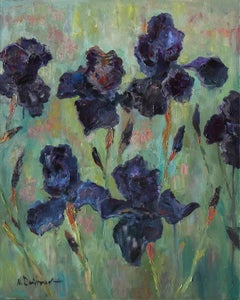
Irises Black Dragon - stylish iris painting
Located in Zofingen, AG
Contemporary and stylish painting with dark irises Black Dragon is a remarkable decoration for any house or office. Irises are one of favourite flowers of Nikolay. Their petal shape ...
Category

2010s Abstract Expressionist Herve Carrier Art

Materials

Canvas, Oil

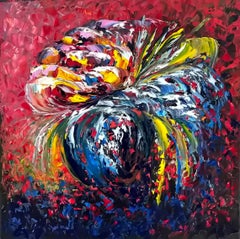
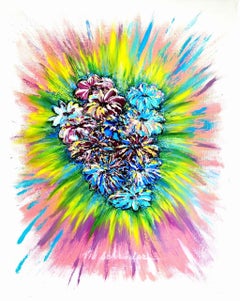
Bouquet of Energy. Interior expressionism semi-abstract oil painting.30x30cm.
Located in Zofingen, AG
What gives us the energy of life? All elements are presented in this painting...)) Using Theta-Hilling techniques, this painting is charged with a surge of vivacity, health and ...
Category

2010s Abstract Impressionist Herve Carrier Art

Materials

Oil

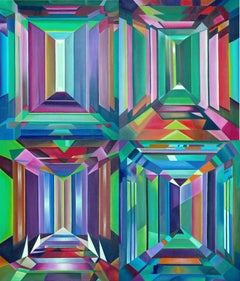
Gates to your dreams. 2023., oil on linen, 140x120 cm 4 pcs. - 70x60 cm
Located in Riga, LV
Gates to your dreams. 2023., oil on linen, 140x120 cm Modular artwork from 4 pcs. - 70x60 cm total size 140x120 cm Alyona Prokofyeva (1988) From 2016 surname Galaktionova. Alyona...
Category

2010s Abstract Geometric Herve Carrier Art

Materials

Canvas, Oil, Linen

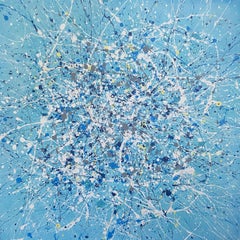
Series “Between Heaven and Earth” - turquoise blue
Located in Vienna, AT
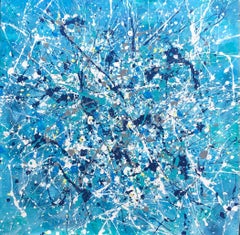
White frame Included. In this expressive piece, I've unleashed my passion through vibrant splatters, embodying the dynamic clash between tranquility and chaos. The turquoise blue, ac...
Category

2010s Abstract Herve Carrier Art

Materials

Canvas, Cotton Canvas, Mixed Media, Oil, Spray Paint, Acrylic

Magic Garden, vibrant mid-century abstract expressionist colorful geometric work
By Richard Andres
Located in Beachwood, OH
Richard Andres (American, 1927-2013) Magic Garden, c. 1962 oil on canvas signed lower left, signed and titled verso 50 x 42 inches Richard Andres was born in Buffalo, New York in 19...
Category

1960s Abstract Expressionist Herve Carrier Art

Materials

Oil

The Spring has come. Semi-abstract floral expressionism oil painting. Gift Art.
Located in Zofingen, AG
Сontemporary Art. Original expressionism painting. Oil on canvas 50/40 cm. The work was created with a palette knife on high-quality canvas, using environmentally friendly oil colors with natural pigment. It is perfect for modern interiors. It has strung with picture cord ready to hang. The Artwork is covered with UV varnish. No need to frame, but you will receive this painting with a frame silver or gold color. One-of-a-Kind Painting. Signed. Certificate is attached. This painting brings positive and joy of life, that we feel with the advent of spring; bright colors give a charge of vivacity and a burst of energy. - Free shipping within Switzerland only, if you are in another country, we can pre-calculate the cost of shipping to your country. Write us your request and we will be happy to answer. About Artist Vik Schroeder...
Category

2010s Abstract Impressionist Herve Carrier Art

Materials

Oil

Series “Between Heaven and Earth” - turquoise blue
Located in Vienna, AT
As I layered acrylic and oil onto the canvas, I was swept into an abstract cosmos, expressing the raw essence of emotion through splashes and strokes. Each color, a dialogue between ...
Category

2010s Abstract Herve Carrier Art

Materials

Canvas, Cotton Canvas, Mixed Media, Oil, Spray Paint, Acrylic

Tintern Abbey, bold colorful brushwork blues pinks earth tones
By C. Dimitri
Located in Brooklyn, NY
Abstract interior, with figures and bison. Oil on panel.
Category

2010s Abstract Herve Carrier Art

Materials

Oil, Panel

By the Dawn s Early Light, mid-century abstract black, red, yellow oil painting
By Charles Green Shaw
Located in Beachwood, OH
Charles Green Shaw (American, 1892-1974) By the Dawn's Early Light, 1955 Oil on masonite Signed lower left, dated and titled verso 35.5 x 23.75 inches 38 x 26.25 inches, framed Provenance: The estate of the artist to Charles H. Carpenter Charles Green Shaw, born into a wealthy New York family, began painting when he was in his mid-thirties. A 1914 graduate of Yale, Shaw also completed a year of architectural studies at Columbia University. During the 1920s Shaw enjoyed a successful career as a freelance writer for The New Yorker, Smart Set and Vanity Fair, chronicling the life of the theater and café society. In addition to penning insightful articles, Shaw was a poet, novelist and journalist. In 1927 he began to take a serious interest in art and attended Thomas Hart Benton's class at the Art Students League briefly in New York. He also studied privately with George Luks, who became a good friend. Once he had dedicated himself to non-traditional painting, Shaw's writing ability made him a potent defender of abstract art. After initial study with Benton and Luks, Shaw continued his artistic education in Paris by visiting numerous museums and galleries. From 1930 to 1932 Shaw's paintings evolved from a style imitative of Cubism to one directly inspired by it, though simplified and more purely geometric. Returning to the United States in 1933, Shaw began a series of abstracted cityscapes of skyscrapers he called Manhattan Motifs which evolved into his most famous works, the shaped canvases he called Plastic Polygons. The 1930s were productive years for Shaw. He showed his paintings in numerous group exhibitions, both in New York and abroad, and was also given several one-man exhibitions. Shaw had his first one-man exhibition at the Valentine Dudensing Gallery in New York in 1934, which included 25 Manhattan Motif paintings and 8 abstract works. In the spring of 1935 Shaw was introduced to Albert Gallatin and George L.K. Morris. Gallatin was so impressed with Shaw's work, he broke a policy against solo exhibitions at his museum, the Gallery of Living Art, and offered Shaw an exhibition there. In the summer of 1935 Shaw traveled to Paris with Gallatin and Morris who provided introductions to many great painters. Shaw regularly spent time with John Ferren and Jean Hélion. The following year Gallatin organized an exhibition called Five Contemporary American Concretionists at the Reinhardt Gallery that included Shaw, Ferren, and Morris, Alexander Calder, and Charles Biederman...
Category

1950s Abstract Herve Carrier Art

Materials

Oil

Blue Wall, mid-century abstract expressionist, geometric blue, black pink work
By Richard Andres
Located in Beachwood, OH
Richard Andres (American, 1927-2013) Blue Wall, c. 1959 oil on canvas signed and titled verso 42 x 60 inches Richard Andres was born in Buffalo, New York in 1927. A graduate of the Cleveland Institute of Art in 1950, he was immediately drafted and served for two years in the army as a mural painter. He received his Master of Arts from Kent State in 1961. A frequent exhibitor at galleries and museums and winner of multiple May Show prizes, Andres taught art in the Cleveland Public Schools for 28 years, as well as teaching the University of Buffalo, the Cleveland Institute of Art and the Western Reserve University. Very little in Richard Andres’ childhood would have predicted his love of classical music, mid-century-modern architecture and certainly not his lifelong passion for art and in particular abstract art. Richard’s father, Raymond, had no more than a third-grade education, and his mother, Clara, was one of thirteen children – only three of whom lived into adulthood and none of whom attended high school. They lived, when Richard was a boy, in a dingy area of Buffalo, NY in a walk-up apartment situated above a tavern. Raymond and Clara supplemented the income from their factory jobs in the bar downstairs with Raymond playing ragtime on the piano and Clara serving drinks. This often left Richard and his two older brothers at home alone to fend for themselves. The two older boys, Raymond and Russell, were - unlike Richard- rather rough and tumble and entertained themselves with stickball, boxing and the like. Richard, on the other hand, from a very young age liked to draw, or better yet even, to paint with the small set of watercolors he received for Christmas one year. Paper, however, at the height of the depression, was hard to come by. Luckily, Clara used paper doilies as decoration for the apartment and Richard would contentedly paint and then cut up doilies, gluing the pieces together to create collages. At eight-years-old, he discovered the Albright-Knox Museum (then known as the Albright Art Gallery) and spent several hours a week there studying the paintings. He was particularly fond of Charles Burchfield‘s landscapes, enamored with their ‘messiness’ and thinking that they somehow captured more ‘feeling’ than works he was previously familiar with. For his tenth Christmas, he asked for and received a ‘how-to’ paint book by Elliot O’Hare. Through this self-teaching, he assembled the portfolio needed for acceptance to Buffalo Technical High School where he studied Advertising Arts. In his Junior year, he was encouraged to enter a watercolor painting, “Two Barns,” in the national 1944-45 Ingersoll Art Award Contest and was one of twelve grand prize winners – each one winning one hundred dollars. More importantly the painting was exhibited at the Carnegie Institute Galleries, which resulted in his winning a national scholarship to the Cleveland School of Art (The Cleveland Art Institute). He flourished at the art school under the tutelage of faculty members such as Carl Gaertner, as well as that of visiting artists such as William Sommer and Henry George Keller. He would say in later years that Gaertner, in particular, influenced his attitude toward life as well as art. “Gaertner,” Andres said, “believed that there was no need to be a ‘tortured artist’, that an artist should rather enjoy beauty, family, and life in general.” Free to spend his days as he chose, he wandered the Cleveland Art Museum for most of the hours he was not attending classes or painting; the remaining time was spent drinking coffee at a local hangout with art school friends – which is where he met fellow Henry Keller scholarship winner, Avis Johnson. Richard was immediately smitten with Avis, but being rather shy, it took him the entire summer of 1948 to build up his courage to ask her out. Over that summer he ‘thought about Avis’ and worked in a diner to save money. He also used the hundred-dollar prize money won in High School to visit the first Max Beckmann retrospective in the United States at the City Art Museum in St. Louis. Over a half century later he spoke of that exhibit with a reverence usually reserved for spiritual matters, “I walked in and it was like nothing I had ever seen before... the color...It just glowed.” Returning to campus in the Fall, the first thing he did was go to the coffee shop in hopes of finding Avis. He did, and she, upon seeing him, realized that she was also smitten with him. They quickly became known as ‘the couple’ on campus, and a year later, with Richard being drafted for the Korean war, they were quickly married by a Justice of the Peace, celebrating after with family at Avis’s Cleveland home. As a gift, faculty member John Paul Miller designed and made the simple gold wedding ring Avis wore for their 65 years of marriage. During those 65 years neither wavered in their mutual love, nor in the respect they shared for one another’s art. The couple lived in a converted chicken coop in Missouri while Richard was in boot camp. At the camp, he would volunteer for any job offered and one of those jobs ended up being painting road signs. His commander noticed how quickly and neatly he worked and gave him more painting work to do - eventually recommending him for a position painting murals for Army offices in Panama. Until her dying day, Avis remained angry that “The army got to keep those fabulous murals and they probably didn’t even know how wonderful they were.” In Panama, their first son, Mark, was born. After Richard’s discharge in 1953, they moved back to the Cleveland area and used the GI bill to attend Kent State gaining his BA in education. The small family then moved briefly to Buffalo, where Richard taught at the Albright Art School and the University of Buffalo – and their second son, Peter, was born. Richard had exhibited work in the Cleveland May Show and the Butler Art Museum during his art school years, and during the years in Buffalo, his work was exhibited at the gallery he had so loved as a child, the Albright Art Gallery. In 1956, the family moved back to the Cleveland area and Richard began teaching art at Lincoln West High School during the day while working toward his MA in art at Kent State in the evenings. Avis and Richard, with the help of an architect, designed their first home - a saltbox style house in Hudson, Ohio, and in 1958, their third son, Max (after Max Beckmann) was born. Richard enjoyed the consistency of teaching high school as well as the time it gave him to paint on the weekends and during the summer months. In 1961, he received his MA and his daughter, Claire, was born. With a fourth child, the house was much too small, and Avis and Richard began designing their second home. An admirer of MCM architecture, Richard’s favorite example of the style was the Farnsworth house – he often spoke of how the concepts behind this architectural style, particularly that of Mies van der Rohe, influenced his painting. Andres described himself as a 1950’s...
Category

1950s Abstract Expressionist Herve Carrier Art

Materials

Oil

Previously Available Items
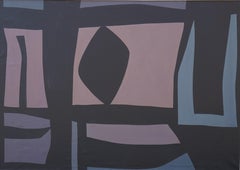
Grey Abstract, Surrealist Original Oil Painting, Signed
By Herve Carrier
Located in Cirencester, Gloucestershire
Grey Abstract, Surrealist Original Oil Painting, Signed By French artist Herve Carrier, Mid 20th Century Signed by the artist on the lower left hand corn...
Category

Mid-20th Century Abstract Herve Carrier Art

Materials

Oil

Herve Carrier art for sale on 1stDibs.

Find a wide variety of authentic Herve Carrier art available for sale on 1stDibs. You can also browse by medium to find art by Herve Carrier in oil paint, paint and more. Much of the original work by this artist or collective was created during the 20th century and is mostly associated with the abstract style. Not every interior allows for large Herve Carrier art, so small editions measuring 31 inches across are available. Customers who are interested in this artist might also find the work of Sophie Danielle Rubinstain, Rosie Copeland, and Tapas Ghosal. Herve Carrier art prices can differ depending upon medium, time period and other attributes. On 1stDibs, the price for these items starts at $1,441 and tops out at $1,672, while the average work can sell for $1,557.

Artists Similar to Herve Carrier

Recently Viewed

View All