Howard Schleeter Abstract Paintings
American, 1903-1976
Howard Schleeter, the son of a commercial artist, studied formally at the Albright Art School in his hometown of Buffalo, New York. However, his studies at Albright were brief and the artist considered himself to be primarily self-taught.
He later met Charles Lindbergh while working as an airplane mechanic. However, he soon chose to make his living entirely as an artist and, in 1929, he traveled to New Mexico. The following year he married and the couple made New Mexico their permanent home.
Schleeter studied under Brooks Willis during the 1930’s and worked in several mediums including gouache, watercolor, oil, scratchboard and engraving.
The Great Depression took its toll on Schleeter who occasionally found work digging ditches to make ends meet. In 1936, his financial status greatly improved when he received the first of several commissions from the Works Progress Administration (WPA). Though he worked primarily in abstraction, the five murals he completed for a WPA commission in the Melrose Public School library are realistic depictions of the West. He worked on several more New Deal commissions during the years of 1936 and 1942 in locations including Santa Fe, Clayton, and Washington D.C. During this time, Schleeter furthered his income by teaching at a Las Vegas, New Mexico, art gallery during 1938 and 1939.
In 1945, the Encyclopedia Britannica referred to Schleeter as “an artist’s artist.” He also received local attention when he became one of the first artists chosen by Peter Hurd and Jane Mabry for his significant contributions to New Mexico’s art.
Schleeter taught at the University of New Mexico during 1950-1951 and 1954.
Member: Art League of New Mexico
Exhibited: Kansas Art Institute, 1936-1938; New Mexico State Fair, 1939 (prize); New Mexico Art League, 1939 (prize); Cedar City, New Mexico, 1941-1946; Philadelphia Artist Alliance, 1945 (solo); deYoung Memorial Museum, 1946; Art Institute of Chicago, 1947; Museum of New Mexico, Santa Fe, 1951 (purchase prize), 1955 (purchase prize); Vienna, Austria, 1952; Guggenheim Museum, 1954; Karlsruhe Museum, Germany, 1955; Stanford University, 1955 (solo); New Mexico Highlands University, 1957 (purchase prize); Colorado Springs Fine Arts Center, 1958; Swope Art Gallery Works Held: A&M College, New Mexico (mural); Art League of New Mexico; Cedar City Institute of Religion; Encyclopaedia Britannica; Miners Hospital, Raton, New Mexico (mural); Museum of New Mexico, Santa Fe; Research Studio, Maitland, Florida; University of New Mexico
©David Cook Galleries, LLCto
1
1
Overall Width
to
Overall Height
to
1
1
1
1
1
1
1
1
1
1
663
619
477
342
1
1
1
Artist: Howard Schleeter
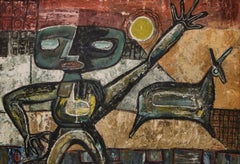
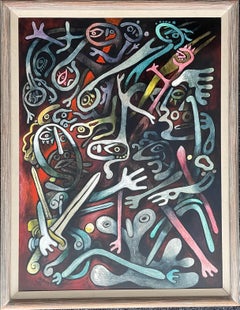
Howard Schleeter 1949 Original Gouache
Wax Painting – Abstract Southwest Art
By Howard Schleeter
Located in Denver, CO
This striking original 1949 gouache and wax painting, titled "Fetishes", is a powerful work by acclaimed New Mexico modernist Howard Schleeter (1903–1976). Rich with symbolic abstrac...
Category
1940s American Modern Howard Schleeter Abstract Paintings
Materials
Wax, Gouache
Related Items
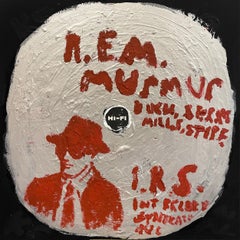
R.E.M. - Murmur (Grammy, Album Art, Iconic, Rock and Roll, Pop, Legendary)
By Kerry Smith
Located in Kansas City, MO
Kerry Smith
R.E.M. - Murmur
Mixed Media on Crescent board
Year: 2022
Size: 21x20in
Signed, dated by hand
COA provided
Ref.: 924802-1633
*Black frame with a mirror-gloss finish avail...
Category
2010s American Modern Howard Schleeter Abstract Paintings
Materials
Mixed Media, Acrylic, Gouache, Board

$888 Sale Price
25% Off
H 21 in W 22 in D 1 in
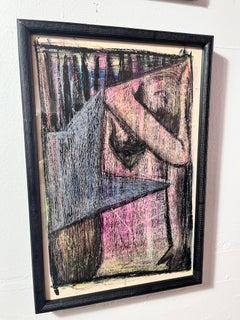
1950s "Eve" American Modern MidCentury Figurative Gouache
Oil Pastel
By Donald Stacy
Located in Arp, TX
Donald Stacy
"Eve"
c.1950s
Gouache and oil pastel on paper
14x17" black wood frame 14.75"x17.75"
Unsigned, Eve written in paint along right margin
Came from artist's estate
Donald S...
Category
Mid-20th Century American Modern Howard Schleeter Abstract Paintings
Materials
Paper, Gouache, Oil Pastel
$760 Sale Price
20% Off
H 17.75 in W 14.75 in
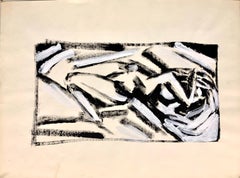
1950s "Curled Up Cubist" MidCentury Figurative Gouache University of Paris
By Donald Stacy
Located in Arp, TX
Donald Stacy
"Curled Up Cubist
c.1950s
Gouache on paper
24" x 18" unframed
Unsigned
Came from artist's estate
Donald Stacy (1925-2011) New Jersey
Studied: Newark School of Fine Art
The Art Students League
Pratt Graphic Arts Center
University of Paris 1953-54
University of Aix-en-Provence 1954-55
Faculty: Art Department of the New School
Museum of Modern Art
School of Visual Arts
Stacy Studio Workshop
Exhibitions: Grand Central Moderns
George Wittenborn
The New School
Print Exhibitions, Chicago
University of Oklahoma
Honolulu Museum
Monclair Museum
Wisconsin State College
Louisiana Art Commission
Philadelphia...
Category
Mid-20th Century American Modern Howard Schleeter Abstract Paintings
Materials
Paper, Gouache
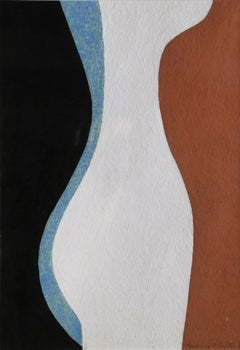
Torso No. 3, Mid-Century Figural Abstract Acrylic Painting, Ohio artist
By Clarence Holbrook Carter
Located in Beachwood, OH
Clarence Holbrook Carter (American, 1904-2000)
Torso No. 3, 1967
Acrylic on paper
Signed and dated lower right
13 x 9 inches
21 x 17 inches
A mid-century figural abstract painting.
Clarence Holbrook Carter achieved a level of national artistic success that was nearly unprecedented among Cleveland School artists of his day, with representation by major New York dealers...
Category
1960s American Modern Howard Schleeter Abstract Paintings
Materials
Acrylic
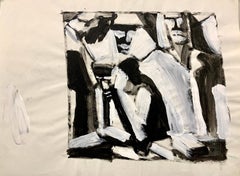
1950s "Group Meeting" Mid Century Figurative Gouache University of Paris
By Donald Stacy
Located in Arp, TX
Donald Stacy
"Group Meeting"
c.1950s
Gouache paint on paper
24" x 18'" unframed
Unsigned
Came from artist's estate
Donald Stacy (1925-2011) New Jersey
Studied: Newark School of Fin...
Category
Mid-20th Century American Modern Howard Schleeter Abstract Paintings
Materials
Paper, Gouache
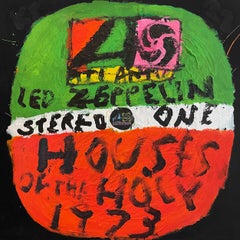
Led Zeppelin - Houses Of The Holy (Grammy, Album Art, Iconic, Rock and Roll)
By Kerry Smith
Located in Kansas City, MO
Kerry Smith
Led Zeppelin - Houses Of The Holy
Mixed Media on Crescent board
Year: 2018
Size: 21x20in
Signed, dated by hand
COA provided
Ref.: 924802-1632
*Black frame with a mirror-...
Category
2010s American Modern Howard Schleeter Abstract Paintings
Materials
Mixed Media, Acrylic, Gouache, Board
$888 Sale Price
25% Off
H 21 in W 22 in D 1 in
Inevitable Day – Birth of the Atom oil and tempera painting by Julio De Diego
By Julio de Diego
Located in Hudson, NY
Julio De Diego’s Atomic Series paintings made an extraordinary statement regarding the shock and fear that accompanied the dawn of the nuclear age. In the artist’s own words, “Scientists were working secretly to develop formidable powers taken from the mysterious depths of the earth - with the power to make the earth useless! Then, the EXPLOSION! . . . we entered the Atomic Age, and from there the neo-Atomic war begins. Explosions fell everywhere and man kept on fighting, discovering he could fight without flesh.”
To execute these works, De Diego developed a technique of using tempera underpainting before applying layer upon layer of pigmented oil glazes. The result is paintings with surfaces which were described as “bonelike” in quality. The forms seem to float freely, creating a three-dimensional visual effect. In the 1954 book The Modern Renaissance in American Art, author Ralph Pearson summarizes the series as “a fantastic interpretation of a weighty theme. Perhaps it is well to let fantasy and irony appear to lighten the devastating impact. By inverse action, they may in fact increase its weight.”
Bibliography
Art in America, April 1951, p.78
About this artists: Julio De Diego crafted a formidable persona within the artistic developments and political struggles of his time. The artist characterized his own work as “lyrical,” explaining, “through the years, the surrealists, the social-conscious painters and the others tried to adopt me, but I went my own way, good, bad or indifferent.” [1] His independence manifested early in life when de Diego left his parent’s home in Madrid, Spain, in adolescence following his father’s attempts to curtail his artistic aspirations. At the age of fifteen he held his first exhibition, set up within a gambling casino. He managed to acquire an apprenticeship in a studio producing scenery for Madrid’s operas, but moved from behind the curtains to the stage, trying his hand at acting and performing as an extra in the Ballet Russes’ Petrouchka with Nijinsky. He spent several years in the Spanish army, including a six-month stretch in the Rif War of 1920 in Northern Africa. His artistic career pushed ahead as he set off for Paris and became familiar with modernism’s forays into abstraction, surrealism, and cubism.
The artist arrived in the U.S. in 1924 and settled in Chicago two years later. He established himself with a commission for the decoration of two chapels in St. Gregory’s Church. He also worked in fashion illustration, designed magazine covers and developed a popular laundry bag for the Hotel Sherman. De Diego began exhibiting through the Art Institute of Chicago in 1929, and participated in the annual Chicago Artists Exhibitions, Annual American Exhibitions, and International Water Color Exhibitions. He held a solo exhibition at the Art Institute of Chicago in the summer of 1935. Though the artist’s career was advancing, his family life had deteriorated. In 1932 his first marriage dissolved, and the couple’s young daughter Kiriki was sent to live with friend Paul Hoffman.
De Diego continued to develop his artistic vocabulary with a growing interest in Mexican art. He traveled throughout the country acquainting himself with the works of muralists such as Carlos Merida, and also began a collection of small native artifacts...
Category
1940s American Modern Howard Schleeter Abstract Paintings
Materials
Masonite, Oil, Tempera
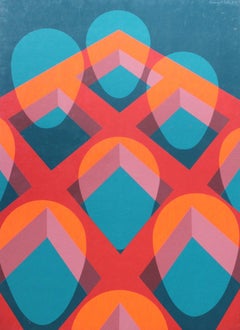
Transection No. 3, Ovoid Geometrical Figural Abstract Neon Acrylic Painting
By Clarence Holbrook Carter
Located in Beachwood, OH
Clarence Holbrook Carter (American, 1904-2000)
Transection No. 3, 1972
Acrylic on paper
Signed and dated upper right
30 x 22 inches
Provenance: Collection of William H. Milliken
Cl...
Category
1970s American Modern Howard Schleeter Abstract Paintings
Materials
Acrylic
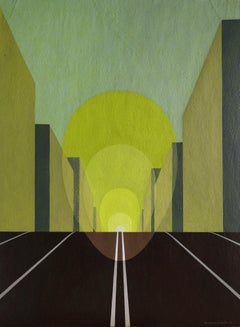
City Scape, Ovoid Geometrical Abstract Green
Brown Structures
By Clarence Holbrook Carter
Located in Beachwood, OH
Clarence Holbrook Carter (American, 1904-2000)
City Scape, 1978
Acrylic on scintilla
Signed and dated lower right
30 x 22 inches
A surrealist mid-century figural abstract painting....
Category
1970s American Modern Howard Schleeter Abstract Paintings
Materials
Acrylic
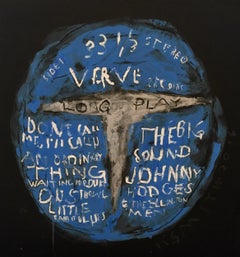
Johnny Hodges - The Big Sound (Grammy, Album Art, Iconic, Rock and Roll, Pop)
By Kerry Smith
Located in Kansas City, MO
Kerry Smith
Johnny Hodges - The Big Sound
Mixed Media on Crescent board
Year: 2016
Size: 21x20in
Signed, dated by hand
COA provided
Ref.: 91-0194
*Black frame with a mirror-gloss fi...
Category
2010s American Modern Howard Schleeter Abstract Paintings
Materials
Mixed Media, Acrylic, Gouache, Board
$888 Sale Price
25% Off
H 21 in W 22 in D 1 in
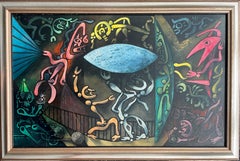
St. Atomic oil and tempera painting by Julio de Diego
By Julio de Diego
Located in Hudson, NY
Julio De Diego’s Atomic Series paintings made an extraordinary statement regarding the shock and fear that accompanied the dawn of the nuclear age. In the artist’s own words, “Scientists were working secretly to develop formidable powers taken from the mysterious depths of the earth - with the power to make the earth useless! Then, the EXPLOSION! . . . we entered the Atomic Age, and from there the neo-Atomic war begins. Explosions fell everywhere and man kept on fighting, discovering he could fight without flesh.”
To execute these works, De Diego developed a technique of using tempera underpainting before applying layer upon layer of pigmented oil glazes. The result is paintings with surfaces which were described as “bonelike” in quality. The forms seem to float freely, creating a three-dimensional visual effect. In the 1954 book The Modern Renaissance in American Art, author Ralph Pearson summarizes the series as “a fantastic interpretation of a weighty theme. Perhaps it is well to let fantasy and irony appear to lighten the devastating impact. By inverse action, they may in fact increase its weight.”
Exhibited
1950 University of Illinois at Urbana "Contemporary American Painting"
1964 Marion Koogler McNay Art Institute, San Antonio, Texas
This work retains its original frame which measures 54" x 36" x 2".
About this artist: Julio De Diego crafted a formidable persona within the artistic developments and political struggles of his time. The artist characterized his own work as “lyrical,” explaining, “through the years, the surrealists, the social-conscious painters and the others tried to adopt me, but I went my own way, good, bad or indifferent.” [1] His independence manifested early in life when de Diego left his parent’s home in Madrid, Spain, in adolescence following his father’s attempts to curtail his artistic aspirations. At the age of fifteen he held his first exhibition, set up within a gambling casino. He managed to acquire an apprenticeship in a studio producing scenery for Madrid’s operas, but moved from behind the curtains to the stage, trying his hand at acting and performing as an extra in the Ballet Russes’ Petrouchka with Nijinsky. He spent several years in the Spanish army, including a six-month stretch in the Rif War of 1920 in Northern Africa. His artistic career pushed ahead as he set off for Paris and became familiar with modernism’s forays into abstraction, surrealism, and cubism.
The artist arrived in the U.S. in 1924 and settled in Chicago two years later. He established himself with a commission for the decoration of two chapels in St. Gregory’s Church. He also worked in fashion illustration, designed magazine covers and developed a popular laundry bag for the Hotel Sherman. De Diego began exhibiting through the Art Institute of Chicago in 1929, and participated in the annual Chicago Artists Exhibitions, Annual American Exhibitions, and International Water Color Exhibitions. He held a solo exhibition at the Art Institute of Chicago in the summer of 1935. Though the artist’s career was advancing, his family life had deteriorated. In 1932 his first marriage dissolved, and the couple’s young daughter Kiriki was sent to live with friend Paul Hoffman.
De Diego continued to develop his artistic vocabulary with a growing interest in Mexican art. He traveled throughout the country acquainting himself with the works of muralists such as Carlos Merida, and also began a collection of small native artifacts...
Category
1940s American Modern Howard Schleeter Abstract Paintings
Materials
Masonite, Oil, Tempera
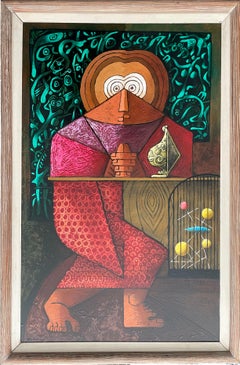
The Magician oil and tempera painting by Julio de Diego
By Julio de Diego
Located in Hudson, NY
Julio De Diego’s Atomic Series paintings made an extraordinary statement regarding the shock and fear that accompanied the dawn of the nuclear age. In the artist’s own words, “Scientists were working secretly to develop formidable powers taken from the mysterious depths of the earth - with the power to make the earth useless! Then, the EXPLOSION! . . . we entered the Atomic Age, and from there the neo-Atomic war begins. Explosions fell everywhere and man kept on fighting, discovering he could fight without flesh.”
To execute these works, De Diego developed a technique of using tempera underpainting before applying layer upon layer of pigmented oil glazes. The result is paintings with surfaces which were described as “bonelike” in quality. The forms seem to float freely, creating a three-dimensional visual effect. In the 1954 book The Modern Renaissance in American Art, author Ralph Pearson summarizes the series as “a fantastic interpretation of a weighty theme. Perhaps it is well to let fantasy and irony appear to lighten the devastating impact. By inverse action, they may in fact increase its weight.”
Exhibited
1964 Marion Koogler McNay Art Institute, San Antonio, Texas
This work retains its original frame which measures 54" x 42" x 2"
About this artist: Julio De Diego crafted a formidable persona within the artistic developments and political struggles of his time. The artist characterized his own work as “lyrical,” explaining, “through the years, the surrealists, the social-conscious painters and the others tried to adopt me, but I went my own way, good, bad or indifferent.” [1] His independence manifested early in life when de Diego left his parent’s home in Madrid, Spain, in adolescence following his father’s attempts to curtail his artistic aspirations. At the age of fifteen he held his first exhibition, set up within a gambling casino. He managed to acquire an apprenticeship in a studio producing scenery for Madrid’s operas, but moved from behind the curtains to the stage, trying his hand at acting and performing as an extra in the Ballet Russes’ Petrouchka with Nijinsky. He spent several years in the Spanish army, including a six-month stretch in the Rif War of 1920 in Northern Africa. His artistic career pushed ahead as he set off for Paris and became familiar with modernism’s forays into abstraction, surrealism, and cubism.
The artist arrived in the U.S. in 1924 and settled in Chicago two years later. He established himself with a commission for the decoration of two chapels in St. Gregory’s Church. He also worked in fashion illustration, designed magazine covers and developed a popular laundry bag for the Hotel Sherman. De Diego began exhibiting through the Art Institute of Chicago in 1929, and participated in the annual Chicago Artists Exhibitions, Annual American Exhibitions, and International Water Color Exhibitions. He held a solo exhibition at the Art Institute of Chicago in the summer of 1935. Though the artist’s career was advancing, his family life had deteriorated. In 1932 his first marriage dissolved, and the couple’s young daughter Kiriki was sent to live with friend Paul Hoffman.
De Diego continued to develop his artistic vocabulary with a growing interest in Mexican art. He traveled throughout the country acquainting himself with the works of muralists such as Carlos Merida, and also began a collection of small native artifacts...
Category
1940s American Modern Howard Schleeter Abstract Paintings
Materials
Masonite, Oil, Tempera
Previously Available Items
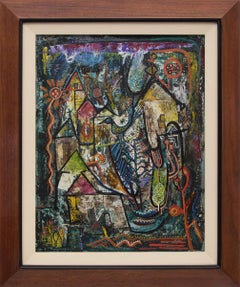
Blue Bird In A Landscape
By Howard Schleeter
Located in Denver, CO
Blue Bird In A Landscape (53 Goache Series). Housed in a custom hardwood frame, outer dimensions measure 24 ¼ x 22 ½ x 1 inches. Image size is 18 x 14 inches.
Howard Schleeter, th...
Category
Mid-20th Century Abstract Howard Schleeter Abstract Paintings
Materials
Mixed Media, Wax, Gouache
Howard Schleeter abstract paintings for sale on 1stDibs.
Find a wide variety of authentic Howard Schleeter abstract paintings available for sale on 1stDibs. You can also browse by medium to find art by Howard Schleeter in archival paper, gouache, organic material and more. Much of the original work by this artist or collective was created during the 1940s and is mostly associated with the modern style. Not every interior allows for large Howard Schleeter abstract paintings, so small editions measuring 32 inches across are available. Customers who are interested in this artist might also find the work of Julio de Diego, Clarence Holbrook Carter, and Donald Stacy. Howard Schleeter abstract paintings prices can differ depending upon medium, time period and other attributes. On 1stDibs, the price for these items starts at $9,200 and tops out at $9,200, while the average work can sell for $9,200.