Ira Moskowitz Landscape Prints
to
6
1
Overall Width
to
Overall Height
to
6
129
179
169
146
143
8
7
1
6
1
7
4
3
2
2
2
1
1
1
1
1
1
1
1
8
8
Artist: Ira Moskowitz
Navajo Reservation Landscape
— Southwest Regionalism
By Ira Moskowitz
Located in Myrtle Beach, SC
Ira Moskowitz, 'Navajo Reservation Landscape', lithograph, 1945, edition c. 30. Signed and titled in pencil. Signed and dated in the stone, lower left. A fine, richly-inked impression, on cream wove paper, the full sheet with margins (1 3/8 to 2 inches), in excellent condition. Matted to museum standards, unframed.
Image size 12 3/4 x 15 3/4 inches (324 x 400 mm); sheet size: 15 1/2 x 19 inches (394 x 482 mm).
ABOUT THE ARTIST
Ira Moskowitz was born in Galicia, Poland, in 1912, emigrating with his family to New York in 1927. He enrolled at the Art Student's League and studied there from 1928-31. In 1935, Moskowitz traveled to Paris and then lived until 1937 in what is now Israel. He returned to the United States in 1938 to marry artist Anna Barry in New York. The couple soon visited Taos and Santa Fe in New Mexico, returning for extended periods until 1944, when they moved there permanently, staying until 1949. During this especially productive New Mexico period, Moskowitz received a Guggenheim fellowship. His work was inspired by the New Mexico landscape and the state’s three cultures (American Southwest, Native American, and Mexican). He focused on Pueblo and Navajo life, producing an extensive oeuvre of authentic American Indian imagery. He and Anna also visited and sketched across the border in Old Mexico. While in the Southwest, Moskowitz flourished as a printmaker while continuing to produce oils and watercolors. Over 100 of Moskowitz’s works depicting Native American ceremonies were used to illustrate the book American Indian Ceremonial Dances by John Collier, Crown Publishers, New York, 1972.
After leaving the Southwest, printmaking remained an essential medium for the artist while his focus changed to subject matter celebrating Judaic religious life and customs. These works were well received early on, and Moskowitz was content to stay with them the rest of his life. From 1963 until 1966, Moskowitz lived in Paris, returning to New York City in 1967, where he made his permanent home until he died in 2001.
Shortly before his death, Zaplin-Lampert Gallery of Santa Fe staged an exhibition of the artist's works, December 2000 - January 2001. Other one-person shows included the 8th Street Playhouse, New York, 1934; Houston Museum, 1941; and the San Antonio Museum, 1941. The artist’s work was included in exhibitions at the Art Students League, Art Institute of Chicago, Philadelphia Print Club, College Art Association (promotes excellence in scholarship and teaching), and the International Exhibition of Graphic Arts (shown at MOMA, 1955).
Moskowitz’s lithographs of American Indian...
Category
1940s Ira Moskowitz Landscape Prints
Materials
Lithograph
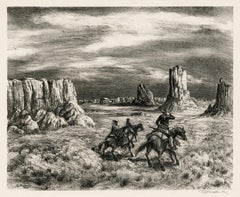
Navajo Horse Race
— Southwest Regionalism, American Indian
By Ira Moskowitz
Located in Myrtle Beach, SC
Ira Moskowitz, 'Navajo Horse Race', lithograph, 1946, edition 30, Czestochowski 204. Signed and titled in pencil. Signed and dated in the stone, lower le...
Category
1940s American Modern Ira Moskowitz Landscape Prints
Materials
Lithograph
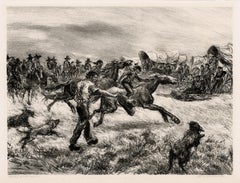
Navajo Trading Post
— Southwest Regionalism, American Indian
By Ira Moskowitz
Located in Myrtle Beach, SC
Ira Moskowitz, 'Navajo Trading Post', lithograph, 1946, edition 30, Czestochowski 161. Signed and dated in the stone, lower left. A fine, richly-inked impression, on cream wove paper, with full margins (1 1/2 to 3 1/8 inches). Pale mat line, otherwise in excellent condition. Matted to museum standards, unframed.
Image size 11 11/16 x 15 1/2 inches (297 x 395 mm); sheet size 16 5/16 x 191/8 inches (414 x 486 mm).
ABOUT THE ARTIST
Ira Moskowitz was born in Galicia, Poland, in 1912, emigrating with his family to New York in 1927. He enrolled at the Art Student's League and studied there from 1928-31. In 1935, Moskowitz traveled to Paris and then lived until 1937 in what is now Israel. He returned to the United States in 1938 to marry artist Anna Barry in New York. The couple soon visited Taos and Santa Fe in New Mexico, returning for extended periods until 1944, when they moved there permanently, staying until 1949. During this especially productive New Mexico period, Moskowitz received a Guggenheim fellowship. His work was inspired by the New Mexico landscape and the state’s three cultures (American Southwest, Native American, and Mexican). He focused on Pueblo and Navajo life, producing an extensive oeuvre of authentic American Indian imagery. He and Anna also visited and sketched across the border in Old Mexico. While in the Southwest, Moskowitz flourished as a printmaker while continuing to produce oils and watercolors. Over 100 of Moskowitz’s works depicting Native American ceremonies were used to illustrate the book American Indian Ceremonial Dances by John Collier, Crown Publishers, New York, 1972.
After leaving the Southwest, printmaking remained an essential medium for the artist while his focus changed to subject matter celebrating Judaic religious life and customs. These works were well received early on, and Moskowitz was content to stay with them the rest of his life. From 1963 until 1966, Moskowitz lived in Paris, returning to New York City in 1967, where he made his permanent home until he died in 2001.
Shortly before his death, Zaplin-Lampert Gallery of Santa Fe staged an exhibition of the artist's works, December 2000 - January 2001. Other one-person shows included the 8th Street Playhouse, New York, 1934; Houston Museum, 1941; and the San Antonio Museum, 1941. The artist’s work was included in exhibitions at the Art Students League, Art Institute of Chicago, Philadelphia Print Club, College Art Association (promotes excellence in scholarship and teaching), and the International Exhibition of Graphic Arts (shown at MOMA, 1955).
Moskowitz’s lithographs of American Indian...
Category
1940s American Modern Ira Moskowitz Landscape Prints
Materials
Lithograph
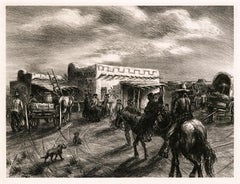
Navajo Medicine Ceremony of the Night Chant
— Southwest Regionalism
By Ira Moskowitz
Located in Myrtle Beach, SC
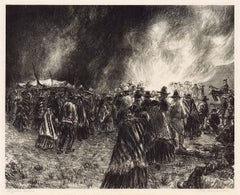
Ira Moskowitz, 'The Three Gods of Healing (Navajo Medicine Ceremony of the Night Chant)', lithograph, 1945, edition 30, Czestochowski 148. Signed and titled in pencil. Signed and dated in the stone, lower right. A fine, richly-inked impression, on cream wove paper, with full margins (2 1/4 to 2 3/4 inches), in excellent condition. Matted to museum standards, unframed.
Image size 12 1/4 x 15 13/16 inches (311 x 402 mm); sheet size 17 1/8 x 20 7/8 inches (435 x 530 mm).
ABOUT THIS WORK
The nine-night ceremony known as the Night Chant or Nightway is believed to date from around 1000 B.C.E. when it was first performed by the Indians who lived in Canyon de Chelly (now eastern Arizona). It is considered the most sacred of all Navajo ceremonies and one of the most difficult and demanding to learn, as it encompasses hundreds of songs, dozens of prayers, and several highly complex sand paintings. And yet the demand for Night Chants is so great that as many as fifty such ceremonies might be held during a single winter season, which lasts eighteen to twenty weeks.
The Night Chant is designed both to cure people who are ill and to restore the order and balance of human and non-human relationships within the Navajo universe. Led by a trained medicine man who has served a long apprenticeship and learned the intricate and detailed practices that are essential to the chant, the ceremony itself is capable of scaring off sickness and ugliness through techniques that shock or arouse. Once the disorder has been removed, order and balance are restored through song, prayer, sand painting, and other aspects of the ceremony.
The medicine men who supervise the Night Chant ensure that everything—each dot and line in every sand painting, each verse in every song, each feather on each mask is arranged precisely, or it will not bring about the desired result. There are probably as many active Night Chant medicine men today as at any time in Navajo history due to the general increase in the Navajo population, the popularity of the ceremony, and the central role it plays in Navajo life and health.
ABOUT THE ARTIST
Ira Moskowitz was born in Galicia, Poland, in 1912, emigrating with his family to New York in 1927. He enrolled at the Art Student's League and studied there from 1928-31. In 1935, Moskowitz traveled to Paris and then lived until 1937 in what is now Israel. He returned to the United States in 1938 to marry artist Anna Barry in New York. The couple soon visited Taos and Santa Fe in New Mexico, returning for extended periods until 1944, when they moved there permanently, staying until 1949. During this especially productive New Mexico period, Moskowitz received a Guggenheim fellowship. His work was inspired by the New Mexico landscape and the state’s three cultures (American Southwest, Native American, and Mexican). He focused on Pueblo and Navajo life, producing an extensive oeuvre of authentic American Indian imagery. He and Anna also visited and sketched across the border in Old Mexico. While in the Southwest, Moskowitz flourished as a printmaker while continuing to produce oils and watercolors. Over 100 of Moskowitz’s works depicting Native American ceremonies were used to illustrate the book American Indian Ceremonial Dances by John Collier, Crown Publishers, New York, 1972.
After leaving the Southwest, printmaking remained an essential medium for the artist while his focus changed to subject matter celebrating Judaic religious life and customs. These works were well received early on, and Moskowitz was content to stay with them the rest of his life. From 1963 until 1966, Moskowitz lived in Paris, returning to New York City in 1967, where he made his permanent home until he died in 2001.
Shortly before his death, Zaplin-Lampert Gallery of Santa Fe staged an exhibition of the artist's works, December 2000 - January 2001. Other one-person shows included the 8th Street Playhouse, New York, 1934; Houston Museum, 1941; and the San Antonio Museum, 1941. The artist’s work was included in exhibitions at the Art Students League, Art Institute of Chicago, Philadelphia Print Club, College Art Association (promotes excellence in scholarship and teaching), and the International Exhibition of Graphic Arts (shown at MOMA, 1955).
Moskowitz’s lithographs of...
Category
1940s American Modern Ira Moskowitz Landscape Prints
Materials
Lithograph
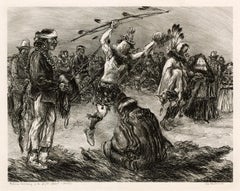
Navajo Courtship Dance
— Southwest Regionalism, American Indian
By Ira Moskowitz
Located in Myrtle Beach, SC
Ira Moskowitz, 'Navajo Courtship Dance (Squaw Dance)', lithograph, 1946, edition 30, Czestochowski 161. Signed and titled in pencil. Signed and dated in the stone, lower left. A fine, richly-inked impression, on cream wove paper; the full sheet with margins (7/16 to 2 3/4 inches). Pale mat line, otherwise in excellent condition. Matted to museum standards, unframed.
Image size 11 13/16 x 14 13/16 inches (300 x 376 mm); sheet size 13 1/16 x 20 1/8 inches (332 x 511 mm).
ABOUT THE ARTIST
Ira Moskowitz was born in Galicia, Poland, in 1912, emigrating with his family to New York in 1927. He enrolled at the Art Student's League and studied there from 1928-31. In 1935, Moskowitz traveled to Paris and then lived until 1937 in what is now Israel. He returned to the United States in 1938 to marry artist Anna Barry in New York. The couple soon visited Taos and Santa Fe in New Mexico, returning for extended periods until 1944, when they moved there permanently, staying until 1949. During this especially productive New Mexico period, Moskowitz received a Guggenheim fellowship. His work was inspired by the New Mexico landscape and the state’s three cultures (American Southwest, Native American, and Mexican). He focused on Pueblo and Navajo life, producing an extensive oeuvre of authentic American Indian imagery. He and Anna also visited and sketched across the border in Old Mexico. While in the Southwest, Moskowitz flourished as a printmaker while continuing to produce oils and watercolors. Over 100 of Moskowitz’s works depicting Native American ceremonies were used to illustrate the book American Indian Ceremonial Dances by John Collier, Crown Publishers, New York, 1972.
After leaving the Southwest, printmaking remained an essential medium for the artist while his focus changed to subject matter celebrating Judaic religious life and customs. These works were well received early on, and Moskowitz was content to stay with them the rest of his life. From 1963 until 1966, Moskowitz lived in Paris, returning to New York City in 1967, where he made his permanent home until he died in 2001.
Shortly before his death, Zaplin-Lampert Gallery of Santa Fe staged an exhibition of the artist's works, December 2000 - January 2001. Other one-person shows included the 8th Street Playhouse, New York, 1934; Houston Museum, 1941; and the San Antonio Museum, 1941. The artist’s work was included in exhibitions at the Art Students League, Art Institute of Chicago, Philadelphia Print Club, College Art Association (promotes excellence in scholarship and teaching), and the International Exhibition of Graphic Arts (shown at MOMA, 1955).
Moskowitz’s lithographs of...
Category
1940s American Modern Ira Moskowitz Landscape Prints
Materials
Lithograph
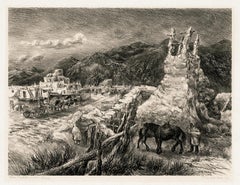
Taos - Relic of the Insurrection of 1845
— Southwest Regionalism
By Ira Moskowitz
Located in Myrtle Beach, SC
Ira Moskowitz, 'Relic of the Insurrection of 1845' also 'Taos Pueblo with Ruin)', lithograph, 1944, edition 30, Czestochowski 121. Signed and titled in pencil. Signed and dated in the stone, lower right. A fine, richly-inked impression, on cream wove paper, with full margins (1 3/8 to 1 15/16 inches). Very pale light toning within a previous mat opening, otherwise in excellent condition. Matted to museum standards, unframed.
Image size 11 5/8 x 15 1/2 inches (296 x 394 mm); sheet size 15 1/8 x 19 inches (384 x 483 mm).
ABOUT THE IMAGE
The Taos Revolt was a populist insurrection in January 1847 by Hispano and Pueblo allies against the United States occupation of present-day northern New Mexico during the Mexican–American War. The rebels killed provisional governor Charles Bent and several other Americans. In two short campaigns, United States troops and militia crushed the rebellion of the Hispano and Pueblo people. The New Mexicans, seeking better representation, regrouped and fought three more engagements, but after being defeated, they abandoned open warfare. The hatred of New Mexicans for the occupying American army, combined with the rebelliousness of Taos residents against imposed outside authority, were causes of the revolt. In the uprising's aftermath, the Americans executed at least 28 rebels. The Treaty of Guadalupe Hidalgo in 1850 guaranteed the property rights of New Mexico's Hispanic and American Indian residents.
ABOUT THE ARTIST
Ira Moskowitz was born in Galicia, Poland, in 1912, emigrating with his family to New York in 1927. He enrolled at the Art Student's League and studied there from 1928-31. In 1935, Moskowitz traveled to Paris and then lived until 1937 in what is now Israel. He returned to the United States in 1938 to marry artist Anna Barry in New York. The couple soon visited Taos and Santa Fe in New Mexico, returning for extended periods until 1944, when they moved there permanently, staying until 1949. During this especially productive New Mexico period, Moskowitz received a Guggenheim fellowship. His work was inspired by the New Mexico landscape and the state’s three cultures (American Southwest, Native American, and Mexican). He focused on Pueblo and Navajo life, producing an extensive oeuvre of authentic American Indian imagery. He and Anna also visited and sketched across the border in Old Mexico. While in the Southwest, Moskowitz flourished as a printmaker while continuing to produce oils and watercolors. Over 100 of Moskowitz’s works depicting Native American ceremonies were used to illustrate the book American Indian Ceremonial Dances by John Collier, Crown Publishers, New York, 1972.
After leaving the Southwest, printmaking remained an essential medium for the artist while his focus changed to subject matter celebrating Judaic religious life and customs. These works were well received early on, and Moskowitz was content to stay with them the rest of his life. From 1963 until 1966, Moskowitz lived in Paris, returning to New York City in 1967, where he made his permanent home until he died in 2001.
Shortly before his death, Zaplin-Lampert Gallery of Santa Fe staged an exhibition of the artist's works, December 2000 - January 2001. Other one-person shows included the 8th Street Playhouse, New York, 1934; Houston Museum, 1941; and the San Antonio Museum, 1941. The artist’s work was included in exhibitions at the Art Students League, Art Institute of Chicago, Philadelphia Print Club, College Art Association (promotes excellence in scholarship and teaching), and the International Exhibition of Graphic Arts (shown at MOMA, 1955).
Moskowitz’s lithographs of American Indian...
Category
1940s American Modern Ira Moskowitz Landscape Prints
Materials
Lithograph
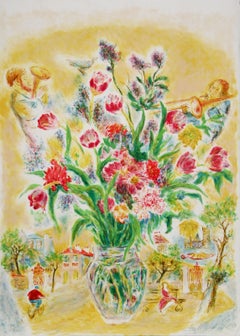
Flowers 5, Modern Lithograph by Ira Moskowitz
By Ira Moskowitz
Located in Long Island City, NY
Ira Moskowitz, Polish/American (1912 - 2001) - Flowers 5, Year: circa 1979, Medium: Lithograph, signed and numbered in pencil, Edition: 200, Size: 30 in. x 21.5 in. (76.2 cm x 54.61...
Category
1970s Modern Ira Moskowitz Landscape Prints
Materials
Lithograph
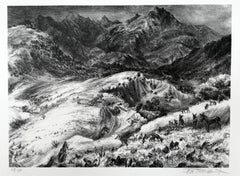
Mountain Scene
By Ira Moskowitz
Located in New York, NY
Ira Moskowitz (1912-1985), [Mountain Scene], 1943, lithograph, signed in pencil lower right, numbered lower left (27/50) [also signed and dated 1943 in ...
Category
1940s American Realist Ira Moskowitz Landscape Prints
Materials
Lithograph
Related Items
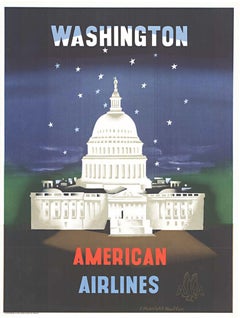
Original Washington D.C. American Airlines vintage travel poster Midcentury
By Edward McKnight Kauffer
Located in Spokane, WA
Original Washington (D.C.) American Airlines mid-century vintage travel poster. Professional archival linen backed in very fine condition, ready to frame.
Featuring one of the ...
Category
1940s American Modern Ira Moskowitz Landscape Prints
Materials
Lithograph

$1,598
H 40 in W 30 in D 0.05 in
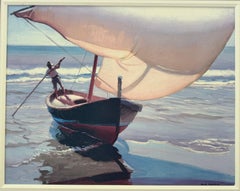
Fishing boat, Spain
By Arthur Rider
Located in Cliffside Park, NJ
Arthur Grover Rider (American 1885-1975)
Offset Litho on board of fisherman in Spain.
Professionally framed and matted in gilt frame.
Born in Chicago, IL on March 21, 1886. Rider ...
Category
20th Century Ira Moskowitz Landscape Prints
Materials
Lithograph, Offset
Haystack
By Thomas Hart Benton
Located in London, GB
A fine impression of this very popular image with full margins (smaller on top and bottom) published by Associated American Artists.
Category
1930s American Modern Ira Moskowitz Landscape Prints
Materials
Lithograph
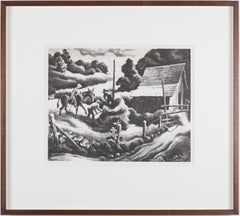
Prodigal Son
By Thomas Hart Benton
Located in London, GB
A man raises his hand to his chin, his neck tilted and face turned to look at a dilapidated farmhouse, barely held together by planks of wood and exposed to the elements. Behind him ...
Category
1930s American Modern Ira Moskowitz Landscape Prints
Materials
Lithograph
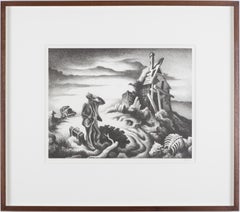
Down the River
By Thomas Hart Benton
Located in London, GB
In this sentimental work from 1939, Benton expresses his admiration for the rural lifestyle of the Midwest. He highlights the connection between man and the land by depicting two fig...
Category
1930s American Modern Ira Moskowitz Landscape Prints
Materials
Lithograph
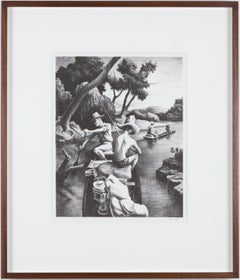
Nebraska Evening
By Thomas Hart Benton
Located in London, GB
A fine impression with good margins published by Associated American Artists.
Category
1940s American Modern Ira Moskowitz Landscape Prints
Materials
Lithograph
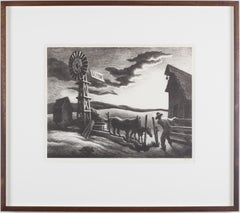
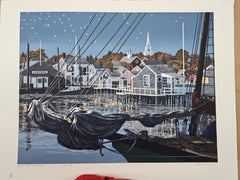
Nantucket North Wharf Night Sky Blue Sailboat Seaside Silkscreen Cottages Sea
By Donn Russell
Located in Nantucket, MA
Donn Russell made his own screen and did his own inking of the prints. He had no assistants and used no computers. He captured the beauty and charm of Nantucket and created images th...
Category
1970s American Realist Ira Moskowitz Landscape Prints
Materials
Lithograph
$400
H 22 in W 29.25 in D 1 in
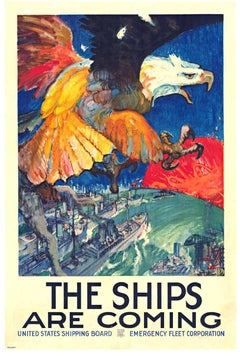
Original "The Ships Are Coming" vintage American poster with an Eagle.
By James Henry Daugherty
Located in Spokane, WA
Original: THE SHIPS ARE COMING vintage poster. Artist: James H. Daugherty (1889-1974)
Publisher: U.S. Shipping Board, Emergency Fleet Corporation, Publication Section, Philadelphia, 1917.
Poster showing a giant eagle...
Category
1910s American Modern Ira Moskowitz Landscape Prints
Materials
Lithograph
James Henry DaughertyOriginal "The Ships Are Coming" vintage American poster with an Eagle., 1917-18
$1,663 Sale Price
20% Off
H 30 in W 20 in D 0.05 in
The Tennis Court - Mandela, South African President, Signed, Robben Island, sport
By Nelson Mandela
Located in Knowle Lane, Cranleigh
Nelson Mandela, The Tennis Court, Signed Limited Edition Lithograph
Many people are unaware that Nelson Mandela turned his hand to art in his 80's as a way of leaving a legacy for hi...
Category
Early 2000s Contemporary Ira Moskowitz Landscape Prints
Materials
Lithograph
$10,226
H 15.75 in W 20.08 in D 1.58 in
Original A Wonderful Opportunity for You, United States Navy 1917 vintage poster
Located in Spokane, WA
Original WW1 poster: A Wonderful Opportunity for You. Ashore, on leave. United States Navy. A pre-war recruiting lithographic poster features an ebullient sailor going home o...
Category
1910s American Modern Ira Moskowitz Landscape Prints
Materials
Lithograph

$1,575
H 28.25 in W 20.75 in D 0.05 in
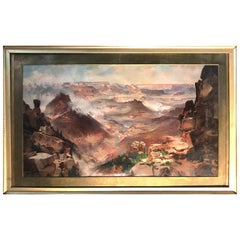
Thomas Moran Chromolithograph Print 1893 of the Grand Canyon
By Thomas Moran
Located in Rome, IT
Created by Gustav Buek from an original oil painting made in 1892 by Thomas Moran. The painting is today owned by the Philadelphia Museum of Art in Philadelphia, Pennsylvania. Both w...
Category
Late 19th Century Ira Moskowitz Landscape Prints
Materials
Lithograph
$11,506 Sale Price
20% Off
H 37.41 in W 54.34 in D 3.15 in
The Harbour - Mandela, Former South African President, Signed Art, Robben Island
By Nelson Mandela
Located in Knowle Lane, Cranleigh
Nelson Mandela, The Harbour, Signed Limited Edition Lithograph
Many people are unaware that Nelson Mandela turned his hand to art in his 80's as a way of leaving a legacy for his fam...
Category
Early 2000s Contemporary Ira Moskowitz Landscape Prints
Materials
Lithograph
Nelson MandelaThe Harbour - Mandela, Former South African President, Signed Art, Robben Island, 2002
$8,862
H 19.69 in W 25.6 in D 1.58 in
Previously Available Items
Shalakos Approaching Ceremonial Ground - Zuni
— 1940s Southwest Regionalism
By Ira Moskowitz
Located in Myrtle Beach, SC
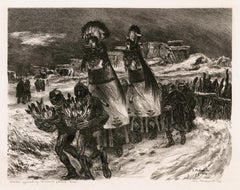
Ira Moskowitz, 'Shalakos Approaching Ceremonial Ground - Zuni', lithograph, 1946, edition c. 30, Czestochowski 181. Signed, dated, and titled in pencil. Signed and dated in the stone, lower right. A fine, richly-inked impression, on cream wove paper, with full margins (2 3/16 to 3 13/16 inches), in excellent condition. Matted to museum standards, unframed.
Image size 11 1/2 x 15 1/16 inches (293 x 383 mm); sheet size 17 5/8 x 20 7/8 inches (448 x 530 mm).
ABOUT THIS WORK
The Shálako festival is a succession of traditional dances, chants, and ceremonies conducted by the Native American Zuni people, which takes place each year on or about December 1st. The Shalakos (two men selected by each kiva) perform the sacred ceremony for the dual purpose of invoking the divine blessing upon newly built houses and of rendering thanks to the gods for the year's harvests.
ABOUT THE ARTIST
Ira Moskowitz was born in Galicia, Poland, in 1912, emigrating with his family to New York in 1927. He enrolled at the Art Student's League and studied there from 1928-31. In 1935, Moskowitz traveled to Paris and then lived until 1937 in what is now Israel. He returned to the United States in 1938 to marry artist Anna Barry in New York. The couple soon visited Taos and Santa Fe in New Mexico, returning for extended periods until 1944, when they moved there permanently, staying until 1949. During this especially productive New Mexico period, Moskowitz received a Guggenheim fellowship. His work was inspired by the New Mexico landscape and the state’s three cultures (American Southwest, Native American, and Mexican). He focused on Pueblo and Navajo life, producing an extensive oeuvre of authentic American Indian imagery. He and Anna also visited and sketched across the border in Old Mexico. While in the Southwest, Moskowitz flourished as a printmaker while continuing to produce oils and watercolors. Over 100 of Moskowitz’s works depicting Native American ceremonies were used to illustrate the book American Indian Ceremonial Dances by John Collier, Crown Publishers, New York, 1972.
After leaving the Southwest, printmaking remained an essential medium for the artist while his focus changed to subject matter celebrating Judaic religious life and customs. These works were well received early on, and Moskowitz was content to stay with them the rest of his life. From 1963 until 1966, Moskowitz lived in Paris, returning to New York City in 1967, where he made his permanent home until he died in 2001.
Shortly before his death, Zaplin-Lampert Gallery of Santa Fe staged an exhibition of the artist's works, December 2000 - January 2001. Other one-person shows included the 8th Street Playhouse, New York, 1934; Houston Museum, 1941; and the San Antonio Museum, 1941. The artist’s work was included in exhibitions at the Art Students League, Art Institute of Chicago, Philadelphia Print Club, College Art Association (promotes excellence in scholarship and teaching), and the International Exhibition of Graphic Arts (shown at MOMA, 1955).
Moskowitz’s lithographs of American Indian...
Category
1940s American Modern Ira Moskowitz Landscape Prints
Materials
Lithograph
Ira Moskowitz landscape prints for sale on 1stDibs.
Find a wide variety of authentic Ira Moskowitz landscape prints available for sale on 1stDibs. You can also browse by medium to find art by Ira Moskowitz in lithograph and more. Much of the original work by this artist or collective was created during the 1940s and is mostly associated with the modern style. Not every interior allows for large Ira Moskowitz landscape prints, so small editions measuring 15 inches across are available. Customers who are interested in this artist might also find the work of Lawrence Wilbur, Gordon Grant, and Thomas Hart Benton. Ira Moskowitz landscape prints prices can differ depending upon medium, time period and other attributes. On 1stDibs, the price for these items starts at $475 and tops out at $1,250, while the average work can sell for $1,000.