Irene Awret Art
to
3
Overall Width
to
Overall Height
to
3
3
3
2
1
1
1
1
1
1
2
2
2
1
4
10,273
2,785
2,504
1,383
3
Artist: Irene Awret
Girl
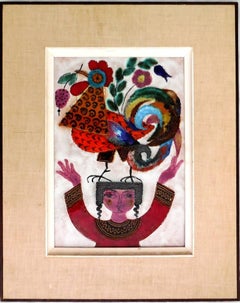
Rooster Enamel Glazed Ceramic Plaque Israeli Artist Awret Naive Folk Art
By Irene Awret
Located in Surfside, FL
This is a rare ceramic plaque painted with enamel glaze by famed Israeli German artist Irene Awret is signed Awret Safed on the verso. the actual glazed ceramic is 10X15 inches.
Irèn...
Category
1950s Expressionist Irene Awret Art
Materials
Enamel
Girl
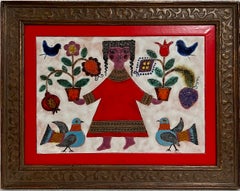
Plants Enamel Glazed Ceramic Plaque Israeli Artist Awret Naive Folk Art
By Irene Awret
Located in Surfside, FL
This is a rare ceramic plaque painted with enamel glaze by famed Israeli German artist Irene Awret (these are generally hand signed Awret Safed on the verso. I just have not opened the frame to check) the actual glazed ceramic is 10.25 X 14.75 inches.
It depicts a girl or woman with potted plants, birds, pomegranates and other fruits and flowers in a naif, folk art style.
Irène Awret was born to a Jewish family in Berlin called Spicker, the youngest of three children. Her mother died in 1927, when Irène was six years old. In 1937 she was forced to stop high school, due to the Nazi race laws. Because she could not continue her regular studies, her father sent her to study drawing, painting and art restoration with a Jewish painter. Among his students were a large number of German Jews who knew they would have to leave Germany within a short time and would require a profession to enable them to support themselves.
When the situation grew worse, following the Kristallnacht (the first major attack on German and Austrian Jews in November 1938), her uncle decided to move to Belgium. In 1939 the situation became even worse - her father was fired from his job and the family were forced to leave their home. As a result, Awret's father tried to send her and her sister to Belgium, with the help of smugglers. The first smuggler proved to be a double agent and they were sent back from Aachen to Berlin. Two weeks later they made a second, successful, attempt to sneak across the border.
Awret worked for a Dutch Jewish family as a maid. As she had her room and board there, she was able to save enough money to study art part-time at Brussels' Académie Royal des Beaux-Arts. A few months later Awret's father joined her and her financial situation became easier. She left her job and studied full-time, helping support herself with restoration work when it was available and by painting portraits to order.
Later, Awret found a hiding place on a farm in Waterloo with a Jewish family who were connected with the underground. In January 1943 she had to return to Brussels, living with a false identity card which stated she was a married woman with two children. Awret succeeded in renting an attic without informing the police where she was - she told her landlady that she had been forced to flee her husband because he beat her. While there, she supported herself by restoring wooden sculptures.
A Jewish informer gave her up to the Gestapo, accompanying the two Gestapo men who arrested her. Awret was able to take a bag containing food and drawing materials. She was detained in the Gestapo cellars in Brussels where she drew. Because there was nothing there to draw, she sketched her own hand (view this work). Awret was interrogated in order to reveal the hiding place of her father who was still in Brussels. The National Socialist regime was determined to persecute him, even though he had fought for Germany in World War I and been permanently disabled. They stepped up their torture and brought Awret before Hartmann, the head of the Gestapo in Brussels. When Hartmann saw her block of drawings, he asked her where she had studied art and halted the interrogation.
Awret was placed in a narrow cell and then transferred to Malines camp, which the Belgian's called Mechelen. Malines was a transit camp to Auschwitz, regularly sending 2000 people at a time. Although she arrived just before Transport No. 20, Irène Awret avoided being included. Instead she was put to work in the leather workshop, decorating broaches. While she was there, Hartmann visited the camp and spotted her: "I could have discovered where your father is hiding," he told her. When her artistic talents became known, she was transferred to the Mahlerstube (artist's workshop) where she worked producing graphics for the Germans until the end of the war. When Carol (Karel) Deutsch (whose works are now on view at Yad Vashem) was sent from Mechelen to his death with his wife, he left young Irene his paintbox. Irene also recalls seeing the great painter Felix Nussbaum and his wife being pushed into a boxcar bound for the gas, and tells of the aftermath of the famous 20th Train incident, when a young Jewish doctor armed only with a pistol and helped by two unarmed friends with a lantern ambushed one of Mechelen's Auschwitz-bound trains carrying 1,618 Jews, most of whom had fled Eastern Europe for Belgium.
Awret's job enabled her to paint and draw - mainly in pencil, but also in watercolors and oils. In the artists' workshop she met a Jewish refugee from Poland - Azriel Awret - who would later become her husband. Among the other artists in the workshop were Herbert von Ledermann-Vütemberg, a sculptor from an aristocratic family with Jewish roots, Léon Landau, and Smilowitz, who perished in the camps in the East. Irène and Azriel tried to bribe a German officer to prevent Smilowitz's deportation. Not only were they unsuccessful, but they were almost put onto the same train. Jacques Ochs was another artist with whom they became friends in the camp. Ochs, a French-born Protestant who lived in Belgium, was interned as a political prisoner. He remained in Belgium after liberation.
After the war the Awrets immigrated to Israel and made their home in Safed. They continued to work, and were instrumental in founding Safed's artists' quarter.
The Beit Lohamei Haghetaot (Ghetto Fighters' House Museum) art collection holds works donated by Awret. These date from her time in Malines camp and from her stay in Brussels after the war, when she was in the company of orphans who had hidden while their parents were sent to Auschwitz. Her highly expressive works have made their way to exhibitions at theTel Aviv Museum, the Haifa Museum of Modern Art and the Modern Art Gallery in Washington, D.C., as well as into the private collections of such individuals as Dr. Jonas Salk...
Category
1950s Expressionist Irene Awret Art
Materials
Enamel
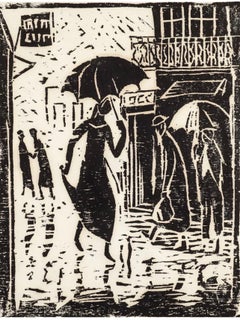
Woodblock Print Polish Israeli Artist Azriel Awret Rainy Street Jerusalem Israel
By Irene Awret
Located in Surfside, FL
Awret, Azriel (Polish Israeli, 1910-2010),
Rainy Street in Jerusalem,
Woodblock print, 9.75 x 7.5 inches, pencil hand signed and numbered 35/60, framed measuring 19.5 x 14.25 inches.
Azriel Awret was born in Lodz, Poland, and moved to Belgium where he lived in Brussels. He married an Aryan woman, Anna Louisa Bonhiere, which saved him from deportation. But in January 1943 he was interned in Malines camp. Awret was an engineer, so he was given employment as an electrician. While in Malines he met Irène Spicker, who was working in the Mahlerstube (art workshop). They married after the war and moved to Israel, settling in Safed and continuing their artistic activity. Today they divide their time between Israel and the United States.
The Beit Lohamei Haghetaot (The Ghetto Fighters’ House Museum) art collection includes works by Awret from his time in Malines. These works depict various aspects of life in Malines, including figures of internees. They were donated by the artist.
He collaborated with his wife in a naif, folk art style.
Irène Awret...
Category
1950s Expressionist Irene Awret Art
Materials
Woodcut
Related Items
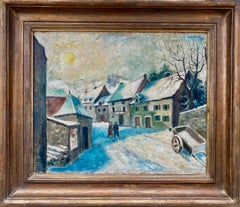
No Ordinary Winter
s Tale: Resilience, the War 1943, German Expressionist oil
Located in Norwich, GB
This is no ordinary winter scene. It is the story of prosecution and survival; of resolve and resilience during World War 2, as it was experienced by German Expressionist Heinz Lohma...
Category
1940s Expressionist Irene Awret Art
Materials
Oil, Board

$1,580
H 19.69 in W 22.84 in D 1.78 in
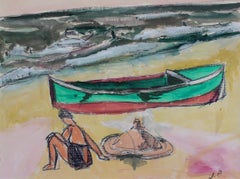
Small Boat and Bather in Dinard
By Jean Pons
Located in London, GB
'Small Boat and Bather in Dinard', gouache and charcoal on art paper, by French artist, Jean Pons (1961). Painted in a naïve style, the piece dep...
Category
1960s Expressionist Irene Awret Art
Materials
Paper, Charcoal, Gouache
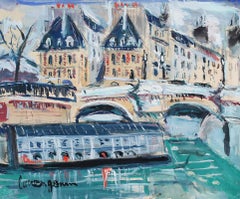
Le Pont Neuf
By Lucien Génin
Located in London, GB
'Le Pont Neuf', gouache on fine art paper, by Lucien Génin (circa 1930s). The Pont Neuf is the oldest standing bridge across the river Seine in Paris, France. It stands by the western point of the Île de la Cité, the island in the middle of the river that was, between 250 and 225 BC, the birthplace of Paris. It is called 'The New Bridge' because at the time of its inauguration (built 1578-1607), it embodied a very modern look compared to other bridges which spanned the Seine. Lucien Génin has captured its beauty in this lively depiction from the 1930s. Just before the bridge is a 'Bateau Mouche' an open excursion boat that provides visitors with a view of the city from along the river. The artwork is in good overall condition commensurate with age and medium used. It has been newly frame with anti-reflective glass. Please enjoy the photos accompanying this listing. Signed by the artist in the lower left hand. Upon request a video may be provided.
About the Artist: After the devastation of the First World War, Lucien Génin (1894 - 1953) left his provincial home in the autumn of 1919 to find his fortune among the lively Parisians in the heart of Montmartre. Génin befriended the painters Frank Will, Gen Paul, Émile Boyer, Marcel Leprin...
Category
1930s Expressionist Irene Awret Art
Materials
Paper, Gouache
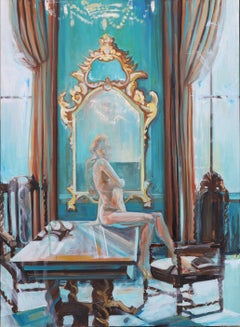
Nude in Venice - original large interior oil painting Paula Craioveanu 55x40in
By Paula Craioveanu
Located in Forest Hills, NY
"Nude in Venice" - original large art by Paula Craioveanu - Contemporary Expressionism
Original, large, unique painting, oil on canvas, 55x40in / 140x102cm.
Shipped rolled in a tube...
Category
2010s Expressionist Irene Awret Art
Materials
Canvas, Oil
Paula CraioveanuNude in Venice - original large interior oil painting Paula Craioveanu 55x40in, 2019
$3,000
H 59 in W 39 in D 1 in
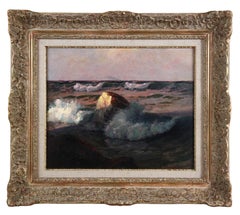
Oil painting on board "Rough sea with steamer on the horizon" by S.A.Vinogradoff
Located in Gavere, BE
Sergey VINOGRADOV ( 1869 - 1938 )
Rough sea with steamer on the horizon
Sergei Arsenievich Vinogradov ( Russian: 1869–1938 ) was a Russian-Soviet Impressionist painter; known for l...
Category
1920s Expressionist Irene Awret Art
Materials
Gold Leaf
$11,385
H 21.26 in W 24.41 in D 2.37 in
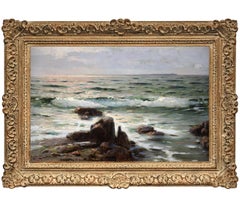
Oil painting on canvas " Rough sea with coastline on the horizon " by Schubring
By Richard Schubring
Located in Gavere, BE
Schubring, Richard (1853-1902)
Rough sea with coastline on the horizon
Oil on canvas. Signed and dated lower right. “1895”
Richard SCHUBRING is an artist born in 1853 and deceased...
Category
1890s Expressionist Irene Awret Art
Materials
Gold Leaf
$5,393
H 11.82 in W 16.93 in D 0.79 in
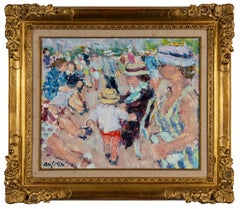
Personnages Dans un Parc
By Pierre Anfosso
Located in Sheffield, MA
Pierre Anfosso
French, 1928-2004
Personnages Dans un Parc
Oil on Canvas
15 by 18 in, w/ frame 21 ½ by 24 ½ in
Signed lower left
Pierre Anfosso (1 Dece...
Category
Mid-20th Century Expressionist Irene Awret Art
Materials
Oil
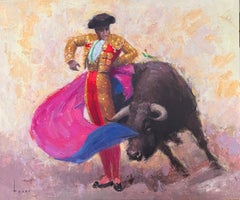
Cape Maneuver bullfighter oil painting
Located in Sitges, Barcelona
Title: Cape Maneuver
Artist: José María Tuser Vázquez (Barcelona, 1919 – 1986)
Technique: Oil on canvas mounted on board
Dimensions: 19.7 x 23.6 in (50 x 60 cm)
Date: Circa 1980s
Signature: Signed "Tuser" in the lower left corner
Condition: Excellent; thick, vibrant brushwork and vivid colors well preserved.
📝 Description
This painting captures a dramatic moment in the bullfight — the classic verónica — as the matador gracefully halts the bull’s charge with a sweeping motion of the cape. The vivid contrast of magentas, blues, and golds intensifies the theatrical tension between man and beast. The composition is dynamic yet controlled, emphasizing the poise of the torero against the raw force of the bull.
The expressive brushstrokes and thick impasto enhance the sense of movement, while the abstracted background ensures focus remains on the central figures. The piece is a striking blend of figuration and emotional energy, characteristic of Tuser’s taurine works.
👤 About the Artist: José María Tuser Vázquez
José María Tuser Vázquez was a Spanish painter born in Barcelona in 1919. He studied at the Barcelona School of Arts and Crafts and began exhibiting in the 1940s. By 1947, he had fully devoted his career to bullfighting scenes, developing a distinctive figurative expressionist style with impressionist influences.
He collaborated with the magazine El Ruedo, creating numerous illustrations and covers, and designed collectible postcards for Editorial Artigas. His work became well-known in Spanish artistic circles and is now part of both private and institutional collections, including the Club Taurino of London.
His paintings have been auctioned internationally, reaching up to $3,000 depending on size and subject. His legacy is that of a painter who masterfully captured the emotion, tradition, and drama of the Spanish corrida.
🎨 Similar Artists
José María Tuser Vázquez’s work shares thematic and stylistic elements with:
Roberto Domingo – A pioneer of bullfighting art...
Category
1970s Expressionist Irene Awret Art
Materials
Canvas, Oil, Board
$898 Sale Price
50% Off
H 19.69 in W 23.63 in
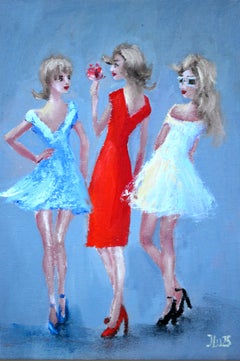
3 funny fashionistas. Original impasto Miniature Oil Gift Art.
Located in Zofingen, AG
This original oil painting captures the joyful spirit of three funny fashionistas. The artist's use of impasto creates a textured surface that brings these characters to life with pl...
Category
2010s Expressionist Irene Awret Art
Materials
Canvas, Oil, Cardboard
$467
H 11.82 in W 8.27 in D 0.12 in
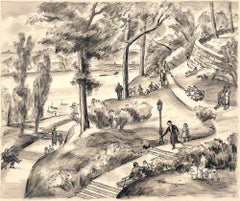
Fort Tryon Park
Located in Middletown, NY
Ink and wash in gray ink on buff wove paper, 13 1/4 x 15 inches (337 x 382 mm), the full sheet. Signed in pencil in the lower right margin. In good condition with a 2-inch horizontal...
Category
Mid-20th Century American Modern Irene Awret Art
Materials
Handmade Paper, Ink
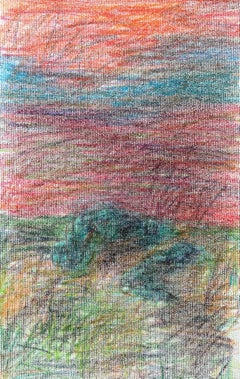
Body in the Field #13 - 21st Century, Red, Orange, Green, Contemporary
By Zsolt Berszán
Located in Baden-Baden, DE
Body in the Field #13, 2022
coloured pencils on canvas
9.84 H x 6.29 W in.
25 H x 16 W cm
Signed and dated on reverse
Zsolt Berszán embodies in his work...
Category
2010s Expressionist Irene Awret Art
Materials
Canvas, Color Pencil
Agres
By Airom
Located in Santa Monica, CA
Enigmatic outsider surrealist work by Australian artist Airom
Category
21st Century and Contemporary Expressionist Irene Awret Art
Materials
Oil
Previously Available Items
Girl
Rooster Enamel Glazed Ceramic Plaque Israeli Artist Awret Naive Folk Art
By Irene Awret
Located in Surfside, FL
This is a rare ceramic plaque painted with enamel glaze by famed Israeli German artist Irene Awret is signed Awret Safed on the verso. the actual glazed ceramic is 10X15 inches.
Irène Awret was born to a Jewish family in Berlin called Spicker, the youngest of three children. Her mother died in 1927, when Irène was six years old. In 1937 she was forced to stop high school, due to the Nazi race laws. Because she could not continue her regular studies, her father sent her to study drawing, painting and art restoration with a Jewish painter. Among his students were a large number of German Jews who knew they would have to leave Germany within a short time and would require a profession to enable them to support themselves.
When the situation grew worse, following the Kristallnacht (the first major attack on German and Austrian Jews in November 1938), her uncle decided to move to Belgium. In 1939 the situation became even worse - her father was fired from his job and the family were forced to leave their home. As a result, Awret's father tried to send her and her sister to Belgium, with the help of smugglers. The first smuggler proved to be a double agent and they were sent back from Aachen to Berlin. Two weeks later they made a second, successful, attempt to sneak across the border.
Awret worked for a Dutch Jewish family as a maid. As she had her room and board there, she was able to save enough money to study art part-time at Brussels' Académie Royal des Beaux-Arts. A few months later Awret's father joined her and her financial situation became easier. She left her job and studied full-time, helping support herself with restoration work when it was available and by painting portraits to order.
Later, Awret found a hiding place on a farm in Waterloo with a Jewish family who were connected with the underground. In January 1943 she had to return to Brussels, living with a false identity card which stated she was a married woman with two children. Awret succeeded in renting an attic without informing the police where she was - she told her landlady that she had been forced to flee her husband because he beat her. While there, she supported herself by restoring wooden sculptures.
A Jewish informer gave her up to the Gestapo, accompanying the two Gestapo men who arrested her. Awret was able to take a bag containing food and drawing materials. She was detained in the Gestapo cellars in Brussels where she drew. Because there was nothing there to draw, she sketched her own hand (view this work). Awret was interrogated in order to reveal the hiding place of her father who was still in Brussels. The National Socialist regime was determined to persecute him, even though he had fought for Germany in World War I and been permanently disabled. They stepped up their torture and brought Awret before Hartmann, the head of the Gestapo in Brussels. When Hartmann saw her block of drawings, he asked her where she had studied art and halted the interrogation.
Awret was placed in a narrow cell and then transferred to Malines camp, which the Belgian's called Mechelen. Malines was a transit camp to Auschwitz, regularly sending 2000 people at a time. Although she arrived just before Transport No. 20, Irène Awret avoided being included. Instead she was put to work in the leather workshop, decorating broaches. While she was there, Hartmann visited the camp and spotted her: "I could have discovered where your father is hiding," he told her. When her artistic talents became known, she was transferred to the Mahlerstube (artist's workshop) where she worked producing graphics for the Germans until the end of the war. When Carol (Karel) Deutsch (whose works are now on view at Yad Vashem) was sent from Mechelen to his death with his wife, he left young Irene his paintbox. Irene also recalls seeing the great painter Felix Nussbaum and his wife being pushed into a boxcar bound for the gas, and tells of the aftermath of the famous 20th Train incident, when a young Jewish doctor armed only with a pistol and helped by two unarmed friends with a lantern ambushed one of Mechelen's Auschwitz-bound trains carrying 1,618 Jews, most of whom had fled Eastern Europe for Belgium.
Awret's job enabled her to paint and draw - mainly in pencil, but also in watercolors and oils. In the artists' workshop she met a Jewish refugee from Poland - Azriel Awret...
Category
1950s Expressionist Irene Awret Art
Materials
Enamel
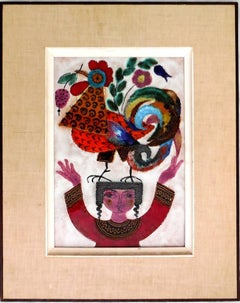
Glazed Israeli Folk Art Naive Tile Figure with Flowers and Birds
By Irene Awret
Located in Surfside, FL
Genre: Modern
Subject: Figures
Medium: Tile, Glaze
Dimensions: 10 1/4 x 14 3/4
Dimensions w/Frame: 16 3/4 x 21 1/2
This is a rare glazed fired ceramic plaque painted with enamel glaze by famed Israeli German artist Irene Awret.
Irène Awret was born to a Jewish family in Berlin called Spicker, the youngest of three children. Her mother died in 1927, when Irène was six years old. In 1937 she was forced to stop high school, due to the Nazi race laws. Because she could not continue her regular studies, her father sent her to study drawing, painting and art restoration with a Jewish painter. Among his students were a large number of German Jews who knew they would have to leave Germany within a short time and would require a profession to enable them to support themselves.
When the situation grew worse, following the Kristallnacht (the first major attack on German and Austrian Jews in November 1938), her uncle decided to move to Belgium. In 1939 the situation became even worse - her father was fired from his job and the family were forced to leave their home. As a result, Awret's father tried to send her and her sister to Belgium, with the help of smugglers. The first smuggler proved to be a double agent and they were sent back from Aachen to Berlin. Two weeks later they made a second, successful, attempt to sneak across the border.
Awret worked for a Dutch Jewish family as a maid. As she had her room and board there, she was able to save enough money to study art part-time at Brussels' Académie Royal des Beaux-Arts. A few months later Awret's father joined her and her financial situation became easier. She left her job and studied full-time, helping support herself with restoration work when it was available and by painting portraits to order.
Later, Awret found a hiding place on a farm in Waterloo with a Jewish family who were connected with the underground. In January 1943 she had to return to Brussels, living with a false identity card which stated she was a married woman with two children. Awret succeeded in renting an attic without informing the police where she was - she told her landlady that she had been forced to flee her husband because he beat her. While there, she supported herself by restoring wooden sculptures.
A Jewish informer gave her up to the Gestapo, accompanying the two Gestapo men who arrested her. Awret was able to take a bag containing food and drawing materials. She was detained in the Gestapo cellars in Brussels where she drew. Because there was nothing there to draw, she sketched her own hand (view this work). Awret was interrogated in order to reveal the hiding place of her father who was still in Brussels. The National Socialist regime was determined to persecute him, even though he had fought for Germany in World War I and been permanently disabled. They stepped up their torture and brought Awret before Hartmann, the head of the Gestapo in Brussels. When Hartmann saw her block of drawings, he asked her where she had studied art and halted the interrogation.
Awret was placed in a narrow cell and then transferred to Malines camp, which the Belgian's called Mechelen. Malines was a transit camp to Auschwitz, regularly sending 2000 people at a time. Although she arrived just before Transport No. 20, Irène Awret avoided being included. Instead she was put to work in the leather workshop, decorating broaches. While she was there, Hartmann visited the camp and spotted her: "I could have discovered where your father is hiding," he told her. When her artistic talents became known, she was transferred to the Mahlerstube (artist's workshop) where she worked producing graphics for the Germans until the end of the war. When Carol (Karel) Deutsch (whose works are now on view at Yad Vashem) was sent from Mechelen to his death with his wife, he left young Irene his paintbox. Irene also recalls seeing the great painter Felix Nussbaum and his wife being pushed into a boxcar bound for the gas, and tells of the aftermath of the famous 20th Train incident, when a young Jewish doctor armed only with a pistol and helped by two unarmed friends with a lantern ambushed one of Mechelen's Auschwitz-bound trains carrying 1,618 Jews, most of whom had fled Eastern Europe for Belgium.
Awret's job enabled her to paint and draw - mainly in pencil, but also in watercolors and oils. In the artists' workshop she met a Jewish refugee from Poland - Azriel...
Category
20th Century Folk Art Irene Awret Art
Materials
Enamel
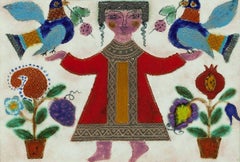
Enamel Glazed Ceramic Plaque Mother and Child
By Irene Awret
Located in Surfside, FL
This is a rare ceramic plaque painted with enamel glaze by famed Israeli German artist Irene Awret is signed Awret Safed on the verso. the actual glazed ceramic is 9.5X13.5 inches.
Irène Awret was born to a Jewish family in Berlin called Spicker, the youngest of three children. Her mother died in 1927, when Irène was six years old. In 1937 she was forced to stop high school, due to the Nazi race laws. Because she could not continue her regular studies, her father sent her to study drawing, painting and art restoration with a Jewish painter. Among his students were a large number of German Jews who knew they would have to leave Germany within a short time and would require a profession to enable them to support themselves.
When the situation grew worse, following the Kristallnacht (the first major attack on German and Austrian Jews in November 1938), her uncle decided to move to Belgium. In 1939 the situation became even worse - her father was fired from his job and the family were forced to leave their home. As a result, Awret's father tried to send her and her sister to Belgium, with the help of smugglers. The first smuggler proved to be a double agent and they were sent back from Aachen to Berlin. Two weeks later they made a second, successful, attempt to sneak across the border.
Awret worked for a Dutch Jewish family as a maid. As she had her room and board there, she was able to save enough money to study art part-time at Brussels' Académie Royal des Beaux-Arts. A few months later Awret's father joined her and her financial situation became easier. She left her job and studied full-time, helping support herself with restoration work when it was available and by painting portraits to order.
Later, Awret found a hiding place on a farm in Waterloo with a Jewish family who were connected with the underground. In January 1943 she had to return to Brussels, living with a false identity card which stated she was a married woman with two children. Awret succeeded in renting an attic without informing the police where she was - she told her landlady that she had been forced to flee her husband because he beat her. While there, she supported herself by restoring wooden sculptures.
A Jewish informer gave her up to the Gestapo, accompanying the two Gestapo men who arrested her. Awret was able to take a bag containing food and drawing materials. She was detained in the Gestapo cellars in Brussels where she drew. Because there was nothing there to draw, she sketched her own hand (view this work). Awret was interrogated in order to reveal the hiding place of her father who was still in Brussels. The National Socialist regime was determined to persecute him, even though he had fought for Germany in World War I and been permanently disabled. They stepped up their torture and brought Awret before Hartmann, the head of the Gestapo in Brussels. When Hartmann saw her block of drawings, he asked her where she had studied art and halted the interrogation.
Awret was placed in a narrow cell and then transferred to Malines camp, which the Belgian's called Mechelen. Malines was a transit camp to Auschwitz, regularly sending 2000 people at a time. Although she arrived just before Transport No. 20, Irène Awret avoided being included. Instead she was put to work in the leather workshop, decorating broaches. While she was there, Hartmann visited the camp and spotted her: "I could have discovered where your father is hiding," he told her. When her artistic talents became known, she was transferred to the Mahlerstube (artist's workshop) where she worked producing graphics for the Germans until the end of the war. When Carol (Karel) Deutsch (whose works are now on view at Yad Vashem) was sent from Mechelen to his death with his wife, he left young Irene his paintbox. Irene also recalls seeing the great painter Felix Nussbaum and his wife being pushed into a boxcar bound for the gas, and tells of the aftermath of the famous 20th Train incident, when a young Jewish doctor armed only with a pistol and helped by two unarmed friends with a lantern ambushed one of Mechelen's Auschwitz-bound trains carrying 1,618 Jews, most of whom had fled Eastern Europe for Belgium.
Awret's job enabled her to paint and draw - mainly in pencil, but also in watercolors and oils. In the artists' workshop she met a Jewish refugee from Poland - Azriel Awret...
Category
20th Century Folk Art Irene Awret Art
Materials
Ceramic
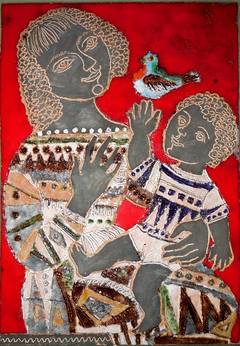
Girl with Rooster, Enamel Glazed Ceramic Plaque
By Irene Awret
Located in Surfside, FL
This is a rare ceramic plaque painted with enamel glaze by famed Israeli German artist Irene Awret is signed Awret Safed on the verso. the actual glazed ceramic is 10X15 inches.
Irène Awret was born to a Jewish family in Berlin called Spicker, the youngest of three children. Her mother died in 1927, when Irène was six years old. In 1937 she was forced to stop high school, due to the Nazi race laws. Because she could not continue her regular studies, her father sent her to study drawing, painting and art restoration with a Jewish painter. Among his students were a large number of German Jews who knew they would have to leave Germany within a short time and would require a profession to enable them to support themselves.
When the situation grew worse, following the Kristallnacht (the first major attack on German and Austrian Jews in November 1938), her uncle decided to move to Belgium. In 1939 the situation became even worse - her father was fired from his job and the family were forced to leave their home. As a result, Awret's father tried to send her and her sister to Belgium, with the help of smugglers. The first smuggler proved to be a double agent and they were sent back from Aachen to Berlin. Two weeks later they made a second, successful, attempt to sneak across the border.
Awret worked for a Dutch Jewish family as a maid. As she had her room and board there, she was able to save enough money to study art part-time at Brussels' Académie Royal des Beaux-Arts. A few months later Awret's father joined her and her financial situation became easier. She left her job and studied full-time, helping support herself with restoration work when it was available and by painting portraits to order.
Later, Awret found a hiding place on a farm in Waterloo with a Jewish family who were connected with the underground. In January 1943 she had to return to Brussels, living with a false identity card which stated she was a married woman with two children. Awret succeeded in renting an attic without informing the police where she was - she told her landlady that she had been forced to flee her husband because he beat her. While there, she supported herself by restoring wooden sculptures.
A Jewish informer gave her up to the Gestapo, accompanying the two Gestapo men who arrested her. Awret was able to take a bag containing food and drawing materials. She was detained in the Gestapo cellars in Brussels where she drew. Because there was nothing there to draw, she sketched her own hand (view this work). Awret was interrogated in order to reveal the hiding place of her father who was still in Brussels. The National Socialist regime was determined to persecute him, even though he had fought for Germany in World War I and been permanently disabled. They stepped up their torture and brought Awret before Hartmann, the head of the Gestapo in Brussels. When Hartmann saw her block of drawings, he asked her where she had studied art and halted the interrogation.
Awret was placed in a narrow cell and then transferred to Malines camp, which the Belgian's called Mechelen. Malines was a transit camp to Auschwitz, regularly sending 2000 people at a time. Although she arrived just before Transport No. 20, Irène Awret avoided being included. Instead she was put to work in the leather workshop, decorating broaches. While she was there, Hartmann visited the camp and spotted her: "I could have discovered where your father is hiding," he told her. When her artistic talents became known, she was transferred to the Mahlerstube (artist's workshop) where she worked producing graphics for the Germans until the end of the war. When Carol (Karel) Deutsch (whose works are now on view at Yad Vashem) was sent from Mechelen to his death with his wife, he left young Irene his paintbox. Irene also recalls seeing the great painter Felix Nussbaum and his wife being pushed into a boxcar bound for the gas, and tells of the aftermath of the famous 20th Train incident, when a young Jewish doctor armed only with a pistol and helped by two unarmed friends with a lantern ambushed one of Mechelen's Auschwitz-bound trains carrying 1,618 Jews, most of whom had fled Eastern Europe for Belgium.
Awret's job enabled her to paint and draw - mainly in pencil, but also in watercolors and oils. In the artists' workshop she met a Jewish refugee from Poland - Azriel Awret...
Category
1950s Expressionist Irene Awret Art
Materials
Enamel
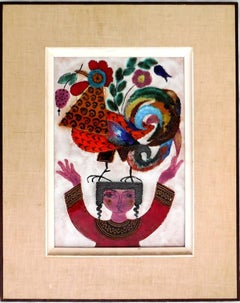
Irene Awret art for sale on 1stDibs.
Find a wide variety of authentic Irene Awret art available for sale on 1stDibs. You can also browse by medium to find art by Irene Awret in ceramic, enamel, metal and more. Much of the original work by this artist or collective was created during the 1950s and is mostly associated with the Expressionist style. Not every interior allows for large Irene Awret art, so small editions measuring 18 inches across are available. Customers who are interested in this artist might also find the work of Erich Waske, Heinrich Richter (b.1884), and Bernard Lorjou. Irene Awret art prices can differ depending upon medium, time period and other attributes. On 1stDibs, the price for these items starts at $1,200 and tops out at $1,200, while the average work can sell for $1,200.