Irving Amen Landscape Prints

American, 1918-2011

Born in New York City, Irving Amen began drawing at the young age of four. By the time he was fourteen-years-old, he won a scholarship to the Pratt Institute. He emulated Michelangelo's masterpieces and spent years perfecting his unique style. From 1942–45, Amen served with the Armed Forces. He headed a mural project and executed murals in the United States and Belgium. He had his first exhibition at the New School for Social Research in New York and his second at the Smithsonian Institution in Washington in 1949. Amen studied in Paris in 1950. Upon his return to the United States, he had one-man shows in New York and Washington D.C. In 1953, Amen traveled throughout Italy. This resulted in a series of eleven woodcuts, eight etchings and several oil paintings. One of these woodcuts, Piazza San Marco #4 and its four woodblocks constitute a permanent exhibit of block printing in color at the Smithsonian Institution. Travel in Israel, Greece and Turkey in 1960 led to a retrospective show in Jerusalem. His art is widely owned and loved. Amen has taught at Pratt Institute and the University of Notre Dame. Commissions include a Peace Medal in honor of the Vietnam War and 12 stained glass windows for the Congregation Agudas Achim in Ohio. He is listed in the Mantle Fielding’s Dictionary of American Painters, Sculptors and Engravers and the Dictionary of Contemporary American Artists by Paul Cummings.

to
1
Overall Width
to
Overall Height
to
1
14
179
169
143
134
1
1
1
1
1
Artist: Irving Amen
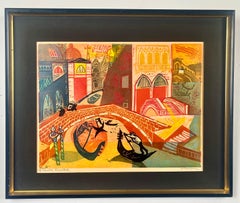
Irving Amen" Venice Recalled " Hand-Signed Numbered Color Woodcut Print
By Irving Amen
Located in Plainview, NY
Irving Amen (American, 1918–2011) Venice Recalled Hand-Signed Numbered Color Woodcut print Edition: 26/75 Radiant and architecturally expressive, Venice Recalled showcases Ir...
Category

20th Century Expressionist Irving Amen Landscape Prints

Materials

Woodcut

Related Items
Bridgetown Barbados, Oil Monotype by Romare Bearden
By Romare Bearden
Located in Long Island City, NY
A unique oil print by Romare Bearden circa 1980. A bright city scene illustrated in a modern expressionist style. Artist: Romare Bearden, American (1911 - 1988) Title: Bridgetown, ...
Category

1980s Expressionist Irving Amen Landscape Prints

Materials

Monoprint, Oil

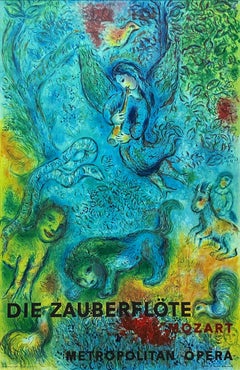
Chagall, Die Zauberflöte (Mourlot CS. 38), The Metropolitan Opera (after)
By Marc Chagall
Located in Fairfield, CT
Title: Die Zauberflöte (Mourlot CS. 38), The Metropolitan Opera Year: 1973 Medium: Lithograph on wove paper Size: 39.5 x 25.75 inches Notes: From the opening of Mozart's 'The Magic F...
Category

1970s Expressionist Irving Amen Landscape Prints

Materials

Lithograph

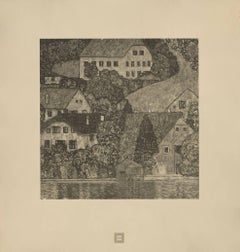
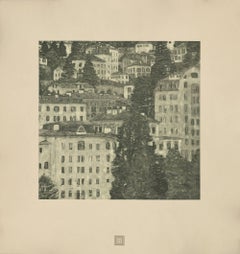
Max Eisler Eine Nachlese folio "Houses in Unterach on Lake Attersee" collotype
By (after) Gustav Klimt
Located in Palm Beach, FL
After Gustav Klimt, Max Eisler Plate #29, Am Attersee; brown-toned monochrome collotype after the 1915-16 painting in oil on canvas. GUSTAV KLIMT EINE NACHLESE (GUSTAV KLIMT AN AFTERMATH), a portfolio of 30 collotypes prints, 15 are multi-color and 15 are monochrome, on chine colle paper laid down on heavy cream-wove paper with deckled edges; Max Eisler, Editor-Publisher; Osterreichischer Staatsdruckerei (Austrian State Printing Office), Printer; in a limited edition of 500 numbered examples of which: 200 were printed in German, 150 were printed in French and 150 were printed in English; Vienna, 1931. 2018 marks the 100th anniversary of Gustav Klimt’s death. It is a fitting time to reflect upon the enduring legacy and deep impact of his art. Recognizing this need for posterity with uncanny foresight, the publication of Gustav Klimt: An Aftermath (Eine Nachlese) provides a rare collection of work after Klimt which has proven to be an indispensable tool for Klimt scholarship as well as a source for pure visual delight. Approximately 25 percent of the original works featured in the Aftermath portfolio have since been lost. Of those 30, six were destroyed by fire on 8 May 1945. On that fateful final day of WWII, the retreating Feldherrnhalle, a tank division of the German Army, set fire to the Schloss Immendorf which was a 16th century castle in Lower Austria used between 1942-1945 to store objects of art. All three of Klimt’s Faculty Paintings: Philosophy, Medicine and Jurisprudence (1900-1907), originally created for the University of Vienna, were on premises at that time. Also among the inventory of Klimt paintings in storage there was art which had been confiscated by the Nazis. One of the most significant confiscated collections was the Lederer collection which featured many works by Gustav Klimt such as Girlfriends II and Garden Path with Chickens. In many instances, Aftermath is our only link to these lost treasures. Max Eisler (1881-1937), the publisher of the 1931 Aftermath portfolio, was an art historian at Vienna University specializing in modern and contemporary arts and crafts whose 1920 book on Klimt was the first Klimt monograph. He saw An Aftermath as filling-in important gaps left by the earlier print portfolios which had only featured Klimt up to 1913 and which had glossed over major art projects such as the Tree of Life frieze for the Palais Stoclet. And whereas only 10 of the 50 prints from the earlier portfolios published by H.O. Miethke were made in intricate multi-color images, Eisler augmented the earlier format by featuring half of the 30 images in stunning multi-colored collotypes. Understanding the fragile nature of the collotype printing process also reinforces this project’s distinctive and exceptional characteristics. Fragile collotype plates can not be reused. As such, this necessitates the completion of a run on the first go and also dictates a limited production number. Printed by hand, the collotypes required deft handling by the printer, Osterreichische Staatsdruckerei. A complicated and lengthy process involving gelatin colloids mixed with dichromates, the creation of 16 color separation thin glass filters to achieve the light-sensitive internegative images which could faithfully capture all of the painting’s tonal gradations and colors, exposure to actinic light, and delicate chine collie papers which allowed for greater color saturation, the printer’s collaborative role in capturing and transmitting Klimt’s nuanced paint strokes is nothing short of remarkable. The Österreichische Staatsdruckerei (Austrian State Printing Office), was the successor to the KK Hof -und Staatsdruckerei which was founded by Emperor Franz I in 1804 and whose collotype printing innovations of Klimt’s art...
Category

1930s Vienna Secession Irving Amen Landscape Prints

Materials

Archival Paper

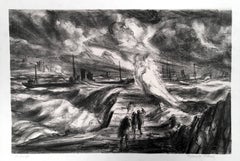
St. Jean de Luz
By Reginald Marsh
Located in New York, NY
Reginald Marsh (1898-1954), St. Jean de Luz, lithograph, c. 1928, signed in pencil lower right and inscribed “40 proofs” lower left [also signed in the plate lo...
Category

1920s Expressionist Irving Amen Landscape Prints

Materials

Lithograph

Mid century Israeli Expressionist
Located in San Francisco, CA
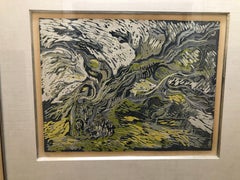
Bit of a mystery here. Really well done colored Linocut A very expressionistic style of a landscape with trees. I’m pretty sure it’s signed in Hebrew but cannot translate. A very low...
Category

Mid-20th Century Expressionist Irving Amen Landscape Prints

Materials

Linocut

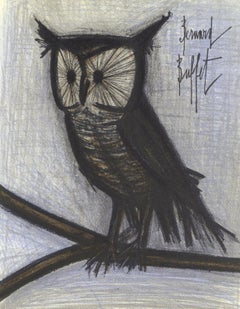
Buffet, Le petit hibou, Lithographs 1952-1966 (after)
By Bernard Buffet
Located in Fairfield, CT
Medium: Lithograph on vélin Acropole Papeteries de Renage paper. Year: 1967 Paper Size: 12.25 x 9.5 inches Inscription: Signed in the plate and unnumbered, as issued Notes: From the ...
Category

1960s Expressionist Irving Amen Landscape Prints

Materials

Lithograph

Buffet, Le petit hibou, Lithographs 1952-1966 (after)
$716 Sale Price
20% Off
H 12.25 in W 9.5 in
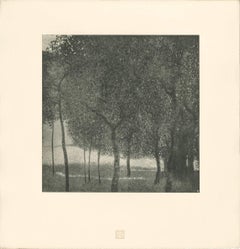
H.O. Miethke Das Werk folio "Fruit Trees" collotype print
By Gustav Klimt K.K. Hof-und Staatsdruckerei
Located in Palm Beach, FL
DAS WERK GUSTAV KLIMTS, a portfolio of 50 prints, ten of which are multicolor collotypes on chine colle paper laid down on hand-made heavy cream wove paper with deckled edges; under ...
Category

Early 1900s Vienna Secession Irving Amen Landscape Prints

Materials

Paper

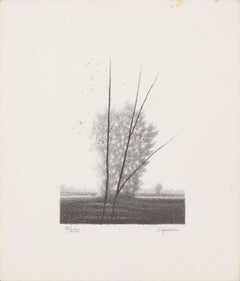
Three Trees
By Robert Kipniss
Located in Columbia, MO
Robert Kipniss, painter and printmaker, was born in New York City in 1931. Born to two artists, Kipniss quickly fostered his love for art. His formal artistic education began at New ...
Category

20th Century Expressionist Irving Amen Landscape Prints

Materials

Lithograph

Three Trees
$1,440
H 16 in W 20 in
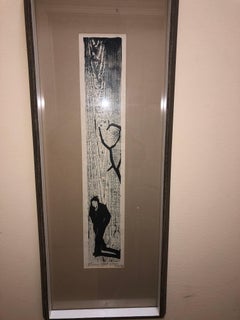
Jacob Pins "Lonely Walker" 1960 Woodcut
By Jacob Pins
Located in San Francisco, CA
Jacob Pins: 1917-2005. Was a German born Israeli woodcut artist and art collector. He has had auction results over $3000 for a print. This powerful scarce example...
Category

1960s Expressionist Irving Amen Landscape Prints

Materials

Woodcut

Max Eisler Eine Nachlese folio "Gastein" collotype
By (after) Gustav Klimt
Located in Palm Beach, FL
After Gustav Klimt, Max Eisler Plate #21, Gastein; grey-green monochrome collotype after the 1917 painting in oil on canvas. Original destroyed by fire May 1945. GUSTAV KLIMT EINE NACHLESE (GUSTAV KLIMT AN AFTERMATH), a portfolio of 30 collotypes prints, 15 are multi-color and 15 are monochrome, on chine colle paper laid down on heavy cream-wove paper with deckled edges; Max Eisler, Editor-Publisher; Osterreichischer Staatsdruckerei (Austrian State Printing Office), Printer; in a limited edition of 500 numbered examples of which: 200 were printed in German, 150 were printed in French and 150 were printed in English; Vienna, 1931. 2018 marks the 100th anniversary of Gustav Klimt’s death. It is a fitting time to reflect upon the enduring legacy and deep impact of his art. Recognizing this need for posterity with uncanny foresight, the publication of Gustav Klimt: An Aftermath (Eine Nachlese) provides a rare collection of work after Klimt which has proven to be an indispensable tool for Klimt scholarship as well as a source for pure visual delight. Approximately 25 percent of the original works featured in the Aftermath portfolio have since been lost. Of those 30, six were destroyed by fire on 8 May 1945. On that fateful final day of WWII, the retreating Feldherrnhalle, a tank division of the German Army, set fire to the Schloss Immendorf which was a 16th century castle in Lower Austria used between 1942-1945 to store objects of art. All three of Klimt’s Faculty Paintings: Philosophy, Medicine and Jurisprudence (1900-1907), originally created for the University of Vienna, were on premises at that time. Also among the inventory of Klimt paintings in storage there was art which had been confiscated by the Nazis. One of the most significant confiscated collections was the Lederer collection which featured many works by Gustav Klimt such as Girlfriends II and Garden Path with Chickens. In many instances, Aftermath is our only link to these lost treasures. Max Eisler (1881-1937), the publisher of the 1931 Aftermath portfolio, was an art historian at Vienna University specializing in modern and contemporary arts and crafts whose 1920 book on Klimt was the first Klimt monograph. He saw An Aftermath as filling-in important gaps left by the earlier print portfolios which had only featured Klimt up to 1913 and which had glossed over major art projects such as the Tree of Life frieze for the Palais Stoclet. And whereas only 10 of the 50 prints from the earlier portfolios published by H.O. Miethke were made in intricate multi-color images, Eisler augmented the earlier format by featuring half of the 30 images in stunning multi-colored collotypes. Understanding the fragile nature of the collotype printing process also reinforces this project’s distinctive and exceptional characteristics. Fragile collotype plates can not be reused. As such, this necessitates the completion of a run on the first go and also dictates a limited production number. Printed by hand, the collotypes required deft handling by the printer, Osterreichische Staatsdruckerei. A complicated and lengthy process involving gelatin colloids mixed with dichromates, the creation of 16 color separation thin glass filters to achieve the light-sensitive internegative images which could faithfully capture all of the painting’s tonal gradations and colors, exposure to actinic light, and delicate chine collie papers which allowed for greater color saturation, the printer’s collaborative role in capturing and transmitting Klimt’s nuanced paint strokes is nothing short of remarkable. The Österreichische Staatsdruckerei (Austrian State Printing Office), was the successor to the KK Hof -und Staatsdruckerei which was founded by Emperor Franz I in 1804 and whose collotype printing innovations of Klimt’s art...
Category

1930s Vienna Secession Irving Amen Landscape Prints

Materials

Paper

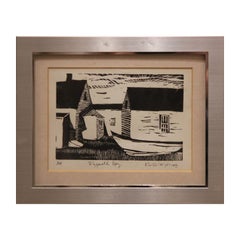
Boat with Houses Landscape Woodblock Print (Possibly Woodstock School of Art)
Located in Houston, TX
Small black and white woodblock print depicting boat with houses. Possibly from the Woodstock School of Art. Inscribed and signed by artist. ...
Category

Mid-20th Century Expressionist Irving Amen Landscape Prints

Materials

Woodcut

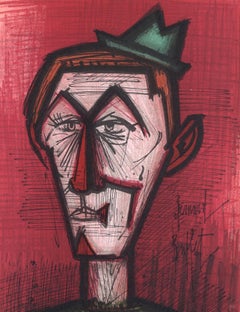
Buffet, Le clown au fond rouge, Lithographs 1952-1966 (after)
By Bernard Buffet
Located in Fairfield, CT
Medium: Lithograph on vélin Acropole Papeteries de Renage paper. Year: 1967 Paper Size: 12.25 x 9.5 inches Inscription: Signed in the plate and unnumbered, as issued Notes: From the ...
Category

1960s Expressionist Irving Amen Landscape Prints

Materials

Lithograph

Irving Amen landscape prints for sale on 1stDibs.

Find a wide variety of authentic Irving Amen landscape prints available for sale on 1stDibs. You can also browse by medium to find art by Irving Amen in woodcut print and more. Much of the original work by this artist or collective was created during the 20th century and is mostly associated with the Expressionist style. Not every interior allows for large Irving Amen landscape prints, so small editions measuring 29 inches across are available. Irving Amen landscape prints prices can differ depending upon medium, time period and other attributes. On 1stDibs, the price for these items starts at $800 and tops out at $800, while the average work can sell for $800.

Still Thinking About These?

All Recently Viewed