Jack Coutu Art
to
1
1
1
2
1
1
1
1
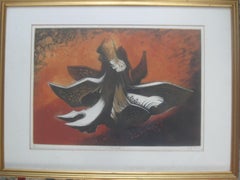
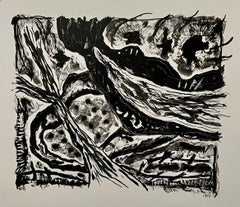
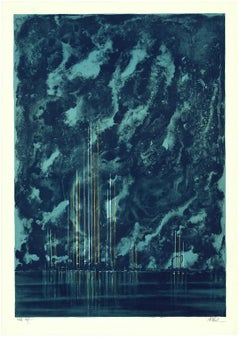
Tree Root
. Hand colored lithogarph circa 1959.
By Jack Coutu
Located in Frome, Somerset
A fine Raymond John 'Jack' Coutu (1924-2017) ARE, ARCA. color lithograph/ engraving. 'Tree Root'. 6th of a 50 handmade edition by the artist.. circa 1959. Well listed Modern Artist. Signed and presented in the original framing. Raymond John "Jack" Coutu ARE ARCA (13 September 1924 – 17 May 2017) was an English printmaker, sculptor, etcher, engraver, carver, watercolourist and teacher. He was influenced by Oriental art.Jack Coutu was born Raymond John Coutu at Farnham, Surrey, England, and was educated at Farnham Grammar School.[ On leaving school in 1940, he worked at Abbott of Farnham, a coachbuilding company in Farnham, where his father Bert Coutu was also employed painting coats of arms and heraldic shields. In 1942, at the age of 18 during World War II, he joined the Royal Corps of Signals, where after training he served in Ceylon (now Sri Lanka), India, and Singapore. At the end of WWII, he was in Kure, Japan, in the Hiroshima Prefecture.
From 1947 to 1951, Coutu studied at the Farnham School of Art, followed by the Royal College of Art in London from 1951 to 1954 and the Central School of Art from 1951 to 1955. At the Central School of Art, Merlin Evans was an influence on Coutu's printmaking.
Coutu taught printmaking at the Central School of Art from 1957 to 1965 and then at the West Surrey College of Art and Design in Farnham from 1965 to 1985. In 1968, he started to carve netsuke (as practised in Japan) and he joined the Netsuke Kenkyukai Society, based in the United StatesHe is also a member of the Royal Society of Painter-Etchers and Engravers and the Printmakers Council.
Jack Coutu has exhibited at the Royal Academy in London, netsuke conventions, jointly with Michael Rothenstein...
Category
1950s Modern Jack Coutu Art
Materials
Lithograph

$712 Sale Price
20% Off
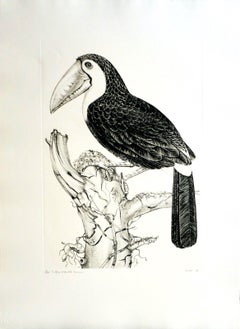
Sulphur Breasted Toucan
By Jack Coutu
Located in Hollywood, FL
Artist: Jack Coutu
Title: Sulphur Breasted Toucan
Medium: Etching
Signed: Hand Signed
Edition: From the edition of 200
Measurements: 23" x 31"
Year: 1970
Note: This piece is so...
Category
1970s Contemporary Jack Coutu Art
Materials
Etching
Related Items
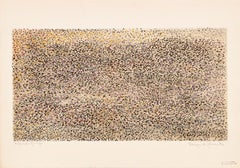
Beach Horizontal
By Manfred Schwartz
Located in Astoria, NY
Manfred Schwartz (American, b. Poland, 1909-1970), Beach Horizontal Composition, Lithograph on Paper, mid 20th century, marked "artist's proof" lower left, signed in pencil and with ...
Category
Mid-20th Century Modern Jack Coutu Art
Materials
Paper, Lithograph
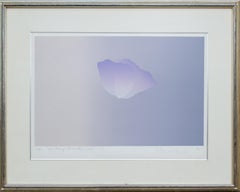
Three Lovely Kozo Inoue Pastel Prints, 1980s
By Kozo Inoue
Located in New York, NY
Kozo Inoue (Japanese, 1937-2017)
Untitled, 1980
Lithograph
Sight: 22 x 31 in. (Each)
Framed: 34 x 42 1/2 x 1 in. (Each)
Signed and dated 1980 lower right
Inscribed lower left
Kozo Inoue was a contemporary Japanese printmaker. Born in Osaka, he graduated from the Department of Art History at Keio University in 1960. During life, he worked during the winter months in the Izu Peninsula and Dordogne or Paris in the summer. He is known for his surrealistic silkscreen prints. His prints can be found in the Museum of Modern Art, Paris, Royal Library of Belgium, Modern Museum of Art Osaka and the Spencer Museum of Art, to name just a few. (Bio sourced from Ronin Gallery)
Category
1980s Modern Jack Coutu Art
Materials
Lithograph
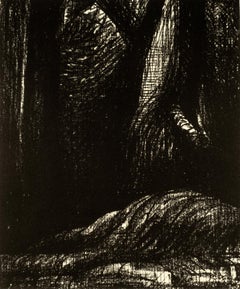
The Cavern: abstract black drawing based on Auden poetry and Yorkshire landscape
By Henry Moore
Located in New York, NY
One of a series of 18 lithographs drawn by the artist for the Auden Poems/Moore Lithographs 1974 book and portfolio. This work is from an edition of 25 printed on vellum aside from t...
Category
Late 20th Century Modern Jack Coutu Art
Materials
Lithograph
$1,200
H 25.25 in W 20.5 in
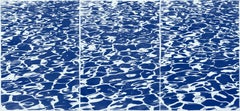
Pool Patterns, Nautical Abstract Seascape Triptych, Blue Cyanotype Print
By Kind of Cyan
Located in Barcelona, ES
This is an exclusive handprinted limited edition of a cyanotype.
This beautiful triptych is called "Fresh California Pool patterns", which shows the semi-abstract movements of light reflecting in a California swimming pool.
Details:
+ Edition Size: only 20
+ Medium: Cyanotype Print on Watercolor Paper
+ Stamped and Certificate of Authenticity provided.
+ Measurements : 100x210 cm (40 x 84 in.)
Each paper measures 100cm x 70cm (about 40 in. x 28 in.) each. , a standard frame size.
+ All cyanotype prints...
Category
2010s Modern Jack Coutu Art
Materials
Lithograph
Carnival
By Richard Florsheim
Located in New York, NY
Richard Florsheim created this color lithograph entitled “Carnival” in 1972 in an edition of 30 pieces. Published by Associated American Artists and printed by Landfall Press, this i...
Category
1970s American Modern Jack Coutu Art
Materials
Lithograph
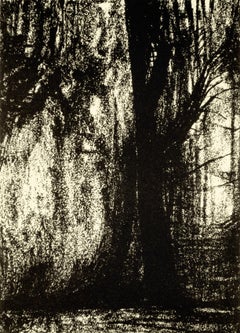
The Forest Henry Moore drawing of Yorkshire landscape for W.H. Auden poetry book
By Henry Moore
Located in New York, NY
One of a series of 18 lithographs drawn by the artist for the Auden Poems/Moore Lithographs 1974 book and portfolio. This work is from an edition of 25 printed on vellum aside from t...
Category
Late 20th Century Modern Jack Coutu Art
Materials
Lithograph
$1,200
H 25.25 in W 20.5 in
Black/White Lithograph American Modernist Gregory Amenoff Abstract Expressionist
By Gregory Amenoff
Located in Surfside, FL
Gregory Amenoff (Contemporary American abstract painter, b. 1948),
Title: Haven, STATE II
Lithograph, 1986
Edition 4/4 Printer Proof
Image Size 21.5 x 30.75"
Gregory Amenoff is a...
Category
1980s American Modern Jack Coutu Art
Materials
Lithograph
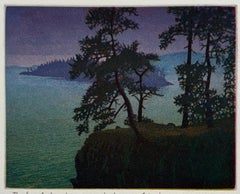
Island Light, by Stephen McMillan
By Stephen McMillan
Located in Palm Springs, CA
Medium: etching and aquatint
Edition of 120
Year: 2023
Image Size: 4 x 5 inches
Signed, titled and numbered by the artist.
The view west from Cypress Island off the coast of Washin...
Category
2010s Contemporary Jack Coutu Art
Materials
Etching, Aquatint
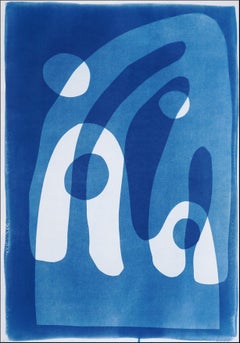
Rain Over Mountain, Modern Art in Blue Tones, Landscape, Cyanotype Monotype 2024
By Kind of Cyan
Located in Barcelona, ES
This is an exclusive handprinted unique cyanotype that takes its inspiration from the mid-century modern shapes.
It's made by layering paper cutouts and different exposures using uv-...
Category
2010s Modern Jack Coutu Art
Materials
Watercolor, Lithograph, Monotype, Paper
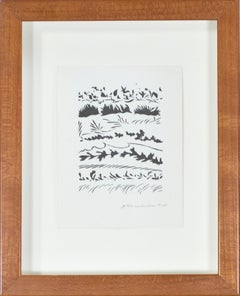
Winter Silhouettes,
offset lithograph by Schomer Lichtner
By Schomer Lichtner
Located in Milwaukee, WI
'Winter Silhouettes,' a small and delicate print, is an original offset lithograph by the Milwaukee artist Schomer Lichtner. The composition displays registers of foliage, emerging from the white of the paper as though emerging from the snow-covered ground. The artwork is thus plays with the materials of printmaking; the paper is both the support and the primary indication of the season. The subtle texture of the tooth of the paper also adds life to the image, giving the snow a wind-swept, creature trodden surface. The free forms of the grasses and leaves resemble the lyrical mid-century works of the French artist Henri Matisse, which combined with these material concerns demonstrate Lichter's modern sensibilities.
3.75 x 2.75 inches, image
5.5 x 4.5 inches, paper
10 x 8 inches frame
Signed and dated in the stone, lower right
Framed to conservation standards in a shadow-box style mounting, using 100 percent rag matting, museum glass, and housed in a cherry wood moulding
Overall excellent condition; some toning to edges of paper; some minor abrasions to frame
Milwaukee artist Schomer Lichtner was well known for his whimsical cows and ballerinas and abstract imagery. He and his late wife Ruth Grotenrath, both well-known Wisconsin artists, began their prolific careers as muralists for WPA projects, primarily post offices.
Lichtner also painted murals for industry and private clients. Schomer was a printmaker and produced block prints, lithographs, and serigraph prints. His casein (paint made from dairy products) and acrylic paintings are of the rural Wisconsin landscape and farm animals. He became interested in cows when he and Ruth spent summers near Holy Hill in Washington County. According to David Gordon, director of the Milwaukee Art Museum, Schomer Lichtner had a tremendous joie de vivre and expressed it in his art.
Schomer Lichtner was nationally known for his whimsical paintings and sculptures of black- and white-patterned Holstein cows and elegant ballerina dancers. Lichtner also painted all sorts of combinations of beautiful women, flowers and country landscapes. James Auer, former Milwaukee Journal Sentinel art critic, said that his art eventually "exploded into expressionistic design elements with bold, flat areas of color and high energy that anticipated Pop Art." Auer went on to describe Lichtner’s work as full of "wit, vigor and virtuosity."
As early as 1930, Lichtner’s work was shown at the prestigious Carnegie International Exhibition in New York and at museums throughout the Midwest. As a student, he was a protégé of another icon of 20th century American art, Gustave Moeller.
Lichtner and his wife, Ruth Grotenrath (1912-1988), are celebrated as Milwaukee’s first couple of painting and are regarded as major Wisconsin artists. Lichtner’s impressive production, perseverance, longevity, and positive approach to his life and art made him and his work distinctive and much loved by his many admirers. His work is currently represented in collections at the Milwaukee Art Museum, the John Michael Kohler Art Center, the West Bend Museum, and in the collections of many individuals. Books on the lives and art work of both Lichtner and Grotenrath are in progress and it is anticipated that they will be published next year.
Schomer Lichtner passed away on May 9, 2006 at the age of 101. He continued to amaze and create with his whimsical paintings of ballerinas...
Category
1960s American Modern Jack Coutu Art
Materials
Black and White, Lithograph
$775
H 9.875 in W 7.875 in
Lullaby: Sleeping Head
By Henry Moore
Located in New York, NY
Paper: 25.25 x 20.5 in. / 64.1 X 52 cm.
Image: 10.75 x 11.5 in / 27.3 x 29.2 cm.
One of a series of 18 lithographs drawn by the artist for the Auden Poems/Moore Lithographs 1974 bo...
Category
Late 20th Century Modern Jack Coutu Art
Materials
Lithograph

Approaching Storm
By Richard Florsheim
Located in New York, NY
Richard Florsheim created this color lithograph entitled “Approaching Storm” in 1967 in an edition of 125 pieces. Published by Associated American Artists and printed by Mourlot Press, Paris, this impression is signed and inscribed “Artist Proof.” It is in good condition with full original color. The printed image size is 28.25 x 19 3/4 inches and the paper size is 31.12 x 22 inches.
RICHARD ABERLE...
Category
1960s American Modern Jack Coutu Art
Materials
Lithograph
Jack Coutu art for sale on 1stDibs.
Find a wide variety of authentic Jack Coutu art available for sale on 1stDibs. You can also browse by medium to find art by Jack Coutu in etching, lithograph and more. Much of the original work by this artist or collective was created during the 20th century and is mostly associated with the modern style. Not every interior allows for large Jack Coutu art, so small editions measuring 23 inches across are available. Customers who are interested in this artist might also find the work of Katie Edwards, Oliver Hall, R.A., R.E., R.S.W., and Martyn Brewster. Jack Coutu art prices can differ depending upon medium, time period and other attributes. On 1stDibs, the price for these items starts at $250 and tops out at $828, while the average work can sell for $539.