James Edward Buttersworth Art
American, 1817-1894
Born in 1817 in Middlesex County, Great Britain, James Edward Buttersworth was the son of important English sea painter Thomas Buttersworth. Settling in New York in 1845, he soon established himself as one of America's leading marine artists. For the most part he signed his works J.E. Buttersworth.
During the next period of his life, many of his works were chosen by Currier
Ives as subjects for lithographs. His images were also used in magazines and newspapers that reported the yachting events of the day. New York Harbor and the surrounding areas became a favorite background for his vessels which he portrayed faithfully with an eye for precise detail. His reputation sprang from his accurate representations of the great sailing yachts of his time.
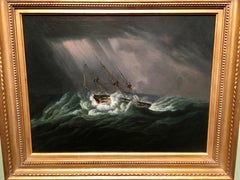
In order to accent the speed and grace of these vessels, he would often elongate the hulls and sails to create a feeling of motion portrayed along a low horizon line. With dramatic skies, churning seas and accurate detail, he ennobled and romanticized sailing ships with what have become historically important paintings that are both beautiful and refined.to
1
1
1
Overall Width
to
Overall Height
to
3
3
3
3
1
3
3
2
2
1
3
10,225
2,785
2,504
1,382
3
3
Artist: James Edward Buttersworth
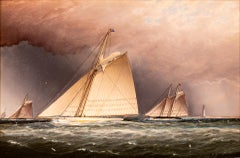
VOLUNTEER Off Sandy Hook, Heading Out to Race in the Goelet Cup
By James Edward Buttersworth
Located in Costa Mesa, CA
This atmospheric painting by James E. Butterworth depicts a group of yachts leaving New York Harbor on the annual New York Yacht Club cruise. In 1887, when this was painted, upon arr...
Category
1880s Other Art Style James Edward Buttersworth Art
Materials
Oil, Board
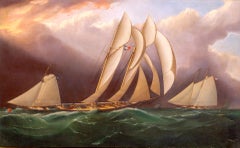
SAPPHO, DAUNTLESS and GRACIE Racing at Cape May 1871
By James Edward Buttersworth
Located in Costa Mesa, CA
James E. Buttersworth's most sought-after artworks emerge from his depictions of American racing yachts going head to head in the major regattas...
Category
1870s American Realist James Edward Buttersworth Art
Materials
Canvas, Oil
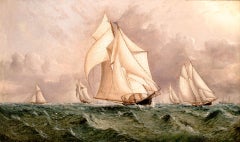
William Astor
s Schooner AMBASSADRESS Leads the Regatta
By James Edward Buttersworth
Located in Costa Mesa, CA
William Astor Pilots the New York Yacht Club Run
A superior and graceful schooner as grand as any ever built, AMBASSADRESS was William Backhouse Astor, Jr's "floating home" from its launch in 1877 until he sold it in 1884 and purchased his massive steam/sail yacht...
Category
1870s American Realist James Edward Buttersworth Art
Materials
Canvas, Oil
Related Items
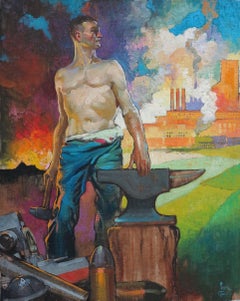
Allegory of Defense Industry (figurative male illustration)
By Frank Godwin
Located in Wilton Manors, FL
Frank Godwin (1889-1959). Allegory of Defense Industry, 1919. Oil on canvas. Signed lower right. Image measures 20.75 x 26.25 inches. The canvas measures 24 x 36 inches in total. Ann...
Category
Early 20th Century American Realist James Edward Buttersworth Art
Materials
Canvas, Oil

$12,000 Sale Price
40% Off
H 26.25 in W 20.75 in
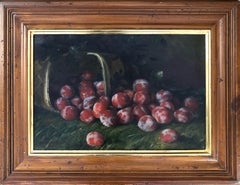
Les Gros Prunes, plums still life
By Adam Lehr
Located in New York, NY
This still life of Plums is a top notch example of 19th century still life painting! Beautiful quality and striking but also spare and honest in nature which is what typified Americ...
Category
Early 1900s American Realist James Edward Buttersworth Art
Materials
Canvas, Oil
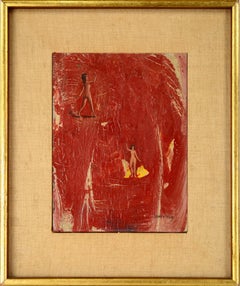
Modern Red Abstract with Two Miniature Female Figures
Located in Soquel, CA
Compelling red abstract with two tiny female figures by Arkansas artist Gene Hatfield (American, 1925-2017). The piece consists of a textural red abstr...
Category
Late 20th Century Contemporary James Edward Buttersworth Art
Materials
Oil, Board
$1,150
H 12.5 in W 11.5 in D 1.5 in
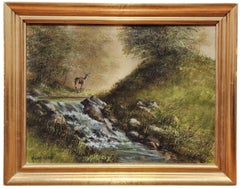
A Friend in the Forest, Landscape with Deer
By Richard Weers
Located in Grand Rapids, MI
Richard Weers (American, 1932-2022)
Signed: Richard Weers (Lower, Left)
" A Friend in the Forest "
Oil on Canvas
12" x 16"
Housed in a 1 1/2" Gol...
Category
Late 20th Century American Realist James Edward Buttersworth Art
Materials
Canvas, Oil
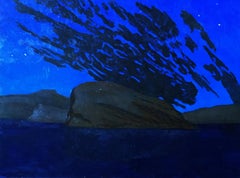
Norway III, dark blues and blacks, night sky
By Gregory Frux
Located in Brooklyn, NY
Dr. Rowland S. Russell PhD. writes about his experience directly witnessing Greg's practice as a “plein air” artist:
Whether he’s portraying quiet scenes from Brooklyn’s Prospect Park or the Botanical Gardens, intriguing remnants of New York’s varied industry (grain silos...
Category
2010s American Realist James Edward Buttersworth Art
Materials
Canvas, Oil
Large-Scale Baltic Figurative Courtyard Genre Scene
Located in Soquel, CA
A substantial mid-century Baltic figurative courtyard genre painting by an unknown Eastern European artist (latvia or Lithuania possible) (20t...
Category
Mid-20th Century Impressionist James Edward Buttersworth Art
Materials
Oil, Board
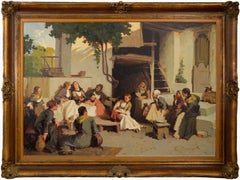
$2,800 Sale Price
20% Off
H 41 in W 55 in D 2.5 in
Sketching Wisconsin
original oil painting, Signed
By John Steuart Curry
Located in Milwaukee, WI
John Steuart Curry
"Sketching Wisconsin," 1946
oil on canvas
31.13 x 28 inches, canvas
39.75 x 36.75 x 2.5 inches, frame
Signed and dated lower right
Overall excellent condition
Presented in a 24-karat gold leaf hand-carved wood frame
John Steuart Curry (1897-1946) was an American regionalist painter active during the Great Depression and into World War II. He was born in Kansas on his family’s farm but went on to study art in Chicago, Paris and New York as young man. In Paris, he was exposed to the work of masters such as Peter Paul Rubens, Eugène Delacroix and Jacques-Louis David. As he matured, his work showed the influence of these masters, especially in his compositional decisions. Like the two other Midwestern regionalist artists that are most often grouped with him, Grant Wood (American, 1891-1942) and Thomas Hart Benton (American, 1889-1975), Curry was interested in representational works containing distinctly American subject matter. This was contrary to the popular art at the time, which was moving closer and closer to abstraction and individual expression.
Sketching Wisconsin is an oil painting completed in 1946, the last year of John Steuart Curry’s life, during which time he was the artist-in-residence at the University of Wisconsin in Madison. The painting is significant in Curry’s body of work both as a very revealing self-portrait, and as a landscape that clearly and sensitively depicts the scenery of southern Wisconsin near Madison. It is also a portrait of the artist’s second wife, Kathleen Gould Curry, and is unique in that it contains a ‘picture within a picture,’ a compositional element that many early painting masters used to draw the eye of the viewer. This particular artwork adds a new twist to this theme: Curry’s wife is creating essentially the same painting the viewer is looking at when viewing Sketching Wisconsin.
The triangular composition of the figures in the foreground immediately brings focus to a younger Curry, whose head penetrates the horizon line and whose gaze looks out towards the viewer. The eye then moves down to Mrs. Curry, who, seated on a folding stool and with her hand raised to paint the canvas on the easel before her, anchors the triangular composition. The shape is repeated in the legs of the stool and the easel. Behind the two figures, stripes of furrowed fields fall away gently down the hillside to a farmstead and small lake below. Beyond the lake, patches of field and forest rise and fall into the distance, and eventually give way to blue hills.
Here, Curry has subverted the traditional artist’s self-portrait by portraying himself as a farmer first and an artist second. He rejects what he sees as an elitist art world of the East Coast and Europe. In this self-portrait he depicts himself without any pretense or the instruments of his profession and with a red tractor standing in the field behind him as if he was taking a break from the field work. Here, Curry’s wife symbolizes John Steuart Curry’s identity as an artist. Compared with a self-portrait of the artist completed a decade earlier, this work shows a marked departure from how the artist previously presented and viewed himself. In the earlier portrait, Curry depicted himself in the studio with brushes in hand, and with some of his more recognizable and successful canvases behind him. But in Sketching Wisconsin, Curry has taken himself out of the studio and into the field, indicating a shift in the artist’s self-conception.
Sketching Wisconsin’s rural subject also expresses Curry’s populist ideals, that art could be relevant to anyone. This followed the broad educational objectives of UW’s artist-in-residence program. Curry was appointed to his position at the University of Wisconsin in 1937 and was the first person to hold any such position in the country, the purpose of which was to serve as an educational resource to the people of the state. He embraced his role at the University with zeal and not only opened the doors of his campus studio in the School of Agriculture to the community, but also spent a great deal of time traveling around the state of Wisconsin to visit rural artists who could benefit from his expertise. It was during his ten years in the program that Curry was able to put into practice his belief that art should be meaningful to the rural populace. However, during this time he also struggled with public criticism, as the dominant forces of the art market were moving away from representation. Perhaps it was Curry’s desire for public acceptance during the latter part of his career that caused him to portray himself as an Everyman in Sketching Wisconsin.
Beyond its importance as a portrait of the artist, Sketching Wisconsin is also a detailed and sensitive landscape that shows us Curry’s deep personal connection to his environment. The landscape here can be compared to Wisconsin Landscape of 1938-39 (the Metropolitan Museum of Art), which presents a similar tableau of rolling hills with a patchwork of fields. Like Wisconsin Landscape, this is an incredibly detailed and expressive depiction of a place close to the artist’s heart. This expressive landscape is certainly the result of many hours spent sketching people, animals, weather conditions and topography of Wisconsin as Curry traveled around the state. The backdrop of undulating hills and the sweeping horizon, and the emotions evoked by it, are emphatically recognizable as the ‘driftless’ area of south-central Wisconsin. But while the Metropolitan’s Wisconsin Landscape conveys a sense of uncertainty or foreboding with its dramatic spring cloudscape and alternating bands of light and dark, Sketching Wisconsin has a warm and reflective mood. The colors of the foliage indicate that it is late summer and Curry seems to look out at the viewer approvingly, as if satisfied with the fertile ground surrounding him.
The landscape in Sketching Wisconsin is also revealing of what became one of Curry’s passions while artist-in-residence at UW’s School of Agriculture – soil conservation. When Curry was a child in Kansas, he saw his father almost lose his farm and its soil to the erosion of The Dust Bowl. Therefore, he was very enthusiastic about ideas from UW’s School of Agriculture on soil conservation methods being used on Wisconsin farms. In Sketching Wisconsin, we see evidence of crop rotation methods in the terraced stripes of fields leading down the hillside away from the Curry’s and in how they alternate between cultivated and fallow fields.
Overall, Sketching Wisconsin has a warm, reflective, and comfortably pastoral atmosphere, and the perceived shift in Curry’s self-image that is evident in the portrait is a positive one. After his rise to favor in the art world in the 1930’s, and then rejection from it due to the strong beliefs presented in his art, Curry is satisfied and proud to be farmer in this self-portrait. Curry suffered from high blood...
Category
1940s American Realist James Edward Buttersworth Art
Materials
Canvas, Oil
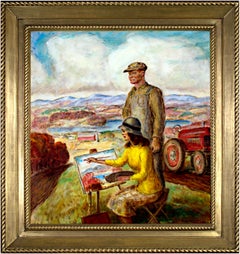
$652,500
H 39.75 in W 36.75 in D 2.5 in
"Texas Hill Country Landscape With Cattle" oil painting of wildflowers, cactus
By Don Warren
Located in Austin, TX
Canvas Size: 12 x 16 in.
Frame Size: 20.5 x 24.5 in.
Signed, lower left: "Don Warren"
A serene, classic, and cheerful scene in the Texas Hill Country by Don Warren. The foreground i...
Category
1970s American Realist James Edward Buttersworth Art
Materials
Canvas, Oil
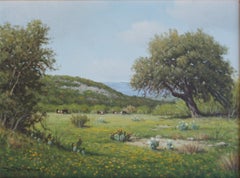
$975
H 11.25 in W 15.25 in
Original Impasto Oil Painting of River Mountain Scene in Wales by British Artist
By Charles Wyatt Warren
Located in Preston, GB
Original Impasto Oil Painting of River Mountain Scene in Wales by British Artist Charles Wyatt Warren (1908-1993)
Art measures 21 x 9 inches
Fra...
Category
Mid-20th Century Land James Edward Buttersworth Art
Materials
Board, Oil
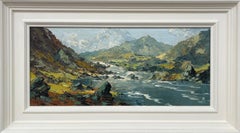
$3,233 Sale Price
20% Off
H 14 in W 26 in D 3 in
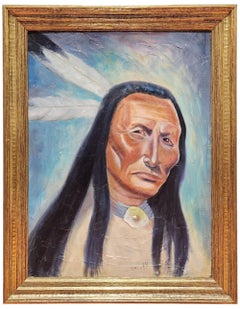
Vintage Portrait of a Native American Man
Located in Grand Rapids, MI
American, 20th Century
Signed: Smiley (Lower, Center)
" Portrait of a Native American Man "
Oil on Board
23 3/4" x 17 3/4"
Housed in a 2" Vintage Gold Frame
Overall Size: 27 3/...
Category
Late 20th Century Modern James Edward Buttersworth Art
Materials
Oil, Board
“All Hallows’ Eve” american realist, landscape oil painting of forest in autumn
By Rachel Personett
Located in Sag Harbor, NY
An oil painting by American artist Rachel Personett (b. 1991, Hawaii) of a woodland scene in October. Yellow foliage adorns the trees and fallen brown leaves cover the ground in this...
Category
21st Century and Contemporary American Realist James Edward Buttersworth Art
Materials
Canvas, Oil

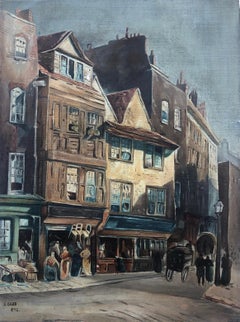
Street of the Old Quarter British School signed Cade oil on canvas painting
Located in Sitges, Barcelona
**Technical Sheet**
**Title:** "Street of the Old Quarter"
**Author:** British School, 19th Century
**Date:** 1892
**Technique:** Oil on canvas
**Dimensions:** 14.17 x 10.63 inc...
Category
1890s American Realist James Edward Buttersworth Art
Materials
Canvas, Oil
$1,431
H 14.18 in W 10.63 in
Previously Available Items
Steam Ship Washington rescuing from the Winchester off Boston 1854
By James Edward Buttersworth
Located in Woodbury, CT
James Edward Butteerworth
Owning a painting by James Edward Buttersworth depicting the heroic rescue of passengers from the ship 'Winchester' by the inscribed steamship 'Washington...
Category
1850s Victorian James Edward Buttersworth Art
Materials
Oil, Board
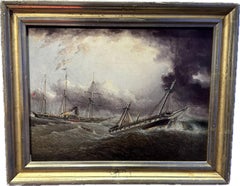
American Steam Schooner Meets British Frigates Crossing the English Channel
By James Edward Buttersworth
Located in Costa Mesa, CA
Three ships - an American Three-Masted Steam Schooner, a British Sailing Royal Navy Frigate and a British Sidewheel Steam Naval Frigate - are all challenged by a tempestuous sea in this English Channel crossing scene. The British sailors work in unison to reef and employ sails on both frigates, running with the heavy, wind-driven sea towards Ramsgate, while the fore-and-aft rigged steam schooner burns her boilers while keeping her sails up to help stabilize the pitch and roll of the American ship, headed to continental Europe. Buttersworth has expertly detailed the actions of the men, their ships and the dramatic setting. Many other ships lay at anchorages off the Kent coast, showing from the Cliffs of Dover to the fortifications of Ramsgate.
This early visit by an American sail/steam vessel to England is remarkable. The first such transatlantic voyage happened in 1819, by the historic S.S. SAVANNAH, and it’d take almost 20 years to be repeated. Among the first names of American Steam Schooners to make British ports, ASP, HARRIET, and BRUTUS are among those recorded. MIDAS, a steam schooner owned by Robert Bennett Forbes, was the first American steamship to China, in 1844.
Showing a varied and illuminated sky that is recognized as a signature of Buttersworth’s artistic talent in his paintings, the stormy clouds are split by a sunburst opening, reflective light creating an emotional, positive hope for the subjects. The English Channel is at its narrowest width in this stretch off Kent, home to the Cinque Ports regulating trade and naval protection in the English Southeast for centuries. Buttersworth is soon bound for life in America, making this one of his last, and in our opinion, best British scenes painted in England.
Sight Size: 18 x 24 Inches
Signed LR: J.E. Buttersworth
Provenance: India House...
Category
1830s James Edward Buttersworth Art
Materials
Canvas, Oil
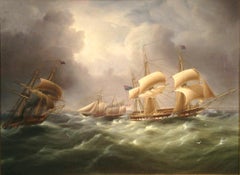
English ship in a rough sea
By James Edward Buttersworth
Located in Woodbury, CT
Hailing from what is now the northwest of Greater London, Buttersworth came from an artistic family. His father, Thomas Buttersworth, Jr., was a re...
Category
1840s Victorian James Edward Buttersworth Art
Materials
Oil
James Edward Buttersworth art for sale on 1stDibs.
Find a wide variety of authentic James Edward Buttersworth art available for sale on 1stDibs. You can also browse by medium to find art by James Edward Buttersworth in oil paint, paint, canvas and more. Not every interior allows for large James Edward Buttersworth art, so small editions measuring 16 inches across are available. Customers who are interested in this artist might also find the work of William Rickarby Miller, William Baptiste Baird, and John Steuart Curry. James Edward Buttersworth art prices can differ depending upon medium, time period and other attributes. On 1stDibs, the price for these items starts at $54,000 and tops out at $245,000, while the average work can sell for $85,000.