Jean-Francois Raffaelli Figurative Paintings
to
2
1
Overall Width
to
Overall Height
to
2
1
1
3
2
1
3
3
1
1
1
1
1
1
3
3
2
1
1
15
493
318
263
225
3
3
Artist: Jean-Francois Raffaelli
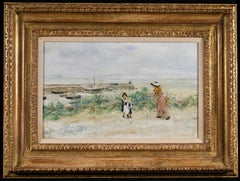
Mother
Children - Impressionist Figurative Oil by Jean-Francois Raffaelli
By Jean-Francois Raffaelli
Located in Marlow, Buckinghamshire
Signed oil on canvas figures in landscape by French impressionist painter Jean-Francois Raffaelli. The work depicts two young girls with their mother in a landscape overlooking boats...
Category
Early 1900s Impressionist Jean-Francois Raffaelli Figurative Paintings
Materials
Oil, Canvas
L
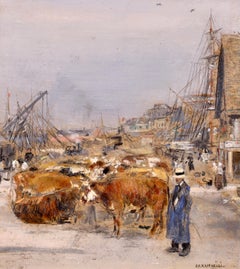
embarquement de boeufs - Impressionist Oil, Cattle by Jean Francois Raffaelli
By Jean-Francois Raffaelli
Located in Marlow, Buckinghamshire
Wonderful signed oil on panel cattle and figures in landscape by French impressionist painter Jean-Francois Raffaelli. The work depicts oxen being loaded onto ships in Honfleur, France en route to England.
Signature:
Signed lower right
Dimensions:
Framed: 18"x16"
Unframed: 9"x8"
Provenance:
Exhibition Jean Francois Raffaélli held at Galerie Simonson, 19 Rue Caumartin Paris - October 1929 (number 44)
Jean-François Raffaëlli's father was a failed Italian businessman and Raffaëlli himself was, among other things, a church chorister, actor and theatre singer. He then studied under Gérôme at the École des Beaux-Arts in Paris. He travelled to Italy, Spain and Algeria and on his return to France settled in Asnières.
In 1876, on a trip to Brittany, he first saw the potential of realist subject matter, if treated seriously. He became involved in meetings of artists at the Café Guerbois, where the Impressionist painters used to gather. As a result, Degas, contrary to the advice of the group, introduced Raffaëlli to the Impressionist exhibitions - according to one uncertain source as early as the very first exhibition, at the home of Nadar, and certainly to those of 1880 and 1881.
In 1904, Raffaëlli founded the Society for Original Colour Engraving. He first exhibited at the Salon de Paris in 1870 and continued to exhibit there until he joined the Salon des Artistes Français in 1881, where he earned a commendation in 1885, was made Chevalier of the Légion d'Honneur in 1889 and in the same year was awarded a gold medal at the Exposition Universelle. In 1906 he was made Officier of the Légion d'Honneur. He was also a member of the Société Nationale des Beaux-Arts. In 1884, a private exhibition of his work cemented his reputation.
He contributed to several newspapers such as The Black Cat (Le Chat Noir) in 1885 and The French Mail (Le Courrier Français) in 1886 and 1887. He published a collection entitled Parisian Characters, which captured his favourite themes of the street, the neighbourhood and local people going about their lives. In 1880 he participated, with Forain, on the illustration of Joris Karl Huysmans' Parisian Sketches (Croquis Parisiens). He also illustrated Huysman's Works. As well as working as an illustrator, he also made etchings and coloured dry-points.
His early attempts at painting were genre scenes, but once he was settled in Asnières he started to paint picturesque views of Parisian suburbs. From 1879 onwards, his subject matter drew on the lives of local people. These popular themes, which he treated with humanity and a social conscience, brought him to the attention of the social realist writers of the time such as Émile Zola. In addition to his realist style, Raffaëlli's dark palette, which ran contrary to the Impressionist aesthethic, helped to explain the opposition of those painters to his participation in their exhibitions. More concerned with drawing than colour, he used black and white for most of his paintings. Towards the end of his life, he lightened his palette, but without adopting any other principles of the Impressionist technique.
After painting several portraits, including Edmond de Goncourt and Georges Clémenceau, he returned to genre painting, particularly scenes of bourgeois life. Later in his career, he painted mainly Breton-inspired sailors and views of Venice. His views of the Paris slums and the fortifications, sites which have almost completely disappeared, went some way towards establishing a genre in themselves and perpetuated the memory of the area: The Slums, Rag-and-Bone Man, Vagabond, Sandpit, In St-Denis, Area of Fortifications. His realistic and witty portrayal of typical Parisian townscapes accounts for his enduring appeal.
Born in Paris, he was of Tuscan descent through his paternal grandparents. He showed an interest in music and theatre before becoming a painter in 1870. One of his landscape paintings was accepted for exhibition at the Salon in that same year. In October 1871 he began three months of study under Jean-Léon Gérôme at the École des Beaux-Arts in Paris; he had no other formal training.
Raffaëlli produced primarily costume pictures until 1876, when he began to depict the people of his time—particularly peasants, workers, and ragpickers seen in the suburbs of Paris—in a realistic style. His new work was championed by influential critics such as J.-K. Huysmans, as well as by Edgar Degas.
The ragpicker became for Raffaëlli a symbol of the alienation of the individual in modern society. Art historian Barbara S. Fields has written of Raffaëlli's interest in the positivist philosophy of Hippolyte-Adolphe Taine, which led him to articulate a theory of realism that he christened caractérisme. He hoped to set himself apart from those unthinking, so-called realist artists whose art provided the viewer with only a literal depiction of nature. His careful observation of man in his milieu paralleled the anti-aesthetic, anti-romantic approach of the literary Naturalists, such as Zola and Huysmans.
Degas invited Raffaëlli to participate in the Impressionist exhibitions of 1880 and 1881, an action that bitterly divided the group; not only was Raffaëlli not an Impressionist, but he threatened to dominate the 1880 exhibition with his outsized display of 37 works. Monet, resentful of Degas's insistence on expanding the Impressionist exhibitions by including several realists, chose not to exhibit, complaining, "The little chapel has become a commonplace school which opens its doors to the first dauber to come along."An example of Raffaëlli's work from this period is Les buveurs d'absinthe (1881, in the California Palace of Legion of Honor Art Museum in San Francisco). Originally titled Les déclassés, the painting was widely praised at the 1881 exhibit.
After winning the Légion d'honneur in 1889, Raffaëlli shifted his attention from the suburbs of Paris to city itself, and the street scenes that resulted were well received by the public and the critics. He made a number of sculptures, but these are known today only through photographs.[2] His work was also part of the painting event in the art competition at the 1912 Summer Olympics. In the later years of his life, he concentrated on color printmaking. Raffaëlli died in Paris on February 11, 1924
Museum and Gallery Holdings:
Béziers: Peasants Going to Town
Bordeaux: Bohemians at a Café
Boston: Notre-Dame; Return from the Market
Brussels: Chevet of Notre-Dame; pastel
Bucharest (Muz. National de Arta al României): Market at Antibes; Pied-à-terre
Copenhagen: Fishermen on the Beach
Douai: Return from the Market; Blacksmiths
Liège: Absinthe Drinker...
Category
1880s Impressionist Jean-Francois Raffaelli Figurative Paintings
Materials
Oil, Panel
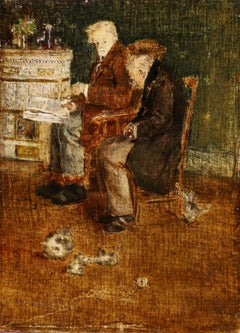
Deux vieillards aux chatons - Impressionist Figurative Oil by J F Raffaelli
By Jean-Francois Raffaelli
Located in Marlow, Buckinghamshire
Signed figures in interior oil on panel by French impressionist painter Jean-Francois Raffaelli. The piece depicts two old men seated in an interior. One is reading his paper as the other naps and there are several kittens on the floor. Painted in the artist's distinctive style.
Signature:
Signed lower left
Dimensions:
Framed: 9.5"x8"
Unframed: 5.5"x4"
Provenance:
Brame & Lorenceau have confirmed the authenticity of this work and it will be included in the digital catalogue raisonne of the painter which is under preparation
A certificate of authenticity fromBrame & Lorenceau accompanies this painting
Private collection - United States
Original artists label verso
Jean-François Raffaëlli's father was a failed Italian businessman and Raffaëlli himself was, among other things, a church chorister, actor and theatre singer. He then studied under Gérôme at the École des Beaux-Arts in Paris. He travelled to Italy, Spain and Algeria and on his return to France settled in Asnières.
In 1876, on a trip to Brittany, he first saw the potential of realist subject matter, if treated seriously. He became involved in meetings of artists at the Café Guerbois, where the Impressionist painters used to gather. As a result, Degas, contrary to the advice of the group, introduced Raffaëlli to the Impressionist exhibitions - according to one uncertain source as early as the very first exhibition, at the home of Nadar, and certainly to those of 1880 and 1881.
In 1904, Raffaëlli founded the Society for Original Colour Engraving. He first exhibited at the Salon de Paris in 1870 and continued to exhibit there until he joined the Salon des Artistes Français in 1881, where he earned a commendation in 1885, was made Chevalier of the Légion d'Honneur in 1889 and in the same year was awarded a gold medal at the Exposition Universelle. In 1906 he was made Officier of the Légion d'Honneur. He was also a member of the Société Nationale des Beaux-Arts. In 1884, a private exhibition of his work cemented his reputation.
He contributed to several newspapers such as The Black Cat (Le Chat Noir) in 1885 and The French Mail (Le Courrier Français) in 1886 and 1887. He published a collection entitled Parisian Characters, which captured his favourite themes of the street, the neighbourhood and local people going about their lives. In 1880 he participated, with Forain, on the illustration of Joris Karl Huysmans' Parisian Sketches (Croquis Parisiens). He also illustrated Huysman's Works. As well as working as an illustrator, he also made etchings and coloured dry-points.
His early attempts at painting were genre scenes, but once he was settled in Asnières he started to paint picturesque views of Parisian suburbs. From 1879 onwards, his subject matter drew on the lives of local people. These popular themes, which he treated with humanity and a social conscience, brought him to the attention of the social realist writers of the time such as Émile Zola. In addition to his realist style, Raffaëlli's dark palette, which ran contrary to the Impressionist aesthethic, helped to explain the opposition of those painters to his participation in their exhibitions. More concerned with drawing than colour, he used black and white for most of his paintings. Towards the end of his life, he lightened his palette, but without adopting any other principles of the Impressionist technique.
After painting several portraits, including Edmond de Goncourt and Georges Clémenceau, he returned to genre painting, particularly scenes of bourgeois life. Later in his career, he painted mainly Breton-inspired sailors and views of Venice. His views of the Paris slums and the fortifications, sites which have almost completely disappeared, went some way towards establishing a genre in themselves and perpetuated the memory of the area: The Slums, Rag-and-Bone Man, Vagabond, Sandpit, In St-Denis, Area of Fortifications. His realistic and witty portrayal of typical Parisian townscapes accounts for his enduring appeal.
Born in Paris, he was of Tuscan descent through his paternal grandparents. He showed an interest in music and theatre before becoming a painter in 1870. One of his landscape paintings was accepted for exhibition at the Salon in that same year. In October 1871 he began three months of study under Jean-Léon Gérôme at the École des Beaux-Arts in Paris; he had no other formal training.
Raffaëlli produced primarily costume pictures until 1876, when he began to depict the people of his time—particularly peasants, workers, and ragpickers seen in the suburbs of Paris—in a realistic style. His new work was championed by influential critics such as J.-K. Huysmans, as well as by Edgar Degas.
The ragpicker became for Raffaëlli a symbol of the alienation of the individual in modern society. Art historian Barbara S. Fields has written of Raffaëlli's interest in the positivist philosophy of Hippolyte-Adolphe Taine, which led him to articulate a theory of realism that he christened caractérisme. He hoped to set himself apart from those unthinking, so-called realist artists whose art provided the viewer with only a literal depiction of nature. His careful observation of man in his milieu paralleled the anti-aesthetic, anti-romantic approach of the literary Naturalists, such as Zola and Huysmans.
Degas invited Raffaëlli to participate in the Impressionist exhibitions of 1880 and 1881, an action that bitterly divided the group; not only was Raffaëlli not an Impressionist, but he threatened to dominate the 1880 exhibition with his outsized display of 37 works. Monet, resentful of Degas's insistence on expanding the Impressionist exhibitions by including several realists, chose not to exhibit, complaining, "The little chapel has become a commonplace school which opens its doors to the first dauber to come along."An example of Raffaëlli's work from this period is Les buveurs d'absinthe (1881, in the California Palace of Legion of Honor Art Museum in San Francisco). Originally titled Les déclassés, the painting was widely praised at the 1881 exhibit.
After winning the Légion d'honneur in 1889, Raffaëlli shifted his attention from the suburbs of Paris to city itself, and the street scenes that resulted were well received by the public and the critics. He made a number of sculptures, but these are known today only through photographs.[2] His work was also part of the painting event in the art competition at the 1912 Summer Olympics. In the later years of his life, he concentrated on color printmaking. Raffaëlli died in Paris on February 11, 1924
Museum and Gallery Holdings:
Béziers: Peasants Going to Town
Bordeaux: Bohemians at a Café
Boston: Notre-Dame; Return from the Market
Brussels: Chevet of Notre-Dame; pastel
Bucharest (Muz. National de Arta al României): Market at Antibes; Pied-à-terre
Copenhagen: Fishermen on the Beach
Douai: Return from the Market; Blacksmiths
Liège: Absinthe Drinker...
Category
1890s Impressionist Jean-Francois Raffaelli Figurative Paintings
Materials
Oil, Panel
Related Items
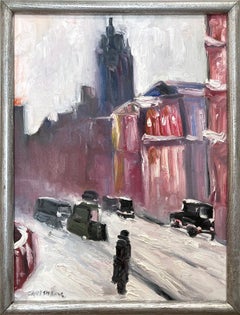
"View of the Empire State NYC in Snow" Impressionistic Ashcan School Style
By Cindy Shaoul
Located in New York, NY
An impressionistic depiction of a figure in the snow with cars and buildings in the busy City Streets. The Empire State Building is portrayed in the background as the snow filled str...
Category
2010s American Impressionist Jean-Francois Raffaelli Figurative Paintings
Materials
Canvas, Oil, Board

$1,200
H 17 in W 13 in D 1.25 in
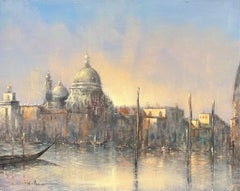
Large Italian Impressionist Signed Oil Painting Grand Canal Venice Atmospheric
Located in Cirencester, Gloucestershire
The Grand Canal, Venice
Italian Impressionist artist, second half 20th centuyr
indistinctly signed
oil on canvas, unframed
Canvas: 26 x 32 inches
Provenance: Private collection
Cond...
Category
Late 20th Century Impressionist Jean-Francois Raffaelli Figurative Paintings
Materials
Oil, Canvas
$2,396 Sale Price
20% Off
H 26 in W 32 in
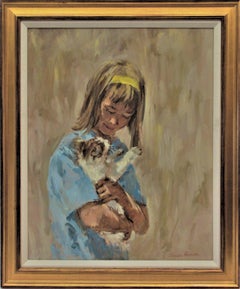
Young Girl with Her Cat
By Gunnar Donald Anderson
Located in San Francisco, CA
This artwork "Young Girl with Her Cat" c.1990 is an oil painting on panel by noted American artist Gunnar Donald Anderson, b.1927-2022. It is signed at the lower right corner by the artist. The panel size is 20 x 16 inches, framed size is 24 x 20 inches. Framed in a wooden gold frame, with fabric liner. It is in excellent condition.
About the artist:
Gunnar Donald Anderson, age 95 of Sonoma CA passed away on April 26, 2022. Gunnar was born to Sven Gunnar Anderson...
Category
Late 20th Century American Impressionist Jean-Francois Raffaelli Figurative Paintings
Materials
Oil
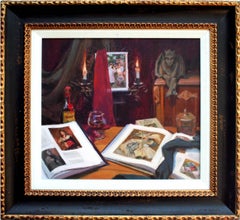
Ultra Realist Library Still-Life Books and Candles "Little Devil in the Details"
By Ken DeWaard
Located in Soquel, CA
Ultra Realist Library Still-Life Books and Candles "Little Devil in the Details"
Highly detailed library interior scene and still-life titled "Little Devil in the Detail" by Ken DeWaard (American, 20th-century). This intriguing artists performance in excellence piece, features realistically rendered books, paintings within paintings, candle light, and a devil or gargoyle sculpture. The artist creates a strong mood as well as interesting subject matter in this unique scene.
Signed "Dewaard '99" upper right.
Displayed in a wood frame.
Image size, 13"H x 14"L.
Frame: 20"H x 21"W x 2"D
After receiving his Bachelor of Arts with honors, Ken began working in a commercial art studio in Chicago. He continued his studies at the American Academy of Art, where he studied with nationally recognized watercolorist, Irving Shapiro. Upon Irving's recommendation Ken joined the acclaimed Palette and Chisel Academy of Fine Art in Chicago, where he soon began studying with Scott Burdick as well as Dan Gerhartz...
Category
1990s American Impressionist Jean-Francois Raffaelli Figurative Paintings
Materials
Masonite, Oil
$2,120 Sale Price
20% Off
H 20 in W 21 in D 2 in
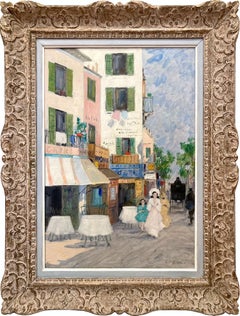
"Italian Village Cafe" Romantic Impressionist Oil Painting Street Scene Canvas
By Luigi Cagliani
Located in New York, NY
A whimsical oil painting depicting a cafe scene in an Italian Village. Luigi Cagliani was known for his charming compositions and settled in Lombardy, which helps explain his passion...
Category
Early 20th Century Impressionist Jean-Francois Raffaelli Figurative Paintings
Materials
Oil, Canvas
$6,000
H 38 in W 29 in D 2.5 in
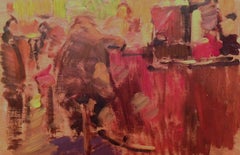
"Bar Scene" small impressionist oil painting - study
By Ben Fenske
Located in Sag Harbor, NY
A small sketch by American Impressionist, Ben Fenske. Painted on site at a local pub, Ben Fenske sketches out an incoherent bar scene. Perhaps the obscurity of forms is a nod to the ...
Category
21st Century and Contemporary American Impressionist Jean-Francois Raffaelli Figurative Paintings
Materials
Oil, Panel
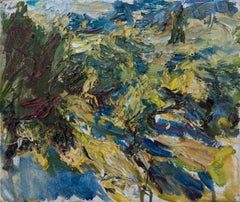
"Olive Orchard (Croatia)" Oil painting
By Ulrich Gleiter
Located in Denver, CO
Ulrich Gleiter's (EUR based) "Olive Orchard (Croatia)" is an oil painting that depicts a impressionistic plains of yellow and green dotted with Olive trees and foliage
Bio/Artist St...
Category
2010s Impressionist Jean-Francois Raffaelli Figurative Paintings
Materials
Canvas, Oil
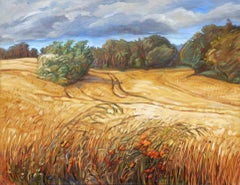
"Wheat Under the Storm", Captivating Stormy Landscape of pre-Harvest Fields
By Yves Calméjane
Located in Clermont-Ferrand, Auvergne-Rhône-Alpes
Yves Calméjane's "Wheat Under the Storm", an oil on canvas measuring approximately 44.9 inches by 57.5 inches, is a stirring depiction of the dynamic French Dordogne landscape under ...
Category
2010s Impressionist Jean-Francois Raffaelli Figurative Paintings
Materials
Canvas, Oil
$3,895
H 44.89 in W 57.49 in
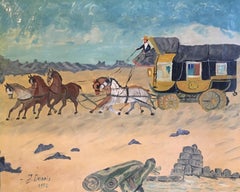
Travellers, Horse Drawn Carriage, Impressionist Oil Painting, Signed
Located in Cirencester, Gloucestershire
Travellers, Horse Drawn Carriage, Impressionist Oil Painting, Signed
By French artist J.Dubois, Mid 20th Century
Signed and dated '1958' by the ar...
Category
Mid-20th Century Impressionist Jean-Francois Raffaelli Figurative Paintings
Materials
Oil
$1,393 Sale Price
20% Off
H 23 in W 27.5 in
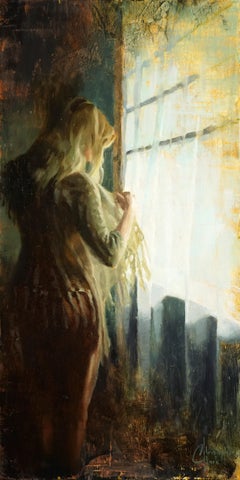
Light From the Window
By Christopher Clark
Located in Denver, CO
Figure standing with window
Category
2010s American Impressionist Jean-Francois Raffaelli Figurative Paintings
Materials
Oil, Wood Panel
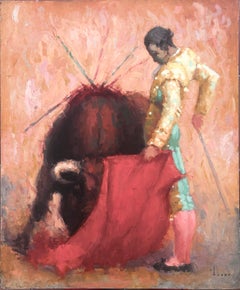
Bullfighting Scene oil on board painting
Located in Sitges, Barcelona
Title: Bullfighting Scene
Artist: José María Tuser Vázquez (1919-1986)
Technique: Oil on board
Dimensions: 25.6 x 21.3 in (65 x 54 cm) Frameless
Period: Second half of the 20th century
Art Movement: Figurative Expressionism with Impressionist influences
Condition: Good, with visible signs of aging on the surface
DESCRIPTION OF THE WORK
This painting captures a crucial moment in a bullfight, where the matador, dressed in a dazzling traje de luces (suit of lights), elegantly holds the red cape (muleta) while facing a wounded bull. The scene conveys tension and drama through energetic and loose brushwork, with strong contrasts of light and color that enhance its expressiveness.
The abstract background, built with gestural brushstrokes in warm, earthy tones, reinforces the dynamism and immediacy of the moment. The thick texture of the paint and the vibrant colors in the matador's attire and cape are characteristic of Figurative Expressionism, giving the work a strong emotional impact.
Tuser masterfully captures the essence of movement and the intensity of the bullfight through a painterly approach reminiscent of Impressionism, but with a greater emphasis on gesture and expressive color, making his work stand out for its raw energy and dramatic depth.
ARTIST BIOGRAPHY
José María Tuser Vázquez (Barcelona, 1919 - 1986) was a Spanish painter specialized in bullfighting themes, gaining recognition in the 20th-century art scene for his expressive depictions of the corrida (bullfight). He studied at the School of Arts and Crafts in Barcelona, where he developed a strong mastery of color and composition.
From 1947 onwards, his work focused almost entirely on bullfighting, creating posters, illustrations, and paintings that capture the emotion and spectacle of the arena. He was a frequent collaborator with El Ruedo magazine, where his illustrations and covers solidified his reputation. Additionally, in the 1940s, he designed series of postcards featuring traditional Spanish costumes for the Artigas Publishing House.
His work has been auctioned in several art houses and is highly valued among collectors of bullfighting paintings. His influence and legacy in tauromaquia (bullfighting art...
Category
1950s Impressionist Jean-Francois Raffaelli Figurative Paintings
Materials
Oil, Board
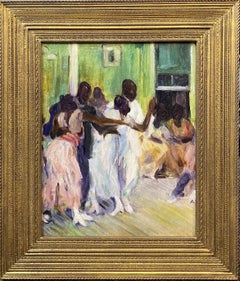
Foxtrot
By Wayman Adams
Located in Milford, NH
A fine impressionist painting of figures dancing by American artist Wayman Elbridge Adams (1883-1959). Adams was born in Muncie, Indiana, studied at the Herron Art Institute in India...
Category
Early 20th Century American Impressionist Jean-Francois Raffaelli Figurative Paintings
Materials
Oil, Panel
Previously Available Items
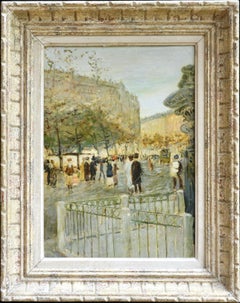
Paris- 19th Century Oil, Elegant Figures in Cityscape by Jean-Francois Raffaelli
By Jean-Francois Raffaelli
Located in Marlow, Buckinghamshire
A truly remarkable oil on board circa 1900. A stunning figurative scene in Paris by the popular artist Jean-Francois Raffaelli. Signed lower left. Framed dimensions are 24.5 inches high by 18.5 inches wide.
Jean-François Raffaëlli's father was a failed Italian businessman and Raffaëlli himself was, among other things, a church chorister, actor and theatre singer. He then studied under Gérôme at the École des Beaux-Arts in Paris. He travelled to Italy, Spain and Algeria and on his return to France settled in Asnières.
In 1876, on a trip to Brittany, he first saw the potential of realist subject matter, if treated seriously. He became involved in meetings of artists at the Café Guerbois, where the Impressionist painters used...
Category
1910s Impressionist Jean-Francois Raffaelli Figurative Paintings
Materials
Oil, Board
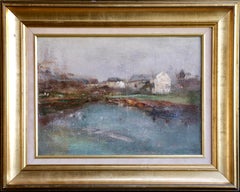
On the River - 19th Century Oil, Cottages by Boats on a River by Raffaelli
By Jean-Francois Raffaelli
Located in Marlow, Buckinghamshire
A striking and charming river scene. Oil on canvas circa 1910 by the popular artist Jean-Francois Raffaelli. Signed lower right. Framed dimensions are 21 inches high by 26 inches wide.
Jean-François Raffaëlli's father was a failed Italian businessman and Raffaëlli himself was, among other things, a church chorister, actor and theatre singer. He then studied under Gérôme at the École des Beaux-Arts in Paris. He travelled to Italy, Spain and Algeria and on his return to France settled in Asnières.
In 1876, on a trip to Brittany, he first saw the potential of realist subject matter, if treated seriously. He became involved in meetings of artists at the Café Guerbois, where the Impressionist painters used...
Category
1910s Impressionist Jean-Francois Raffaelli Figurative Paintings
Materials
Canvas, Oil
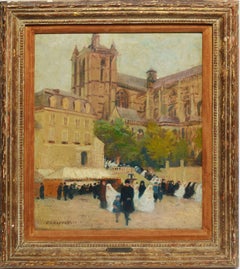
Communion Day by Jean Francois Raffaelli
By Jean-Francois Raffaelli
Located in Buffalo, NY
Impressionist cityscape view with figures at communion by Jean Francois Raffaelli (1850 - 1924). Oil on board, circa 1890. Signed lower left. Displayed in a period giltwood frame...
Category
Early 1900s Impressionist Jean-Francois Raffaelli Figurative Paintings
Materials
Canvas, Oil, Board
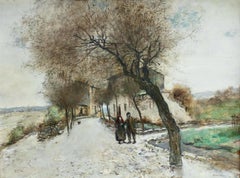
Figures in a Village
By Jean-Francois Raffaelli
Located in Marlow, Buckinghamshire
A remarkable and enchanting picture depicting figures having conversation in the street of a beautifully and expressively illustrated village. Oil on panel, signed lower right. c.1890.
The authenticity of the work has been confirmed by Brame et Lorenceau and will be included in their forthcoming Catalogue Raisonne of the work of Jean Francois Raffaelli.
Provenance, The Cider House Galleries, Bletchingley, Surrey , Hôtel Drouot, Mes Rieunier et Bailly-Pommery, 10 avril 1954, Christie's, King Street, London December 2016, Lot 48.
Jean-François Raffaëlli's father was a failed Italian businessman and Raffaëlli himself was, among other things, a church chorister, actor and theatre singer. He then studied under Gérôme at the École des Beaux-Arts in Paris. He travelled to Italy, Spain and Algeria and on his return to France settled in Asnières.
In 1876, on a trip to Brittany, he first saw the potential of realist subject matter, if treated seriously. He became involved in meetings of artists at the Café Guerbois, where the Impressionist painters used...
Category
19th Century Impressionist Jean-Francois Raffaelli Figurative Paintings
Jean-francois Raffaelli figurative paintings for sale on 1stDibs.
Find a wide variety of authentic Jean-Francois Raffaelli figurative paintings available for sale on 1stDibs. You can also browse by medium to find art by Jean-Francois Raffaelli in oil paint, paint, panel and more. Much of the original work by this artist or collective was created during the 19th century and is mostly associated with the Impressionist style. Not every interior allows for large Jean-Francois Raffaelli figurative paintings, so small editions measuring 8 inches across are available. Customers who are interested in this artist might also find the work of Eugene Galien-Laloue, Victor Gabriel Gilbert, and Jean-Baptiste-Antoine Guillemet. Jean-Francois Raffaelli figurative paintings prices can differ depending upon medium, time period and other attributes. On 1stDibs, the price for these items starts at $12,326 and tops out at $24,692, while the average work can sell for $18,509.