Jerome Myers Art

American, 1867-1940

Born in Petersburg, Virginia in 1867, Jerome Myers became an important painter of urban realism, starting with a series of images of ghetto life in 1887, the year he began studying at the Cooper Union. One of his earliest works is Backyard from that year, in a private collection, which already shows a raw, unidealized view of New York City. Thus, he actually anticipated the productions of the Ashcan School. Myers continued his studies at the Art Students League where his teacher was George de Forest Brush, the academic painter of idealized Native Americans. Brush's classicism did not rub off on Myers, who had no patience for careful drawing. He was even disturbed by the presence of a studio model, so he completed a series of self-portrait drawings to satisfy the faculty's requirements. For Myers, the academic experience was too imitative. However, he stayed around for eight years. Like artists of the Ashcan School, Myers went directly to the streets of New York for inspiration. He carried a 9x11 inch sketch pad wherever he went, like a "day and night prowler in and out of the crowds," explained Guy Pène du Bois. By 1895, Myers found a position in the New-York Tribune's art department. Probably because of academic indoctrination, Myers thought it was necessary to travel to Paris. There, he shared a room with Solon Borglum and noted the pathetic ruins of American students who had lingered too long. Myers realized the trip was not really that helpful and returned to America. "I asked myself what Paris could give, and the answer was 'Nothing’" Later in a newspaper article, Myers was extolled as "the only artist of consequence in the United States, possibly, who had no European training." He met the influential art dealer William Macbeth, who agreed to exhibit his art and the painter noted ". . . almost overnight, I had become a professional artist," thanks to this encounter. This led to various exhibitions, including the St. Louis World's Fair in 1904, where his painting Night Concert won a bronze medal. In 1908, Macbeth gave Myers his first one-man show in January, a month before the famous exhibition of Robert Henri's group The Eight. In many respects, the style of Myers paralleled the gritty urban realism of Henri, George Luks, John Sloan, Everett Shinn, Theresa Bernstein and William Glackens. Although Myers was a friend of Henri, he was not part of the group because Henri regarded Myers's art as too sentimental. Sloan thought it was more a question of Myers being roughly the same age as Henri and thus could not have been a disciple. Myers did, however, participate in the "Exhibition of Independent Artists" in 1910, which Henri and his colleagues organized. Then Myers hosted a group in his studio that was to become the American Association of Painters and Sculptors (AAPS), the group responsible for the Armory Show in 1913. Myers, who exhibited two paintings there along with fifteen drawings, was dismayed that the European art in the show attracted the most attention. In addition, the work turned out to be radical modernist-oriented, excluding the contemporary realists entirely. Myers returned to the streets of New York, especially the places where immigrants gathered on the Lower East Side. He noted, when the immigrants "merge here with New York, something happens that gives vibrancy I didn't get in any other place." He also depicted the moment of leisure, for example, at the East River Pier and night concerts in the parks. Myers relished in the outdoor activities of New Yorkers, and at the end of his life, he regretted a new distrusting atmosphere in which people tended to stay more at home: "Something is gone. Something is missing." I say to myself, "It is the warmth of human contact. New Yorkers no longer live in the open." Myers continued to exhibit and win prizes, five at the National Academy of Design. His works are to be found in major American museums.

to
2
1
Overall Width
to
Overall Height
to
6
1
2
1
2
1
6
5
4
3
3
2
2
1
1
5
1
1
1
1
7
9,962
2,753
1,376
1,373
1
6
Artist: Jerome Myers
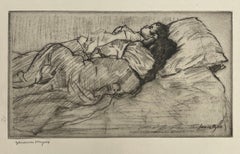
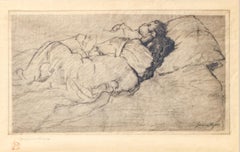
MOTHER AND CHILD RESTING #1
By Jerome Myers
Located in Portland, ME
Myers, Jerome (American. 1867-1940). MOTHER AND CHILD RESTING #1 Softground etching, not dated. Signed in pencil, lower right and also in the plate. 5 1/4 x 9 3/8 inches (plate), 12 ...
Category

Early 20th Century Jerome Myers Art

Materials

Etching

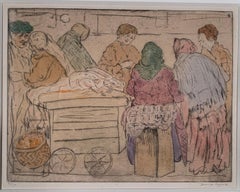
UNTITLED (STREET SCENE WITH PUSHCART)
By Jerome Myers
Located in Portland, ME
Myers, Jerome. UNTILED (STREET SCENE WITH PUSHCART). Etching with hand-coloring, not dated, but about 1910. Edition of 50. Signed in pencil and numbered 32/50. 7 3/8 x 9 3/4 inches, ...
Category

Early 20th Century Jerome Myers Art

Materials

Etching

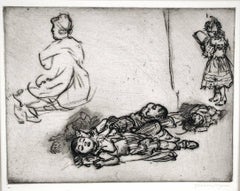
Children in Mulberry Street
By Jerome Myers
Located in New York, NY
Jerome Myers (1867-1940), Children in Mulberry Street, c. 1910, soft ground etching and plate tone, signed in pencil lower right. In good condition (apart from weakening at platemark...
Category

1910s American Realist Jerome Myers Art

Materials

Etching

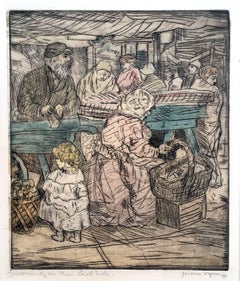
Morning on the East Side
By Jerome Myers
Located in New York, NY
Jerome Myers (1867-1940), Morning on the East Side, c. 1910, colored etching, signed in pencil lower right and annotated “imp.”; numbered and titled (twice) lower left. In very good ...
Category

1910s Jerome Myers Art

Materials

Color, Etching

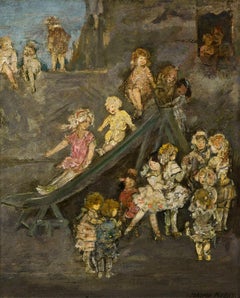
Children Playing on The Slide, Ashcan School - Lower East Side
By Jerome Myers
Located in Miami, FL
Immigrant children from New York's Lower East Side are joyfully captured whizzing down on a slide. From the window of a tenement building, a lone adult with child witnesses the foli...
Category

Early 1900s Ashcan School Jerome Myers Art

Materials

Canvas, Oil

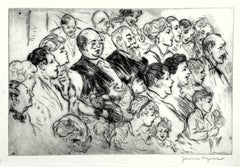
At the Show
By Jerome Myers
Located in New York, NY
Jerome Myers (1867-1940), At the Show, etching and drypoint, c. 1920, signed in pencil lower right. In good condition, with margins (paper losses upper corners), faint ink marks and ...
Category

1920s American Realist Jerome Myers Art

Materials

Drypoint, Etching

Related Items
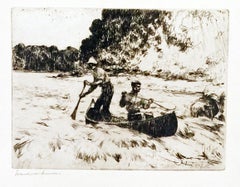
RUNNING THE RAPIDS
By Frank Benson
Located in Portland, ME
Benson, Frank. RUNNING THE RAPIDS. Paff 269. Etching, 1927. Edition of 150. Signed in pencil. Printed on Whatman paper. 5 7/8 x 7 3/4 inches (plate), 8 1/2 x 10 5/8 inches (sheet). A...
Category

1920s American Realist Jerome Myers Art

Materials

Etching

John Taylor Arms, Study in Stone, Cathedral of Ourense
By John Taylor Arms
Located in New York, NY
John Taylor Arms was known for making such finely drawn etchings that commercial tools were not good enough: He regularly used sewing needles with corks ...
Category

Mid-20th Century American Realist Jerome Myers Art

Materials

Etching

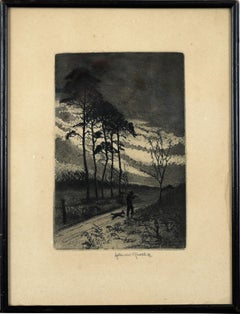
"End of Day" Original Limited Edition Etching
Located in Soquel, CA
"End of Day" Original Limited Edition Etching by John McGrath (Irish/American b.1884 d.1942). This etching depicts a man with a tool slung over his shoulder walking along a path th...
Category

Early 20th Century American Realist Jerome Myers Art

Materials

Paper, Ink, Drypoint, Etching

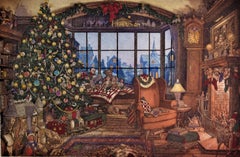
Fireside Christmas
Located in San Francisco, CA
This artwork titled "Fireside Christmas" c. 1985 is an original color etching by American artist Scott Fitzgerald. It is hand signed, titled and numbered 158/250 in pencil by the artist. Published and printed by the artist. The image (plate mark) size is 11.5 x 17.65 inches, sheet size is 19.25 x 25.25 inches. it is in excellent condition, has never been framed. About the artist: Scott Fitzgerald received his Master’s Degree in Arts from California State University Fullerton, and went on to teach drawing and printmaking for 2 years at the university. During his college years, he focused his study in contemporary art and photography, creating mixed media works often with social comments. It was not until the sophomore year, he discovered the traditional art of etching in his printmaking class. Immediately, he embraced the complex and difficult technical process of making prints from etching on copper plates. Scott Fitzgerald established himself as a prominent printmaker in the next few years. With a strong interest in history, he accepted a commission to produce a series of etching depicting 15 Orange County historical landmarks. Besides producing very intricate prints in various sizes, he has engaged in many special projects. He worked with renowned English printer John Randle to produce a group of etchings...
Category

Late 20th Century American Realist Jerome Myers Art

Materials

Etching

Fireside Christmas
Fireside Christmas
$500
H 19.25 in W 25.25 in D 0.01 in
Children freeing a caged bird
By Eileen Soper
Located in Middletown, NY
Etching on cream wove paper, 4 1/2 x 7 inches (114 x 177 mm), wide margins, signed in pencil in the lower right. Laid down to non-archival board with the mat affixed, obscuring the verso and the sheet edges. The visible portion of the sheet is clean with minor toning around the mat window opening. The signature is unobscured and clear. Best known as the original illustrator of Enid Blyton...
Category

Early 20th Century American Realist Jerome Myers Art

Materials

Handmade Paper, Etching

Querelle d amoureux. (Quarreling). 1
By James Tissot
Located in Storrs, CT
En plein soleil. (In the Sunlight). 1881. Etching and drypoint. Tissot 54, Béraldi 45, Wentworth 54. 7 13/16 x 11 1/2 (sheet 11 1/4 x 15). Edition about 100. Mat line and two hinge s...
Category

19th Century Impressionist Jerome Myers Art

Materials

Drypoint, Etching

Querelle d
amoureux. (Quarreling). 1
Querelle d
amoureux. (Quarreling). 1
$2,800 Sale Price
20% Off
H 7.82 in W 8.5 in D 0.5 in
Mid Century Portrait of Wine Enologist Claude Wolf
By Abel Warshawsky
Located in Soquel, CA
Wine Enologist Claude Wolf - Mid Century Portrait A stately mid-century portrait of Claude Wolf (1904-1973), a vintner Enologist by Abel George Warshawsky...
Category

1950s Photorealist Jerome Myers Art

Materials

Oil, Canvas

Winter Tracery (Milford Connecticut)
Located in San Francisco, CA
This artwork titled 'Winter Tracery (Milford Connecticut)" is an original drypoint etching by noted American artist Philip Kappel, 1901-1981. It is hand signed and titled in pencil by the artist. The plate mark (Image) size is 9 x 12 inches, framed size is 17.25 x 21.25 inches. Custom framed in a wooden light grey frame, with light grey matting and black color fillet. It is in excellent condition. About the artist: Philip Kappel — painter, illustrator, printer, writer, and lecturer — was born on February 10, 1901 in Hartford, CT and died in 1981. Kappel is best remembered for his landscapes, portraits, figures, marine, lithography, and etching. He held a teaching position with H. B. Snell, Boothbay, ME Studios, 1923 and 1924. His addresses in 1929 were 500 Fifth Avenue in New York City and, for the summer, care of Philip Little, 10 Chestnut Street, Salem, MA; and in 1935, Sarasota, FL. Kappel was a pupil of the Pratt Institute Art School in Brooklyn, NY and Philip Little (1857-1942) and held memberships with the North Shore Artists Association in Gloucester, MA; the Marblehead...
Category

Mid-20th Century American Realist Jerome Myers Art

Materials

Drypoint, Etching

Gloucester Ferry, No. 2
By Stephen Parrish
Located in Middletown, NY
A beautiful and delicate 19th century image of one of New England's most storied ports. Boston: Estes & Lauriat Editions, 1882 Etching on cream laid paper, 2 3/4 x 5 1/4 inches (68 ...
Category

Early 20th Century American Realist Jerome Myers Art

Materials

Laid Paper, Etching

Mr. L (oil painting monochrome vintage old man beard portrait nostalgia, hat)
By Rudolf Kosow
Located in Quebec, Quebec
keywords; surrealism, portrait, oil painting, earth tones, figurative painting, strangeness, contemporary surrealistic, unsettling, contemporary figurative painting, dreams, symbolic...
Category

2010s Realist Jerome Myers Art

Materials

Canvas, Oil

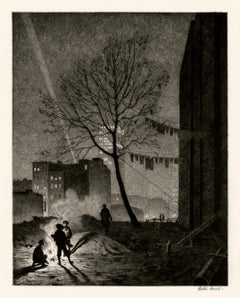
Tree, Manhattan — Classic American Realism
By Martin Lewis
Located in Myrtle Beach, SC
Martin Lewis, 'Tree, Manhattan', drypoint, 1930, edition 91 (including 10 trial proofs), McCarron 87. Signed in pencil. A superb, atmospheric impression, in warm black ink, on cream...
Category

1930s American Realist Jerome Myers Art

Materials

Drypoint

Portrait of James McBey.
By Walter Tittle
Located in Storrs, CT
James McBey. 1931. Drypoint. 8 7/8 x 5 7/8 (sheet 11 1/2 x 9 ). An extremely rich impression with drypoint burr, printed by the artist on cream wove paper. Signed in the plate lower ...
Category

1930s American Modern Jerome Myers Art

Materials

Drypoint, Etching

Previously Available Items
Signed Jerome Myers Engraving of Sleeping Children
By Jerome Myers
Located in New York, NY
Jerome Myers (American, 1867-1940) Untitled (Sleeping Children), c. 1915 Engraving on paper Sight: 6 3/4 x 10 in. Framed: 12 3/4 x 15 7/8 x 1/2 in. Signed lower left and stamped with artist monogram Signed lower right in plate Born in Petersburg, Virginia in 1867, Myers became an important painter of urban realism, starting with a series of images of ghetto life in 1887, the year he began studying at the Cooper Union. One of his earliest works is Backyard from that year, in a private collection, which already shows a raw, unidealized view of New York City. Thus he actually anticipated the productions of the Ash Can School. Myers continued his studies at the Art Students League where his teacher was George de Forest Brush...
Category

1910s American Modern Jerome Myers Art

Materials

Engraving

"Street Scene, Paris, France" Jerome Myers, Ashcan School Drawing
By Jerome Myers
Located in New York, NY
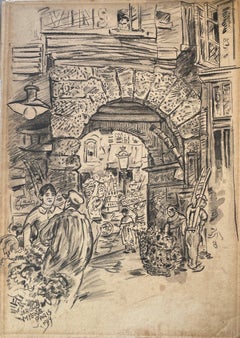
Jerome Myers (1867 - 1940) Street Scene, Paris, France, 1914 Black crayon and gray wash on paper on card stock 14 x 10 1/8 inches Signed, titled and dated lower left Provenance: Private Collection, New York Born in Petersburg, Virginia in 1867, Myers became an important painter of urban realism, starting with a series of images of ghetto life in 1887, the year he began studying at the Cooper Union.  One of his earliest works is Backyard from that year, in a private collection, which already shows a raw, unidealized view of New York City.  Thus he actually anticipated the productions of the Ashcan School.  Myers continued his studies at the Art Students League where his teacher was George de Forest Brush, the academic painter of idealized Native Americans. Brush's classicism did not rub off on Myers, who had no patience for careful drawing - he was even disturbed by the presence of a studio model, so he completed a series of self-portrait drawings to satisfy the faculty's requirements.  For Myers, the academic experience was too imitative, however he stayed around for eight years.  Like artists of the Ashcan School, Myers went directly to the streets of New York for inspiration.  He carried a 9" x 11" sketch pad wherever he went, like a "day and night prowler...
Category

1910s Ashcan School Jerome Myers Art

Materials

Crayon, Ink, Cardboard

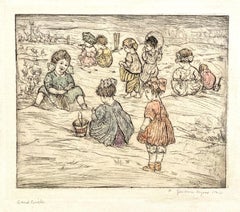
Sand Circle
By Jerome Myers
Located in New York, NY
Besides being one of the organizers of the famous Armory Show of 1913, Jerome Myers was a wonderful interpreter of New York City life -- it's children included. The charmingly named 'Sand Circle...
Category

1910s Ashcan School Jerome Myers Art

Materials

Etching

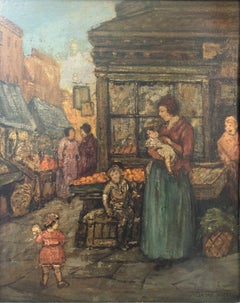
"East Side Corner, New York City" Jerome Myers Ashcan Cityscape, Market Scene
By Jerome Myers
Located in New York, NY
Jerome Myers (1867 - 1940) East Side Corner, New York City, 1934 Oil on board 20 x 16 inches Signed lower right Provenance: Collection of G. David Thompson, Pittsburgh George David Thompson (1899 – 1965) was an American investment banker, industrialist, and modern art collector, based in Pittsburgh. He started as a banker, but by 1945 was running four steel mills. In 1959 Pittsburgh's Carnegie Museum of Art rejected his offer of over 600 artworks, unwilling to build a gallery bearing his name, and he gradually sold much of his collection, although he left the Carnegie Museum over 100 artworks when he died in 1965. In May 1961, New York's Solomon R. Guggenheim Museum held an exhibition entitled One Hundred Paintings from the G. David Thompson Collection, with works by Cézanne, Monet, Degas, Josef Albers, Braque, Klee, Legér, Matisse, Miró, and Mondrian, with Picasso being the most represented, with 12 works. Born in Petersburg, Virginia in 1867, Myers became an important painter of urban realism, starting with a series of images of ghetto life in 1887, the year he began studying at the Cooper Union.  One of his earliest works is Backyard from that year, in a private collection, which already shows a raw, unidealized view of New York City.  Thus he actually anticipated the productions of the Ashcan School.  Myers continued his studies at the Art Students League where his teacher was George de Forest Brush, the academic painter of idealized Native Americans. Brush's classicism did not rub off on Myers, who had no patience for careful drawing - he was even disturbed by the presence of a studio model, so he completed a series of self-portrait drawings to satisfy the faculty's requirements.  For Myers, the academic experience was too imitative, however he stayed around for eight years.  Like artists of the Ashcan School, Myers went directly to the streets of New York for inspiration.  He carried a 9" x 11" sketch pad wherever he went, like a "day and night prowler...
Category

1930s American Modern Jerome Myers Art

Materials

Oil, Board

Jerome Myers art for sale on 1stDibs.

Find a wide variety of authentic Jerome Myers art available for sale on 1stDibs. You can also browse by medium to find art by Jerome Myers in etching, canvas, drypoint and more. Not every interior allows for large Jerome Myers art, so small editions measuring 5 inches across are available. Customers who are interested in this artist might also find the work of George Biddle, Stephen Parrish, and Saul Chase. Jerome Myers art prices can differ depending upon medium, time period and other attributes. On 1stDibs, the price for these items starts at $525 and tops out at $25,000, while the average work can sell for $850.

Artists Similar to Jerome Myers

Recently Viewed

View All