John Frederick Kensett Art
to
2
1
1
Overall Width
to
Overall Height
to
4
3
1
1
1
1
1
1
1
1
1
1
1
1
1
1
1
1
1
1
4
3
2
2
1
4
10,043
2,757
1,381
1,375
3
4
Artist: John Frederick Kensett
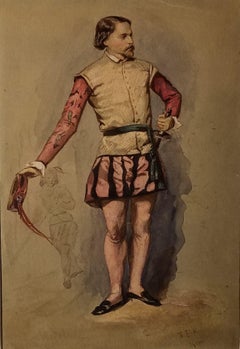
"Portrait of an Italian Fencer, " John Frederick Kensett, Hudson River School
By John Frederick Kensett
Located in New York, NY
John Frederick Kensett (1816 - 1872)
Portrait of an Italian Fencer, circa 1845-47
Watercolor on wove paper
13 1/8 x 8 1/8 inches
Signed with initials and inscribed lower right "J.F.K. Rome"
From October 1845 through the spring of 1847, Kensett lived in Rome. He attended classes where he sketched from live models, and he sketched in the countryside outside Rome and around Florence, Perugia, and Venice, places he visited with his artist friends. He fulfilled commissions for paintings from Americans in Italy, and by 1847 his career was well established.
Son of an English immigrant engraver, John Kensett lacked enthusiasm for that medium and became one of the most accomplished painters of the second generation of Hudson River School painters. His reputation is for Luminism, careful depiction of light, weather, and atmosphere as they affect color and texture of natural forms. He was particularly influenced by the painting of Asher Durand in that he focused on realism and detail rather than the highly dramatic views associated with Thomas Cole. Going to the western United States in the mid 1850s and the 1860s, he was the first of the Hudson River School painters to explore and paint the West.
Kensett was born and raised in Cheshire, Connecticut, and learned his engraving from his father, Thomas Kensett with whom he worked in New Haven, Connecticut until 1829. He continued working until 1840 as an engraver of labels, banknotes and maps and was employed part of that time by the American Bank Note Company in New York City. There he met Thomas Rossiter, John Casilear, and other artists who urged him to pursue painting. In 1840, he and Rossiter, Asher Durand, and Casilear went to Europe where Kensett stayed for seven years and supported himself by doing engraving but became accomplished in landscape painting.
Having sent canvases of Italian landscapes back to New York, he had a reputation for skillful painting that preceded him. When he returned to New York City in 1847, he was an "instant success" and very sought after by collectors. Two of his Italian landscapes had already been purchased by the American Art Union. By 1849, he was a full member of the National Academy of Design and was generally popular among his peers. His studio was a gathering place with travelers stopping by to see his canvases and to identify "precise locations in the Catskills or Newport or New England in the oil sketches and drawings that covered his walls." (Zellman 170). For the women, he was a popular bachelor, "romantic looking with high forehead and sensitive expression." (Samuels 262)
He was also sought after by many organizations. Among his activities were serving on the committee to oversee the decoration of the United States Capitol in Washington DC, and becoming one of the founders of the Metropolitan Museum in New York.
An inveterate traveler, Kensett spent summers on painting excursions away from New York City. One of these trips was a special painting excursion with fifteen other artists sponsored by the B & O Railroad from Baltimore, Maryland to Wheeling, West Virginia. Unlike many of the Hudson River painters...
Category
1840s Hudson River School John Frederick Kensett Art
Materials
Paper, Watercolor
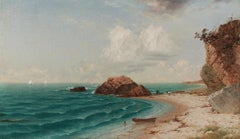
New England Coastal Scene with Figures
By John Frederick Kensett
Located in New York, NY
Monogramed and dated lower right: JF.K. / ‘64.
Category
Mid-19th Century Hudson River School John Frederick Kensett Art
Materials
Canvas, Oil
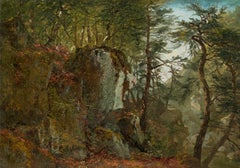
Wooded Landscape with Boulders
By John Frederick Kensett
Located in New York, NY
In his oil painting titled, “Wooded Landscape with Boulders,” John Frederick Kensett depicts a rocky outcropping in a dense forest, with the slope of a mountain behind.
Category
Mid-19th Century John Frederick Kensett Art
Materials
Canvas, Oil
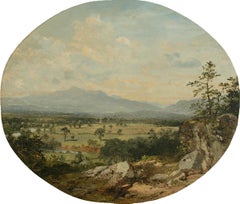
Mount Chocorua
By John Frederick Kensett
Located in New York, NY
Leading Hudson River School Painter Famous for New England Views.
Category
19th Century Hudson River School John Frederick Kensett Art
Materials
Oil
Related Items
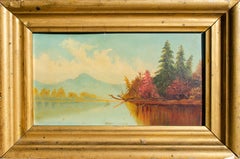
19th Century White Mountain Landscape, Unknown American School
Located in New York, NY
Unknown White Mountain Artist
White Mountain Landscape, 19th Century
Oil on board
5 x 9 1/4 in.
Framed: 7 3/4 x 11 3/4 in.
Category
19th Century Hudson River School John Frederick Kensett Art
Materials
Oil, Board

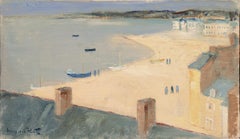
Near Locranan, Brittany
, Paris, Charlottenborg, Bornholm School, Benezit
Located in Santa Cruz, CA
Signed lower left, 'Mogens Hertz' (Danish, 1909-1999) and painted circa 1935.
This notable Impressionist first studied with the classically-trained Academician, Laurits Ring and, su...
Category
1930s Impressionist John Frederick Kensett Art
Materials
Canvas, Oil, Plywood
$2,450 Sale Price
30% Off
H 10.75 in W 18 in D 0.13 in
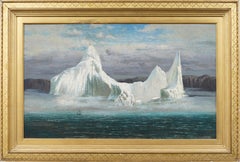
Historic and Rare 19th Century Arctic Iceberg Seascape Framed Winter Painting
Located in Buffalo, NY
Antique American winter seascape with an iceberg by Carl Philipp Weber (1849 - 1922). Oil on canvas. Signed. In excellent original condition. Handsomely framed in a period gold g...
Category
1880s Hudson River School John Frederick Kensett Art
Materials
Canvas, Oil
$36,000 Sale Price
20% Off
H 25 in W 37 in D 2 in
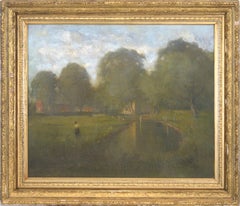
Late 19th Century Tonalist Landscape -- Afternoon by the Pond
Located in Soquel, CA
Gorgeous tonalist oil painting woman walking in field by pond with home in background by Willis Seaver Adams (American, 1844-1921), circa 1880. Trees and an amazing sky in the background add depth and interest to this beautiful piece. Signed "W. S. Adams" lower right corner. Condition: Previous restoration includes relining of canvas. Frame is vintage gilt molded and wood frame and shows previous repair of molding losses. Image size: 20"H x 24"W.
Auctions records for the artist exceed $6,000.
Willis Seaver Adams was known for his landscapes of the Connecticut River Valley. A relative recluse for much of his artistic life, his loneliness can be seen in much of his works. Oil miniatures were the focus for almost all of his later works. He is credited with over 425 oils, watercolors, and drawings.
Willis Seaver was born in 1844 on a farm in Suffield, near the Connecticut River. He intermittently attended the Suffield Academy, and always wanted to be a painter. A wealthy doctor became his patron, and financed his studies in 1868 at the Royal Academy in Antwerp. When the doctor passed away, Adams returned home and struggled to make a living painting. After working for a photographer for three years, he opened his own studio.
Adams helped organize Cleveland's first watercolor exhibit in 1876. Soon thereafter, he completed a portrait of Rutherford B. Hayes, then governor of Ohio, prior to his becoming President of the United States. This portrait enhanced Adams notoriety.
In 1878, Adams traveled to Italy where he opened a studio in Venice, and became friendly with neighbor James Whistler. Prior to returning to Springfield, Adams lived in Florence, Italy for three years. He returned to became an instructor for the Springfield Art Association, and began to exhibit his works at the galleries of James D. Gill. His first one-man exhibit was held there in 1894. Other successful exhibitions took place in Chicago, New York, and Boston. Although his works garnered respectable prices and reflected his success, Adams felt he was due more recognition.
In 1906, he moved to Greenfield, Massachusetts and converted a barn into a studio. There, he fell into relative obscurity, accompanied mainly by his dog, Collie. In 1921, Adams passed away.
Examples of Willis Adams works can be seen at the Kent Memorial Library, the Wadsworth Atheneum, and the Suffield Academy. Several Suffield residents are thought to own Adams paintings.
Category
1880s Hudson River School John Frederick Kensett Art
Materials
Linen, Oil
$3,160 Sale Price
36% Off
H 25.75 in W 29.5 in D 3.75 in
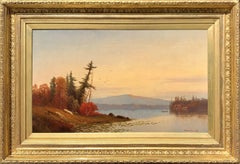
Sunset on the Hudson River by Hermann Simon (American, 1846-1895)
Located in New York, NY
Painted by Hudson River School artist Hermann Simon (1846-1895) , "Sunset on the Hudson River" is oil on canvas, measures 15 x 25 inches, and is signed and dated 1875 at the lower ri...
Category
19th Century Hudson River School John Frederick Kensett Art
Materials
Canvas, Oil
$15,000
H 15 in W 25 in
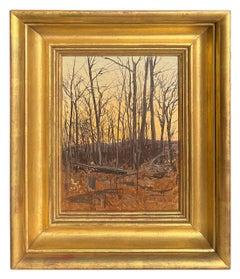
Dusk Forest Scene, Catskills by Lockwood DeForest (American, 1850-1932)
Located in New York, NY
"Dusk Forest Scene, Catskills," 1875 by Hudson River School painter Lockwood DeForest (American, 1850-1932) is oil on artists card-stock and measures 9.5 x 7 inches. The work is signed by DeForest, and dated May 13, 1875 at lower right. The work is framed in an elegant, period appropriate frame, and ready to hang.
Lockwood DeForest was born in New York in 1850 to a prominent family. He grew up in Greenwich Village and on Long Island at the family summer estate in Cold Spring Harbor. As was customary for a cultivated family in the Gilded Age, the DeForests made frequent trips abroad. Excursions to the great museums, which were prominent on the DeForests agenda, deepened the young Lockwood's familiarity with European painting and sculpture. Though he had begun drawing and painting somewhat earlier, it was during a visit to Rome in 1868 that nineteen-year-old DeForest first began to study art seriously, taking painting lessons from the Italian landscapist Hermann David Salomon Corrodi (1844–1905). More importantly, on the same trip, Lockwood met one of America’s most celebrated painters, (and his maternal great-
uncle by marriage) Frederic Edwin Church (1826–1900), who quickly became his mentor. DeForest accompanied Church on sketching trips around Italy and continued this practice when they both returned to America in 1869. Early on in his career, de Forest made a habit of recording the date and often the place of his oil sketches, as to create a visual diary of his travels. Lockwood’s profession as a landscape painter can be primarily attributed to Frederic E. Church and his belief in the young artist’s talent.
DeForest often visited Church in the Hudson River community of Catskill where, in addition to sketching trips and afternoons of painting, he assisted with the architectural drawings and planning of Olana. In 1872, DeForest took a studio at the Tenth Street Studio Building in New York. During these formative years DeForest counted among his friend’s artists such as Sanford Robinson Gifford (1823–80), George Henry Yewell (1830–1923), John Frederick Kensett (1816–72), Jervis McEntee (1828–91), and Walter Launt Palmer (1854–1932).
Over the next decade DeForest experienced success as a painter. He exhibited for the first time at the National Academy of Design in 1872, and made two more painting trips abroad, in 1875–76 and 1877–78, traveling to the major continental capitals but also the Middle East and North Africa. His trip to the Middle East and the library at Church’s home, Olana, established his interest in design during his mid-twenties. From about 1878 to 1902, landscape painting was overshadowed by his activities and preoccupation with East Indian architecture and décor, a style that became quite fashionable in late nineteenth century America. From 1879-1883, de Forest founded Associated Artists along with Louis Comfort Tiffany, Candace Wheeler...
Category
19th Century Hudson River School John Frederick Kensett Art
Materials
Oil, Board
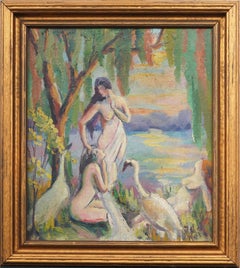
Antique American Early 1900s Nude Women
Swans Deco River Landscape Painting
Located in Buffalo, NY
Antique American impressionist nude women landscape oil painting. Oil on canvas. Framed. Signed "Wolfe". In excellent original condition. Handsomely framed in a giltwood molding....
Category
1920s Impressionist John Frederick Kensett Art
Materials
Oil, Canvas
$875
H 20 in W 18 in D 2 in
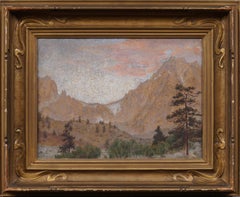
Antique American California Sunset Landscape Impressionist Early Oil Painting
Located in Buffalo, NY
Antique American landscape oil painting by . Oil on board. Signed. Framed. Measuring 16 by 19 inches overall and 10 by 13.5 painting alone.
Category
1910s Impressionist John Frederick Kensett Art
Materials
Canvas, Oil
$3,475
H 16 in W 19 in D 2 in
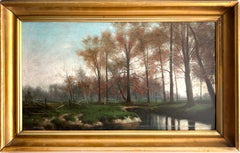
Stunning Antique American Oil Painting Lake Original Frame Signed Illegibly Rare
Located in Buffalo, NY
This tranquil landscape captures a sunlit autumn morning along a quiet stream. Delicate mist softens the background, while a weathered split-rail fence leads the eye through a grove ...
Category
Late 19th Century American Realist John Frederick Kensett Art
Materials
Canvas, Oil
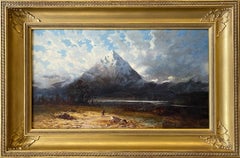
Native American Encampment, western scene
By Harvey Otis Young
Located in New York, NY
This rare and impressive depiction of a white capped mountain and Indian encampment from the 1870's is a great image for a library or rustic room. Exquisitely painted, Young focused...
Category
1870s Hudson River School John Frederick Kensett Art
Materials
Canvas, Oil
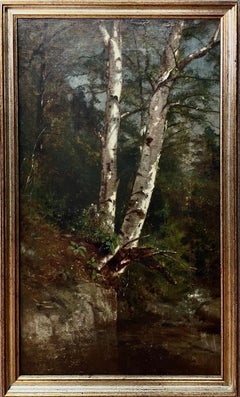
“Woodland Study”
Located in San Francisco, CA
Remarkably, this painting tells its own story on the verso. To save your eyesight, here's what it reveals: James McDougal Hart (1828-1901) Landscape, animal, and portrait painter.
A ...
Category
1860s Hudson River School John Frederick Kensett Art
Materials
Canvas, Linen, Oil
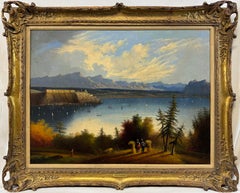
“Quebec City, 1853” Panoramic Landscape View, Cityscape, Canada Signed Oil
By Edmund C. Coates
Located in Yardley, PA
“Quebec City, 1853” by Edmund C. Coates (American, 1816-1871).
A luminous 19th-century view of Quebec City by the American painter Edmund C. Coates, known for his detailed Hudson Ri...
Category
1850s Hudson River School John Frederick Kensett Art
Materials
Canvas, Oil
$4,500
H 31.5 in W 39 in D 2.5 in
Previously Available Items
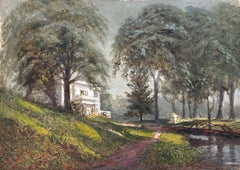
"White House and Trees, " John Frederick Kensett, Hudson River School, New Jersey
By John Frederick Kensett
Located in New York, NY
John Frederick Kensett
White House and Trees, circa 1853
Oil and gouache on paper
6 3/4 x 9 3/4 inches
Provenance:
Estate of Vincent Colyer (1824 - 1888)
By descent
Paul Magriel Collection
Private Collection, Long Island
Exhibited:
New York, The Finch College Museum of Art; Southampton, New York, The Parrish Art Museum; New Orleans, Louisiana, Isaac Delgado Museum of Art; Norfolk, Virginia, Norfolk Museum of Art; Montclair, New Jersey, Montclair Art Museum; New London, Connecticut, Lyman Allyn Museum; Manchester, New Hampshire, The Currier Gallery of Art; Providence, Rhode Island, Rhode Island School of Design; Youngstown, Ohio, The Butler Institute of American Art, American Drawings (Benjamin West to the present) from the Paul Magriel Collection, June 1961 - December 1962.
Portland, Oregon, Portland Art Museum, April 14 - May 15, 1963.
Boston International Fine Art Show at the Cyclorama, Lincoln Glenn, October 19 - 23, 2022.
In the 1850s through 1860, John Frederick Kensett, painted a series of at least five landscapes of the "Shrewsbury River" (now the Navesink River) along the New Jersey shore. Art historians have described Kensett’s paintings of the river as having evolved from a trip in the fall of 1853 at the invitation of Kensett's friend, author and lecturer George Curtis. However, letters viewable at the Smithsonian Archives of American Art website make it clear that Kensett had become acquainted with the area over a year earlier, most likely in connection with fellow artist and friend Thomas Prichard Rossiter.
Kensett and Rossiter had been friends since at least the 1830s. As aspiring artists, they had traveled to Europe together in the 1840s. In 1851 Rossiter married Anna Ehrick Parmly, then in her early 20s, and Kensett attended the wedding. Anna was one of four daughters of Eleazer and Anna Maria Parmly. Eleazer, one of the major figures in American dentistry history, was a wealthy and accomplished member of New York society.
When not in the city, the Parmly family gathered at Bingham Place, a sprawling estate on 275 pastoral acres spanning the peninsula between the Shrewsbury and Navesink Rivers along the New Jersey shore. The Bingham Place estate encompassed much of what is now Rumson, then known as Oceanic, N.J. It was a wide-open landscape of ocean views, orchards, lawns, and cattle-dotted pastures. There the Parmlys opened their doors to family, friends, and the summer breeze.
Rossiter, newly-married into the Parmly family, was likely the reason that Kensett paid a social visit to Bingham Place in the summer of 1852. On July 11, 1852, having reluctantly departed, Kensett wrote Rossiter who was still at Bingham Place:
New York to me now is that of a deserted place…marking a dismal contrast to the green lawns at Bingham Place. I saw the receding shores of Shrewsbury & the line of dust which marked your homeward course & finally the last glimpse of the Locust trees that shade the pleasant mansion & happy inmates at Bingham with any thing but a joyous spirit.
A major figure in the American luminist tradition and one of the most renowned painters of the Civil War era, John Frederick Kensett was born in Cheshire, Connecticut, in 1816. He was the son of Thomas Kensett, a British immigrant engraver, and it was in his father's New Haven firm that Kensett first learned to draw.
After mastering the rudiments of the graphic arts, he worked as an engraver in print shops in New Haven, Albany, and New York throughout the 1830's. During this period, he began to paint on his own, encouraged by a friend and fellow artist, John W. Casilear. In 1838, he made his first submission, a landscape, to the annual exhibitions of the National Academy of Design.
Desirous of continuing his training, Kensett traveled to Europe in 1840. For the next seven years, often in the company of artists such as Casilear and Asher B...
Category
1850s Hudson River School John Frederick Kensett Art
Materials
Paper, Oil
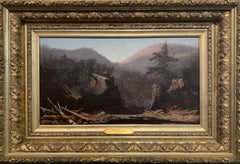
Kaaterskill Falls, New York, Hudson River School Landscape, Signed and Framed
By John Frederick Kensett
Located in Doylestown, PA
"Kaaterskill Falls" is a 9" x 16" oil on canvas landscape by Hudson River School and luminist painter John Frederick Kensett. The painting is framed and monogrammed in the lower left...
Category
Mid-19th Century Hudson River School John Frederick Kensett Art
Materials
Canvas, Oil
John Frederick Kensett art for sale on 1stDibs.
Find a wide variety of authentic John Frederick Kensett art available for sale on 1stDibs. You can also browse by medium to find art by John Frederick Kensett in paint, oil paint, canvas and more. Not every interior allows for large John Frederick Kensett art, so small editions measuring 10 inches across are available. Customers who are interested in this artist might also find the work of Jasper Francis Cropsey, William Bradford, and William Rickarby Miller. John Frederick Kensett art prices can differ depending upon medium, time period and other attributes. On 1stDibs, the price for these items starts at $10,000 and tops out at $450,000, while the average work can sell for $87,500.