Prideaux John Selby Art
to
1
Overall Width
to
Overall Height
to
1
1
1
1
1
1
9,962
2,752
1,376
1,373
1
1
Artist: Prideaux John Selby
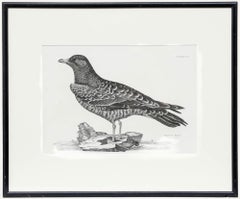
Prideaux John Selby (1788-1867) - Early 20th Century Engraving, Arctic Skua
By John Selby Prideaux
Located in Corsham, GB
A delightful ornithological study by the artist Prideaux John Selby (1788-1867). This artwork is an early 20th-century restrike of a mid-19th-century engraving. Signed in plate to th...
Category
20th Century Prideaux John Selby Art
Materials
Engraving
Related Items
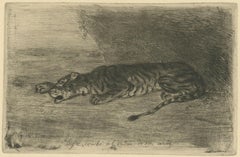
Tigre couché à l
entrée de son antre (Tiger Lying at the Entrance to its Lair)
By Eugène Delacroix
Located in Middletown, NY
Etching, drypoint, and roulette on watermarked Hallines cream laid paper, 3 3/4 x 5 7/8 inches (95 x 148 mm), full margins. A very good impression of this charming image, with all of...
Category
Early 19th Century Realist Prideaux John Selby Art
Materials
Laid Paper, Drypoint, Etching
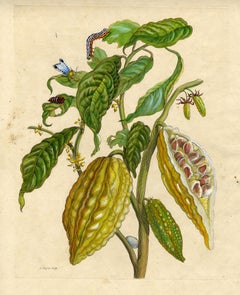
Cocoa plant, caterpillar, ..., Plate 26, Metamorphosis Insectorum Surinamensium
By Maria Sibylla Merian
Located in Middletown, NY
Metamorphosis Insectorum Surinamensium, Plate No. 26; Cocoa plant, caterpillar, pupa, and butterflies. The Netherlands: 1705. En...
Category
Early 18th Century Naturalistic Prideaux John Selby Art
Materials
Watercolor, Engraving
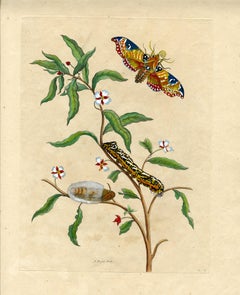
Tree with moth, caterpillar..., Plate 39, Metamorphosis Insectorum Surinamensium
By Maria Sibylla Merian
Located in Middletown, NY
Metamorphosis Insectorum Surinamensium, Plate No. 39; Unidentified tree with moth, caterpillar and pupa.
The Netherlands: 1705....
Category
Early 18th Century Naturalistic Prideaux John Selby Art
Materials
Watercolor, Engraving
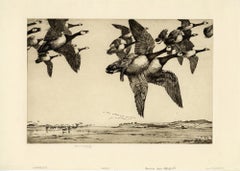
Barnacle Geese Affrighted
Located in Middletown, NY
Etching and drypoint on cream wove paper, full margins. Signed and numbered 59/75 in pencil, lower margin. Notations in pencil along the lower sheet edge, recto, well outside of ima...
Category
Mid-20th Century Modern Prideaux John Selby Art
Materials
Handmade Paper, Drypoint, Etching
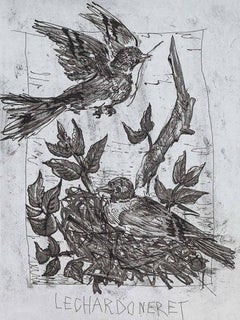
The Goldfinch, 1942 (Histoire Naturelle - Textes de Buffon, B.348 )
By Pablo Picasso
Located in Greenwich, CT
The Goldfinch is an aquatint and drypoint print on chine from one of the deluxe copies of Picasso's 1942 Histoire Naturelle - Textes de Buffon series. The image size is 11.2 x 8.25 inches, unsigned as issued, and framed in a contemporary silver and gray moulding. One of about 36 prints that exist with Picasso's remarqued title in French, from the edition of 262 (there were 226 portfolios, some with additional sets on varying papers).
Catalogue - Cramer #37
The exceptional etchings from Picasso’s Histoire Naturelle – Textes de Buffon are a masterful combination of sugar-lift aquatint and drypoint, showcasing a full range of gray tonalities. The etchings of animals, birds and insects are considered some of the most beautiful and most unusual examples of Picasso’s graphic work.
Roger Lacourière, Picasso’s master printer, pulled the prints for each etching between 1939-1942. It was Lacourière who taught Picasso the sugar-lift aquatint technique which allowed him to mimic the effect of brushstrokes in these etched images. Picasso first explored the technique in his plates for the Vollard Suite, but it was in the creation of the Buffon images that he fully realized its stunning, painterly potential.
For the edition, 226 portfolios were produced with the first thirty-six counting as deluxe compilations. These rare deluxe sets were on diverse papers (chine, japon or vergé ancien) and each included a complete additional suite showing Picasso’s title remarques along the bottom. As such, the remarqued versions of the prints are quite rare with just thirty-six of each produced for the edition (with the exception of The Wolf which is never remarqued – the image always fills the entire etching plate).
These prints are based on the writings of French naturalist Georges-Louis Leclerc, Comte de Buffon, who extensively documented the natural world in his monumental work Histoire Naturelle. Picasso’s association with the project to illustrate parts of the Buffon came during a tumultuous time in European history – the prelude to, and early years of, World War II. As the continent was ravaged, Picasso lived through the disaster in Paris, which the Germans occupied in 1940. These prints could be seen as a political statement – Picasso channeling his artistic expression into a form of resistance art...
Category
20th Century Modern Prideaux John Selby Art
Materials
Drypoint, Aquatint

$12,850
H 24.125 in W 20.5 in
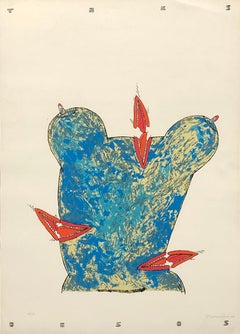
Antonio Eligio Fernández Cuban Artist Original Hand Signed silkscreen 1988
Located in Miami, FL
Antonio Eligio Fernández (Cuba, 1958)
'Tres Besos', 1988
silkscreen on paper Guarro Geler
27.6 x 20.1 in. (70 x 51 cm.)
Edition of 125
ID: TON-301
Hand-signed by author
Category
1980s Contemporary Prideaux John Selby Art
Materials
Paper, Engraving, Screen
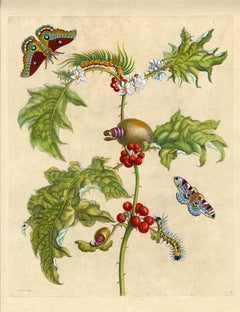
Thistle and Moths, plate no. 6, Metamorphosis Insectorum Surinamensium
By Maria Sibylla Merian
Located in Middletown, NY
Metamorphosis Insectorum Surinamensium, Plate No. 6; Thistle and Moths. The Netherlands: 1705. Engraving with hand coloring in w...
Category
Early 18th Century Naturalistic Prideaux John Selby Art
Materials
Watercolor, Engraving
$5,300
H 12.88 in W 9.63 in
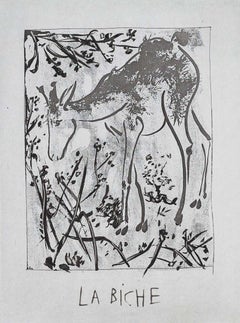
The Deer, 1942 (Histoire Naturelle - Textes de Buffon, B.336)
By Pablo Picasso
Located in Greenwich, CT
The Deer is an aquatint and drypoint print on chine from one of the deluxe copies of Picasso's 1942 Histoire Naturelle - Textes de Buffon series. The image size is 10.5 x 8.15 inches, unsigned as issued, and framed in a contemporary silver and gray moulding. One of about 36 prints that exist with Picasso's remarqued title in French, from the edition of 262 (there were 226 portfolios, some with additional sets on varying papers).
Catalogue - Cramer #37
The exceptional etchings from Picasso’s Histoire Naturelle – Textes de Buffon are a masterful combination of sugar-lift aquatint and drypoint, showcasing a full range of gray tonalities. The etchings of animals, birds and insects are considered some of the most beautiful and most unusual examples of Picasso’s graphic work.
Roger Lacourière, Picasso’s master printer, pulled the prints for each etching between 1939-1942. It was Lacourière who taught Picasso the sugar-lift aquatint technique which allowed him to mimic the effect of brushstrokes in these etched images. Picasso first explored the technique in his plates for the Vollard Suite, but it was in the creation of the Buffon images that he fully realized its stunning, painterly potential.
For the edition, 226 portfolios were produced with the first thirty-six counting as deluxe compilations. These rare deluxe sets were on diverse papers (chine, japon or vergé ancien) and each included a complete additional suite showing Picasso’s title remarques along the bottom. As such, the remarqued versions of the prints are quite rare with just thirty-six of each produced for the edition (with the exception of The Wolf which is never remarqued – the image always fills the entire etching plate).
These prints are based on the writings of French naturalist Georges-Louis Leclerc, Comte de Buffon, who extensively documented the natural world in his monumental work Histoire Naturelle. Picasso’s association with the project to illustrate parts of the Buffon came during a tumultuous time in European history – the prelude to, and early years of, World War II. As the continent was ravaged, Picasso lived through the disaster in Paris, which the Germans occupied in 1940. These prints could be seen as a political statement – Picasso channeling his artistic expression into a form of resistance art...
Category
20th Century Modern Prideaux John Selby Art
Materials
Drypoint, Aquatint
$12,850
H 24.125 in W 20.5 in
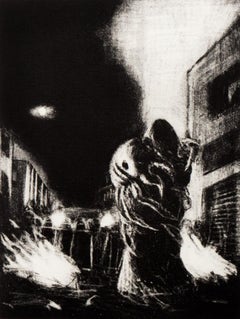
Mexican signed limited edition orginal print mezzotint 17.4x13.8 in.
By Fernando Aceves Humana
Located in Miami, FL
Fernando Aceves Humana (Mexico, 1969)
'Lo que nos trajeron', 2007
mezzotint on paper
17.4 x 13.8 in. (44 x 35 cm.)
Edition of 20
ID: ACE-101
Unframed
Category
Early 2000s Contemporary Prideaux John Selby Art
Materials
Paper, Etching, Screen, Mezzotint
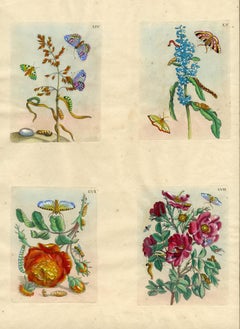
4 plates from The Wondrous Transformation of Caterpillars
their Strange Diet..
By Maria Sibylla Merian
Located in Middletown, NY
Four plates from The Wondrous Transformation of Caterpillars and their Strange Diet of Flowers. “Wolfsmelk Rupsen;" “Wolfsmilch, Raupe und Schmetterling" Amsterdam: J F Bernard, 1730. Each an engraving with hand coloring in watercolor and gouache printed on one sheet of watermarked Honig cream laid paper, each measures 6 1/4 x 5 inches (157 x 121 mm), sheet measures 20 5/8 x 14 inches (522 x 355 mm), full margins. With handling creases in the lower right sheet quadrant, as well as minor, loose cockling, otherwise in very good condition. The colors are superb with exceptionally fresh and bright saturation. Engraved between 1679 and 1683, printed 1730. Plates included: LIV, LV, LVI, & LVII.
MARIA SIBYLLA MERIAN was one of the most highly respected entomologists of the 17th century, and remains today one of the field's most significant figures. A German-born naturalist and scientific illustrator, she reared herself on the study of caterpillars, and made tremendous contributions to the knowledge of the life cycles of numerous species. Until her detailed and careful study of the process of metamorphosis it was thought that insects were "born of mud," through spontaneous generation.
Trained as a miniature painter by her stepfather, she published her first book of illustrations in 1675, at the age of 28. In 1679, Merian published the first volume of the two-volume series on caterpillars, The Wondrous Transformation of Caterpillars and their Strange Diet of Flowers; the second volume followed in 1683. Each volume contained 50 plates that she engraved and etched. In 1699, Merian traveled to Dutch Guiana...
Category
Early 18th Century Naturalistic Prideaux John Selby Art
Materials
Watercolor, Engraving
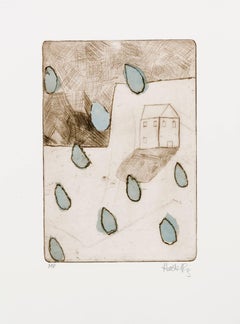
Homesick 4
By Hector Ruiz
Located in Phoenix, AZ
monoprint with drypoint and chine colle; unframed
image size: 10 x 7 inches
Category
Early 2000s Contemporary Prideaux John Selby Art
Materials
Drypoint, Monoprint
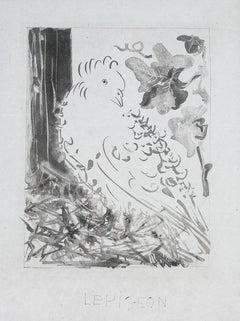
The Pigeon, 1942 (Histoire Naturelle - Textes de Buffon, B.347)
By Pablo Picasso
Located in Greenwich, CT
The Pigeon is an aquatint and drypoint print on chine from one of the deluxe copies of Picasso's 1942 Histoire Naturelle - Textes de Buffon series. The image size is 10.75x 8 inches, unsigned as issued, and framed in a contemporary silver and gray moulding. One of about 36 prints that exist with Picasso's remarqued title in French, from the edition of 262 (there were 226 portfolios, some with additional sets on varying papers).
Catalogue - Cramer #37
The exceptional etchings from Picasso’s Histoire Naturelle – Textes de Buffon are a masterful combination of sugar-lift aquatint and drypoint, showcasing a full range of gray tonalities. The etchings of animals, birds and insects are considered some of the most beautiful and most unusual examples of Picasso’s graphic work.
Roger Lacourière, Picasso’s master printer, pulled the prints for each etching between 1939-1942. It was Lacourière who taught Picasso the sugar-lift aquatint technique which allowed him to mimic the effect of brushstrokes in these etched images. Picasso first explored the technique in his plates for the Vollard Suite, but it was in the creation of the Buffon images that he fully realized its stunning, painterly potential.
For the edition, 226 portfolios were produced with the first thirty-six counting as deluxe compilations. These rare deluxe sets were on diverse papers (chine, japon or vergé ancien) and each included a complete additional suite showing Picasso’s title remarques along the bottom. As such, the remarqued versions of the prints are quite rare with just thirty-six of each produced for the edition (with the exception of The Wolf which is never remarqued – the image always fills the entire etching plate).
These prints are based on the writings of French naturalist Georges-Louis Leclerc, Comte de Buffon, who extensively documented the natural world in his monumental work Histoire Naturelle. Picasso’s association with the project to illustrate parts of the Buffon came during a tumultuous time in European history – the prelude to, and early years of, World War II. As the continent was ravaged, Picasso lived through the disaster in Paris, which the Germans occupied in 1940. These prints could be seen as a political statement – Picasso channeling his artistic expression into a form of resistance art...
Category
20th Century Modern Prideaux John Selby Art
Materials
Drypoint, Aquatint
$14,850
H 24.125 in W 20.5 in
Previously Available Items
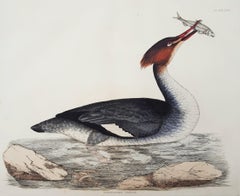
Gooseander, Female
By John Selby Prideaux
Located in Saint Augustine, FL
An original hand-colored etching and engraving on J. Whatman wove paper by English artist Prideaux John Selby (1788-1867) titled "Gooseander, Female" (Plate LVII, 57), 1833. Signed i...
Category
1830s Victorian Prideaux John Selby Art
Materials
Copper
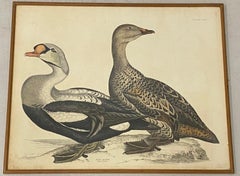
Prideaux John Selby "King Eider" "King Eider, Male
Female" Etching c.1830
By John Selby Prideaux
Located in San Francisco, CA
Prideaux John Selby "King Eider" "King Eider, Male & Female" Hand Colored Etching C.1830
Plate dimensions 24" wide x 19" high
The distressed frame measures 25.75" wide x 20.75" hig...
Category
Early 19th Century Prideaux John Selby Art
Materials
Etching
H 20.75 in W 25.75 in D 1 in
Prideaux John Selby art for sale on 1stDibs.
Find a wide variety of authentic Prideaux John Selby art available for sale on 1stDibs. You can also browse by medium to find art by Prideaux John Selby in engraving, etching and more. Not every interior allows for large Prideaux John Selby art, so small editions measuring 26 inches across are available. Customers who are interested in this artist might also find the work of John Wilkes, Samuel Sydney, and Dr. Robert John Thornton. Prideaux John Selby art prices can differ depending upon medium, time period and other attributes. On 1stDibs, the price for these items starts at $475 and tops out at $1,340, while the average work can sell for $908.