John Williamson Paintings
to
1
1
Overall Width
to
Overall Height
to
2
2
2
1
1
2
2
1
2
776
747
729
681
2
2
Artist: John Williamson
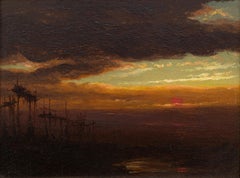
Evening, Sioux Burial Grounds
By John Williamson
Located in New York, NY
John Williamson, a Scottish-born artist who settled in Brooklyn, became known for his landscapes during the height of the Hudson River School. He painted intimate, atmospheric views ...
Category
19th Century John Williamson Paintings
Materials
Oil, Board
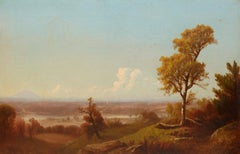
Indian Summer
By John Williamson
Located in New York, NY
Monogrammed and dated lower right: JW. 71; on verso: Indian Summer / By Jw. Williamson / N. Y. 1871 –
Category
19th Century Hudson River School John Williamson Paintings
Materials
Oil
Related Items
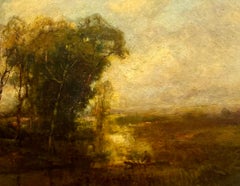
Antique American 1900 SUNSET LUMINOUS Stream Landscape Figure W/ Boat
Located in New York, NY
Here we have an incredible Luminous Landscape with a boat in a stream by Charles P Appel (1857-1928)
Painting is very calm and soothing to look at….
amazing condition, unlined and ...
Category
1890s Hudson River School John Williamson Paintings
Materials
Oil

$4,600
H 26 in W 30 in D 3 in
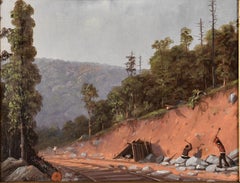
"Building the Allegheny Railroad, Pennsylvania" Alfred Wall, Scalp Level School
Located in New York, NY
Alfred S. Wall (American, 1825-1896)
Untitled (Building the Railroad), 1859
Oil on canvas
14 1/2 x 18 1/2 inches
Signed and dated lower left
For Christmas, 2008, the Pittsburgh Post-Gazette featured Alfred Wall's painting, Old Saw Mill from the collection of the Westmoreland Museum of American Art in Greensburg, PA. It was painted in 1851 in the town of Lilly, Pennsylvania in the Allegheny Mountains. The newspaper description stated that "though the saw mill is long gone, it still conveys all the warmth and coziness of this time of year. The article, written by Patricia Lowry, continued:
At first glance, Alfred S. Wall's painting of a saw mill in snowy woods triggers nostalgia for the coziness of a log cabin, the smell of a wood-burning fire and the warming of chilled hands and feet beside it.
But as sentimental as it seems on the surface, Mr. Wall's painting has a deeper and unexpected context.
This is more than a painting about sled-riding children and early industry planted in the middle of virgin forest. Intended or not, this is a painting about conquering the great divide of the Allegheny Mountains.
For the third consecutive year, the Post-Gazette features a winter-scene painting on the cover of the Christmas Day newspaper. This year's painting, Old Saw Mill, was selected by co-publisher and editor-in-chief John Robinson Block and executive editor David Shribman during a visit to the Westmoreland Museum of American Art in Greensburg.
Mr. Wall, listed as a portrait painter in the 1850 census, was about 26 when he painted Old Saw Mill in 1851. The self-taught artist was born in Mount Pleasant, Westmoreland County, to William and Lucy Wall, who'd emigrated from England around 1820. An artistic sensibility ran in the family: William was a sculptor who carved ornate tombstones here; Alfred's children, A. Bryan and Bessie, were landscape painters, as was Alfred's older brother, William Coventry Wall. For more than a century the Walls formed a prominent art dynasty in Pittsburgh, and Alfred, eventually a partner in the city's most prestigious art gallery, was well known as a painter, dealer and restorer.
In Old Saw Mill, two wood cutters, each holding an axe, meet outside the mill; one points in the direction of the forest. On the other side of the stream, one child pulls another down the hillside on a sled. Just behind the hill's slope, the roof of a building appears, perhaps the home of the sawyer. The luminous, late afternoon light comes from the northwest, casting lengthening shadows on the snow under a darkening sky.
The saw mill in "Old Saw Mill" likely would have been impossible to track down had Mr. Wall, presumably, not written on the back of the painting: "old saw mill near Jct. 4, Portage RR, Pa."
"There was no Junction 4," said Mike Garcia, park ranger at the Allegheny Portage Railroad National Historic Site, about 90 miles east of Pittsburgh near Gallitzen, Cambria County. "But there was an Inclined Plane No. 4 at Lilly, and there was a saw mill there."
In fact, there were at least six saw mills at Lilly over the years, said longtime resident Jim Salony, president of the Lilly-Washington Historical Society. But when he saw an image of the painting, Mr. Salony had no trouble coming up with a location. While there are no known photographs of the saw mill, he believes it stood near the intersection of Portage and Washington streets, next to Bear Rock Run.
Mr. Salony, retired academic dean at Mount Aloysius College, didn't know exactly when the mill was torn down, but it's been gone since at least the late 1800s. He was pleased to learn of the painting, even though that knowledge came too late for inclusion in a new book about Lilly, The Spirit of a Community, for which he served as primary author and editor. It runs to more than 700 pages. For a little town -- population 869 last year -- Lilly has a lot of history.
Nestled in a bowl on the western slope of the Allegheny Mountains about 3 miles south of Cresson, Lilly was first settled in 1806 by Joseph Meyer and his family, who named their 332-acre land patent Dundee. Although the Meyers had left by 1811, other settlers followed, but the community didn't flourish until the 1830s, when the Allegheny Portage Railroad began its 23-year-run through the town.
For 200 years the Alleghenies had stood as an impediment to trade and travel between Pittsburgh and the east. A canal from Philadelphia to Pittsburgh would change that and compete with New York's Erie Canal. But a portage railroad would have to be built, on which teams of horses would lead the canal boats over the mountains. Engineer Sylvester Welch began his surveying from the small settlement at Lilly. The railroad would require 10 inclined planes, some quite steep, between Hollidaysburg and Johnstown. To build it, trees had to be cut along a 120-foot-wide right-of-way for 36 miles, along which track and engine houses had to be built.
William Brown, who owned the saw mill on Bear Rock Run, built at least one of the engine houses at Inclined Plane No. 4; an 1834 contract also included fencing the dwelling lots at the head and foot of the plane. Lilly is located at what was the foot of Inclined Plane No. 4., giving the community one of its early informal names, Foot of Four.
Named in 1883 for Richard Lilly, who'd completed the grist mill there, Lilly had another early name: Hemlock, so dubbed by a Portage Railroad traveler who smelled the bark stripped from the trees at the saw mill.
Because there isn't another Allegheny Portage Railroad location like it, where a cut in the mountains opens into a bowl, Mr. Salony thinks it was Lilly that Charles Dickens wrote about following his trip from Harrisburg to Pittsburgh on the Pennsylvania Canal in late March 1842, describing what he saw after emerging from "the bottom of the cut": "It was very pretty while traveling, to look down into a valley full of light and softness, catching glimpses through the tree-tops of scattered cabins; children running to the doors; dogs bursting out to bark, who we could see without hearing; terrified pigs scampering homeward; families sitting out in their rude gardens; cows gazing upward with a stupid indifference; men in their shirt-sleeves looking on at their unfinished houses, planning out to-morrow's work; and we riding onward, high above them, like a whirlwind."
To get to Lilly, Mr. Wall may have taken the Pennsylvania Canal from his home in Allegheny City, now the North Side. He'd married young, at 21, to Sarah Carr in 1846, the same year he began his career as an artist. By 1880 they were living in a brick townhouse at 104 (later 814) Arch St., now demolished.
Across the river in Pittsburgh he shared a studio at 67 Fourth Ave. with his brother William; they later moved to Burke's Building, today the city's oldest office building at 209-211 Fourth. But often they worked outdoors, sometimes as part of the colony of artists that grew up around painter George Hetzel beginning in the late 1860s at Scalp Level...
Category
1850s Hudson River School John Williamson Paintings
Materials
Canvas, Oil
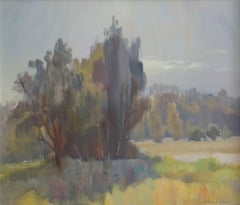
Landscape. 2002, oil on cardboard, 60x70 cm
By Vasily Hvatov
Located in Riga, LV
Landscape. 2002, oil on cardboard, 60x70 cm
Category
Early 2000s Realist John Williamson Paintings
Materials
Oil, Cardboard
$827 Sale Price
30% Off
H 23.63 in W 27.56 in D 0.99 in
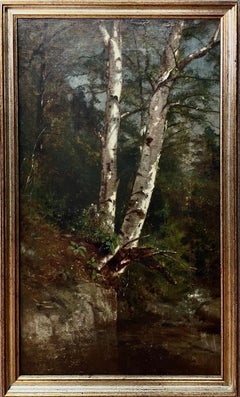
“Woodland Study”
Located in San Francisco, CA
Remarkably, this painting tells its own story on the verso. To save your eyesight, here's what it reveals: James McDougal Hart (1828-1901) Landscape, animal, and portrait painter.
A ...
Category
1860s Hudson River School John Williamson Paintings
Materials
Canvas, Linen, Oil
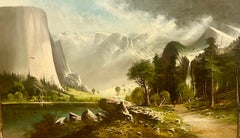
Large Panoramic YOSEMITE VALLEY Western California Encampment Landscape Figures
Located in New York, NY
Joseph John Englehart (1867-1915) was a prolific American landscape painter who painted in realist style. He was born on June 14, 1867 in Chicago, Illi...
Category
19th Century Hudson River School John Williamson Paintings
Materials
Oil
$5,400
H 38 in W 58 in D 3 in
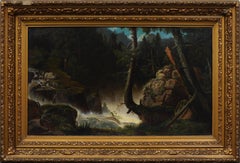
Large Antique American Hudson River School Waterfall Landscape Rare Oil Painting
Located in Buffalo, NY
Antique American rare woman artist Hudson River School waterfall landscape by Susan E. W. Fuller (1831 - 1907). Oil on canvas. Signed. Large and impressive painting. Handsomely fr...
Category
1870s Hudson River School John Williamson Paintings
Materials
Canvas, Oil
$27,800 Sale Price
20% Off
H 38 in W 56 in D 4 in
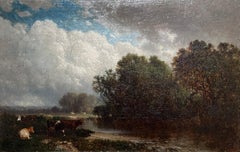
"Pastoral Landscape, " William Hart, Hudson River School, Cloudy View with Cows
By William Hart
Located in New York, NY
William Hart (1823 - 1894)
Pastoral Landscape, 1877
Oil on canvas
9 1/2 x 14 1/2 inches
Signed and dated lower left
Born in Paisley, Scotland, William Ha...
Category
1870s Hudson River School John Williamson Paintings
Materials
Canvas, Oil
$15,000
H 19.5 in W 24.5 in
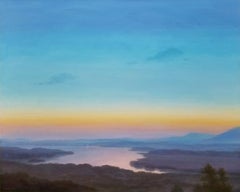
In the Afterglow (Contemporary Atmospheric Landscape Color Field Painting)
By Jane Bloodgood-Abrams
Located in Hudson, NY
Modern Luminist, Hudson River School landscape painting on canvas of the expansive view over the Hudson River as observed at the top of Olana, the historic home of Frederic Church
"In the Afterglow" by Jane Bloodgood-Abrams, painted in 2021
Horizontal landscape painting, 48 x 60 x 1 inches unframed with white painted sides
wired on reverse for easy hanging
Artist's signature is located on lower left
Acclaimed artist of the Hudson Valley, Jane Bloodgood, takes her painting to a new level with a new work entitled "In the Afterglow". Her interpretation of this very iconic view (observed from the top of Olana, the historic home of Frederic Church located near Hudson, NY) is set during the very quiet moments of a summer's evening when the sun has dipped beyond the mountains. The crystal blue sky illuminates with the sun's setting rays; a golden band of yellow haze otherwise known as "The Venus Belt" is an atmospheric phenomenon only visible shortly before sunrise or right before sunset. The water reflects the pink and purple glow that forms near the horizon; the dusty shadows of trees tower over the water's edge. We marvel at how simply Jane captures a complex phenomenon, evidence of her unparalleled ability to paint light and endow her work with luminosity. Yet this painting succeeds not only in its representation of the actual landscape and the awe produced by the experience, but also in its contemporary abstraction of atomsphere. The big, open blue sky is stacked with the colors of the sunset against the horizon, calling to mind a Rothko or the other great color field painters who achieve mood and depth from singular color.
About the work:
Painter Jane Bloodgood-Abrams has become one of the area’s most celebrated artists, gracing viewers with her compositions of sky, river, and earth. Being less concerned with documenting specific scenes, Bloodgood-Abrams is focused on capturing nature’s essence, “the deeply profound moments, where there is a connection to a vital energy.” Her process begins with being in nature, where she allows the emotional energy of the landscape to filter through her psyche. The memory is then translated onto canvas after being worked over a period of time with layers of paint that is applied, wiped away, and reworked. The result is a radiantly dramatic remembrance of Bloodgood-Abram’s encounter with “something beyond everyday life”. The artist’s final hope is for these images to evoke remembrances within the viewer's own personal relationship with nature.
Artist Biography:
Jane Bloodgood Abrams was born in Queens, New York. She received her Bachelor’s of Fine Arts from the College of Saint Rose in Albany, in 1985. Three years later, she earned a Master’s of Fine Arts at the State University of New York in New Paltz. Now she paints in the Hudson River Valley and the Berkshires.
EDUCATION
Master of Fine Arts Painting - (cum laude) State University of New York at New Paltz 1988
Bachelor of Studio Arts - (cum laude) College of Saint Rose, Albany 1985
SELECTED SOLO EXHIBITIONS:
2015
Carrie Haddad Gallery, Hudson, NY
2014
Mark Gruber Gallery, New Paltz, NY
Carrie Haddad Gallery, Hudson, NY
2013
Christopher Clark Fine Art, San Francisco, CA
The Harrison Gallery, Williamstown, MA
2012
Carrie Haddad Gallery, Hudson NY
River Gallery, Chattanooga, TN
The Storefront Gallery, Kingston, NY "Beyond the Real"
2011
The Harrison Gallery, Williamstown, MA
Carrie Haddad Gallery, Hudson, NY
Locust Grove State Historical Site, Poughkeepsie, NY
2010
Carrie Haddad Gallery, Hudson, NY
2009
Carrie Haddad Gallery, Hudson, NY
2008
DFN Gallery, New York, NY
2007
Meyer East Gallery, Santa Fe, NM
The Harrison Gallery, Williamstown, MA
Carrie Haddad Gallery, Hudson, NY
2006
Mendenhall-Sobieski Gallery, Los Angeles, CA
DFN Gallery, New York, NY
Carrie Haddad Gallery, Hudson, NY
2005
Carrie Haddad Gallery, Hudson, NY
River Gallery, Chattanooga, TN
2004
Albert Shahinian Galleries, Poughkeepsie, NY
Carrie Haddad Gallery, Hudson, NY
2003
Carrie Haddad Gallery, Hudson, NY
Living Room Gallery, Kingston, NY
River Gallery, Chattanooga, TN
2002
Carrie Haddad Gallery, Hudson, NY
2001
Carrie Haddad Gallery, Hudson, NY
Artforms Gallery, Albany, NY
2000
Carrie Haddad Gallery, Hudson, NY
Mark Gruber Gallery, "Romancing the Landscape" New Paltz, NY
1999
River Gallery, Chattanooga, TN
1998
Alan Sheppard Gallery, Piermont, NY "New Traditions"
1997
Coffey Gallery, Kingston, NY
SELECTED JURIED AND INVITATIONAL MULTI-ARTIST EXHIBITIONS:
2016
Byrdcliffe’s Legacy: An ode to Nature and Place, Kleinert Art Center, Woodstock, NY
Artists of the Mohawk-Hudson Region, Hyde Collection Museum, Glens Falls, NY
ARTBAR Gallery, Kingston, NY
2015
The Laffer Gallery, Schuylerville, NY
Jessica Hagen Fine Art, Newport, RI
2014
Jessica Hagen Fine Art, Newport, RI
“Riverscapes,” The Harrison Gallery, Williamstown, MA
"Far and Wide" Regional Juried Exhibition, Woodstock Art Association and Museum, Woodstock, NY
2013
Artists of the Mohawk-Hudson Region, Hyde Collection Museum, Glens Falls, NY
Far and Wide" Regional Juried Exhibition, Woodstock Art Association and Museum, Woodstock, NY
2012
"Riverscapes," The Harrison Gallery, Williamstown, MA
“The Great Hudson River Exhibition,” Mill Street...
Category
2010s Hudson River School John Williamson Paintings
Materials
Oil, Canvas
$14,800
H 48 in W 60 in D 1 in
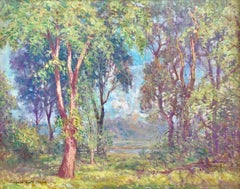
“Woodland Vista”
By Winfield Scott Clime
Located in Southampton, NY
Oil on artist board painting by the American artist, Winfield Scott Clime. Signed lower left. Titled verso. Partial Lyme Association exhibition label verso. In good condition. Frame...
Category
1930s Post-Impressionist John Williamson Paintings
Materials
Oil, Board
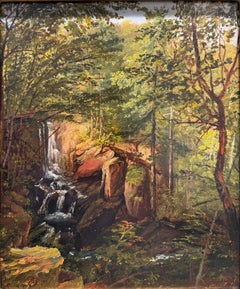
"Janetta Falls, New Jersey" Jasper F. Cropsey, Hudson River Wooded Landscape
By Jasper Francis Cropsey
Located in New York, NY
Jasper F. Cropsey
Janetta Falls, New Jersey, circa 1846
Signed J.F. Cropsey
Oil on canvas
12½ x 10¾ inches
Provenance
Private Collection, New York, 1930s
Thence by descent to the pr...
Category
1840s Hudson River School John Williamson Paintings
Materials
Canvas, Oil
"Ship Portrait, " William Edward Norton, Seascape Maritime Painting, New England
By William Edward Norton
Located in New York, NY
William Edward Norton (1843 - 1916)
Ship Portrait, 1876
Oil on canvas
10 x 16 inches
Signed and dated lower left
Born in Boston, William Norton became a noted marine painter, stirred by his youth when he sailed on family-owned ships. He studied at the Lowell Institute in Boston, and with George Inness, and then established a studio in Boston.
In the early 1870s, he went to Paris and became a student with Chevreuse and A. Vollon, and then he settled in London where he exhibited throughout the last quarter of the 19th century. His reputation there was based on his scenes of the Thames River, and ocean and coastal views.
In 1901, he and his wife returned to the United States and settled in New York City. He also painted at Monhegan Island, Maine, where a treacherous ledge on the southern side of the island is named "Norton's Ledge" for him.
He was a member of the Boston Art Club with whom he exhibited from 1873 to 1909. He also exhibited with the Pennsylvania Academy, the Royal Academy in London, the Paris Salon, the 1893 Chicago Exposition...
Category
1870s Hudson River School John Williamson Paintings
Materials
Canvas, Oil
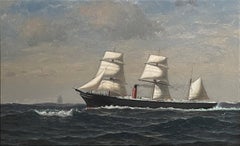
"Greek Ruins"
By Franklin D. Briscoe
Located in Lambertville, NJ
Signed Lower Right
Known for his marine, history, and portrait paintings, Franklin Briscoe was born in Baltimore, Maryland and at age four moved with his family to Philadelphia where he later became a student of Edward Moran and where eventually he settled his studio.
Briscoe made extended ocean voyages, including trips to Europe where he saw much painting in galleries, and from these adventures and observations developed his landmark paintings of the ocean and ships in all kinds of weather conditions.
In 1885, he painted an historical mural that was in ten panels, a total of 230 feet long, and 13 feet tall--"The Battle of Gettysburg...
Category
19th Century Hudson River School John Williamson Paintings
Materials
Canvas, Oil
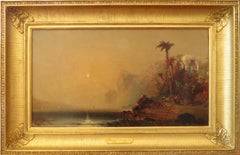
Previously Available Items
"Dover Plains" John Williamson, Hudson River School Landscape, Upstate New York
By John Williamson
Located in New York, NY
John Williamson
Dover Plains, New York
Oil on canvas
24 x 32 inches
Provenance:
Estate of Catherine McEntee
Linda Rodgers
Private Collection, Westlake, California
Brian Applegate, Ventura...
Category
19th Century Hudson River School John Williamson Paintings
Materials
Canvas, Oil
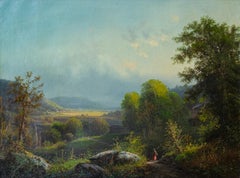
John Williamson paintings for sale on 1stDibs.
Find a wide variety of authentic John Williamson paintings available for sale on 1stDibs. You can also browse by medium to find art by John Williamson in oil paint, paint, canvas and more. Not every interior allows for large John Williamson paintings, so small editions measuring 14 inches across are available. Customers who are interested in this artist might also find the work of William Rickarby Miller, Jasper Francis Cropsey, and Sanford Robinson Gifford. John Williamson paintings prices can differ depending upon medium, time period and other attributes. On 1stDibs, the price for these items starts at $12,000 and tops out at $40,000, while the average work can sell for $15,000.