Johnny Friedlaender More Prints
Polish, 1912-1992
Johnny Gotthard Friedlaender was born in Pless (Silesia) and his early studies were in Breslau under Otto Mueller. In 1936 Friedlaender journeyed to Czechoslovakia, Switzerland, Austria, France and Belgium. At the Hague he held a successful exhibition of etchings and watercolours. He fled to Paris in 1937 as a political refugee of the Nazi regime with his young wife, who was an actress. In that year he held an exhibition of his etchings which included the works: L 'Equipe and Matieres et Formes. From 1939 to 1943 he was interned in a series of concentration camps, but survived.
After freedom in 1944 Friedlaender began a series of twelve etchings entitled Images du Malheur with Sagile as his publisher. In the same year he received a commission to illustrate four books by Freres Tharaud of the French Academy. In 1945 he performed work for several newspapers including Cavalcade and Carrefour. In 1947, he produced the work Reves Cosmiques, and in that same year he became a member of the Salon de Mai, which position he held until 1969. In the year 1948 he began a friendship with the painter Nicolas de Stael and held his first exhibition in Copenhagen at Galerie Birch. The following year he showed for the first time in Galerie La Hune in Paris. After living in Paris for 13 years, Friedlaender became a French citizen in 1950.
Friedlaender expanded his geographic scope in 1951, and exhibited in Tokyo in a modern art show. In the same year he was a participant in the XI Trienale in Milan, Italy. By 1953 he had produced works for a one-man show at the Museum of Neuchâtel and exhibited at the Galerie Moers in Amsterdam, the II Camino Gallery in Rome, in São Paulo, Brazil and in Paris. He was a participant of the French Italian Art Conference in Turin, Italy that same year.
Friedlaender accepted an international art award in 1957, becoming the recipient of the Biennial Kakamura Prize in Tokyo. In 1959 he received a teaching post awarded by UNESCO at the Museum of Modern Art in Rio de Janeiro. By 1968, Friedlaender was travelling to Puerto Rico, New York and Washington, D.C. to hold exhibitions. That year he also purchased a home in the Burgundy region of France. 1971 was another year of diverse international travel including shows in Bern, Milan, Paris, Krefeld and again New York. In the latter city he exhibited paintings at the Far Gallery, a venue becoming well known for its patronage of important twentieth century artists.
1978 brought a retrospective of Friedlaender's works at the Musee d'Art Moderne de la Ville de Paris. He was awarded the Lovis Corinth Prize in Regensburg three years later. On his 75th birthday, Friedlaender was given a retrospective in the Bremen Art Museum. On his 80th birthday he held a retrospective exhibition in Bonn at the municipal council offices. Friedlaender died in Paris at the age of 89.to
1
1
Overall Width
to
Overall Height
to
1
1
50
701
453
237
169
2
2
1
1
1
1
1
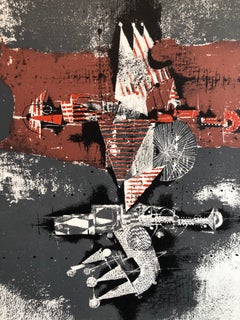
Artist: Johnny Friedlaender
Large Johnny Friedlaender Poster Print No Text
By Johnny Friedlaender
Located in Surfside, FL
Johnny Friedlaender (26 December 1912 – 18 June 1992) was a leading 20th-century artist, whose works have been exhibited in Germany, France, Netherlands, Italy, Japan and the United States. He has been influential upon other notable artists, who were students in his Paris gallery. His preferred medium of aquatint etching is a technically difficult artistic process, of which Friedlaender has been a pioneer.
Gotthard Johnny Friedlaender was born in Pless (Pszczyna), Prussian Silesia, as the son of a pharmacist. He was graduated from the Breslau (Wrocław) high school in 1922 and then attended the Academy of Arts (Akademie der Bildenden Kunste) in Breslau, where he studied under Otto Mueller. He graduated from the Academy as a master student in 1928. In 1930 he moved to Dresden where he held exhibitions at the J. Sandel Gallery and at the Dresden Art Museum. He was in Berlin for part of 1933, and then journeyed to Paris. After two years in a Nazi concentration camp, he emigrated to Czechoslovakia, where he settled in Ostrava, where he held the first one-man show of his etchings.
In 1936 Friedlaender journeyed to Czechoslovakia, Switzerland, Austria, France and Belgium. At the Hague he held a successful exhibition of etchings and watercolours. He fled to Paris in 1937 as a political refugee of the Nazi regime with his young wife, who was an actress. In that year he held an exhibition of his etchings which included the works: L ‘Equipe and Matieres et Formes. From 1939 to 1943 he was interned in a series of concentration camps, but survived against poor odds.
After freedom in 1944 Friedlaender began a series of twelve etchings entitled Images du Malheur with Sagile as his publisher. In the same year he received a commission to illustrate four books by Freres Tharaud of the French Academy. In 1945 he performed work for several newspapers including Cavalcade and Carrefour. In the year 1947 he produced the work Reves Cosmiques and in that same year he became a member of the Salon de Mai, which position he held until 1969. In the year 1948 he began a friendship with the painter Nicolas de Staël and held his first exhibition in Copenhagen at Galerie Birch. The following year he showed for the first time in Galerie La Hune in Paris. After living in Paris for 13 years, Friedlaender became a French citizen in 1950.
Friedlaender expanded his geographic scope in 1951 and exhibited in Tokyo in a modern art show. In the same year he was a participant in the XI Trienale in Milan, Italy. By 1953 he had produced works for a one-man show at the Museum of Neuchâtel and exhibited at the Galerie Moers in Amsterdam, the II Camino Gallery in Rome, in São Paulo, Brazil and in Paris. He was a participant of the French Italian Art Conference in Turin, Italy that same year.
Friedlaender accepted an international art award in 1957, becoming the recipient of the Biennial Kakamura Prize in Tokyo. In 1959 he received a teaching post awarded by UNESCO at the Museum of Modern Art in Rio de Janeiro. By 1968 Friedlaender was travelling to Puerto Rico, New York City and Washington, D.C. to hold exhibitions. That year he also purchased a home in the Burgundy region of France. 1971 was another year of diverse international travel including shows in Bern, Milan, Paris, Krefeld and again New York. In the latter city he exhibited paintings at the Far Gallery, a venue becoming well known for its patronage of important twentieth-century artists.
From his atelier in Paris Friedlaender instructed younger artists who themselves went on to become noteworthy, among them Arthur Luiz Piza, Brigitte Coudrain...
Category
Mid-20th Century Modern Johnny Friedlaender More Prints
Materials
Offset, Screen
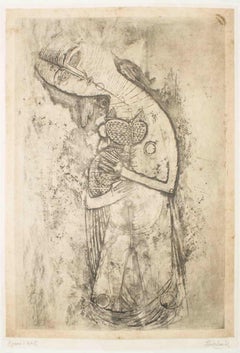
Portrait of Woman - Original Etching by Johnny Friedlaender
By Johnny Friedlaender
Located in Roma, IT
Artist's Proof, Hand signed.
Edition of 50 prints.
Image Dimensions : 42 x 55 cm
Very good conditions.
This artwork is shipped from Italy. Under existing legislation, any artwork ...
Category
Late 20th Century Surrealist Johnny Friedlaender More Prints
Materials
Etching
Related Items
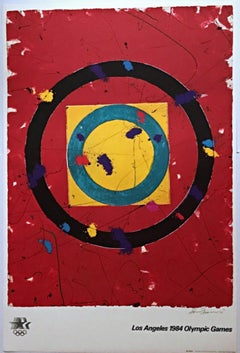
Lt Ed. Lithograph from the Deluxe (Hand Signed) 1984 Olympic Committee portfolio
By Sam Francis
Located in New York, NY
Sam Francis
Untitled Abstract Expressionist print for the 1984 Olympics, 1982
Offset Lithograph on Parsons Diploma Parchment paper, hand signed with COA from publisher for Olympic Co...
Category
1980s Abstract Expressionist Johnny Friedlaender More Prints
Materials
Pencil, Lithograph, Offset

$2,800
H 36 in W 6 in D 6 in
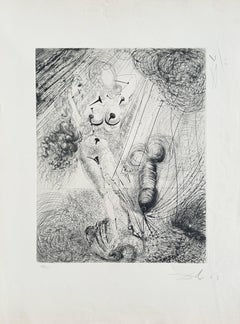
Aphrodite
By Salvador Dalí
Located in OPOLE, PL
Salvador Dali (1904-1989) - Aphrodite
Etching from 1963.
Handsigned in two places.
The edition 114/150.
Dimensions of work: 76 x 56 cm
Reference: Michler/Löpsinger 117
Side not...
Category
1960s Surrealist Johnny Friedlaender More Prints
Materials
Etching
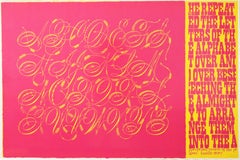
He Repeated the Letters of the Alphabet
By Corita Kent
Located in Missouri, MO
Sister Mary Corita Kent (American, 1918-1986)
He Repeated the Letters of the Alphabet...
Color Screenprint
22.5 x 38.75 inches
Signed Lower Right
Sister Mary Corita Kent, once the n...
Category
Mid-20th Century American Modern Johnny Friedlaender More Prints
Materials
Color, Screen
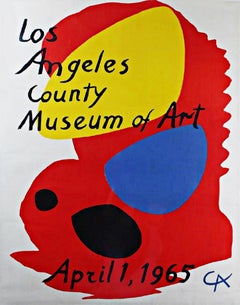
The ORIGINAL limited edition 1965 Los Angeles County Museum of Art LACMA poster
By Alexander Calder
Located in New York, NY
Alexander Calder
The original Los Angeles County Museum of Art poster, 1965
Limited Edition vintage Offset Lithograph
32 × 24 3/4 inches 81.3 × 62.9 cm
Edition of 300
This is the OR...
Category
1960s Modern Johnny Friedlaender More Prints
Materials
Lithograph, Offset
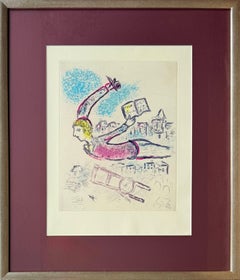
De Mauvais Sujets - Planche V
By Marc Chagall
Located in OPOLE, PL
Marc Chagall (1887-1985) - De Mauvais Sujets - Planche V
Etching and aquatint from 1958.
An unnumbered and unsigned copy from a limited edition of 153.
Dimensions of sheet: 43.5 x 32.5 cm
Dimensions in frame: 63.2 x 53.2 cm
Publisher: Les Bibliophiles de l’Union Française, Paris.
Printer: Atelier Lacourière et Frélaut, Paris.
Reference: Cramer 35
--
This original color etching comes from De Mauvais Sujets ("The Bad Subjects"), a 1958 illustrated portfolio that paired Marc Chagall’s artwork...
Category
1950s Surrealist Johnny Friedlaender More Prints
Materials
Etching, Aquatint
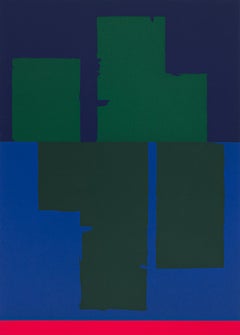
Untitled
By Louise Nevelson
Located in New York, NY
Very good impressions of these 4 color screenprints on white wove paper. Each signed, dated and numbered 15/25, 18/36, 15/39 or 6/40 in pencil.
Category
1970s Modern Johnny Friedlaender More Prints
Materials
Color, Screen
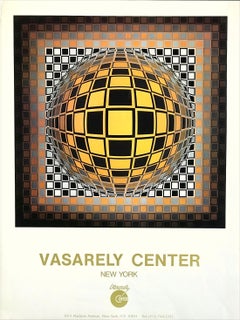
VASARELY CENTER NY 1978 Vintage Op-Art Poster, Geometric Abstract, Gold Black
By Victor Vasarely
Located in Union City, NJ
VICTOR VASARELY
VASARELY CENTER NY
Vintage original vintage Op-art poster published by VCNY (Vasarely Center New York), New York, 1978.
Poster size - 32 x 24 inches, unframed, unsi...
Category
1970s Op Art Johnny Friedlaender More Prints
Materials
Offset, Lithograph
Stones III (~22% OFF LIST PRICE)
Located in Kansas City, MO
Avraham Inlender
Stones III
Color Offset Lithograph
Year: 2003
Size: 5.9 x 5.5 inches (15 x 14 cm)
Signed in pencil
COA provided
Avraham Inlender (1932–2003) was a Polish-born arti...
Category
Early 2000s Abstract Johnny Friedlaender More Prints
Materials
Lithograph, Offset

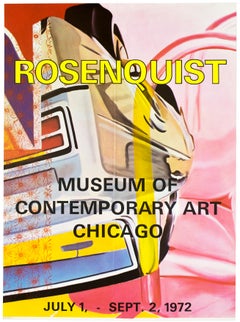
Vintage James Rosenquist poster MOCA Chicago 1972 neon yellow pink chrome
By James Rosenquist
Located in New York, NY
An inverted car, gleaming in chrome, speeds through sumptuous layers of pink, translucent yellow, and a veil of lacy, flower-like shapes. Across the top, the artist’s name is splashe...
Category
1970s Pop Art Johnny Friedlaender More Prints
Materials
Offset
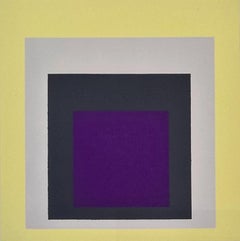
Homage to the Square: Dedicated (Bauhaus, Minimal, Retrospective, ~34% OFF)
By Josef Albers
Located in Kansas City, MO
Josef Albers
Homage to the Square: Dedicated
1956
Silkscreen in brilliant Colors on Paper after Oil on Masonite, 1950-1956
From "Josef Albers - Paintings, Prints, Projects", 1956
Im...
Category
1950s Modern Johnny Friedlaender More Prints
Materials
Screen
$458 Sale Price
34% Off
H 5 in W 5 in
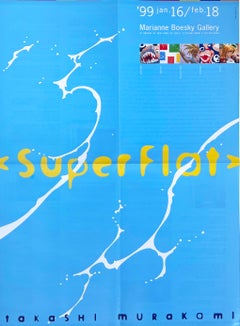
Takashi Murakami
Superflat
exhibition poster (vintage Takashi Murakami)
By Takashi Murakami
Located in NEW YORK, NY
Takashi Murakami Superflat Exhibition Poster 1999:
Rare 1990s exhibit poster designed by Murakami and published by Marianne Boesky Gallery New York...
Category
21st Century and Contemporary Pop Art Johnny Friedlaender More Prints
Materials
Lithograph, Offset
$375 Sale Price
31% Off
H 22 in W 17 in D 0.01 in
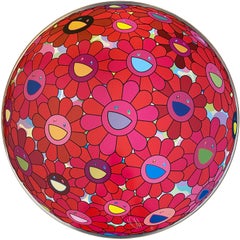
Takashi Murakami - Let us Devote Our Hearts, bright pink colors and flowers
By Takashi Murakami
Located in Dallas, TX
This collectible work on paper by Murakami is edition # 78 of 300. It comes unframed.
One of the most acclaimed artists to emerge from post-war Asia, Takashi Murakami is known for h...
Category
2010s Pop Art Johnny Friedlaender More Prints
Materials
Paper, Varnish, Offset
Previously Available Items
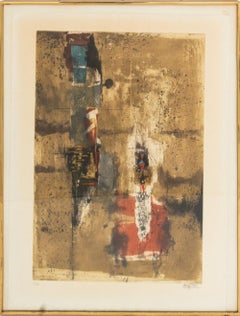
Johnny Friedlaender Abstract Composition Aquatint
By Johnny Friedlaender
Located in Astoria, NY
Johnny Gotthard Friedlaender (German, 1912-1992), Abstract Composition, Etching and Aquatint in color on "L'Oeuvre Gravee" paper, blind stamped lower left, signed in pencil lower rig...
Category
20th Century Abstract Johnny Friedlaender More Prints
Materials
Paper, Etching, Aquatint, Intaglio
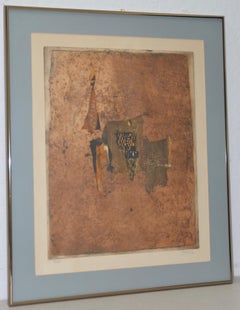
Johnny Gotthard Friedlaender Abstract Lithograph c.1970s
By Johnny Friedlaender
Located in San Francisco, CA
Johnny Gotthard Friedlaender Abstract Lithograph c.1970s
Rare limited edition lithograph by listed artist Johnny Gotthard Friedlaender (1912-1992)
Pe...
Category
Mid-20th Century Abstract Johnny Friedlaender More Prints
Materials
Lithograph
H 28.5 in W 23.5 in D 3 in
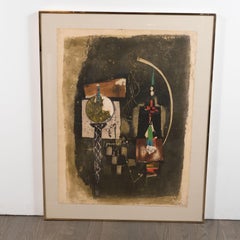
Untitled Composition
By Johnny Friedlaender
Located in New York, NY
This beautiful and sophisticated aquatint (his preferred print medium) was executed by the renowned modern artist Johnny Friedlaender. It offers an abstract composition against a jav...
Category
20th Century Modern Johnny Friedlaender More Prints
Materials
Aquatint
Large Johnny Friedlaender Poster Print No Text
By Johnny Friedlaender
Located in Surfside, FL
Johnny Friedlaender (26 December 1912 – 18 June 1992) was a leading 20th-century artist, whose works have been exhibited in Germany, France, Netherlands, Italy, Japan and the United States. He has been influential upon other notable artists, who were students in his Paris gallery. His preferred medium of aquatint etching is a technically difficult artistic process, of which Friedlaender has been a pioneer.
Gotthard Johnny Friedlaender was born in Pless (Pszczyna), Prussian Silesia, as the son of a pharmacist. He was graduated from the Breslau (Wrocław) high school in 1922 and then attended the Academy of Arts (Akademie der Bildenden Kunste) in Breslau, where he studied under Otto Mueller. He graduated from the Academy as a master student in 1928. In 1930 he moved to Dresden where he held exhibitions at the J. Sandel Gallery and at the Dresden Art Museum. He was in Berlin for part of 1933, and then journeyed to Paris. After two years in a Nazi concentration camp, he emigrated to Czechoslovakia, where he settled in Ostrava, where he held the first one-man show of his etchings.
In 1936 Friedlaender journeyed to Czechoslovakia, Switzerland, Austria, France and Belgium. At the Hague he held a successful exhibition of etchings and watercolours. He fled to Paris in 1937 as a political refugee of the Nazi regime with his young wife, who was an actress. In that year he held an exhibition of his etchings which included the works: L ‘Equipe and Matieres et Formes. From 1939 to 1943 he was interned in a series of concentration camps, but survived against poor odds.
After freedom in 1944 Friedlaender began a series of twelve etchings entitled Images du Malheur with Sagile as his publisher. In the same year he received a commission to illustrate four books by Freres Tharaud of the French Academy. In 1945 he performed work for several newspapers including Cavalcade and Carrefour. In the year 1947 he produced the work Reves Cosmiques and in that same year he became a member of the Salon de Mai, which position he held until 1969. In the year 1948 he began a friendship with the painter Nicolas de Staël and held his first exhibition in Copenhagen at Galerie Birch. The following year he showed for the first time in Galerie La Hune in Paris. After living in Paris for 13 years, Friedlaender became a French citizen in 1950.
Friedlaender expanded his geographic scope in 1951 and exhibited in Tokyo in a modern art show. In the same year he was a participant in the XI Trienale in Milan, Italy. By 1953 he had produced works for a one-man show at the Museum of Neuchâtel and exhibited at the Galerie Moers in Amsterdam, the II Camino Gallery in Rome, in São Paulo, Brazil and in Paris. He was a participant of the French Italian Art Conference in Turin, Italy that same year.
Friedlaender accepted an international art award in 1957, becoming the recipient of the Biennial Kakamura Prize in Tokyo. In 1959 he received a teaching post awarded by UNESCO at the Museum of Modern Art in Rio de Janeiro. By 1968 Friedlaender was travelling to Puerto Rico, New York City and Washington, D.C. to hold exhibitions. That year he also purchased a home in the Burgundy region of France. 1971 was another year of diverse international travel including shows in Bern, Milan, Paris, Krefeld and again New York. In the latter city he exhibited paintings at the Far Gallery, a venue becoming well known for its patronage of important twentieth-century artists.
From his atelier in Paris Friedlaender instructed younger artists who themselves went on to become noteworthy, among them Arthur Luiz Piza, Brigitte Coudrain...
Category
Mid-20th Century Modern Johnny Friedlaender More Prints
Materials
Offset, Screen
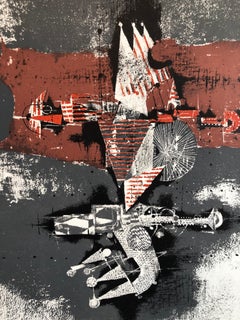
Johnny Friedlaender more prints for sale on 1stDibs.
Find a wide variety of authentic Johnny Friedlaender more prints available for sale on 1stDibs. You can also browse by medium to find art by Johnny Friedlaender in offset print, screen print, etching and more. Much of the original work by this artist or collective was created during the 20th century and is mostly associated with the modern style. Not every interior allows for large Johnny Friedlaender more prints, so small editions measuring 17 inches across are available. Customers who are interested in this artist might also find the work of Leszek Rózga, Rufino Tamayo, and Pat Steir. Johnny Friedlaender more prints prices can differ depending upon medium, time period and other attributes. On 1stDibs, the price for these items starts at $400 and tops out at $1,604, while the average work can sell for $750.