Jonathan Richardson, the Elder Art
to
1
Overall Width
to
Overall Height
to
1
1
1
1
1
1
1
1
1
10,164
2,783
2,504
1,379
1
Artist: Jonathan Richardson, the Elder
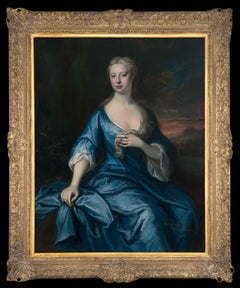
Portrait of Mary Hooper née Davie, Blue Dress, Seated in a Parkland, Provenance
By Jonathan Richardson the Elder
Located in London, GB
Portrait of Mary Hooper (née Davie) in a Blue Dress & Seated in a Parkland c. 1715–1725
Jonathan Richardson the Elder (1667–1745)
This portrait, presented by Titan Fine Art, is of p...
Category
18th Century Old Masters Jonathan Richardson, the Elder Art
Materials
Canvas, Oil
Related Items
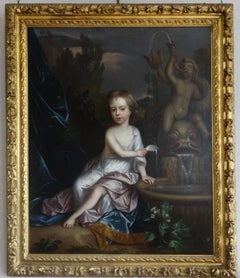
English 17th century portrait of James Thynne as a young boy by a fountain
By Johann Kerseboom
Located in Bath, Somerset
Portrait of the Hon. James Thynne (c. 1680-1704), full-length, in the gardens of Longleat House, seated beside a fountain, holding a shell beneath water spouting from a horn blown by a cherub on a dolphin. A glimpse of part of Longleat House can be seen upper left. Oil on canvas in a period giltwood frame, decorated with leaves and acorns. C. 1682.
Dimensions: 145 x 123cm (57 x 48in) in frame
Provenance:
Ex Longleat House, Wiltshire
Private collection, Bath
James Thynne was the youngest son of Thomas Thynne, 1st Viscount Weymouth and Frances Finch of Longleat House, Wiltshire. He died in his youth and his Aunt, Anne Kingsmill Finch, Countess of Winchilsea (1661-1720), wrote a moving poem on his death. He was buried in the family vault at Longbridge Deverill, Wiltshire. A mezzotint of this painting by William Faithorne the Younger is held in the Royal Collection.
Johann Kerseboom (d.1708) was the nephew of Frederick Kerseboom and first worked in Germany before coming to England in the 1680's where his sitters included the 'Electress Sophia Dorothea' (known from a mezzotint by William Faithorne). His early works were influenced by William Wissing...
Category
17th Century Old Masters Jonathan Richardson, the Elder Art
Materials
Oil, Canvas

$26,387 Sale Price
20% Off
H 57.09 in W 48.43 in
Two royal portraits (the Duc d
Angoulême and the Duc de Berry) by H.P. Danloux
Located in PARIS, FR
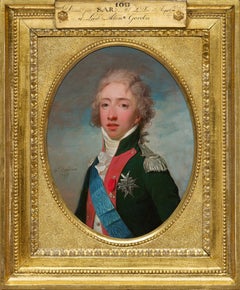
These two royal portraits are a major historical testimony to the stay of the Comte d'Artois (the future Charles X) and his family in Edinburgh in 1796-1797. Given by the sitters to Lord Adam Gordon, the Governor of Edinburgh, and kept by family descent to this day, these two portraits provide us with a vivid and spontaneous image of the Duc d’Angoulême and his brother the Duc de Berry. Danloux, who had emigrated to London a few years before, demonstrate his full assimilation of the art of British portrait painters in the brilliant execution of these portraits.
1. Henri-Pierre Danloux, a portraitist in the revolutionary turmoil
Born in Paris in 1753, Henri-Pierre Danloux was first a pupil of the painter Nicolas-Bernard Lépicié (1735 - 1784) and then, in 1773, of Joseph-Marie Vien (1716 - 1809), whom he followed to Rome when, at the end of 1775, Vien became Director of the Académie de France. In Rome he became friends with the painter Jacques-Louis David (1748 - 1825).
Returning to France around 1782, he settled in Lyon for a few years before returning to Paris in 1785. One of his first portraits was commissioned by the Baroness d'Etigny, the widow of the former Intendant of the Provinces of Gascony, Bearn and Navarre Antoine Mégret d'Etigny (1719 – 1767). He then became close to his two sons, Mégret de Sérilly and Mégret d'Etigny, who in turn became his patrons. In 1787, this close relationship with the d'Etigny family was further strengthened by his marriage to Antoinette de Saint-Redan, a relative of Madame d'Etigny. After his marriage, he left for Rome and did not return to France until 1789. It was during the winter of 1790-1791 that he painted one of his masterpieces, the portrait of Baron de Besenval. Set in a twilight atmosphere, this portrait of an aristocrat who knows that his death is imminent symbolizes the disappearance of an erudite and refined society which would be swept away by the French Revolution.
The Jacobin excesses led Danloux to emigrate to England in 1792; many members of his family-in-law who remained in France were guillotined on 10 May 1794. Danloux enjoyed great success as a portrait painter in England before returning to France in 1801.
During his stay in England, Danloux was deeply under the influence of English portraitists: his colors became warmer (as shown by the portrait of the Duc d'Angoulême that we are presenting), and his execution broader.
2. Description of the two portraits and biographical details of the sitters
The Duc d'Angoulême (1775-1844) was the eldest son of the Comte d'Artois, the younger brother of King Louis XVI (the future King Charles X), and his wife Marie-Thérèse of Savoie. He is shown here, in the freshness of his youth, wearing the uniform of colonel-general of the "Angoulême-Dragons" regiment.
He is wearing the blue cordon of the Order of the Holy Spirit, which was awarded to him in 1787, and two decorations: the Cross of Saint-Louis and the Maltese Cross, as he was also Grand Prior of the Order of Malta.
Born on 16 August 1775 in Versailles, Louis-Antoine d'Artois followed his parents into emigration on 16 July 1789. In 1792, he joined the émigrés’ army led by the Prince de Condé. After his stay in Edinburgh (which will be further discussed), he went to the court of the future King Louis XVIII, who was in exile at the time, and in 1799 married his first cousin Marie-Thérèse Charlotte of France, the daughter of Louis XVI and the sole survivor of the royal family. The couple had no descendants. He became Dauphin of France in 1824, upon the accession to the throne of his father but played only a minor political role, preferring his military position as Grand Admiral. Enlisted in Spain on the side of Ferdinand VII, he returned home crowned with glory after his victory at Trocadero in 1823.
He reigned for a very short time at the abdication of Charles X in 1830, before relinquishing his rights in favor of his nephew Henri d'Artois, the Duc de Bordeaux. He then followed his father into exile and died on 3 June 1844 in Gorizia (now in Italy).
His younger brother, the Duc de Berry, is shown in the uniform of the noble cavalry of the émigrés’ Army. He is wearing the blue cordon of the Order of the Holy Spirit, awarded to him in May 1789, and the Cross of Saint-Louis (partly hidden by his blue cordon).
Born on 24 January 1778 in Versailles, Charles-Ferdinand d'Artois also followed his parents into emigration and joined the émigrés’ army in 1792. After his stay in Edinburgh, he remained in Great Britain, where he had an affair with Amy Brown...
Category
1790s Old Masters Jonathan Richardson, the Elder Art
Materials
Canvas, Oil, Wood Panel
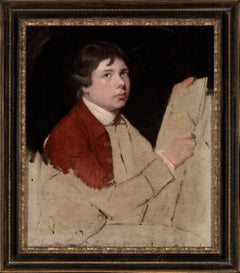
Self-Portrait
By John Hamilton Mortimer
Located in London, GB
Oil on canvas
30 x 25 ⅛ inches; 762 x 638 mm
Verso: after Sir Joshua Reynolds, a self-portrait
Not signed
Painted c. 1758
Collections:
Philip Gell (1775–1842), Hopton Hall, Derbyshire;
By inheritance at Hopton Hall to his daughter, Isabella, who married William Pole Thornhill, who renounced Hopton and its contents in favour of his kinsman, Henry Chandos-Pole-Gell (1829–1902);
By descent to his son, Brigadier General Harry Chandos-Pole-Gell (1872–1934), who sold Hopton Hall in 1918 and moved the family to Newnham Hall, Northamptonshire;
By descent to his son, Lt Colonel John Chandos-Pole (1909–1993), Newnham Hall;
Thence by descent until 2015, when acquired
By descent to 2015;
Lowell Libson
Jonny Yarker Ltd.
Literature:
Algernon Graves and Walter V. Cronin, A History of the works of Sir Joshua Reynolds P.R.A., London, 1901, IV, p. 1394.
David Manning...
Category
18th Century Old Masters Jonathan Richardson, the Elder Art
Materials
Canvas, Oil
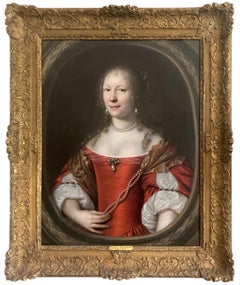
17th century Dutch portrait of a Lady in Red adorned with Pearls
By Pieter Nason
Located in Bath, Somerset
Portrait of a lady, half-length in a feigned oval wearing a ruby coloured silk gown holding entwined strings of pearls across her bodice. Signed 'PNason' and dated 1667 (lower right)...
Category
17th Century Old Masters Jonathan Richardson, the Elder Art
Materials
Oil, Canvas
$26,286 Sale Price
20% Off
H 33.94 in W 26.26 in
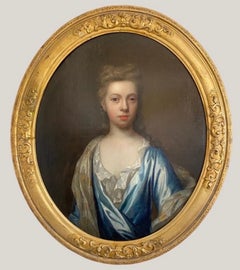
English 18th century portrait of a lady, Circle of Thomas Murray (1663-1735)
Located in Bath, Somerset
An early 18th century portrait of a young lady, half length, wearing a blue silk gown with white chemise and gold trimmed cloak draped across her arm and shoulders. Her sensitively observed soft expression and skilfully painted youthful 'dewy' complexion are reminiscent of the portrait style of John Closterman whose work Murray would have been familiar with, being a close colleague of Murray's teacher, John Riley.
An old label on the reverse identifies the sitter as a young Princess Charlotte...
Category
Early 18th Century Old Masters Jonathan Richardson, the Elder Art
Materials
Canvas, Oil
$8,246 Sale Price
20% Off
H 35.04 in W 30.32 in
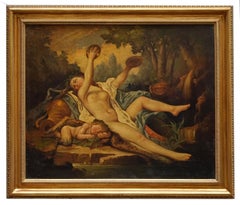
ALLEGORICAL SCENE - Giovanni Faliero - Italy Oil on Canvas Painting
By Giovanni Faliero
Located in Napoli, IT
Allegorical Scene - Giovanni Faliero Italia 2009 - Oil on canvas cm. 90x110.
This beautiful oil on canvas is the personal reinterpretation of the magnificent painting “Bacchant playing the Cymbals” by Jean-Simon Berthélemy, a French painter of the 18th century. Here we admire a mythological scene showing a naked bacchant playing cymbals next to a wooded stream, with a small sleeping faun...
Category
Early 2000s Old Masters Jonathan Richardson, the Elder Art
Materials
Canvas, Oil
$4,521
H 41.34 in W 49.22 in
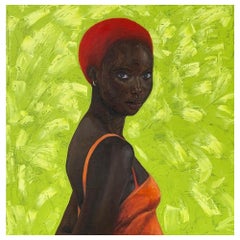
Answer Within
Located in Ibadan, Oyo
Painting
Ships in a well-protected tube from Nigeria
This work is unique, this is not a print or other type of copy.
Accompanied by a Certificate of Authenticity (Issued by the Gallery)
Category
21st Century and Contemporary Old Masters Jonathan Richardson, the Elder Art
Materials
Canvas, Oil
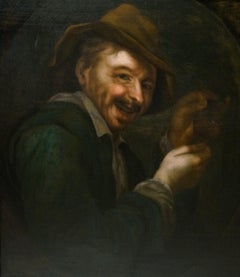
Antique oil paining, A laughing man with an upturned glass, Dutch golden age
Located in DEVENTER, NL
Anonymous, 18th century
Inspired by a painting by Petrus Staverenus (1610/1612 – 1654-07-28/1664-07-28) from a series of Five Senses
'Taste: A laughing man...
Category
18th Century Old Masters Jonathan Richardson, the Elder Art
Materials
Canvas, Oil
$1,961
H 29.34 in W 23.63 in
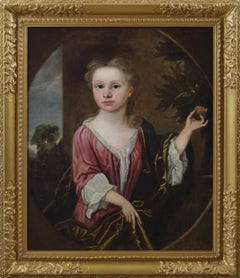
18th Century portrait oil painting of a girl with an orange
By Robert Byng
Located in Nr Broadway, Worcestershire
Circle of Robert Byng
British, (1666-1720)
Girl with Orange
Oil on canvas
Image size: 29 inches x 24 inches
Size including frame: 36 inches x 31 inc...
Category
18th Century Old Masters Jonathan Richardson, the Elder Art
Materials
Canvas, Oil
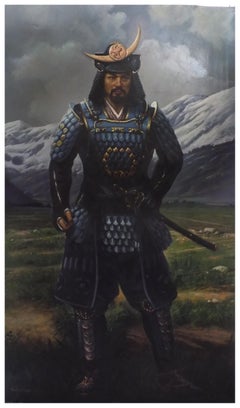
SAMURAI -Italian School - Oil on Canvas Italian Figurative Painting
By Maximilian Ciccone
Located in Napoli, IT
Samurai - Maximilian Ciccone - Italia - Oil on canvas cm.210x120-
In this majestic oil on canvas painting the Artist Ciccone portrays a samurai, exhibiting the Japanese warrior cast...
Category
2010s Old Masters Jonathan Richardson, the Elder Art
Materials
Canvas, Oil
$4,164
H 82.68 in W 47.25 in
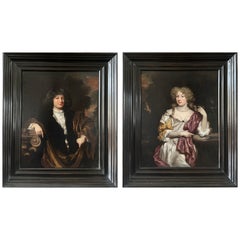
A pair of Dutch 17th century old master portraits of a husband and wife
By Nicolaes Maes
Located in Bath, Somerset
A rare pair of three-quarter length 'marriage' portraits by one of the foremost dutch portrait painters of the 17th century, Nicolaes Maes (Dordrecht 1634-1693 Amsterdam). The gentleman signed middle left 'Maes 1679'. Oil on canvas in dutch style ebonised frames. Dimensions 58 x 47.5cms each.
The gentleman is shown in a landscape at dusk, leaning against a stone capital, wearing a white chemise decorated with lace, a black coat and a brown silk cloak draped across his body.
The lady is elegantly dressed in an ivory silk gown decorated with jewels on the neckline and shoulders, the contrasting sleeves in gold fabric, with a rose pink silk cloak draped over her shoulder and bodice. She wears a pearl necklace and earrings with her fair hair worn up with ringlets falling down onto her chest in the fashionable style of the day. She stands with one hand touching a lock of her hair as she rests her arm on the bowl of a stone water drinking fountain...
Category
17th Century Old Masters Jonathan Richardson, the Elder Art
Materials
Canvas, Oil
$54,973
H 22.84 in W 18.71 in
18th Century portrait oil painting of a gentleman
Located in Nr Broadway, Worcestershire
Follower of Enoch Seeman the Younger
German, (1694-1744)
Portrait of Gilbert Sympkin
Oil on canvas
Image size: 29.25 inches x 24.5 inches
Size including frame: 38 inches x 33.25 inches
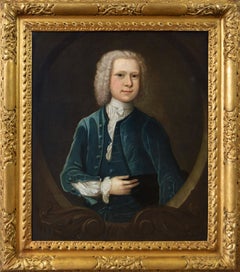
A fine three quarter length portrait of a gentleman traditionally identified as Gilbert Simpkin (Sympkin), follower of Enoch Seeman the younger, C1720. The portrait is set in a feigned sculptured oval cartouche, a device used to give a sense of depth. The sitter is depicted wearing a fashionable blue jacket and matching waistcoat with a white chemise and lace jabot. He wears a powdered wig in the fashionable style of the day and is posed holding his hat under his left arm with the fingers of his right hand stretched out. At court, long fingers signified wealth, culture and intelligence. The painting has clearly been executed by an artist of great ability who has been influenced by Enoch Seeman the younger.
Gilbert Simpkin (Sympkin) was born in London on 24 August 1683, the son of John Simpkin and Susannah Butler. His grandfather was also called Gilbert Simpkin. He entered Oxford University in 1700 where he studied at St John’s College. In 1702, he became a student of Middle Temple, which at the time was one of the world’s most important centres of legal education. He later settled in Plymouth and then Bristol. He died in Bristol on 15 May, 1744 and was buried at Bristol Cathedral. He remained unmarried and the portrait may well have been commissioned to commemorate when he was first Called to the Bar or perhaps had established his own practice.
Enoch Seeman or Seemann the younger was born in Danzig, Germany now Gdansk, Poland in 1694. His father was Enoch Seeman Senior, an artist of Flemish origin and his brothers Isaac, Noah and Abraham also became artists. He came to London with his father and brothers around 1704 and established himself as a portrait artist. From 1717 he became painter to the Royal court painting...
Category
18th Century Old Masters Jonathan Richardson, the Elder Art
Materials
Canvas, Oil
$6,390
H 38 in W 33.25 in D 2.5 in
Previously Available Items
The Poet Judith Madan (1702-1781)
By Jonathan Richardson the Elder
Located in Bath, Somerset
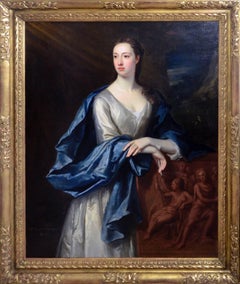
Portrait of the English poet Judith Madan (1702-1781), standing three-quarter length in a classical landscape wearing an oyster coloured gown with blue cloak, holding her quill beside a classical bas-relief of the muses. Inscribed lower left ' Mrs Judith Cowper 1721 AET 21'. Further inscription lower centre right 'CAEIO', the Greek name for Clio, the muse of history, writing and poetry. Oil on canvas in a giltwood 'Lely' style frame.
Dimensions: 151 x 127cm (59 1/2 x50in)
Provenance:
Property of the Minnesota Historical Society from the Mary Griggs Burke Collection. By descent through the family of the sitter until sold at Christies London, May 1930 by Rev. Henry Madan-Pratt, sold to Collins.
Judith Madan was the fifth child and only daughter of the judge and MP Spencer Cowper (1670-1728) and his wife, Pennington (1665, d.1727) of Hertingfordbury Park, Hertfordshire. From her mid-teens she composed verse, mainly in heroic couplets, inspired by the poets she was reading. She is likely to have met the poet Alexander Pope whilst sitting for a pastel portrait by his friend Charles Jervas and in the years 1722-3 she conducted a literary correspondence with him who encouraged her writing. He wrote and sent her a poem 'To a Lady on her Birthday' which he also sent to another Lady he admired, Martha Blount. Her work incliuded 'The Progress of Poetry' (1721) surveying English poets from Chaucer to Pope which was included in 'The Flower Piece' published in 1731 and re-published as a separate poem as late as 1783. In 1721 she wrote 'Abelard to Eloisa' which was a response to Pope`s 'Eloisa to Abelard'. She wrote less after her marriage in 1723 to Colonel Martin Madan who was the Groom to the Bedchamber to Frederick, Prince of Wales and MP for Wootton Bassett, by whom she had nine children. She was praised in John Duncombe's 'Feminiad' (1754) and some of her work appeared in 'Poems by Eminent Ladies '(1755) edited by George Colman and Bonnell Thornton. In 1769 'Letters of the Late Alexander Pope, Esq. to a Lady' appeared for the first time in print, though Madan, the addressee, was not named. She died in London and was buried in Grosvenor Chapel in Grosvenor Square, leaving much unpublished material. Her nephew was the poet William Cowper.
Jonathan Richardson...
Category
Early 18th Century Old Masters Jonathan Richardson, the Elder Art
Materials
Oil
Portrait of a Family
By Jonathan Richardson the Elder
Located in Bath, Somerset
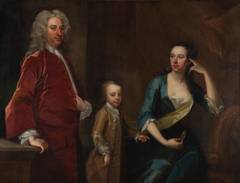
Circle of Jonathan Richardson (London 1665 - 1745), Portrait of a Family, traditionally identified as The Thornhill Family, depicting Sir James Tho...
Category
18th Century and Earlier Jonathan Richardson, the Elder Art
Jonathan Richardson The Elder art for sale on 1stDibs.
Find a wide variety of authentic Jonathan Richardson The Elder art available for sale on 1stDibs.