Joseph Domjan Landscape Prints
to
2
Overall Width
to
Overall Height
to
2
188
169
156
147
2
2
2
1
1
1
1
2
Artist: Joseph Domjan
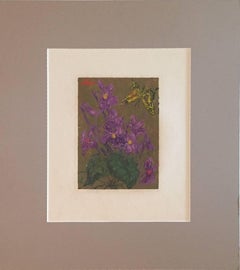
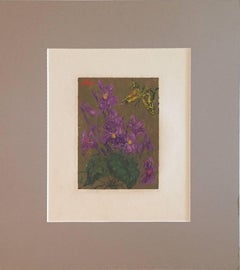
Violets
By Joseph Domjan
Located in Surfside, FL
Born in Budapest in 1907, he had a humble upbringing and a passion for the arts. Shortly after the Hungarian Revolution broke out in 1956, Domján was invited to showcase his work in ...
Category
20th Century Joseph Domjan Landscape Prints
Materials
Wood, Mixed Media, Woodcut
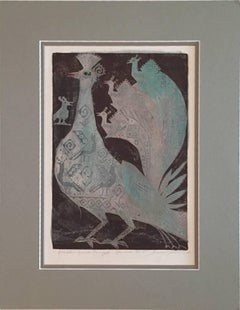
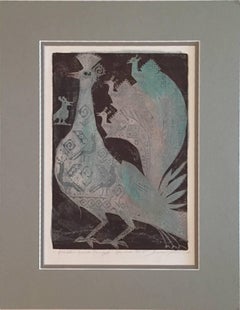
Bird
Young
By Joseph Domjan
Located in Surfside, FL
Born in Budapest in 1907, he had a humble upbringing and a passion for the arts. Shortly after the Hungarian Revolution broke out in 1956, Domján was invited to showcase his work in ...
Category
20th Century Joseph Domjan Landscape Prints
Materials
Mixed Media, Wood Panel
Related Items
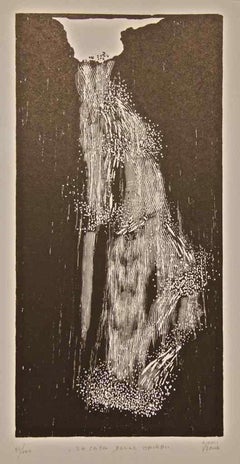
The House of Naiads - Woodcut Print by G. Verna - 1946
By Claudio Verna
Located in Roma, IT
Image dimension 36.5 x 18 cm.
Hand Signed. Edition of 100 pieces.
Category
1940s Contemporary Joseph Domjan Landscape Prints
Materials
Woodcut
$309
H 19.69 in W 13.78 in D 0.04 in
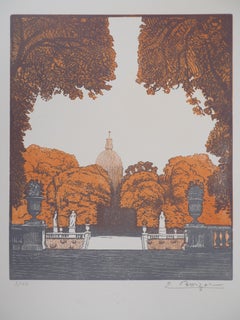
Paris, Luxembourg Garden - Original wooodcut, Handsigned and numbered /105
Located in Paris, IDF
Emile BOIZOT
Paris, Luxembourg Garden - 1920
Original woodcut
Handsigned in pencil
Numbered /165
On vellum 32.5 x 25.5 cm (c. 13 x 10 in)
Bears the blind...
Category
1920s Art Deco Joseph Domjan Landscape Prints
Materials
Woodcut

$297
H 12.8 in W 10.04 in
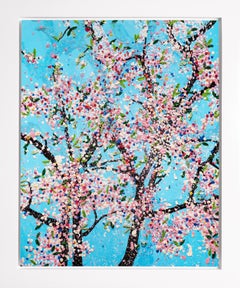
The Virtues
Politeness
, Limited Edition
Cherry Blossom
Landscape
By Damien Hirst
Located in New York, NY
The contemporary pop art cherry blossom landscape ‘Politeness' is one of the eight from the iconic ‘Virtues’ series by Damien Hirst, the laminated giclée print on aluminum panel was ...
Category
2010s Contemporary Joseph Domjan Landscape Prints
Materials
Panel, Giclée
$46,800
H 55.5 in W 45.8 in D 2 in
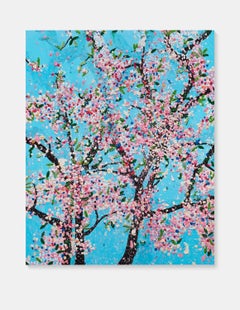
Politeness (The Virtues) Damien Hirst Cherry Blossom Print
By Damien Hirst
Located in Manchester, GB
Damien Hirst, Politeness - Cherry Blossom, 2021
Laminated Giclée Print on Aluminium Composite Panel
120.1 × 96 × 0.1 cm (47 3/10 × 37 4/5 × 1/50 in)
Edition of 1549
Hand-signed and ...
Category
2010s Contemporary Joseph Domjan Landscape Prints
Materials
Giclée, Panel
$36,329
H 47.25 in W 37.8 in
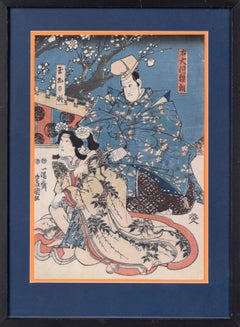
Two Actors - Japanese Woodblock by Chikanobu Yoshu
By Toyohara Chikanobu
Located in Soquel, CA
Two Actors - Japanese Woodblock by Toyohara Chikanobu (豊原周延, 1838–1912), better known to his contemporaries as Yōshū Chikanobu (楊洲周延).
Colorful and expressive court scene. Two actors...
Category
1890s Edo Joseph Domjan Landscape Prints
Materials
Ink, Rice Paper, Woodcut
$875
H 18.5 in W 13.5 in D 1 in
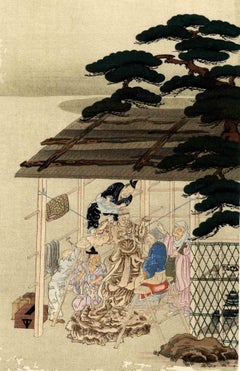
Sculptor at Work - Woodcut after Takakane Fujiwara - 1950s
Located in Roma, IT
Sculptor at work is an artwork realized in the Early 20th Century after Takakane Fujiwara.
Sheet dimensions: 30 x 19.5 cm.
Reprint.
Good conditions.
Category
1950s Modern Joseph Domjan Landscape Prints
Materials
Paper, Woodcut
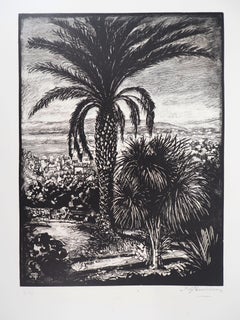
Cannes : View from California Park - Original wooodcut, Handsigned
Located in Paris, IDF
Jules PERRICHON (1866-1946)
Cannes : View from California Park, 1928
Original woodcut
Handsigned in pencil
Numbered /160
On vellum 32.5 x 25.5 cm (c. 13 x 10 in)
Bears the blind sta...
Category
1920s Art Deco Joseph Domjan Landscape Prints
Materials
Woodcut
$297
H 12.8 in W 10.04 in
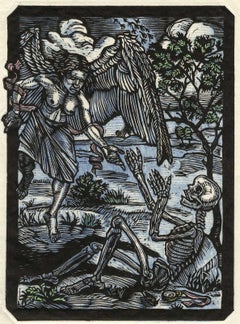
Angel and Skeleton (the rescuing Angel appears to be female)
By Donna Evans
Located in New Orleans, LA
Donna Evans' "Angel and Skeleton" shows an angel reaching out to a skeleton as if to rescue it from a wooded landscape.
Donna Evans is one of a group of N...
Category
1980s Contemporary Joseph Domjan Landscape Prints
Materials
Woodcut
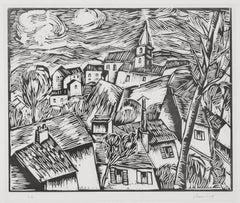
Bougival
By Maurice de Vlaminck
Located in Fairlawn, OH
Bougival
Woodcut, 1914
Signed and numbered in pencil
Edition 30, this numberd 22
Printed on laid Van Gelder Zonen paper
Published by Henri Kanweiler, Paris
Printed by Paul Birault, P...
Category
1910s Fauvist Joseph Domjan Landscape Prints
Materials
Woodcut
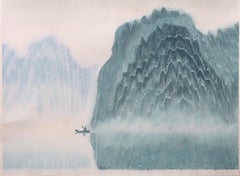
Music in Morning, Contemporary Woodcut Print with Ink Drawing by Lu Fang
Located in Long Island City, NY
Lu Fang, Chinese (1932 - ) - Music in Morning, Year: 1983, Medium: Woodcut and water-soluble ink and Chine colle, signed, titled and dated in pencil, Image Size: 15 x 21 inches, S...
Category
1980s Contemporary Joseph Domjan Landscape Prints
Materials
Ink, Woodcut
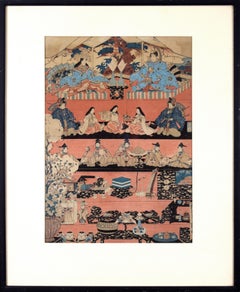
"Various Himochi" Wagashi Festival Japanese Woodblock Print by Utagawa Toyokuni
By Utagawa Toyokuni
Located in Soquel, CA
"Various Himochi" Wagashi Festival Japanese Woodblock Print by Utagawa Toyokuni
Rare oversized early 19th century 5-tiered woodblock by Utagawa Ichiyosai Toyokuni, (Japan, 1769-1825), a Japanese lord and wife oversee a sekku festival of food, music, and dolls or toys. '"oshi" is the first day of “Mi (Snake)” in the third month of the lunar calendar. This day, known in modern Japan as the Girls' Festival, originated in China as a form of purification ceremony in which water and drinking peach blossom wine were used to drive away evil. Many kinds of hishi-mochi appear in this picture of hina ningyo (dolls associated with Hinamatsuri, or the Girl’s Day) from Omochae.
The custom of eating special dishes at events throughout the year and at milestones in people's lives has existed since ancient times. This paragraph specifically focuses on the annual event called sekku, and life events that involve eating sweets. Joshi is the first day of “Mi (Snake)” in the third month of the lunar calendar. This day, known in modern Japan as the Girls' Festival, originated in China as a form of purification ceremony in which water and drinking peach blossom wine were used to drive away evil. According to the Keiso saijiki, in ancient China, on the third day of the third lunar month, people ate “ryuzetsuhan,” which is the juice of gogyo (Jersey cudweed) mixed with rice flour and nectar. In Japan, there is a record in the Heian period history book Nihon Montoku tenno jitsuroku [839-5] that it was an annual event to make kusamochi using gogyo on the third day of the third month of the lunar calendar, which may have been influenced by Chinese customs.
The tradition of eating kusamochi on the third day of the third month of the lunar calendar continued after that. By the Edo period, however, hishimochi had come to be used as a sweet to serve on the third day of the third month. A picture of a hishimochi is included in the Morisada manko , which we mentioned in Part 1. According to it, hishimochi in the Edo period were often three layers of green-white-green instead of the now common red-white-green. However, it is possible to see from our collection that not all hishimochi were made in this way. Omochae published in 1857, is a good example. Omochae is a type of ukiyoe print...
Category
1820s Edo Joseph Domjan Landscape Prints
Materials
Ink, Rice Paper, Woodcut
$1,850
H 26.75 in W 21.75 in D 0.25 in
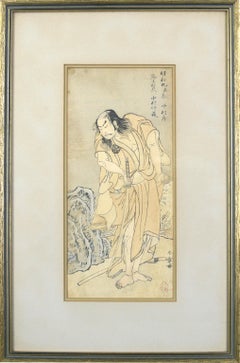
Actor as Samurai - 18th Century Japanese Woodblock Print
By Katsukawa Shunshō
Located in Soquel, CA
Actor as Samurai - 18th Century Japanese Woodblock Print
Woodblock print depicting an actor, possibly Nakamura Denkuro II, as a samurai. The actor stands with his sword unsheathed a...
Category
Late 18th Century Edo Joseph Domjan Landscape Prints
Materials
Woodcut, Rice Paper
$750
H 19 in W 12.5 in D 0.63 in
Previously Available Items
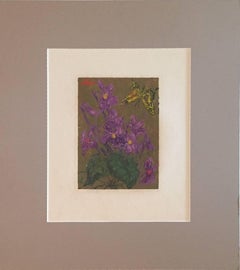
Violets
By Joseph Domjan
Located in Surfside, FL
Born in Budapest in 1907, he had a humble upbringing and a passion for the arts. Shortly after the Hungarian Revolution broke out in 1956, Domján was invited to showcase his work in New York; given both the circumstances and opportunities, he readily accepted. Eventually, with his wife and children, he settled in Tuxedo Park. Here, he established the Domján Studio and where lived until his passing in 1992. In his early years, and during the Great Depression, Domján toured Europe with the desire to be engulfed by art. Previously, much of his time had been consumed with the work of both an engine fitter and foundry worker. After testing the waters of over 20 different professions, he discovered his passion in the arts. Later, during his European tour, he earned his way by selling a variety of works including both paintings and sketches. Post-depression, he returned to Hungry where he studied seven years at the Budapest Academy of Arts.
Having spent an earlier portion of his life as a painter, Domján created his first woodcut in 1947 by using oil paint as opposed to printer’s ink. The result was stunning. This technique, becoming his signature style, would later set him apart from others within the trade. To create his pieces, Domján applied rich color, layer by layer, and lays claim to having “succeeded in bringing to the world something that had not existed before.”
Ultimately, each print became three dimensional and gave the appearance of a painting. His technique has gained him international merit as well as the honor of receiving China’s “Master of the Color Wooodcut” award, a recognition given only once every century. The inspiration behind many of Domján’s woodcuts, coupled with his love of nature, is derived from Hungary’s brilliant folklore. The intricacy of his design is certainly his prominent element; however, their subtle coloring and abstract images contribute to his
unique style.
For the 59th Anniversary of composer Béla Bartók’s opera, Duke Bluebeard’s Castle, Domján used the opera’s profound imagery to create a series of woodcuts. The work included an ominous castle, coiled snakes, smirking masks, elusive zodiac symbols, and the story’s forbidden key. In doing so, Domján was able to weave traditional folklore components into a fantastic piece of modernized art. His work is not only expressive of Hungarian folklore...
Category
20th Century Joseph Domjan Landscape Prints
Materials
Wood, Mixed Media, Woodcut
Bird
Young
By Joseph Domjan
Located in Surfside, FL
Born in Budapest in 1907, he had a humble upbringing and a passion for the arts. Shortly after the Hungarian Revolution broke out in 1956, Domján was invited to showcase his work in New York; given both the circumstances and opportunities, he readily accepted. Eventually, with his wife and children, he settled in Tuxedo Park. Here, he established the Domján Studio and where lived until his passing in 1992. In his early years, and during the Great Depression, Domján toured Europe with the desire to be engulfed by art. Previously, much of his time had been consumed with the work of both an engine fitter and foundry worker. After testing the waters of over 20 different professions, he discovered his passion in the arts. Later, during his European tour, he earned his way by selling a variety of works including both paintings and sketches. Post-depression, he returned to Hungry where he studied seven years at the Budapest Academy of Arts.
Having spent an earlier portion of his life as a painter, Domján created his first woodcut in 1947 by using oil paint as opposed to printer’s ink. The result was stunning. This technique, becoming his signature style, would later set him apart from others within the trade. To create his pieces, Domján applied rich color, layer by layer, and lays claim to having “succeeded in bringing to the world something that had not existed before.”
Ultimately, each print became three dimensional and gave the appearance of a painting. His technique has gained him international merit as well as the honor of receiving China’s “Master of the Color Wooodcut” award, a recognition given only once every century. The inspiration behind many of Domján’s woodcuts, coupled with his love of nature, is derived from Hungary’s brilliant folklore. The intricacy of his design is certainly his prominent element; however, their subtle coloring and abstract images contribute to his
unique style.
For the 59th Anniversary of composer Béla Bartók’s opera, Duke Bluebeard’s Castle, Domján used the opera’s profound imagery to create a series of woodcuts. The work included an ominous castle, coiled snakes, smirking masks, elusive zodiac symbols, and the story’s forbidden key. In doing so, Domján was able to weave traditional folklore components into a fantastic piece of modernized art. His work is not only expressive of Hungarian folklore...
Category
20th Century Joseph Domjan Landscape Prints
Materials
Mixed Media, Wood Panel
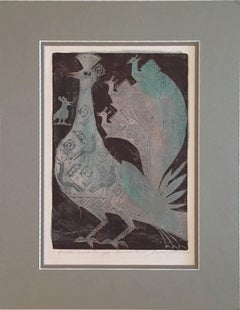
Bird
Young
By Joseph Domjan
Located in Surfside, FL
Born in Budapest in 1907, he had a humble upbringing and a passion for the arts. Shortly after the Hungarian Revolution broke out in 1956, Domján was invited to showcase his work in...
Category
20th Century Joseph Domjan Landscape Prints
Materials
Mixed Media, Wood Panel
Violets
By Joseph Domjan
Located in Surfside, FL
Born in Budapest in 1907, he had a humble upbringing and a passion for the arts. Shortly after the Hungarian Revolution broke out in 1956, Domján was invited to showcase his work in...
Category
20th Century Joseph Domjan Landscape Prints
Materials
Mixed Media, Wood, Woodcut
Joseph Domjan landscape prints for sale on 1stDibs.
Find a wide variety of authentic Joseph Domjan landscape prints available for sale on 1stDibs. You can also browse by medium to find art by Joseph Domjan in mixed media, panel, wood panel and more. Not every interior allows for large Joseph Domjan landscape prints, so small editions measuring 17 inches across are available. Customers who are interested in this artist might also find the work of Reuven Rubin, David Klein, and Charles Lapicque. Joseph Domjan landscape prints prices can differ depending upon medium, time period and other attributes. On 1stDibs, the price for these items starts at $1,200 and tops out at $1,200, while the average work can sell for $1,200.