Joseph-Emmanuel Zwiener Musical Instruments
French, 1848-1895

The 19th-century German cabinetmaker Joseph-Emmanuel Zwiener rose to prominence for his beautiful reproductions of Louis XV furniture in the Rococo style. The influence of the Art Nouveau movement can be seen in Zwiener's work as well, and his ornate cabinets, gilded writing desks and exquisitely detailed chests of drawers are just some of the many examples of his mastery of furniture design.

Zwiener was born in Herdon, Germany, around 1848. By 1880, he had moved to Paris and established a workshop on the Rue de la Roquette. Zwiener was quick to earn esteem among the European nobility as a producer of fine furniture. In 1884, he created a replica of the famous Bureau du Roi roll-top desk for King Ludwig II of Bavaria. He also partnered with famed French sculptor Léon Messagé, whose gorgeous designs are credited with helping Zwiener win the gold medal at the 1889 Paris Exposition Universelle.

In 1895, Zwiener returned to Berlin after securing a commission from Wilhelm II. His workshop was taken over by cabinetmaker François Linke. Linke's style was similar to Zwiener's. Linke also continued to work with Messagé, preserving the workshop's tradition of exceptional craftsmanship.

In Germany, Wilhelm II was eager to showcase the talents of German furniture makers to the world. He tasked Zwiener with producing an extensive suite of furniture for his royal palaces. The furniture was exhibited at the German Pavilion during the 1900 Paris Exposition Universelle. Later, many of the pieces followed Wilhelm II to his manor house, Huis Doorn, in the Netherlands, where he lived in exile.

Over his career, Zwiener also produced furniture for elite international clients like New York art collector Charles Tyson Yerkes and French author Baroness Hélène van Zuylen of the Rothschild banking family.

On 1stDibs, find antique Joseph-Emmanuel Zwiener case pieces, tables, wall decorations and more.

to
1
1
1
1
1
1
1
1
1
1
1
1
1
14
21
19
12
12
Creator: Joseph-Emmanuel Zwiener
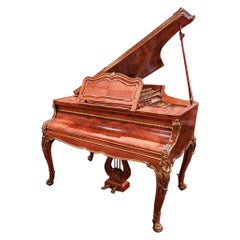
A very fine 19th century Grand Piano by Joseph Emmanuel Zwiener
By Joseph-Emmanuel Zwiener
Located in Dallas, TX
A magnificent French 19th century Louis XV designed marquetry kingwood Grand Piano . Signed in the bronze by Joseph Zwiener. The finest gilt bronze mounts. 6 legs . The piano works b...
Category

Late 19th Century French Belle Époque Antique Joseph-Emmanuel Zwiener Musical Instruments

Materials

Bronze

Related Items
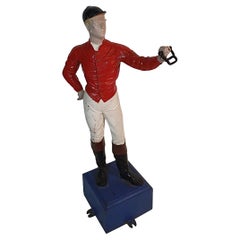
Very Rare 19th Century Cast Iron Jockey Hitching Post
Located in Dublin, IE
A very rare 19th century cast iron equine hitching post in the form of a jock-ey. The jockey is classically dressed in the 19th century riding attire, com-prising of a black riding hat, red jacket and cream jodhpurs. The jockey is poised on a moulded blue plinth...
Category

19th Century English Antique Joseph-Emmanuel Zwiener Musical Instruments

Materials

Iron

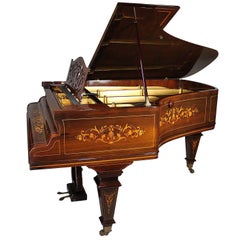
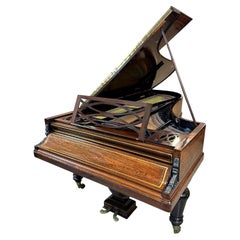
19th Century Louis XIV Style Marquetry Baby Grand Piano by Collard Collard
By Collard Collard
Located in Los Angeles, CA
A very fine Anglo-French 19th century rosewood, palisander, amboyna and satinwood marquetry (inlaid) art-case baby grand piano, the works by "Collard & Collard". The intricately deco...
Category

Late 19th Century English Neoclassical Revival Antique Joseph-Emmanuel Zwiener Musical Instruments

Materials

Bronze

19th Century Louis XIV Style Marquetry Baby Grand Piano by Collard 
Collard
19th Century Louis XIV Style Marquetry Baby Grand Piano by Collard 
Collard
$75,600 Sale Price
20% Off
H 40.25 in W 72 in D 55.5 in
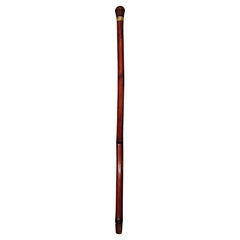
A Very Rare 19th Century Gadget Walking Cane with Brass Telescope
Located in Dublin, IE
A very rare 19th Century well figured gadget walking cane with a hidden brass telescope. This exceptional item is stamped with the Manchester Reg...
Category

19th Century English Antique Joseph-Emmanuel Zwiener Musical Instruments

Materials

Brass

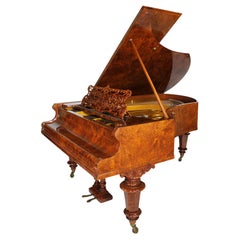
A German 19th Century Louis XVI Style Burr Walnut Bechstein Concert Grand Piano
By Bechstein Piano Company
Located in Los Angeles, CA
A Very Fine German 19th Century Louis XVI Style Burr Walnut Bechstein Concert Grand Piano, Serial No. 5655. The beautifully crafted Grand piano, raised on three tapered barrel shaped legs, with an intricately carved ornate music desk and original keys. Circa: 1872. Length: 80 inches (203.2 cm) Width: 59 inches: (149.9 cm) Height (top closed): 38 5/8 inches (98.1 cm) C. Bechstein Pianofortefabrik C. Bechstein Pianofortefabrik AG (also known as Bechstein) is a German manufacturer of pianos, established in 1853 by Carl Bechstein. Before Bechstein Young Carl Bechstein studied and worked in France and England as a piano craftsman, before he became an independent piano maker. His first pianos were made for other companies. C. Bechstein C. Bechstein piano factory was founded on 1 October 1853 by Carl Bechstein in Berlin, Germany. Carl Bechstein set out to manufacture a piano able to withstand the great demands imposed on the instrument by the virtuosi of the time, such as Franz Liszt. In 1857, Hans von Bülow (Liszt's son-in-law) gave the first public performance on a Bechstein grand piano by performing Liszt's Piano Sonata in B minor in Berlin By 1870, with endorsements from Franz Liszt and Hans von Bülow, Bechstein pianos had become a staple in many concert halls and private mansions. By that time three piano makers, all of which were founded in 1853, became established as the industry leaders across the world: Bechstein, Blüthner and Steinway & Sons. In 1881 Bechstein began supplying pianos to Queen Victoria. A gilded art-case piano was delivered to Buckingham Palace, followed by several more Bechstein pianos to Windsor Castle and other royal residences. By January 1886 they were among the piano manufacturers holding a Royal Warrant as a supplier to the Queen. Several British embassies across the world acquired Bechstein pianos. In 1885, Bechstein opened a branch in London, that eventually grew to become the largest showroom and dealership in Europe. By 1890 showrooms had been opened in Paris, Vienna, and Saint Petersburg. On 31 May 1901, Bechstein Hall, built at a cost of £100,000, was opened next to the company's London showroom at 36-40 Wigmore Street. Between 1901 and 1914, C. Bechstein was the largest piano dealership in London. At that time, Bechstein was patronized by the tsars of Russia, the royal families of Spain, Belgium, the Netherlands, Italy, Sweden, Norway, Austria and Denmark, and other royalty and aristocracy. The list of royal clients of Bechstein may be found on the soundboard of vintage Bechstein pianos made before the Second World War. The list is part of the original Bechstein trademark logo; it can be seen under the strings in the center of a piano's soundboard. The signature of Carl Bechstein The years from the 1870s through 1914 brought Bechstein their most dramatic increase in sales. In 1880 a second Bechstein factory was opened in Berlin, and the third factory was opened in 1897 in Berlin-Kreuzberg. Production reached 3,700 pianos annually in 1900, and 4,600 in 1910, making Bechstein the largest German manufacturer of high-end pianos. At that time, about three quarters of production went to international markets, especially Britain and the Commonwealth, and Russia. Carl Bechstein died in 1900, and the Bechstein company continued to operate under the management of his sons. Between 1900 and 1914 C. Bechstein was one of the leading piano makers in the world, employing 1,200 craftsmen and workers by 1913 and making five thousand pianos per year. First World War C. Bechstein suffered huge property losses in London, Paris, and St. Petersburg during World War I. The largest loss was in London. Although the company's position in the United Kingdom was initially unaffected, with the company still listed as holding a Royal Warrant in January 1915, Warrants to both King George V, and his wife Queen Mary were cancelled on 13 April 1915. Bechstein was not the only musical concern to be affected by growing anti-German sentiment: there were earlier attempts, led by William Boosey, to boycott German music altogether. In 1915, despite being a Baronet and Privy Counsellor, Sir Edgar Speyer, who was then funding the Proms, was forced to leave the country. Following the passing of the Trading with the Enemy Amendment Act 1916 the British arm of the company was wound-up on 5 June 1916, all Bechstein property, including the concert hall and showrooms full of pianos, were seized as "enemy property" and closed. In 1916 the hall was sold as alien property at auction to Debenhams for £56,500. It was renamed Wigmore Hall, and then re-opened under the new name in 1917. All 137 Bechstein pianos at the Bechstein showrooms were confiscated too, and became property of the new owner of the Hall. After a dispute with his brother, Edwin Bechstein left the company and was paid off. Eventually the Bechstein factory resumed full-scale production during the 1920s. At that time, technical innovations and inventions of new materials and tools, as well as improvements in piano design and construction, had allowed Bechstein to become one of the leading piano makers again. The most successful models were the updated "A"-185 and "B"-208 grand pianos. The upright pianos became more popular after the war, and C. Bechstein were successful with its upright pianos Model-8 and Model-9, both of which have been considered the finest upright pianos. As the company was changed into a joint-stock company 1923, Edwin Bechstein and his wife Helene, bought themselves back into the company as shareholders. In 1930 the company collaborated with German electrical goods manufacturer Siemens under Nobel laureate Walther Nernst to produce one of the first electric pianos...
Category

19th Century German Louis XVI Antique Joseph-Emmanuel Zwiener Musical Instruments

Materials

Bronze

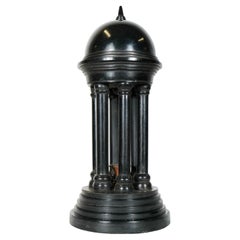
Wooden Roman temple. Grand Tour 19th c.
Located in Stockholm, SE
Grand Tour Roman Temple Souvenir – A Timeless Masterpiece in Blackened Wood. Transport yourself to the grandeur of classical antiquity with this exquisite Grand Tour Roman Temple So...
Category

19th Century Italian Grand Tour Antique Joseph-Emmanuel Zwiener Musical Instruments

Materials

Wood

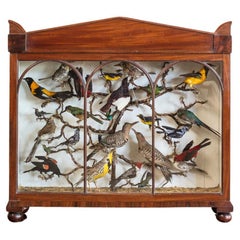
Fine Example of Aviary Taxidermy, Late 19th Century
Located in London, GB
The group consisting of twenty six exotic species of bird, displaying vivad plumage, enclosed in its original glazed mahogany case. Additional information: Dimension: Height 86 cm, ...
Category

Late 19th Century Antique Joseph-Emmanuel Zwiener Musical Instruments

Fine Example of Aviary Taxidermy, Late 19th Century
$6,560
H 33.86 in W 37.01 in D 9.26 in
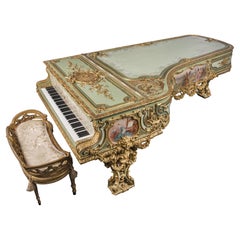
Steinway Sons Concert Grand Piano
Located in SAINT-OUEN-SUR-SEINE, FR
This extraordinary concert grand piano with 88 keys was made by the prestigious firm Steinway & Sons around 1894. The case's decoration was entrust...
Category

Late 19th Century French Louis XV Antique Joseph-Emmanuel Zwiener Musical Instruments

Materials

Wood, Giltwood

Steinway 
Sons Concert Grand Piano
Steinway 
Sons Concert Grand Piano
$1,458,498
H 42.92 in W 108.27 in D 61.03 in
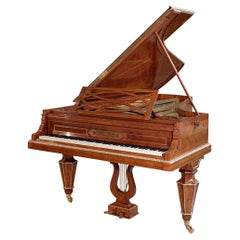
French Mid-19th Century Concert Grand Piano Signed Pleyel
By Pleyel
Located in West Palm Beach, FL
A spectacular French mid-19th century, circa 1855, Louis XVI st. tulipwood parquetry and ormolu mounted, Model 2 Concert Grand Piano, signed Pleyel...
Category

19th Century French Louis XVI Antique Joseph-Emmanuel Zwiener Musical Instruments

Materials

Ormolu

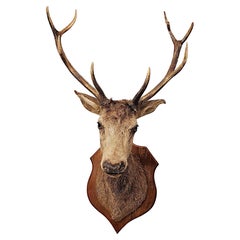
A Very Fine Large 20th Century Taxidermy Stags Head
Located in Dublin, IE
A very fine 20th Century beautifully detailed taxidermy stags head of large proportions mounted on a well figured oak shield plaque.
Category

20th Century English Joseph-Emmanuel Zwiener Musical Instruments

Materials

Oak

A Very Rare 19th Century Walking Cane with Watercolours and Brushes
Located in Dublin, IE
A very rare 19th Century well figured gadget walking cane with a built in painters mixing vial, watercolour palette and brushes. This exceptional...
Category

19th Century English Antique Joseph-Emmanuel Zwiener Musical Instruments

Materials

Brass

Pleyel Grand Piano, Paris 1870
By Pleyel
Located in Littleton, CO
This Pleyel concert grand piano crafted in Paris in 1870 is a timeless masterpiece that embodies the elegance and craftsmanship of 19th-century French piano manufacturing. Pleyel instruments are renowned for their exceptional quality and rich musicality, representing the pinnacle of piano design in the Romantic era, and this piano – an early example of the technological innovation of cross-stringing that was burgeoning during the period – is one in a series of only six ever produced. This piano is in extraordinarily immaculate condition with nearly every original part, including the soundboard, pristine ivory keys, and the brass inlay in its beautifully figured walnut cabinet. Candle stands slide forward on either side of the collapsable music desk. This piano was first purchased by the French Count Charles Étienne Gustave Le Clerc, count of Juigné (1825-1900), one of the wealthiest landowners in Brittany and a member of the French National Assembly, later a member of the House of Representatives, and in late life, the Senate. The piano was restored in 1997 at Maison Erard by master restorationist Frits Janmaat in Amsterdam, and later conditioned by Edwin Beunk. In recent years, some of Europe's finest historically-informed musical artists played this Pleyel in PBS concert performances in collaboration with the late Sergiu Luca. Standing on substantial carved legs and brass wheels, the piano exudes a majestic presence through the graceful lines of its Second Empire style cabinet that embodies the period's aesthetics. The keyboard, meticulously crafted from ivory and ebony, is a testament to the attention to detail in every aspect. Its 85 keys...
Category

17th Century French Romantic Antique Joseph-Emmanuel Zwiener Musical Instruments

Materials

Walnut

Pleyel Grand Piano, Paris 1870
$125,000
H 38.5 in W 54.5 in D 103.25 in
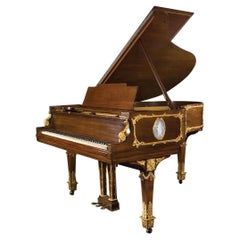
Fine Steinway Sons Wedgwood Ormolu Mounted Mahogany Baby Grand Piano Model M
By Steinway Sons
Located in Roslyn, NY
Steinway & Sons Ormolu Mounted Mahogany Baby Grand Piano Model M, serial no. 244684, circa 1926 With Wedgwood Light Blue Jasperware / Wedgwood Framed Ov...
Category

20th Century American Regency Joseph-Emmanuel Zwiener Musical Instruments

Materials

Bronze, Ormolu

Fine Steinway 
Sons Wedgwood Ormolu Mounted Mahogany Baby Grand Piano Model M
Fine Steinway 
Sons Wedgwood Ormolu Mounted Mahogany Baby Grand Piano Model M
$50,000 Sale Price
23% Off
H 39.5 in W 56 in D 65.5 in

Joseph-emmanuel Zwiener musical instruments for sale on 1stDibs.

Joseph-Emmanuel Zwiener musical instruments are available for sale on 1stDibs.

Still Thinking About These?

All Recently Viewed