Joseph Stella Landscape Drawings and Watercolors

American, Italian, 1877-1946

Joseph Stella was a visionary artist who painted what he saw, an idiosyncratic and individual experience of his time and place. Stella arrived in New York in 1896, part of a wave of Italian immigrants from poverty-stricken Southern Italy. But Stella was not a child of poverty. His father was a notary and respected citizen in Muro Lucano, a small town in the southern Apennines. The five Stella brothers were all properly educated in Naples. Stella’s older brother, Antonio, was the first of the family to come to America. Antonio Stella trained as a physician in Italy, and was a successful and respected doctor in the Italian community centered in Greenwich Village. He sponsored and supported his younger brother, Joseph, first sending him to medical school in New York, then to study pharmacology, and then sustaining him through the early days of his artistic career. Antonio Stella specialized in the treatment of tuberculosis and was active in social reform circles. His connections were instrumental in Joseph Stella’s early commissions for illustrations in reform journals.

Joseph Stella, from the beginning, was an outsider. He was of the Italian-American community, but did not share its overwhelming poverty and general lack of education. He went back to Italy on several occasions, but was no longer an Italian. His art incorporated many influences. At various times his work echoed the concerns and techniques of the so-called Ashcan School, of New York Dada, of Futurism and, of Cubism, among others. These are all legitimate influences, but Stella never totally committed himself to any group. He was a convivial, but ultimately solitary figure, with a lifelong mistrust of any authority external to his own personal mandate. He was in Europe during the time that Alfred Stieglitz established his 291 Gallery. When Stella returned he joined the international coterie of artists who gathered at the West Side apartment of the art patron Conrad Arensberg. It was here that Stella became close friends with Marcel Duchamp.

Stella was 19 when he arrived in America and studied in the early years of the century at the Art Students League, and with William Merritt Chase, under whose tutelage he received rigorous training as a draftsman. His love of line, and his mastery of its techniques, is apparent early in his career in the illustrations he made for various social reform journals. Stella, whose later work as a colorist is breathtakingly lush, never felt obliged to choose between line and color. He drew throughout his career, and unlike other modernists, whose work evolved inexorably to more and more abstract form, Stella freely reverted to earlier realist modes of representation whenever it suited him. This was because, in fact, his “realist” work was not “true to nature,” but true to Stella’s own unique interpretation. Stella began to draw flowers, vegetables, butterflies, and birds in 1919, after he had finished the Brooklyn Bridge series of paintings, which are probably his best-known works. These drawings of flora and fauna were initially coincidental with his fantastical, nostalgic and spiritual vision of his native Italy which he called Tree of My Life (Mr. and Mrs. Barney A. Ebsworth Foundation and Windsor, Inc., St. Louis, illus. in Barbara Haskell, Joseph Stella, exh. cat. [New York: Whitney Museum of American Art, 1994], p. 111 no. 133).

(Biography provided by Hirschl Adler)

to
2
Overall Width
to
Overall Height
to
2
1
2
1
1
2
1
1
2
1
1
1
1
32
331
140
123
66
2
2
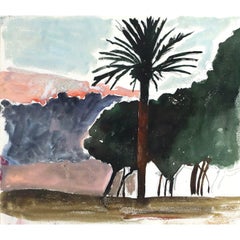
Artist: Joseph Stella
Exhibited American Modernist painting titled Tropical Scene
By Joseph Stella
Located in Colfax, CA
An exhibited American watercolor by Italian-born American modernist Joseph Stella. Stella is widely recognized for his futurist and precisionist contributions to American modern art...
Category

1930s American Modern Joseph Stella Landscape Drawings and Watercolors

Materials

Paper, Watercolor

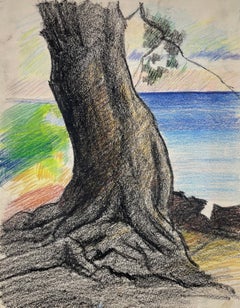
Untitled (Tree Trunks)
By Joseph Stella
Located in Bryn Mawr, PA
Untitled (Tree Trunks) Pastel on paper, 12 x 9 1/4 inches (30.5 x 23.5 cm) Framed dimensions: 15 1/4 x 12 3/4 inches Inscribed on verso of overmat: 148 W. Houston St. Joseph Stella’...
Category

20th Century American Modern Joseph Stella Landscape Drawings and Watercolors

Materials

Paper, Pastel

Related Items
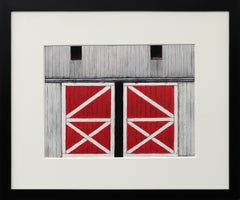
George Vander Sluis Mid-Century Modern Barn Landscape Oil Stick on Paper
Located in Denver, CO
This original mid-20th-century oil stick on paper by acclaimed American modernist George Vander Sluis (1915–1984), titled Barn Side with Sliding Do...
Category

1980s American Modern Joseph Stella Landscape Drawings and Watercolors

Materials

Paper, Oil Pastel

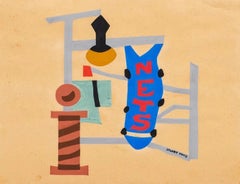
"NY Street Signs" Mid-20th Century WPA 1938 Modernist Abstract Realism Pop Art
By Stuart Davis
Located in New York, NY
"NY Street Signs" Mid-20th Century WPA 1938 Modernist Abstract Realism Pop Art Stuart Davis (American, 1892-1964) "Street Signs" Modernist gouache and traces of pencil on paper in the proto-pop art style Davis is celebrated for, 1938, signed to lower right, framed. Image: 11 1/4 x 15 1/4 inches. Frame by Bark: 18 1/2 x 22 inches. LITERATURE: A, Boyajian, M. Rutkowski, Stuart Davis, A Catalogue Raisonne, Vol. 2, New Haven, Connecticut, 2007, vol. II, p. 632, no. 1232, illustrated. EXHIBITIONS: ACA Galleries, New York American Artists' Congress: Group Exhibition of Paintings and Sculpture, Dec. 3-16, 1939 (SDAB I, 12/3/39, p. 129). Outlines Gallery, Pittsburgh, Stuart Davis, Mar. 3-16, 1946. Coleman Art Gallery, Philadelphia, 5 Prodigal Sons: Former Philadelphia Artists: Ralston Crawford, Stuart Davis, Charles Demuth, Julian Levi, Charles Sheeler, Oct 4 - 30, 1947 (pamphlet), no. 12. PROVENANCE: The artist; Mr. and Mrs. Frank Bowles, New York, Apr. 3, 1956; thence by descent, Private Collection, New York. NOTES: According to the Catalogue Raissonne, "the title 'Street Signs' is recorded in the artist's account books...
Category

1930s American Modern Joseph Stella Landscape Drawings and Watercolors

Materials

Paper, Gouache, Pencil

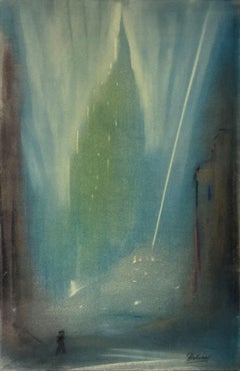
"Empire State Building" Leon Dolice, New York City Street Scene, Mid-Century
By Leon Dolice
Located in New York, NY
Leon Dolice Empire State Building Signed lower right Watercolor on paper 19 x 12 inches The romantic backdrop of Vienna at the turn of the century had a life-long influence upon th...
Category

1930s American Modern Joseph Stella Landscape Drawings and Watercolors

Materials

Paper, Pastel

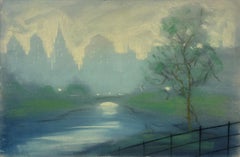
"Central Park" Leon Dolice, New York Central Park Scene, Mid-Century
By Leon Dolice
Located in New York, NY
Leon Dolice Central Park Signed lower left Watercolor on paper 12 x 19 inches The romantic backdrop of Vienna at the turn of the century had a life-long influence upon the young ma...
Category

1930s American Modern Joseph Stella Landscape Drawings and Watercolors

Materials

Paper, Pastel

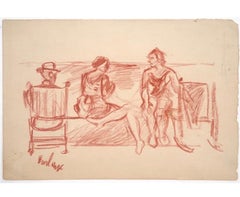
Modernist Conte Crayon Drawing Beach Scene David Burliuk Russian Futurist
By David Burliuk
Located in Surfside, FL
David Burliuk (Ukrainian, 1882-1967) Three figure on the beach (Hamptons, Long Island New York) Conte crayon drawing on paper. Hand signed lower left. Unframed Provenance: Bloomsbury Auctions David Davidovich Burliuk (Дави́д Дави́дович Бурлю́к; 1882-1967) was a Russian poet, artist and publicist of Ukrainian origin associated with the Futurist and Neo-Primitivist movements. Burliuk has been described as "the father of Russian Futurism." David Burliuk was born on 21 July 1882 in the village of Riabushky (near Lebedyn, Ukraine) in the Kharkov Governorate of the Russian Empire. Burliuk's family was artistically inclined; two of his brothers were talented artists as well, Nikolai and Volodimir Burliuk. The Burliuk family partly descended from Ukrainian Cossacks on their father's side, who held premier positions in the Hetmanate. His mother, Ludmyla Mikhnevich, was of ethnic Belarusian descent. From 1898 to 1904, he studied at Kazan and Odesa art schools, as well as at the Royal Academy in Munich. His exuberant, extroverted character was recognized by Anton Azhbe, his professor at the Munich Academy, who called Burliuk a "wonderful wild steppe horse". During a time of significant industrialization and political change, movements such as the famed Der Blaue Reiter, a group Burliuk associated with in 1912, while he was in Munich, emphasized a shift away from the classical styles of the past, prioritizing the innovations of the future. In 1907, he made contact with the Russian art world; he met and befriended Mikhail Larionov, and they are both credited as being major forces in bringing together the contemporary art world. In 1908, an exhibition with the group Zveno ("The Link") in Kiev was organized by David Burliuk together with Wladimir Baranoff-Rossine, Alexander Bogomazov, his brother Volodymyr (Wladimir) Burliuk and Aleksandra Exter. The exhibition was a flop, especially because they were all unknown painters. The Burliuks and Larionov left for the aforementioned brothers' home in Chernianka, also known as Hylea; it was during this stay that their work became more Avant-Garde. That autumn, while visiting Ekster, they organized an exhibition which took place in the street; it was a success, and enough money was raised to go to Moscow. In 1909, Burliuk painted a portrait of his future wife, Marussia, on a background of flowers and rocks...
Category

Mid-20th Century American Modern Joseph Stella Landscape Drawings and Watercolors

Materials

Paper, Conté, Crayon

"Chrysler Building" Leon Dolice, New York City Street Scene, Mid-Century
By Leon Dolice
Located in New York, NY
Leon Dolice Chrysler Building Signed lower right Watercolor on paper 19 x 12 inches The romantic backdrop of Vienna at the turn of the century had a life-long influence upon the yo...
Category

1930s American Modern Joseph Stella Landscape Drawings and Watercolors

Materials

Paper, Pastel

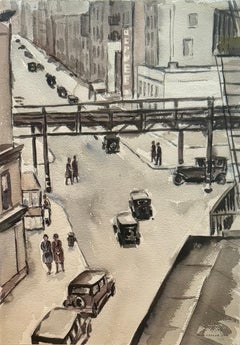
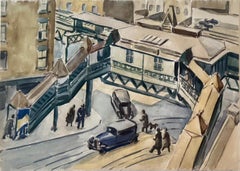
"6th Avenue El" American Scene Social Realism Mid-20th Century Cityscape Modern
By Max Arthur Cohn
Located in New York, NY
"6th Avenue El" American Scene Social Realism Mid-20th Century Cityscape Modern Max Arthur Cohn (1903-1998) 6th Avenue Elevated 19 1/4 x 13 3/4 inches Watercolor on paper Signed an...
Category

1920s American Modern Joseph Stella Landscape Drawings and Watercolors

Materials

Paper, Watercolor

6th Avenue El at 8th St NYC Cityscape American Scene Social Realism Mid-Century
By Max Arthur Cohn
Located in New York, NY
6th Avenue El at 8th St NYC Cityscape American Scene Social Realism Mid-Century Max Arthur Cohn (1903-1998) 6th Avenue El at 8th Street 13 x 18 inches Watercolor on paper, c. 1930 ...
Category

1930s American Modern Joseph Stella Landscape Drawings and Watercolors

Materials

Paper, Watercolor

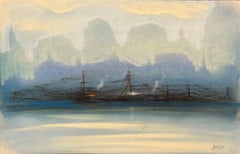
"New York Harbor Nocturne" Leon Dolice, Mid-Century New York Nocturnal Landscape
By Leon Dolice
Located in New York, NY
Leon Dolice New York Harbor Nocturne, circa 1930-40 Signed lower right Pastel on paper 12 x 19 inches The romantic backdrop of Vienna at the turn of the century had a life-long inf...
Category

1930s American Modern Joseph Stella Landscape Drawings and Watercolors

Materials

Paper, Pastel

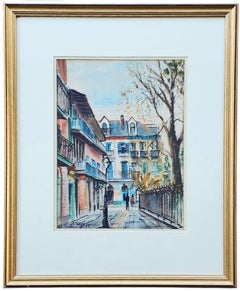
Pirate s Alley, French Quarter, New Orleans
Located in Grand Rapids, MI
Nestor Hippoyle Fruge (American, 1914/16 - 2011/12) Signed: N Fruge 51 (Lower, Left) " Pirate's Alley, French Quarter ," 1951 (New Orleans) Watercolo...
Category

Mid-20th Century American Modern Joseph Stella Landscape Drawings and Watercolors

Materials

Paper, Watercolor

Watercolor Painting American Modern Painting Bridge Harbor Female Artist 1950
Located in Buffalo, NY
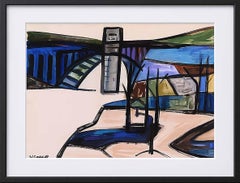
Dorothy Rivo Untitled (Bridge Tower), c. 1960s–70s Acrylic on paper, floated in a mat Framed dimensions: 30 in. H × 24 in. W Contemporary walnut or black wood frame with white archiv...
Category

1940s American Modern Joseph Stella Landscape Drawings and Watercolors

Materials

Archival Ink, Watercolor, Archival Paper, Acrylic
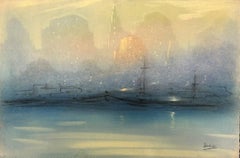
"New York Harbor Nocturne" Leon Dolice, Mid-Century New York Nocturnal Landscape
By Leon Dolice
Located in New York, NY
Leon Dolice New York Harbor Nocturne Signed lower right Pastel on paper 12 x 19 inches The romantic backdrop of Vienna at the turn of the century had a life-long influence upon the...
Category

1930s American Modern Joseph Stella Landscape Drawings and Watercolors

Materials

Paper, Pastel

Joseph Stella landscape drawings and watercolors for sale on 1stDibs.

Find a wide variety of authentic Joseph Stella landscape drawings and watercolors available for sale on 1stDibs.
Questions About Joseph Stella Landscape Drawings and Watercolors
  • 1stDibs ExpertOctober 15, 2024
    Joseph Stella is known for his work as an artist. He was a visionary artist who painted what he saw: an idiosyncratic and individual experience of his time and place. Stella was 19 when he arrived in the United States and studied in the early years of the century at the Art Students League and with William Merritt Chase, under whose tutelage he received rigorous training as a draftsman. His love of line and his mastery of its techniques are apparent in his early illustrations for various social reform journals. Stella, whose later work as a colorist is breathtakingly lush, never felt obliged to choose between line and color. He drew throughout his career, and unlike other modernists, whose work evolved to more and more abstract forms, Stella freely reverted to earlier realist modes of representation whenever it suited him. Some of his most famous works include Battle of Lights, Coney Island, Mardi Gras; The Brooklyn Bridge: Variation on an Old Theme and Flowers, Italy. Shop a selection of Joseph Stella art on 1stDibs.
  • 1stDibs ExpertAugust 29, 2024
    No, Frank Stella was not related to Joseph Stella. While it's possible that in-depth genealogical research may uncover a shared ancestor many generations ago, the two artists are not currently believed to be related. Joseph Stella was born in 1877 in Muro Lucano, Italy, while Frank Stella was born in 1936 in Malden, Massachusetts. On 1stDibs, shop a diverse assortment of Frank Stella and Joseph Stella art.
  • 1stDibs ExpertAugust 29, 2024
    Opinions differ about what kind of artist Joseph Stella was. At various times, his work echoed the concerns and techniques of the so-called Ashcan School, New York Dada, Futurism and Cubism, among others. These are all legitimate influences, but Stella never totally committed himself to any group. Some people also associate him with the American Precisionist movement, which emerged after World War I and explored industrialization and urbanization themes. Shop a diverse assortment of Joseph Stella art on 1stDibs.
  • 1stDibs ExpertAugust 29, 2024
    Joseph Stella first painted the Brooklyn Bridge in 1918. He actually returned to the subject numerous times, completing additional paintings of the landmark in 1918, 1920, 1939 and 1941. Examining these paintings side by side shows how Stella's style became more and more abstract over the course of his career. Explore an assortment of Joseph Stella art on 1stDibs.

Still Thinking About These?

All Recently Viewed