Joshua Shaw Figurative Paintings

British, 1776-1860

Joshua Shaw was a farmer’s son, born in Billingborough, Lincolnshire, and orphaned at the age of seven. After a boyhood of privation, he tried a number of occupations, until he finally apprenticed to a sign painter and found his métier. Shaw went to Manchester to study art, and by 1802 was in Bath, painting landscapes. In that year he began to exhibit his work at the Royal Academy in London. Essentially self-taught, Shaw achieved an impressive level of competence and versatility, producing portraits, floral compositions, still lifes, landscapes and cattle pieces. Shaw continued to send works for exhibition at the Royal Academy, the British Institution, and the Suffolk Street Gallery, all in London, until 1841. (Although Shaw is regularly mentioned and frequently illustrated in a host of general books on American art history, as well as included in numerous historical survey exhibitions, the only monographic study of this artist is Miriam Carroll Woods, “Joshua Shaw [1776–1860]: A Study of the Artist and his Paintings” [M.A. thesis, University of California at Los Angeles, 1971]. Apart from short biographical sketches in various dictionaries and museum collection catalogues, the two most interesting references — both contemporary — are John Sartain’s personal recollections in The Reminiscences of a Very Old Man, 1808–1897 [1899; reprint 1969] and an article in Scientific American from August 7, 1869, “Joshua Shaw, Artist and Inventor.” The article quotes extensively from an autobiographical document in the possession of Shaw’s grandson that Shaw prepared for William Dunlap when Dunlap was collecting data for his History of the Rise and Progress of the Arts of Design in the United States [1834].)

Shaw was determined to succeed, and London defined success. By 1813, Shaw had moved from Bath, where he enjoyed considerable local esteem to the capital city. In that year he showed his ambitious The Deluge, towards Its Close at the British Institution, where it attracted favorable critical attention (the painting is now at The Metropolitan Museum of Art, New York, see John Caldwell and Oswaldo Rodriguez Roque, American Paintings in The Metropolitan Museum of Art, Volume I: A Catalogue of Works by Artists Born by 1815 [1994], pp. 273–77, p. 277 illus.). At some point Shaw became acquainted with the famous American expatriate and President of the Royal Academy, Benjamin West. West made Shaw the guardian of his epic canvas, Christ Healing the Sick in the Temple, which he had painted for the Pennsylvania Hospital in Philadelphia. Shaw and the painting sailed on the Electra, arriving in Philadelphia in 1817, where Shaw supervised the unpacking and hanging of West’s munificent gift. Shaw, who was throughout his life both restless and prone to fits of irascibility, decided to leave England behind. He remained in Philadelphia, where his wife joined him in the following year.

Shaw’s first projects in his new country involved traveling and sketching scenic locales for an illustrated travelogue. Picturesque Views of American Scenery was published in Philadelphia in 1819 with engravings by his fellow English immigrant, John Hill (1770–1850). A second illustrated travel book, United States Directory for the Use of Travelers followed in 1822. Shaw was an activist and an organizer and a principal player in a series of art initiatives in Philadelphia. In 1835, he was among the founders of the Artist’s Fund Society, a breakaway group from the Pennsylvania Academy of Art. Two years later, after quarrelling with the Society’s President, John Neagle, he led a dissident group in establishing the Artists’ and Amateurs’ Association. He left that also after a brief time. Shaw’s differences with the Pennsylvania Academy did not keep him from being among its most active exhibitors. Beginning in 1818, Shaw showed over 75 pictures at the Academy, ending two years after his death in 1862.

Shaw was also an early exhibitor at James Herring’s Apollo Gallery in New York City, the forerunner to the American Art-Union. His correspondence with Herring (who had also been, at one time, a Philadelphia artist) offered Shaw an opportunity to complain about the vicissitudes of the artist’s life, including the injuries incurred from destructive critics and the harms inflicted by enemy colleagues. Indeed, a deal of Shaw’s energy was taken up in struggle, and not just in the art world. Like many artists before and since, Shaw was an inventor as well as a fine artist. In his case, he invented an important copper percussion cap for heavy artillery, as well as the glazier’s revolving diamond for cutting curves in glass. According to his own account (as published in the 1869 Scientific American), Shaw invented the percussion cap in 1814 in England, but did nothing with the invention until he came to America. When he attempted to patent his invention, his application was denied on the grounds that he had not met the criteria of having been a resident of the United States for the previous two years. Shaw struggled mightily with the patent system and is credited with later reforms to the law. He was able to patent his percussion cap in 1822, as well as additional firearm improvements in 1828. He was eventually awarded $25,000 by the United States Congress for his invention, of which he received $17,000. This money, although agreed upon, was also not easily extracted from the Federal government and Shaw made numerous trips to Washington, D.C., to advocate for himself. According to Sartain, Shaw received, for his inventions, “a present of a purse of money” from the Czar of Russia. In 1833, Shaw traveled back to England, in an attempt to claim disputed patent rights there. Around this time, he also exhibited paintings at the Royal Society of British Artists.

Despite all of this, Shaw was primarily an artist. He was an Honorary Member of the National Academy of Design, New York, from 1828 until his death in 1860 and exhibited there regularly from 1828 through 1852. (He was “Honorary” because he did not live in New York and therefore was not eligible for regular academician status.) His participation with the Art-Union lasted through 1848 (the Art-Union closed down in 1851). It is clear from the titles of works that Shaw exhibited at these venues that he continued throughout his career to paint English and European subjects as well as American. Shaw remained in Philadelphia until about 1843, when he moved to nearby Bordentown, New Jersey. Bordentown had become something of an artist’s colony due to the presence of Joseph Bonaparte, Napoleon’s brother, and former King of Spain and Sicily, who in 1817 bought the estate, Point Breeze, and built a mansion that included a gallery for his substantial art collection. Although Joseph returned to Europe in 1839 and died there in 1844, his family kept the estate until 1847. Shaw remained in Bordentown for the rest of his life, acquiring a house of his own in 1847. Shaw continued his activity as an artist until 1853, when a stroke put an end to his painting career.

Shaw was a mature artist when he arrived in the United States. His work, according to William H. Gerdts, echoes concerns and themes expressed in the Rococo style of the French artist, François Boucher (1703–1770), as well as the canvases of Philippe de Loutherbourg (1740–1812) who emigrated from the continent to England, the Dutch artist Nicholas Berchem (1620–1683), and English genre artists George Morland (1763–1804) and Julius Caesar Ibbetson (1759–1817), all of whose work Shaw knew from his time in England. Caldwell and Roque (American Paintings in The Metropolitan Museum) also find echoes in Shaw of two mainstays of 18th-century English art, Richard Wilson (1714–1782) and Thomas Gainsborough (1714–1782). All of this is consistent with the methodology of an autodidact whose chief means of education was to observe as closely as he could the techniques and subjects of the leading men of his day. The consequence for this with regard to Shaw’s oeuvre, is that in America, Shaw was very much sui generis, an artist whose style was, in origin, and remained throughout his career, essentially English.

(Biography provided by Hirschl Adler)

to
1
Overall Width
to
Overall Height
to
1
1
1
1
1
1
1
1
1
1
2
467
319
256
229
1
1
Artist: Joshua Shaw
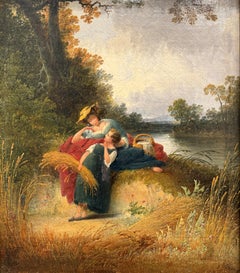
"Summer Picnic by the River" Joshua Shaw, American Atmospheric Genre Painting
By Joshua Shaw
Located in New York, NY
Joshua Shaw Summer Picnic by the River, circa 1840 Signed lower right Oil on canvas 15 1/2 x 13 1/2 inches Born in Bellingborough, Lincolnshire, England, Joshua Shaw became known f...
Category

1840s Academic Joshua Shaw Figurative Paintings

Materials

Canvas, Oil

Related Items
Solothman on the Aase, Switzerland
By Eugene Schmidt
Located in San Francisco, CA
Artist: Eugene Schmidt (German/American, 1919-2007) Title: Solothman on the Aase, Switzerland Year: Circa 1970 Medium: Oil on canvas board Board size: 10 x 8 inches Signature...
Category

Late 20th Century Academic Joshua Shaw Figurative Paintings

Materials

Oil

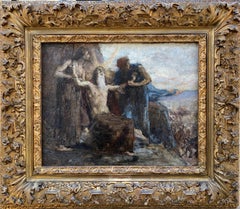
Mythological scene, study for the Prize of Rome 1864, French academism, Homer
Located in Norwich, GB
This rare mythological scene depicting the Greek author Homer on the island of Scyros. You will notice the Trojan War being fought in the background. Our painting, dating from 1864, is unsigned, but has a solid attribution to academic artist Henri-Léopold Lévy...
Category

Mid-19th Century Academic Joshua Shaw Figurative Paintings

Materials

Canvas, Oil

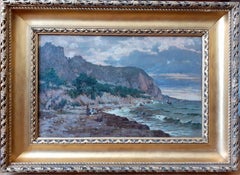
Children on the Beach Marine Landscape French Antique Oil Painting
Located in Norwich, GB
The setting is the French coast, on a tranquil summer's evening. Clouds are drawing in, the sky is turning dusky pink and purple, but there is still time left for play, for the children on the beach...
Category

Early 20th Century Academic Joshua Shaw Figurative Paintings

Materials

Canvas, Oil

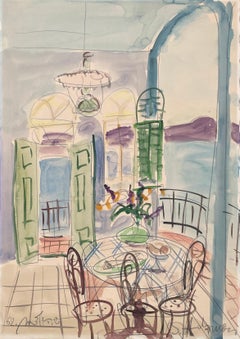
Untitled (Cafe Interior), Shimshon Holzman
By Shimshon Holzman
Located in Fairfield, CT
Artist: Shimshon Holzman (1907-1986) Title: Untitled (Cafe Interior) Year: 1962 Medium: Watercolor and graphite on wove paper Size: 27.75 x 19.75 inches ...
Category

1960s Academic Joshua Shaw Figurative Paintings

Materials

Watercolor, Graphite

Untitled (Cafe Interior), Shimshon Holzman
$2,200 Sale Price
20% Off
H 27.75 in W 19.75 in
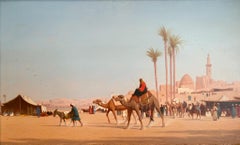
Departure of the Caravan
By Charles Théodore Frère
Located in New York, NY
Departure of the Caravan, 1834-1887, by Theodore Frere (1814-1888) Oil on wood 10 x 16 inches unframed (25.4 x 40.64 cm) 18 ¾ x 24 ¾ inches framed (47.625 x 62.865 cm) Signed on bott...
Category

19th Century Academic Joshua Shaw Figurative Paintings

Materials

Oil

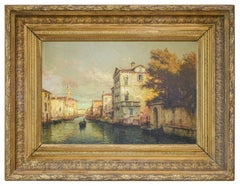
View of Venice canal with bridge
By Antoine Bouvard Snr.
Located in New York, NY
Excellent condition. No restorations. Signed low right.
Category

Early 20th Century Academic Joshua Shaw Figurative Paintings

Materials

Canvas, Oil

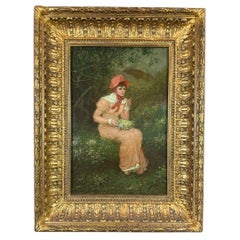
"Meeting in the Woods" 19th Century Antique Oil Painting on Canvas
By George Henry
Located in Jacksonville, FL
The painting is signed. Description: George Henry Boughton: A Master of Narrative and Natural Beauty George Henry Boughton, a distinguished Anglo-American artist of the 19th centur...
Category

18th Century Academic Joshua Shaw Figurative Paintings

Materials

Oil, Canvas

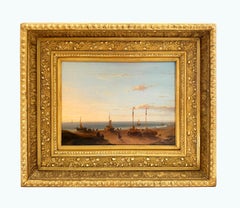
" At The Port" 19th Century Academic Realist Landscape Oil Painting on Panel
By Andreas Schelfhout
Located in Jacksonville, FL
"Sunrise on the Shore" by Andreas Schelfhout stands as a testament to the extraordinary talent of the Dutch artist, born in The Hague in 1787. A prominent figure of the Romantic move...
Category

19th Century Academic Joshua Shaw Figurative Paintings

Materials

Oil, Board

Dance of the Nymphs
By Paul Desire Trouillebert
Located in New Orleans, LA
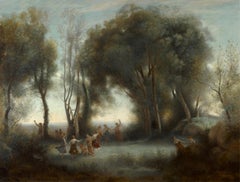
This lyrical landscape entitled Dance of the Nymphs was composed by the French Barbizon painter Paul Désiré Trouillebert. A joyful scene of nymphs dancing the morning fog, the work closely resembles an important work by the great Camille Corot, which is now housed at the Musée d'Orsay (Paris). Renowned for his unique individuality that toed the line between the traditional and modern, Corot and his landscapes helped pave the way for an entire generation of Impressionists who followed him. Trouillebert perfectly captures the poetic atmosphere of Corot’s groundbreaking works, while also imbuing this scene with a freshness and character that is all his own. Trouillebert's oil on canvas is exemplary of the tradition of historical painting. The work perfectly combines a realistic depiction of the natural world with a spirited romanticism as his idealized nymph figures frolic playfully beneath a crisp morning sky. As a whole, it is a lovely composition executed with a level of skill and artistry that proves Trouillebert's exceptional talent in the arts. Born in Paris in 1831, Paul Désiré Trouillebert was a student of the academic painters Ernest Hébert...
Category

19th Century Academic Joshua Shaw Figurative Paintings

Materials

Canvas, Oil

Antique SUNSET VIEW OF SAN LAZZARO, VENICE
Located in New York, NY
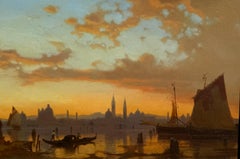
Up for sale is a wonderful Italian Venetian Sunset painting by Bernhard Stange (1807-1880). Painting for sale depicts SUNSET VIEW OF SAN LAZZARO, VENICE It is absolutely colorful a...
Category

1870s Academic Joshua Shaw Figurative Paintings

Materials

Oil

Greek / Roman Naturalistic Allegory Painting
Located in Houston, TX
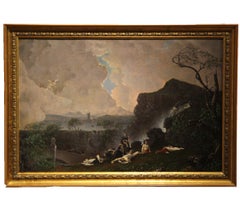
Stormy landscape scene in which a Cupid-like figure seen in the clouds appearing to have shot a number of wounded and dying men in the foreground. The men have a number of women and ...
Category

19th Century Academic Joshua Shaw Figurative Paintings

Materials

Oil

A Fine French 19th Century Oil on Canvas A Young Girl Holding a Bird s Nest
By Charles Joshua Chaplin
Located in LA, CA
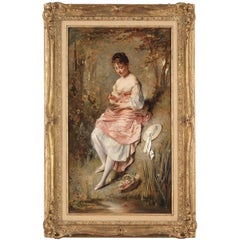
Charles Joshua Chaplin (French, 1825-1891) 'The Bird's Nest' A very fine and charming Rococo revival style oil on canvas depicting a young girl, dressed in 18th century costume and resting by a river bank, holding a bird's nest and one of the tiny eggs. Her bonnet resting to her side and a wicker basket full of hand-picked flowers by her feet; within a later giltwood carved frame. Signed: ChChaplin (lower left). Circa: 1870-1880. Canvas Height: 31 1/2 inches (80 cm) Canvas Width: 17 15/16 inches (45.5 cm) Frame Height: 38 5/8 inches (98 cm) Frame Width: 24 3/4 inches (63 cm) Frame Depth: 2 3/8 inches (6 cm) Charles Joshua Chaplin (8 June 1825 – 30 January 1891) was a French painter and printmaker who painted both landscapes and portraits. He worked in techniques such as pastels, lithography, watercolor, chalk, oil painting and etching. He was best known for his elegant portraits of young women. Chaplin was born on 8 June 1825 in Les Andelys, Eure, France. His mother, Olympia Adelle Moisy, was French, whereas his father, John Chaplin, was an art broker from England. Charles Chaplin spent his whole life in France, becoming a naturalized citizen in 1886. He studied at the École des Beaux-Arts in Paris from 1840, and he took private lessons in the studio of Michel Martin Drolling, whose apprentices included Paul Baudry, Jules Breton and Jean-Jacques Henner. Later he also taught at the École des Beaux-Arts. In 1845, he entered the Paris Salon, the official art exhibition of the Académie des Beaux-Arts, as a portrait and landscape painter with the painting Portrait of the Artist's Mother. Chaplin conducted art classes specifically for women at his studio, including Marie Joséphine Nicolas. The American artist Mary Cassatt, the French artist Louise Abbéma and the English artist Louise Jopling were among Chaplin's students. His son Arthur Chaplin was also a painter. Early Work: Chaplin made his debut at the Salon with portraits, but he also painted landscapes, particularly the countryside of Auvergne. His early works, from 1848 to 1851, were painted in a manner characterized by an interest in realism, a style established in the French Second Republic, that had the motto Liberté, égalité, fraternité, and was ruled for three years by the republican government of France from the 1848 Revolution until the 1851 coup by Louis-Napoléon Bonaparte. Realism was an artistic movement that began in France in the 1850s, after the 1848 Revolution. From the late 18th century Romanticism dominated French art and literature but was spurned by Realists, who revolted against the display of the emotions of the Romantic movement, seeking to depict real and characteristic contemporary individuals and situations with truth and accuracy. Chaplin painted many works in his early days, including floral studies that were displayed at the Salon de las Flores. Later, in the late 1850s, he abandoned naturalism, his earlier style, exchanging it for a more graceful, elegant and supple technique that brought him a certain notoriety in France during his time as a portrait painter; as such he embraced the idyllic and voluptuous and fashionable style of the prominent French painter, François Boucher (1703–1770). He also embraced the tradition of the great English portraitists and developed his very own style of painting but was inspired by the British painters Joshua Reynolds and Thomas Gainsborough. He used to engrave the works of the Dutch artist Pieter Paul Rubens and gained further influence from his work. Later Work: Gradually the muddy colours used by Chaplin transformed into white, grey and pink, depicting his models with an opalescent, mother-of-pearl complexion by applying a subtle palette of rosy flesh tones and light greys. After painting portraits and trying his skills on ornamental painting, Chaplin took up genre painting in the 1850s. His favourite subjects are the feminine grace of a young woman's everyday life. He portrays women in several poses: resting; grooming; singing; and reading. He captures them with lightness and carelessness and accentuates the decorative elements of the composition. Empress Eugénie, the wife of Napoleon III and an admirer of the "Pompadour style", rapidly fell under the enchantment of the painter's neo-Rococo works. Chaplin was among Napoleon III and Empress Eugénie's favourite court artists. In 1859, when his portrait of Aurora was banned by the judges of the Salon as "too erotically suggestive", Napoléon III defended Chaplin and overturned the disqualification order. He was similarly valued as an interior decorator and was appointed to remodel the decor of Empress Eugénie's rooms. His sensual portraits of women and young girls, often with models posed erotically in hazy surroundings and frequently wearing transparent clothing, attracted the interest of the high society and aristocracy of Paris during the French Third Republic (1870–1940) guaranteeing his success and wealth. He was one of the most popular painters of his time, but nowadays his work is almost unknown, in spite of the fact that his works hang in many major museums around the world. He employed his Rococo style for his mythological scenes and genre scenes paintings. His genre pictures formed a significant part of his work. In 1861, working as a decorative painter. Chaplin painted the doors and several glass panels above them of the Salon des Fleurs in the Tuileries Palace. The Palace was gutted by fire in 1871 and its ruins swiftly demolished.[9] He also undertook decorating work in the Salon de l’Hémicycle of the Palais de l’Elysée. Honours and awards: As a member of the Académie royale de peinture et de sculpture, Chaplin exhibited his paintings at the Paris Salon, the official exhibition venue of members' work. He began exhibiting his paintings at the French Artists' Salon in 1845 and was represented there habitually each year. These exhibitions made him one of France's most famous portrait artists. Commencing in 1847, his work was exhibited regularly at the Royal Academy in London. During his lifetime, he received acclamation for his artistic talents by the award of several medals: a third class medal in 1851; a second class medal the following year; and an Honour Medal...
Category

19th Century Academic Joshua Shaw Figurative Paintings

Materials

Oil

Joshua Shaw figurative paintings for sale on 1stDibs.

Find a wide variety of authentic Joshua Shaw figurative paintings available for sale on 1stDibs. You can also browse by medium to find art by Joshua Shaw in canvas, fabric, oil paint and more. Not every interior allows for large Joshua Shaw figurative paintings, so small editions measuring 14 inches across are available. Customers who are interested in this artist might also find the work of Herman Hyneman, Alex Roulette, and Kevin Weckbach. Joshua Shaw figurative paintings prices can differ depending upon medium, time period and other attributes. On 1stDibs, the price for these items starts at $17,500 and tops out at $17,500, while the average work can sell for $17,500.

Recently Viewed

View All