Jules Chéret Figurative Prints

French, 1836-1932

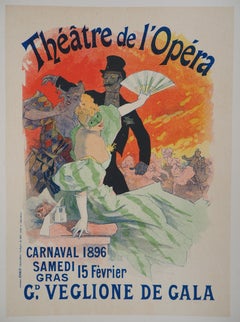
Once upon a belle époque, Jules Chéret and his posters were the toast of Paris. It was the Art Nouveau era, a time when works like those created by Chéret were key to the fabric of the cosmopolitan thoroughfare in the French capital. Today, this extraordinary artist and printer is little known. 

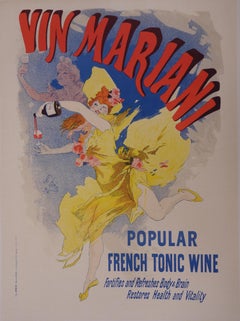
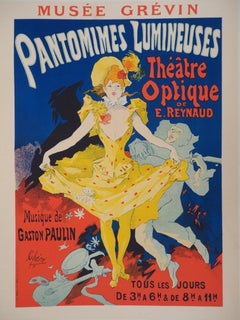
It was Chéret who transformed the street advert into the most expressive and coveted art form of the late 1800s. Think: a red-headed belle in a flimsy yellow dress, frolicking through a field of blue as she pours a glass of “tonic wine,” with the brand name Vin Mariani wafting about her.

Through his bold advances in chromolithography and the graphic arts, Chéret and the younger talents he inspired — like Pierre Bonnard, Alphonse Mucha and Henri de Toulouse-Lautrec — along with other artists, turned the stone-gray streets of Paris into a kaleidoscopic, ever-changing urban spectacle.

Raised in a family of poor Parisian artisans, Jules Chéret was apprenticed to a lithographer at 13. Although he took a class at the École nationale de dessin, as an artist, he was largely self-taught, schooling himself in art history and technique by visiting remarkable works at museums. When his first solo poster designs failed to garner further commissions, Chéret, then 23, relocated to London, where colorful but text-heavy posters enlivened the streets.

The move proved pivotal, as he soon found work with the French expat Eugène Rimmel, a visionary businessman and one of the founders of the beauty and healthcare industries. A brilliant marketer, he regularly produced colorful, elegantly illustrated and culturally sophisticated catalogues to publicize House of Rimmel cosmetics and fragrances. These and other promotional ventures kept Chéret busy, while sharpening his understanding of the commercial potential of print. 

So, when he learned of the invention of a press that could print large-scale formats inexpensively, Chéret recognized an opportunity to become his own boss. Now 30 years old, he returned to Paris with the financial support of Rimmel to establish his own print shop specializing in jumbo-size street posters and set about forging a fresh, eye-catching approach to their design.

Chéret accelerated the process of chromolithography by adding a stone with a graduated background that scaled in hue from orange to blue. With this, in addition to red- and black-pigmented stones, he could make vibrant posters more quickly and cheaply. In the late 1870s, his acquisition of steam-powered presses further sped up production and dramatically increased the volume of his output. 

But perhaps Chéret’s greatest contribution to our world today was a simple insight into an eternal truth: Sex sells. The best way to market a product is to put a pretty, revealingly dressed young woman in the ad. In the 1890s, Chéret put so many to work in this cause that they came to be known as “Chérettes,” a conflation of chérie (“darling”) and Chéret. 

Descended from the enchanting mademoiselles in the bucolic painterly confections of Rococo artists like Antoine Watteau and Jean-Honoré Fragonard, all smiles and femininity, they fused the present with the past, making them potent symbols of a newly affluent and peaceful France. 

Find original Jules Chéret posters and prints and other Art Nouveau posters on 1stDibs.

to
4
6
4
1
3
2
Overall Width
to
Overall Height
to
1
1
62
890
385
373
310
15
1
1
13
3
14
9
8
8
6
5
5
4
3
3
2
2
1
1
1
1
1
15
2
4
12
4
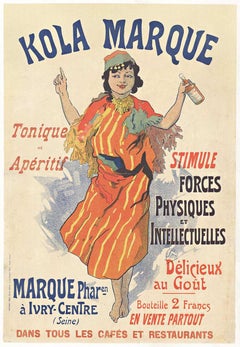
Artist: Jules Chéret
Original Kola Marque, 1895 vintage French liquor poster by Jules Cheret
By Jules Chéret
Located in Spokane, WA
Original stone lithograph KOLA MARQUE, created by the artist Jules Cheret in 1895. Size: 16" x 23.5". Professional acid free archival linen backed and ready to frame. Full boarders. Printer: Chaix. Jules Cheret is known as the father of the poster helping bring color printing to the world. Kola Marque. Tonique et Aperitif. Stimule forces physiques et intellectuelles. It indicates that if you drink this it helps give you physical and intellectual stimulus. In addition, it is served in all the local cafes and restaurants. I haven't found a breakdown of what 'special' ingredients in this liquor would make you feel and think so much better. Condition. This 1895 poster...
Category

1890s Art Nouveau Jules Chéret Figurative Prints

Materials

Lithograph

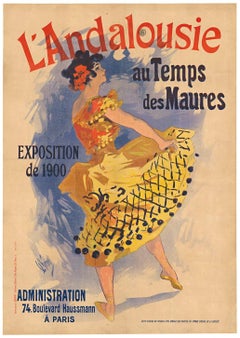
L Andalouise au Temps des Maures
By Jules Chéret
Located in Spokane, WA
Original L'Andalouise au Temps des Maures vintage art nouveau poster. L'Andalousie au Temps des Maures. Exposition de 1900. Imprimerie C...
Category

1890s Art Nouveau Jules Chéret Figurative Prints

Materials

Lithograph

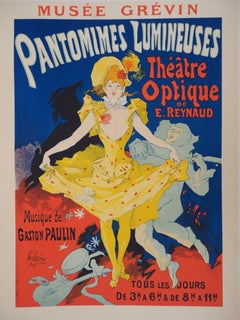
Musée Grévin : Dancer - Lithograph (Les Maîtres de l Affiche), 1895
By Jules Chéret
Located in Paris, IDF
Jules Chéret Musée Grévin : Dancer Lifting Her Skirt, 1895 Stone lithograph Printed signature in the plate On vellum Size 39 x 29 cm (c. 15.3 x 11.4") INFORMATION : Plate 41 of "L...
Category

1890s Art Nouveau Jules Chéret Figurative Prints

Materials

Lithograph

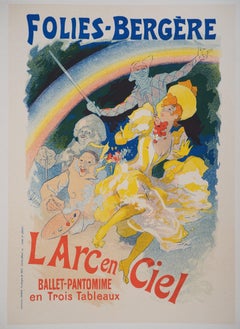
Folies-Bergère - Lithograph (Les Maîtres de l Affiche), 1895
By Jules Chéret
Located in Paris, IDF
Jules Chéret Folies-Bergère (L'Arc-en-Ciel), 1895 Stone ithograph Printed signature in the plate On vellum Size 39 x 29 cm (c. 15.3 x 11.4") INFORMATION : Plate 21 of "Les Maîtres...
Category

1890s Art Nouveau Jules Chéret Figurative Prints

Materials

Lithograph

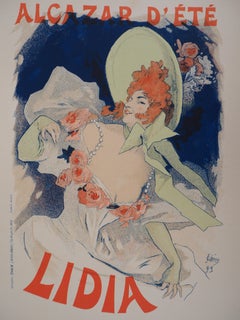
Lidia - Lithograph (Les Maîtres de l Affiche), 1895
By Jules Chéret
Located in Paris, IDF
Jules Chéret Lidia (Alcazar d'été), 1895 Stone ithograph Printed signature in the plate On vellum Size 39 x 29 cm (c. 15.3 x 11.4") INFORMATION : Plate 25 of "Les Maîtres de...
Category

1890s Art Nouveau Jules Chéret Figurative Prints

Materials

Lithograph

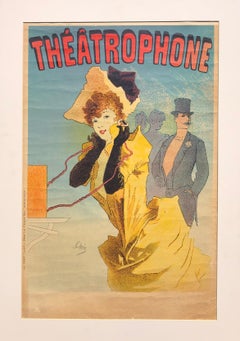
Le Théâtrophone
By Jules Chéret
Located in East Quogue, NY
Limited edition vintage lithographic reproduction poster of "Le Théâtrophone" by Jules Cheret, published in 1968 by The Sunday Times (London). This limited edition poster is numbered 600/2000 in pencil with the Sunday Times blind stamp (ST Limited Edition) in the lower right corner. The print is offered with a matt presentation frame. It also includes printed text from the original Chaix lithograph in Paris, visible along the left margin of the page. The Théâtrophone was a popular device that allowed listeners to enjoy opera and theatre performances for a small fee over the telephone. It began in Paris in 1890 and by inserting a coin and listening through earphones, one could hear performances from the Paris Opera. Its popularity spread to other cities but was eclipsed by the radio in 1932. art deco...
Category

1890s Art Nouveau Jules Chéret Figurative Prints

Materials

Lithograph

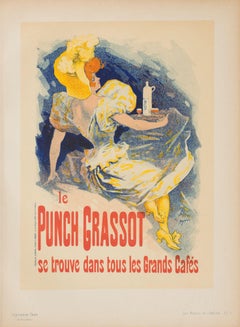
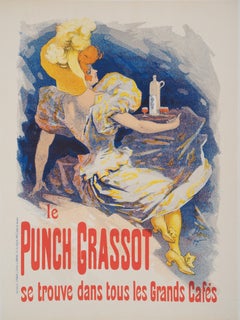
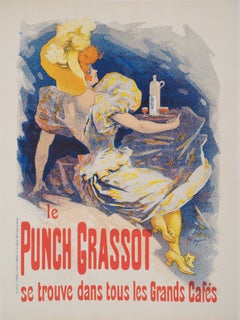
Grassot Punch (Plate 5)
By Jules Chéret
Located in Greenwich, CT
Grassot Punch (Plate 5) is an 1896 lithograph of Jules Chéret's poster, printed at Imprimerie Chaix by Jules Chéret and included in the famed collection of Belle Époque posters 'Les ...
Category

1890s Art Nouveau Jules Chéret Figurative Prints

Materials

Paper, Lithograph

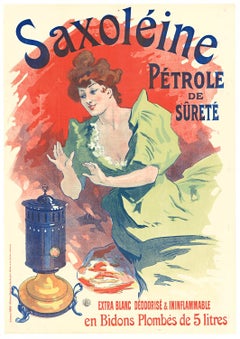
Original "Saxoleine Petrole Surete" vintage stone lithograph 1900
By Jules Chéret
Located in Spokane, WA
Original Saxoleine Petrole de Surete, artist Jules Cheret. Linen-backed turn-of-the-century original stone lithograph poster advertising Saxoleine, a lamp oil. The glow from this l...
Category

Early 1900s Art Nouveau Jules Chéret Figurative Prints

Materials

Lithograph

Punch Grassot - Lithograph (Les Maîtres de l Affiche), 1895
By Jules Chéret
Located in Paris, IDF
Jules Chéret Punch Grassot, 1895 Lithograph Printed signature in the plate On vellum Size 39 x 29 cm (c. 15.3 x 11.4") INFORMATION : Plate 5 of "Les Maîtres de...
Category

1890s Art Nouveau Jules Chéret Figurative Prints

Materials

Lithograph

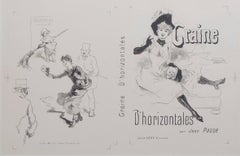
"Graine d Horizontales, " Original Black White Lithograph by Jules Cheret
By Jules Chéret
Located in Milwaukee, WI
"Graine d'Horizontales" is an original black and white lithograph by Jules Cheret. It depicts a woman with an animal on her left next to a page of everyday people. 8" x 11 1/2" ima...
Category

1890s Modern Jules Chéret Figurative Prints

Materials

Lithograph

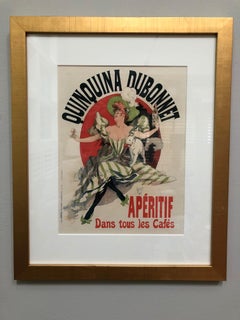
"Quinquina Dubonnet" Original Jules Cheret Maitre de l Affiche
By Jules Chéret
Located in Hinsdale, IL
CHERET, JULES (1836 - 1932) "Quinquina Dubonnet" Original lithograph from “Les Maitres de L’Affiche” series Printed by Imprimerie Chaix, Paris Bearing MDL stamp lower right, from issue #28, 1898. Plate #109 Unframed Size: 11 3/8 x 15 3/4” The “Les Maitres de l’Affiche” series was offered as a subscription series to collectors every month for 60 months, from December 1895 through November 1900. The “Maitres de l’Affiche,” were issued as separate numbered sheets, referred to as “plates”. They were numbered, with the printers name “Imprimerie Chaix,” in the margin at the bottom left hand corner, “PL.1” to “PL.240.” In the margin at the bottom right hand corner of each, is a blind embossed stamp from a design of Cheret’s. The smaller format and the fact the “Maitres” were a paid subscription series, allowed Imprimerie Chaix to use the latest state of the art printing techniques, not normally used in the large format posters due to cost. A very high quality of paper was used, where as the large format posters were printed on lesser quality newsprint, due to cost and a short expected life span. This explains why the quality of the printing, in the “Maitres de l’Affiche,” usually far exceeds that of their larger counterparts. “The Dubonnet poster...
Category

1890s Art Nouveau Jules Chéret Figurative Prints

Materials

Lithograph

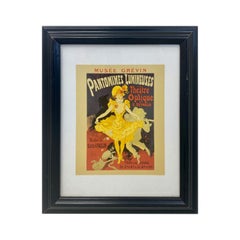
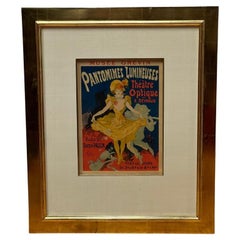
Muse Grevin "Pantomimes Lumineuses" Original Poster by Jules Cheret
By Jules Chéret
Located in Plainview, NY
Jules Cheret created this captivating French poster to promote Emile Reynaud's "Theatre Optique," where he introduced the groundbreaking "Pantomimes Lumi...
Category

Late 19th Century French School Jules Chéret Figurative Prints

Materials

Paper

ballet dancer with yellow dress late 19th century color lithograph poster
By Jules Chéret
Located in Milwaukee, WI
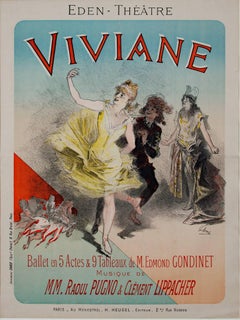
"Viviane, Maindron" is an original color lithograph by Jules Cheret. It is an advertisement for a five-act ballet from 1886. It depicts a performer in a yellow dress with other dance...
Category

1880s Jules Chéret Figurative Prints

Materials

Lithograph

ballet dancer with yellow dress late 19th century color lithograph poster
By Jules Chéret
Located in Milwaukee, WI
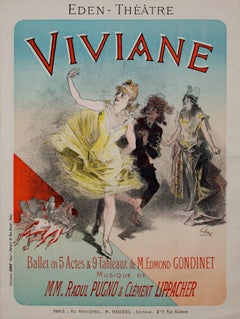
An original color lithograph by Jules Cheret numbered 52 of three dancers. 31 5/8" x 23 3/4" art 37 1/2" x 29 5/8" framed Jules Chéret (31 May 1836 – 23 September 1932) was a Frenc...
Category

1880s Contemporary Jules Chéret Figurative Prints

Materials

Lithograph

late 19th century color lithograph poster military figure drummer text
By Jules Chéret
Located in Milwaukee, WI
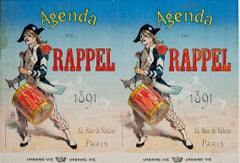
"Rappel" is an original lithograph poster designed by Jules Cheret. This poster depicts a young man drumming. There is a small stain in the upper left corner. This poster was publish...
Category

1890s Jules Chéret Figurative Prints

Materials

Lithograph

"Les Petits Japonais, " Original Color Lithograph by Jules Chéret
By Jules Chéret
Located in Milwaukee, WI
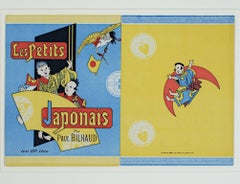
"Les Petits Japonais" is an original color lithograph by Jules Cheret. It depicts three young Japanese children in red, yellow, and blue. This piece is a design for the cover of "Les...
Category

1890s Jules Chéret Figurative Prints

Materials

Lithograph

Related Items
Original "Saxoleine Petrole Surete" vintage stone lithograph 1900
By Jules Chéret
Located in Spokane, WA
Original Saxoleine Petrole de Surete, artist Jules Cheret. Linen-backed turn-of-the-century original stone lithograph poster advertising Saxoleine, a lamp oil. The glow from this l...
Category

Early 1900s Art Nouveau Jules Chéret Figurative Prints

Materials

Lithograph

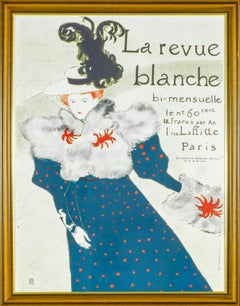
Henri de Toulouse-Lautrec "La Revue Blanche" limited edition lithograph
By Henri de Toulouse-Lautrec
Located in Boca Raton, FL
Limited edition lithograph on Arches paper from edition of 2,000 of "La Revue Blanche" by Henri de Toulouse-Lautrec. Reproduction reissued in 1974. Th...
Category

1970s Art Nouveau Jules Chéret Figurative Prints

Materials

Paper, Lithograph

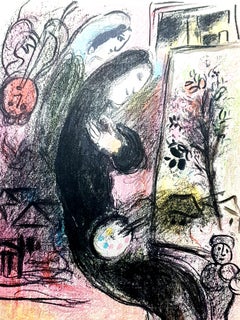
Marc Chagall - Inspiration - Original Lithograph from "Chagall Lithographe" v. 2
By Marc Chagall
Located in Collonge Bellerive, Geneve, CH
Marc Chagall Original Lithograph from Chagall Lithographe 1957-1962. VOLUME II. 1963 Dimensions: 32 x 24 cm From the unsigned edition of 10000 copies without margins Reference: Mourlot 398 Condition : Excellent Marc Chagall (born in 1887) Marc Chagall was born in Belarus in 1887 and developed an early interest in art. After studying painting, in 1907 he left Russia for Paris, where he lived in an artist colony on the city’s outskirts. Fusing his own personal, dreamlike imagery with hints of the fauvism and cubism popular in France at the time, Chagall created his most lasting work—including I and the Village (1911)—some of which would be featured in the Salon des Indépendants exhibitions. After returning to Vitebsk for a visit in 1914, the outbreak of WWI trapped Chagall in Russia. He returned to France in 1923 but was forced to flee the country and Nazi persecution during WWII. Finding asylum in the U.S., Chagall became involved in set and costume design before returning to France in 1948. In his later years, he experimented with new art forms and was commissioned to produce numerous large-scale works. Chagall died in St.-Paul-de-Vence in 1985. The Village Marc Chagall was born in a small Hassidic community on the outskirts of Vitebsk, Belarus, on July 7, 1887. His father was a fishmonger, and his mother ran a small sundries shop in the village. As a child, Chagall attended the Jewish elementary school, where he studied Hebrew and the Bible, before later attending the Russian public school. He began to learn the fundamentals of drawing during this time, but perhaps more importantly, he absorbed the world around him, storing away the imagery and themes that would feature largely in most of his later work. At age 19 Chagall enrolled at a private, all-Jewish art school and began his formal education in painting, studying briefly with portrait artist Yehuda Pen. However, he left the school after several months, moving to St. Petersburg in 1907 to study at the Imperial Society for the Protection of Fine Arts. The following year, he enrolled at the Svanseva School, studying with set designer Léon Bakst, whose work had been featured in Sergei Diaghilev's Ballets Russes. This early experience would prove important to Chagall’s later career as well. Despite this formal instruction, and the widespread popularity of realism in Russia at the time, Chagall was already establishing his own personal style, which featured a more dreamlike unreality and the people, places and imagery that were close to his heart. Some examples from this period are his Window Vitebsk (1908) and My Fianceé with Black Gloves (1909), which pictured Bella Rosenfeld, to whom he had recently become engaged. The Beehive Despite his romance with Bella, in 1911 an allowance from Russian parliament member and art patron Maxim Binaver enabled Chagall to move to Paris, France. After settling briefly in the Montparnasse neighborhood, Chagall moved further afield to an artist colony known as La Ruche (“The Beehive”), where he began to work side by side with abstract painters such as Amedeo Modigliani and Fernand Léger as well as the avant-garde poet Guillaume Apollinaire. At their urging, and under the influence of the wildly popular fauvism and cubism, Chagall lightened his palette and pushed his style ever further from reality. I and the Village (1911) and Homage to Apollinaire (1912) are among his early Parisian works, widely considered to be his most successful and representative period. Though his work stood stylistically apart from his cubist contemporaries, from 1912 to 1914 Chagall exhibited several paintings at the annual Salon des Indépendants exhibition, where works by the likes of Juan Gris, Marcel Duchamp and Robert Delaunay were causing a stir in the Paris art world. Chagall’s popularity began to spread beyond La Ruche, and in May 1914 he traveled to Berlin to help organize his first solo exhibition, at Der Sturm Gallery. Chagall remained in the city until the highly acclaimed show opened that June. He then returned to Vitebsk, unaware of the fateful events to come. War, Peace and Revolution In August 1914 the outbreak of World War I precluded Chagall’s plans to return to Paris. The conflict did little to stem the flow of his creative output, however, instead merely giving him direct access to the childhood scenes so essential to his work, as seen in paintings such as Jew in Green (1914) and Over Vitebsk (1914). His paintings from this period also occasionally featured images of the war’s impact on the region, as with Wounded Soldier (1914) and Marching (1915). But despite the hardships of life during wartime, this would also prove to be a joyful period for Chagall. In July 1915 he married Bella, and she gave birth to a daughter, Ida, the following year. Their appearance in works such as Birthday (1915), Bella and Ida by the Window (1917) and several of his “Lovers” paintings give a glimpse of the island of domestic bliss that was Chagall’s amidst the chaos. To avoid military service and stay with his new family, Chagall took a position as a clerk in the Ministry of War Economy in St. Petersburg. While there he began work on his autobiography and also immersed himself in the local art scene, befriending novelist Boris Pasternak, among others. He also exhibited his work in the city and soon gained considerable recognition. That notoriety would prove important in the aftermath of the 1917 Russian Revolution when he was appointed as the Commissar of Fine Arts in Vitebsk. In his new post, Chagall undertook various projects in the region, including the 1919 founding of the Academy of the Arts. Despite these endeavors, differences among his colleagues eventually disillusioned Chagall. In 1920 he relinquished his position and moved his family to Moscow, the post-revolution capital of Russia. In Moscow, Chagall was soon commissioned to create sets and costumes for various productions at the Moscow State Yiddish Theater...
Category

1960s Surrealist Jules Chéret Figurative Prints

Materials

Lithograph

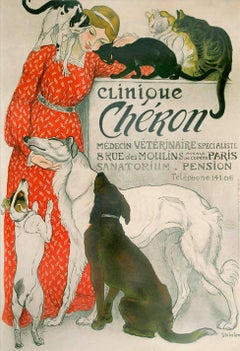
CLINIQUE CHÉRON Lithograph, Girl, Cats, Dogs, Vintage French Advertising 58 in.
By Théophile Alexandre Steinlen
Located in Union City, NJ
CLINIQUE CHÉRON is a fine art lithographic re-creation after the original 1905 vintage French advertising poster created by Théophile Steinlen for the veterinary CLINIQUE CHÉRON Fran...
Category

1990s Art Nouveau Jules Chéret Figurative Prints

Materials

Lithograph

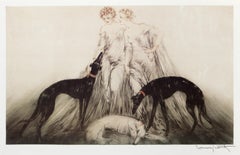
Coursing 3, Art Nouveau Offset Lithograph after Louis Icart
By Louis Icart
Located in Long Island City, NY
Louis Icart, After, French (1888 - 1950) - Coursing 3, Medium: Offset Lithograph on paper, signed in plate, Image Size: 14.5 x 23.75 inches, Size: 16 x 25 in. (40.64 x 63.5 cm), D...
Category

Early 20th Century Art Nouveau Jules Chéret Figurative Prints

Materials

Lithograph, Offset

Silk Robe, Art Nouveau Offset Lithograph by Louis Icart
By Louis Icart
Located in Long Island City, NY
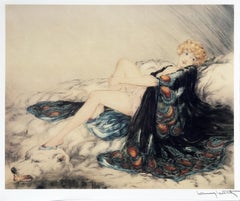
Louis Icart, French (1888 - 1950) - Silk Robe, Medium: Offset Lithograph on paper, signed in plate, Image Size: 17.5 x 21.5 inches, Size: 19 x 22.5 in. (48.26 x 57.15 cm), Descrip...
Category

Early 20th Century Art Nouveau Jules Chéret Figurative Prints

Materials

Lithograph, Offset

"Fernand Clement Cie" lithograph print poster by Pal (Jean de Paléologue)
By Pal (Jean de Paléologue)
Located in Boca Raton, FL
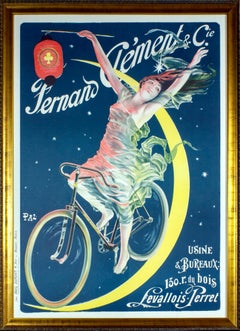
"Fernand Clément & Cie" framed lithograph poster by Pal (Jean de Paléologue.) Inscription on side reads Imp. Paul Dupont, 4 Rue du Bouloi, Paris. Recreation 84 Wannabe Affiche, Ltd. ...
Category

1890s Art Nouveau Jules Chéret Figurative Prints

Materials

Lithograph

C F S I, Signed Lithograph, Coney Island, Comic Character Figures
By Marie Roberts
Located in Union City, NJ
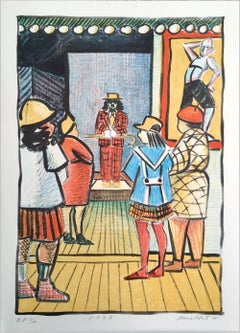
C F S I is an original hand drawn lithograph by the New York woman artist Marie Roberts printed using hand lithography techniques on archival Arches paper 100% acid free. C F S I portrays a Coney Island Sideshow Performance with several onlookers standing by the stage watching the show. C F S I is a skillfully expressed comic character figure drawing printed in black ink shaded with colored crayon line textures in shades of red, yellow and blue. C F S I is a very fine impression exemplifying the magic and artistic mastery of hand crafted lithography with its nuanced tusche brush strokes and pencil crayon line textures and shading. Print size - 29.5 x 21.25 in, unframed, excellent condition, hand signed in pencil by Marie Roberts Image size - 26.25 x 18.25 in Year published - 1995 Edition size - 25 Marie Roberts, a Coney Island native is best known for her banners for the Coney Island Circus Sideshow...
Category

1990s Contemporary Jules Chéret Figurative Prints

Materials

Lithograph

Original Mozart en France vintage French poster, 200th Birthday of Mozart
Located in Spokane, WA
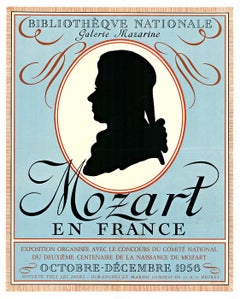
“Mozart en France” – Original French Exhibition 1956 Poster, Linen-Backed. Grade A- condition, ready to frame. Fold marks restored. A striking, authentic mid-century poster creat...
Category

1950s Art Nouveau Jules Chéret Figurative Prints

Materials

Lithograph

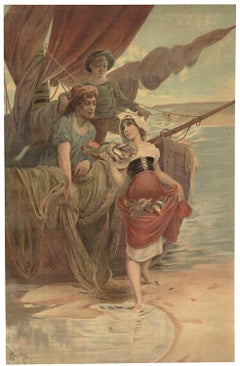
Original "Fishmonger" or Pesche, untitled vintage print c. 1908
By Alphonse Mucha
Located in Spokane, WA
Original Alphonse Mucha decorative panel. Linen backed in very good condition A-/B+ condition. This lovely poster looks just like an oil painting. It is a rare design by Alphonse ...
Category

Early 1900s Art Nouveau Jules Chéret Figurative Prints

Materials

Lithograph

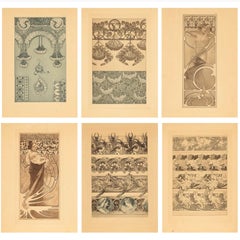
Alphonse Mucha Documents Decoratifs 6 Lithographs 1902
By Alphonse Mucha
Located in Dallas, TX
Alfons Mucha DOCUMENTS DECORATIFS Six color lithographs, 1902, on wove paper, printed by F. Champenois, Paris, published by the Librarie Cen...
Category

Early 1900s Art Nouveau Jules Chéret Figurative Prints

Materials

Lithograph

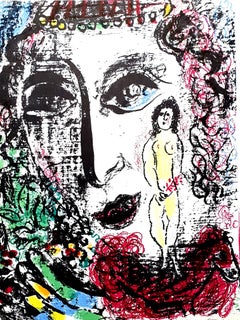
Marc Chagall - Original Lithograph
By Marc Chagall
Located in Collonge Bellerive, Geneve, CH
Marc Chagall Original Lithograph 1963 Dimensions: 32 x 24 cm Reference: Chagall Lithographe 1957-1962. VOLUME II. Condition : Excellent Marc Chagall (born in 1887) Marc Chagall was born in Belarus in 1887 and developed an early interest in art. After studying painting, in 1907 he left Russia for Paris, where he lived in an artist colony on the city’s outskirts. Fusing his own personal, dreamlike imagery with hints of the fauvism and cubism popular in France at the time, Chagall created his most lasting work—including I and the Village (1911)—some of which would be featured in the Salon des Indépendants exhibitions. After returning to Vitebsk for a visit in 1914, the outbreak of WWI trapped Chagall in Russia. He returned to France in 1923 but was forced to flee the country and Nazi persecution during WWII. Finding asylum in the U.S., Chagall became involved in set and costume design before returning to France in 1948. In his later years, he experimented with new art forms and was commissioned to produce numerous large-scale works. Chagall died in St.-Paul-de-Vence in 1985. The Village Marc Chagall was born in a small Hassidic community on the outskirts of Vitebsk, Belarus, on July 7, 1887. His father was a fishmonger, and his mother ran a small sundries shop in the village. As a child, Chagall attended the Jewish elementary school, where he studied Hebrew and the Bible, before later attending the Russian public school. He began to learn the fundamentals of drawing during this time, but perhaps more importantly, he absorbed the world around him, storing away the imagery and themes that would feature largely in most of his later work. At age 19 Chagall enrolled at a private, all-Jewish art school and began his formal education in painting, studying briefly with portrait artist Yehuda Pen. However, he left the school after several months, moving to St. Petersburg in 1907 to study at the Imperial Society for the Protection of Fine Arts. The following year, he enrolled at the Svanseva School, studying with set designer Léon Bakst, whose work had been featured in Sergei Diaghilev's Ballets Russes. This early experience would prove important to Chagall’s later career as well. Despite this formal instruction, and the widespread popularity of realism in Russia at the time, Chagall was already establishing his own personal style, which featured a more dreamlike unreality and the people, places and imagery that were close to his heart. Some examples from this period are his Window Vitebsk (1908) and My Fianceé with Black Gloves (1909), which pictured Bella Rosenfeld, to whom he had recently become engaged. The Beehive Despite his romance with Bella, in 1911 an allowance from Russian parliament member and art patron Maxim Binaver enabled Chagall to move to Paris, France. After settling briefly in the Montparnasse neighborhood, Chagall moved further afield to an artist colony known as La Ruche (“The Beehive”), where he began to work side by side with abstract painters such as Amedeo Modigliani and Fernand Léger as well as the avant-garde poet Guillaume Apollinaire. At their urging, and under the influence of the wildly popular fauvism and cubism, Chagall lightened his palette and pushed his style ever further from reality. I and the Village (1911) and Homage to Apollinaire (1912) are among his early Parisian works, widely considered to be his most successful and representative period. Though his work stood stylistically apart from his cubist contemporaries, from 1912 to 1914 Chagall exhibited several paintings at the annual Salon des Indépendants exhibition, where works by the likes of Juan Gris, Marcel Duchamp and Robert Delaunay were causing a stir in the Paris art world. Chagall’s popularity began to spread beyond La Ruche, and in May 1914 he traveled to Berlin to help organize his first solo exhibition, at Der Sturm Gallery. Chagall remained in the city until the highly acclaimed show opened that June. He then returned to Vitebsk, unaware of the fateful events to come. War, Peace and Revolution In August 1914 the outbreak of World War I precluded Chagall’s plans to return to Paris. The conflict did little to stem the flow of his creative output, however, instead merely giving him direct access to the childhood scenes so essential to his work, as seen in paintings such as Jew in Green (1914) and Over Vitebsk (1914). His paintings from this period also occasionally featured images of the war’s impact on the region, as with Wounded Soldier (1914) and Marching (1915). But despite the hardships of life during wartime, this would also prove to be a joyful period for Chagall. In July 1915 he married Bella, and she gave birth to a daughter, Ida, the following year. Their appearance in works such as Birthday (1915), Bella and Ida by the Window (1917) and several of his “Lovers” paintings give a glimpse of the island of domestic bliss that was Chagall’s amidst the chaos. To avoid military service and stay with his new family, Chagall took a position as a clerk in the Ministry of War Economy in St. Petersburg. While there he began work on his autobiography and also immersed himself in the local art scene, befriending novelist Boris Pasternak, among others. He also exhibited his work in the city and soon gained considerable recognition. That notoriety would prove important in the aftermath of the 1917 Russian Revolution when he was appointed as the Commissar of Fine Arts in Vitebsk. In his new post, Chagall undertook various projects in the region, including the 1919 founding of the Academy of the Arts. Despite these endeavors, differences among his colleagues eventually disillusioned Chagall. In 1920 he relinquished his position and moved his family to Moscow, the post-revolution capital of Russia. In Moscow, Chagall was soon commissioned to create sets and costumes for various productions at the Moscow State Yiddish Theater...
Category

1960s Surrealist Jules Chéret Figurative Prints

Materials

Lithograph

Marc Chagall - Original Lithograph
$1,483
H 9.45 in W 12.6 in D 0.04 in
Previously Available Items
Muse Grevin - Pantomimes Lumineuses" Original Poster by Jules Cheret
By Jules Chéret
Located in Pasadena, CA
A French original poster by Jules Cheret advertising the "Theatre Optique" Optical theater owned by Emile Reynaud who presented in the Musee Grevin" the Pantomimes Lumineuses, the world’s first animated films, using his innovative system which projected light through moving pictures to offer illuminated pantomimes. It rests in its original gold leaf frame and was edited by Ateliers Cheret. A removable film under the glass protects it against the light. I have added the matching one. Jules Chéret, ( 1836-1933), one of the pioneering poster artists of the late 19th century, was quick to realize not only the aesthetic but also the commercial potential of his medium caused by changes in technology and society. After founding his own Paris studio in 1867, Chéret merged text and image in ways that predicted the advent of cartooning with their harmonious integration of elements. The proliferation of the new department stores, patronized by the growing middle class, midwifed the birth of a consumer culture that gave him new markets for his work. Chéret’s posters...
Category

1880s Art Nouveau Jules Chéret Figurative Prints

Materials

Lithograph

Théâtre de l Opéra (Carnival) - Lithograph (Les Maîtres de l Affiche), 1895
By Jules Chéret
Located in Paris, IDF
Jules Chéret Théâtre de l'Opéra (Carnival), 1895 Lithograph Printed signature in the plate On vellum Size 39 x 29 cm (c. 15.3 x 11.4") INFORMATION : Plate 9 of "Les Maîtres de l'A...
Category

1890s Art Nouveau Jules Chéret Figurative Prints

Materials

Lithograph

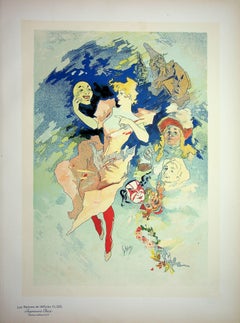
La Comédie : Woman with masks - Lithograph (Les Maîtres de l Affiche), 1900
By Jules Chéret
Located in Paris, IDF
Jules Chéret La Comédie : Woman with masks, 1897 Lithograph Printed signature in the plate On vellum Size 39 x 29 cm (c. 15.3 x 11.4") INFORMATION : Plate 201 of "Les Maîtres de l...
Category

Early 1900s Art Nouveau Jules Chéret Figurative Prints

Materials

Lithograph

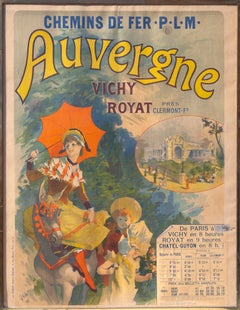
Auvergne, French Travel Poster by Jules Cheret 1892
By Jules Chéret
Located in Long Island City, NY
Vintage lithograph poster by French artist Jules Cheret, advertising travel to the French region of Auvergne. Jules Cheret, French (1836–1932) Date: 1892...
Category

1890s Art Nouveau Jules Chéret Figurative Prints

Materials

Lithograph

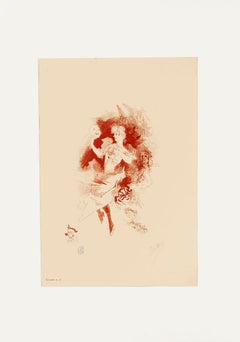
Girl with Mask - Original Lithograph by Jules Chéret - 1890s
By Jules Chéret
Located in Roma, IT
Girl with Mask is an original lithograph on ivory-colored paper, realized by Jules Chéret, in 1890s. In very good conditions. Numbered on the lower left margin, Epreuvre n°13. Han...
Category

1890s Modern Jules Chéret Figurative Prints

Materials

Lithograph

Mariani : French Tonic - Lithograph (Les Maîtres de l Affiche), 1897
By Jules Chéret
Located in Paris, IDF
Jules Chéret Mariani : French Tonic Wine, 1897 Lithograph Printed signature in the plate On vellum Size 39 x 29 cm (c. 15.3 x 11.4") INFORMATION : Plate 17 of "Les Maîtres de l'Af...
Category

1890s Art Nouveau Jules Chéret Figurative Prints

Materials

Lithograph

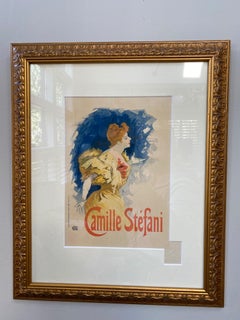
"Camille Stefani" Maitre de l affiche color lithograph
By Jules Chéret
Located in Hinsdale, IL
CHERET, JULES (1836 -1932) "Camille Stefani" Original lithograph from "Les Maitres de L'Affiche" series Printed by Imprimerie Chaix, Paris Bearing MDL st...
Category

1890s Art Nouveau Jules Chéret Figurative Prints

Materials

Lithograph

Punch Grassot - Lithograph (Les Maîtres de l Affiche), 1895
By Jules Chéret
Located in Paris, IDF
Jules Chéret Punch Grassot, 1895 Lithograph Printed signature in the plate On vellum Size 39 x 29 cm (c. 15.3 x 11.4") INFORMATION : Plate 5 of "Les Maîtres de l'Affiche", Paris, ...
Category

1890s Art Nouveau Jules Chéret Figurative Prints

Materials

Lithograph

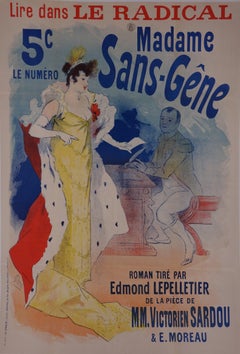
Madame Sans Gene - Original Stone Lithograph - 1894
By Jules Chéret
Located in Paris, IDF
Jules CHERET Madame sans gene Original stone lithograph Printed signature in the plate On paper applied on linen 123 x 87 cm (c. 50 x 35 inch) Bears the French Republic stamp ; thi...
Category

1890s Art Nouveau Jules Chéret Figurative Prints

Materials

Lithograph

Musée Grévin : Dancer - Lithograph (Les Maîtres de l Affiche), 1895
By Jules Chéret
Located in Paris, IDF
Jules Chéret Musée Grévin : Dancer Lifting Her Skirt, 1895 Stone lithograph Printed signature in the plate On vellum Size 39 x 29 cm (c. 15.3 x 11.4") ...
Category

1890s Art Nouveau Jules Chéret Figurative Prints

Materials

Lithograph

Les Affiches Illustrées
By Jules Chéret
Located in New Orleans, LA
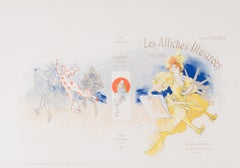
Les Affiches Illustrees, (1886-1895) written by Ernest Maindron with 64 original lithographic prints was published in 1896 by Imprimerie Chaix and printed by Imprimerie Eugene Vernea...
Category

1880s Art Deco Jules Chéret Figurative Prints

Materials

Lithograph

The ballerinas - Lithograph (Les Maîtres de l Affiche), 1895
By Jules Chéret
Located in Paris, IDF
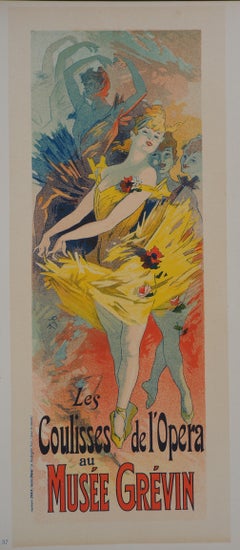
Jules Chéret The ballerinas, 1895 Stone lithograph Printed signature in the plate On vellum Size 39 x 29 cm (c. 15.3 x 11.4") INFORMATION : Plate 37 of "Les Maîtres de l'Affiche",...
Category

1890s Art Nouveau Jules Chéret Figurative Prints

Materials

Lithograph

Jules Chéret figurative prints for sale on 1stDibs.

Find a wide variety of authentic Jules Chéret figurative prints available for sale on 1stDibs. If you’re browsing the collection of figurative prints to introduce a pop of color in a neutral corner of your living room or bedroom, you can find work that includes elements of orange and other colors. You can also browse by medium to find art by Jules Chéret in lithograph, paper and more. Much of the original work by this artist or collective was created during the 19th century and is mostly associated with the modern style. Not every interior allows for large Jules Chéret figurative prints, so small editions measuring 12 inches across are available. Customers who are interested in this artist might also find the work of Charles Paul Renouard, Henri Gabriel Ibels, and Adolphe Willette. Jules Chéret figurative prints prices can differ depending upon medium, time period and other attributes. On 1stDibs, the price for these items starts at $285 and tops out at $10,000, while the average work can sell for $1,200.
Questions About Jules Chéret Figurative Prints
  • 1stDibs ExpertApril 5, 2022
    Jules Cheret contributed to poster history by changing how the art world viewed posters. In 1884, he showed his works in the first-ever gallery exhibition of posters, helping to elevate the art form. Find a variety of Jules Cheret art on 1stDibs.