Jules Chéret More Prints

French, 1836-1932

Once upon a belle époque, Jules Chéret and his posters were the toast of Paris. It was the Art Nouveau era, a time when works like those created by Chéret were key to the fabric of the cosmopolitan thoroughfare in the French capital. Today, this extraordinary artist and printer is little known. 

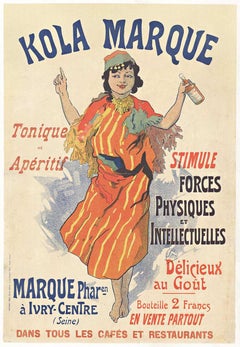
It was Chéret who transformed the street advert into the most expressive and coveted art form of the late 1800s. Think: a red-headed belle in a flimsy yellow dress, frolicking through a field of blue as she pours a glass of “tonic wine,” with the brand name Vin Mariani wafting about her.

Through his bold advances in chromolithography and the graphic arts, Chéret and the younger talents he inspired — like Pierre Bonnard, Alphonse Mucha and Henri de Toulouse-Lautrec — along with other artists, turned the stone-gray streets of Paris into a kaleidoscopic, ever-changing urban spectacle.

Raised in a family of poor Parisian artisans, Jules Chéret was apprenticed to a lithographer at 13. Although he took a class at the École nationale de dessin, as an artist, he was largely self-taught, schooling himself in art history and technique by visiting remarkable works at museums. When his first solo poster designs failed to garner further commissions, Chéret, then 23, relocated to London, where colorful but text-heavy posters enlivened the streets.

The move proved pivotal, as he soon found work with the French expat Eugène Rimmel, a visionary businessman and one of the founders of the beauty and healthcare industries. A brilliant marketer, he regularly produced colorful, elegantly illustrated and culturally sophisticated catalogues to publicize House of Rimmel cosmetics and fragrances. These and other promotional ventures kept Chéret busy, while sharpening his understanding of the commercial potential of print. 

So, when he learned of the invention of a press that could print large-scale formats inexpensively, Chéret recognized an opportunity to become his own boss. Now 30 years old, he returned to Paris with the financial support of Rimmel to establish his own print shop specializing in jumbo-size street posters and set about forging a fresh, eye-catching approach to their design.

Chéret accelerated the process of chromolithography by adding a stone with a graduated background that scaled in hue from orange to blue. With this, in addition to red- and black-pigmented stones, he could make vibrant posters more quickly and cheaply. In the late 1870s, his acquisition of steam-powered presses further sped up production and dramatically increased the volume of his output. 

But perhaps Chéret’s greatest contribution to our world today was a simple insight into an eternal truth: Sex sells. The best way to market a product is to put a pretty, revealingly dressed young woman in the ad. In the 1890s, Chéret put so many to work in this cause that they came to be known as “Chérettes,” a conflation of chérie (“darling”) and Chéret. 

Descended from the enchanting mademoiselles in the bucolic painterly confections of Rococo artists like Antoine Watteau and Jean-Honoré Fragonard, all smiles and femininity, they fused the present with the past, making them potent symbols of a newly affluent and peaceful France. 

Find original Jules Chéret posters and prints and other Art Nouveau posters on 1stDibs.

to
1
1
1
Overall Width
to
Overall Height
to
62
702
453
236
169
2
2
2
2
Artist: Jules Chéret
Original Kola Marque, 1895 vintage French liquor poster by Jules Cheret
By Jules Chéret
Located in Spokane, WA
Original stone lithograph KOLA MARQUE, created by the artist Jules Cheret in 1895. Size: 16" x 23.5". Professional acid free archival linen backed and ready to frame. Full boarders. Printer: Chaix. Jules Cheret is known as the father of the poster helping bring color printing to the world. Kola Marque. Tonique et Aperitif. Stimule forces physiques et intellectuelles. It indicates that if you drink this it helps give you physical and intellectual stimulus. In addition, it is served in all the local cafes and restaurants. I haven't found a breakdown of what 'special' ingredients in this liquor would make you feel and think so much better. Condition. This 1895 poster...
Category

1890s Art Nouveau Jules Chéret More Prints

Materials

Lithograph

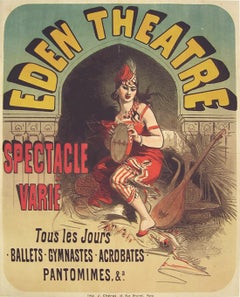
Original Antique French Poster, "Eden Theatre", Jules Cheret, Lithograph
By Jules Chéret
Located in Dallas, TX
"Eden Theatre - Spectacle Varie" artist: Jules Cheret . Size: 28 x 23. Year: 1880. Archival linen backed in pretty good condition; ready to frame. Original linen backed stone lithog...
Category

1880s Art Nouveau Jules Chéret More Prints

Materials

Lithograph

Related Items
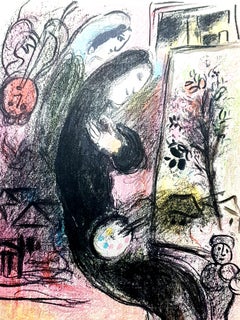
Marc Chagall - Inspiration - Original Lithograph from "Chagall Lithographe" v. 2
By Marc Chagall
Located in Collonge Bellerive, Geneve, CH
Marc Chagall Original Lithograph from Chagall Lithographe 1957-1962. VOLUME II. 1963 Dimensions: 32 x 24 cm From the unsigned edition of 10000 copies without margins Reference: Mourlot 398 Condition : Excellent Marc Chagall (born in 1887) Marc Chagall was born in Belarus in 1887 and developed an early interest in art. After studying painting, in 1907 he left Russia for Paris, where he lived in an artist colony on the city’s outskirts. Fusing his own personal, dreamlike imagery with hints of the fauvism and cubism popular in France at the time, Chagall created his most lasting work—including I and the Village (1911)—some of which would be featured in the Salon des Indépendants exhibitions. After returning to Vitebsk for a visit in 1914, the outbreak of WWI trapped Chagall in Russia. He returned to France in 1923 but was forced to flee the country and Nazi persecution during WWII. Finding asylum in the U.S., Chagall became involved in set and costume design before returning to France in 1948. In his later years, he experimented with new art forms and was commissioned to produce numerous large-scale works. Chagall died in St.-Paul-de-Vence in 1985. The Village Marc Chagall was born in a small Hassidic community on the outskirts of Vitebsk, Belarus, on July 7, 1887. His father was a fishmonger, and his mother ran a small sundries shop in the village. As a child, Chagall attended the Jewish elementary school, where he studied Hebrew and the Bible, before later attending the Russian public school. He began to learn the fundamentals of drawing during this time, but perhaps more importantly, he absorbed the world around him, storing away the imagery and themes that would feature largely in most of his later work. At age 19 Chagall enrolled at a private, all-Jewish art school and began his formal education in painting, studying briefly with portrait artist Yehuda Pen. However, he left the school after several months, moving to St. Petersburg in 1907 to study at the Imperial Society for the Protection of Fine Arts. The following year, he enrolled at the Svanseva School, studying with set designer Léon Bakst, whose work had been featured in Sergei Diaghilev's Ballets Russes. This early experience would prove important to Chagall’s later career as well. Despite this formal instruction, and the widespread popularity of realism in Russia at the time, Chagall was already establishing his own personal style, which featured a more dreamlike unreality and the people, places and imagery that were close to his heart. Some examples from this period are his Window Vitebsk (1908) and My Fianceé with Black Gloves (1909), which pictured Bella Rosenfeld, to whom he had recently become engaged. The Beehive Despite his romance with Bella, in 1911 an allowance from Russian parliament member and art patron Maxim Binaver enabled Chagall to move to Paris, France. After settling briefly in the Montparnasse neighborhood, Chagall moved further afield to an artist colony known as La Ruche (“The Beehive”), where he began to work side by side with abstract painters such as Amedeo Modigliani and Fernand Léger as well as the avant-garde poet Guillaume Apollinaire. At their urging, and under the influence of the wildly popular fauvism and cubism, Chagall lightened his palette and pushed his style ever further from reality. I and the Village (1911) and Homage to Apollinaire (1912) are among his early Parisian works, widely considered to be his most successful and representative period. Though his work stood stylistically apart from his cubist contemporaries, from 1912 to 1914 Chagall exhibited several paintings at the annual Salon des Indépendants exhibition, where works by the likes of Juan Gris, Marcel Duchamp and Robert Delaunay were causing a stir in the Paris art world. Chagall’s popularity began to spread beyond La Ruche, and in May 1914 he traveled to Berlin to help organize his first solo exhibition, at Der Sturm Gallery. Chagall remained in the city until the highly acclaimed show opened that June. He then returned to Vitebsk, unaware of the fateful events to come. War, Peace and Revolution In August 1914 the outbreak of World War I precluded Chagall’s plans to return to Paris. The conflict did little to stem the flow of his creative output, however, instead merely giving him direct access to the childhood scenes so essential to his work, as seen in paintings such as Jew in Green (1914) and Over Vitebsk (1914). His paintings from this period also occasionally featured images of the war’s impact on the region, as with Wounded Soldier (1914) and Marching (1915). But despite the hardships of life during wartime, this would also prove to be a joyful period for Chagall. In July 1915 he married Bella, and she gave birth to a daughter, Ida, the following year. Their appearance in works such as Birthday (1915), Bella and Ida by the Window (1917) and several of his “Lovers” paintings give a glimpse of the island of domestic bliss that was Chagall’s amidst the chaos. To avoid military service and stay with his new family, Chagall took a position as a clerk in the Ministry of War Economy in St. Petersburg. While there he began work on his autobiography and also immersed himself in the local art scene, befriending novelist Boris Pasternak, among others. He also exhibited his work in the city and soon gained considerable recognition. That notoriety would prove important in the aftermath of the 1917 Russian Revolution when he was appointed as the Commissar of Fine Arts in Vitebsk. In his new post, Chagall undertook various projects in the region, including the 1919 founding of the Academy of the Arts. Despite these endeavors, differences among his colleagues eventually disillusioned Chagall. In 1920 he relinquished his position and moved his family to Moscow, the post-revolution capital of Russia. In Moscow, Chagall was soon commissioned to create sets and costumes for various productions at the Moscow State Yiddish Theater...
Category

1960s Surrealist Jules Chéret More Prints

Materials

Lithograph

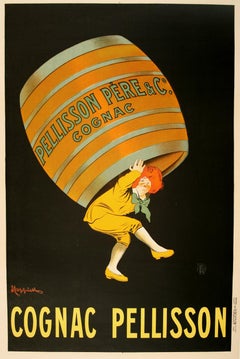
Original Vintage Leonetto Cappiello 1920 s Cognac Pellisson Poster Small Size
By Leonetto Cappiello
Located in Boca Raton, FL
Cognac Pellisson is a French liquor poster from circa 1920, by famous poster artist Leonetto Cappiello. It is a typically whimsical Cappiello design featuring the oversized keg of Co...
Category

1920s Jules Chéret More Prints

Materials

Lithograph

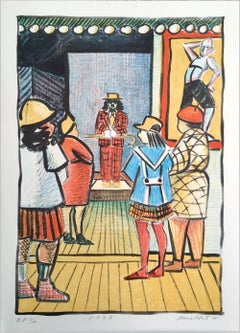
C F S I, Signed Lithograph, Coney Island, Comic Character Figures
By Marie Roberts
Located in Union City, NJ
C F S I is an original hand drawn lithograph by the New York woman artist Marie Roberts printed using hand lithography techniques on archival Arches paper 100% acid free. C F S I portrays a Coney Island Sideshow Performance with several onlookers standing by the stage watching the show. C F S I is a skillfully expressed comic character figure drawing printed in black ink shaded with colored crayon line textures in shades of red, yellow and blue. C F S I is a very fine impression exemplifying the magic and artistic mastery of hand crafted lithography with its nuanced tusche brush strokes and pencil crayon line textures and shading. Print size - 29.5 x 21.25 in, unframed, excellent condition, hand signed in pencil by Marie Roberts Image size - 26.25 x 18.25 in Year published - 1995 Edition size - 25 Marie Roberts, a Coney Island native is best known for her banners for the Coney Island Circus Sideshow...
Category

1990s Contemporary Jules Chéret More Prints

Materials

Lithograph

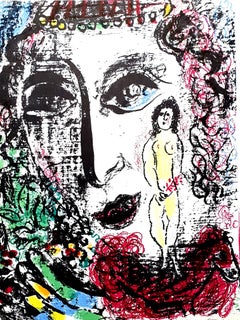
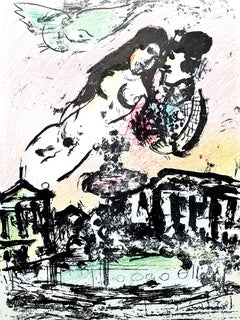
Marc Chagall - Original Lithograph
By Marc Chagall
Located in Collonge Bellerive, Geneve, CH
Marc Chagall Original Lithograph 1963 Dimensions: 32 x 24 cm Reference: Chagall Lithographe 1957-1962. VOLUME II. Condition : Excellent Marc Chagall (born in 1887) Marc Chagall was born in Belarus in 1887 and developed an early interest in art. After studying painting, in 1907 he left Russia for Paris, where he lived in an artist colony on the city’s outskirts. Fusing his own personal, dreamlike imagery with hints of the fauvism and cubism popular in France at the time, Chagall created his most lasting work—including I and the Village (1911)—some of which would be featured in the Salon des Indépendants exhibitions. After returning to Vitebsk for a visit in 1914, the outbreak of WWI trapped Chagall in Russia. He returned to France in 1923 but was forced to flee the country and Nazi persecution during WWII. Finding asylum in the U.S., Chagall became involved in set and costume design before returning to France in 1948. In his later years, he experimented with new art forms and was commissioned to produce numerous large-scale works. Chagall died in St.-Paul-de-Vence in 1985. The Village Marc Chagall was born in a small Hassidic community on the outskirts of Vitebsk, Belarus, on July 7, 1887. His father was a fishmonger, and his mother ran a small sundries shop in the village. As a child, Chagall attended the Jewish elementary school, where he studied Hebrew and the Bible, before later attending the Russian public school. He began to learn the fundamentals of drawing during this time, but perhaps more importantly, he absorbed the world around him, storing away the imagery and themes that would feature largely in most of his later work. At age 19 Chagall enrolled at a private, all-Jewish art school and began his formal education in painting, studying briefly with portrait artist Yehuda Pen. However, he left the school after several months, moving to St. Petersburg in 1907 to study at the Imperial Society for the Protection of Fine Arts. The following year, he enrolled at the Svanseva School, studying with set designer Léon Bakst, whose work had been featured in Sergei Diaghilev's Ballets Russes. This early experience would prove important to Chagall’s later career as well. Despite this formal instruction, and the widespread popularity of realism in Russia at the time, Chagall was already establishing his own personal style, which featured a more dreamlike unreality and the people, places and imagery that were close to his heart. Some examples from this period are his Window Vitebsk (1908) and My Fianceé with Black Gloves (1909), which pictured Bella Rosenfeld, to whom he had recently become engaged. The Beehive Despite his romance with Bella, in 1911 an allowance from Russian parliament member and art patron Maxim Binaver enabled Chagall to move to Paris, France. After settling briefly in the Montparnasse neighborhood, Chagall moved further afield to an artist colony known as La Ruche (“The Beehive”), where he began to work side by side with abstract painters such as Amedeo Modigliani and Fernand Léger as well as the avant-garde poet Guillaume Apollinaire. At their urging, and under the influence of the wildly popular fauvism and cubism, Chagall lightened his palette and pushed his style ever further from reality. I and the Village (1911) and Homage to Apollinaire (1912) are among his early Parisian works, widely considered to be his most successful and representative period. Though his work stood stylistically apart from his cubist contemporaries, from 1912 to 1914 Chagall exhibited several paintings at the annual Salon des Indépendants exhibition, where works by the likes of Juan Gris, Marcel Duchamp and Robert Delaunay were causing a stir in the Paris art world. Chagall’s popularity began to spread beyond La Ruche, and in May 1914 he traveled to Berlin to help organize his first solo exhibition, at Der Sturm Gallery. Chagall remained in the city until the highly acclaimed show opened that June. He then returned to Vitebsk, unaware of the fateful events to come. War, Peace and Revolution In August 1914 the outbreak of World War I precluded Chagall’s plans to return to Paris. The conflict did little to stem the flow of his creative output, however, instead merely giving him direct access to the childhood scenes so essential to his work, as seen in paintings such as Jew in Green (1914) and Over Vitebsk (1914). His paintings from this period also occasionally featured images of the war’s impact on the region, as with Wounded Soldier (1914) and Marching (1915). But despite the hardships of life during wartime, this would also prove to be a joyful period for Chagall. In July 1915 he married Bella, and she gave birth to a daughter, Ida, the following year. Their appearance in works such as Birthday (1915), Bella and Ida by the Window (1917) and several of his “Lovers” paintings give a glimpse of the island of domestic bliss that was Chagall’s amidst the chaos. To avoid military service and stay with his new family, Chagall took a position as a clerk in the Ministry of War Economy in St. Petersburg. While there he began work on his autobiography and also immersed himself in the local art scene, befriending novelist Boris Pasternak, among others. He also exhibited his work in the city and soon gained considerable recognition. That notoriety would prove important in the aftermath of the 1917 Russian Revolution when he was appointed as the Commissar of Fine Arts in Vitebsk. In his new post, Chagall undertook various projects in the region, including the 1919 founding of the Academy of the Arts. Despite these endeavors, differences among his colleagues eventually disillusioned Chagall. In 1920 he relinquished his position and moved his family to Moscow, the post-revolution capital of Russia. In Moscow, Chagall was soon commissioned to create sets and costumes for various productions at the Moscow State Yiddish Theater...
Category

1960s Surrealist Jules Chéret More Prints

Materials

Lithograph

Marc Chagall - Original Lithograph
$1,487
H 9.45 in W 12.6 in D 0.04 in
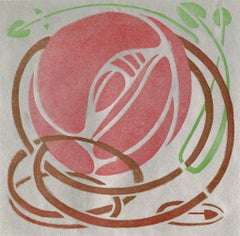
Art Nouveau "Glasgow Rose" original lithograph by Charles Rennie Mackintosh
Located in Palm Beach, FL
Charles Rennie Mackintosh was a Scottish architect, designer, and visual artist. His artistic approach had much in common with European Symbolism. His work, alongside that of his wife Margaret Macdonald, was influential on European design movements such as Art Nouveau and Secessionism and praised by great modernists such as Josef Hoffmann. Mackintosh was born in Glasgow and died in London. He is among the most important figures of Modern Style (British Art Nouveau...
Category

Early 1900s Art Nouveau Jules Chéret More Prints

Materials

Lithograph

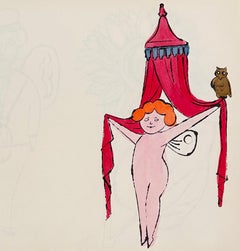
Untitled from In the Bottom of My Garden (Plate 1)
By Andy Warhol
Located in Washington, DC
Artist: Andy Warhol Title: Untitled (Plate 1) Portfolio: 1956 In the Bottom of My Garden Medium: Offset lithograph and watercolor on paper Date: 1956 Frame Size: 15 3/4" x 18 3/8" Sh...
Category

1950s Pop Art Jules Chéret More Prints

Materials

Lithograph

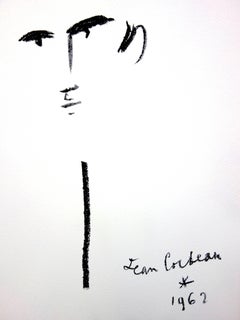
Jean Cocteau - Portrait - Original Lithograph
By Jean Cocteau
Located in Collonge Bellerive, Geneve, CH
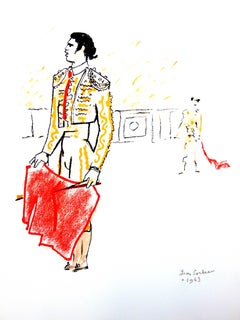
Original Lithograph by Jean Cocteau Title: Taureaux Signed in the plate Dimensions: 40 x 30 cm Edition: 200 Luxury print edition from the portfolio of Trinckvel 1965 Jean Cocteau W...
Category

1960s Modern Jules Chéret More Prints

Materials

Lithograph

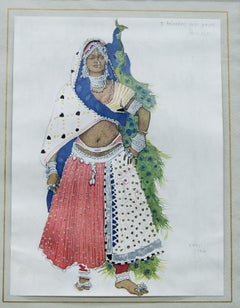
Leon Bakst Three Costume designs from Le Dieu Bleu Ballet 1911
By Leon Bakst
Located in Paonia, CO
Three iconic Leon Bakst costume designs for Le Dieu Bleu ( The Blue God ) a ballet choreographed by Michel Fokine and written by Cocteau. The ballet premiered in Paris in 1912. It tells the story of a girl who tries to dissuade her fiancé from becoming a priest and is thereafter tormented by demons; but she is eventually saved by the Blue God, a part performed by Vaslaw Nijinsky, the greatest male dancer of his time. Fokine’s choreography and Bakst’s costumes drew upon Siamese dance and Hindu sculpture. These three prints are vintage reproductions quite unlike the reproductions of today. They each have the look of original watercolors and are backed on heavy grey rag paper with a hand painted gold border. Properly framed they will definitely look like the original drawing. The size of the actual prints varies slightly but the background paper size is consistently 10.5 x 15.5. Born in Russia in 1866, Léon Bakst belonged to a young generation of European artists who rebelled against 19th-century stage realism, sparking a revolution in theatre design. His fame lay in the sets and costumes he designed for Serge Diaghilev’s (1872 – 1929) legendary dance company the Ballets Russes, and his huge pageant spectaculars for the dancer and patron of the performing arts, Ida Rubinstein...
Category

20th Century Art Nouveau Jules Chéret More Prints

Materials

Color

Marc Chagall - Original Lithograph
By Marc Chagall
Located in Collonge Bellerive, Geneve, CH
Marc Chagall Original Lithograph 1963 Dimensions: 32 x 24 cm Reference: Chagall Lithographe 1957-1962. VOLUME II. Condition : Excellent Marc Chagall (born in 1887) Marc Chagall was born in Belarus in 1887 and developed an early interest in art. After studying painting, in 1907 he left Russia for Paris, where he lived in an artist colony on the city’s outskirts. Fusing his own personal, dreamlike imagery with hints of the fauvism and cubism popular in France at the time, Chagall created his most lasting work—including I and the Village (1911)—some of which would be featured in the Salon des Indépendants exhibitions. After returning to Vitebsk for a visit in 1914, the outbreak of WWI trapped Chagall in Russia. He returned to France in 1923 but was forced to flee the country and Nazi persecution during WWII. Finding asylum in the U.S., Chagall became involved in set and costume design before returning to France in 1948. In his later years, he experimented with new art forms and was commissioned to produce numerous large-scale works. Chagall died in St.-Paul-de-Vence in 1985. The Village Marc Chagall was born in a small Hassidic community on the outskirts of Vitebsk, Belarus, on July 7, 1887. His father was a fishmonger, and his mother ran a small sundries shop in the village. As a child, Chagall attended the Jewish elementary school, where he studied Hebrew and the Bible, before later attending the Russian public school. He began to learn the fundamentals of drawing during this time, but perhaps more importantly, he absorbed the world around him, storing away the imagery and themes that would feature largely in most of his later work. At age 19 Chagall enrolled at a private, all-Jewish art school and began his formal education in painting, studying briefly with portrait artist Yehuda Pen. However, he left the school after several months, moving to St. Petersburg in 1907 to study at the Imperial Society for the Protection of Fine Arts. The following year, he enrolled at the Svanseva School, studying with set designer Léon Bakst, whose work had been featured in Sergei Diaghilev's Ballets Russes. This early experience would prove important to Chagall’s later career as well. Despite this formal instruction, and the widespread popularity of realism in Russia at the time, Chagall was already establishing his own personal style, which featured a more dreamlike unreality and the people, places and imagery that were close to his heart. Some examples from this period are his Window Vitebsk (1908) and My Fianceé with Black Gloves (1909), which pictured Bella Rosenfeld, to whom he had recently become engaged. The Beehive Despite his romance with Bella, in 1911 an allowance from Russian parliament member and art patron Maxim Binaver enabled Chagall to move to Paris, France. After settling briefly in the Montparnasse neighborhood, Chagall moved further afield to an artist colony known as La Ruche (“The Beehive”), where he began to work side by side with abstract painters such as Amedeo Modigliani and Fernand Léger as well as the avant-garde poet Guillaume Apollinaire. At their urging, and under the influence of the wildly popular fauvism and cubism, Chagall lightened his palette and pushed his style ever further from reality. I and the Village (1911) and Homage to Apollinaire (1912) are among his early Parisian works, widely considered to be his most successful and representative period. Though his work stood stylistically apart from his cubist contemporaries, from 1912 to 1914 Chagall exhibited several paintings at the annual Salon des Indépendants exhibition, where works by the likes of Juan Gris, Marcel Duchamp and Robert Delaunay were causing a stir in the Paris art world. Chagall’s popularity began to spread beyond La Ruche, and in May 1914 he traveled to Berlin to help organize his first solo exhibition, at Der Sturm Gallery. Chagall remained in the city until the highly acclaimed show opened that June. He then returned to Vitebsk, unaware of the fateful events to come. War, Peace and Revolution In August 1914 the outbreak of World War I precluded Chagall’s plans to return to Paris. The conflict did little to stem the flow of his creative output, however, instead merely giving him direct access to the childhood scenes so essential to his work, as seen in paintings such as Jew in Green (1914) and Over Vitebsk (1914). His paintings from this period also occasionally featured images of the war’s impact on the region, as with Wounded Soldier (1914) and Marching (1915). But despite the hardships of life during wartime, this would also prove to be a joyful period for Chagall. In July 1915 he married Bella, and she gave birth to a daughter, Ida, the following year. Their appearance in works such as Birthday (1915), Bella and Ida by the Window (1917) and several of his “Lovers” paintings give a glimpse of the island of domestic bliss that was Chagall’s amidst the chaos. To avoid military service and stay with his new family, Chagall took a position as a clerk in the Ministry of War Economy in St. Petersburg. While there he began work on his autobiography and also immersed himself in the local art scene, befriending novelist Boris Pasternak, among others. He also exhibited his work in the city and soon gained considerable recognition. That notoriety would prove important in the aftermath of the 1917 Russian Revolution when he was appointed as the Commissar of Fine Arts in Vitebsk. In his new post, Chagall undertook various projects in the region, including the 1919 founding of the Academy of the Arts. Despite these endeavors, differences among his colleagues eventually disillusioned Chagall. In 1920 he relinquished his position and moved his family to Moscow, the post-revolution capital of Russia. In Moscow, Chagall was soon commissioned to create sets and costumes for various productions at the Moscow State Yiddish Theater...
Category

1960s Surrealist Jules Chéret More Prints

Materials

Lithograph

Marc Chagall - Original Lithograph
$1,487
H 9.45 in W 12.6 in D 0.04 in
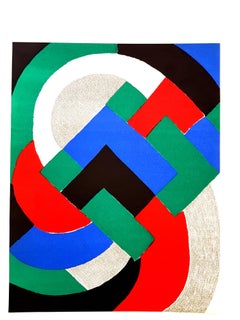
Sonia Delaunay - Composition - Original Lithograph
By Sonia Delaunay
Located in Collonge Bellerive, Geneve, CH
Sonia Delaunay - Composition Original Lithograph 1969 Dimensions: 32 x 25 cm Revue XXe Siècle Cahiers d'art published under the direction of G. di San Lazzaro. Sonia Delaunay was known for her vivid use of color and her bold, abstract patterns, breaking down traditional distinctions between the fine and applied arts as an artist, designer and printmaker. Born Sarah Stern on November 14, 1885 in Gradizhsk, Ukraine, she was adopted in 1890 by her maternal uncle, Henri Terk, a lawyer in St. Petersburg, where she grew up, exposed to music and art, and learning several foreign languages. In 1903, she moved to Germany to study drawing with Ludwig Schmidt-Reutler (1863–1909) at the Karlsruhe academy of fine arts; Arnold Schoenberg (1874–1951), composer-to-be, was among her classmates there. In 1905, she traveled to Paris where she attended art classes at the Académie de la Palette, learned printmaking from Rudolf Grossman (1889–1941), and met Amédée Ozenfant (1886–1966), André Dunoyer de Segonzac (1884–1974), and Jean-Louis Boussingault (1883–1943). Sonia spent much of her time at exhibitions and galleries in Paris, which showed works by Paul Cézanne, Vincent Van Gogh, Pierre Bonnard, and Edouard Vuillard, as well as Les Fauves, Henri Matisse and André Derain. She did, however, maintain contact with Germany, exhibiting at the Galerie Der Sturm, Berlin, in 1913, 1920 and 1921. During her first year in Paris, Sonia met the German collector and art-dealer, Wilhelm Uhde (1874–1947), whom she married on December 5, 1908, and whose Montparnasse gallery, the Galerie Notre-Dame des Champs, showed her first solo exhibition. Through Uhde, Sonia encountered many painters, including Pablo Picasso, Georges Braque, Maurice de Vlaminck, and Robert Delaunay (1885–1941). In 1910, Sonia divorced Uhde by mutual agreement, married Delaunay that same year, and gave birth to their son, Charles, in January 1911. Together Sonia and Robert Delaunay pursued the study of color, influenced by theories of Michel-Eugène Chevreul (1786–1889). Sonia’s interest in simultaneous contrast, as evidenced in her early collages, book bindings, small painted boxes, cushions, waistcoats and lampshades, led to one of her first large-scale works, the painting of the Bal Bullier (1912–1913), a popular Parisian dance-hall. Sonia’s first “simultaneous dresses,” a mix of squares and triangles of taffeta, tulle, flannelette, moiré, and corded silk, date from this period. Friendship with the poet Blaise Cendrars...
Category

1970s Abstract Geometric Jules Chéret More Prints

Materials

Lithograph

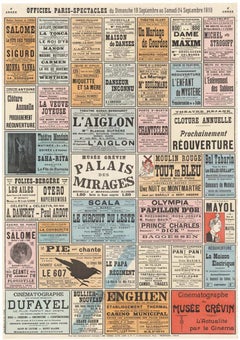
Original 1910 Officiel Paris Spectacles vintage poster for theater performances
Located in Spokane, WA
Linen backed original of the official event spectacles of Paris, promoting Moulin Rouge, Salome, Musee Grevin, Sarah-Rita, Madame Butterfly, Carmen, La Vie de Boheme. Orignial in ex...
Category

1910s Art Nouveau Jules Chéret More Prints

Materials

Lithograph

Jean Cocteau - Bulls - Original Lithograph
By Jean Cocteau
Located in Collonge Bellerive, Geneve, CH
Original Lithograph by Jean Cocteau Title: Taureaux Signed in the plate Dimensions: 40 x 30 cm Edition: 200 Luxury print edition from the portfolio of Trinckvel 1965 Jean Cocteau W...
Category

1960s Modern Jules Chéret More Prints

Materials

Lithograph

Previously Available Items
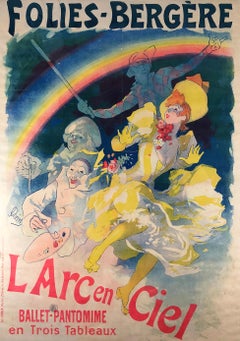
Folies-Bergère, L Arc-en-Ciel
By Jules Chéret
Located in Missouri, MO
Jules Cheret Folies-Bergère, L'Arc-en-Ciel Original Color Lithographic Poster Imp. Chaix (Ateliers Chéret), Paris Catalogue raisonne: Cheret 146, Broido 123, Maindron 111 48 3/4 x ...
Category

1890s Art Nouveau Jules Chéret More Prints

Materials

Lithograph

Jules Chéret more prints for sale on 1stDibs.

Find a wide variety of authentic Jules Chéret more prints available for sale on 1stDibs. You can also browse by medium to find art by Jules Chéret in lithograph and more. Not every interior allows for large Jules Chéret more prints, so small editions measuring 12 inches across are available. Customers who are interested in this artist might also find the work of and Leonetto Cappiello. Jules Chéret more prints prices can differ depending upon medium, time period and other attributes. On 1stDibs, the price for these items starts at $329 and tops out at $3,800, while the average work can sell for $439.
Questions About Jules Chéret More Prints
  • 1stDibs ExpertApril 5, 2022
    Jules Cheret contributed to poster history by changing how the art world viewed posters. In 1884, he showed his works in the first-ever gallery exhibition of posters, helping to elevate the art form. Find a variety of Jules Cheret art on 1stDibs.