Jules Pascin Prints and Multiples
Bulgarian, French, 1885-1930
Jules Pascin was born Julius Mordecai Pincas, in Widdin, Bulgaria to a Spanish-Sephardic Jewish father and a Serbian-Italian mother. His early artistic training was in Vienna and Munich. In 1905, at the age of 20, he adopted the pseudonym Pascin (an anagram of Pincas). About the same time, he began contributing drawings to Simplicissimus, a satirical magazine published in Munich.
In December 1905, Pascin moved to Paris, becoming part of the great migration of artists to that city at the start of the 20th century. In 1907, Pascin met Hermine Lionette Cartan David, also a painter, and they became lovers. They lived together until Pascin left for America on October 3, 1914. A few weeks later on October 31, Hermine David sailed for the United States to join Pascin.
Pascin lived in the United States from 1914 to 1920, sitting out World War I. He taught at the Telfair Academy in Savannah, Georgia, associated with the Telfair Art Museum. He and Hermine painted in New York City as well as in Miami, New Orleans, and Cuba.
Despite his social life, Pascin created thousands of watercolors and sketches, plus drawings and caricatures, which he sold to various newspapers and magazines. He studied the art of drawing at the Académie Colarossi and, like Henri de Toulouse-Lautrec, he drew upon his surroundings and his friends, both male and female, as subjects. He wanted to become a serious painter, but in time, he became deeply depressed over his inability to achieve critical success with his efforts.
During the 1920s, Pascin mostly painted fragile petites filles, prostitutes waiting for clients, or models waiting for the sitting to end. His fleetingly rendered paintings sold readily, but the money he made was quickly spent. Famous as the host of numerous large parties in his flat, whenever he was invited elsewhere for dinner, he arrived with as many bottles of wine as he could carry. He frequently led a large group of friends on summer picnics beside the River Marne, where their excursions lasted all afternoon.
Ernest Hemingway's chapter titled "With Pascin At the Dôme," in A Moveable Feast, recounted a night in 1923 when he had stopped off at Le Dôme and met Pascin escorted by two models. Hemingway's portrayal of the evening is considered one of the defining images of Montparnasse at the time.
Pascin struggled with depression and alcoholism. "[D]riven to the wall by his own legend," according to art critic Gaston Diehl, he committed suicide at the age of 45 on the eve of a prestigious solo show. He slit his wrists and hung himself in his studio in Montmartre. On the wall he left a message written in blood, to a former lover, Cecile (Lucy) Vidil Krohg In his last will and testament, Pascin left his estate equally to his wife, Hermine David, and his mistress Lucy Krohg.to
1
7
1
2
Overall Width
to
Overall Height
to
7
1
1
23
1,221
968
913
840
10
1
3
2
8
2
8
6
4
3
3
2
1
1
1
6
4
1
1
1
1
3
6
4
Artist: Jules Pascin
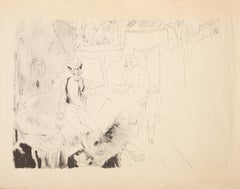
Interior Bedroom, Modern Etching by Jules Pascin
By Jules Pascin
Located in Long Island City, NY
Jules Pascin, Bulgarian/French (1885 - 1930) - Interior Bedroom, Medium: Etching on thin woven paper, Image Size: 11.75 x 16 inches, Size: 14.5 x 18.5 in. (36.83 x 46.99 cm), Descr...
Category
Mid-20th Century Modern Jules Pascin Prints and Multiples
Materials
Etching
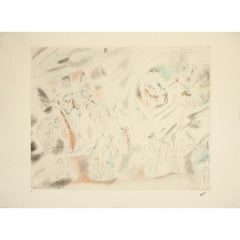
1930 aquatint by Jules Pascin titled Salomé dansant devant le roi Hérode
By Jules Pascin
Located in PARIS, FR
This refined 1930 aquatint by Jules Pascin, titled Salomé dansant devant le roi Hérode, offers a poetic and dream-like interpretation of the biblical scene of Salome before King Hero...
Category
1930s Jules Pascin Prints and Multiples
Materials
Paper, Aquatint, Lithograph
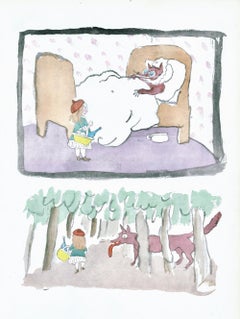
Jules Pascin, Little Red Riding Hood, from XXe siecle, 1938 (after)
By Jules Pascin
Located in Southampton, NY
This exquisite lithograph after Jules Pascin (1885–1930), titled Le Petit Chaperon Rouge (Little Red Riding Hood), from the album XXe siecle, Sommaire du No. 1, 1er Mars 1938, Chroni...
Category
1930s Modern Jules Pascin Prints and Multiples
Materials
Lithograph

$716 Sale Price
20% Off
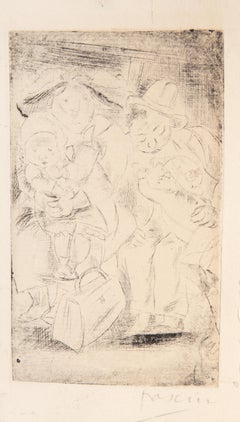
Women and Children, Modern Etching by Jules Pascin
By Jules Pascin
Located in Long Island City, NY
Jules Pascin (1885 - 1930) - Women and Children, Medium: Etching, signed in pencil lower right and dedicated on verso, Image Size: 4.75 x 2.75 inches, Size: 5.75 x 3.25 in. (14.61 ...
Category
Mid-20th Century Modern Jules Pascin Prints and Multiples
Materials
Etching
The Sisters - Original woodcut - 1965
By Jules Pascin
Located in Paris, IDF
Jules Pascin
The Sisters
Original woodcut in colors
Printed signature in the plate
On Arches vellum 38 x 28 cm (c. 15 x 11 in)
INFORMATION :
Edited for the portfolio Les Peintres ...
Category
1960s Modern Jules Pascin Prints and Multiples
Materials
Woodcut
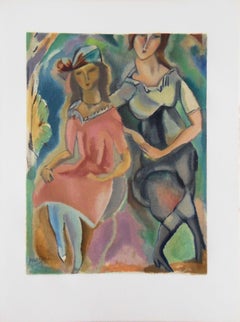
11 Rue Foyatier, Modern Etching by Jules Pascin
By Jules Pascin
Located in Long Island City, NY
Jules Pascin, Bulgarian/French (1885 - 1930) - 11 Rue Foyatier, Medium: Etching, signed in the plate, Image Size: 6.5 x 4.5 inches, Size: 8.75 x 6 in. (22.23 x 15.24 cm), Descripti...
Category
Mid-20th Century Modern Jules Pascin Prints and Multiples
Materials
Etching
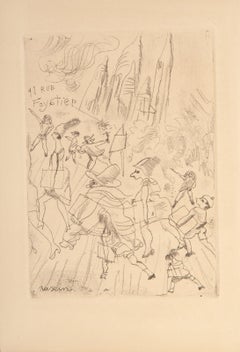
Jules Pascin (French, 1885-1930) "Two Women Reclining" Original Etching C.1920
By Jules Pascin
Located in San Francisco, CA
Jules Pascin (French, 1885-1930) "Two Women Reclining" Original Etching C.1920
Plate dimensions 9" wide x 12" high
Frame dimensions 19.5" wide x 26.5" high
Plate signed
The etchi...
Category
Early 20th Century Impressionist Jules Pascin Prints and Multiples
Materials
Etching
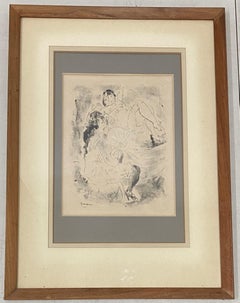
"Dame de la Nuit, " Jules Pascin, hand-colored etching, 1920-30, figurative
By Jules Pascin
Located in Wiscasset, ME
Born Julius Pincas in 1885 in Bulgaria, the artist adopted the name Jules Pascin under which his paintings are known. Pascin studied in Vienna and Munich, and traveled and painted regularly in Paris and Berlin. Pascin came to the United States in 1914 and in 1920 became a US citizen. He returned later...
Category
1920s Modern Jules Pascin Prints and Multiples
Materials
Etching
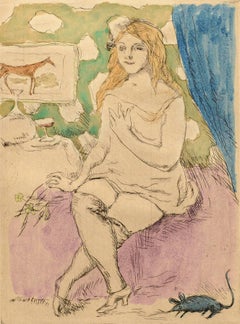
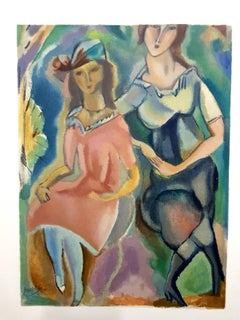
Femininity - Lithograph
By Jules Pascin
Located in Collonge Bellerive, Geneve, CH
(after) Jules Pascin
Title: Femininity
Signed in the plate
Dimensions: 38 x 28 cm
from the edition of 250 as issued in Warnod, Andre, "Les Peintres mes amis" (Paris: Les Heures Claires, 1965)
Jules Pascin, born Julius Mordechai Pincas, was a Bulgarian Jewish painter sometimes referred to as "the Prince of Montparnasse."
He was born on March 31, 1885 in Vidin, Bulgaria to a Spanish-Sephardic Jewish father and a Serbian-Italian mother, the eighth of eleven children. The Pincas family moved to Bucharest, Romania in 1892 and Pascin was raised there until he left for boarding school in Vienna in 1896.
While briefly working for his father’s grain merchant firm in Bucharest at fifteen, Pascin spent much of his time completing his earliest drawings in the local bordello, where he was residing under the Madame’s protection. In 1902, at the age of seventeen, Pascin moved to Vienna to study painting. The next year, he studied at the Heymann Art School in Munich. There, he supported himself by selling satirical drawings to Simplicissimus and other German magazines. Pascin would contribute drawings to a Munich daily through 1929.
Pascin’s contributions were widely recognized for their wit and insight, and upon his arrival in Paris in 1905 he was welcomed at the Gare Montparnasse by an international group of artists and writers who gathered at the Café du Dôme, which Pascin soon began to frequent regularly. The group included Grossman, Grosz, William Howard, Levy, and Emil Orlik. Pascin was also a close friend of Amadeo Modigliani.
Upon his arrival in Paris, Julius Mordechai Pincas changed his name to Jules Pascin and soon became the symbol of the Montparnasse artist community. Always in his bowler hat, he was a witty presence at Le Dôme café, Le Jockey club, and the others haunts of the area’s bohemian society, and was known for hosting legendary all-night parties. In his story, A Moveable Feast, Ernest Hemingway wrote a chapter titled With Pascin At the Dôme, recounting a night in 1923 when he had stopped off at Le Dôme and met Pascin escorted by two models. Hemingway's depiction of the events of that night is considered one of the defining images of Montparnasse at the time.
In 1907, Pascin had his first solo exhibition at Paul Cassirer Gallery in Berlin. Three years later, Cassirir commissioned Pascin to illustrate Heinrich Heine's Aus den Memoiren des Herrn von Schnabelewopski. In 1911, Pascin exhibited his work at Berlin Secession and a year later at the Sonderbund-Aussstellung in Cologne. The artist’s first exhibition in the United States was at the Armory Show in New York, where he exhibited twelve of his works.
Upon the outbreak of World War I, Pascin left Paris for London in order to avoid conscription in the Bulgarian Army. In October 1914, he immigrated to New York, where he stayed through 1920 and would later return again in 1927. Pascin was immediately welcomed into an artists circle based around the Penguin Club and became acquainted with John Quinn, an important art collector. A short time after his arrival in New York, Pascin was given a one-man show by the Berlin Photographic Company, a Madison Avenue gallery. While in New York, Pascin became associated with several progressive painters, including Walt Kuhn, Yasuo Kuniyoshi, and Max Weber. Many of these painters were influenced by Pascin’s unique style, in which he combined elements from Expressionism and Cubism with his own personal view of his environment.
Pascin used his time in the United States to travel extensively, especially in the southern states and the Caribbean islands, recording his travels in sketches that were widely acclaimed. Pascin married Hermine David in 1918. In 1920, Pascin was awarded American citizenship with support from Alfred Stieglitz and Maurice Sterne. He returned to Paris in October of that same year and met his future mistress, Lucy Krohg, the wife of the Norwegian painter Per Krohg...
Category
1960s Modern Jules Pascin Prints and Multiples
Materials
Lithograph
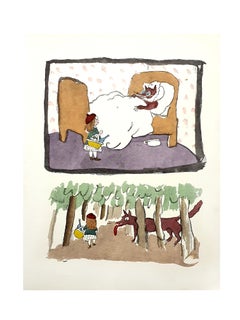
Jules Pascin - Little Red Riding Hood - Original Lithograph
By Jules Pascin
Located in Collonge Bellerive, Geneve, CH
Jules Pascin - Little Red Riding Hood - Original Lithograph
Conditions: excellent
32 x 24 cm
1938
From the art review XXe siècle, San Lazzaro
Un...
Category
1930s Contemporary Jules Pascin Prints and Multiples
Materials
Lithograph
Related Items
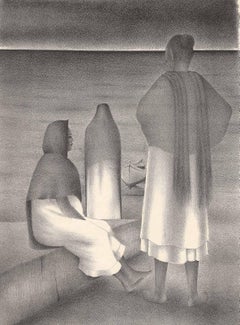
La Espera (The Wait -- Three Women by the sea)
By Francisco Dosamantes
Located in New Orleans, LA
The Wait. Three native Mexican women wait by the sea. This impression is #31/100. An impression of this lithograph is in the permanent collectio...
Category
Mid-20th Century Modern Jules Pascin Prints and Multiples
Materials
Lithograph
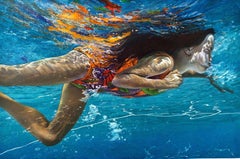
Muse (a young novice in colorful swim suit struggles thru a pool of blue)
By Art Werger
Located in New Orleans, LA
Muse is #43 of 45. It depicts a young woman in a colorful swimsuit doing her best to swim through the blue waters of the pool. Her mouth is pursed and the bubbles flow out. I sold an impression of this image to an olympic swimming...
Category
Early 2000s American Modern Jules Pascin Prints and Multiples
Materials
Etching
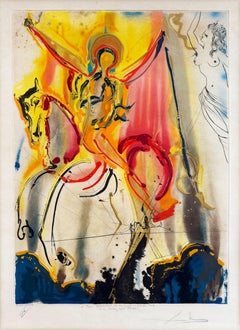
Le Cavalier Triomphant
By Salvador Dalí
Located in OPOLE, PL
Salvador Dali (1904-1989) - Le Cavalier Triomphant
Drypint etching on chromolithograph, embossed from 1973.
The edition epruve d'artiste.
Countersigned by the editor.
Additionall...
Category
1970s Surrealist Jules Pascin Prints and Multiples
Materials
Etching, Aquatint, Lithograph
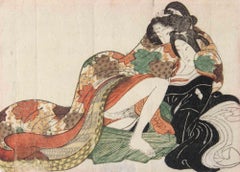
Shunga - Woodcut attr. Keisai Eisen - Mid-19th Century
By Keisai Eisen
Located in Roma, IT
Woodcut shunga print attributed to Keisai Eisen and realized in the early 19th century.
Good condition except for some signs of time.
Category
Mid-19th Century Modern Jules Pascin Prints and Multiples
Materials
Woodcut
$355
H 3.55 in W 4.73 in D 0.04 in
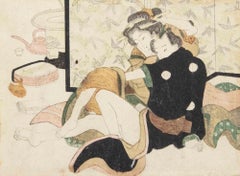
Shunga - Woodcut attr. Keisai Eisen - Mid-19th Century
By Keisai Eisen
Located in Roma, IT
Woodcut shunga print attributed to Keisai Eisen and realized in the early 19th century.
Good condition except for some signs of time.
Category
Mid-19th Century Modern Jules Pascin Prints and Multiples
Materials
Woodcut
$355
H 3.55 in W 4.73 in D 0.04 in
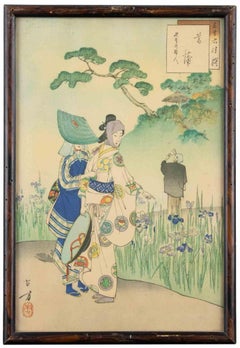
Sanjûroku Kasen ... - Woodcut by Mizuno Toshikata - 1893
By Mizuno Toshikata
Located in Roma, IT
Nishiki-e (woodcut print), in vertical oban format (31x20.5) realized by Mizuno Toshikata in 1893 (Meiji 26).
Belongs to the Series "Sanjûroku Kasen" (Thirty-Six Beauties in Compari...
Category
1890s Modern Jules Pascin Prints and Multiples
Materials
Woodcut
$379
H 12.21 in W 8.08 in D 0.04 in
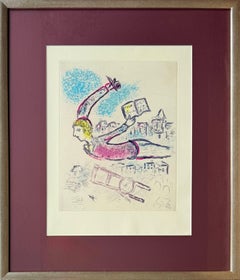
De Mauvais Sujets - Planche V
By Marc Chagall
Located in OPOLE, PL
Marc Chagall (1887-1985) - De Mauvais Sujets - Planche V
Etching and aquatint from 1958.
An unnumbered and unsigned copy from a limited edition of 153.
Dimensions of sheet: 43.5 x 32.5 cm
Dimensions in frame: 63.2 x 53.2 cm
Publisher: Les Bibliophiles de l’Union Française, Paris.
Printer: Atelier Lacourière et Frélaut, Paris.
Reference: Cramer 35
--
This original color etching comes from De Mauvais Sujets ("The Bad Subjects"), a 1958 illustrated portfolio that paired Marc Chagall’s artwork...
Category
1950s Surrealist Jules Pascin Prints and Multiples
Materials
Etching, Aquatint
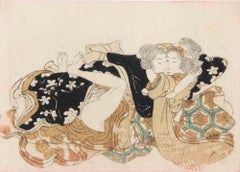
Shunga - Woodcut attr. Keisai Eisen - Mid-19th Century
By Keisai Eisen
Located in Roma, IT
Woodcut shunga print attributed to Keisai Eisen and realized in the early 19th century.
Good condition except for some signs of time.
Category
Mid-19th Century Modern Jules Pascin Prints and Multiples
Materials
Woodcut
$355
H 3.55 in W 4.73 in D 0.04 in
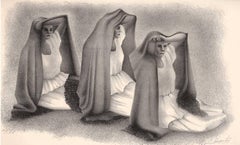
Mujeres Veracruzans (three seated women from Vera Cruz Mexico in shawls)
By Francisco Dosamantes
Located in New Orleans, LA
Three native Mexican women all similarly dressed in traditional, flowing white dresses covered in dark, fringed shawls raise their heads as if the...
Category
Mid-20th Century Modern Jules Pascin Prints and Multiples
Materials
Lithograph
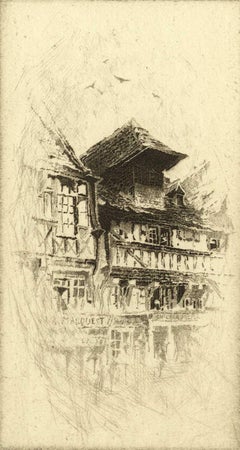
A Gable in the Grande Rue, Lisieux
By John Taylor Arms
Located in New Orleans, LA
This image is the 3rd etching created by Arms. It was printed byGrederick Reynolds in an edition of 116. Referenced as Fletcher #3 the image is the second in his Gable series. Lis...
Category
1910s American Modern Jules Pascin Prints and Multiples
Materials
Etching
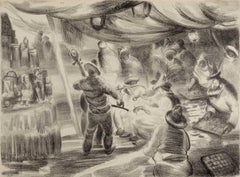
Mexican Orchestra (joy of the people is captured in this celebratory festival)
By George Overbury Hart
Located in New Orleans, LA
"Mexican Orchestra" is one of the George Overbury Hart's largest pieces. It is #14 from a limited edition of 50. The image captures a festive event with hanging lanterns, an orches...
Category
1920s American Modern Jules Pascin Prints and Multiples
Materials
Lithograph
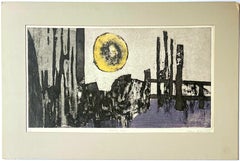
Evening Moon, color etching renowned printmaker Signed/N, ex Denver Art Museum
Located in New York, NY
Kathan Brown
Evening Moon, 1962
Color etching on wove paper
Hand signed, titled, dated and numbered 30/100 by Kathan Brown on the front
18 3/4 × 27 3/4 inches
De-accessioned from the...
Category
Mid-20th Century Modern Jules Pascin Prints and Multiples
Materials
Etching
$1,000
H 18.75 in W 27.75 in
Previously Available Items
Cendrillon, Impressionist Etching by Jules Pascin
By Jules Pascin
Located in Long Island City, NY
Jules Pascin, Bulgarian/French (1885 - 1930) - Cendrillon, Year: 1929, Medium: Etching with Aquatint, signed in the plate, Image Size: 10 x 14 inches, Size: 13 x 17.5 in. (33.02 x ...
Category
1920s Impressionist Jules Pascin Prints and Multiples
Materials
Etching, Aquatint
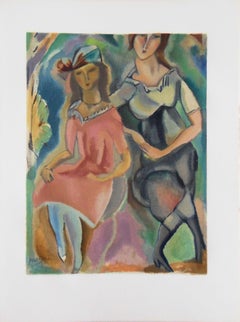
The Sisters - Original woodcut - 1965
By Jules Pascin
Located in Paris, IDF
Jules Pascin
The Sisters
Original woodcut in colors
Printed signature in the plate
On Arches vellum 38 x 28 cm (c. 15 x 11 in)
INFORMATION :
Edited for the portfolio Les Peintres ...
Category
1960s Modern Jules Pascin Prints and Multiples
Materials
Woodcut
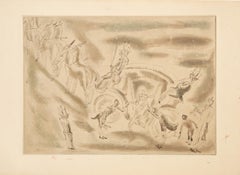
"King Solomon
s Verdict" Etching, Linear Drawing, Nudes, Biblical Scene
By Jules Pascin
Located in Detroit, MI
The Judgement of Solomon, “King Solomon’s Verdict” is a story from the Hebrew Bible in which King Solomon of Israel ruled between two women both claiming ...
Category
1920s Expressionist Jules Pascin Prints and Multiples
Materials
Etching
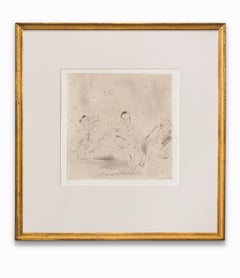
School of Paris etching,
At the Cafe
by the Prince of Montparnasse
By Jules Pascin
Located in Santa Cruz, CA
Signed lower right, 'Pascin' (French, 1885-1930) with number and limitation, '5/100' lower left; additionally inscribed verso, 'Pascin: Hommes et Femmes au Cafe'.
Born Julius Mordec...
Category
1910s Jules Pascin Prints and Multiples
Materials
Paper, Etching
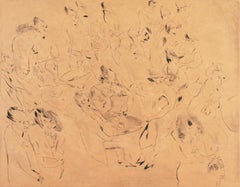
The Sisters - Original woodcut - 1965
By Jules Pascin
Located in Paris, IDF
Jules Pascin
The Sisters
Original woodcut in colors
Printed signature in the plate
On Arches vellum 38 x 28 cm (c. 15 x 11 in)
INFORMATION :
Edited for the portfolio Les Peintres ...
Category
1960s Modern Jules Pascin Prints and Multiples
Materials
Woodcut
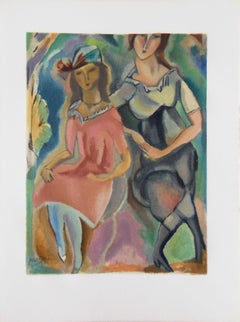
The Sisters - Original woodcut - 1965
By Jules Pascin
Located in Paris, IDF
Jules Pascin
The Sisters
Original woodcut in colors
Printed signature in the plate
On Arches vellum 38 x 28 cm (c. 15 x 11 in)
INFORMATION :
Edited for the portfolio Les Peintres ...
Category
1960s Modern Jules Pascin Prints and Multiples
Materials
Woodcut
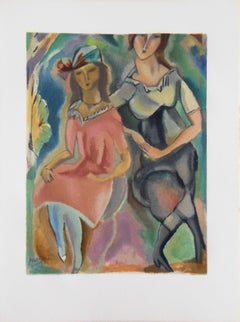
Jules Pascin - Au Bal - Original Etching
By Jules Pascin
Located in Collonge Bellerive, Geneve, CH
Jules Pascin - Au Bal - Original Etching
Dimensions : 13 x 10".
Paper : Rives vellum.
Edition : 225 copies.
1927
From Tableaux de Paris, Emile-Paul Freres, Paris
Jules Pascin, born Julius Mordechai Pincas, was a Bulgarian Jewish painter sometimes referred to as "the Prince of Montparnasse."
He was born on March 31, 1885 in Vidin, Bulgaria to a Spanish-Sephardic Jewish father and a Serbian-Italian mother, the eighth of eleven children. The Pincas family moved to Bucharest, Romania in 1892 and Pascin was raised there until he left for boarding school in Vienna in 1896.
While briefly working for his father’s grain merchant firm in Bucharest at fifteen, Pascin spent much of his time completing his earliest drawings in the local bordello, where he was residing under the Madame’s protection. In 1902, at the age of seventeen, Pascin moved to Vienna to study painting. The next year, he studied at the Heymann Art School in Munich. There, he supported himself by selling satirical drawings to Simplicissimus and other German magazines. Pascin would contribute drawings to a Munich daily through 1929.
Pascin’s contributions were widely recognized for their wit and insight, and upon his arrival in Paris in 1905 he was welcomed at the Gare Montparnasse by an international group of artists and writers who gathered at the Café du Dôme, which Pascin soon began to frequent regularly. The group included Grossman, Grosz, William Howard, Levy, and Emil Orlik. Pascin was also a close friend of Amadeo Modigliani.
Upon his arrival in Paris, Julius Mordechai Pincas changed his name to Jules Pascin and soon became the symbol of the Montparnasse artist community. Always in his bowler hat, he was a witty presence at Le Dôme café, Le Jockey club, and the others haunts of the area’s bohemian society, and was known for hosting legendary all-night parties. In his story, A Moveable Feast, Ernest Hemingway wrote a chapter titled With Pascin At the Dôme, recounting a night in 1923 when he had stopped off at Le Dôme and met Pascin escorted by two models. Hemingway's depiction of the events of that night is considered one of the defining images of Montparnasse at the time.
In 1907, Pascin had his first solo exhibition at Paul Cassirer Gallery in Berlin. Three years later, Cassirir commissioned Pascin to illustrate Heinrich Heine's Aus den Memoiren des Herrn von Schnabelewopski. In 1911, Pascin exhibited his work at Berlin Secession and a year later at the Sonderbund-Aussstellung in Cologne. The artist’s first exhibition in the United States was at the Armory Show in New York, where he exhibited twelve of his works.
Upon the outbreak of World War I, Pascin left Paris for London in order to avoid conscription in the Bulgarian Army. In October 1914, he immigrated to New York, where he stayed through 1920 and would later return again in 1927. Pascin was immediately welcomed into an artists circle based around the Penguin Club and became acquainted with John Quinn, an important art collector. A short time after his arrival in New York, Pascin was given a one-man show by the Berlin Photographic Company, a Madison Avenue gallery. While in New York, Pascin became associated with several progressive painters, including Walt Kuhn, Yasuo Kuniyoshi, and Max Weber. Many of these painters were influenced by Pascin’s unique style, in which he combined elements from Expressionism and Cubism with his own personal view of his environment.
Pascin used his time in the United States to travel extensively, especially in the southern states and the Caribbean islands, recording his travels in sketches that were widely acclaimed. Pascin married Hermine David in 1918. In 1920, Pascin was awarded American citizenship with support from Alfred Stieglitz and Maurice Sterne. He returned to Paris in October of that same year and met his future mistress, Lucy Krohg, the wife of the Norwegian painter Per Krohg...
Category
1920s Modern Jules Pascin Prints and Multiples
Materials
Etching
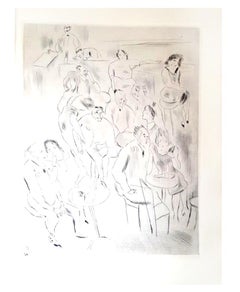
Jules Pascin prints and multiples for sale on 1stDibs.
Find a wide variety of authentic Jules Pascin prints and multiples available for sale on 1stDibs. You can also browse by medium to find art by Jules Pascin in etching and more. Not every interior allows for large Jules Pascin prints and multiples, so small editions measuring 4 inches across are available. Customers who are interested in this artist might also find the work of André Lhote, Arthur John Trevor Briscoe, and Caroline Durieux. Jules Pascin prints and multiples prices can differ depending upon medium, time period and other attributes. On 1stDibs, the price for these items starts at $1,000 and tops out at $1,000, while the average work can sell for $1,000.