Julio de Diego Paintings

American, 1900-1979

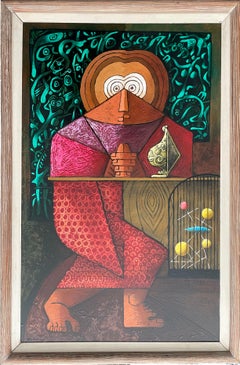
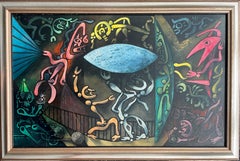
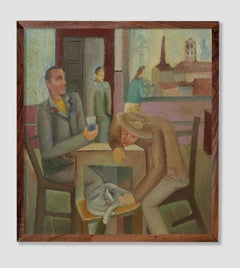
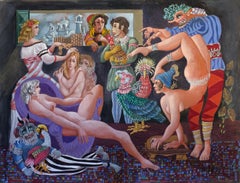
Julio De Diego was one of the most colorful artists to work in Chicago. Born in Madrid in 1900, he left home at the age of 15 to apprentice as a scene painter for theatres. After service in the Spanish army, including six months fighting in North Africa, Diego traveled to Paris and Rome to study art. He also appeared as an extra in Diaghilev’s Ballet Russes. He emigrated to the United States in 1924. He lived in New York for two years, then went to Chicago, where he remained until 1942. At first, he earned a living as a magazine illustrator, decorative painter and graphic designer. By the early 1930s, Diego began to show regularly at the Art Institute of Chicago, appearing at thirty-two annual exhibitions of Chicago Artists, American artists and watercolorists, between 1931–47. He was employed by the easel division of the Illinois Art Project during the mid-1930s. He traveled to Mexico for the first time in 1939, becoming close friends with Carlos Mérida. Diego was deeply affected by the Spanish Civil War, and many of his works reflect the conflict that presaged the Second World War. Meditation over Inexplicable Logic seems to be a kind of preparation for his self-portrait in the Art Institute’s collection, titled The Perplexity of What To Do (1940). Both feature isolated, brooding figures lost in their inability to respond to events. He left Chicago in 1942 but continued to exhibit his work at major institutions. In 1946, Life magazine’s article described him spending time “cooking aromatic Spanish dishes and reading works of Spanish mystical philosophers and poets. He smokes cigarettes incessantly and dresses flamboyantly, affecting cerise mufflers and jangling bracelets.” Diego gained more notoriety in 1948 when he married the great burlesque artist, Gypsy Rose Lee. After their separation and divorce in the mid-1950s, he lived for a time in New York at the Chelsea Hotel, a haunt of artists, musicians and poets. Diego settled in Sarasota, Florida in 1967, near former friends from Chicago, where he died in 1979. Daniel Schulman References “Julio De Diego: He Paints Weird War and Peace.” Life Magazine, March 11, 1946. De Diego, Julio. Pamphlet File P-07866. Ryerson Library, Art Institute of Chicago.

to
1
1
1
4
Overall Width
to
Overall Height
to
7
2
4
6
1
6
1
2
2
1
1
7
7
5
5
4
17
781
712
707
690
7
7
Artist: Julio de Diego
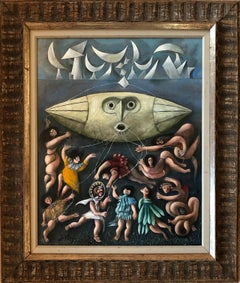
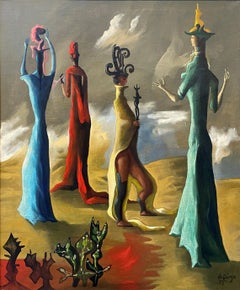
Lords of the Sky oil painting by Julio De Diego
By Julio de Diego
Located in Hudson, NY
Lords of the Sky (c.1950) Oil on canvas, 30" x 24" 40" x 34" x 2" framed Provenance: The Artist, his daughter About this artist: Julio De Diego crafted a formidable persona within ...
Category

Mid-20th Century Modern Julio de Diego Paintings

Materials

Canvas, Oil

The Magician oil and tempera painting by Julio de Diego
By Julio de Diego
Located in Hudson, NY
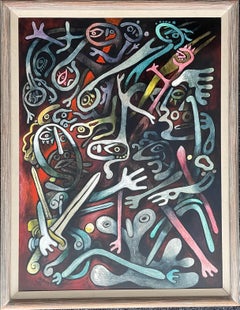
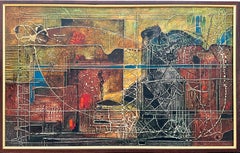
Julio De Diego’s Atomic Series paintings made an extraordinary statement regarding the shock and fear that accompanied the dawn of the nuclear age. In the artist’s own words, “Scientists were working secretly to develop formidable powers taken from the mysterious depths of the earth - with the power to make the earth useless! Then, the EXPLOSION! . . . we entered the Atomic Age, and from there the neo-Atomic war begins. Explosions fell everywhere and man kept on fighting, discovering he could fight without flesh.” To execute these works, De Diego developed a technique of using tempera underpainting before applying layer upon layer of pigmented oil glazes. The result is paintings with surfaces which were described as “bonelike” in quality. The forms seem to float freely, creating a three-dimensional visual effect. In the 1954 book The Modern Renaissance in American Art, author Ralph Pearson summarizes the series as “a fantastic interpretation of a weighty theme. Perhaps it is well to let fantasy and irony appear to lighten the devastating impact. By inverse action, they may in fact increase its weight.” Exhibited 1964 Marion Koogler McNay Art Institute, San Antonio, Texas This work retains its original frame which measures 54" x 42" x 2" About this artist: Julio De Diego crafted a formidable persona within the artistic developments and political struggles of his time. The artist characterized his own work as “lyrical,” explaining, “through the years, the surrealists, the social-conscious painters and the others tried to adopt me, but I went my own way, good, bad or indifferent.” [1] His independence manifested early in life when de Diego left his parent’s home in Madrid, Spain, in adolescence following his father’s attempts to curtail his artistic aspirations. At the age of fifteen he held his first exhibition, set up within a gambling casino. He managed to acquire an apprenticeship in a studio producing scenery for Madrid’s operas, but moved from behind the curtains to the stage, trying his hand at acting and performing as an extra in the Ballet Russes’ Petrouchka with Nijinsky. He spent several years in the Spanish army, including a six-month stretch in the Rif War of 1920 in Northern Africa. His artistic career pushed ahead as he set off for Paris and became familiar with modernism’s forays into abstraction, surrealism, and cubism. The artist arrived in the U.S. in 1924 and settled in Chicago two years later. He established himself with a commission for the decoration of two chapels in St. Gregory’s Church. He also worked in fashion illustration, designed magazine covers and developed a popular laundry bag for the Hotel Sherman. De Diego began exhibiting through the Art Institute of Chicago in 1929, and participated in the annual Chicago Artists Exhibitions, Annual American Exhibitions, and International Water Color Exhibitions. He held a solo exhibition at the Art Institute of Chicago in the summer of 1935. Though the artist’s career was advancing, his family life had deteriorated. In 1932 his first marriage dissolved, and the couple’s young daughter Kiriki was sent to live with friend Paul Hoffman. De Diego continued to develop his artistic vocabulary with a growing interest in Mexican art. He traveled throughout the country acquainting himself with the works of muralists such as Carlos Merida, and also began a collection of small native artifacts...
Category

1940s American Modern Julio de Diego Paintings

Materials

Masonite, Oil, Tempera

St. Atomic oil and tempera painting by Julio de Diego
By Julio de Diego
Located in Hudson, NY
Julio De Diego’s Atomic Series paintings made an extraordinary statement regarding the shock and fear that accompanied the dawn of the nuclear age. In the artist’s own words, “Scientists were working secretly to develop formidable powers taken from the mysterious depths of the earth - with the power to make the earth useless! Then, the EXPLOSION! . . . we entered the Atomic Age, and from there the neo-Atomic war begins. Explosions fell everywhere and man kept on fighting, discovering he could fight without flesh.” To execute these works, De Diego developed a technique of using tempera underpainting before applying layer upon layer of pigmented oil glazes. The result is paintings with surfaces which were described as “bonelike” in quality. The forms seem to float freely, creating a three-dimensional visual effect. In the 1954 book The Modern Renaissance in American Art, author Ralph Pearson summarizes the series as “a fantastic interpretation of a weighty theme. Perhaps it is well to let fantasy and irony appear to lighten the devastating impact. By inverse action, they may in fact increase its weight.” Exhibited 1950 University of Illinois at Urbana "Contemporary American Painting" 1964 Marion Koogler McNay Art Institute, San Antonio, Texas This work retains its original frame which measures 54" x 36" x 2". About this artist: Julio De Diego crafted a formidable persona within the artistic developments and political struggles of his time. The artist characterized his own work as “lyrical,” explaining, “through the years, the surrealists, the social-conscious painters and the others tried to adopt me, but I went my own way, good, bad or indifferent.” [1] His independence manifested early in life when de Diego left his parent’s home in Madrid, Spain, in adolescence following his father’s attempts to curtail his artistic aspirations. At the age of fifteen he held his first exhibition, set up within a gambling casino. He managed to acquire an apprenticeship in a studio producing scenery for Madrid’s operas, but moved from behind the curtains to the stage, trying his hand at acting and performing as an extra in the Ballet Russes’ Petrouchka with Nijinsky. He spent several years in the Spanish army, including a six-month stretch in the Rif War of 1920 in Northern Africa. His artistic career pushed ahead as he set off for Paris and became familiar with modernism’s forays into abstraction, surrealism, and cubism. The artist arrived in the U.S. in 1924 and settled in Chicago two years later. He established himself with a commission for the decoration of two chapels in St. Gregory’s Church. He also worked in fashion illustration, designed magazine covers and developed a popular laundry bag for the Hotel Sherman. De Diego began exhibiting through the Art Institute of Chicago in 1929, and participated in the annual Chicago Artists Exhibitions, Annual American Exhibitions, and International Water Color Exhibitions. He held a solo exhibition at the Art Institute of Chicago in the summer of 1935. Though the artist’s career was advancing, his family life had deteriorated. In 1932 his first marriage dissolved, and the couple’s young daughter Kiriki was sent to live with friend Paul Hoffman. De Diego continued to develop his artistic vocabulary with a growing interest in Mexican art. He traveled throughout the country acquainting himself with the works of muralists such as Carlos Merida, and also began a collection of small native artifacts...
Category

1940s American Modern Julio de Diego Paintings

Materials

Masonite, Oil, Tempera

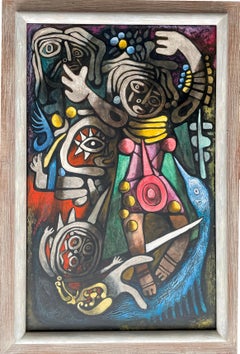
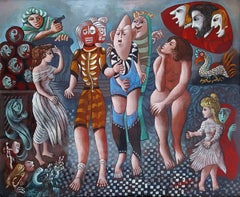
Ceremonial Dancers oil and tempera painting by Julio De Diego
By Julio de Diego
Located in Hudson, NY
Artwork measures 48" x 30" and framed 56 ¼" x 38 ¼" x 3" Provenance: John Heller Gallery, NYC, circa 1975 (label verso) The artist's daughter Corbino Galleries, Sarasota, FL (1990)...
Category

1940s Modern Julio de Diego Paintings

Materials

Masonite, Oil, Tempera

Homage to the Spanish Republic 1938 oil painting by Julio De Diego
By Julio de Diego
Located in Hudson, NY
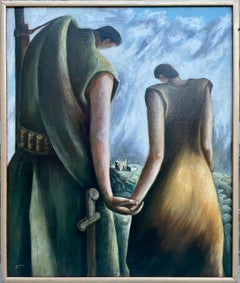
An early work by Julio De Diego embodies the deep love he had for his homeland of Spain, combined with his strong emotions against war. The peacefulness of the couple holding hands l...
Category

1930s Modern Julio de Diego Paintings

Materials

Masonite, Oil

Tlaloc and the Tiger oil painting by Julio de Diego
By Julio de Diego
Located in Hudson, NY
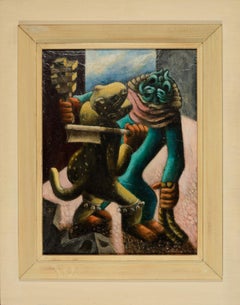
Tlaloc and the Tiger (1939) Oil on panel 16" x 12" 23 ¾" x 18 ¾"x 2 ½" framed Signed and dated (and inscribed) "de Diego 39" lower left. Provenance: The artist; private collection Ch...
Category

1930s Surrealist Julio de Diego Paintings

Materials

Oil, Panel

Inevitable Day – Birth of the Atom oil and tempera painting by Julio De Diego
By Julio de Diego
Located in Hudson, NY
Julio De Diego’s Atomic Series paintings made an extraordinary statement regarding the shock and fear that accompanied the dawn of the nuclear age. In the artist’s own words, “Scientists were working secretly to develop formidable powers taken from the mysterious depths of the earth - with the power to make the earth useless! Then, the EXPLOSION! . . . we entered the Atomic Age, and from there the neo-Atomic war begins. Explosions fell everywhere and man kept on fighting, discovering he could fight without flesh.” To execute these works, De Diego developed a technique of using tempera underpainting before applying layer upon layer of pigmented oil glazes. The result is paintings with surfaces which were described as “bonelike” in quality. The forms seem to float freely, creating a three-dimensional visual effect. In the 1954 book The Modern Renaissance in American Art, author Ralph Pearson summarizes the series as “a fantastic interpretation of a weighty theme. Perhaps it is well to let fantasy and irony appear to lighten the devastating impact. By inverse action, they may in fact increase its weight.” Bibliography Art in America, April 1951, p.78 About this artists: Julio De Diego crafted a formidable persona within the artistic developments and political struggles of his time. The artist characterized his own work as “lyrical,” explaining, “through the years, the surrealists, the social-conscious painters and the others tried to adopt me, but I went my own way, good, bad or indifferent.” [1] His independence manifested early in life when de Diego left his parent’s home in Madrid, Spain, in adolescence following his father’s attempts to curtail his artistic aspirations. At the age of fifteen he held his first exhibition, set up within a gambling casino. He managed to acquire an apprenticeship in a studio producing scenery for Madrid’s operas, but moved from behind the curtains to the stage, trying his hand at acting and performing as an extra in the Ballet Russes’ Petrouchka with Nijinsky. He spent several years in the Spanish army, including a six-month stretch in the Rif War of 1920 in Northern Africa. His artistic career pushed ahead as he set off for Paris and became familiar with modernism’s forays into abstraction, surrealism, and cubism. The artist arrived in the U.S. in 1924 and settled in Chicago two years later. He established himself with a commission for the decoration of two chapels in St. Gregory’s Church. He also worked in fashion illustration, designed magazine covers and developed a popular laundry bag for the Hotel Sherman. De Diego began exhibiting through the Art Institute of Chicago in 1929, and participated in the annual Chicago Artists Exhibitions, Annual American Exhibitions, and International Water Color Exhibitions. He held a solo exhibition at the Art Institute of Chicago in the summer of 1935. Though the artist’s career was advancing, his family life had deteriorated. In 1932 his first marriage dissolved, and the couple’s young daughter Kiriki was sent to live with friend Paul Hoffman. De Diego continued to develop his artistic vocabulary with a growing interest in Mexican art. He traveled throughout the country acquainting himself with the works of muralists such as Carlos Merida, and also began a collection of small native artifacts...
Category

1940s American Modern Julio de Diego Paintings

Materials

Masonite, Oil, Tempera

Related Items
Pair of Romantic Bavarian Paintings by Karl Adolf Wilhelm Chelius - 1889
Located in Roma, IT
Pair of romantic Bavarian paintings is an old master artwork realized in 1889 by the master Karl Adolf Wilhelm Chelius (1856-1923). Mixed colored oil panting on...
Category

1880s Modern Julio de Diego Paintings

Materials

Oil, Canvas

"Mr. Mute Mops Mouths Silent" - Whimsical Figurative in Acrylic on Masonite
Located in Soquel, CA
"Mr. Mute Mops Mouths Silent" - Whimsical Figurative in Acrylic on Masonite Bright figurative composition with a mime by Frances Mann (American, 20th Century). The figure in this pi...
Category

Early 2000s Modern Julio de Diego Paintings

Materials

Masonite, Acrylic

Seated Nude in the Studio – A Modernist Study from the 1920s
Located in Stockholm, SE
This evocative oil painting, titled Studio Muse, depicts a seated nude in a quiet moment of contemplation. The model is shown in profile, resting on a simple wooden stool against a n...
Category

1920s Modern Julio de Diego Paintings

Materials

Canvas, Oil

Till the Clouds Roll By 1945 Frank Sinatra Mid Century Modern Hollywood Film WPA
By Richard Whorf
Located in New York, NY
Till the Clouds Roll By 1945 Frank Sinatra Mid Century Modern Hollywood Film WPA TILL THE COULDS ROLL BY (Film Set), oil on canvas, 20 x 24 inches signed “Richard Whorf” lower right and signed and dated on the verso “R. Whorf/ Dec. 21, 1945. Frame by Hendenryk. ABOUT THE PAINTING This painting is from the collection of Barbara and Frank Sinatra, dated December 21, 1945 (just nine days after Frank Sinatra’s 30th birthday), and depicts the Metro-Goldwyn-Mayer Culver City backlot during the filming of Till the Clouds Roll By, the direction of the film having been taking over by Richard Whorf in December 1945. It is not presently clear if Whorf gave the Sinatras this painting as a gift, as the presence of the Dalzell Hatfield Galleries label on the verso indicates the painting may have been sourced there. Frank and Nancy Sinatra acquired a number of works from Dalzell Hatfield Galleries during the 1940’s, or perhaps they framed it for the couple. Sinatra performed “Old Man River’ in the film. Sinatra and June Allyson are depicted in the center of the painting. PROVENANCE From the Estate of Mrs. Nancy Sinatra; Dalzell Hatfield Galleries, Ambassador Hotel, Los Angeles. An image of the Dalzell Hatfield label and the back of the original frame (which we replaced with a stunning Heydenrk frame) are attached. Nancy Sinatra was Fran's first wife. Nancy Rose Barbato was 17 years old when she met Frank Sinatra, an 18-year-old singer from Hoboken, on the Jersey Shore in the summer of 1934. They married in 1939 at Our Lady of Sorrows Church in Jersey City where Frank gave Nancy a recording of a song dedicated to her titled "Our Love" as a wedding present. The young newlyweds lived and worked in New Jersey, where Frank worked as an unknown singing waiter and master of ceremonies at the Rustic Cabin while Nancy worked as a secretary at the American Type Founders. His musical career took off after singing with big band leaders Harry James and Tommy Dorsey...
Category

1940s American Modern Julio de Diego Paintings

Materials

Canvas, Oil

"Cubist Landscape" Albert Heckman, American Modernist, Fractured Landscape
By Albert Heckman
Located in New York, NY
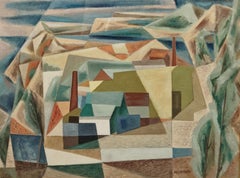
Albert Heckman Cubist Landscape Signed lower right Oil on canvas 21 3/4 x 30 inches Albert Heckman was born in Meadville, Western Pennsylvania, 1893. He went to New York City to tr...
Category

1940s American Modern Julio de Diego Paintings

Materials

Canvas, Oil

A Colorful, 1950s Mid-Century Modern Pool Hall Scene by Francis Chapin
By Francis Chapin
Located in Chicago, IL
A Vibrant, Colorful, 1950s Mid-Century Modern Pool Hall Scene by Notable Chicago Artist, Francis Chapin. Artwork size: 6 3/4" x 8 1/2", Oil on Masonite, Framed size: 11" x 12 1/2"....
Category

Mid-20th Century American Modern Julio de Diego Paintings

Materials

Masonite, Oil

Charming 1950s Painting "Oak Bluffs, Mass." Martha s Vineyard by Francis Chapin
By Francis Chapin
Located in Chicago, IL
A charming vintage 1950s painting of Martha's Vineyard, "Oak Bluffs, Mass." by notable Chicago artist Francis Chapin. A bustling view of the picturesque lighthouse and Soldiers Mem...
Category

1950s American Modern Julio de Diego Paintings

Materials

Masonite, Oil

Nocturnal Train In The City Abstract Expressionism
By Tom Hamil
Located in Soquel, CA
Bright, small abstract expressionist painting of train and town at night by Tom Hamil (American, b. 1928). Signed upper left corner "Hamil". Condition: Excellent. Presented in rustic wooden shadow box frame. Image size: 8"H x 6"W. Tom Hamil, was born in New York in 1928 and raised primarily in California. After attending the US Naval Academy in Annapolis, he returned to California to begin his formal art training at the California School of Fine Arts in San Francisco (now known as the San Francisco Art Institute). He completed his education at the University of Washington with a Master’s Degrees and Doctorate in Fine Arts and Education. His first solo exhibition was held in 1956. Since then, he has participated in numerous one man shows, group shows, and has been represented in galleries in the US and Mexico. In addition to his painting, Hamil has authored and illustrated a number of books. While at the Naval Academy, he received recognition for his paintings, drawings, and illustrations. Listed among Hamil’s many awards and honors are a Ford Foundation Fellowship and an Award of Excellence from the American Graphics Society. Currently, he lives in Zirahuen, Michoacan, Mexico and Truth or Consequences, New Mexico. Hamil’s statement: “I am a man...
Category

1960s Abstract Expressionist Julio de Diego Paintings

Materials

Masonite, Oil

Nocturnal Train In The City Abstract Expressionism
$420 Sale Price
20% Off
H 7 in W 9 in D 1.5 in
An Exceptional Mid-Century Modern Oil Painting of a Reclining Nude Female Model
Located in Chicago, IL
An Exceptional Mid-Century Modern Oil Painting of a Reclining Nude Female Model by Noted Chicago Artist, Rudolph T. Pen. This alluring studio scene, painted in the 1960s, exemplifi...
Category

Mid-20th Century American Modern Julio de Diego Paintings

Materials

Masonite, Oil

Mid-Century Modern Abstract Geometric Trapeze Artists by Hilda Arp
By Hilda Arp
Located in Soquel, CA
Fanciful mid-century modern abstract of trapeze artists by Brooklyn artist Hilda Dora Pape Arp (b. 1909). This 1962 highly abstracted depiction of trape...
Category

1960s American Modern Julio de Diego Paintings

Materials

Oil, Linen

A Fabulous 1960s Mid-Century Modern Painting of an Embracing Couple, Lovers
Located in Chicago, IL
A Fabulous 1960s Mid-Century Modern Painting of an Embracing Couple, Lovers, by noted Chicago Artist, Rudolph Pen. A wonderful example of the artist's uniquely expressive, abstract...
Category

Mid-20th Century American Modern Julio de Diego Paintings

Materials

Masonite, Oil

Neon Lighting WPA Mid 20th Century Social Realism American Scene Modern Figures
By Maurice Becker
Located in New York, NY
Neon Lighting WPA Mid 20th Century Social Realism American Scene Modern Figures MAURICE BECKER (1889-1975) 'Neon Lighting 17 1/4 x 13 3/4 inches Oil on masonite Signed, dated 1936 and titled on verso BIO Maurice Becker, painter, political cartoonist and social reformer, was born in 1889 either in Gorky or Niznij Novgorod, in Russia. His family came to the United States in 1892, to New York City. After high school, Becker worked in a clothing factory. He studied with Ash Can School artist Robert Henri in 1908, and exhibited in the famous 1913 Armory Show in New York City when he was only twenty-four years of age. At the Armory show, Becker showed a drawing of a dog's head...
Category

1930s American Modern Julio de Diego Paintings

Materials

Masonite, Oil

Previously Available Items
"City East" Julio De Diego, Spanish Modernist Composition, Abstracted Cityscape
By Julio de Diego
Located in New York, NY
Julio de Diego City East, circa 1943 Signed lower right Oil on masonite 29 3/4 x 24 1/2 inches Exhibitions: San Antonio, McNay Art Institute. Julio De Diego was one of the most col...
Category

1940s Modern Julio de Diego Paintings

Materials

Masonite, Oil

Altitude 2000, Departure by Julio De Diego
By Julio de Diego
Located in Hudson, NY
Featured in the Julio de Diego - Paintings and Drawings exhibition at the McNay Art Institute, this is an exceptional work by the artist. Altitude 2000, Departure (1946) Oil on maso...
Category

1940s Abstract Julio de Diego Paintings

Materials

Masonite, Oil

Christmas Turkey the General s Daughter painting by Julio De Diego
By Julio de Diego
Located in Hudson, NY
The artwork measures 18" x 24", and the frame 25" x 29.5" x 1.75". Upon request a video clip of this work may be provided. About this artist: Julio De Diego crafted a formidable per...
Category

1960s Surrealist Julio de Diego Paintings

Materials

Paper, Tempera, Watercolor

Girl in Interior oil painting by Julio De Diego
By Julio de Diego
Located in Hudson, NY
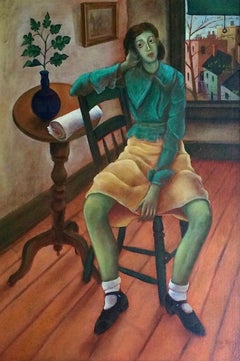
Julio De Diego was a keen observer of the human condition. This work, painted in Chicago the year of his one-man show at the Art Institute, showcases his powerful vision, daring aesthetic sensibilities, and innate artistic skills. The quiet, steady gaze of the sitter as she nonchalantly relaxes with a disaffected look is almost enough to make the viewer not realize her skin was painted green. A careful assessment of the rest of the painting reveals many elements which appear "normal" at first, but are actually slightly distorted. Skewed perspective is utilized in a purposefully restrained manner - the sign of an artist with confidence - which De Diego had in spades. The sitter's outfit of yellowish/orange skirt paired with a belted green blouse and black Mary...
Category

1930s Surrealist Julio de Diego Paintings

Materials

Masonite, Oil

Surrealist Figures in a Desert Landscape, Julio de Diego, Chicago Artist Cactus
By Julio de Diego
Located in New York, NY
Julio De Diego Surrealist Figures in the Desert, 1955 Signed and dated lower right Oil on canvas 32 x 27 inches Provenance: Private Collection, Long Island Julio De Diego was one of the most colorful artists to work in Chicago. Born in Madrid in 1900, De Diego left home at the age of 15 to apprentice as a scene painter for theatres. After service in the Spanish army...
Category

1950s Surrealist Julio de Diego Paintings

Materials

Canvas, Oil

Critics in a red cloud
By Julio de Diego
Located in Miami, FL
Signed lower right . gilt frame some minor surface grime other than that is present very well with strong saturated colors
Category

Mid-20th Century Surrealist Julio de Diego Paintings

Materials

Oil, Tempera

Kachina II
By Julio de Diego
Located in Fairlawn, OH
Signed lower left by the artist Provenance: Estate of the artist
Category

1940s Julio de Diego Paintings

Materials

Oil

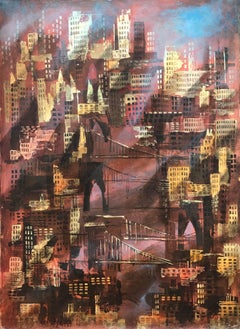
"Populous City Vertical"
By Julio de Diego
Located in Southampton, NY
Oil on masonite painting by Julio De Diego. Signed lower left and dated 1943. A view of New York. Titled verso. In excellent original condition. Provenance: Estate of the artist....
Category

1940s American Modern Julio de Diego Paintings

Materials

Masonite, Oil

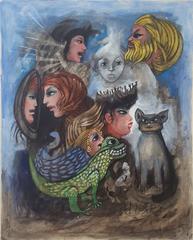
Admirable Cat Analyzed by the Bourgeoisie
By Julio de Diego
Located in Saint Augustine, FL
An original signed Tempera by Spanish artist Julio de Diego (1900-1979), titled "Admirable Cat Analyzed by the Bourgeoisie", c. 1950s. Hand signed lower right. A great image, wonderf...
Category

1950s Surrealist Julio de Diego Paintings

Materials

Tempera

Julio De Diego paintings for sale on 1stDibs.

Find a wide variety of authentic Julio de Diego paintings available for sale on 1stDibs. You can also browse by medium to find art by Julio de Diego in paint, oil paint, tempera and more. Much of the original work by this artist or collective was created during the 20th century and is mostly associated with the Surrealist style. Not every interior allows for large Julio de Diego paintings, so small editions measuring 12 inches across are available. Customers who are interested in this artist might also find the work of Leon Kelly, Byron Browne, and Walter Beach Humphrey. Julio de Diego paintings prices can differ depending upon medium, time period and other attributes. On 1stDibs, the price for these items starts at $4,500 and tops out at $26,000, while the average work can sell for $20,250.

Recently Viewed

View All