Kate Shepherd Drawings and Watercolor Paintings
American, b. 1961
Kate Shepherd, born in 1961 in New York City, is an American artist renowned for her vibrant paintings that blend architectural precision with abstract forms. She earned her B.A. from Oberlin College in 1982 and furthered her studies at the Institute for Architecture and Urban Studies in New York. Shepherd's work is characterized by the use of monochromatic enamel surfaces overlaid with intricate oil line drawings, creating a dynamic interplay between color and structure.
Shepherd's work has been exhibited extensively across the United States and Europe, with solo exhibitions at institutions such as the Phillips Collection in Washington, D.C., and the Charlotte and Philip Hanes Art Gallery at Wake Forest University. Her pieces are included in numerous museum collections, including the Los Angeles County Museum of Art and the Museum of Fine Arts, Boston.
Through her innovative approach to painting, Shepherd continues to explore the relationships between color, form, and space, solidifying her position as a significant figure in contemporary art.to
1
Overall Width
to
Overall Height
to
1
1
1
1
1
5
971
401
359
279
1
Artist: Kate Shepherd
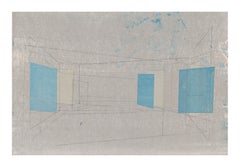
Here and There #4
By Kate Shepherd
Located in Houston, TX
Kate Shepherd
Here and There #4, 2020
Enamel and transfer on paper
12 1/2 x 19 inches
Category
21st Century and Contemporary Abstract Geometric Kate Shepherd Drawings and Watercolor Paintings
Materials
Enamel
Related Items
Untitled Geometric Abstraction - unique signed and inscribed work -framed
Located in New York, NY
Paul Pagk
Untitled Geometric Abstraction, 1989
Gouache and watercolor on paper
Signed, dated and inscribed "A Jacqueline".
Frame included
Excellent unique work on paper by contempora...
Category
1980s Abstract Geometric Kate Shepherd Drawings and Watercolor Paintings
Materials
Watercolor, Gouache, Pencil, Graphite


$5,000
H 28.5 in W 18.5 in
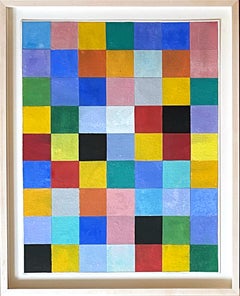
Intersecting Magic Square
By Charmion von Wiegand
Located in New York, NY
Charmion von Wiegand
Intersecting Magic Square, ca. 1963
Gouache on paperboard
Signed and titled on the back of the artwork. The signature shown on the frame back is a photo of the actual signature on the artwork itself.
Frame Included: elegantly floated and framed in hand made white wood museum frame with UV plexiglass
This work is signed and titled on the back of the artwork itself. The signature shown on the back of the frame is a photo of the actual signature, since the actual pencil signature and title is on the artwork itself, which can't be seen within the frame
Measurements:
Frame:
21 x 17 x 1.5 inches
Artwork:
18 x 14.25 inches
The Estate of the celebrated artist Charmion Von Wiegand has been represented exclusively by Michael Rosenfeld...
Category
1960s Abstract Geometric Kate Shepherd Drawings and Watercolor Paintings
Materials
Gouache, Handmade Paper, Mixed Media, Pencil
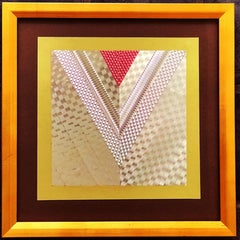
Chevron Collage, Signed, de-accessioned from the Honolulu Museum of Art, Framed
By Kenneth Noland
Located in New York, NY
KENNETH NOLAND
Untitled, for Trustees of the Honolulu Museum of Art, 1984
Mixed Media collage with silver and colored foil on board.
Signed on verso (back) with personal inscription. "for Twig and Laila" (Trustees of the Honolulu Museum of Art), Deaccessioned from the Honolulu Museum of Art Collection
Inscription done in black marker and reads: "A Little Exercise For Twig and Laila With Thanks For A Wonderful 3 Days At ' Cedar House' On The 'Big Island'... 1 Sept 1984 Honolulu Hawaii."
Frame included
Measurements
Framed:
12.5" x 12.5" x .3"
Artwork:
8.75" x 8.75"
This reflective Chevron collage was de-accessioned by the Honolulu Museum of Art. In 2018, it was exhibited in the show "On Black Mountain: The Bauhaus Legacy in America", April 5, 2019-April 27, 2019 at the Sager Braudis Gallery in Columbia, Missouri, and is reproduced in the exhibition catalogue.
Unique signed and dedicated mixed media collage with silver and colored foil on board by the important Color Field painter Kenneth Noland. It's quite a dazzling work, combining color field, geometric abstraction with Op Art, as the work changes appearance and color with the reflected and refracted light. - sometimes appearing light; sometimes darker. See the photos -- there's a light one and a darker one - and they both depict the same work. What's so impressive is that this work literally changes color depending on how the light reflects against it. The artist wrote a personal and heartfelt inscription on the verso to "Twig and Laila". (Twig (sic), which the artist deliberately misspells, is Thurston Twigg Smith, former publisher of The Honolulu Advertiser, who was married to New York philanthropist Laila Twigg Smith. Laila had lived in Hawaii since 1970, where she and her husband had put together a substantial collection of contemporary art. Unfortunately, the two divorced in 1996 and soon after she returned to New York. Two years later, in 1998, Laila died of liver failure at the young age of only 53. Laila was a major philanthropist and art collector who moved from Manhattan to Hawaii. She was a board member of the New Museum of Contemporary Art in New York and a major donor the Honolulu Museum in Hawaii. Laila donated the present Ken Noland...
Category
1980s Abstract Geometric Kate Shepherd Drawings and Watercolor Paintings
Materials
Foil
$20,000
H 12.5 in W 12.5 in D 0.3 in
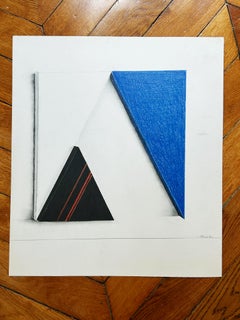
Joel Froment, Untitled, 1986, pastel on paper
Located in PARIS, FR
Joel FROMENT (1938-2023)
Untitled, 1986
Pastel on paper
Signed et dated “86.12” lower right
50 x 50 cm
without frame
Joël Froment attended the Lycée d'Art de Sèvres before entering ...
Category
1980s Abstract Geometric Kate Shepherd Drawings and Watercolor Paintings
Materials
Pastel
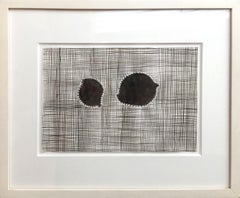
Untitled
By Thomas Nozkowski
Located in Columbia, MO
Untitled
This piece includes an artist hand-signed note attached to the back of the framed work.
Category
Mid-20th Century Abstract Geometric Kate Shepherd Drawings and Watercolor Paintings
Materials
Watercolor
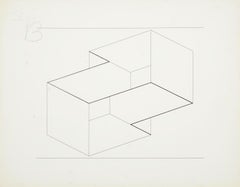
"Structural Constellation" - Abstract, Drawing, Geometric, Black, White
By Josef Albers
Located in Köln, DE
Ink drawing "Structural Costellation" by Josef Albers from 1958.
Josef Albers' works “Structural Constellations” were created from 1949 onwards. They demonstrate spatial perception...
Category
1950s Abstract Geometric Kate Shepherd Drawings and Watercolor Paintings
Materials
Ink
$31,730
H 18 in W 22.92 in
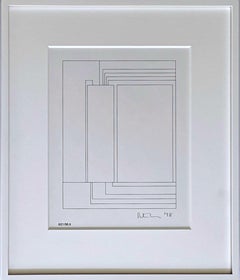
Peter Halley, Hand signed
dated original ink
graphite drawing; unique Framed
By Peter Halley
Located in New York, NY
PETER HALLEY
6/21/96.9, 1998
Graphite and ink drawing
Hand-signed by artist, signed and dated in graphite lower right front; lower left front bears title: 6/21/96.9
Frame included: elegantly matted and framed in a hand made museum frame with UV plexiglass
signed and dated in graphite lower right front; lower left front bears title: 6/21/96.9
This is a unique work
Frame included: elegantly floated and framed in a museum quality hand made white wood frame under UV plexiglass
Measurements:
Framed
16.5 inches vertical by 13 inches horizontal by 1.5 inches
Artwork (visible)
10 inches vertical by 8 inches horizontal
Peter Halley Biography
Peter Halley was born in 1953 in New York. He began his formal training at Phillips Academy in Andover, Massachusetts, from which he graduated in 1971. During that time, Halley read Josef Albers’s Interaction of Color (1981), which would influence him throughout his career. From 1973 to 1974 Halley lived in New Orleans, where he absorbed the vibrant cultural influences of the city, began using commercial materials in his art, and first became acquainted with the writings of earthwork artist Robert Smithson. In 1975 the artist graduated from Yale University, New Haven, with a degree in art history. After Yale, Halley returned to New Orleans, where he received an MFA in painting from the University of New Orleans in 1978. He had his first solo exhibition at the Contemporary Art Center, New Orleans, that same year.
In 1978 Halley spent a semester teaching art at the University of Louisiana, Lafayette. He has continued to teach throughout his career. In 1980, Halley moved back to New York and had his first solo exhibition in the city at PS122 Gallery. At this time, Halley was drawn to the pop themes and social issues addressed in New Wave music. Inspired by New York’s intense urban environment, Halley set out to use the language of geometric abstraction to describe the actual geometricized space around him. He also began his iconic use of fluorescent Day-Glo paint.
In 1984, Halley started to exhibit with the International With Monument gallery, becoming closely associated with the organization and its artists, who exhibited conceptually rigorous work in a market-savvy, coolly presented space that stood in stark contrast to the bohemian, Neo-Expressionist flair of the East Village art scene at the time. In 1986, an exhibition of four artists from International With Monument at the Sonnabend Gallery in New York heralded the group’s growing success. By the late 1980s, Halley was exhibiting with prominent galleries in the United States and Europe. In 1989, an exhibition of his paintings traveled to the Museum Haus Esters, Krefeld, Germany; Maison de la culture et de la communication de Saint-Étienne, France; and Institute of Contemporary Arts, London. From 1991 to 1992, a retrospective toured Europe, with presentations at the CAPC Musée d’art contemporain de Bordeaux, France; Musée d’art contemporain, Lausanne, Switzerland; Museo nacional centro de arte Reina Sofía, Madrid; and Stedelijk Museum, Amsterdam. In 1992, the Des Moines Art Center hosted his first solo exhibition at a U.S. museum.
While developing his visual language, Halley became interested in French post-structuralist writers, including Jean Baudrillard, Guy Debord, Michel Foucault, and Paul Virillio, all of whom shared his concern with the character of social spaces in a post-industrial society. In 1981, he published his first essay “Beat, Minimalism, New Wave, and Robert Smithson” in Arts, a New York–based magazine that would publish eight of his essays before the decade’s end. Halley’s writings became the basis for Neo-Geometric Conceptualism (also known as Neo-Geo), the offshoot of Neo-Conceptualism associated with the work of Ashley Bickerton, Halley, and Jeff Koons. In 1988, the artist’s writings were anthologized in Collected Essays, 1981–1987, and again in 1997 in a second anthology, Recent Essays, 1990–1996.
In the mid-1990s, Halley began to produce site-specific installations for museums, galleries, and public spaces. These characteristically brought together a range of imagery and mediums, including paintings, wall-size flowcharts, and digitally generated wallpaper prints. Halley has executed permanent installations at the Dallas/Fort Worth International Airport, Texas, and the Gallatin School of Individualized Study at New York University. In 2011, his installation of digital prints Judgment Day...
Category
1990s Abstract Geometric Kate Shepherd Drawings and Watercolor Paintings
Materials
Ink, Graphite
$8,800
H 16.5 in W 13 in D 1.5 in
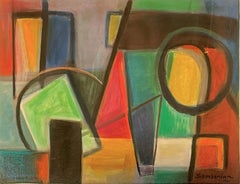
"Colorful Geometric Abstraction, " Simon Samsonian, Armenian Artist
Located in New York, NY
Simon Samsonian (1912 - 2003)
Colorful Geometric Abstraction, 1981
Oil on paper
16 x 22 inches
Signed and dated lower right
Provenance:
Estate of the artist
This survivor of the Armenian genocide wound up in a Cairo orphanage in 1927. He rose to fame as one of Egypt’s great modernists, but after moving to Long Island late in life he withdrew into anonymity. Now his compelling story is being told. Art historians are finally beginning to realize that the power of abstraction in its early years was a zeitgeist not limited to the major European centers of the avant-garde — Paris, Munich, and Moscow — but one that quickly rippled to major cities throughout the world. Within a few decades that original shock of a new vision had inspired thousands of artists from different cultures — particularly those the Middle East — whose translations were not slavish imitations of works by seminal figures like Picasso, Braque, Malevich, and Kandinsky but creative variants colored by their respective cultures.
This essay focuses on an extraordinary Armenian artist, his harrowing survival of the genocide, his rise to fame in Cairo, and his creation of a unique style of abstraction. Art historians have typically formed a chorus that teaches the history of abstraction like this: Just before and during the World War I era, several avant-garde artists emerged to create shockingly different new forms by which artists could express themselves. In Paris, Picasso and Braque broke out with cubism, quickly followed by Mondrian. In Moscow, Malevich created Suprematism, the ultimate hard-edge geometric abstraction. And in Munich, Kandinsky emerged as the father of Abstract Expressionism. Within these few short years a zeitgeist was sensed throughout the art world. American pioneers, too — particularly Stanton Macdonald-Wright and Morgan Russell — felt this explosive freedom of expression. When Europe was recovering after World War I it became clear that Paris would retain its title as capitol of the art world, lasting through the Roaring Twenties and even through the Great Depression. But the end of World War II changed everything. A parallel war had been won by a group of irascible young Abstract Expressionists in New York — led by Pollock, Rothko, DeKooning, and Kline. No sooner had Paris been liberated from the Germans than Picasso, Matisse, Breton, and Duchamp surrendered to the Americans. From that point on New York would be the epicenter of the art world.
But a lens that focuses myopically on the war between the avant-garde of Paris and New York misses the wider narrative of multiple aesthetic modernities that developed in the several decades following World War I. For Armenian artists the matter is even more complex owing to the genocide of 1915 where more than 1.5 million people — seventy-five percent of Armenians in the Ottoman Empire — were massacred. Those not shot on the spot were sent on death marches through the Mesopotamian desert without food or water. Frequently, the marchers were stripped and forced to walk naked under the scorching sun until they dropped dead.
As a child Samsonian witnessed the murder of his parents and most of the members of his family. Soon thereafter, his older sister, Anahid, quickly shepherded him into a line of children being rescued by Greek nuns. But they became separated and he lost her, too. He was sent to a Greek orphanage in Smyrna (now Izmir), on Turkey’s west coast. Because he only knew his first name, the orphanage gave him a last name based on the place where they found him — Samsun — a major port on Turkey’s north coast on the Black Sea. His birth date was unknown, too. According to Samsonian’s vague recollections he assumed he was about three or four years old at the onset of the genocide, which would place his birth year in 1911 or 1912. In 1922, when Samsonian was about 10, the Turks ended their war with the Greeks by putting Smyrna to the torch in what has been called the “Catastrophe of Smyrna.” Once again, the child was on the run, escaping the fire and slaughter. He found temporary refuge in Constantinople, but within a year that major port would fall to the Turks, too, and become renamed as Istanbul. This time, Samsonian was whisked away to an orphanage in Greece founded by the American charity, Near East Relief — which is credited with saving so many Armenian orphans that the American historian Howard M. Sachar said it “quite literally kept an entire nation alive.
Any understanding of Samsonian’s approach to modernism requires careful consideration of the impact of his early years because his art is inseparable from the anguish he experienced. In 1927, when he was a teenager, he was transferred to Cairo, Egypt, then a cosmopolitan city hosting a sizable portion of the Armenian diaspora. There he lived with thirty-two other children on the top floor of the Kalousdian Armenian School. Upon graduating in 1932 he won a scholarship to attend the Leonardo da Vinci Art Institute — an Italian art school in Cairo — where he won first prize in final examinations among one hundred students. He found work with an Armenian lithographic printer and he returned to the Kalousdian Armenian School to teach drawing. In 1939 he married one of his students, Lucy Guendimian.
The Cairo in which Samsonian matured as an artist was home to many prominent art collectors after World War I. In this receptive environment Samsonian exhibited widely and won many awards. Beginning in 1937 and for the next thirty years he exhibited annually at the prestigious Le Salon du Caire hosted by the Société les Amis de l’Art (founded in 1921). After World War II he hit his stride as a modernist in Cairo, counting among his peers other artists of the Armenian diaspora such as Onnig Avedissian, Achod Zorian, Gregoire Meguerdichian, Hagop Hagopian...
Category
1980s Abstract Geometric Kate Shepherd Drawings and Watercolor Paintings
Materials
Paper, Oil
"Untitled" Mernet Larsen, Abstract, Hard-Edged, Shades of Purple, Dark Colors
Located in New York, NY
Mernet Larsen
Untitled, 1988
Signed and dated lower right
Oil and collage on paper
Image 17 3/4 x 18 3/4 inches
Sheet 19 x 24 inches
For more than sixty years, Mernet Larsen has been making paintings that tell stories, showing sharp-edged, mysterious characters in a strange world full of tension and clever humor. She uses different ways to show space that sometimes don't match up. By mixing different perspectives, like reversed and traditional views, she turns everyday situations into a dizzying version of reality that feels familiar yet strange. Her influences come from many places, including geometric shapes from Russian Constructivism, Japanese Bunraku...
Category
1980s Abstract Geometric Kate Shepherd Drawings and Watercolor Paintings
Materials
Paper, Oil
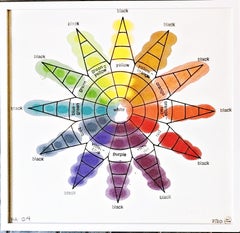
Color Circle and Star, Marker on fabric print Hand signed (ed of only 20) Framed
By Polly Apfelbaum
Located in New York, NY
Polly Apfelbaum
Color Circle and Star, 2004
Fabric Marker and Fabric Dye on Velvet Cotton
Signed and dated in ink by the artist on the front with artist's inkstamp.
Frame Included
Si...
Category
Early 2000s Abstract Geometric Kate Shepherd Drawings and Watercolor Paintings
Materials
Fabric, Dye, Ink, Mixed Media, Permanent Marker
$7,000
H 31 in W 31 in D 1 in
Blood and Light (2021)
Located in Jersey City, NJ
Drawing / Geometric Abstraction / Mythology and Religion / Bright and Vivid Colors / Black and White
Enamel, ink, colored pencil and alcohol ink on paper....
Category
2010s Abstract Geometric Kate Shepherd Drawings and Watercolor Paintings
Materials
Enamel
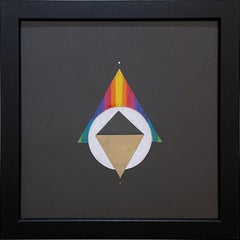
Verge - abstract geometric holographic light effect drawing on aluminum
Located in New York, NY
James Minden
Verge
Holographic drawing- engraved anodized aluminum and enamel paint
24 x 24 inches
2017
To get a sense of the holographic effect look at the video on that vimeo's si...
Category
2010s Abstract Geometric Kate Shepherd Drawings and Watercolor Paintings
Materials
Metal, Enamel
Previously Available Items
Eve #18
By Kate Shepherd
Located in Houston, TX
Kate Shepherd
Eve #18, 2022
Unique screenprint on Coventry Rag paper
38 3/4 x 23 5/8 in (98.4 x 60 cm)
JPHB 5919
Category
21st Century and Contemporary Kate Shepherd Drawings and Watercolor Paintings
Materials
Screen
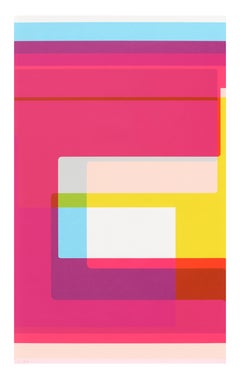
Kate Shepherd drawings and watercolor paintings for sale on 1stDibs.
Find a wide variety of authentic Kate Shepherd drawings and watercolor paintings available for sale on 1stDibs. You can also browse by medium to find art by Kate Shepherd in enamel, metal and more. Much of the original work by this artist or collective was created during the 21st century and contemporary and is mostly associated with the abstract style. Not every interior allows for large Kate Shepherd drawings and watercolor paintings, so small editions measuring 19 inches across are available. Customers who are interested in this artist might also find the work of Dana Piazza, John Anderson, and Jenifer Kent. Kate Shepherd drawings and watercolor paintings prices can differ depending upon medium, time period and other attributes. On 1stDibs, the price for these items starts at $3,500 and tops out at $3,500, while the average work can sell for $3,500.