Kawase Hasui Figurative Prints
Japanese, 1883-1957
Hasui Kawase (Japanese, 1883 -1957) was an artist, one of modern Japan's most important and prolific printmakers. He was a prominent designer of the shin-hanga ("new prints") movement, whose artists depicted traditional subjects with a style influenced by Western art. Like many earlier ukiyo-e prints, Hasui's works were commonly landscapes, but displayed atmospheric effects and natural lighting.
Hasui designed approximately 620 prints over a career that spanned nearly forty years. Towards the end of his life the government recognized him as a Living National Treasure for his contribution to Japanese culture.
From youth Hasui dreamed of an art career. His maternal uncle was Kanagaki Robun (1829–94), a Japanese author and journalist, who produced the first manga magazine. Hasui went to the school of the painter Aoyagi Bokusen as a young man. He sketched from nature, copied the masters' woodblock prints, and studied brush painting with Araki Kanyu. His parents had him take on the family rope and thread wholesaling business, but its bankruptcy when he was 26 freed him to pursue art.
He approached Kiyokata Kaburagi to teach him, but Kaburagi instead encouraged him to study Western-style painting, which he did with Okada Saburōsuke for two years. Two years later he again applied as a student to Kaburagi, who this time accepted him. Kiyokata bestowed the name Hasui upon him, which can be translated as "water gushing from a spring", and derives from his elementary school combined with an ideogram of his family name.
Kawase studied ukiyo-e and Japanese style painting at the studio of Kiyokata Kaburagi. He mainly concentrated on making watercolors of actors, everyday life and landscapes, many of them published as illustrations in books and magazines in the last few years of the Meiji period and early Taishō period.
Kawase worked almost exclusively on landscape and townscape prints based on sketches and watercolors he made in Tokyo and during travels around Japan. However, his prints are not merely meishō (famous places) prints that are typical of earlier ukiyo-e masters such as Hiroshige and Katsushika Hokusai (1760-1849). Kawase's prints feature locales that are tranquil and obscure in urbanizing Japan.
Hasui Kawase's works are currently kept in several museums worldwide, including the British Museum, the Toledo Museum of Art, the Brooklyn Museum, the Indianapolis Museum of Art, the Museum of Fine Arts, Boston, the Metropolitan Museum of Art, the Portland Art Museum, the Los Angeles County Museum of Art, the University of Michigan Museum of Art, the Minneapolis Institute of Art, the Stanley Museum of Art, the Walters Art Museum, the Clark Art Institute, the Smart Museum of Art, the Nelson-Atkins Museum of Art, and the Virginia Museum of Fine Arts.to
1
Overall Width
to
Overall Height
to
9
890
385
373
310
1
1
1
1
1
1
1
1
1
1
1
Artist: Kawase Hasui
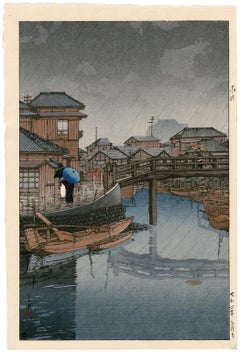
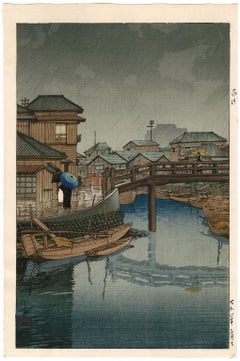
Rain at Shinagawa, Ryoshimachi
— Showa-era Woodblock Print
By Kawase Hasui
Located in Myrtle Beach, SC
Kawase Hasui, 'Rain at Shinagawa, Ryoshimachi' from the series 'Selection of Views of the Tokaido', woodblock print, 1931. A very fine, atmospheric impression, with fresh colors; the...
Category
1930s Showa Kawase Hasui Figurative Prints
Materials
Woodcut
Related Items
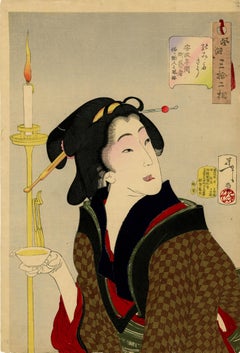
Thirsty: The Appearance of a Town Geisha - a So-Called Wine-Server - in the Anse
By Taiso Yoshitoshi
Located in Fairlawn, OH
Thirsty: The Appearance of a Town Geisha - a So-Called Wine-Server - in the Ansei Era
Color woodcut, 1888
Signed; Seal: Taiso (see photo)
Plate 22 from the series "Thirty-two Aspects...
Category
1880s Showa Kawase Hasui Figurative Prints
Materials
Woodcut

$1,800
H 14.13 in W 9.63 in
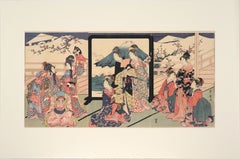
"Toy Horse Dance" Japanese Woodblock Triptych with Beauties and Mt Fuji
Located in Soquel, CA
"Toy Horse Dance" Japanese Woodblock Triptych with Beauties and Mt Fuji
Vibrant three-panel woodblock print by Utagawa Toyohiro (Japanese,...
Category
Early 20th Century Edo Kawase Hasui Figurative Prints
Materials
Ink, Rice Paper, Woodcut
Utagawa Toyohiro"Toy Horse Dance" Japanese Woodblock Triptych with Beauties and Mt Fuji, early 1900s
$1,700
H 24 in W 36 in D 0.25 in
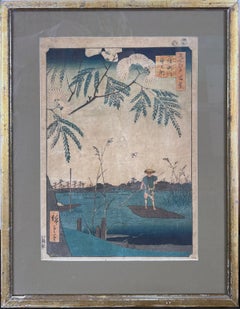
The Ayase River and Kanegafuchi, Summer, One Hundred Famous Views of Edo
By Utagawa Hiroshige (Ando Hiroshige)
Located in Soquel, CA
The Ayase River and Kanegafuchi, Summer, One Hundred Famous Views of Edo
Summer on the Ayase River by Hiroshige (Ando) Utagawa (Japan, 1797 - 1858 ). Woodcut circa 1856.
Ima...
Category
1850s Realist Kawase Hasui Figurative Prints
Materials
Ink, Woodcut
$1,350
H 19.5 in W 14.13 in D 0.38 in
3 Panel Hand Colored Japanese Woodcut Print Lithograph
By Keisai Eisen
Located in Soquel, CA
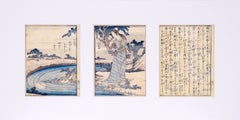
3 Panel Hand Colored Japanese Woodcut Print Lithograph
Three panel hand colored woodcut lithograph from Nanso Satomi hakkenden, Tale of the Eight Dogs...
Category
Early 19th Century Edo Kawase Hasui Figurative Prints
Materials
Paper, Ink, Woodcut
Kiyomizu Temple, Scenes of Famous Places along Tôkaidô Road - Woodblock on Paper
By Utagawa Hiroshige II
Located in Soquel, CA
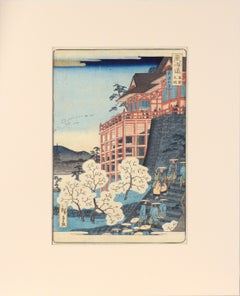
Kiyomizu Temple, Scenes of Famous Places along Tôkaidô Road - Woodblock on Paper
Full Title:
Kyoto: Kiyomizu Temple (Kyô Kiyomizudera), from the series Scenes of Famous Places along...
Category
1860s Edo Kawase Hasui Figurative Prints
Materials
Ink, Rice Paper, Woodcut
$1,200
H 20 in W 16 in D 0.25 in
Prometheus — Mythological Figure in Expressive Red and Black by William Wolff
By William Wolff
Located in Palm Springs, CA
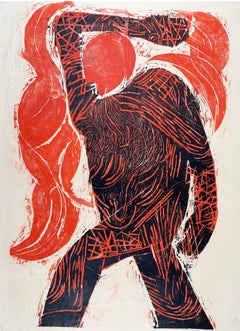
Wolff’s woodcut of the mythological figure of Prometheus is carved and printed in only two strong colors—black and a fiery red-orange—yet the impact is monumental. The central figure...
Category
1990s Contemporary Kawase Hasui Figurative Prints
Materials
Woodcut
$450 Sale Price
25% Off
H 30.25 in W 21 in
"The Engraver" Double Layer Woodblock Print
Located in Soquel, CA
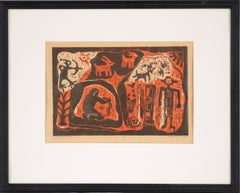
Bold woodcut print by M. Sheppard (20th Century). This piece is filled with Neolithic imagery of people and animals. There are two figures that are engaged in hunting and several pre...
Category
1980s Other Art Style Kawase Hasui Figurative Prints
Materials
Paper, Ink, Woodcut
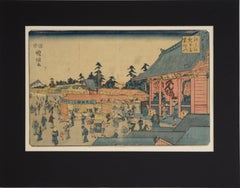
"The Kaminarimon at the Kanseon Temple in Asakusa" - Original Japanese Print
Located in Soquel, CA
"The Kaminarimon at the Kanseon Temple in Asakusa" - Original Japanese Print
Japanese Print "The Kaminarimon at the Kanseon Temple in Asakusa", from the series "Famous Places in Ed...
Category
1850s Showa Kawase Hasui Figurative Prints
Materials
Rice Paper, Woodcut
$850
H 14 in W 18 in D 1 in
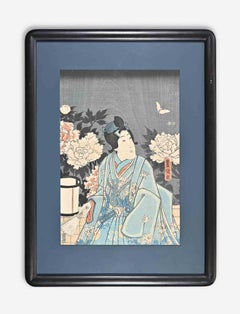
Kabuki Actor - Woodblock Print attr. to Utagawa Kunisada - Mid-19th Century
By Utagawa Kunisada (Toyokuni III)
Located in Roma, IT
Kabuki Actor is an original Woodcut print realized in mid 19 century and attributed to Utagawa Kunisada.
Beautiful colored woodblock print, included a cardboard passpartout.
Includ...
Category
Mid-19th Century Modern Kawase Hasui Figurative Prints
Materials
Woodcut
$428
H 14.18 in W 9.85 in D 0.04 in
Mitate of a Daimyo
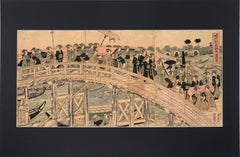
s Procession Crossing Ryogoku Bridge - Woodblock Print
By Keisai Eisen
Located in Soquel, CA
Mitate of a Daimyo's Procession Crossing Ryogoku Bridge - Woodblock Print
Woodblock print of a procession by Keisai Eisen (Japanese, 1790–1848). Terrific triptych of a procession of...
Category
Early 19th Century Edo Kawase Hasui Figurative Prints
Materials
Ink, Rice Paper, Woodcut
$1,650
H 24 in W 36 in D 0.25 in
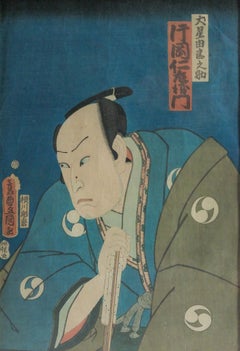
"Actor Kataoka Nazaemon as Oboshi Yaranosuke Leader of the 47 Ronin" Portrait
By Utagawa Kunisada (Toyokuni III)
Located in Austin, TX
Artist: Utagawa Kunisada "Toyokuni the Third" (Japanese 1786 - 1864)
Page Size: 14 x 9.5 in.
Frame Size: 21 x 16.25
Translation of Calligraphic Japanese Text:
大星由良之助 Ōboshi Yuranosu...
Category
Mid-19th Century Kawase Hasui Figurative Prints
Materials
Paper, Woodcut
Kyoka-Tokaido - Woodcut after Utagawa Hiroshige -1925
By Utagawa Hiroshige
Located in Roma, IT
Kyoka-Tokaido is an original modern artwork realized after Utagawa Hiroshige (1797 – 12 October 1858) in 1925.
Original Woodcut print Chuban yokoe.
Red...
Category
1920s Modern Kawase Hasui Figurative Prints
Materials
Woodcut
Previously Available Items
Lakeside Shower, Matsue
— Showa-era Woodblock Print
By Kawase Hasui
Located in Myrtle Beach, SC
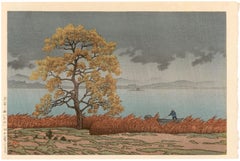
Kawase Hasui, 'Chihan no Ame, Matsue' (Lakeside Shower, Matsue), color woodblock print, 1932. A fine, atmospheric impression, with fresh colors; the full sheet, from a postwar editio...
Category
1930s Showa Kawase Hasui Figurative Prints
Materials
Woodcut
Rain at Shinagawa, Ryoshimachi
— lifetime impression
By Kawase Hasui
Located in Myrtle Beach, SC
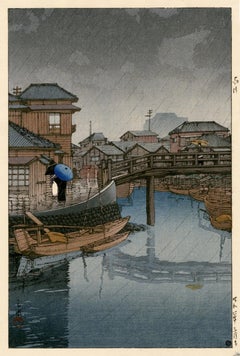
A fine, atmospheric impression, with fresh colors; the full sheet, in excellent condition. Signed 'Hasui' with the artist’s seal 'Kawase', lower left. Published by Watanabe Shozaburo with the Watanabe 6mm round seal indicating a lifetime impression printed between 1945 - 1957. Archivally sleeved, unmatted.
Image size 14 1/4 x 9 3/8 inches (362 x 238 mm); sheet size 15 1/2 x 10 3/8 inches (391 x 264 mm).
An impression of this work is in the permanent collection of the Fine Arts Museum of San Francisco, Achenbach Foundation.
ABOUT THE ARTIST
“I do not paint subjective impressions. My work is based on reality...I can not falsify...(but) I can simplify…I make mental impressions of the light and color at the time of sketching. While coloring the sketch, I am already imagining the effects in a woodblock print.” — Kawase Hasui
Hasui Kawase (1883–1957) is the most celebrated Japanese print designer of the shin-hanga ('new prints') movement. His prints, produced under the guidance and discerning eye of his publisher, Watanabe Shozaburo, represent the modern legacy of the renowned 19th-century Ukiyo-e masters Hiroshige and Hokusai. Hasui was able to evoke the fleeting beauty of Japan during the interwar period as no other printmaker of his time could.
Hasui's work enjoyed huge popularity upon producing his first print in 1918. Watanabe recognized and developed the enormous potential of the American market, resulting in Hasui's prints achieving high prices at auctions in New York as early as the 1920s. After the Second World War, his prints became highly sought-after collectible works among the American occupying forces in Japan. Hasui designed more than 600 prints during the 40-year span of his artistic career, and in 1956, he was named a 'Living National Treasure' of Japan.
Hasui’s woodblock...
Category
1930s Showa Kawase Hasui Figurative Prints
Materials
Woodcut
Kiyomizu Temple in the Snow - Woodblock Print
By Kawase Hasui
Located in Soquel, CA
Kiyomizu Temple in the Snow - Woodblock Print
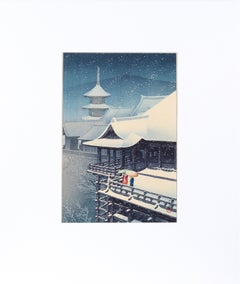
A spectacular woodblock print by Hasui Kawase (Japanese, 1883-1957), depicting a serene wintery balcony with two women under umbrellas in the falling snow at the Kiyomizu Temple (Temple of Pure Waters). One of the most celebrated temples in Japan, the temple was founded in 780 on the site of the Otowa Waterfall among the wooded hills to the east of Kyoto - the temple's name based on the fall's crystalline waters.
Publisher: Doi Hangaten
Artist's seal and signature in lower right corner.
Presented in a new white mat.
Paper size: 15.63"H x 10.25"W (ôban size with raw top edge)
Mat size: 24"H x 20"W
Hasui Kawase (Japanese, 1883 -1957) was an artist, one of modern Japan's most important and prolific printmakers. He was a prominent designer of the shin-hanga ("new prints") movement, whose artists depicted traditional subjects with a style influenced by Western art. Like many earlier ukiyo-e prints, Hasui's works were commonly landscapes, but displayed atmospheric effects and natural lighting.
Hasui designed approximately 620 prints over a career that spanned nearly forty years. Towards the end of his life the government recognized him as a Living National Treasure for his contribution to Japanese culture.
From youth Hasui dreamed of an art career. His maternal uncle was Kanagaki Robun (1829–94), a Japanese author and journalist, who produced the first manga magazine. Hasui went to the school of the painter Aoyagi Bokusen as a young man. He sketched from nature, copied the masters' woodblock prints, and studied brush painting with Araki Kanyu. His parents had him take on the family rope and thread wholesaling business, but its bankruptcy when he was 26 freed him to pursue art.
He approached Kiyokata Kaburagi to teach him, but Kaburagi instead encouraged him to study Western-style painting, which he did with Okada Saburōsuke...
Category
1940s Edo Kawase Hasui Figurative Prints
Materials
Ink, Laid Paper
Rain at Shinagawa, Ryoshimachi
— lifetime impression
By Kawase Hasui
Located in Myrtle Beach, SC
A very fine, atmospheric impression, with fresh colors; the full sheet, in excellent condition. Signed 'Hasui' with the artist’s seal 'Kawase', lower left. Published by Watanabe Shozaburo with the Watanabe 6mm round seal indicating a lifetime impression printed between 1945 - 1957.
An impression of this work is in the permanent collection of the Fine Arts Museum of San Francisco, Achenbach Foundation.
ABOUT THE ARTIST
Hasui Kawase...
Category
1930s Showa Kawase Hasui Figurative Prints
Materials
Woodcut
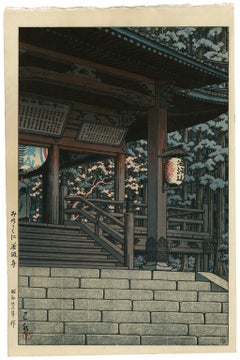
Tanigumi Temple, Mino (Minonokuni Tanigumidera)
By Kawase Hasui
Located in Myrtle Beach, SC
A fine, lifetime impression, with fresh colors, in very good condition. Signed 'Hasui' in ink, with the artist’s seal 'Kawase', lower left. Published by Watanabe Shozaburo with the 6...
Category
Mid-20th Century Showa Kawase Hasui Figurative Prints
Materials
Woodcut
Kawase Hasui figurative prints for sale on 1stDibs.
Find a wide variety of authentic Kawase Hasui figurative prints available for sale on 1stDibs. You can also browse by medium to find art by Kawase Hasui in woodcut print and more. Not every interior allows for large Kawase Hasui figurative prints, so small editions measuring 10 inches across are available. Customers who are interested in this artist might also find the work of and Taiso Yoshitoshi. Kawase Hasui figurative prints prices can differ depending upon medium, time period and other attributes. On 1stDibs, the price for these items starts at $1,900 and tops out at $1,900, while the average work can sell for $1,900.
Questions About Kawase Hasui Figurative Prints
- What did Hasui Kawase do?1 Answer1stDibs ExpertJune 30, 2023Hasui Kawase made woodblock prints and was one of the most important modern Japanese artists. The woodblock printmaking genre, unique to Japan, grew out of 17th-century developments in printing and book publishing. Kawase was a prominent practitioner of the shin-hanga (“new prints”) movement, whose artists depicted traditional subjects with a style influenced by Western art. Like many earlier artists working in woodblock printmaking, Hasui primarily created richly atmospheric landscapes. They’re characterized by an emphasis on natural lighting and the artist’s effort to draw attention to the beauty of nature. Hasui created hundreds of prints over a career that spanned nearly forty years. On 1stDibs, find a range of original Japanese woodblock prints.
- Where was Kawase Hasui born?1 Answer1stDibs ExpertFebruary 17, 2023Kawase Hasui was born in Tokyo, Japan, in 1883. He was one of modern Japan's most important and prolific printmakers and a prominent designer of the shin-hanga ("new prints") movement, whose artists depicted traditional subjects with a style influenced by Western art. Shop a range of Kawase Hasui art from some of the world's top galleries on 1stDibs.