Koloman Moser Art

Austrian, 1868-1918

Born in Vienna in 1868, Koloman Moser briefly attended trade school, honoring his father’s wish to see him in commerce. But he soon surrendered to his artistic inclinations, enrolling in 1885 in Vienna’s Academy of Fine Arts, where he studied painting.

When his father died unexpectedly in 1888, leaving the family in financial straits, Moser (1868–1918) helped out by doing illustrations for books and magazines. Meanwhile, he continued his painting studies, at the academy and then at the School of Arts and Crafts, starting in 1892. That was also the year that Moser, along with other young artists revolting against the Viennese art world’s devotion to naturalism, formed the Siebner Club, the precursor to the Vienna Secession.

Moser’s introduction during his last term at school to Gustav Klimt’s Allegory of Sculpture proved a turning point for the young artist. Christian Witt-Dörring, guest curator of the 2018–19 exhibition “Koloman Moser: Universal Artist between Gustav Klimt and Josef Hoffmann” at the MAK in Vienna, noted a change in the artist’s drawing style. “Primarily inspired by the art of Japan, [Klimt] introduces new paper sizes, fragmented image details, and an emphasis on the line as opposed to the surface,” wrote Witt-Dörring in the exhibition’s catalogue.

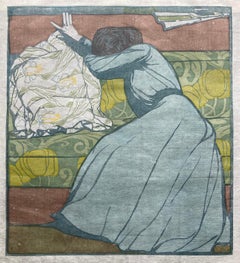
A year later, in 1897, Moser together with Klimt, Carl Moll, Joseph Olbrich and Josef Hoffmann founded the Vienna Secession, a union of artists and designers determined to upend Austria’s artistic conservatism. The members were committed to making total works of art: Gesamtkunstwerken. Looking to the English Arts and Crafts Movement, with its guiding principle of unity of the arts, the group attempted to bring art back into everyday life and introduce a local modernism to fin-de-siècle Vienna. Moser, whose membership in the club also afforded him entry into upper-class Viennese society, turned his back on oil painting and forged ahead with Gesamtkunstwerk.

Moser created everything from exhibition design to facade ornamentation for the Secession Building, to graphic materials. Moser also produced posters and advertisements in his “modern style” for various companies. In 1898, he presented his first decor pieces, including hand-knotted rugs and cushion covers. In 1899, Moser began what would become a lifelong professorship at the School of Arts and Crafts. His repertoire now expanded to include furniture, ceramics and patterns like his trademark checkerboard design. He also moved into scenography and fashion and established himself as an interior designer.

The artist decorated his own home in 1902, after which he received a series of important commissions, notably the villa of textile industrialist Fritz Waerndorfer. It was Waerndorfer who provided the financial support that enabled Moser and Hoffmann in 1903 to found the Wiener Werkstätte, a platform for fully realizing their ideal of Gesamtkunstwerk. Two years later, Moser married Edith Mautner von Markhof, the daughter to one of Austria’s great industrial barons, and his work thrived. 

In 1907, the Wiener Werkstätte ran into financial trouble. Losing faith in the unity of the arts and disillusioned with the group’s dependency on wealthy patrons like Waerndorfer, Moser left the Werkstätte. He returned to his original discipline, painting, which he continued to practice until his untimely death from cancer, in 1918.

Today, Koloman Moser’s work, from his metal vases to his jewelry to his interiors, remains sought-after and revered. Browse Moser's radically modern creations at 1stDibs.

to
11
Overall Width
to
Overall Height
to
10
1
1
11
6
5
11
7
6
6
6
6
4
2
2
1
1
1
1
1
10
1
39
9,962
2,752
1,376
1,373
11
Artist: Koloman Moser
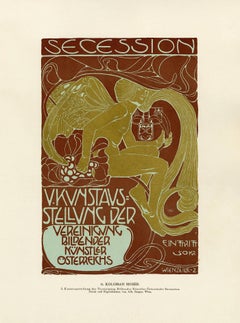
Ottokar Mascha Folio: plate 11 "5th Secession Exhibition Poster" by Kolo Moser
By Koloman Moser
Located in Palm Beach, FL
after KOLOMAN MOSER (1868-1918) 5TH SECESSION EXHIBITION POSTER, 1899, (In Mascha, no. 11) A pivotal figure in early-20th century Austrian ...
Category

1910s Vienna Secession Koloman Moser Art

Materials

Lithograph

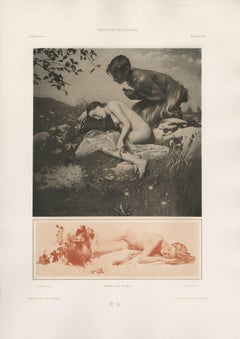
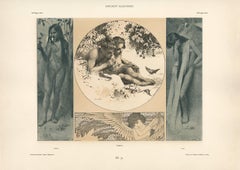
Gerlach s Allegorien Plate #89: "Bookplate Spring" Lithograph
By Koloman Moser
Located in Palm Beach, FL
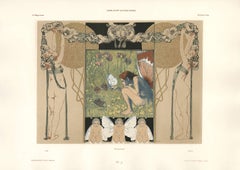
Koloman Moser (1868 –1918), AUSTRIAN Instead of applying his flair and art education solely to painting, Koloman Moser embodied the idea of Gesamt Kunstwerk (all-embracing art work) by designing architecture, furniture, jewelry, graphics, and tapestries meant to coordinate every detail of an environment. His work transcended the imitative decorative arts of earlier eras and helped to define Modernism for generations to come. Moser achieved a remarkable balance between intellectual structure (often geometric) and hedonistic luxury. Collaborating with Gustav Klimt and Josef Hoffmann, the artist was an editor and active contributor to Ver Sacrum, (Sacred Spring), the journal of the Viennese Secession that was so prized for its aesthetics and high quality production that it was considered a work of art. The magazine featured drawings and designs in the Jugendstil style (Youth) along with literary contributions from distinguished writers from across Europe. It quickly disseminated both the spirit and the style of the Secession. In 1903 Moser and Hoffmann founded and led the Wiener Werkstatte (Viennese Workshop) a collective of artisans that produced elegant decorative arts items, not as industrial prototypes but for the purpose of sale to the public. The plan, as idealistic then as now, was to elevate the lives of consumers by means of beautiful and useful interior surroundings. Moser’s influence has endured throughout the century. His design sensibility is evident from the mid-century modern furniture of the 1950s and ‘60s to the psychedelic rock posters...
Category

1890s Vienna Secession Koloman Moser Art

Materials

Lithograph

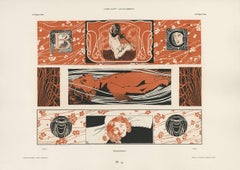
Gerlach s Allegorien Plate #44: "Music" Lithograph
By Koloman Moser
Located in Palm Beach, FL
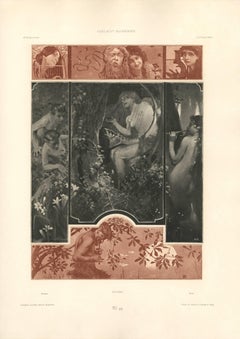
Koloman Moser (1868 –1918), AUSTRIAN Instead of applying his flair and art education solely to painting, Koloman Moser embodied the idea of Gesamt Kunstwerk (all-embracing art work) by designing architecture, furniture, jewelry, graphics, and tapestries meant to coordinate every detail of an environment. His work transcended the imitative decorative arts of earlier eras and helped to define Modernism for generations to come. Moser achieved a remarkable balance between intellectual structure (often geometric) and hedonistic luxury. Collaborating with Gustav Klimt and Josef Hoffmann, the artist was an editor and active contributor to Ver Sacrum, (Sacred Spring), the journal of the Viennese Secession that was so prized for its aesthetics and high quality production that it was considered a work of art. The magazine featured drawings and designs in the Jugendstil style (Youth) along with literary contributions from distinguished writers from across Europe. It quickly disseminated both the spirit and the style of the Secession. In 1903 Moser and Hoffmann founded and led the Wiener Werkstatte (Viennese Workshop) a collective of artisans that produced elegant decorative arts items, not as industrial prototypes but for the purpose of sale to the public. The plan, as idealistic then as now, was to elevate the lives of consumers by means of beautiful and useful interior surroundings. Moser’s influence has endured throughout the century. His design sensibility is evident from the mid-century modern furniture of the 1950s and ‘60s to the psychedelic rock posters...
Category

1890s Vienna Secession Koloman Moser Art

Materials

Lithograph

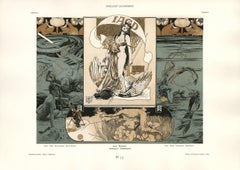
Gerlach s Allegorien Plate #51: "Summer" Lithograph
By Koloman Moser
Located in Palm Beach, FL
Koloman Moser (1868 –1918), AUSTRIAN Instead of applying his flair and art education solely to painting, Koloman Moser embodied the idea of Gesamt Kunstwerk (all-embracing art w...
Category

1890s Vienna Secession Koloman Moser Art

Materials

Lithograph

Gerlach s Allegorien Plate #37: "Music" Lithograph
By Koloman Moser
Located in Palm Beach, FL
Koloman Moser (1868 –1918), AUSTRIAN Instead of applying his flair and art education solely to painting, Koloman Moser embodied the idea of Gesamt Kunstwerk (all-embracing art w...
Category

1890s Vienna Secession Koloman Moser Art

Materials

Lithograph

Gerlach s Allegorien Plate #20: "Song, Love, Music, Dance" Lithograph
By Koloman Moser
Located in Palm Beach, FL
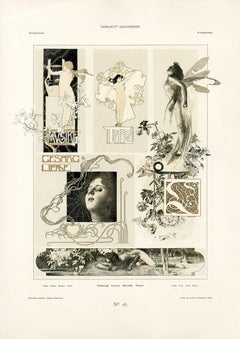
Koloman Moser (1868 –1918), AUSTRIAN Instead of applying his flair and art education solely to painting, Koloman Moser embodied the idea of Gesamt Kunstwerk (all-embracing art w...
Category

1890s Vienna Secession Koloman Moser Art

Materials

Lithograph

Gerlach s Allegorien Plate #35: "Love Wine" Lithograph
By Koloman Moser
Located in Palm Beach, FL
Koloman Moser (1868 –1918), AUSTRIAN Instead of applying his flair and art education solely to painting, Koloman Moser embodied the idea of Gesamt Kunstwerk (all-embracing art work) by designing architecture, furniture, jewelry, graphics, and tapestries meant to coordinate every detail of an environment. His work transcended the imitative decorative arts of earlier eras and helped to define Modernism for generations to come. Moser achieved a remarkable balance between intellectual structure (often geometric) and hedonistic luxury. Collaborating with Gustav Klimt and Josef Hoffmann, the artist was an editor and active contributor to Ver Sacrum, (Sacred Spring), the journal of the Viennese Secession that was so prized for its aesthetics and high quality production that it was considered a work of art. The magazine featured drawings and designs in the Jugendstil style (Youth) along with literary contributions from distinguished writers from across Europe. It quickly disseminated both the spirit and the style of the Secession. In 1903 Moser and Hoffmann founded and led the Wiener Werkstatte (Viennese Workshop) a collective of artisans that produced elegant decorative arts items, not as industrial prototypes but for the purpose of sale to the public. The plan, as idealistic then as now, was to elevate the lives of consumers by means of beautiful and useful interior surroundings. Moser’s influence has endured throughout the century. His design sensibility is evident from the mid-century modern furniture of the 1950s and ‘60s to the psychedelic rock posters...
Category

1890s Vienna Secession Koloman Moser Art

Materials

Lithograph

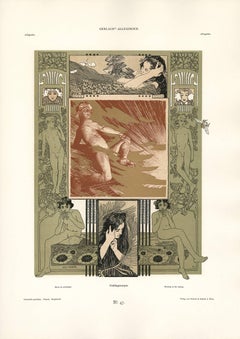
Gerlach s Allegorien Plate #47: "Morning in the Spring" Lithograph
By Koloman Moser
Located in Palm Beach, FL
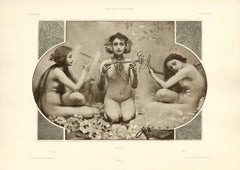
Koloman Moser (1868 –1918), AUSTRIAN Instead of applying his flair and art education solely to painting, Koloman Moser embodied the idea of Gesamt Kunstwerk (all-embracing art work) by designing architecture, furniture, jewelry, graphics, and tapestries meant to coordinate every detail of an environment. His work transcended the imitative decorative arts of earlier eras and helped to define Modernism for generations to come. Moser achieved a remarkable balance between intellectual structure (often geometric) and hedonistic luxury. Collaborating with Gustav Klimt and Josef Hoffmann, the artist was an editor and active contributor to Ver Sacrum, (Sacred Spring), the journal of the Viennese Secession that was so prized for its aesthetics and high quality production that it was considered a work of art. The magazine featured drawings and designs in the Jugendstil style (Youth) along with literary contributions from distinguished writers from across Europe. It quickly disseminated both the spirit and the style of the Secession. In 1903 Moser and Hoffmann founded and led the Wiener Werkstatte (Viennese Workshop) a collective of artisans that produced elegant decorative arts items, not as industrial prototypes but for the purpose of sale to the public. The plan, as idealistic then as now, was to elevate the lives of consumers by means of beautiful and useful interior surroundings. Moser’s influence has endured throughout the century. His design sensibility is evident from the mid-century modern furniture of the 1950s and ‘60s to the psychedelic rock posters...
Category

1890s Vienna Secession Koloman Moser Art

Materials

Paper

Gerlach s Allegorien Plate #30: "Love" Lithograph
By Koloman Moser
Located in Palm Beach, FL
Koloman Moser (1868 –1918), AUSTRIAN Instead of applying his flair and art education solely to painting, Koloman Moser embodied the idea of Gesamt Kunstwerk (all-embracing art w...
Category

1890s Vienna Secession Koloman Moser Art

Materials

Lithograph

Gerlach s Allegorien Plate #75: "Hunting, Fishing, Rowing, Cycling"
By Koloman Moser
Located in Palm Beach, FL
Koloman Moser (1868 –1918), AUSTRIAN Instead of applying his flair and art education solely to painting, Koloman Moser embodied the idea of Gesamt Kunstwerk (all-embracing art work) by designing architecture, furniture, jewelry, graphics, and tapestries meant to coordinate every detail of an environment. His work transcended the imitative decorative arts of earlier eras and helped to define Modernism for generations to come. Moser achieved a remarkable balance between intellectual structure (often geometric) and hedonistic luxury. Collaborating with Gustav Klimt and Josef Hoffmann, the artist was an editor and active contributor to Ver Sacrum, (Sacred Spring), the journal of the Viennese Secession that was so prized for its aesthetics and high quality production that it was considered a work of art. The magazine featured drawings and designs in the Jugendstil style (Youth) along with literary contributions from distinguished writers from across Europe. It quickly disseminated both the spirit and the style of the Secession. In 1903 Moser and Hoffmann founded and led the Wiener Werkstatte (Viennese Workshop) a collective of artisans that produced elegant decorative arts items, not as industrial prototypes but for the purpose of sale to the public. The plan, as idealistic then as now, was to elevate the lives of consumers by means of beautiful and useful interior surroundings. Moser’s influence has endured throughout the century. His design sensibility is evident from the mid-century modern furniture of the 1950s and ‘60s to the psychedelic rock posters...
Category

1890s Vienna Secession Koloman Moser Art

Materials

Lithograph

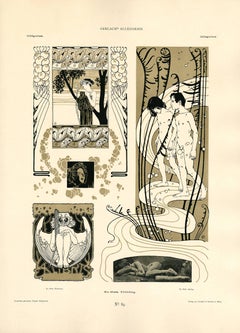
Gerlach s Allegorien Plate #94: "Heads" Lithograph
By Koloman Moser
Located in Palm Beach, FL
Koloman Moser (1868 –1918), AUSTRIAN Instead of applying his flair and art education solely to painting, Koloman Moser embodied the idea of Gesamt Kunstwerk (all-embracing art work) by designing architecture, furniture, jewelry, graphics, and tapestries meant to coordinate every detail of an environment. His work transcended the imitative decorative arts of earlier eras and helped to define Modernism for generations to come. Moser achieved a remarkable balance between intellectual structure (often geometric) and hedonistic luxury. Collaborating with Gustav Klimt and Josef Hoffmann, the artist was an editor and active contributor to Ver Sacrum, (Sacred Spring), the journal of the Viennese Secession that was so prized for its aesthetics and high quality production that it was considered a work of art. The magazine featured drawings and designs in the Jugendstil style (Youth) along with literary contributions from distinguished writers from across Europe. It quickly disseminated both the spirit and the style of the Secession. In 1903 Moser and Hoffmann founded and led the Wiener Werkstatte (Viennese Workshop) a collective of artisans that produced elegant decorative arts items, not as industrial prototypes but for the purpose of sale to the public. The plan, as idealistic then as now, was to elevate the lives of consumers by means of beautiful and useful interior surroundings. Moser’s influence has endured throughout the century. His design sensibility is evident from the mid-century modern furniture of the 1950s and ‘60s to the psychedelic rock posters...
Category

1890s Vienna Secession Koloman Moser Art

Materials

Lithograph

Related Items
Cavaliers dans les Dunes
By André Brasilier
Located in San Francisco, CA
Artist: Andre Brasilier (French, born 1929) Title: Cavaliers dans les Dunes Year: 1974 Medium: Color lithograph Edition: Inscribed "Bien Amicalement" (With Friendship) and "Epr...
Category

Late 20th Century Expressionist Koloman Moser Art

Materials

Lithograph

Cavaliers dans les Dunes
$1,200
H 21.25 in W 30 in D 0.01 in
"Brotherhood" lithograph by Käthe Kollwitz
By Käthe Kollwitz
Located in Soquel, CA
Bold print of "Brotherhood" by Kathe Kollwitz (German, 1867-1945). This piece is one of the Lithographic reproductions of the original lithographs, plate 3 from a series of 10, print...
Category

1940s Expressionist Koloman Moser Art

Materials

Paper, Ink, Lithograph

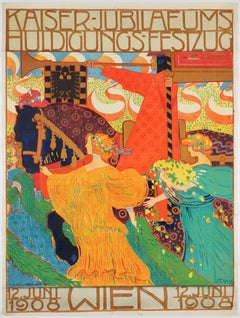
Original Vintage Secession Poster celebrating the emperor s jubilee
Located in Zurich, CH
Original Vintage Poster by the Austrian artist Ferdinand Ludwig Graf, a member of the Hagenbund. This Viennese artist association moved as soon a...
Category

Early 1900s Vienna Secession Koloman Moser Art

Materials

Paper

Cul de Sac
By Alexandre Minguet
Located in San Francisco, CA
This artwork titled "Cul de Sac" is an original color lithograph by French artist Alexandre Minguet, 1937-1996. The image size is 7 x 11 inches, framed size is 17.35 x 21.5 inches. I...
Category

Late 20th Century Expressionist Koloman Moser Art

Materials

Lithograph

Cul de Sac
Cul de Sac
$300
H 17.35 in W 21.5 in D 1 in
Chagall, Die Zauberflöte (Mourlot CS. 38), The Metropolitan Opera (after)
By Marc Chagall
Located in Fairfield, CT
Title: Die Zauberflöte (Mourlot CS. 38), The Metropolitan Opera Year: 1973 Medium: Lithograph on wove paper Size: 39.5 x 25.75 inches Notes: From the opening of Mozart's 'The Magic F...
Category

1970s Expressionist Koloman Moser Art

Materials

Lithograph

Femme en Rose Avec un Arbre
By André Brasilier
Located in San Francisco, CA
Artist: Andre Brasilier (French, born 1929) Title: Femme en Rose Avec un Arbre Year: c.1975 Medium: Color lithograph Edition: Inscribed "Bien Amicalement" (With Friendship) in pe...
Category

Late 20th Century Expressionist Koloman Moser Art

Materials

Lithograph

Femme en Rose Avec un Arbre
$2,000
H 29.65 in W 21.25 in D 0.01 in
Les Visages, Lithograph by Georges Rouault (After)
By Georges Rouault
Located in Long Island City, NY
Les Visages Georges Rouault (after), French (1871–1958) Date: 1968 Lithograph, restrike by the Collectors Guild Size: 6 x 7.75 in. (15.24 x 19.69 cm) Frame Size: 15.5 x 17.25 inches
Category

1960s Expressionist Koloman Moser Art

Materials

Lithograph

Intimations sur La Vie
By Alvar Sunol Munoz-Ramos
Located in Paonia, CO
Intimations sur la Vie.. from Le Miracle Quotidien suite 1974 Original signed lithograph Edition no. 132/225 paper size 40 x 30 image size 33.50 x 24 condition ...
Category

1970s Expressionist Koloman Moser Art

Materials

Lithograph

Image D un Été (Image of Summer) Signed Lithograph, Red Female Nude, Exotic Bird
By Corneille
Located in Union City, NJ
Image D'un Été is an original hand drawn limited edition lithograph printed using hand lithography techniques on archival Somerset paper, 100% acid free, by the Dutch artist known as CORNEILLE(Guillaume van Beverloo) an abstract expressionist who co-founded the 20th Century experimental art movement CoBrA recognized for their spontaneous, rebellious style of painting that was heavily inspired by the art of children and the mentally ill. Corneille devises his colorful fantastic imagery with exotic plant forms, sensuous female bodies, animals and lively pattern design. Image D'un Été confronts the viewer with a bold erotic red female nude with blue hair and an exotic tropical bird soaring beneath the heat of a blazing red orange sun. Print size - 23.25 x 19.75 in. unframed, vivid colors, hand signed in white pencil by Corneille Edition size - 200, plus proofs Year published - 1981 Printer - J K Fine Art Editions Co., NY About the artist Corneille - Guillaume Corneille was born in Liege, Belgium on July 3, 1922. Corneille studied drawing at the Amsterdam Rijksakademie, but as a painter he was entirely self-taught. After having attended courses at the School of Fine Arts in Amsterdam, he started his painting experience influenced by Surrealism. Corneille, also known as Corneille Guillaume Beverloo, was a painter and graphic artist who radicalized the conservative Dutch art world in the early 1950s. He is co-founder with Karel Appel, Eugene Brands...
Category

1980s Expressionist Koloman Moser Art

Materials

Lithograph

Provence : Meeting in the Neighborhood - Original Lithograph
By Pierre Ambrogiani
Located in Paris, IDF
Pierre AMBROGIANI (1907-1985) Meeting in the Neighborhood, 1974 Original Lithograph (Gourdon Workshop) Signed with the artist's stamp On vellum 38 x 28 cm (c. 14.9 x 11 in) Excelle...
Category

Mid-20th Century Expressionist Koloman Moser Art

Materials

Lithograph

FAMILY Signed Lithograph Abstract Portrait, People, Latin American Woman Artist
By Raquel Forner
Located in Union City, NJ
Raquel Forner (1902-1988) Argentine woman painter and printmaker born in Buenos Aires in 1902 and died in the same city in 1988, regarded as one of the best Argentine female painters...
Category

1980s Expressionist Koloman Moser Art

Materials

Lithograph

French Riviera : House Surrounded by Lavender - Original Lithograph
By Pierre Ambrogiani
Located in Paris, IDF
Pierre AMBROGIANI (1907-1985) House Surrounded by Lavender, 1974 Original Lithograph (Gourdon Workshop) Signed with the artist's stamp On vellum 38 x 28 cm (c. 14.9 x 11 in) Excell...
Category

Mid-20th Century Expressionist Koloman Moser Art

Materials

Lithograph

Previously Available Items
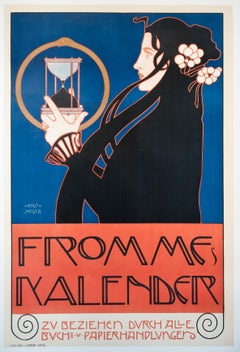
Fromme s Kalender Art Nouveau Lithograph Poster Koloman Moser Vienna Secession
By Koloman Moser
Located in Palm Beach, FL
Lithograph printed by Albert Berger, Vienna. This design "was considered very advanced in 1899, with its large scale portrayal of the motif and the almost complete renunciation of interior drawing. The silhouette of the body is in mysterious contrast to the realistically portrayed head and hands. The unwavering gaze of the woman underlines the symbolism of the design: the Norn [ancient Norse goddess of fate] with the hour-glass and snake-ring embodies the eternal circle of life and the running out of time" (Vienna Secession, Denscher, p. 45). As the poster was originally used in 1899, the waning sand in the hourglass quite naturally can be assumed to be the coming of the end of the century. KOLOMAN MOSER: Instead of applying his flair and art education to paintings, Koloman Moser embodied the idea of Gesamt Kunstwerk (all-embracing art work) by designing architecture, furniture, jewelry, graphics, and tapestries meant to coordinate every detail of an environment. His work transcended the imitative decorative arts of earlier eras and helped to define Modernism for generations to come. Moser achieved a remarkable balance between intellectual structure (often geometric) and hedonistic luxury. Collaborating with Gustav Klimt and Josef Hoffmann, the artist was an editor and active contributor to Ver Sacrum, (Sacred Spring), the journal of the Viennese Secession that was so prized for its aesthetics and high quality production that it was considered a work of art. The magazine featured drawings and designs in the Jugendstil (Youth Style) along with literary contributions from distinguished writers from across Europe. It quickly disseminated both the spirit and the style of the Secession. In 1903 Moser and Hoffmann founded and led the Wiener Werkstatte (Viennese Workshop) a collective of artisans that produced elegant decorative arts items, not as industrial prototypes but for the purpose of sale to the public. The plan, as idealistic then as now, was to elevate the lives of consumers by means of beautiful and useful interior surroundings. Moser’s influence has endured throughout the century. His design sensibility is evident from the mid-century modern furniture of the 1950s and ‘60s to the psychedelic rock posters...
Category

1890s Art Nouveau Koloman Moser Art

Materials

Paper, Lithograph

Koloman Moser art for sale on 1stDibs.

Find a wide variety of authentic Koloman Moser art available for sale on 1stDibs. You can also browse by medium to find art by Koloman Moser in lithograph, paper and more. Much of the original work by this artist or collective was created during the 19th century and is mostly associated with the Expressionist style. Not every interior allows for large Koloman Moser art, so small editions measuring 12 inches across are available. Customers who are interested in this artist might also find the work of Carl Otto Czeschka, Gustav Klimt, and Gustav Klimt K.K. Hof-und Staatsdruckerei. Koloman Moser art prices can differ depending upon medium, time period and other attributes. On 1stDibs, the price for these items starts at $2,750 and tops out at $55,000, while the average work can sell for $2,750.

Recently Viewed

View All