Koloman Moser Pitchers

Austrian, 1868-1918

Born in Vienna in 1868, Koloman Moser briefly attended trade school, honoring his father’s wish to see him in commerce. But he soon surrendered to his artistic inclinations, enrolling in 1885 in Vienna’s Academy of Fine Arts, where he studied painting.

When his father died unexpectedly in 1888, leaving the family in financial straits, Moser (1868–1918) helped out by doing illustrations for books and magazines. Meanwhile, he continued his painting studies, at the academy and then at the School of Arts and Crafts, starting in 1892. That was also the year that Moser, along with other young artists revolting against the Viennese art world’s devotion to naturalism, formed the Siebner Club, the precursor to the Vienna Secession.

Moser’s introduction during his last term at school to Gustav Klimt’s Allegory of Sculpture proved a turning point for the young artist. Christian Witt-Dörring, guest curator of the 2018–19 exhibition “Koloman Moser: Universal Artist between Gustav Klimt and Josef Hoffmann” at the MAK in Vienna, noted a change in the artist’s drawing style. “Primarily inspired by the art of Japan, [Klimt] introduces new paper sizes, fragmented image details, and an emphasis on the line as opposed to the surface,” wrote Witt-Dörring in the exhibition’s catalogue.

A year later, in 1897, Moser together with Klimt, Carl Moll, Joseph Olbrich and Josef Hoffmann founded the Vienna Secession, a union of artists and designers determined to upend Austria’s artistic conservatism. The members were committed to making total works of art: Gesamtkunstwerken. Looking to the English Arts and Crafts Movement, with its guiding principle of unity of the arts, the group attempted to bring art back into everyday life and introduce a local modernism to fin-de-siècle Vienna. Moser, whose membership in the club also afforded him entry into upper-class Viennese society, turned his back on oil painting and forged ahead with Gesamtkunstwerk.

Moser created everything from exhibition design to facade ornamentation for the Secession Building, to graphic materials. Moser also produced posters and advertisements in his “modern style” for various companies. In 1898, he presented his first decor pieces, including hand-knotted rugs and cushion covers. In 1899, Moser began what would become a lifelong professorship at the School of Arts and Crafts. His repertoire now expanded to include furniture, ceramics and patterns like his trademark checkerboard design. He also moved into scenography and fashion and established himself as an interior designer.

The artist decorated his own home in 1902, after which he received a series of important commissions, notably the villa of textile industrialist Fritz Waerndorfer. It was Waerndorfer who provided the financial support that enabled Moser and Hoffmann in 1903 to found the Wiener Werkstätte, a platform for fully realizing their ideal of Gesamtkunstwerk. Two years later, Moser married Edith Mautner von Markhof, the daughter to one of Austria’s great industrial barons, and his work thrived. 

In 1907, the Wiener Werkstätte ran into financial trouble. Losing faith in the unity of the arts and disillusioned with the group’s dependency on wealthy patrons like Waerndorfer, Moser left the Werkstätte. He returned to his original discipline, painting, which he continued to practice until his untimely death from cancer, in 1918.

Today, Koloman Moser’s work, from his metal vases to his jewelry to his interiors, remains sought-after and revered. Browse Moser's radically modern creations at 1stDibs.

to
1
1
1
1
1
1
1
1
1
1
1
1
1
1
1
40
26
23
21
21
Creator: Koloman Moser
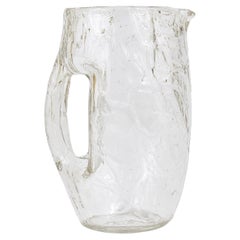
Koloman Moser Art Nouveau Glass Pitcher by Loetz Witwe, Bohemia, 1900s
By Johann Lötz Witwe, Loetz Glass, Koloman Moser
Located in Vienna, AT
A beautiful mouth blown Art Nouveau / Jugendstil glass pitcher, dated around 1900, designed by Vienna Secessionist Kolo Moser. This lovely jug is handmade of clear crystal glass and ...
Category

Early 1900s Czech Art Nouveau Antique Koloman Moser Pitchers

Materials

Crystal

Related Items
Vase Loetz Widow Klostermuehle Bohemia Art Nouveau Creta Pampas before 1902
By Loetz Glass
Located in Vienna, AT
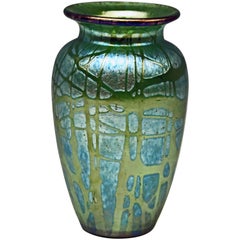
VASE LOETZ (LÖTZ) WIDOW KLOSTERMUEHLE BOHEMIA ART NOUVEAU Made by Loetz, Klostermuehle (Bohemia), before 1902 Decor: CRETA PAMPAS BLUE-GREEN It is an elegant Loetz Art Nouveau ...
Category

Late 19th Century Austrian Art Nouveau Antique Koloman Moser Pitchers

Materials

Glass

Bohemia Loetz Art Nouveau Twisted Dephi Glass Vase 1899
By Loetz Glass
Located in Worcester Park, GB
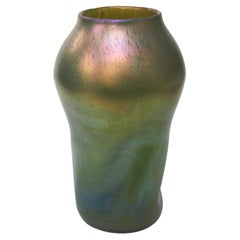
A large Loetz Delphi pattern vase in green with a bulbus near spherical top with a large opening over a round base with a typical Loetz twist to the body. Finely iridised a classic L...
Category

1890s Czech Art Nouveau Antique Koloman Moser Pitchers

Materials

Art Glass

Vase Loetz Widow Klostermuehle Bohemia Art Nouveau Phaenomen Genre 6893 c.1900
By Johann Lötz Witwe
Located in Vienna, AT
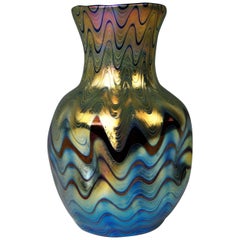
Vase Loetz (Lötz) Widow Klostermuehle Bohemia Art Nouveau Made by Loetz, Klostermuehle (Bohemia), circa 1899-1900 Decor: RUBY PHAENOMEN GENRE 6893 It is a most remarkable as wel...
Category

1890s Austrian Art Nouveau Antique Koloman Moser Pitchers

Materials

Glass

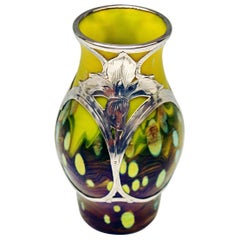
Vase Loetz Widow Klostermuehle Bohemia Art Nouveau Lemon Yellow Cytisus
By Loetz Glass
Located in Vienna, AT
Vase Loetz (Lötz) Widow Klostermuehle Bohemia Art Nouveau Made by Loetz, Klostermuehle (Bohemia), circa 1902 Decor: Lemon Yellow Cytisus It is a very interesting Loetz Art N...
Category

Early 1900s Austrian Art Nouveau Antique Koloman Moser Pitchers

Materials

Glass

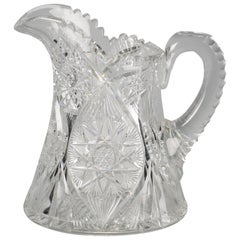
American Brilliant Cut Glass Pitcher, circa 1900
Located in New York, NY
Category

Early 20th Century American Koloman Moser Pitchers

Materials

Cut Glass

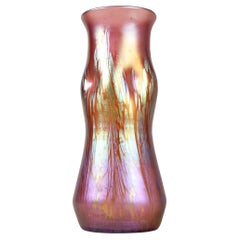
Art Nouveau Glass Vase by Loetz Witwe - Decor Medici Pink Iridescent, CZ, 1902
By Johann Lötz Witwe
Located in Lichtenberg, AT
Outstanding Loetz Witwe glass vase in decor "Medici Pink" from the world famous workshops in Klostermuehle/ Bohemia around 1902. This highly iriscident vase is a perfect example of L...
Category

Early 20th Century Czech Art Nouveau Koloman Moser Pitchers

Materials

Blown Glass

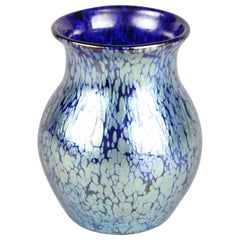
Loetz Witwe Art Nouveau Glass Vase Decor Cobalt Papillon, Bohemia, circa 1903
By Johann Lötz Witwe
Located in Lichtenberg, AT
Very decorative Loetz Witwe glass vase in decoration Cobalt Papillon from the Art Nouveau period in Bohemia, circa 1903. This gorgeous vase from the workshops in Klostermuehle shows ...
Category

Early 20th Century Czech Art Nouveau Koloman Moser Pitchers

Materials

Blown Glass

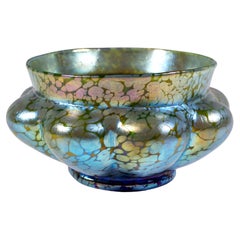
Large Loetz Art Nouveau Bowl, Decor Crete Papillon, Bohemia Austria-Hungary 1899
By Loetz Glass
Located in Vienna, AT
Finest Bohemian Art Nouveau Glass Item: Mould blown, wide bowl on a stand ring, eightfold ribbed, outwardly curved wall with humped protuberances, tamed by a smooth, slightly outward...
Category

1890s Austrian Art Nouveau Antique Koloman Moser Pitchers

Materials

Glass

Bohemia Loetz Art Nouveau Square OzoneCisele Glass Vase 1900-Christopher Dresser
By Christopher Dresser, Loetz Glass
Located in Worcester Park, GB
A fabulous Art Nouveau Ozone Cisele Loetz small vase, of square form with a hand worked wavy top. This is one of a series commissioned by the English retailer Max Emanuel, who regula...
Category

Early 1900s Czech Art Nouveau Antique Koloman Moser Pitchers

Materials

Art Glass

Vase Loetz Widow Klostermuehle Bohemia Art Nouveau 1900 Phaenomen Genre 85/3780
By Loetz Glass
Located in Vienna, AT
Vase Loetz (Lötz) Widow Klostermuehle Bohemia Art Nouveau Made by Loetz, Klostermuehle (Bohemia), circa 1899-1900 Decor: Phaenomen Genre 85/3780 It is a most remarkable Loetz...
Category

1890s Austrian Art Nouveau Antique Koloman Moser Pitchers

Materials

Glass

Bohemian Glass Vase Loetz circa 1900 Pampas Cobalt Art Nouveau Blue
By Loetz Glass
Located in Klosterneuburg, AT
Bohemian glass vase, manufactured by Johann Loetz Witwe, Pampas Cobalt decoration, ca. 1899, Blue, Silver, Viennese Art Nouveau, Jugendstil, Art Deco, art glass, iridescent glass. T...
Category

Early 20th Century Austrian Jugendstil Koloman Moser Pitchers

Materials

Glass

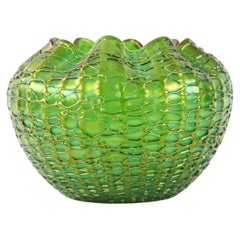
Loetz Art Nouveau Jugendstil Art Glass Bowl
By Loetz Glass
Located in Miami, FL
A stunning Loetz art glass green bowl decorated with gold inclusions. The glass manufacturer Loetz after their big success at the Paris World Exhibition in 1900. While creating decoration variants, the owner of the glass workshop, Max Ritter von Spaun, was presumably inspired by works of Louis C. Tiffany. The applied applications by Loetz are positioned more prominently and have their own ornament in the form of pulled iridescent threads. This glass work of art known as Loetz Jugendstil...
Category

Early 20th Century Austrian Art Nouveau Koloman Moser Pitchers

Materials

Glass, Art Glass

Koloman Moser pitchers for sale on 1stDibs.

Koloman Moser pitchers are available for sale on 1stDibs. These distinctive items are frequently made of stone and are designed with extraordinary care. There are many options to choose from in our collection of Koloman Moser pitchers, although gray editions of this piece are particularly popular. Many of the original pitchers by Koloman Moser were created in the Art Nouveau style in europe during the early 1900s. Prices for Koloman Moser pitchers can differ depending upon size, time period and other attributes — on 1stDibs, these items begin at $1,400 and can go as high as $1,400, while a piece like these, on average, fetch $1,400.

Still Thinking About These?

All Recently Viewed